Alkaline phosphatase (ALP, EC 3.1.3.1) is an enzyme widely used in establishing adequate pasteurization of milk. The detection of ALP is used as a legal test to determine whether milk has been adequately pasteurized or whether it has been contaminated with raw milk (Aschaffenburg & Mullen, Reference Aschaffenburg and Mullen1949; Murthy & Cox, Reference Murthy and Cox1988). Moreover, due to its high heat sensitivity, ALP could be used as an intrinsic time-temperature indicator (TTI) for mild heat treatment. TTI are heat-sensitive components present or irreversibly formed in the product during heat processing. They must be time- and temperature-dependent, easily measured and closely correlated with the change of a target attribute (a safety or a quality characteristic) of a food undergoing the same treatment (Claeys et al. Reference Claeys, Ludikhuyze, Van Loey and Hendricckx2001). Extensive kinetics studies are required to validate a TTI.
The ALP activity has been mostly quantified spectrophotometrically with phenylphosphate or p-nitrophenyl phosphate (p-NPP) as a substrate. A less complex and more sensitive method has been developed using a fluorometric measurement of the commercial substrate Fluorophos (Rocco, Reference Rocco1990; Black et al. Reference Black, Kuzyk and Duggan1992). However, the presence of ALP activity in properly pasteurized milk as a consequence of contamination with bacterial ALPs has been reported (Hammer & Olson, Reference Hammer and Olson1941). To quantify milk ALP without interference by non-bovine milk ALPs, ELISA tests based on polyclonal antibodies against purified bovine milk ALP have been proposed (Vega-Warner et al. Reference Vega-Warner, Gandhi, Smith and Ustunol2000; Chen et al. Reference Chen, Tai, Shen, Tu, Wu and Chang2006). However, none of them has been proven to quantify dilutions of raw milk in pasteurized milk. In Geneix et al. (Reference Geneix, Dufour, Vénien and Levieux2007) we presented a new capture immunoassay based on monoclonal antibodies (MAbs) highly specific for bovine milk ALP. This immunoassay was able to detect 0·02% raw milk in boiled milk and did not cross-react with bovine intestinal or microbial ALPs.
The objective of the present study was to evaluate the ability of the immunoassay to quantify bovine milk ALP as a TTI for mild heat treatment of milk by using inactivation kinetics studies, and to compare the results with those obtained by a colorimetric quantification of the enzyme activity considered as a reference test.
Materials and Methods
Materials and samples
Clarifying Reagent (R) and iso-butylalcohol (2-butanol) were from VWR-Prolabo (France). Ready to use p-nitrophenyl phosphate substrate (p-NPP, N-7653) was purchased from Sigma.
Samples of thermized (62–67°C for 20–90 s) and pasteurized (73°C 20 s) milk were provided by ARILAIT (France). Fresh bulk raw milk was obtained from the INRA Research Centre dairy herd.
Monoclonal antibodies
MAbs specific for bovine milk ALP were obtained from mice immunized with crude bovine milk ALP and purified by anion-exchange chromatography as reported by Geneix et al. (Reference Geneix, Dufour, Vénien and Levieux2007).
Butanol extraction of milk samples
Three ml butanol were added to 3 ml milk in glass tubes. The tubes were capped, vigorously inverted several times, vortexed for 15 s and centrifuged at 2500 g for 30 min. The lower aqueous phase was recovered and stored at 4°C until analysis within the day or stored at −20°C.
Immunocapture assay
The immunoassay was conducted as described in details in the preceding paper (Geneix et al. Reference Geneix, Dufour, Vénien and Levieux2007). Briefly, microtitre plates were coated with the chromatographically purified MAbs, washed and incubated with butanol treated milks adequately diluted in PBS. After washing, the captured ALP was quantified by adding p-NPP as a substrate.
Colorimetric quantification of ALP activity
ALP activity was measured essentially as described by Blel et al. (Reference Blel, Guingamp, Gaillard and Humbert2002), with adaptation to microtitre plates. Milk samples extracted by butanol were adequately diluted in 1 m-diethanolamine-HCl pH 10·6 containing 10 mm-MgCl2. 25 μl of the diluted extracts were incubated in flat-bottomed polystyrene microtitre plates with 50 μl of ready to use p-NPP substrate at 37°C for 30 min after sealing with an adhesive foil. Then 100 μl Clarifying Reagent® were added. After careful homogenization and further incubation at 37±1°C for 15 min, the absorbance was recorded at 405 nm. Standards were the same as those used for the immunoassay.
Heat treatment
Aliquots (2 ml) of raw bulk milk in stoppered (5 ml, 9 mm internal diameter) glass tubes were heated in triplicate in a thermostatically controlled water bath (Polystat 44, Bioblock Scientific, Illkirch, France) maintained ±0·05 deg C of the required temperature. Heat treatment was halted immediately by immersion in ice water. An unheated aliquot was used as a control. The time for the milk to come up to final temperature was less than 1 min and thus was not included in the heating time.
D and Z values
D-values (time required for 90% denaturation) were calculated by linear regression analysis, as the reciprocal of the slope of lines obtained for each temperature by plotting the logarithm of residual native protein (%) as a function of holding time. For second order reaction, D values were calculated from the general equation:

For a decimal value of c0:

For a second-order reaction

Z-values (deg C needed for a 10 fold decrease in D) was calculated, by linear regression analysis, as the reciprocal of the slope of the line obtained by plotting the logarithm of D values as a function of temperature, in a range which showed a linear relationship.
All linear regression were calculated using Microsoft Excel.
Results and Discussion
Although ALP is widely applied as an indicator of efficient pasteurization, only a few detailed quantitative kinetics studies on thermal inactivation of ALP have been published. Such kinetics studies are required to describe the way a reaction proceeds (inactivation, denaturation) as a function of time. The mathematical form of the kinetics model expresses how the reaction proceeds while the rate of the reaction is represented by kinetics parameters obtained by fitting a model to experimental data. Thus, accurate prediction of the thermal behaviour of a TTI depends on the development of an exact kinetics model (Claeys et al. Reference Claeys, Ludikhuyze, Van Loey and Hendricckx2001).
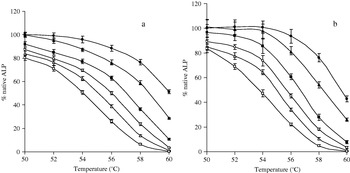
The denaturation percentage of ALP during heat treatment as determined by the immunoassay (Fig. 1a) was clearly a function of time as well as temperature. As expected, ALP is a very heat sensitive protein since for a 30 min heating the denaturation midpoint was obtained at 56°C. Moreover, ALP appears as a particularly useful TTI for heating between 50°C (87·3% residual activity) and 60°C (3·5% residual activity) for 30 min incubation time. Similar results were obtained by colorimetric assay (Fig. 1b).
Thermal denaturation of ALP in the range 50–60°C after heating for 5 min (closed circles), 10 min (closed triangles), 20 min (closed squares), 30 min (open circles), 45 min (open triangles) or 120 min (open squares). Residual native ALP was determined by immunoassay (a) and colorimetric assay (b). Results are expressed as mean and standard deviation (n=3) of percent of initial concentration.

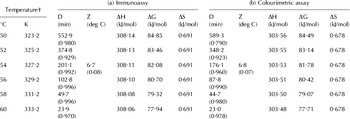
D-values were calculated for first and second order reactions. Best fits were obtained for both immunoassay and colorimetric assay when using first order reaction, as previously reported by Murthy et al. (Reference Murthy, Bradshaw and Peeler1990) or Eckner (Reference Eckner1992). The D60°C values (Table 1) determined by immunoassay (23·9 min) and colorimetric assay (23·0 min) are in close agreement with the results obtained by Claeys et al. (Reference Claeys, Ludikhuyze, Van Loey and Hendricckx2001) for isothermal (D60°C=24·6 min) and non-isothermal (D60°C=24·7 min) conditions.
D and Z values, changes in enthalpy of activation (ΔH), free energy of activation (ΔG) and entropy of activation (ΔS) for ALP inactivation quantified by (a) immunoassay and (b) colorimetric assay
Values in parentheses for D are coefficient of correlation (r2) for first-order kinetics
Value in parentheses for Z is standard error

† Temperature range used for Z determination
For both assays (Table 1), the Z-values (6·7–6·8 deg C) are in the range 5–8 of previously reported results for bovine milk ALP (Murthy et al. Reference Murthy, Bradshaw and Peeler1990; Eckner, Reference Eckner1992; Claeys et al. Reference Claeys, Ludikhuyze, Van Loey and Hendricckx2001; Blel et al. Reference Blel, Guingamp, Gaillard and Humbert2002). These results are also consistent with the value of 6·1 we obtained previously for the heat sensitive enzyme L-lactic dehydrogenase M4 (Levieux et al. Reference Levieux, Levieux and Vénien1995). For the determination of thermodynamic parameters experimental points were plotted according to the following equation:

which was obtained from the integrated form of the equation for first-order reaction kinetics:

where c0 and ct are the concentration (g/kg) of native protein in milk at time 0 and t respectively, and k the rate constant with unit of 1/s. Straight lines from linear regression in the temperature range used for Z determination showed coefficient of correlation between 0·929 and 0·999 (Table 1).
The rate constant k, calculated from the slope of eqn (1), was then related to the temperature of treatment according to transformed version of the Arrhenius equation:

where A (1/s) is a constant, Ea (kJ/mol−1) the apparent activation energy, R the universal gas constant (8·315 J⋅mol−1⋅K−1) and T the absolute temperature (°K).
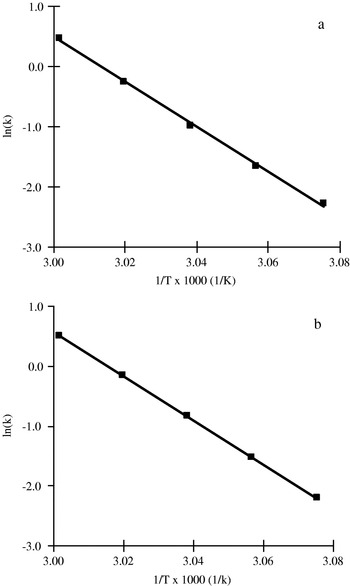
When the logarithm of the rate constant was plotted v. the reciprocal of the absolute temperature (Arrhenius plots) according to eqn (2), straight lines were fitted to the data by linear regression (Fig. 2). The activation energy values were calculated from the slope of these lines. The linear regression and the coefficient of correlation of the Arrhenius plots were y=−37·387x+113 (r2=0·996) and y=−36·835x+111 (r2=0·998) for respectively immunoassay and colorimetric assay, confirming ALP inactivation to follow first-order kinetics.
Arrhenius plots of kinetics constants for residual native ALP quantified by immunoassay (a) or colorimetric activity (b). Each point represents an average of three determinations.

Ea values were 311±3·1 and 306±4·0 kJ/mol (sd) for respectively immunoassay and colorimetric assays. These values agree with those reported for thermodynamic studies of proteins in complex media such as β-lactoglobulin A and B and α-lactalbumin in bovine milk: 260–310 kJ/mol in the range 70–80°C (Lyster, Reference Lyster1970; Dannenberg & Kessler, Reference Dannenberg and Kessler1988; Gotham et al. Reference Gotham, Fryer and Pritchard1992). Values found for energy of activation are characteristic of protein denaturation (Daemen, Reference Daemen1981).
The activation energy value enabled determination of enthalpy (ΔH, kJ/mol), entropy (ΔS, kJ/mol), and free energy of activation (ΔG, kJ/mol), according to the following expressions:


where ln A is the ordinate intersection of the straight line obtained by linear regression for Ea calculation (eqn 2), Kb is the Boltzmann constant (1·38066×10−23 J/K), hp the Planck constant (6·62618×10−34 J/s), R the gas constant and T the absolute temperature. The high values of enthalpy of activation and the positive values of the entropy of activation and free energy of activation (Table 1) indicate that, during denaturation, ALP underwent a large change in conformation. The results we obtained agree with those reported by Dannenberg & Kessler (Reference Dannenberg and Kessler1988) for heat denaturation of β-lactoglobulin in skim milk or whey (ΔH: 262–368 kJ/mol; ΔG: 99–109 kJ/mol; ΔS: 0·44–0·63 kJ/mol).
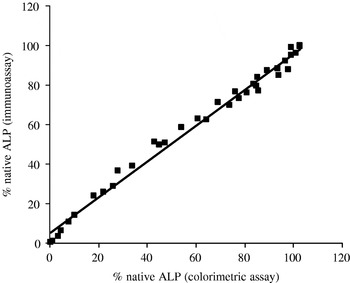
The correlation between results obtained by immunoassay and colorimetric assay is presented on Fig. 3. The linear regression was y=0·909x+4·92 with r=0·994.
Linear regression between quantification of residual native ALP by immunoassay and colorimetric assay (y=0·909x+4·9, r=0·994). Each point represents an average of three determinations.

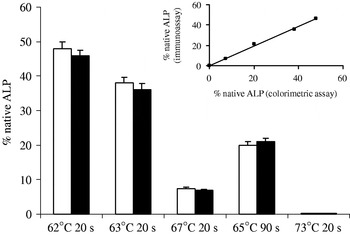
Lastly, ALP activities in industrially thermized milks were quantified by immunoassay and colorimetric assay (Fig. 4). The midpoint denaturation was observed at the lowest heating process (62°C for 20 s) and a 10% futher decrease of residual native ALP was observed when increasing the heating temperature from 62 to 63°C. As expected, no ALP was found in the pasteurized milk sample. Results obtained by both techniques were highly correlated (y=0·953x+0·36; r=0·999).
Quantification of ALP activity in industrially thermized (62–67°C for 20–90 s) or pasteurized (73°C 20 s) milk samples by immunoassay (white columns) or colorimetric assay (black columns). Each point represents an average of three determinations. Insert: linear regression between the assays (y=0·953x+0·361, r=0·999).

The high correlation we obtained when immunoassay and colorimetric assay was applied to laboratory heated milk and to industrially thermized milk indicates that the heat sensitivity of the enzymatic site is similar to or higher than that of the epitope recognized by the capture MAb. Thus ALP inactivation (loss of enzyme activity) cannot be differentiated from ALP denaturation (change in epitope conformation).
In the context of TTI, factors affecting milk ALP activity is of main interest. The activity of ALP in raw milk has been found to be dependent on season, breed of cow, stage of lactation, volume of milk produced and age of cow (Schlimme & Thieman, Reference Schlimme and Thiemann1992; Girotti et al. Reference Girotti, Ferri, Ghini, Budini and Roda1994). Claeys et al. (Reference Claeys, Van Loey and Hendrickx2002, Reference Claeys, Van Loey and Hendrickx2003) demonstrated that ALP activity in raw milk shows little seasonal variation but is related to the milk fat content. Nevertheless, these variations have been found not to substantially affect the applicability of ALP as a TTI (Claeys et al. Reference Claeys, Smout, Van Loey and Hendrickx2004).
Results obtained for industrially thermized milk confirmed the applicability of the immunoassay to quantify ALP as a TTI for heat treatments lower than pasteurization conditions with high sensitivity: an increase of 1 deg C in the temperature range tested (62–67°C, 20 s holding time) can be detected by a significant decrease of residual native ALP.
To conclude, our kinetics studies confirm that thermal inactivation of ALP is appropriate for determining mild time/temperature treatment of milk. Moreover, we found that thermally induced epitopic structural changes recognized by the capture monoclonal antibody are concomitant with or occur after the loss of enzymatic activity. Thus the bovine milk ALP immunoassay could be substituted for the usual non-specific colorimetric or fluorimetric methods particularly when contaminations with bacterial or fungal ALPs are suspected (Geneix et al. Reference Geneix, Dufour, Vénien and Levieux2007).
The authors wish to thank ARILAIT (France) for constant interest during completion of this research and for providing the industrially thermized milk samples. This project was partly funded by the French Ministry for Research (AQS n° 2002 T08).