Introduction
Thermal shape-memory nickel-titanium alloy stapes prostheses have been used for more than a decade in stapedotomy, with studies showing equal and sometimes superior hearing outcomes to those of older types.Reference Rogue, Donato, Almeida, Castelhano and Escada1 Their main advantage is crimp-free coupling as opposed to manual crimping, resulting in less damage to the incus.Reference Wegner, Swartz, Bance and Grolman2
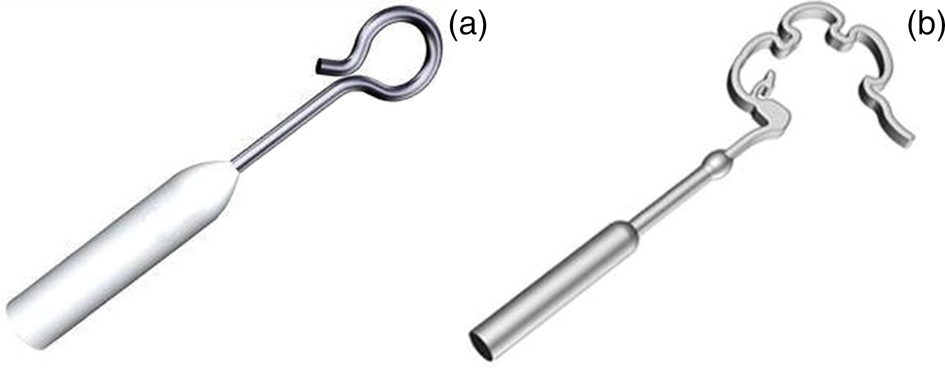
The two prostheses used in the current study comprised a piston made of pure titanium and a loop made of nickel-titanium alloy (Figure 1). The attachment loop has a thermal shape-memory and adopts the predefined shape when heat is applied.Reference Huber, Schrepfer and Eiber3 The loop of the newer, structurally improved thermal shape-memory NiTiBOND (Heinz Kurz, Dusslingen, Germany) piston has a daisy shape, which results in reduced coverage of the surface of the long process of the incus when compared with the crozier-shaped Smart Nitinol piston (Olympus, Center Valley, Pennsylvania, USA). When closed, the Nitinol prosthesis covers almost two-thirds of the mucosal surface of the long process, while the NiTiBOND covers significantly less.Reference Huber, Schrepfer and Eiber3 This leads to reduced mucosal strangulation as compared with the Nitinol and might theoretically lead to reduced incus necrosis. The NiTiBOND loop has four integrated contact zones, conforming to the asymmetrical dimensions of the incus. Additionally, the loop features three independent activation zones, which keep thermal transfer from the mucosal surface during laser activation. These activation zones can be sequentially closed, producing a custom coupling to the individual incus.4
(a) Nitinol and (b) NiTiBOND shape-memory alloy prostheses.

This study aimed to compare the intermediate-term hearing thresholds following the application of a self-crimping heat-memory NiTiBOND piston and a Nitinol piston.Reference Gerlinger, Bakó, Piski, Révész, Ráth and Karosi5 We hypothesised that the NiTiBOND is superior to the Nitinol prosthesis in the intermediate term.
Materials and methods
Study design
This is a retrospective cohort study reported according to the Strengthening the Reporting of Observational Studies in Epidemiology (‘STROBE’) statement for cohort studies.6
Ethical considerations
The study was approved by the Scientific and Research Ethics Committee of the Medical Research Council, University of Pécs, Hungary (approval number: 8338).
Population, interventions and outcomes
We reviewed our records for all patients who underwent stapedotomy with either the NiTiBOND or the Nitinol prosthesis in the Department of Otorhinolaryngology – Head and Neck Surgery, Medical School, University of Pécs (Hungary). Only primary cases were included, and patients with chronic ear diseases, those undergoing revision surgical procedures and patients who did not return for their annual hearing tests were excluded from the study.
The prostheses used measured 4.5–4.75 × 0.6 mm, in line with the distance between the oval window and the lateral surface of the long process of the incus. The surgical technique was identical for all patients with the exception of the prosthesis type used. The NiTiBOND prostheses were implanted between September 2012 and September 2017, and the Nitinol prostheses were implanted between November 2005 and January 2007.
It is our standard protocol for patients undergoing stapedotomy to have yearly hearing evaluations. The hearing values were recorded as per the guidelines of the American Academy of Otolaryngology – Head and Neck Surgery.7 The baseline values and results from the most recent hearing assessments were collected. Our primary outcome was clinical success defined as a post-operative air–bone gap (ABG) of 10 dB or less at follow up.
Statistical analysis
When we treated hearing results as continuous variables, the Mann–Whitney U test and the Wilcoxon signed rank test were used for univariate analysis, and p < 0.05 was considered to be statistically significant.
We calculated the statistical differences between: (1) the pre- and post-operative values in the NiTiBOND group; (2) the pre- and post-operative values in the Nitinol group; (3) the two groups’ pre-operative values; and (4) the two groups’ post-operative values.
When we treated hearing results as dichotomous variables (success vs failure, as defined by a post-operative ABG cut-off of less than 10 dB), we performed binary logistic regression (with the logit link function and without model selection) and calculated odds ratios with Wald 95 per cent confidence intervals (CIs). After univariate analysis, we performed multivariate analysis, in which, in addition to the implant type, models one and two included two (age and sex) and four explanatory variables (age, sex, follow-up duration and pre-operative bone conduction), respectively. The convergence criterion was satisfied in both models. No values were missing (91 participants in both groups).
Results
Altogether, 91 patients were eligible for inclusion in our study. The NiTiBOND group had 53 patients (with an average of 4.1 years of follow up) and the Nitinol group had 38 patients (with an average of 4.4 years of follow up). Female predominance was observed (40 females out of 53 patients in the NiTiBOND group, and 30 out of 38 in the Nitinol group). The patients’ mean age was 44.5 years (range, 22–68 years) in the NiTiBOND group and 40.4 years (range, 27–69 years) in the Nitinol group.
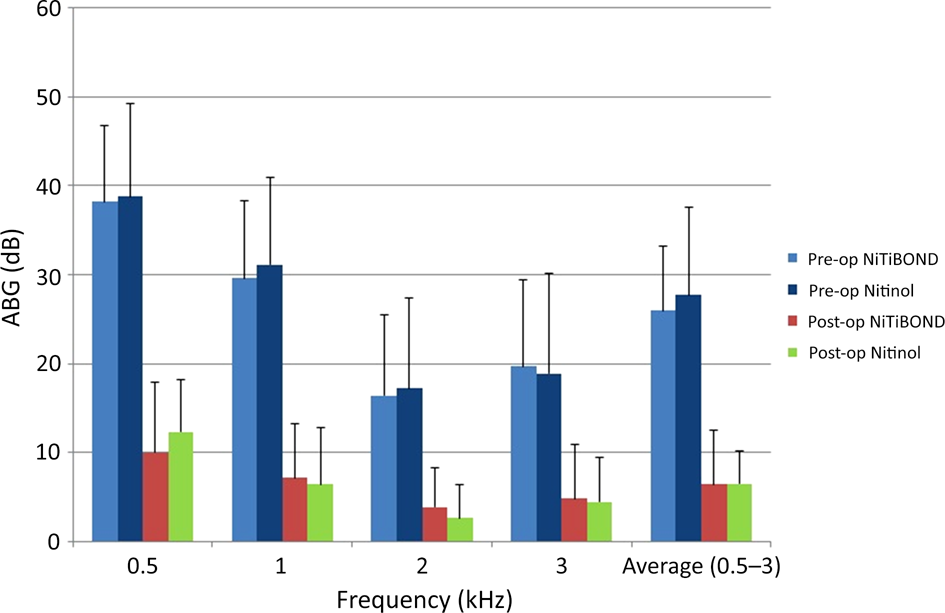
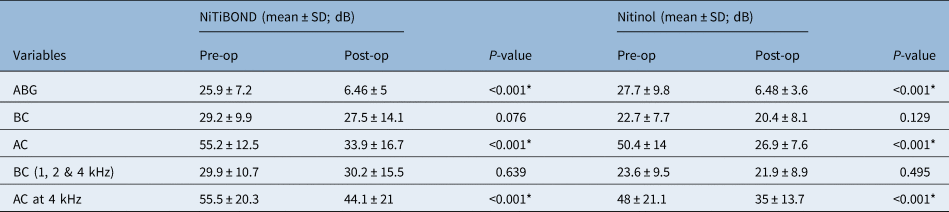
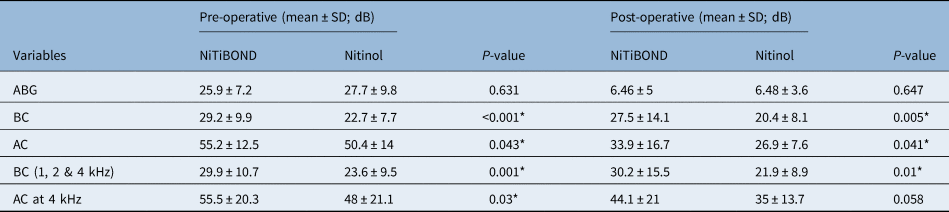
Table 1 summarises the comparison between pre- and post-operative hearing values within the NiTiBOND and the Nitinol groups, while Table 2 summarises the same values between the groups. The difference between the pre- and post-operative mean ABGs, as presented in Figure 2, was statistically significant within both groups, confirming hearing improvement with both prostheses. Bone conduction was similar pre- and post-operation within each group, indicating no worsening of sensorineural hearing caused by the procedure. Air conduction was statistically different within each group, indicating improvement of conductive hearing after the procedure. However, there was no statistically significant difference when ABGs from the two groups were compared with each other.
NiTiBOND mid-term (4.1 years) and Nitinol mid-term (4.4 years) post-operative (post-op) mean air–bone gap (ABG) data, as compared with the merged pre-operative (pre-op) ABG data. Bars indicate 1 standard deviation.

Intra-group statistical analysis of hearing data

*Indicates significant difference. SD = standard deviation; Pre-op = pre-operative; post-op = post-operative; ABG = air–bone gap; BC = bone conduction; AC = air conduction
Inter-group statistical analysis of hearing data

*Indicates significant difference. SD = standard deviation; ABG = air–bone gap; BC = bone conduction; AC = air conduction; SD = standard deviation
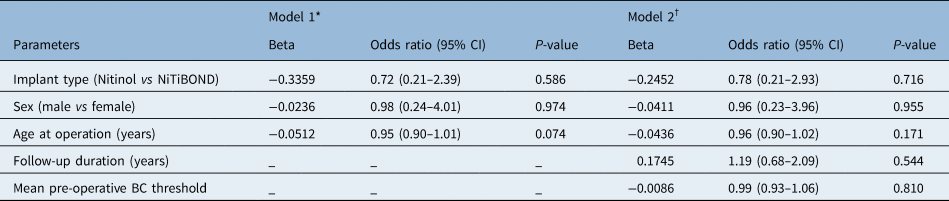
All patients achieved a post-operative ABG of less than 20 dB, except one patient in the NiTiBOND group (ABG = 28 dB; pre- vs post-operative ABG, p = 0.397). Clinical success (defined as an ABG of 10 dB or less) was achieved in 83 per cent and 86 per cent of cases in the NiTiBOND and Nitinol groups, respectively, with no significant difference between groups (odds ratio = 0.74, 95 per cent CI = 0.23–2.42, p = 0.620 for univariate analysis). The results were consistent after adjustment for co-variates for model one (odds ratio = 0.72, 95 per cent CI = 0.21–2.39, p = 0.586) and for model two (odds ratio = 0.78, 95 per cent CI = 0.21–2.93, p = 0.716), as summarised in Table 3).
Predictors of an air–bone gap of 10 dB or less at follow up

Implant type and sex were entered as dichotomous variables; age at operation, follow-up duration and mean pre-operative bone conduction threshold were entered as continuous variables. *Adjusted for age at operation and sex. †Adjusted for age at operation, sex, follow-up duration and mean pre-operative bone conduction threshold. CI = confidence interval; BC = bone conduction
No cases of sensorineural hearing loss occurred following surgery. To date, we have observed one transient facial paralysis with the NiTiBOND piston and one with the Nitinol piston, but both patients have subsequently recovered completely.
Discussion
Our paper compares the audiological results of Nitinol versus NiTiBOND prostheses with the longest follow-up period to date. It has shown comparable audiological outcomes at an average of 4.1 and 4.4 years post-operatively for NiTiBOND and Nitinol, respectively. The authors demonstrated similar audiological outcomes in the short term when comparing the prostheses in 2016.Reference Révész, Szanyi, Ráth, Bocskai, Lujber and Piski8 However, much larger patient cohorts are needed for an evaluation of long-term prosthesis stability. No suspicion of incus erosion or prosthesis luxation arose in the Nitinol group, but one patient had a greater ABG post-operatively in the NiTiBOND group, which was still being investigated at the time of submission of this manuscript.
Other long-term follow-up studies published in the literature include an investigation by Green and McElveen. This study had a larger cohort, and ABG closures of less than 10 dB in 83.7 per cent of patients at 13.6 months post-operatively, with the use of a NiTiBOND piston.Reference Green and McElveen9 Roosli and Huber reported ABG closures of less than 10 dB in 84.5 per cent of patients at 12 months post-operatively with a Nitinol piston.Reference Roosli and Huber10 The intermediate-term post-operative mean ABG of less than 10 dB achieved with the NiTiBOND piston in our study is similar to those reported by both the Roosli and Huber,Reference Roosli and Huber10 and Green and McElveen,Reference Green and McElveen9 studies.
The rate of post-operative ABG closure achieved was comparable to the data demonstrated by other authors reporting intermediate- or long-term results following the implantation of a Nitinol prosthesis. Heywood et al. reported a 9.5-year post-operative ABG of 9.7 dB in their study of 56 patients who underwent stapedectomy with a Nitinol piston.Reference Heywood, Quick and Atlas11 Lavy and Khalil reported a five-year post-operative ABG of 5.89 dB among 48 patients with the use of Nitinol pistons.Reference Lavy and Khalil12 Rajan et al. demonstrated a two-year post-operative ABG of 5.15 dB in their study of 90 patients who received a Nitinol prosthesis.Reference Rajan, Diaz, Blackham, Eikelboom, Atlas and Shelton13
Wegner et al. published a systematic review of the effect of crimping techniques in stapes surgery in 2016.Reference Wegner, Swartz, Bance and Grolman2 They demonstrated superior hearing outcomes for heat crimping over manual or no crimping, although the longest follow-up period reported was two years among the studies included.
Both prostheses are magnetic resonance imaging compatible with 1.5 Tesla scanners; no change was demonstrated in either the position or the conformation of the Nitinol piston.Reference Brown and Gantz14,Reference Knox and Reitan15 The pure nickel content of both prostheses is not likely to be accessible, as the surface of the nickel-titanium alloy is covered by titanium oxide after oxygen exposure.Reference Es-Souni, Es-Souni and Fischer-Brandies16,Reference Shabalovskaya17
• Self-crimping has a better outcome than manual crimping stapes prosthesis, as there is less damage to the incus at insertion
• The NiTiBOND prosthesis’ shape reduces contact with the incus surface area compared to Nitinol
• NiTiBOND's smaller contact surface area may reduce complications such as incus erosion
• This study found no statistical difference between the two prostheses when comparing hearing outcomes after an average follow up of four years
• Larger case numbers and longer follow up is needed to establish genuine variation between the two prostheses
Limitations
The quality of evidence is limited by the study design (retrospective cohort study and case selection criteria) and by the small number of cases. In addition, as the number of cases not achieving success was low, in the multivariate analysis (n = 14), the adjusted results of model two may be underpowered. The length of the study period might not be sufficient to reveal long-term complications such as incus necrosis.
Conclusion
Our study has shown similar hearing outcomes after four years, leading us to reject our null hypothesis. The latest NiTiBOND stapes prosthesis offers significant structural innovations when compared with the Nitinol prosthesis.
Acknowledgement
Copyright permission obtained from European Archives of Oto-Rhino-Laryngology for data presented in our previous publicationReference Révész, Szanyi, Ráth, Bocskai, Lujber and Piski8 (order number: 4820671194725).
Competing interests
None declared