INTRODUCTION
Young children have higher rates of emergency room visits due to head injury than any other age group (Taylor, Bell, Breiding, & Xu, Reference Taylor, Bell, Breiding and Xu2017). A variety of adverse effects can follow such head injuries, with behavioral and adaptive dysfunction among the most common complaints (Anderson, Northam, & Wrennall, Reference Anderson, Northam and Wrennall2019; Micklewright, King, O’Toole, Henrich, & Floyd, Reference Micklewright, King, O’Toole, Henrich and Floyd2012; Perrott, Taylor, & Montes, Reference Perrott, Taylor and Montes1991; Rosema, Crowe, & Anderson, Reference Rosema, Crowe and Anderson2012; Taylor et al., Reference Taylor, Yeates, Wade, Drotar, Stancin and Minich2002). These behavioral and adaptive difficulties can persist and even increase over time among children with traumatic brain injuries (TBIs), despite the recovery of other cognitive functions (Thomsen, Reference Thomsen1984). Such increases in behavioral difficulties over time may be a result of halted or delayed development during a time when children typically evidence drastic improvements in adaptive functioning (AF) and other complex behaviors. Moreover, TBI is especially likely to disrupt skills that have not yet fully developed (Taylor & Alden, Reference Taylor and Alden1997), and downstream effects on the disruption of complex, later-developing skills may not be observed until years after injury. Longitudinal designs are therefore needed in order to examine potential latent effects following pediatric TBI.
Adaptive difficulties are described by the American Association on Intellectual and Developmental Disabilities (AAIDD) as deficits in the ability to function safely and with similar independence to same age peers in day-to-day situations and can be divided into three domains of functioning: (1) conceptual AF, which includes language use and literacy, (2) social AF, which includes interpersonal skills, and (3) practical AF, which includes hygiene practices, being able to cross the street safely, etc. (Schalock et al., Reference Schalock, Borthwich-Duffy, Bradley, Buntinx, Coulter, Craig and Yeager2010). Although some cognitive mechanisms may contribute equally to all domains of AF, recent evidence suggests that certain cognitive mechanisms [such as executive functioning (EF)] may differentially predict to different domains of AF following TBI (Shultz et al., Reference Shultz, Hoskinson, Keim, Dennis, Taylor, Bigler and Yeates2016). It is therefore important to explore domains of AF and their respective predictors separately in order to more accurately characterize the long-term effects of TBI and to identify more effective cognitive interventions that will improve adaptive outcomes for at-risk children.
It may be particularly important to examine AF difficulties following TBI in early childhood because TBI during the preschool years may lead to particularly persistent social and behavioral impairments over time, even following mild TBI (Donders & Warschausky, Reference Donders and Warschausky2007; Ryan et al., Reference Ryan, van Bijnen, Catroppa, Beauchamp, Crossley, Hearps and Anderson2016; Zamani, Mychasiuk, & Semple, Reference Zamani, Mychasiuk and Semple2019). Although certain abilities have been shown to recover to pre-injury levels of functioning in older children and adolescents 2 years after injury, this is not the case when TBI occurs while the brain is especially high in plasticity (i.e., early in development; Anderson, Catroppa, Morse, Haritou, & Rosenfeld, Reference Anderson, Catroppa, Morse, Haritou and Rosenfeld2005; Ryan et al., Reference Ryan, Catroppa, Beare, Coleman, Ditchfield, Crossley and Anderson2015). The developing brain undergoes many changes in the first few years of life: functional networks become more distributed and develop longer-range connections (Fair et al., Reference Fair, Cohen, Power, Dosenbach, Church, Miezin and Petersen2009; Gao, Alcauter, Smith, Gilmore, & Lin, Reference Gao, Alcauter, Smith, Gilmore and Lin2015), in part due to the development of interneurons, which modulate neural co-activation (Allene et al., Reference Allene, Picardo, Becq, Miyoshi, Fishell and Cossart2012; Bonifazi et al., Reference Bonifazi, Goldin, Picardo, Jorquera, Cattani, Bianconi and Cossart2009; Cossart, Reference Cossart2011); white matter tracts become increasingly adultlike as myelination increases (Gilmore, Knickmeyer, & Gao, Reference Gilmore, Knickmeyer and Gao2018); and infrequently used neural connections are pruned (Huttenlocher, Reference Huttenlocher1979; Huttenlocher & Dabholkar, Reference Huttenlocher and Dabholkar1997). Disruption to any of these neurobiological processes can alter the development of functional and structural connections that are necessary for complex adaptive behaviors. Indeed, pediatric TBI has been linked to white matter alterations in the corpus callosum (Ewing-Cobbs et al., Reference Ewing-Cobbs, Prasad, Swank, Kramer, Cox, Fletcher and Hasan2008) via neural vasculature changes (Wendel et al., Reference Wendel, Lee, Affeldt, Hamer, Harahap-Carrillo, Pardo and Obenaus2019) as well as altered functional connectivity of social processing networks (Tuerk et al., Reference Tuerk, Dégeilh, Catroppa, Dooley, Kean, Anderson and Beauchamp2019) years after injury, suggesting that pediatric TBI contributes to lasting alterations in behaviorally relevant brain structure and function.
From a developmental perspective, TBI may also be most likely to affect cognitive processes and language skills that are not fully developed at the time of the injury (Ewing-Cobbs, Miner, Fletcher, & Levin, Reference Ewing-Cobbs, Miner, Fletcher and Levin1989; Taylor & Alden, Reference Taylor and Alden1997). Many cognitive skills are rapidly developing during infancy and early childhood. The disruption of these early skills could have a long-term cascading effect on later-developing abilities, such as AF, which depend upon these more fundamental skills to serve as a foundation (Chapman & McKinnon, Reference Chapman and McKinnon2000).
EF is a group of abilities that develops across childhood (Best, Miller, & Jones, Reference Best, Miller and Jones2009), is disrupted following pediatric TBI (Haarbauer-Krupa et al., Reference Haarbauer-Krupa, King, Wise, Gillam, Trapani, Weissman and DePompei2019), and predicts later social adaptive outcomes among children (Shultz et al., Reference Shultz, Hoskinson, Keim, Dennis, Taylor, Bigler and Yeates2016; Treble-Barna et al., Reference Treble-Barna, Zang, Zhang, Taylor, Yeates and Wade2017). It is therefore common for researchers to examine EF as a predictor of later behavioral functioning (Shultz et al., Reference Shultz, Hoskinson, Keim, Dennis, Taylor, Bigler and Yeates2016; Struchen et al., Reference Struchen, Clark, Sander, Mills, Evans and Kurtz2008). However, EF is only one set of skills that is rapidly developing early in childhood, and there remain many other potential predictors of AF that have yet to be explored (Ganesalingam et al., Reference Ganesalingam, Yeates, Taylor, Walz, Stancin and Wade2011; Muscara, Catroppa, & Anderson, Reference Muscara, Catroppa and Anderson2008; Yeates et al., Reference Yeates, Swift, Taylor, Wade, Drotar, Stancin and Minich2004). For instance, language skills are important for both social and cognitive day-to-day functioning and may be particularly vulnerable to early TBI (Anderson et al., Reference Anderson, Beauchamp, Yeates, Crossley, Ryan, Hearps and Catroppa2017, Reference Anderson, Catroppa, Morse, Haritou and Rosenfeld2005; Ewing-Cobbs et al., Reference Ewing-Cobbs, Miner, Fletcher and Levin1989). Children injured before 5 years of age have been shown to exhibit decreased verbal fluency (Levin, Song, Ewing-Cobbs, Chapman, & Mendelsohn, Reference Levin, Song, Ewing-Cobbs, Chapman and Mendelsohn2001), receptive language ability, vocabulary, and verbal IQ following TBI (Anderson et al., Reference Anderson, Jacobs, Spencer-Smith, Coleman, Anderson, Williams and Leventer2010). This body of work shows that at least basic language skills are vulnerable to brain injuries that occur in early childhood (but note that many children who experience uncomplicated mild TBI largely follow a typical developmental trajectory long-term; see Babikian, Mcarthur, & Asarnow, Reference Babikian, Mcarthur and Asarnow2012; Papoutsis, Stargatt, & Catroppa, Reference Papoutsis, Stargatt and Catroppa2014).
In addition to immediate changes in basic language skills, language alterations following TBI may have a subsequent negative impact on later-developing, more complex language skills, such as pragmatic language (PL), or the ability to use language in context (Dennis & Barnes, Reference Dennis and Barnes2000; Turkstra, Politis, & Forsyth, Reference Turkstra, Politis and Forsyth2015). Even insituations where more basic language skills (e.g., expressive language) remain intact, the complex skill of integrating and utilizing language to achieve a goal (i.e., PL) may still be impaired (McDonald, Reference McDonald2013; Turkstra et al., Reference Turkstra, Politis and Forsyth2015) even after a mild TBI (Dennis & Barnes, Reference Dennis and Barnes2000). Our recent study indicated that although children scored on average, within the average range of PL skills, there were significant differences between children with primarily mild-complicated TBI compared to orthopedic injury (OI) controls, even 5 years after injury. Moreover, these differences were not present when we examined basic language skills (Haarbauer-Krupa et al., Reference Haarbauer-Krupa, King, Wise, Gillam, Trapani, Weissman and DePompei2019), which underscores the importance of examining complex linguistic and cognitive skills following pediatric TBI, even when more fundamental abilities appear to have recovered.
Accurate PL use, in turn, is an important aspect of building relationships with peers, increasing employment opportunities in adulthood, and generally enhancing one’s quality of life (DeGroot & Motowidlo, Reference DeGroot and Motowidlo1999; Struchen et al., Reference Struchen, Clark, Sander, Mills, Evans and Kurtz2008). Importantly, even subtle PL deficits are associated with social functioning impairments in children with ADHD (Staikova, Gomes, Tartter, McCabe, & Halperin, Reference Staikova, Gomes, Tartter, McCabe and Halperin2013) as well as in individuals with a history of TBI (Beauchamp & Anderson, Reference Beauchamp and Anderson2010; Yeates et al., Reference Yeates, Swift, Taylor, Wade, Drotar, Stancin and Minich2004). PL deficits are additionally predictive of future rule-breaking behaviors up to 2 years after injury (Ryan et al., Reference Ryan, Catroppa, Beare, Coleman, Ditchfield, Crossley and Anderson2015). Although this body of work suggests that PL may play an important role in shaping behavioral development following TBI, the long-term functional impact of PL alterations following TBI requires further study (Deighton, Ju, Graham, & Yeates, Reference Deighton, Ju, Graham and Yeates2019). For instance, it remains unknown how PL relates to different aspects of AF, and whether any observed effects are specific to PL rather than generalized to other linguistic and cognitive mechanisms. This knowledge is crucial for accurate characterization of the cascading, long-term effects of early head injuries.
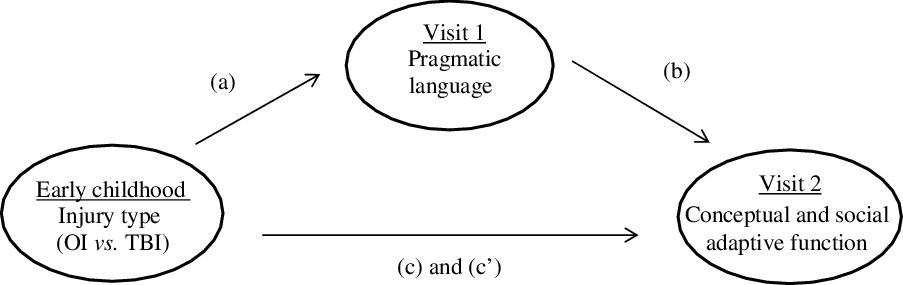
Informed by a developmental neuropsychology model, the primary goal of this paper was to examine the relationship between TBI in early childhood and subsequent AF abilities in middle childhood (on average 5 years post-injury). AF was divided into three components: conceptual, social, and practical functioning, consistent with the AAIDD model. Early TBI (as opposed to an early OI) was expected to predict reduced performance in all areas of AF in middle childhood. Importantly, our sample included mild and mild-complicated TBI. Although older children who sustain mild TBI may recover many of their cognitive and behavioral functioning following injury, children who sustain a mild TBI early in life continue to show increased behavior problems a year after injury (Taylor et al., Reference Taylor, Orchinik, Minich, Dietrich, Nuss, Wright and Yeates2015). Yet there has been little research on whether such effects persist years after injury, or whether children who experience mild TBI can match the developmental pace of their peers as they continue to age. It is therefore important to better characterize the long-term impacts of mild pediatric TBI. The second goal was to assess PL as a mediator of the relationship between early TBI and later AF. Specifically, decreased PL was hypothesized to mediate the relationships between early TBI and decreased conceptual and social AF because these domains of AF are theoretically dependent on complex language use (see Figure 1). PL skills were not hypothesized to predict practical AF as this skill set is theoretically more dependent on task-related functioning, such as brushing one’s teeth. In order to rule out that any mediational effects of PL were not due to broader language deficits in children, we examined expressive vocabulary as a control task. Finally, given that our previous study identified EF difficulties following early TBI, and other research has identified EF as a predictor of AF deficits, we examined EF as a mediator linking early TBI and later AF to examine specificity of effects.
Proposed mediational model. The proposed model is that early childhood TBI will predict pragmatic language (PL) functioning in middle childhood (a), which will in turn predict conceptual and social AF over a year later (b). This model also proposes that PL ability in middle childhood (on average 5 years after an early childhood TBI) mediates the relationship between early TBI and conceptual and social AF skills on average 6.5 years after TBI. Finally, the model proposes that these results are not bidirectional, highlighting the predictive and longitudinal nature of the analyses.

METHODS
Participants
The data for these analyses were drawn from a larger longitudinal study on the acquisition of language and literacy skills following TBI in early childhood (Haarbauer-Krupa et al., Reference Haarbauer-Krupa, King, Wise, Gillam, Trapani, Weissman and DePompei2019). Fliers, mass mailings, and targeted calls were used to recruit school-age children who were retrospectively recruited from the greater Atlanta area and from hospital trauma registry lists from Children’s Healthcare of Atlanta that were compiled based on ICD-9 codes for TBI and OI (Faul, Wald, Xu, & Coronado, Reference Faul, Wald, Xu and Coronado2010). All children were tested at least 1 year post-injury and were between the ages of 6 and 11 years at the time of the initial study visit. Potential participants were screened via phone interview for injury type (TBI or OI), very preterm birth (i.e., born at less than 32 weeks gestational age), history of developmental delay or other medical diagnoses, and rehabilitation service utilization prior to injury. Children who were born very preterm, evidenced developmental delays prior to the injury or were enrolled in early intervention or rehabilitation services, were victims of abusive head trauma, or had parents who were not fluent in English were excluded from the study.
After obtaining informed consent at the initial study visit, injury information was verified by reviewing emergency room, urgent care, and/or pediatrician medical records. Parental report of the injury was documented on the Safe Child Screening Tool: Grades 1–5 (Hux, Dymacek, & Childers, Reference Hux, Dymacek and Childers2013), a screening tool that queries parents about the occurrence of neurologic events (e.g., falls, high fevers, and emergency department visits) and subsequent symptoms (e.g., headaches, coordination problems, and behavior change). Children were required to have both parent report of an injury and medical documentation of a TBI or OI before the age of 6 years to be included in the present analyses. Children were eligible for the OI group if they sustained a fractured or broken bone before the age of 6 years and had no history of head injury as indicated by medical record review and parent report on the Safe Child Screening Grades 1–5.
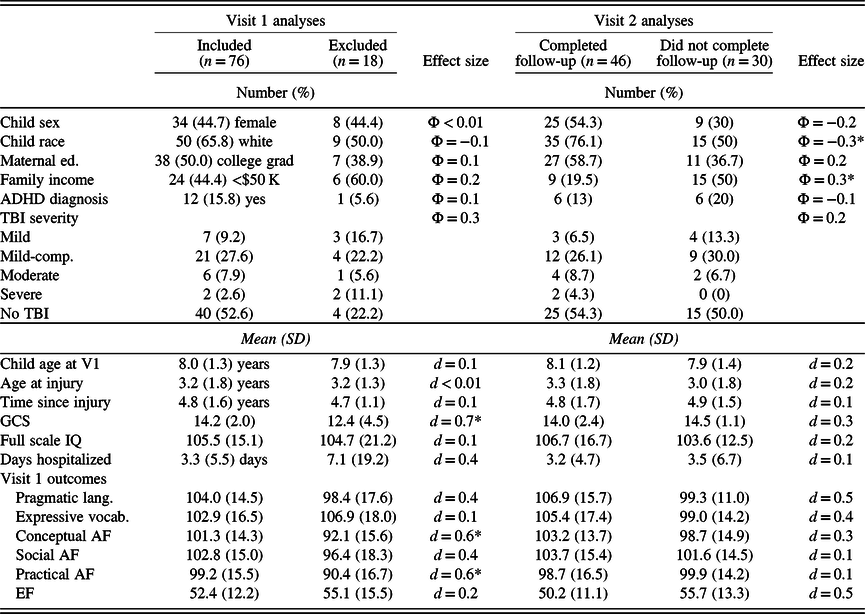
A total of 93 children completed at least one study visit, but children were excluded from analyses if they failed the administered hearing screening (n = 11) or if the parent-reported injury could not be confirmed by medical record review (n = 3). Finally, four children with histories of TBI were excluded from analyses because we were unable to reliably determine injury severity from the medical record [i.e., no Glasgow Coma Score (GCS) was provided]. The final sample for the present analyses included 76 children (TBI = 36, OI = 40) with visit 1 data, which occurred when children were approximately 8 years old. Of these 76 children, 46 children (TBI = 21, OI = 25) also completed a follow-up visit approximately 1 year later (M = 13 months, SD = 1.8) when children were on average 9 years old. Children who were excluded from visit 1 (i.e., age 8) analyses had lower GCSs (t(73) = −2.2, p = .03) as well as lower scores on the conceptual (t(85)=−2.3, p = .02) and practical AF measures (t(84)=−2.0, p = .047), but there were no other differences between children who were and were not included in the study (see Table 1). Table 1 also includes the demographic and injury information for the current sample as well as differences between children who did or did not complete both study visits. The TBI group was comprised predominantly of children who sustained a mild-complicated TBI.
Differences between children who were and were not included in analyses

GCS = Glasgow Coma Score; AF = adaptive functioning; EF = executive functioning.
Children who were excluded from visit 1 analyses had lower GCS scores on average, but there were no other differences in terms of demographic information. Children who were excluded from the present analyses also tended to have lower conceptual and practical AF scores based on parent report but were not different on any other primary outcomes. Children who did not complete V2 had a lower household income and were less likely to be of white race but did not otherwise differ. Injury severity and location of injury were missing for four excluded participants. All visit 1 outcomes are standard scores, except EF, which is a T score. Race, maternal education, and family income were defined dichotomously as white or non-white, mothers’ graduation from college or not, and making more or less than $50,000/year, respectively. ADHD diagnosis was assessed by parent report at visit 1. *p < .05.
Procedures
All research procedures were completed in compliance with the Helsinki Declaration as well as Institutional Review Boards at Georgia State University and Children’s Healthcare of Atlanta. Written consent was obtained from a legal guardian and the child provided verbal assent. Trained post-baccalaureate and graduate Research Assistants conducted testing in a private room while the parent completed questionnaires in a nearby room. Participants were screened for hearing, vision, and articulation ability prior to commencing the other study measures. Each visit lasted approximately 3 hrs and the same measures were completed at visit 1 (i.e., the age 8 visit) and visit 2 (i.e., the age 9 visit). Participants were compensated $50 at each visit for their time and travel expenses.
Measures
Pragmatic language
PL was assessed using the Pragmatic Judgment test from the Comprehensive Assessment of Spoken Language (CASL; Carrow-Woolfolk, Reference Carrow-Woolfolk1999). This test of the CASL is an open-ended free response examination in which the tester verbally presents the child with a variety of social situations. The child must then judge whether the language used by the actor in the situation was appropriate or describe the appropriate language to use in each scenario. The test situations assess a range of pragmatic skills including identifying appropriate greetings and conversation topics, effectively asking for help, expressing communicative intent, and using language to express different emotions. The tester employs a pre-established rubric to determine the appropriateness of each response. This measure shows high interrater reliability and appropriate criterion-related and construct validity (Carrow-Woolfolk, Reference Carrow-Woolfolk1999). Higher scores reflect more advanced PL use.
Adaptive functioning
AF was assessed using the Adaptive Behavior Assessment System-II (ABAS-II; Harrison, Reference Harrison2003). The ABAS-II measures AF across three domains: practical, social, and conceptual. The parent report version of the ABAS-II was completed by the parent or legal guardian. This test shows high internal consistency, test–retest reliability, and interrater reliability as well as good content validity in normative samples (Harrison, Reference Harrison2003; McCauley et al., Reference McCauley, Wilde, Anderson, Bedell, Beers, Campbell and Yeates2012). Higher scores reflect more mature AF.
Expressive vocabulary
Basic expressive vocabulary was assessed using the Expressive One Word Picture Vocabulary Test (Brownell, Reference Brownell2000). The child is asked to name depicted objects, concepts, and actions. This test exhibits high internal consistency, good test–retest reliability, strong interrater reliability, and respectable construct validity (Brownell, Reference Brownell2000). Higher scores represent more advanced expressive vocabulary.
Executive functioning
Parents completed the Behavior Rating Inventory for Executive Functions (BRIEF) rating form. This questionnaire asks parents to respond to 86 items that assess their child’s executive functions within the context of their daily environments. The BRIEF was used for the present study because parent report of EF may be a more sensitive predictor of child behavior problems compared to laboratory-based measures (Riccio, Hewitt, & Blake, Reference Riccio, Hewitt and Blake2011). The Global Executive Composite T score was used for the present analyses. Higher scores represent worse EF.
Intelligence
IQ was measured using the Kaufman Brief Intelligence Test, Second Edition (Kaufman & Kaufman, Reference Kaufman and Kaufman2004), which exhibits good internal and test–retest reliability as well as respectable construct validity. It was used for descriptive purposes only.
Injury severity
Injury severity was coded using the GCS and imaging findings extracted from participants’ medical records. Children were considered to have a mild head injury if they had a GCS between 13 and 15 without abnormal neuroimaging findings (e.g., skull fracture, subdural hematoma) and mild-complicated TBI if they had a GCS between 13 and 15 at the time of injury and abnormal neuroimaging findings. Moderate TBIs were indicated if child had a GCS between 9 and 12 and severe TBI if child had a GCS ≤ 8. These GCS cutoffs are consistent with the published literature on pediatric TBI severity (Babikian & Asarnow, Reference Babikian and Asarnow2009). All children in our moderate and severe TBI groups also had verified abnormal imaging findings, with the most common findings including both intracranial lesions and skull fractures (Haarbauer-Krupa et al., Reference Haarbauer-Krupa, King, Wise, Gillam, Trapani, Weissman and DePompei2019).
Data Analyses
Standardized scores were used for all analyses. Descriptive statistics were calculated using mean values and measures of variability. All of the data met criteria for normality and did not evidence significant skew or kurtosis. Demographic characteristics were examined as potential covariates (see Supplemental Table S1) using t-tests and Pearson correlations. Any demographic variables that were associated with the dependent variable(s) in a given analysis were considered covariates and included in those analyses. Therefore, covariates employed in the analyses varied by dependent variable (see Tables 4–9).
Visual inspection of the data revealed the performance of children who had mild, moderate, or severe TBI was evenly distributed across outcome variables. In order to avoid having groups with very few participants (e.g., having only two participants in the severe TBI group) and to maximize power, analyses examining injury type therefore contained two levels: TBI versus OI. A series of analysis of variance (ANOVA) tests and hierarchical linear regressions were used to test the primary study aims. Indirect effects were examined for the mediation analyses using the PROCESS macro script with bootstrapping (Hayes, Reference Hayes2012) with 5000 samples. Indirect effects were determined to be significant if zero was not included between the upper and lower bounds of the 95% confidence interval (Preacher, Rucker, & Hayes, Reference Preacher, Rucker and Hayes2007). False discovery rate (FDR) correction was implemented when multiple comparisons were conducted using the Benjamini–Hochberg method (Benjamini & Hochberg, Reference Benjamini and Hochberg1995). It is important to note that the literature is mixed regarding the long-term consequences of uncomplicated mild TBIs, with a number of studies finding only transient effects of uncomplicated mild TBI on cognitive development (e.g., Babikian, Mcarthur, & Asarnow, Reference Babikian, Mcarthur and Asarnow2012). Therefore, we additionally re-ran all of our analyses excluding children with uncomplicated mild TBI. Our results were unchanged by this exclusion, so we retained all participants in the below analyses in order to maximize our sample size and subsequent power to detect effects.
RESULTS
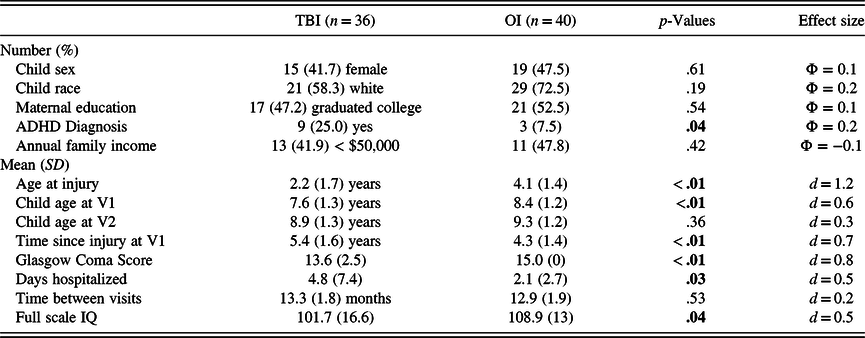
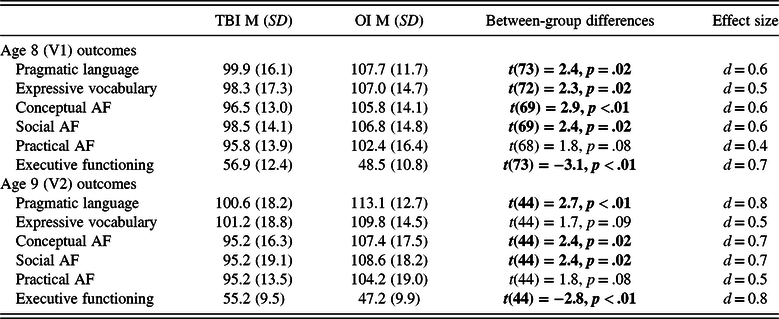
TBI and OI between-group differences are described in Tables 2 and 3. One-way ANOVAs revealed the TBI group had significantly lower scores compared to the OI group on all age 8 outcome measures except for practical AF. Performance for both groups was, on average, within the average range relative to normative data (see Table 3). Between-group differences in PL and social AF persisted at the age 9 visit, and at this visit, the TBI group also showed lower conceptual AF abilities compared to the OI group (see Table 3). Intercorrelation between study measures is displayed in Supplemental Table S2.
Sample characteristics by injury type

Children with a history of TBI had higher rates of ADHD, were injured at younger ages, were younger at the time of their first study visit, had a greater time since injury, lower GCS, longer hospital stays at the time of injury, and had lower full scale IQ scores compared to children in the OI group. Race was defined dichotomously as white or non-white. Maternal education was also defined dichotomously as mothers’ graduation from college or not. Finally, family income was dichotomously defined as making more or less than $50,000/year. ADHD diagnosis was assessed by parent report at the first study visit.
Descriptive statistics and mean differences on language and AF measures

AF = adaptive functioning.
Children with a history of TBI had persistently lower scores on pragmatic language, conceptual AF, and social AF at ages 8 and 9 years. They also had lower scores on expressive vocabulary and executive functioning at age 8. Visit 2 outcome data are based on a subset of participants who completed visit 2 (n = 46). All outcomes are standard scores, except EF, which is a T score.
Visit 1 (Age 8) Outcomes
Hierarchical linear regressions were used to examine whether concurrent language ability and EF explain incremental variance in AF, above and beyond the type of injury a child experienced early in life (i.e., TBI vs. OI).
Pragmatic language
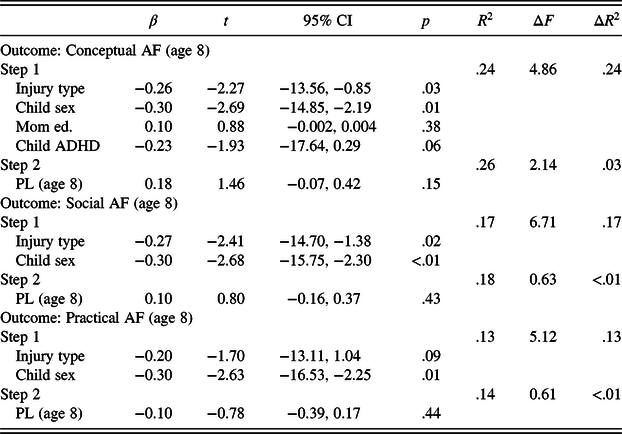
Contrary to expectations, age 8 PL did not predict additional variance in concurrent conceptual AF, social AF, or practical AF (see Table 4).
Expressive vocabulary
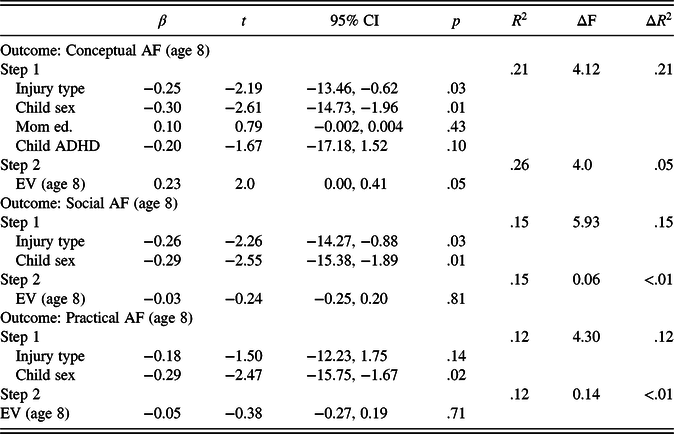
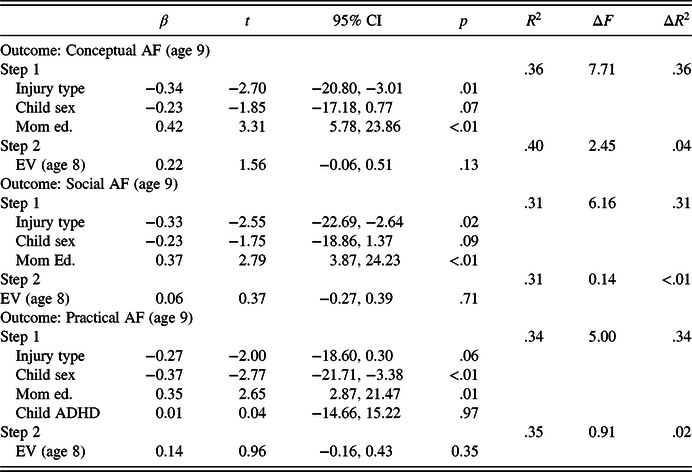
Age 8 expressive vocabulary also did not explain additional variance above and beyond the presence of early life TBI and relevant covariates in concurrent conceptual AF, social AF, or practical AF, which was consistent with predictions (see Table 5).
Age 8 pragmatic language hierarchical regressions

This table depicts results from three separate hierarchical regressions. Pragmatic language (PL) did not predict incremental variance in concurrent AF at age 8. Confidence intervals are of the unstandardized beta values.
Age 8 expressive vocabulary hierarchical regressions

This table depicts results from three separate hierarchical regressions. Expressive vocabulary (EV) did not predict incremental variance in concurrent AF at age 8. Confidence intervals are of the unstandardized beta values.
Executive functioning
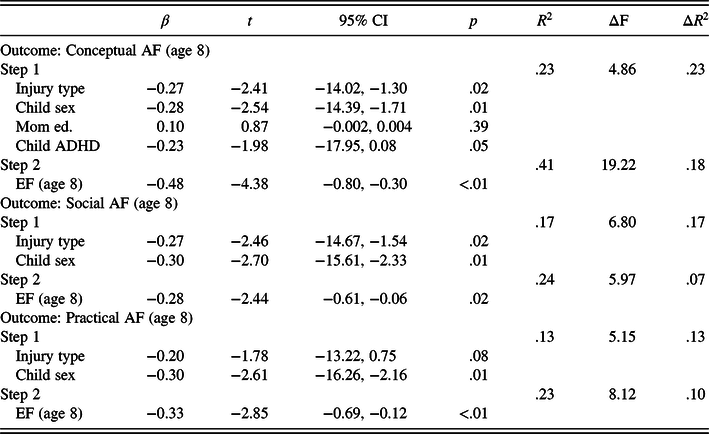
EF at age 8 explained incremental variance in concurrent conceptual AF, social AF, and practical AF over and above injury type (see Table 6). These results survived FDR correction, suggesting that EF may be a general predictor of concurrent AF.
Age 8 executive functioning hierarchical regressions

This table depicts results from three separate hierarchical regressions. Executive functioning (EF) predicted incremental variance in all domains of concurrent AF at age 8 over and above early TBI and other covariates. Confidence intervals are of the unstandardized beta values.
Visit 2 (Age 9) Outcomes
Pragmatic language
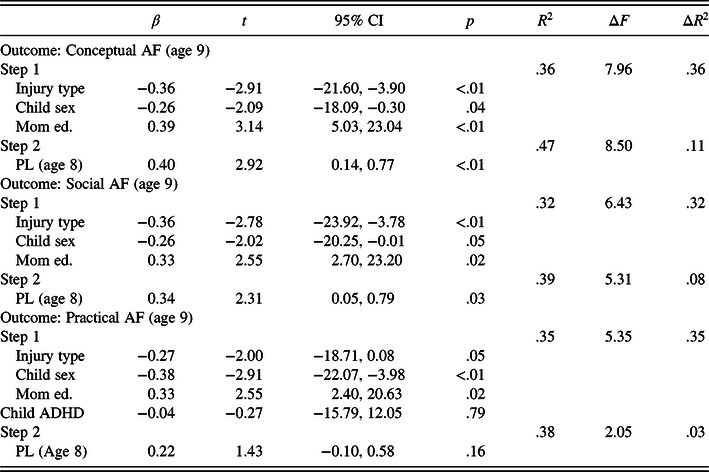
Using a longitudinal approach, we examined predictors of age 9 AF. Consistent with our proposed model, PL at age 8 predicted an additional 11% of the variance in conceptual AF at age 9 over and above injury type and covariates. Moreover, PL at age 8 also predicted 8% of variance in social AF at age 9. Also consistent with our hypotheses, PL at age 8 did not predict additional variance in practical functioning at age 9 (see Table 7).
Pragmatic language predicting age 9 adaptive functioning

This table depicts results from three separate hierarchical regressions. Pragmatic language (PL) at age 8 predicted significant variance in conceptual and social, but not practical, AF at age 9 above and beyond the presence of an early TBI and covariates. Confidence intervals are of the unstandardized beta values.
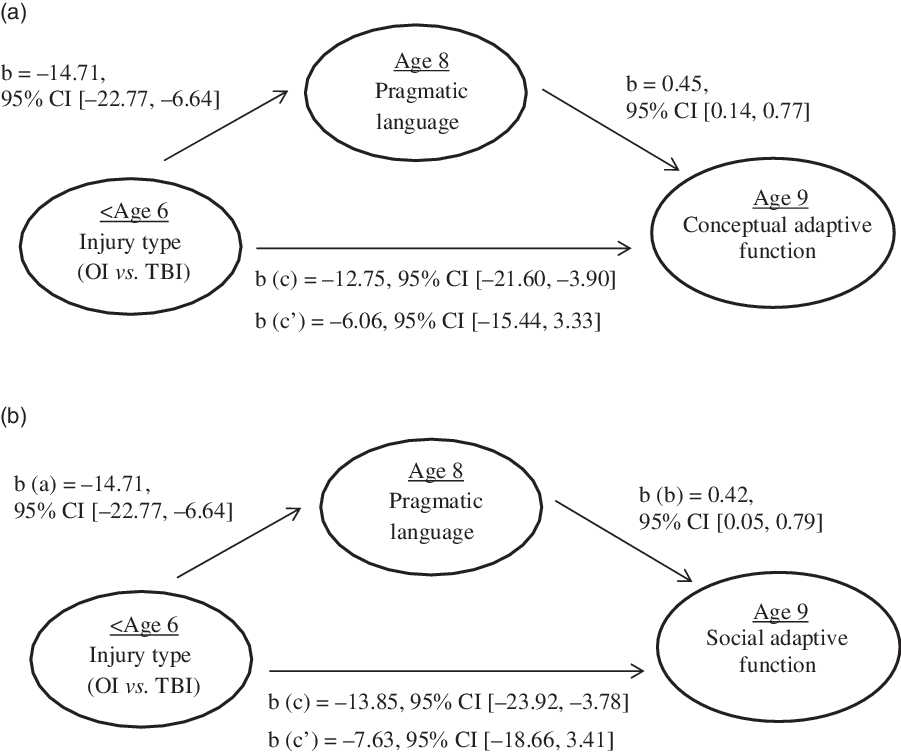
Next, we examined whether changes in PL acted as a cognitive mechanism by which early TBI disrupted conceptual and social AF. The presence of a TBI before age 6 predicted reduced PL at age 8 [β = −0.94, b = −14.71, SE = 3.99, p < .001, 95% CI (−22.77, −6.64)], which in turn predicted lower conceptual AF at age 9 [β = 0.40 b = 0.45, SE = 0.16, p < .01, 95% CI (0.14, 0.77)]. Moreover, examination of the indirect effect of injury type on conceptual AF revealed that PL was a significant mediator of this relationship (β = −0.37, SE = 0.17, 95% CI (−0.75, −0.11)].
PL was also examined as a mediator of the relationship between early TBI and social AF in a second mediation model. In this model, reduced PL ability at age 8 predicted lower social AF at age 9 [β = 0.34 b = 0.42, SE = 0.18, p = .03, 95% CI (0.05, 0.79)], and examination of the indirect effect showed that age 8 PL also mediated the association between early TBI and social AF at age 9 [β = −0.31, SE = 0.18, 95% CI (−0.72, −0.01)]. These results survived FDR correction (Figure 2).
Indirect and direct associations between injury type, pragmatic language (PL), and AF. Sustaining a TBI before the age of 6 years was predictive of lower PL scores at age 8 (a), and lower social and conceptual AF at age 9 (c). Moreover, decreased PL ability at age 8 predicted lower social and conceptual AF at age 9 (b) but not practical AF. Finally, PL mediated the relationships between early TBI and social and conceptual AF. Moreover, we also examined whether these effects were bidirectional, but age 8 conceptual and social AF did not significantly predict age 9 PL, suggesting that changes in PL may precede changes in social and conceptual AF following early TBI.

To rule out the possibility that changes in AF and PL were bidirectional, we examined whether AF at age 8 predicted later changes in PL at age 9. The presence of a TBI early in life continued to predict PL at age 9 [β = −0.40, p < .01, 95% CI (−20.05, −3.55)], but neither conceptual AF [β = 0.08, p = .59, 95% CI (−0.24, 0.42)] nor social functioning [β = 0.10, p = .49, 95% CI (−0.19, 0.39)] at age 8 predicted age 9 PL. These results rule out the possibility that AF at age 8 mediates the association between TBI before age 6 and PL at age 9.
Expressive vocabulary
Consistent with predictions, expressive vocabulary at age 8 did not predict conceptual, social, or practical AF at age 9 (see Table 8). Because expressive vocabulary was not associated with any of the AF domains examined at age 9, it was not examined as a potential mediator.
Expressive vocabulary predicting age 9 adaptive functioning

This table depicts results from three separate hierarchical regressions. Expressive vocabulary (EV) at age 8 did not predict significant variance in any domain of AF at age 9 above and beyond the presence of an early TBI and covariates. Confidence intervals are of the unstandardized beta values.
Executive function
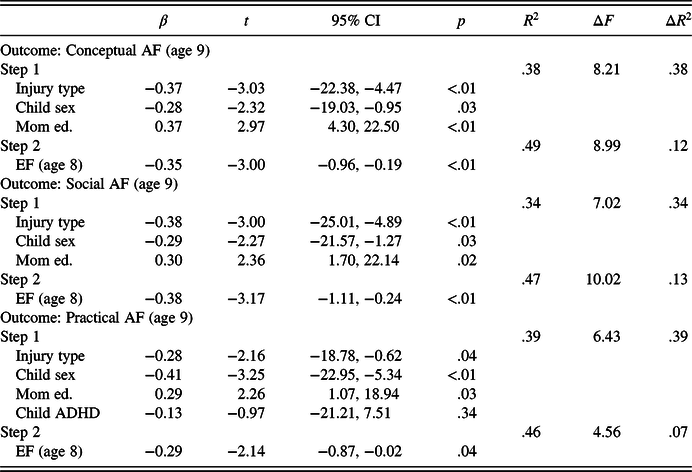
EF at age 8 continued to predict variance in all AF domains at age 9 above and beyond injury type and relevant covariates (see Table 9). When implementing FDR correction, EF at age 8 continued to significantly predict age 9 conceptual and social, but not practical, AF. However, the indirect effect of injury type via EF was not significant for any age 9 AF composite score [conceptual: β = −0.18, SE = 0.14, 95% CI (−0.54, 0.02); social: β = −0.19, SE = 0.14, 95% CI (−0.54, 0.03); practical: β = −0.09, SE = 0.11, 95% CI (−0.38, 0.06)], suggesting that age 8 EF does not mediate the relationship between early TBI and AF at age 9 in our sample. Our mediation findings are therefore specific to PL.
Executive functioning predicting age 9 adaptive functioning

This table depicts results from three separate hierarchical regressions. Executive functioning (EF) at age 8 predicted significant variance in all domains of AF at age 9 above and beyond the presence of an early TBI and covariates, but EF no longer predicted practical AF at age 9 after implementing false discovery rate correction using the Benjamini–Hochberg method. Confidence intervals are of the unstandardized beta values.
DISCUSSION
This longitudinal study examined the relationship between TBI in early childhood and AF in middle childhood in a cohort of children who were at least 1 year post-injury at the time of study enrollment. The results supported the hypothesis that early TBI may subtly interfere with PL development into middle childhood, which in turn may negatively affect the ongoing development of conceptual and social adaptive skills. Moreover, this relationship is not better explained by basic expressive vocabulary. Specific deficits in discourse production, including difficulties with ambiguous sentence interpretation, figurative language comprehension, and making inferences have previously been reported in children following TBI (Chapman, Levin, Wanek, Weyrauch, & Kufera, Reference Chapman, Levin, Wanek, Weyrauch and Kufera1998; Dennis & Barnes, Reference Dennis and Barnes1990). The present findings support and extend these results, suggesting that more complex language skills which rely on the organization of language and cognitive skills to respond to social situations are particularly vulnerable to TBI even when basic expressive vocabulary is intact (Gerrard-Morris et al., Reference Gerrard-Morris, Taylor, Yeates, Walz, Stancin, Minich and Wade2010; Rousseaux, Vérigneaux, & Kozlowski, Reference Rousseaux, Vérigneaux and Kozlowski2010; Ylvisaker, Reference Ylvisaker1993). Moreover, although the long-term effects of mild TBI remain unclear, recent research indicates that mild TBI may yield more consistent effects on child behavior and functioning if it occurs early in development (Taylor et al., Reference Taylor, Orchinik, Minich, Dietrich, Nuss, Wright and Yeates2015). The present results are consistent with this research given that we found subtle, but persistent, differences in complex skills like PL and AF in a sample of children who sustained predominantly mild-complicated TBI. On average, PL skills in the TBI group were in the average range, but there was significant variability in these scores and this variability prospectively predicted individual differences in functioning.
Other studies have found PL deficits to predict adaptive dysfunction in adolescents and adults with TBI (Galski, Tompkins, & Johnston, Reference Galski, Tompkins and Johnston1998). The present findings contribute to the literature by illustrating that PL specifically predicts conceptual and social AF skills in school-age children who sustained a TBI during a period of rapid language development (M = 2.2 years old, SD = 1.7). Moreover, these differences in PL are present even in the context of mild and mild-complicated TBI, which is consistent with other research showing subtle differences in PL following TBI in middle childhood (Ryan et al., Reference Ryan, Catroppa, Beare, Coleman, Ditchfield, Crossley and Anderson2015). The present findings suggest that even when PL skills are within the average range, subtle differences may be interfering with children’s day to day interactions and interrupting the development of complex AF skills that are shaped by social experiences. Interestingly, differences in PL predicted future conceptual and social AF but do not predict concurrent AF. It could be that differences in PL can be detected earlier in development than differences in AF, which may not become apparent until developmental demands increase. Alternatively, effective PL use may afford children particular opportunities that help to hone the development of social and conceptual AF.
Social AF relies on language expression and social interaction skills in the context of adept social cognition during common everyday interactions. Having a more advanced understanding of language pragmatics allows children to monitor conversation intent and quality and to respond flexibly and appropriately across a number of situations. This effective language use may contribute to increased child popularity, and subsequently more social interactions in which to further refine their adaptive use of other social skills (e.g., sharing, compromising).
Conceptual AF primarily involves higher-order integration of communication, planning, and self-direction. Pragmatic communication may be one avenue through which children learn to integrate self-direction and organization to accomplish a goal, perhaps by increasing child exposure to peers who can effectively model these behaviors. Children who are more able to ask for help or verbalize their ideas may also be better able to overcome reduced conceptual skills. It is also possible that some other cognitive mechanism contributes to both PL and adaptive development in children with early injuries, thereby driving the observed effects. However, we did rule out two such potential mechanisms: basic vocabulary and EF. It therefore seems plausible that PL may uniquely contribute to long-term social and conceptual AF among children with early head injuries.
Although some research suggests that children may be able to develop at a typical rate 30 months after sustaining a TBI, initial delays may not allow children to completely catch up to their peers and subtle, persistent differences in functioning following an early head injury may remain (Anderson, Godfrey, Rosenfeld, & Catroppa, Reference Anderson, Godfrey, Rosenfeld and Catroppa2012). Although these differences may not be clinically significant at young ages, subtle alterations in functioning can interfere with the formation of social relationships as children age and developmental demands increase. Difficulty in forming these relationships with peers may contribute to further disruption of PL development and AF skills over time.
As hypothesized, there were no group differences among school-age children in practical functioning following early TBI. Perhaps practical deficits would be more apparent in children with severe TBI as it may be more physically or cognitively challenging for these children to perform more advanced self-care tasks (Fay et al., Reference Fay, Yeates, Wade, Drotar, Stancin and Taylor2009); this type of severe impairment was largely absent in our sample as most children in our TBI group sustained mild-complicated head injuries. In addition, it is possible that if we continued to follow this sample into adolescence, we may detect disruption in practical AF skills, since this is a time when expectations have increased for independent living skills and when reminders and assistance from family members are normatively expected to decrease.
EF did not mediate the relationship between injury type and any type of AF. This finding was surprising given demonstrated associations between EF and AF in the present study as well as in other research (e.g., Mangeot, Armstrong, Colvin, Owen Yeates, & Gerry Taylor, Reference Mangeot, Armstrong, Colvin, Owen Yeates and Gerry Taylor2002; Shultz et al., Reference Shultz, Hoskinson, Keim, Dennis, Taylor, Bigler and Yeates2016). However, it is important to note that research examining associations between EF and adaptive outcomes yields mixed results, with some studies failing to find a significant association (e.g., Treble-Barna et al., Reference Treble-Barna, Zang, Zhang, Taylor, Yeates and Wade2017). One possible explanation for these mixed results is that EF impacts later developing AF via disruption to other cognitive processes, such as social problem solving (Muscara et al., Reference Muscara, Catroppa and Anderson2008). In other words, EF may impact AF indirectly rather than directly, which could make this association difficult to detect reliably. It is also possible that specific facets of EF, such as self-regulation, may mediate adaptive behavioral outcomes following TBI (Ryan et al., Reference Ryan, Reyes, Crossley, Beauchamp, Catroppa and Anderson2019), while other facets of EF do not. Using a measure of global EF may therefore obscure significant associations. The presence of specific moderators, such as the extent of injury-related brain damage, could also explain the heterogenous associations between EF and AF following early TBI.
The current findings should be considered in the context of study limitations. One such limitation is the dependence on parent recall about children’s pre-injury functioning due to the retrospective nature of the study screening process. We also utilized ICD-9 codes to initially identify our recruitment pool of potential study participants, which have previously been associated with false positive and false negative diagnoses of TBI, particularly of mild TBI (Bazarian, Veazie, Mookerjee, & Lerner, Reference Bazarian, Veazie, Mookerjee and Lerner2006; Carroll, Cochran, Guse, & Wang, Reference Carroll, Cochran, Guse and Wang2012). However, thorough medical record reviews were conducted to confirm the injury and parent report. Study screening and eligibility procedures allowed for exclusion of children with developmental delays, extreme prematurity, or history of medical diagnoses prior to the injury. Few studies have examined children’s abilities years after an early head injury, so the present study makes an important contribution to the current literature.
It is also important to note the inherent limitations with any laboratory-based assessment of PL. In the present study, test administrators were not blind to injury group, which inherently raises the possibility of scoring biases. However, it is unlikely that test administrator bias explains the present results given that children in the TBI group continued to score, on average, within the average range. Moreover, test administrators were blind to parental report of AF, and parents were blind to children’s scores on our PL measure. PL is a highly context-dependent skill and there are many cultural, situational, and ethnic variables that are not measured by laboratory-based assessments, but nonetheless contribute to the appropriateness of PL use (McDonald, Turkstra, & Togher, Reference McDonald, Turkstra, Togher, Anderson and Beauchamp2012). Future research could address this limitation by examining in vivo PL use among children with histories of early TBI using more naturalistic methods (e.g., recording real-life conversations). Finally, given that children with TBI were younger than those with OI, it is possible that associations between PL and AF may change as children age and face ever-increasing social and academic demands. We partially accounted for this possibility by using standardized, rather than raw, scores in our analyses, and child age was not associated with any of our outcome measures. However, it will be important for future research to collect repeated measures of PL and AF into adolescence and adulthood in order to determine the extent to which the observed mediational relationships are age dependent.
It is also possible that the development of language and AF is moderated by environmental influences following pediatric TBI. In the present study, maternal education was associated with child PL at both study visits, and child sex was linked to parent report of AF. Although we controlled for these variables in our analyses, it remains possible that sex and/or parental education interact with early TBI to predict long-term outcomes (Mollayeva, Mollayeva, & Colantonio, Reference Mollayeva, Mollayeva and Colantonio2018). Notably, a recent study found that childhood TBI-related functional differences in adolescents were only present when these teens lived in homes with low environmental enrichment and that these differences disappeared at higher levels of enrichment. Functional differences following TBI were also more pronounced among adolescents whose parents showed high levels of permissive or authoritarian parenting behaviors (Wade, Zhang, Yeates, Stancin, & Taylor, Reference Wade, Zhang, Yeates, Stancin and Taylor2016). This finding is consistent with a broader literature that demonstrates positive parenting practices serve a protective role in offspring brain development, and highlights parenting interventions as a potential avenue for buffering adaptive and PL development following pediatric TBI.
One notable strength of the present study was the use of both parent report and performance-based assessments of child ability. The use of multiple methods reduced experimenter bias and eliminated shared-method variance as a potential confound in our PL analyses, which suggests that the present findings are robust. Additionally, the use of an OI group partially accounted for pre-injury variables (such as inattention or impulsivity) that may predispose children to sustain an injury early in life and thus confound the present findings. There were higher rates of parent-reported ADHD in our TBI group compared to the OI group, but this may be a consequence of early TBI (Adeyemo et al., Reference Adeyemo, Biederman, Zafonte, Kagan, Spencer, Uchida and Faraone2014) and was controlled for in the relevant analyses. We were therefore able to determine that head injuries (rather than other injuries that require hospitalization) which occur early in life are specifically related to differences in PL and conceptual and social AF skills, even several years after injury. Another very important strength of the current study is the longitudinal data that we were able to acquire, which further enabled us to examine the cognitive mechanisms that predict adaptive outcomes, on average 6 years since injury. In addition to the constructs of interest, we were able to examine plausible confounds and use control tasks to help increase the specificity of our results.
The present study suggests that even mild-complicated head injuries can have a lasting impact on children’s adaptive and complex linguistic development and that these differences may begin to emerge during school-age years. Additional longitudinal research is crucial to examining the concurrent developmental trajectories of these skills following TBI, especially when TBIs occur during sensitive periods of rapid skill development. Furthermore, this study highlights that it is important for clinicians to consider the inclusion of PL assessments with mild-complicated TBIs in childhood given that even subtle PL difficulties predict later adaptive outcomes. Fortunately, interventions for PL and social communication skills are available through speech-language therapy, which can be accessed in both healthcare and school settings (Haarbauer-Krupa et al., Reference Haarbauer-Krupa, Ciccia, Dodd, Ettel, Kurowski, Lumba-Brown and Suskauer2017). These interventions are effective at improving social communication problems in children with other health conditions, such as autism (Adams et al., Reference Adams, Lockton, Freed, Gaile, Earl, McBean and Law2012; Baxendale, Lockton, Adams, & Gaile, Reference Baxendale, Lockton, Adams and Gaile2013; Parsons, Cordier, Munro, Joosten, & Speyer, Reference Parsons, Cordier, Munro, Joosten and Speyer2017), but their effectiveness has not yet been tested in the pediatric TBI population (Ciccia, Beekman, & Ditmars, Reference Ciccia, Beekman and Ditmars2018). Based on the evidence from other pediatric populations, identifying and intervening early will likely help children improve their PL skills, especially if PL skills are clinically impaired, which in turn may result in more optimal adaptive behavior outcomes long-term.
ACKNOWLEDGMENTS
We are indebted to the children and their families who gave willingly of their time to make this research possible. We also thank Schauna Gilliam for her help with recruitment and testing, and the King Developmental Neuropsychological Across the Lifespan Laboratory for assistance with data scoring and management. The contents of this paper were developed under a grant from the Department of Education (J.K., NIDRR grant no. H133G110109). However, those contents do not necessarily represent the policy of the Department of Education, and you should not assume endorsement by the Federal Government. Pilot data that made this research possible were supported by the internal grant Research on the Challenges of Acquiring Language and Literacy Initiative Funding Project from the Georgia State University Provost Office (T.K.). Author C.L.H. is supported by the National Science Foundation Graduate Research Fellowship Program under grant no. DGE-1444932 and the American Association of University Women American Dissertation Fellowship.
CONFLICT OF INTEREST
The authors declare no conflicts of interest.
SUPPLEMENTARY MATERIAL
To view supplementary material for this article, please visit https://doi.org/10.1017/S1355617720000399