The patera (‘drinking-bowl’) of King Pterelas that Amphitruo brings back as a trophy of his victory over the Teleboeans plays a central role in Plautus' Amphitruo. Amphitruo and Sosia plan to show it off to Alcumena to impress her and to aggrandize their triumph, and this military bragging characterizes Amphitruo as a modified miles gloriosus (‘braggart soldier’).Footnote 1 Jupiter steals it and, in disguise as Amphitruo, gives it to Alcumena, wooing her and further solidifying her belief that she has just spent the night with her husband. After Amphitruo accuses his wife of lying when she states that she has slept only with him and that he gave her the drinking-bowl, he commands Sosia to open their box containing it to prove otherwise; of course, it has vanished, and its disappearance leads to more confusion and accusations. The drinking-bowl thus also serves as a physical token that might establish a character's identity, just like the cistella (‘box’) of Plautus' Cistellaria or Rudens, but with the twist that Jupiter's manipulation of the token intensifies misunderstanding rather than dispels it, per the usual model of comic anagnorisis.Footnote 2 In short, this prop contributes greatly to Amphitruo's characterization, narrative development, and metatheatrical play.
But why a patera? Although usually translated as ‘drinking-bowl’, as I have done above, it is actually a highly specialized shallow vessel for liquids in sacrificial rituals and libations.Footnote 3 Pieces of weaponry or armour could just as easily characterize Amphitruo as the braggart soldier, as they do in other plays, and any number of props could work as Amphitruo's prize or Jupiter's gift to Alcumena.Footnote 4 Likewise, while ‘recognition tokens’ are common in Roman comedy, they are usually nondescript generic objects such as rings or boxes, not ritualistic pottery.Footnote 5 Scholars have overlooked the strangeness of Plautus' prop, but its unconventionality suggests that his choice is meaningful and motivated by the unique circumstances of this comedy.Footnote 6 This article examines how the patera functions as an especially significant prop for Plautus' Amphitruo, arguing that Plautus uses it to parody prior literary and mythological traditions upon which the play draws. He also engages in previously unnoticed punning using patera and potare (‘to drink’) and pater (‘father’), further spoofing the Amphitruo myth while creating wordplay and dramatic irony that amplify the play's humour and highlight its core issues of power and paternity. Finally, the patera contributes to the tragicomic quality of Amphitruo while connecting its disparate thematic and comic elements, acting as a physical anchor that ties the play together into a complex and unified whole.
The mythological tradition and the patera's parodic functions
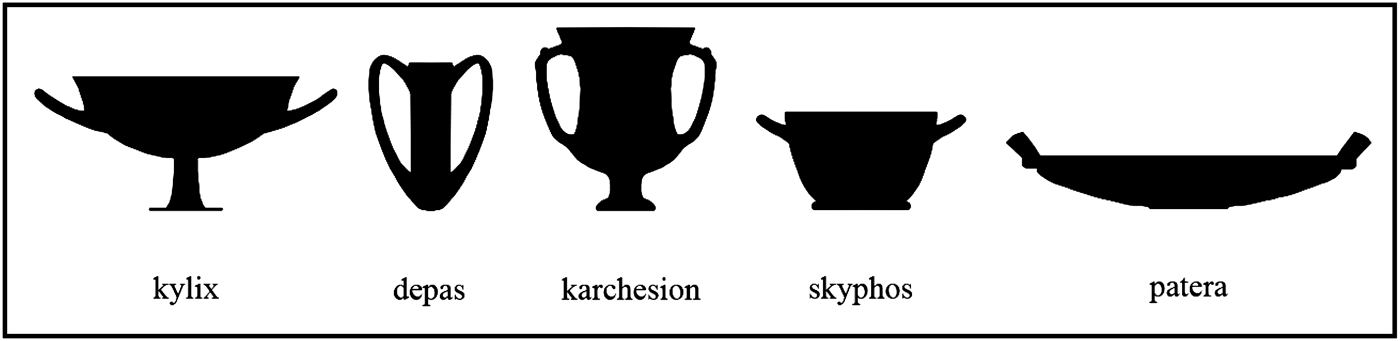
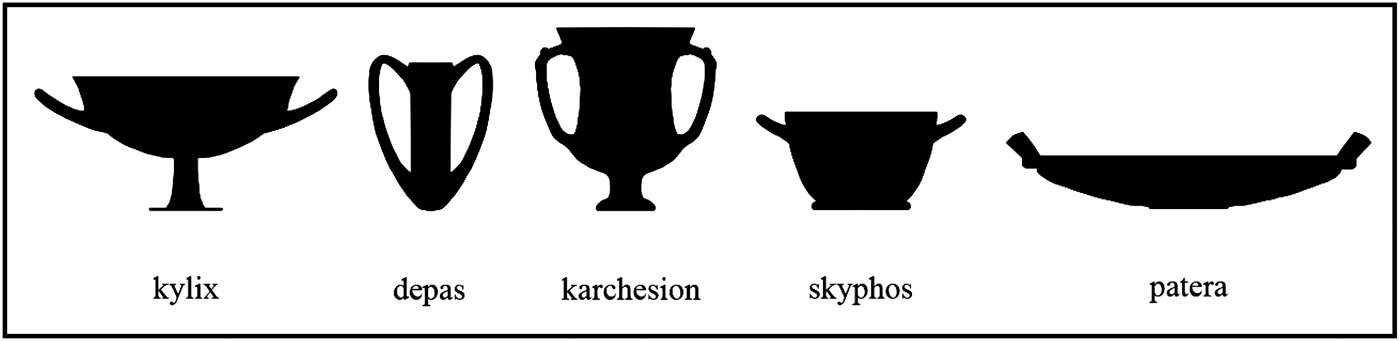
The Amphitruo myth is very ancient, alluded to in the Iliad, the Odyssey, and Theogony and appearing in brief but more or less complete narrative form in the pseudo-Hesiodic Shield.Footnote 7 As a result, there are many variations on the story, but in most versions Amphitruo leaves his virgin wife, Alcumena, to wage war against the Teleboeans; during his absence, Jupiter sleeps with her, usually in disguise as Amphitruo.Footnote 8 Though the details differ, the story also normally involves an object that is given to Alcumena: either a trophy that Amphitruo brings back to confirm his victory or a gift that Jupiter presents (or both, as in Plautus' version, where they are one and the same). In many versions this object is some kind of drinking vessel, though the type varies: Pausanias describes a chest belonging to the seventh-century bce Corinthian tyrant Cypselus as showing Zeus offering a kylix; Charon of Lampsacus says he gave her a depas; Pherecydes of Athens and Herodorus of Heraclea say it was a karchesion; Anaximander the Younger and Archippus of Athens say it was a skyphos.Footnote 9 Each vessel differs in form, but they all share one trait: they are unmistakably cups, relatively deep and with handles on their sides. As I observed above, though, a patera is a wide shallow bowl unlike any of the other vessels mentioned by authors besides Plautus (see figure 1 for comparison). For spectators who knew the tradition that Jupiter gave Alcumena a drinking-cup (probably a fair number, given the cup's prevalence and prominence in the various mythological accounts), Plautus' deviation would be unexpected and funny, as the patera is bizarrely specific and unusually shaped; its form would be especially amusing if the patera's width were comically exaggerated, a common technique in Roman comedy that would be necessary for it to be visible from seats in the back of the theatre.Footnote 10
Comparison of vessel types related to the Amphitruo myth.
There is another tradition that the gift is not a drinking vessel at all, but rather the shield of King Pterelas that Amphitruo receives after defeating him. Though it is extant only in one of Theocritus' Idylls, Wilamowitz argued that this tradition of single combat between Amphitruo and Pterelas also appeared in Euripides' Alkmene, which seems to have served as one of Plautus' models and objects of parody for his Amphitruo.Footnote 11 Furthermore, Stewart persuasively demonstrated that Euripides' Alkmene was familiar to Roman audiences, at least in Latin translation, and that it had probably been performed at Rome not long before Plautus' Amphitruo was first staged; the prologue to Plautus' Rudens refers to Euripides' tragedy, and scholars consistently date Rudens to slightly before Amphitruo, so some members of the audience would probably have known the tradition that Amphitruo fought and killed Pterelas single-handedly.Footnote 12
Whether or not they knew Theocritus' statement that Amphitruo stripped the shield from Pterelas' body after defeating him, Roman conventions pertaining to single combat would automatically set up the expectation that Amphitruo would carry off the arms of his vanquished foe as a trophy. As Riess demonstrated, Plautus' emphasis on Amphitruo's victory in single combat as the climax of the battle (ipsusque Amphitruo regem Pterelam sua optruncavit manu, ‘Amphitruo himself cut down King Pterelas with his own hand’, line 252) would bring to mind the spolia opima, the arms and armour of an enemy leader that were given to the Roman general who had personally slain him in battle.Footnote 13 This feat and its reward were rare, said to have occurred only three times in Roman history; not coincidentally, the third and last person to have the spolia opima was M. Claudius Marcellus, who earned them after defeating the Gallic King Viridomarus in 222 bce, shortly before Plautus' Amphitruo was written.Footnote 14 Moreover, as many scholars have noted, the play as a whole caricatures aspects of the Roman triumph, in which the enemy's arms and armour were publicly displayed, and the speech in which Sosia details Amphitruo's deeds in war (and more to the point, in which the patera is first mentioned) alludes to the requirements for the granting of a triumph by the Senate.Footnote 15 In sum, there is good reason to think that Plautus' audience would expect Amphitruo to bring back the shield of Pterelas as a trophy.
After a long build-up in which Sosia sets the stage for Amphitruo's triumphant accolades, he comes at the close of his speech to the end of the war and the reward for his general's bravery (lines 256–61):Footnote 16
To an audience that had been primed – by literary tradition, Roman cultural convention, and the play itself – to anticipate spolia opima as Amphitruo's reward, the patera would have presented a ludicrous let-down, deflating the epico-tragic tone of Sosia's account of the war.Footnote 17 This reversal of a potentially, even predictably, epico-tragic item into something relatively mundane parallels tragicomic inversions that occur throughout the play: the mutation of Amphitruo from victorious general to cuckolded miles gloriosus; the gods' disposal of gravitas and appropriation of juvenile adulescens amator (‘young man in love’) and servus callidus (‘clever slave’) stock types; Alcumena's encomium of virtue while she is grotesquely hypersexual and pregnant simultaneously by her husband and her divine lover.Footnote 18 The patera also adds to the play's parody of the Roman triumph, altering Amphitruo's spolia opima, the most exclusive and tangible marker of a general's virtus, into an object with no overtones of military excellence.Footnote 19 Indeed, this collapse of esteemed Roman military rituals and high-minded ideals into the humdrum materiality of the patera is symptomatic of something Bakhtin termed ‘grotesque realism’ – the degradation of the high, spiritual, and abstract into the everyday and earthly – a quality in which (as Christenson demonstrates) Plautus' Amphitruo abounds and revels.Footnote 20
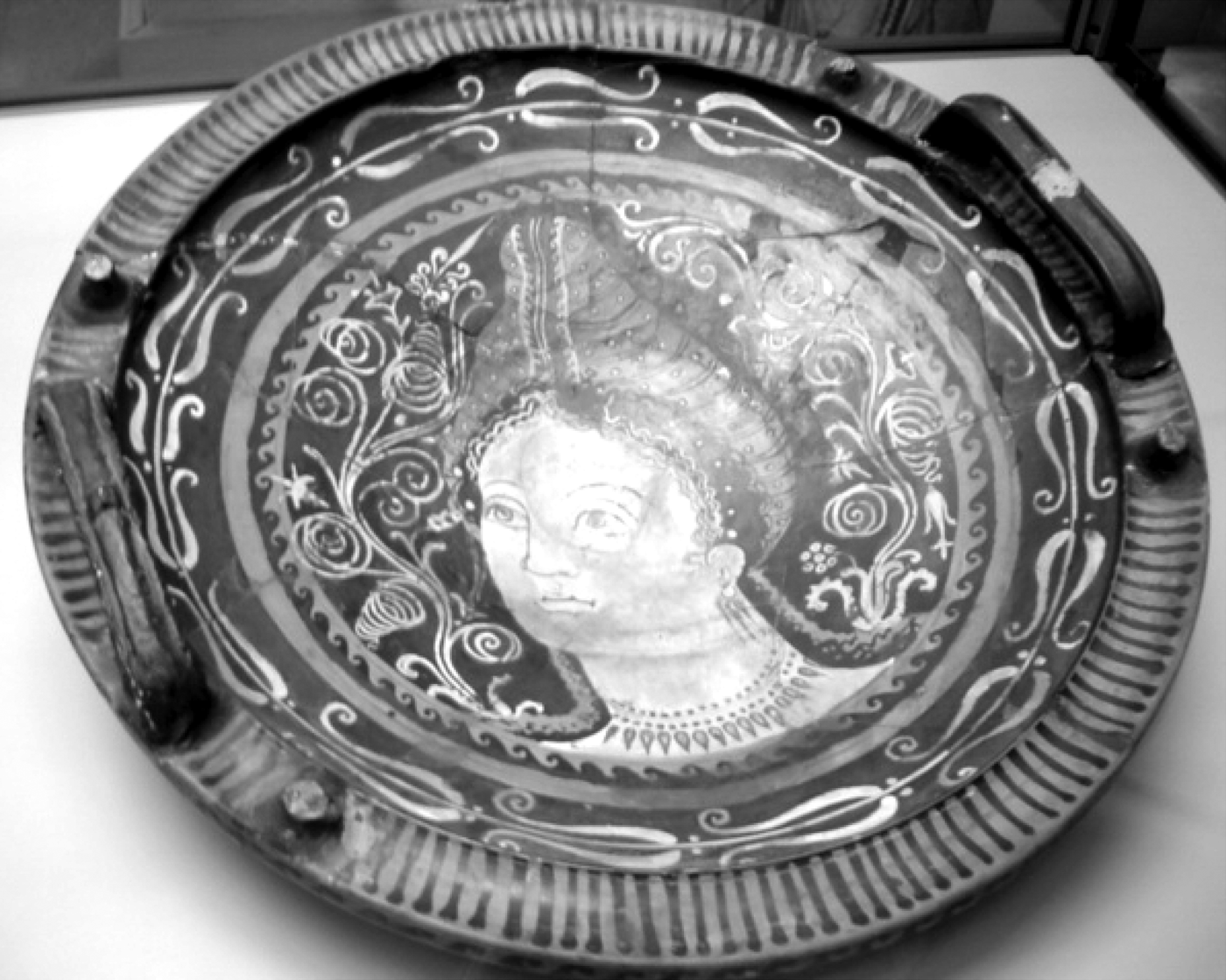
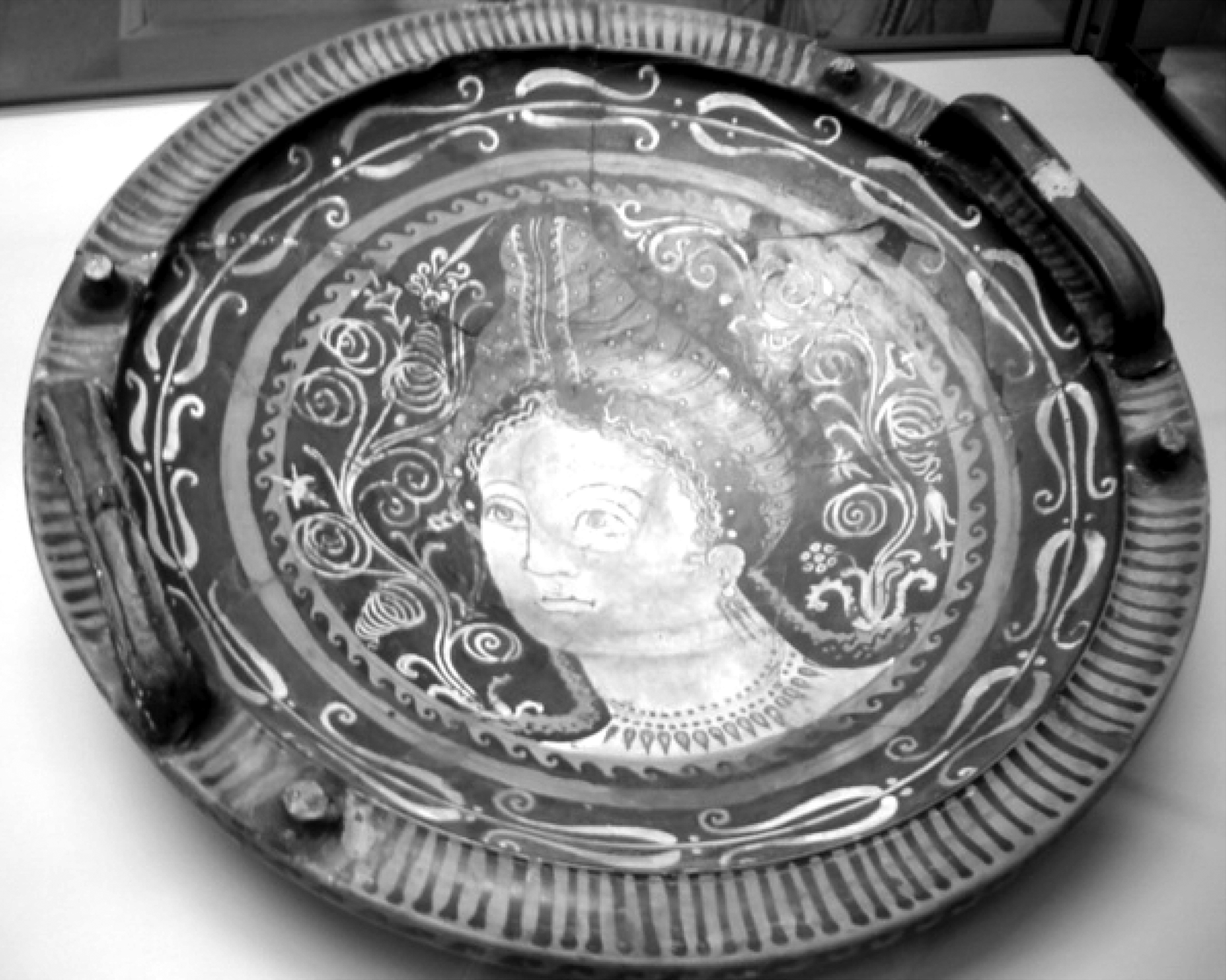
There is also the possibility that certain members of the audience would be aware of both traditions, the drinking-cup and the shield of King Pterelas. For these spectators, the tension between the variant versions would create anticipation, as well as the potential for more visual humour. As I noted above, a patera is a broad and shallow dish and its shape corresponds roughly to that of a round shield, especially in examples where its handles protrude upward from the rim like the arm band and hand grip of a shield, as in many surviving fourth- and third-century bcepaterae from southern Italy (see figure 2), which were probably familiar to Plautus' audience.Footnote 21 In the context of the myth, Plautus' use of a patera for Amphitruo's trophy and Jupiter's gift creates a preposterous amalgamation of both traditions: a drinking vessel shaped like a shield, and maybe just as big, if enlarged for visual and comic purposes. This combination aggrandizes the cup, lending military connotations that characterize Amphitruo as a miles gloriosus, while also undercutting the heroic and triumphal associations of the shield.
Apulian knob-handled terracotta patera, third century bce, now in the Museo Archeologico di Milano.
Beyond its literary, mythological, and cultural implications, Plautus also uses the patera to create humorous wordplay that depends on the name of this uncommon vessel. I would now like to turn to two scenes in Amphitruo where Plautus puns on patera, both of which contribute to tragicomic and parodic elements discussed above. As we will see, these also point to several thematic issues that are central to the play, especially issues of power and paternity.
A king in his cups: puns on patera and potare
As noted above, the drinking-bowl is first mentioned when Sosia recounts the battle with the Teleboeans and how Amphitruo single-handedly defeated King Pterelas, for which he received the patera as a prize (lines 260–1):
Two fairly straightforward puns are operating in these lines. The verb potitare, ‘to drink’, plays off patera, and there is a potential etymological connection between the two: Isidore says that ‘saucers are called “paterae” because we are accustomed to drink, “potare”, from them’ (paterae phialae sunt dictae…quod in ipsis potare solemus; Etym. 20.5.2).Footnote 22 The link between patera and potitare can be seen in turn to influence how the audience interprets King Pterelas' name. As is well known, Plautus enjoys etymological play with proper names and dubious etymologies, and his Amphitruo even opens with an extended set of puns connecting Mercury with mercimonium, ‘merchandise’.Footnote 23 Besides sharing most of the same consonants and in the same order (p-t-r), the close proximity and framing arrangement of patera and potitare suggest that the name Pterela derives from the same root, as if it were a diminutive form of patera.Footnote 24 Note also the use of the iterative form potitare rather than the simplex potare; Pterelas was not a king who merely drank, but one who drank continuously. Paterella, ‘Little Cup’, would be an appropriate moniker for a king who had a habit of getting drunk (potitare…est solitus). The collocation of patera, potitare, and Pterela appears twice more, at lines 418–19 and 534–6; if spectators missed the wordplay in this scene, its repetition offers multiple opportunities for the audience to catch these puns later.
As I discussed above, mythological tradition and Roman cultural conventions primed the audience before this scene to expect a trophy on the grand scale of spolia opima, so when Sosia reveals the patera as Amphitruo's prize, he alters a predictably epico-tragic object to something unexpectedly mundane, adding to the play's tragicomedy. The wordplay on patera, potitare, and Pterela serves similar functions, implying that King Pterelas was a drunk and therefore not to be taken seriously as a challenge to Amphitruo. Besides deflating Amphitruo's victory further, this etymological characterization lampoons Pterelas and his mythological tradition, which was also ancient and tragic.Footnote 25 The pun functions independently by minimizing Amphitruo's virtus, but for audience members familiar with Pterelas from outside the context of this play, it performs double work by making another character from tragedy tragicomically ridiculous. Moreover, we can see that this pun contributes to the play's ‘grotesque realism’, which revels not only in degrading the high into the low but also in the sordid functions and desires of the body. Pterelas' unquenchable thirst thus can be seen to parallel Alcumena's insatiable sexual appetite, and both of these serve to emasculate Amphitruo and undercut the virility of the triumphant soldier that he tries to assume.Footnote 26
Pater(a)nity test: puns on patera and pater
The final appearance of the patera in the play occurs in a long scene in which Amphitruo returns home to Alcumena, whom Jupiter, disguised as Amphitruo, has just left. When Alcumena greets her husband without excitement – and with good reason, since as far as she is concerned he has barely been away – Amphitruo becomes puzzled. She tells Amphitruo how that morning he had given her the drinking-bowl of King Pterelas, and in disbelief he demands that she bring it out so that he can prove he did no such thing and that he still has it. Directly before they open the box in which it is sealed, Sosia jokes about all the doubling that has been going on (lines 785–6):
The lines could be understood perfectly literally: Amphitruo and Sosia both find twins in Jupiter and Mercury disguised as them, and with everything in the play becoming doubled and confused, Sosia would not be especially surprised to find yet another twin in the form of the drinking-bowl. As Forehand has clearly demonstrated, however, much of Amphitruo's humour develops from ironic statements that are understood differently by the mystified Sosia and Amphitruo on the one hand and by the omniscient gods on the other hand (together with the audience, who sees both sides).Footnote 27 Sosia's verb choice here does exactly that: while he uses pario to mean no more than ‘produce’, it strongly connotes parentage and childbirth, nodding to Alcumena's double impregnation and the resulting birth of the twins Heracles and Iphicles.Footnote 28
In addition to thematic joking, we can also see in these lines that the verb pario sets up an etymological wordplay connecting patera to pater, ‘father’. The similarity of their sounds and spelling are sufficient to suggest links between these words, but there is also evidence that the ancients derived pater from pario.Footnote 29 The phrase patera pateram peperit thus serves as an ironic and playful figura etymologica with secondary meanings. Besides the literal sense – ‘the drinking-bowl has fathered a drinking-bowl’ – the phrase also implies ‘a father has produced a father’. This is an ironic but factual statement if interpreted on the model of tu peperisti Amphitruonem (‘you [Amphitruo] have produced an Amphitruo’) in the same sentence, since the play revolves around Alcumena's double impregnation and production of fraternal twins, whose birth at the end of the play will reveal that the number of fathers has doubled as well. As with congeminavimus (‘we've twinned up’), Sosia intends his quip about the paterae to mean only that everyone and everything seems lately to have developed a double. The audience, however, which knows about Jupiter's amorous intrigues and his fathering of one of Alcumena's embryonic twins, sees that Sosia says more than he means and can laugh at the resulting irony latent in the link between the doubled paterae and patres.
As I noted above, the patera can be seen as the physical signifier of Amphitruo's victory over King Pterelas and therefore symbolic of his virtus, in recognition of which the Teleboeans gifted it to him (ob virtutem, line 260). The humorous visual and parodic functions that the prop performs within the play serve to undercut Amphitruo's seriousness as a soldier and a character, as does the wordplay connecting patera and King Pterelas with potare, ‘to drink’. The resulting loss of gravitas that Amphitruo suffers contributes to the tragicomic quality of the play, since it changes him from a potentially epico-tragic character into a ridiculous caricature of no power or consequence. Besides producing ironic humour, Plautus' wordplay on patera and pater, ‘father’, can be seen to develop this tragicomic characterization further. Amphitruo believes that he has exclusive control over the patera, which he has shut away in a box that has been sealed with his own signet (in cistula;/Amphitruonis opsignata signo est, lines 421–2), but Jupiter bypasses his safeguards with ease and gains control of it for himself. In the same way, Amphitruo has left his pregnant wife (gravidam ego illanc hic reliqui quom abeo, line 668), thinking that his exclusive access to Alcumena and role as father of her child is assured, but Jupiter likewise uses his divine powers to have sex with her and become her baby's father. Amphitruo thus simultaneously loses control of his patera and of his paternity, and the pun implicating patera, pario, and pater makes the thematic link between the two explicit.
Given this correspondence between control over the patera and control over fatherhood here, I wonder if there might also be a more sexual connection between the patera and pater at work with this prop throughout the play. The word pater usually either denotes literal fatherhood or connotes respect or endearment, but it is used several times by Plautus with sexual undertones, roughly equivalent to ‘active male partner’.Footnote 30 The patera serves as an extension of Amphitruo's virtus, which Phillips argues conveys a similar sense of sexual and procreative manliness in this play.Footnote 31 Finally, the cistella in which the patera is sealed may potentially be seen as symbolic of Alcumena's womb; though the word and its cognates are not used elsewhere in explicitly sexual senses, containers are often used metaphorically for female genitalia in Latin.Footnote 32 The exchange between Mercury and Sosia over the patera can thus be seen as ironically sexual (lines 420–2):
Along these lines, we might interpret the seal to represent Alcumena's pregnancy: it is thought to guarantee that the patera remains safe and intact, just as Amphitruo's impregnation of her acts as a marker and assurance of his legitimate paternity. The design on the seal may confirm this idea: the rising Sun, which looks to the coming dawn when Amphitruo first arrives on stage (lucescit hoc iam, line 543, a few lines before Amphitruo's appearance at 551), stands in sharp contrast to Jupiter's lengthening of night so he may enjoy Alcumena, especially considering Sosia's remark that the night has stretched out because the Sun fell asleep after excess drinking (lines 279–83).Footnote 33 Plautus puns on patera and potare in the lines directly preceding this passage (418–19), recalling Pterelas' drunkenness and the deflation of the virtus that Amphitruo gained by killing him. In the process, he also introduces another instance of ‘grotesque realism’ by sexualizing the patera and using it to lower the high concept of virtus to the material realm of bodily functions and appetites. Pterelas' drinking and Jupiter's nocturnal cuckolding thus knock the potency out of the patera, a symbol of Amphitruo's manliness both in battle and in bed.
As Bond notes, a central theme of Amphitruo is power and the (in)ability to assert control over oneself and others.Footnote 34 Amphitruo's double loss of control – over the patera and over the paternity of his wife's children – culminates in scenes where the fate of both is revealed. Surprisingly, when he opens the box, the patera has not been doubled as Sosia predicted, so the battle for its custody is shown to be a zero-sum game: only one character gets the patera and its attendant virtus, both social and sexual. Given the fact that the patera, though a mundane object, is nevertheless ritual equipment, it is not surprising that Jupiter takes total possession of it, since as king and father of both gods and men he has ultimate religious authority in Rome. The fatherhood issue might seem different, as the number of patres has indeed been doubled along with the number of babies, but in the play's closing revelation Jupiter makes it clear that there is really only one father-and-son pair that matters (lines 1135–40):
The son born from Jupiter's seed, Heracles, completely overshadows Amphitruo's biological son, Iphicles, whose absence in this speech is significant. Amphitruo impregnated Alcumena first, but his role in the affair is treated as an afterthought (tu gravidam item fecisti) and his contribution to the family so minimal that he will gain more from his stepson than his stepson will gain from him: Amphitruo will have a share of immortality, but only in the form of glory reflected from the son of the god who cuckolded him. There can be only one patera, and only one pater, and neither is as safe and secure as Amphitruo thought.
Conclusion
As I hope to have shown, the patera plays several important roles in Plautus' Amphitruo: contributing to the play's mythological burlesque and tragicomedy; acting as a scaffold on which humorous wordplay hangs; signifying Amphitruo's military, sexual, and paternal mediocrity and characterizing him as a cuckolded miles gloriosus; and representing in physical form the struggle for power that runs throughout the comedy. The many functions that the patera performs reveals that its significance and centrality to the play is far greater than has been appreciated, and that, far from being an arbitrary prop choice, it is specifically and uniquely bound to Amphitruo. By tying together the various motifs and themes of power, control, triumph, drunkenness, night and day, sex, procreation, and fatherhood, the patera is not just a prop in the play but rather the prop, the central element that propels the comedy and gives Amphitruo so much of its humour and meaning.