There is a number of mating patterns in humans and one of them is assortative mating, which appears if individuals mate with others based on similarity between one to another. Assortative mating has been shown in humans, amongst others, in physical and psychological characteristics, or ideology (Díaz-Morales, Quiroga, Escribano, & Delgado, Reference Díaz-Morales, Quiroga, Escribano and Delgado2009; Figueredo, Sefcek, & Jones, Reference Figueredo, Sefcek and Jones2006; Kail & Cavanaugh, Reference Kail and Cavanaugh2010; Vinkhuyzen, van der Sluis, Maes, & Posthuma, Reference Vinkhuyzen, van der Sluis, Maes and Posthuma2012). Interestingly, assortative mating in many aspects is not concordant with humans’ preferences. For example, humans mate based on similarity in intelligence (Vinkhuyzen et al., Reference Vinkhuyzen, van der Sluis, Maes and Posthuma2012), whereas females prefer highly intelligent males, or males prefer young and physically attractive females (Buss & Barnes, Reference Buss and Barnes1986), but actually there exists assortative mating regarding those characteristics as well. Though, it seems that both sexes have strong preferences regarding different individual characteristics, but actually they mate assortatively in many of them – the phenomenon that could be partially explained by limited number of highly desired partners in population.
Chronotype, also named morningness-eveningness, often indicated by the easiest for self-observation facet of circadian rhythm – timing of sleeping – is an individual’s preference for a given time to go to bed and to get up (Adan, Hidalgo, Di Milia, Natale, & Randler, Reference Adan, Archer, Hidalgo, Di Milia, Natale and Randler2012). Morning oriented persons prefer to get up early and reach their maximum in cognitive performance and well-being soon (Jankowski & Ciarkowska, Reference Jankowski and Ciarkowska2008), while evening oriented persons prefer to get up late but stay up longer and perform better in the afternoon or evening hours. Eveningness is also related to some disadvantageous psychological outcomes, as lower life satisfaction and health (Jankowski, Reference Jankowski2012a; Randler, Reference Randler2011a), lower endurance (Jankowski, Reference Jankowski2012b), and to some disadvantageous physiological functioning, like greater pain sensitivity (Jankowski, Reference Jankowski2013). There are also age and sex differences in chronotype. Children usually are morning oriented (Randler, Fontius, & Vollmer, Reference Randler, Ebenhöh, Fischer, Höchel, Schroff, Stoll and Vollmer2012; Randler & Truc, Reference Randler and Truc2014) and boys and girls start delaying their bed times from the beginning of puberty until the end of adolescence, when sleep timing becomes earlier again (Randler, Reference Randler2011b; Roenneberg et al., Reference Roenneberg, Kuehnle, Pramstaller, Ricken, Havel, Guth and Merrow2004). Sleep timing is earlier in women, that is, they go to bed earlier, and thus are earlier chronotypes (Randler, Reference Randler2007; Roenneberg et al., Reference Roenneberg, Kuehnle, Pramstaller, Ricken, Havel, Guth and Merrow2004; Tonetti, Fabbri, & Natale, Reference Tonetti, Fabbri and Natale2008), and this gender difference exists primarily between puberty and menopause (Randler & Bausback, Reference Randler and Bausback2010; Roenneberg et al., Reference Roenneberg, Kuehnle, Pramstaller, Ricken, Havel, Guth and Merrow2004). However, some studies found no gender differences between boys and girls (Russo, Bruni, Lucidi, Ferri, & Violani, Reference Russo, Bruni, Lucidi, Ferri and Violani2007) or between men and women (e.g., Paine, Gander, & Travier, Reference Paine, Gander and Travier2006; Zimmermann, Reference Zimmermann2011), which might be a matter of sample size, variation in age or may depend on the questionnaires used (see for discussion, e.g., Randler, Reference Randler2007), but these non-significant results indicate that there is an additional need for further research to assess why some studies showed gender differences and others not. The significant gender difference suggests morningness being subject to sexual dimorphism related to reproductive aspects (Randler, Ebenhöh, Fischer, Höchel, Schroff, Stoll, & Vollmer Reference Randler, Ebenhöh, Fischer, Höchel, Schroff, Stoll and Vollmer2012) and to sexual hormones or the reproductive cycle (e.g., eveningness is related to longer menstrual cycle and more bleeding: Toffol et al., Reference Toffol, Merikanto, Lahti, Luoto, Heikinheimo and Partonen2013). However, social or cultural factors also could be implicated, given that some studies realized among adults samples have found higher morningness in men (Díaz-Morales & Sánchez-López, 2008; Park, Matsumoto, Seo, Kang, & Nagashima, Reference Park, Matsumoto, Seo, Kang and Nagashima2002; Taillard, Philip, Chastang, Diefenbach, & Bioulac, Reference Taillard, Philip, Chastang, Diefenbach and Bioulac2001).
Morningness has been shown as a trait subject to assortative mating in humans (Randler & Kretz, Reference Randler and Kretz2011). Furthermore, eveningness in males has been related to greater mating success, as indicated by a higher number of sexual partners (Gunawardane, Custance, & Piffer, Reference Gunawardane, Custance and Piffer2011; Piffer, Reference Piffer2010; Randler, Ebenhöh, Fischer, Höchel, Schroff, Stoll, Vollmer et al., Reference Randler, Ebenhöh, Fischer, Höchel, Schroff, Stoll and Vollmer2012), what could be partially subject to their higher levels of testosterone (Randler, Ebenhöh, Fischer, Höchel, Schroff, Stoll, & Vollmer, Reference Randler, Ebenhöh, Fischer, Höchel, Schroff, Stoll and Vollmer2012). However, one has to keep in mind that these studies are all correlational, so cause and effect cannot be assumed. Nevertheless, some of the aspects could not be easily tested experimentally, thus, we have to rely on correlational studies (e.g. concerning mating success). The studies mentioned above suggest that females may in fact prefer more evening oriented males, but it has not been verified so far. Thus, the aim of the present study was to test whether females prefer evening males (discordance between preference and assortative mating) or those closer to their own circadian preference (concordance with assortative mating). Therefore, we compare actual partners with women’s preferred partners. As a hypothesis, we expect some assortment in mating concerning chronotype (with the actual partner), but we also expect a higher synchronization with a preferred ideal partner.
Methods
Instruments
Sleep-Wake Variables
We asked women for eight different variables concerning the habitual sleep-wake cycle: bed times, sleep onset time, time of awakening and time of rising, both for weekdays (workdays) and weekend days (free days). Sleep duration was calculated from the difference between awakening and sleep onset. Average sleep duration was calculated as (5 times weekday sleep duration plus 2 times weekend sleep duration) divided by 7. Midpoint of sleep is the midpoint between sleep onset and awakening in clock time. We applied an algorithm to correct for the midpoint of sleep because people sleep longer at the weekends compared to weekdays. This algorithm was proposed by Roenneberg et al. (Reference Roenneberg, Kuehnle, Pramstaller, Ricken, Havel, Guth and Merrow2004): MSFsc = MSF – 0.5*(SDF - (5*SDW+2*SDF)/7). SDW is sleep duration on weekdays and SDF is sleep duration on free days. MSF is the midpoint of sleep on free days. Please note that we asked for weekend days rather than for free days.
Mate Preference Questions
We adapted the method of Figueredo et al. (Reference Figueredo, Sefcek and Jones2006). These authors created an inventory that looked specifically at an individual’s ideal romantic partner, and the phrase “my ideal romantic partner” (“Mein Wunschpartner” in German) was used instead of the first person pronoun in each of the items, making only the necessary grammatical adjustments for that substitution. No other changes were made to the original inventory. Women had to report their own times for going to bed, falling asleep, waking up and getting up, on weekends and weekdays, and their partner’s times as well as their ideal partner’s preferred times. Similarly as above, midpoint of sleep was calculated from these sleep-wake variables for actual partners and ideal partners. Another choice item was based on two questions: “Which partner would you prefer?: Going to bed much earlier, a bit earlier, at the same time, a bit later, much later”. Similarly, we asked this question for rise time.
Questions about Fertile Cycle and Contraception
We asked questions to assess the fertile period or the contraception because women’s mate preference has been found to change during the short phase of ovulation. The first question was “do you use hormonal contraception?” (dichotomous), the second was the date of the last menses (first day) to calculate a proxy of ovulation (see participants section for exclusion/inclusion criteria).
Participants and Data Collection
Data were collected at the Universities of Education in Heidelberg and Schwäbisch Gmünd. Data collection took place in June and July 2011. All participants were informed about the nature of the study and oral consent was obtained. The study was unpaid, anonymous and voluntary. Mean age was 23.0 ± 2.57 years. Mean duration of the relationship was 4.51 ± 1.40 years, and 37% were co-habiting. The initial dataset contained 258 women but some did not answer the question about hormonal contraception (however, two of them indicated the date of their last menstruation). Also, some women did not respond to the question “first day of last menses”. We therefore excluded women with missing data concerning their fertile phase and 9 women with their fertile phase right at the time of the administration of the questionnaire (between day 10 and 17, Wilcox, Dunson, & Baird, Reference Wilcox, Dunson and Baird2000) because mating preferences are influenced by fertility (Gangestad, Thornhill, & Garver-Apgar Reference Gangestad, Thornhill and Garver-Apgar2010). From these remaining 216 women, 177 women took hormonal contraceptives, 37 did not and 2 did not answer but were outside their fertile phase. A total of 167 women were mated and 49 were not. For the analyses, only mated women were used and others were excluded.
Statistical Analyses
We used Pearson’s correlations to assess the relationship between women and their partners and their ideal/preferred partners. A matched pair t-test was used to compare means between women and their actual and preferred partners. Cohen’s d is given as a measure of effect size. The χ2-test was used to compare categories of preferred sleep-wake schedules. SPSS 20 was used.
Results
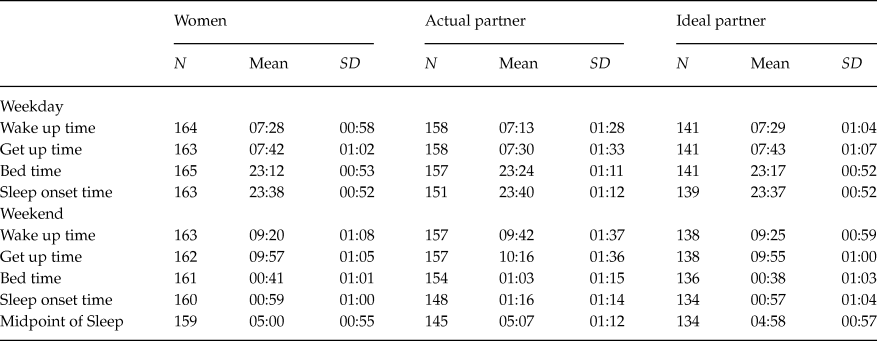
Descriptive statistics for the sleep-wake variables are depicted in Table 1. Mated women were earlier chronotypes than their partners (5:08, t = –2.051, p = .042) but the difference was small (11:02 min ± 1:04 min, d = .34).
Descriptive statistics of the sleep-wake variables.

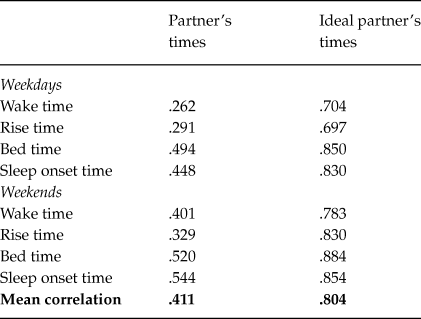
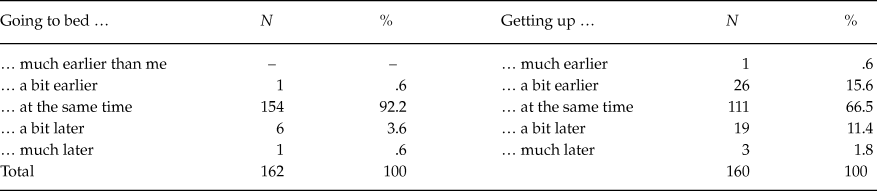
The correlation analyses (Table 2) showed moderate synchronization between females and their actual partners regarding eight sleep-wake variables on weekdays and on the weekend (average correlation .411). However, correlations between times of females and times of their ideal partners (average correlation .804) indicated that given a choice, females would prefer a partner closer to their own sleep-wake-rhythm. Similarly, a correlation in midpoint of sleep existed between women and their partners (r = .513, p < .001), but the coefficient was higher between women and their ideal partners (r = .855, p < .001). However, on average, women did not prefer their ideal partner to be earlier/later in midpoint of sleep than the actual one (t = 1.660, p = .099, d = .29). This result is further strengthened by χ2 analyses (Table 3), showing females more often preferring a partner who goes to bed (χ2 (3) = 424.51, p < .001) and gets up (χ2 (4) = 257.75, p < .001) at the same time as they do.
Pearson correlations between females’ sleep-wake cycle (wake time, rise time, bed time, sleep onset time) and their actual and an ideal partner sleep-wake cycle. Calculated for mated females only (N = 167).

Note: all coefficients are significant at p < .001.
Analyses of females’ mate preferences. When your ideal partner should go to bed and get up? (based on a Likert-type rating).

Discussion
Previous studies showed men and women differing in their sleep-wake cycle, with men more evening oriented than women, and eveningness orientation in men related to a higher mating success – this relationship remained even when controlling for age, extraversion and propensity to stay out long (Randler, Ebenhöh, Fischer, Höchel, Schroff, Stoll, Vollmer et al., Reference Randler, Ebenhöh, Fischer, Höchel, Schroff, Stoll and Vollmer2012). The results of the present study showed female preferences seem to be in contrast to these aspects and assortative mating seems more preferred by females than a selection for evening type men. If given a choice, women would prefer the same chronotype in an ideal partner when compared to their actual mate, and this preference for similarity was especially pronounced for bed times.
On the other hand, in this research we asked for ideal partners, who are viewed as candidates for long-term relationships, and asking for short-term relationships or for a partner for extra pair copulation might have revealed a different result. This would be an interesting aspect for a further study. Figueredo et al. (Reference Figueredo, Sefcek and Jones2006) have shown there is assortative mating for a romantic partner in personality along with preference for higher or lower levels of particular traits in an ideal partner. Here, we report similar result - higher correlations of one self’s and an ideal romantic partner’s chronotype suggest a desire for a higher matching in this aspect of personality. This could be partially explained by the timing of sexual activity, which mostly takes place at bedtime (Refinetti, Reference Refinetti2005), thus an ideal partner would be most available when having a similar bed time.
Mate preferences are different between the sexes and women prefer status and income of their partner, while men value attractiveness of their partner more (Buss & Barnes, Reference Buss and Barnes1986). Concerning chronotype, women preferred ideal partners that are more similar to them in chronotype, thus suggesting that positive assortment might be selected by women seeking a long-term relationship. Interestingly, women preferred the same bed time, but get up time was not preferred as strongly. The lesser preference for partner’s similarity in get up times may be explained by a presumably women’s need to have some time on their own in the morning by getting up before or after their partner – a hypothesis requiring further qualitative survey. Alternatively, bed time could be a time at which couples are less conditioned to work duties and other schedules so that they are free to plan, while get up times might be more related to be dictated by work/university schedules.
The control of the fertile phase in our study (inclusion of participants during their non-fertile phase), is only one aspect which may influence on mating preferences. However, there are other variables that could influence on mating preferences such as marital satisfaction with the actual partner (Díaz-Morales et al., Reference Díaz-Morales, Quiroga, Escribano and Delgado2009). This point is could be also addressed in future studies.
One limitation lies in the self-report nature of the data and that we did not ask women for their preferences of short-term vs. long-term partners or for a preference for a possible extra-pair copulation partner. Second, we did not consider social or cultural factors, because apart from biologically driven sex differences in circadian rhythms, sex differences in daily behavioral time structure reflect the differences in the social roles of the two sexes (Monk, Buysse, Potts, DeGrazia, & Kupfer, Reference Monk, Buysse, Potts, DeGrazia and Kupfer2004). Interaction between biological and social factors could be considered in future studies. Also, we only assessed the preferred long-term ideal partner and not the short-term partners. Further, preferences may also depend on the phase of a woman’s menstrual cycle (“fertile window”; Pawlowski & Jasienska, Reference Pawlowski and Jasienska2005). Mating preferences can change according to the fertile phase (Pawlowski & Jasienska, Reference Pawlowski and Jasienska2005). We did not analyze women in their fertile phase, but only during their non-fertile phase. On the other hand, this is the strength of the present study because it leads to a homogenous sample. Nevertheless, this would be an interesting aspect for further research.
As a conclusion, the present results strengthen a view there exists a conflict between the sexes with females preferring males with similar chronotype (and therefore earlier than males actually have) on one hand, and with more evening males receiving a higher mating success on the other. In the light of our findings, the previously reported higher mating success of male evening types rather seems to be a result of short-term matings or extra-pair copulations.
The study was supported by a grant 2011/03/D/HS6/05760 from the National Science Centre, Poland. We are grateful to two reviewers for their very helpful comments that improved an earlier version.