As long ago as The Other America (1962), Michael Harrington asked, “How long shall we ignore this undeveloped nation in our midst? How long shall we look the other way while our fellow human beings suffer?”Footnote 1 Hurricane Katrina and its aftermath brought into plain sight the plight of the poor, with Michael Brown, then director of FEMA, admitting sombrely at the Superdome that he was seeing people he never knew existed. The black poor were drawn forcefully into the national consciousness, for a while at least, as they had not been during the 2004 presidential election when it was discovered that many electronic voting machines had not found their way into New Orleans to register the votes of one of the largest blocs of African Americans.
On 29 August 2005, when Hurricane Katrina hit New Orleans and the Gulf Coast, the media followed in its wake. In many ways the Gulf Coast was hardest hit with forty-nine out of eighty-two counties in Mississippi being declared disaster areas. But what focussed the post-Katrina story on New Orleans was the failure of the levees that were supposed to ensure that the storm-wracked city would not also be devastated by flood water. The concrete flood walls built across the tops of levees could not withstand the flooding; nor could the earthen back levees, of course, and not even those levees designed to fortify the Industrial Canal that connects the Mississippi River with Lake Pontchartrain. As each fortification was breached, water poured into those areas of the city that were the least protected. Five years on, it is difficult to conceive of how swathes of New Orleans could have been left in such disarray for so long, especially when it was already obvious that attention to flood control would be the most effective insurance for the city's future. Driving into the centre of the Ninth Ward, it soon becomes apparent that there are no longer any grocery stores within a four-mile radius. Community infrastructures are not yet back in place. It is striking that while ventures such as Brad Pitt's Make It Right Foundation are building new homes, these will never blend into what was an old and historical neighbourhood and that people are still subsisting in makeshift ways until they reclaim anything like the domestic security they lost in 2005.
Visiting those areas still most visibly affected by the disaster five years later, I was reminded of one of the photographs in Robert Polidari's After the Flood (2006), a collection published soon after the storm. It is of a wrecked car abandoned on Deslondes Street onto which a sign has been tacked declaring “Tourism here is Profane!” Even the most personal of visits feels like disaster tourism, or at least taking a detour into other people's reality.
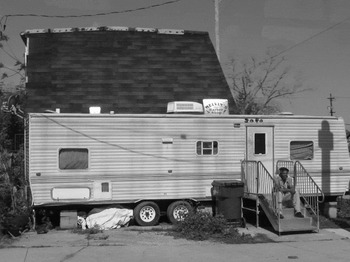
Melvin's Barbershop, coming back in 2010. © Sharon Monteith.

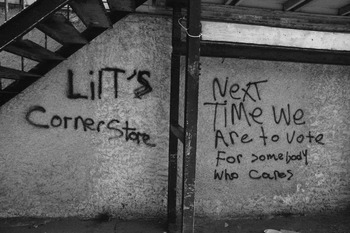
The disaster scenario has always existed at the edges of New Orleans' story, especially in its most melodramatic or surreal forms, as Nahem Yousaf notes in his essay for this issue. It also presaged Hurricane Katrina. Reading Samuel R. Delaney's dystopian novel Dhalgren (1975) now, for example, one is struck anew by his descriptions of the blasted landscape of Bellona as the city's plight is ignored by the National Guard. More specifically, FX's movie Oil Storm (2003) ran through a disaster scenario which was, with hindsight, uncannily close to that which followed Katrina, and which reminds us that a potent metaphor for the collapse in credibility of federal government may even be located in the TV movie, a genre that since its beginnings in the 1960s has thrived on immediacy and its topical relevance to democratic ideals. Narratives in which Hurricane Katrina becomes a main “character” may be read as acerbic political commentary on the disaster that fixed the event as a local tragedy while simultaneously dramatizing its meaning as a national shame. The tagline for the award-winning documentary Trouble the Water (2008) speaks to this idea, in a defensive tone that is all too understandable to New Orleanians: “It's not about a hurricane – It's about America.” Tracing graffiti daubed on the walls of collapsed and ruined buildings is one way of exploring the resentment fuelled by civic neglect and fear. Makeshift signs include “FEMA – Fix Everything My Ass!” and “Chirac Buy Us Back.” In one of freelance photographer David Rae Morris's pictures that document the city since 2005,Footnote 2 the graffito is even more explicit: “Next Time We'll Vote for Someone Who Cares.”
Dr. John, the New Orleans singer-songwriter, guitarist and pianist, released the seven-song cycle ‘Sippiana Hericane within weeks of the hurricane, and his album The City That Care Forgot (2008) tells Katrina stories song-by-song as stark blues. He called the wrecking of the city a “cold-blooded murder.”Footnote 3 But graffiti also tells a tale of courage, resilience and even humour: “We Don't Run From Hurricanes, We Drink Them,” an allusion to the cocktail for which the city is famed. Countless fleurs-de-lis symbolize the cultural revival of the city as a far-reaching and also a transatlantic campaign, as Helen Taylor outlines in the essay which opens this issue. Taylor has been writing about New Orleans since her 1989 study of Grace King, Ruth McEnery Stuart and Kate Chopin, all of whom lived and wrote in Louisiana at the end of the nineteenth and the beginning of the twentieth centuries. Here, in “After the Deluge: The Post-Katrina Cultural Revival of New Orleans,” Taylor surveys the abundance of musical performances, art exhibitions, novels, films and plays that have engaged with the post-Katrina city and explores some of the ways in which images and stories have been exported most successfully. Taylor argues that the vibrancy of its post-Katrina cultural life – despite huge challenges facing its very survival – means that, for now, New Orleans may be able to thrive.
Message to all voters: Poland Avenue. © David Rae Morris.

There has been a plethora of artwork, photography and memorials that commemorates those residents who died in the flooded city and depicts its struggle for recovery. Photographic art, by its very name, paints a scathing picture of neglect and of the long struggle for recovery and renewal: Larry Towell's In the Wake of Katrina, Kara Walker's After the Deluge, Chris Jordan's Portraits of Loss, Debbie Fleming Caffery's Portrait of Neglect, Keith Calhoun and Chandra McCormick's Souls of the City, Joseph Rodríguez's Still Here, Thomas Neff's Holding Out and Hanging On are just a few examples. Two articles focus on post-Katrina art and others include mention of a number of exhibitions, including Katrina Exposed, about which its curator allows that there “may never be a time when looking at these photographs will seem like an analytical, rather than an emotional, experience.”Footnote 4 Joseph Rodríguez is the subject of Celeste-Marie Bernier's essay, “You Can't Photograph Everything”: The Acts and Arts of Bearing Witness in Joseph Rodríguez's Still Here: Stories After Katrina.” He self-consciously explores the limitations of photographic representation in documenting the enormity of unspeakable tragedy and suffering. Through close reading of a number of images and accompanying texts, Bernier uncovers the “ambiguous poetics” that underpins Rodríguez's Still Here (2008) and led to his conceptualization of an aesthetics epitomized by a simple statement that the hurricane left “a lot of work to do in terms of just bearing witness.” It is a problem to which D'Ann Penner's essay also turns.
Michael Bibler explores Kara Walker's acclaimed exhibition After the Deluge (2006), in which she combined pieces from the Metropolitan Museum of Modern Art's collection with her own graphic installation art, specifically the black paper silhouettes through which she had already created a series of racially charged interventions into American cultural history. In “The Flood Last Time: ‘Muck’ and the Uses of History in Kara Walker's ‘Rumination’ on Katrina,” Bibler reads the 2007 book of the exhibition through James Baldwin's The Fire Next Time (1963), to which Walker alludes. In so doing, he argues that Walker situates Katrina within an “irregular continuum” which “compels us to adumbrate what is wholly new and unknown about Katrina even as we acknowledge the seeming repetition of events from slavery to the present.” The idea of history as a boomerang that returns us to earlier traumatic events and discourses at the same time that it propels us forward into new territory is taken up in Allison Graham's essay.
Gary Richards's contribution to this special issue is an exploration of gay responses to the hurricane. At its broadest it surveys the ways that queer elements have circulated within discourses surrounding the anticipation, the arrival and particularly the aftermath of Hurricane Katrina. It reads such discourses most specifically through the filter of essays included in the 2006 collection Love, Bourbon Street: A Celebration of Gay New Orleans, edited by gay mystery writer Greg Herren and his partner Paul Willis, as well as through Mark Sam Rosenthal's 2009 one-man off-Broadway show Blanche Survives Katrina in FEMA Trailer Named Desire, a parody of Tennessee Williams's play A Streetcar Named Desire. Richards argues that these works, like the broader responses of which they are representative, are historically significant in articulating certain queer understandings of Katrina-era New Orleans, but worries that Love, Bourbon Street “risks implying that sexual activity is the only aspect of gay identity worthy of representation.” His essay is suggestive about the ways in which “queer” continues to be read according to a cultural hierarchy.
Nahem Yousaf's essay turns to images of New Orleans in crime fiction and police procedurals. He argues that when “reading about the ravaged city in the crime genre, it is as if the hurricane brought with it a rupture in history that became the city's new originary moment.” He examines novels and television dramas that both exploited and engaged with media images of the city during and after the storm. “Regeneration through Genre: Romancing Katrina in Crime Fiction from Tubby Meets Katrina to K-Ville” anchors its analysis in key tropes of this media metanarrative and closes with a case study of Fox TV's K-Ville (2007) to explore why it may have failed to take the pulse of New Orleans two years after the storm. Five years on, New Orleanians tend to grimace when K-Ville is mentioned as if honestly regretful that it did not tell the post-Katrina story they might have hoped to see on national television. Yousaf posits reasons for this response and, in his conclusion, looks forward to Treme, David Simon's series that aired its first episode on HBO in April 2010. Yousaf's essay reminds us of the importance of television culture, of how quickly lurid reports of rape and looting circulated in the aftermath of Katrina, and of how sometimes disaster reportage wreaked havoc with the truth. The next essay explores a different method for coming to terms with bitter truths – by recontextualizing Katrina as a humanitarian disaster.
Between September 2005 and August 2008, D'Ann Penner conducted over 275 interviews with African American survivors displaced by Hurricane Katrina. With Dr. Keith C. Ferdinand she coedited Overcoming Katrina: African American Voices from the Crescent City and Beyond (New York: Palgrave Macmillan Press, 2009), from which her essay in this volume derives its context. In “Assault Rifles, Separated Families, and Murder in Their Eyes: Unasked Questions on Mental Health Protocols after Hurricane Katrina,” Penner urges us to listen self-reflexively to witnesses and to acknowledge that they are “consciously speaking not only for themselves but for members of their absent community.” Her study urges a rethinking of diagnoses and treatment plans, policy priorities, and aid strategies post-Katrina.
Allison Graham's essay provides a coda to the volume. It traces a continuum of conspiracy culture and reveals an antediluvian labour system. The disaster uncovered racial and class divisions and it also exposed a continuing history of peonage. In “Free at Last: Post-Katrina New Orleans and the Future of Conspiracy,” Graham examines a lawsuit that was filed a year after the hurricane on behalf of workers from South and Central America who found themselves stranded in the city after paying thousands of dollars to labour recruiters for the promise of full-time work that did not materialize. Graham reaches back into American history for a precedent for the case, finding it in the 1871 Civil Rights Act, which set forth possible definitions of criminality that made federal prosecution of Ku Klux Klan members possible. This essay casts back and forth in its examination of the recycling of visual and verbal rhetoric of the 1960s.
New Orleans post-Katrina is “a place where beginnings and ends merge,” to borrow a phrase from Thomas Bonner Jr.'s study of the city. It remains the nation's postcolonial shadow.Footnote 5 Towards the end of 1 Dead in Attic (2007), Times-Picayune columnist Chris Rose wonders how the very many stories of Katrina both in the city and, indeed, far away from New Orleans may be collectively acknowledged. “Will it take five years to figure out who did what and for whom?” he asks.Footnote 6 A fear is that Katrina will fall to background and that, as director of the Whitney Museum Adam Weinberg worried as early as 2006, “For many Americans [and, indeed, foreigners], such events … exist more as the crackle of background static than as a palpable presence.”Footnote 7 The idea for this special issue originated during the first UK symposium on Hurricane Katrina at the University of Nottingham. Five years on, the human story of Hurricane Katrina is still being mapped in all its complexities and we continue to wrest meaning from the tragedy.Footnote 8
POSTSCRIPT
On 20 April 2010, the Gulf Coast suffered another tragedy when BP's Deepwater Horizon oil rig, fifty miles off the Louisiana coast, exploded and valves designed to contain an oil spill failed. Eleven rig workers died. Now each day some 5,000 tons of oil spew into the water and each day the toxic oil slick moves closer to land. It has morphed into a 2,000-square-mile threat to the ecosystem, to the region's wildlife and wetlands (some 40 percent of the nation's wetlands), industries, livelihoods and homes. It is an environmental catastrophe that has forced Louisiana to declare a state of emergency and the oil threatens to decimate coastal areas across Mississippi, Florida and Alabama; it could soak into the marshes of the Mississippi Delta and seep further north. With commercial and recreational fishing closed in the industry's high season, there is real fear that the region still coming back after Hurricane Katrina will fail to survive this onslaught. A fifth-generation fisherman summarizes that feeling: “Katrina dug a hole for us … We're lying in this grave, trying to get out, and this spill comes along.”Footnote 9 Katrina is still so present in the region that this new disaster cannot but make one fear that Louisiana is the bellwether of twenty-first-century America. As George W. Bush was judged by how he responded to Katrina, President Obama is being watched closely for how he will deal with the fallout of what he describes as a “potentially unprecedented” environmental catastrophe. At the moment of writing it is hard to imagine a crueller postscript to the region's recovery.