Introduction
The field of adolescent neuroimaging has greatly enhanced our understanding of how macrostructural and microstructural changes evolve in both gray matter and white matter tissue during this unique time of development. Large longitudinal investigations, many spanning childhood to adulthood, have found cortical gray matter tissue to undergo a subtraction process (Giedd et al., Reference Giedd, Blumenthal, Jeffries, Castellanos, Liu, Zijdenbos and Rapoport1999; Giedd, Raznahan, Mills, & Lenroot, Reference Giedd, Raznahan, Mills and Lenroot2012; Jernigan, Trauner, Hesselink, & Tallal, Reference Jernigan, Trauner, Hesselink and Tallal1991; Lenroot et al., Reference Lenroot, Gogtay, Greenstein, Wells, Wallace, Clasen and Giedd2007; Shaw et al., Reference Shaw, Kabani, Lerch, Eckstrand, Lenroot, Gogtay and Wise2008; Sowell, Trauner, Gamst, & Jernigan, Reference Sowell, Trauner, Gamst and Jernigan2002), which may be accounted for by underused synaptic connections becoming eliminated (e.g., synaptic pruning) and white matter encroachment on gray matter due to increasing axonal myelination (Paus, Reference Paus2005) resulting in decreased gray matter volume (Huttenlocher, Reference Huttenlocher1990). White matter tissue volume, however, continues to increase more linearly well into late adolescence and early adulthood (Lebel & Beaulieu, Reference Lebel and Beaulieu2011; Tamnes, Ostby, et al., Reference Tamnes, Ostby, Fjell, Westlye, Due-Tønnessen and Walhovd2010). The temporal pattern of continued white matter and gray matter tissue change appears to occur sooner for sensorimotor cortex than for association areas that are typically used for higher-order processing (e.g., prefrontal cortex). Furthermore, some cortical and subcortical gray matter structures decrease in volume, while others, such as the hippocampus, tend to show slight increases with age (Østby et al., Reference Østby, Tamnes, Fjell, Westlye, Due-Tønnessen and Walhovd2009).
Regional brain maturation has been shown to differ between boys and girls. For example, girls have been shown to peak in cerebral gray matter volume approximately 1–2 years earlier than boys (Giedd et al., Reference Giedd, Clasen, Lenroot, Greenstein, Wallace, Ordaz and Chrousos2006; Lenroot et al., Reference Lenroot, Gogtay, Greenstein, Wells, Wallace, Clasen and Giedd2007). The mechanism behind this is unclear; however, it is suspected that the sexual dimorphic effects may be related to hormone levels at different stages of pubertal maturation (Bramen et al., Reference Bramen, Hranilovich, Dahl, Chen, Rosso, Forbes and Sowell2012; Giedd et al., Reference Giedd, Raznahan, Mills and Lenroot2012; Panizzon et al., Reference Panizzon, Fennema-Notestine, Eyler, Jernigan, Prom-Wormley, Neale and Kremen2009).
Recent computational approaches allow for separating cortical thickness from surface area (Brown & Jernigan, Reference Brown and Jernigan2012; Fischl & Dale, Reference Fischl and Dale2000; Winkler et al., Reference Winkler, Kochunov, Blangero, Almasy, Zilles, Fox and Glahn2010, Reference Winkler, Sabuncu, Yeo, Fischl, Greve, Kochunov and Glahn2012). The literature has suggested that cortical volume is driven more by surface area, whereas the number of cells that exist within organized perpendicular columns within the cortex (e.g., thickness) may be more sensitive (vs. volume), and reflective of age-related structural maturation such as cortical thinning and myelination (Brown & Jernigan, Reference Brown and Jernigan2012; Østby et al., Reference Østby, Tamnes, Fjell, Westlye, Due-Tønnessen and Walhovd2009).
Changes in cortical thickness are believed to be associated with neurocognitive performance, and several studies have found correlations between widespread cortical maturation and general intellectual functioning (Karama et al., Reference Karama, Colom, Johnson, Deary, Haier, Waber and Evans2009; Sowell et al., Reference Sowell, Thompson, Leonard, Welcome, Kan and Toga2004). The rate of cortical thinning may be linked to intellectual functioning in teens (Shaw et al., Reference Shaw, Greenstein, Lerch, Clasen, Lenroot, Gogtay and Giedd2006). In one of the earlier brain mapping studies to focus on cortical thinning, Gogtay and colleagues (Reference Gogtay, Giedd, Lusk, Hayashi, Greenstein, Vaituzis and Thompson2004) showed a multi-phased progression of cortical thinning that first involved maturation of areas important for sensory functioning (ages 4–8), followed by parietal (ages 11–13) and frontal lobe (late adolescence) maturation in older stages of pubertal development, as more complex abilities such as language, attention, and executive functioning emerge. Such longitudinal data provided supporting evidence for regional brain development linked to neurocognitive trajectories that are typically observed throughout development. Few studies have examined how localized cortical thickness is related to particular neurocognitive abilities in adolescence during corresponding stages of development, although some work has been done in adult populations (Luders, Narr, Thompson, & Toga, Reference Luders, Narr, Thompson and Toga2009). Reduced volume and cortical thinning during adolescence have also been associated with better performance on individual cognitive tasks, including perceptual reasoning (Schilling et al., Reference Schilling, Kühn, Paus, Romanowski, Banaschewski, Barbot and Gallinat2013), visual (Østby, Tamnes, Fjell, & Walhovd, Reference Østby, Tamnes, Fjell and Walhovd2012) and verbal memory (Sowell, Delis, Stiles, & Jernigan, Reference Sowell, Delis, Stiles and Jernigan2001), verbal fluency (Porter, Collins, Muetzel, Lim, & Luciana, Reference Porter, Collins, Muetzel, Lim and Luciana2011), and executive functioning (Tamnes, Østby, et al., Reference Tamnes, Østby, Walhovd, Westlye, Due-Tønnessen and Fjell2010).
Limited investigations have examined localized cortical thickness and associations with a comprehensive neuropsychological battery in adolescents, and many have focused on subtests of intelligence tests exclusively. In this study, we proposed to look at cortical thickness indices and associations with neurocognitive functioning spanning several domains, including memory, spatial processing, and executive functioning. We hypothesized that cortical regions would show thinning with increased age, particularly frontal regions, during this period of early adolescence, and we expected that this relationship would be different for males and females. Finally, and most importantly, we hypothesized that thinner cortices within this age range would be associated with better neurocognitive performance. Because frontal, parietal, and temporal regions are undergoing the most significant cortical thinning during this period (Gogtay et al., Reference Gogtay, Giedd, Lusk, Hayashi, Greenstein, Vaituzis and Thompson2004), we expect the relationship between cortical thinning and cognitive performance will be strongest in these regions, as opposed to more posterior regions like the occipital lobe. Specifically, we hypothesized that thinner frontal regions would be associated with better working memory, sustained attention, spatial planning and problem solving, and inhibition; thinner parietal regions would be related to better visuospatial functioning and spatial planning and problem solving; and thinner temporal regions would relate to better verbal learning and memory.
Materials and methods
Participants
Participants were 185 healthy 12- to 14-year-olds (44% female) recruited through flyers sent to households of students attending San Diego area public middle schools. Extensive screening and background information were obtained from the youth, their biological parent, and one other parent or close relative. The study protocol was executed in accordance with the standards approved by the University of California, San Diego Human Research Protections Program.
Strict exclusionary criteria were: any neurological or DSM-IV (American Psychological Association, 1994) Axis I disorder, determined by the NIMH Diagnostic Interview Schedule for Children –version 4.0 (Shaffer, Fisher, Lucas, Dulcan, & Schwab-Stone, Reference Shaffer, Fisher, Lucas, Dulcan and Schwab-Stone2000); head trauma or loss of consciousness (>2 min); history of chronic medical illness; learning disability or mental retardation; use of medications potentially affecting the brain; premature birth (i.e., born before 35th gestational week); any suggestion of prenatal alcohol (>2 drinks during a given week) or illicit drug exposure; experience with alcohol or drugs, defined as ≥10 total days in their life on which drinking had occurred, or >2 drinks in a week; ≥1 lifetime experiences with marijuana and any use in the past 3 months; ≥5 lifetime cigarette uses; and any history of other intoxicant use (Squeglia et al., Reference Squeglia, Pulido, Wetherill, Jacobus, Brown and Tapert2012; Squeglia, Spadoni, Infante, Myers, & Tapert, Reference Squeglia, Spadoni, Infante, Myers and Tapert2009); contraindication to magnetic resonance imaging (MRI) (e.g., braces); inadequate comprehension of English; and non-correctable sensory problems. In the final sample, there were forty-one 12-year-olds (51% female), ninety-six 13-year-olds (44% female), and forty-eight 14-year-olds (38% female).
Measures
Neuropsychological measures
A comprehensive neuropsychological battery was completed within 1 week of scanning to assess cognitive functioning on six cognitive domains: working memory, sustained attention, verbal learning and memory, visuospatial functioning, spatial planning and problem solving, and inhibition. Domains were determined by a factor analysis of the Z-scores of the 24 total neuropsychological test variables ascertained. Working memory was comprised of: Wechsler Intelligence Scale for Children-3rd edition (WISC-III; Wechsler, Reference Wechsler1991) Digit Span digit forward and digit backward raw scores, and Wechsler Adult Intelligence Scale-4th edition (WAIS-IV; Wechsler, Reference Wechsler2008) Letter-Number sequencing raw scores. Sustained attention consisted of: Digit Vigilance Test (Lewis, Reference Lewis1995) total time (seconds), WISC-III Coding raw score, and Delis-Kaplan Executive Function System (D-KEFS; Delis, Kaplan, & Kramer, Reference Delis, Kaplan and Kramer2001) Trails Conditions 1, 2, 3, and 4 (i.e., Visual Scanning, Number Sequencing, Letter Sequencing, Letter-Number Switching) time to complete (seconds). Verbal learning and memory consisted of California Verbal Learning Test-Children's version (CVLT-C; List A Total 1-5 raw, Short Delay Free and Cued Recall raw, and Long Delay Free and Cued Recall raw scores. Visuospatial functioning was comprised of Rey-Osterrieth Complex Figure Copy and 30-min Delay Accuracy scores (Rey & Osterrieth, Reference Rey and Osterrieth1993), Wechsler Abbreviated Scale of Intelligence (WASI; Wechsler, Reference Wechsler1999) Block Design raw scores, and Hooper Visual Organization Test (Hooper, Reference Hooper1958) raw total. Spatial planning and problem solving included the WISC-III Mazes total score, WASI Matrix Reasoning total score, and D-KEFS Towers total achievement score. Inhibition was comprised of D-KEFS Color-Word Interference Conditions 3 and 4 time to complete (seconds). All timed raw scores (i.e., Digit Vigilance, Trails, Color-Word Interference) were reversed-coded so that longer times corresponded to poorer performance. An overall Global Functioning score was calculated by averaging all of subtest Z-scores together.
Procedures
Imaging
High-resolution anatomical images were collected at the UC San Diego Center for functional MRI; images were acquired on a 3-Tesla CXK4 short bore Excite-2 MR system (General Electric, Milwaukee, WI) with an eight-channel phase-array head coil. Participants were placed comfortably on the scanner table and the head was stabilized within the head coil using foam cushions (NoMoCo Pillow, La Jolla, CA). Scan sessions involved a 10-s scout scan to assure good head placement and slice selection covering the whole brain, followed by a sagittally acquired high-resolution T1-weighted anatomical MRI (7:19 min, FOV 24 cm, 256 × 256 × 192 matrix, 0.94 × 0.94 × 1 mm voxels, 176 slices, repetition time = 20 ms, echo time = 4.8 ms; flip angle 12°).
Data analysis
Cortical thickness measurement
Cortical surface reconstruction and cortical thickness estimation were performed using FreeSurfer (version 5.0, surfer.nmr.mgh.harvard.edu). The FreeSurfer program uses a series of automated imaging algorithms to produce measures of cortical thickness. The process first involves intensity normalization, Talairach transformation, skull stripping, and labeling of the subcortical white matter. The white matter border is then tessellated by placing two triangles at each face (square) that separates white matter voxels from other voxels (i.e., gray matter). This initial coarse tessellation is then smoothed via surface deformation algorithm that is guided by local MRI intensity gradients to optimally place smooth gray/white and, by deforming outward, gray/cerebrospinal fluid borders at the location where the greatest shift in intensity defines the transition to the other tissue class (Dale, Fischl, & Sereno, Reference Dale, Fischl and Sereno1999; Fischl & Dale, Reference Fischl and Dale2000; Fischl, Sereno, & Dale, Reference Fischl, Sereno and Dale1999; Fischl et al., Reference Fischl, van der Kouwe, Destrieux, Halgren, Segonne, Salat and Dale2004). The smoothing produced from the spatial intensity gradients across tissue classes frees the surfaces from being reliant on the absolute signal intensity. Thus, this surface rendering process yields data that are not constrained to the voxel resolution of the original images, allowing for the quantification of submillimeter group differences (Fischl & Dale, Reference Fischl and Dale2000). Cortical thickness was calculated as the closest distance from the gray/white matter boundary to the gray matter/cerebral spinal fluid boundary at each vertex on the cortical surface (Fischl & Dale, Reference Fischl and Dale2000). The validity of the cortical thickness measurement procedures has been verified using manual measurements (Kuperberg et al., Reference Kuperberg, Broome, McGuire, David, Eddy, Ozawa and Fischl2003; Salat et al., Reference Salat, Buckner, Snyder, Greve, Desikan, Busa and Fischl2004) and histological analysis (Rosas et al., Reference Rosas, Liu, Hersch, Glessner, Ferrante, Salat and Fischl2002).
One rater (L.M.S.), blind to participant characteristics, followed the reconstruction procedures (http://surfer.nmr.mgh.harvard.edu/fswiki/RecommendedReconstruction) to identify and correct any errors made during the cortical reconstruction. This involved verification of the Talairach transformation and of the automated skull stripping, as well as a coronal plane slice-by-slice inspection of the gray/white and gray/cerebrospinal fluid surfaces. Modifications to the surfaces were made as necessary to correct for tissue misclassifications (e.g., residual dura matter classified as cortex). Following inspection, an automated parcellation procedure divided each hemisphere into 32 independent cortical regions based on gyral and sulcal features (Desikan et al., Reference Desikan, Segonne, Fischl, Quinn, Dickerson, Blacker and Killiany2006; Fischl et al., Reference Fischl, van der Kouwe, Destrieux, Halgren, Segonne, Salat and Dale2004). To reduce the number of statistical tests run, these regions were combined by lobe (i.e., frontal, parietal, temporal, and occipital) for each hemisphere. Cortical thickness estimates of each lobe were extracted for subsequent statistical analysis.
Statistical analyses
Cortical thickness values, averaged across each lobe, were imported from FreeSurfer to SPSS (Rel. 18.0.0. 2009. IBM, Chicago, IL) for each participant. To examine the effect of age on cortical thickness, hierarchical linear regressions were run, with age as a continuous independent variable (IV) predicting cortical thickness (dependent variable; DV), controlling for intracranial volume (ICV). To see if gender moderated the relationship with cortical thickness (DV), hierarchical linear regressions were run on all regions specifying age (IV), gender (IV), and the corresponding age by gender interaction term.
To examine the influence of cortical thickness on neuropsychological functioning for each cognitive domain and global summary score, hierarchical linear regressions were examined for cortical thickness (IV) in each brain lobe, controlling for age and ICV. Type I error was set at p < .05 per lobe. For lobes with significant findings, follow-up analyses were performed to determine the exact brain regions influencing the finding. The pattern of regressions was also tested for statistical significance using Fisher's exact test to examine whether more relationships occurred in the predicted direction (i.e., thinner cortices would correspond to better cognitive functioning) than would have occurred by chance (Ghahramani, Reference Ghahramani1996). This was done to mitigate the consequences of the inflated error rate associated with multiple comparisons by examining whether the overall pattern of correlations was suggestive of the hypothesized relationship.
Results
Cortical Thickness and Age
Ten brain regions showed correspondence between cortical thinness and increasing age between 12 and 14 years of age, and no region suggested cortical thickening across this period (see Figure 1). Areas where age was related to cortical thinning included: right isthmus cingulate (R 2Δ = .04; p = .01; β = −.21), right medial orbitofrontal (R 2Δ = .06; p = .001; β = −.25), right pars orbitalis (R 2Δ = .03; p = .02; β = −.17), right posterior cingulate (R 2Δ = .04; p = .008; β = −.20), right rostral middle frontal (R 2Δ = .04; p = .004; β = −.21), right insula (R 2Δ = .04; p = .006; β = −.21), left isthmus cingulate (R 2Δ = .02; p = .05; β = −.15), left medial orbitofrontal (R 2Δ = .03; p = .02; β = −.17), left rostral anterior cingulate (R 2Δ = .05; p = .002; β = −.23), and left insula (R 2Δ = .06; p = .001; β = −.25). See Figures 1 and 2.
Ten brain regions showed a relationship between thinner cortex and age between ages 12 and 14 (N = 185; 81 females, 104 males), with no brain region suggesting cortical thickening. *significant (p < .05) gender × age interactions (i.e., males and females showed different patterns across this age range).

Brain regions showing cortical thinning over ages 12 to 14 (N = 185). Note: No regions showed cortical thickening.
Age × Gender Interaction on Cortical Thinning
Ten regions showed significant Age × Gender interactions (indicated by * in Figure 1). While both males and females showed thinning cortices over age as expected, the rate and trajectory varied between males and females. These areas included the right isthmus cingulate, right medial orbitofrontal, right pars orbitalis, right posterior cingulate, right rostral middle frontal, right insula, left caudal anterior cingulate, left medial orbitofrontal, left rostral anterior cingulate, and left insula.
Neuropsychological Functioning and Age
There was no significant relationship (p < .05) between age and performance in any of the six empirically derived cognitive domains.
Cortical Thickness and Neuropsychological Performance
Global functioning
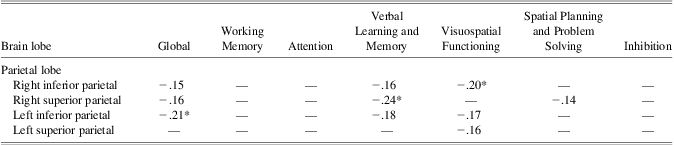
Thinner left and right parietal lobes were related to better global cognitive performance (p < .05). Follow-up analyses revealed that thinner cortices in right inferior parietal (R 2Δ = .02; p = .04; β = −.15), right superior parietal (R 2Δ = .02; p = .04; β = −.16), and left inferior parietal (R 2Δ = .04; p < .01; β = −.21) regions were related to better global cognitive performance. Cortical thickness was not related to cognitive performance in frontal, temporal, or occipital regions. No regions showed a positive relationship between cortical thickness and overall neuropsychological performance (see Table 1 and Figure 3).
Beta weights for brain regions showing a relationship between cortical thickness and neuropsychological performance (N = 185; p < .05)
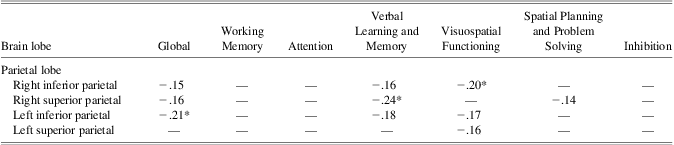
Note. For all regions, thinner cortices corresponded to better neuropsychological performance (p < .05). Asterisks indicates regions where results surpass Bonferroni corrections.
Cortical thinning related to improved global cognitive functioning, verbal learning and memory, visuospatial functioning, and spatial planning and problem solving in parietal regions in 12- to 14-year-old adolescents (N = 185).
Working memory
No brain lobes showed a significant relationship between cortical thickness and working memory.
Attention
No brain lobes showed a significant relationship between cortical thickness and attention performance.
Verbal learning and memory
Thinner cortices in the left and right parietal lobe related to better verbal learning and memory. Specifically, thinner right inferior parietal (R 2Δ = .02; p = .04; β = −.16), right superior parietal (R 2Δ = .06; p < .001; β = −.24), and left inferior parietal (R 2Δ = .03; p = .02; β = −.18), lobes were related to better verbal learning and memory performance (see Table 1 and Figure 3).
Visuospatial functioning
Thinner cortices in the left and right parietal lobe related to better visuospatial functioning. Specifically, thinner right inferior parietal (R 2Δ = .04; p < .01; β = −.20), left inferior parietal (R 2Δ = .03; p = .02; β = −.17), and left superior parietal (R 2Δ = .03; p = .03; β = −.16) lobes were related to better visuospatial functioning (see Table 1 and Figure 3).
Spatial planning/problem solving
Thinner cortices in the right parietal lobe were related to better spatial planning and problem solving abilities. Specifically, thinner right superior parietal (R 2Δ = .02; p = .05; β = −.14) cortices were related to better spatial planning and problem solving (See Table 1 and Figure 3).
Inhibition
No brain lobes showed a significant relationship between cortical thickness and inhibition.
Discussion
The present study aimed to elucidate the relationship between typical cortical thinning during adolescence and neuropsychological functioning in a sample of 185 healthy 12- to 14-year-old adolescents. As expected, several brain regions, predominantly in frontal areas, showed significant relationships between cortical thinning and age, within this age range. In no region was cortex thicker with older age. Gender moderated the effect of age on cortical thinning in several regions, with males showing more accelerated thinning than females between ages 12 and 14. Finally, we found thinner cortex in parietal association cortices was associated with better neurocognitive functioning globally, and in particular for verbal learning and memory, visuospatial functioning, and spatial planning and problem solving.
The pattern of cortical thinning in frontal regions observed in our sample of healthy adolescents may reflect findings from studies suggesting the elimination of unnecessary synaptic connections (Huttenlocher, Reference Huttenlocher1990). As expected, rates of development differed for males and females in our sample. Males appeared to show more accelerated thinning of cortices over this age range, while females exhibited more attenuated thinning. This could be consistent with the idea that females tend to mature earlier in these regions than male counterparts, with females already having exhibited the most significant thinning in these regions as compared to males (Lenroot et al., Reference Lenroot, Gogtay, Greenstein, Wells, Wallace, Clasen and Giedd2007). These sexual dimorphic effects may be related to hormone levels at different stages of pubertal maturation (Bramen et al., Reference Bramen, Hranilovich, Dahl, Chen, Rosso, Forbes and Sowell2012; Giedd et al., Reference Giedd, Raznahan, Mills and Lenroot2012; Panizzon et al., Reference Panizzon, Fennema-Notestine, Eyler, Jernigan, Prom-Wormley, Neale and Kremen2009).
While normative neuropsychological data has shown a consistent improvement in cognitive functioning over adolescence (Delis et al., Reference Delis, Kaplan and Kramer2001; Delis, Kramer, Kaplan, & Ober, Reference Delis, Kramer, Kaplan and Ober1994; Wechsler, Reference Wechsler1997, Reference Wechsler1999), the neural underpinnings of these improvements are less clear. In this study, we found that cortical thinning, particularly in parietal regions, may help explain this increase in both global and domain-specific neuropsychological functioning. Cortical thinning was related to better neuropsychological functioning in bilateral parietal cortices. This relationship was also found across specific cognitive domains, including verbal learning and memory, visuospatial functioning, and spatial planning and problem solving. No regions showed a significant relationship between cortical thickening and cognitive performance.
Synaptic pruning, white matter encroachment on gray matter due to increasing axonal myelination, and changes in the extracellular matrix are believed to underlie developmental changes and differences seen in gray matter volume between childhood to adulthood (Gogtay et al., Reference Gogtay, Giedd, Lusk, Hayashi, Greenstein, Vaituzis and Thompson2004; Gogtay & Thompson, Reference Gogtay and Thompson2010; Sowell et al., Reference Sowell, Trauner, Gamst and Jernigan2002, Reference Sowell, Peterson, Thompson, Welcome, Henkenius and Toga2003, Reference Sowell, Thompson, Leonard, Welcome, Kan and Toga2004). Elimination of unnecessary synaptic connections and increases in myelination could be contributing to the neurocognitive improvements observed in this study. Specifically, these structural changes may be related to more efficient and speeded processing of information, which affected not only general intelligence, but also specific cognitive domains.
Of interest, all relationships between cortical thinning and neuropsychological functioning were in parietal regions and associated with enhanced cognitive performance. Posterior brain regions typically undergo neurodevelopment before frontal and temporal regions and may be a more stabilized marker of neuropsychological functioning at this developmental stage. Anterior regions of the brain continue to undergo significant neurodevelopment (as evidenced by our cortical thickness-age analyses), and, therefore, ongoing architectural changes during this window of development may obscure existing structural-functional relationships, particularly for higher-order cognitive demands where performance is more distributed throughout the brain.
This study had several notable strengths and limitations. This is one of the largest examinations (N = 185) of healthy adolescents that used both comprehensive neuropsychological test and 3T neuroimaging data. As opposed to previous research which primarily focused on overall intelligence or very specific neurocognitive domains, we examined the relationship between general intelligence and several neuropsychological domains over the entire brain to obtain a more complete picture of the brain structure-function relationship. However, each participant had data at only one time point, so we could not examine individual trajectories over this age range, and cannot infer causation or assert that cortical thinning is responsible for the observed improved behavioral performance. If strict Type I error corrections were applied, many of the regions would not have reached significance. To mitigate the consequences of the inflated error rate associated with multiple comparisons, we used Fischer's exact test to see if the overall pattern of correlations was suggestive of the hypothesized relationship, and found that the results, when taken together, were highly consistent (p < .001). Finally, this study focused on gray matter maturation only. Future studies examining both gray and white matter maturation in tandem, as well as exploration of the effect of cortical thinning on affective development (Urošević, Collins, Muetzel, Lim, & Luciana, Reference Urošević, Collins, Muetzel, Lim and Luciana2012) are warranted.
In summary, our findings support the idea that during early adolescence, the cortex is undergoing significant cortical thinning, particularly in parietal and frontal regions. In turn, thinner cortices relate to better global cognitive functioning, as well as improved functioning on domain-specific tasks of learning and memory, visuospatial functioning, and spatial planning and problem solving, above and beyond the effect of chronological age. Any insults to typical cortical thinning during this time period from substance use, traumatic brain injury, or medical illness could have implications on adolescents’ expected cognitive and behavioral functioning, or interruptions to cognitive functioning could likewise affect the cortical thinning process. Future research over a larger age range using longitudinal data is warranted to clarify the effect of age-related cortical thinning on cognitive functioning during adolescence.
Acknowledgements
Special thanks to the Youth at Risk lab: M. J. Meloy, Ph.D., Sonja Eberson, M.S., Norma Castro, M.S., Katy Bever, B.A., and the participating schools in the San Diego Unified School District and their families. The authors report no conflicts of interest. Portions of this study were presented at the 2013 meeting of the International Neuropsychological Society conference. This work was supported by grants from the National Institute of Alcohol Abuse and Alcoholism (S.F.T., R01 AA13419, U01 AA021692; L.M.S., F32 AA021610); the National Institute of Mental Health (L.M.S., T32 MH018399); and the National Institute of Drug Abuse (J.J., F32 DA032188).