Introduction
The current coronavirus disease 2019 (COVID-19) pandemic, caused by severe, acute respiratory syndrome coronavirus 2 (SARS-CoV-2), is a global public health concern. The most common clinical manifestations include fever, cough, dyspnea, and chest pain. However, in the severe form, it could cause acute respiratory distress syndrome (ARDS), multiorgan failures, and death. Reference Dhama, Khan and Tiwari1,Reference Harapan, Itoh and Yufika2 Case-fatality rate (CFR), which is the proportion of deaths within a defined population of interest, is an indicator for prioritizing public health interventions during the current pandemic. Initial studies reported an estimation of 3% for the global CFR of COVID-19, but the actual numbers of deaths are considerable higher given the huge scale of the pandemic. Reference Vincent and Taccone3 Studies have suggested that deaths are 10 times more common in those aged over 60 years and in those with co-morbidities. Poor outcomes and mortality are associated with old age, profound disabilities, and frailty. Reference Vincent and Taccone3
Medical function in armed conflict areas was also challenged by the armed conflict itself. Thermal injury, toxic injury, blast, and ballistic injuries were the main cause of morbidity and mortality during armed war. Reference Champion, Bellamy, Roberts and Leppaniemi4–Reference Dalenius6 These injuries required fast medical support units to facilitate treatment and fast medical evacuation that can penetrate the fighting zone. Reference Khorram-Manesh, Goniewicz, Burkle and Robinson7 Military medical personnel were also influenced by the peacetime effect where their skills to respond to the first casualties of the war were affected by the ceasefire, drawdown combat, or peace agreement. Reference Cannon, Gross and Rasmussen8 Health consequences of Armed conflict were also borne by women and children, including direct consequences (mortality due to war) or indirect ones (malnutrition, physical injuries, infectious diseases, poor mental health, and poor sexual and reproductive health). Therefore, defining the health burden in areas of armed conflict cannot be equated with other peaceful countries. Reference Bendavid, Boerma and Akseer9
The characteristics of the current COVID-19 pandemic in the Middle East region, particularly from countries under perpetual armed-conflict, are less reported compared to other regions. In Yemen, the armed conflict has intensified since March 2015 and has severely affected the infrastructure in the country and crippled the nation’s fragile healthcare system. Reference Qirbi and Ismail10
Uncountable deadly airstrike and bombardment since 2015 has led Yemen into a humanitarian crisis with forced migration, food insecurities, limited economic opportunities and fragile medical infrastructure where only 50% of its medical facilities are fully operated. Reference Mousavi and Anjomshoa11 Shortage of staff, medicine, and medical equipment weakened the healthcare system in Yemen; this led to a cholera endemic since October 2016. Yemen Ministry of Public Health and Population recorded 15074 cases of cholera with 76 deaths in just 3 months after a cholera epidemic was declared by Yemen’s health authority. Reference Dureab, Shibib, Al-Yousufi and Jahn12
In October 2017, Yemen faced an outbreak of diphtheria which is still ongoing. From 2017 till 2020, there were 5701 cases of diphtheria with 330 fatal cases from all governorates which were reported up to April 26, 2020. Reference Badell, Alharazi and Criscuolo13 Diphtheria has always been endemic in Yemen with 27 sporadic cases in 2016. Failure in efforts on tackling this outbreak is due to low coverage of the national immunization program, overcrowding among displaced population, and inadequate quantities of diphtheria antitoxin and antibiotics. 14
Battered by 6 years of war, currently Yemen is not only facing COVID-19 outbreaks but also famine and economic collapse. Reference Hashim, Miranda and Babar15 The same case happened in Syria, when war broke out in 2011; controlling the spread of SARS-CoV-2 in refugee camps is challenging due to the dense camps, shortage in protective gears and insufficient supply of food. Reference Kassem16 Syria reported 13885 cases of COVID-19 by the end of the year 2020. Reference Daw17 In Libya, a total of 698 cases of COVID-19 was reported within 3 months between March 25 and May 25, 2020. Reference Daw, El-Bouzedi, Ahmed and Alejenef18 In these countries where armed-conflicts are raging, calculating the mortality and morbidity of the Covid-19 pandemic is complicated. Reference Norell19 The number of COVID-19 cases in Yemen might therefore be underrated and masked due to authorities’ frantic responses to the pandemic. Reference Daw17
Therefore, the aim of this study was to assess the CFR of Covid-19 in Yemen and its associated comorbidities. It is hoped that the result of this study may shed light on the true magnitude of the pandemic burden in Yemen and encourage prompt interventions in particular high-risk groups in order to reduce the COVID-19-associated mortality in the country.
Materials and Methods
Setting and source of data
Soon after the first Covid-19 case was detected in Yemen, a COVID-19 surveillance system was developed by the Ministry of Public Health and Population (MPHP) of Yemen. This system reports COVID-19 cases and deaths daily. Based on this surveillance system, when a COVID-19 case was identified, tracings were conducted to pinpoint possible sources that were previously in close contacts with the case and subsequently tested for SARS-CoV-2. For cases with Covid-19-positive laboratory confirmation, those accompanied by mild-to-severe, and severe clinical manifestations were admitted to isolation centers in the hospitals, while those with mild symptoms were observed at home. Both groups were included and recorded in the surveillance system. The case definition and criteria of COVID-19 used by the MPHP followed the World Health Organization (WHO) criteria, 20 and only confirmed cases; i.e., only those with laboratory confirmation using a real-time reverse transcriptase polymerase chain reaction (RT-PCR) test, were included.
Data management and analysis
We retrospectively analyzed COVID-19 surveillance data covered between April 10, when the first COVID-19 case was reported, and May 31, 2020. This included data of 419 confirmed COVID-19 cases. Due to continuous conflict, only the southern and eastern parts of Yemen are controlled by the Yemeni government, which includes 12 governorates including the capital Aden. Therefore, the COVID-19 surveillance included these regions while leaving other regions unreported. Data of demographics, comorbidities, severity, and the number of deaths were extracted for analysis. The national CFR was calculated based on confirmed cases, and the proportion of mortality for each characteristic (i.e., demographics, comorbidities, and severity) was also calculated. Chi-square was employed to assess the determinants associated with death. Odds ratio (OR) and 95% confidence interval (95% CI) were calculated using EPI info version 7 (CDC, Atlanta, Georgia, U.S.A.).
Results
Characteristics of COVID-19 patients
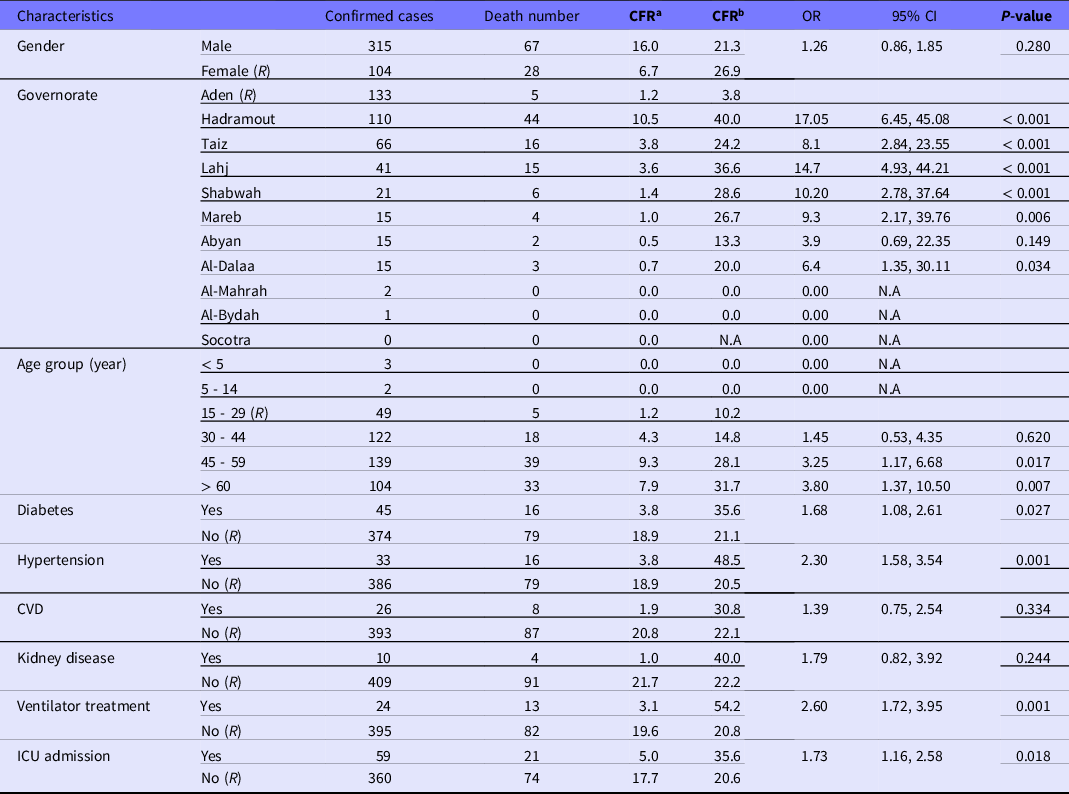
As of May 31, 2020, 419 confirmed Covid-19 cases were reported in Yemen. Out of the total cases, 75.1% (315/419) were male and almost a third of the cases (31.7%, 133/419) were reported in the capital (Aden) followed by 26.2% (110/419) in Hadramout; no cases were reported in Socotra (Table 1). Approximately 57.9% (243/419) of cases were documented in those aged 45 years or older and only 7 (1.6%) were reported in children less than 14 years old. The most common comorbid was diabetes (45; 10.7%), followed by hypertension (7.8%), cardiovascular disease (CVD) (6.2%), and kidney disease (2.3%). There were 59 patients (14.1%) who required intensive care in the intensive care unit (ICU), and 24 (5.7%) were treated with mechanical ventilator.
Factors associated with COVID-19 mortality among 419 patients in Yemen

a Case-fatality rate: number of deaths divided by number of total confirmed cases
b Case-fatality rate: number of deaths divided by number of confirmed cases within each characteristic
Abbreviations: CFR, case-fatality rate, CI, confidence interval; CVD, cardiovascular disease; ICU, intensive care unit; N.A, Undefined; OR, odds ratio; R, Reference group
CFR of COVID-19 patients
Out of the total 419 cases, 95 deaths were reported with a CFR of 22.6%. The mean and median age of deaths were 53.6 years (SD±15 years) and 52 years, respectively, with age ranged between 15 and 88 years old. The CFR among patients older than 60 years old was 31.7% (33/104); the percentage was reduced to 28.1% in the 45-59 year- old group, and 10.2% in the 15-29 year-old group (Table 1). No death was reported among those who were younger than 15 years old. The mortality rate varied between governorates and ranged from 0% in Al-Mahrah and Al-Bydah, 3.7% in Aden, to 40% in Hadramout (Table 1).
Out of all subjects with comorbidities that were included in this study, the highest mortality was reported in those with hypertension (16/33; 48.5%), followed by kidney disease (4/10; 40.0%) and diabetes (16/44; 35.6%) (Table 1). Among patients who required ventilator, the mortality rate was 54.2%.
CFR-associated determinants
Although CFR was not significantly different between gender (21.3% vs. 26.9% for male and female, respectively), age was associated with COVID-19 mortality (Table 1). The odds of dying among those between 45-59 years old was more than 3 times compared to young adults (15-29 years old) (OR: 3.25; 95% CI: 1.17, 6.68, P = 0.017) (Table 1). Those who were 60 years old or older had almost 4-fold odds of dying compared to young adults (OR: 3.80; 95% CI: 1.37, 10.50, P = 0.007). The presence of diabetes and hypertension was associated with mortality of COVID-19. Diabetes and hypertension increased the mortality rate approximately 1.6 and 2.3 times compared to those without diabetes and hypertension (OR: 1.68; 95% CI: 1.08, 2.61, P = 0.027 and OR: 2.3; 95% CI: 1.58, 3.54, P = 0.001).
When COVID-19 patients required intensive care and therefore were admitted to the ICU, the mortality rate increased to almost twice that of other patients (OR: 1.73; 95% CI: 1.16, 2.58, Table 1). Compared to patients who did not require mechanical ventilator, those who did had 2.6 times higher CFR (OR: 2.6; 95%CI: 1.72, 3.95, P = 0.001).
Discussion
Our study suggests that Yemen has suffered a catastrophic COVID-19 spread, nearly 3 months after the report of its first case on April 10, 2020. Reference Dureab, Al-Awlaqi and Jahn21 Such condition has been predicted to emerge amid the humanitarian crisis which has been occurring in Yemen since 2015. Reference Dureab, Al-Awlaqi and Jahn21 At present, comprehensive responses to COVID-19 pandemic have been a challenging issue in Yemen due to the fact that the country is facing a complex geosociopolitical situation as a result of long-lasting armed-conflict. Reference Dureab, Al-Awlaqi and Jahn21 Escalation of population displacement, crowded housing, malnutrition, and inadequate level of public sanitation, are some of the risk factors of COVID-19 spread in Yemen. Reference Dureab, Al-Awlaqi and Jahn21,Reference Poole, Escudero, Gostin, Leblang and Talbot22 Yemen is heading towards calamity due to the disinformation about COVID-19 and the opposition against vaccination under the influence of Houthi authorities in the northern part of the country. Afghanistan is better in controlling the pandemic than Yemen with the screening upon entry to the country, hygiene promotion programs, increasing COVID-19 testing laboratories and national lockdown. Reference Lucero-Prisno, Ahmadi, Essar, Lin and Adebisi23 Afghanistan has also reached 641295 total vaccinations or 1.24% of their total population whereas Yemen has only immunized 196234 citizens (0.66% of the Yemen total population). Reference Mathieu, Ritchie and Ortiz-Ospina24
Using a representative national COVID-19 database in Yemen, we found that although the majority of COVID-19 cases (74.9%) were reported in men, the CFR was not significantly different between genders. This finding was distinct compared to other studies where the mortality rate was higher in males such as in New York where most of the cases were reported in males and the CFR was higher in males compared to females. Reference Richardson, Hirsch and Narasimhan25 Our study found that the CFR was more than 20%, considerably higher than the CFR reported in some countries; 2.3% in China, Reference Wu and McGoogan26 and 7.2% in Italy. Reference Onder, Rezza and Brusaferro27 Several explanations have been proposed to explain the discrepancy of the CFR between countries, including the possible role of age structure in the affected population (higher proportion of the elderly in a country is associated with higher CFR). Indeed, the high CRF in Italy, Reference Onder, Rezza and Brusaferro27 compared to China, Reference Wu and McGoogan26 may be related to the high proportion of their elderly in Italy. Similar findings were reported in Indonesia. Reference Surendra, Elyazar and Djaafara28 Our data indicated that the CFR was much higher among patients who were older than 16 years old, compared to those within the same age groups in China Reference Wu and McGoogan26 and Italy Reference Onder, Rezza and Brusaferro27 , suggesting age structure might not be the main factor associated with high CFR in Yemen.
Alternatively, high COVID-19 mortality rate in Yemen could be due to different prevalence of comorbidity among COVID-19 cases. Our data indicated that pre-existing conditions such as diabetes and hypertension were associated with high mortality rate of COVID-19 patients, similar to the results of a previous report using data of 5700 hospitalized patients in New York. Reference Richardson, Hirsch and Narasimhan25 In the present study the risk of mortality was higher in those with pre-existing hypertension than diabetes (2.3- fold vs. 1.6- fold). Although conflicting findings have been reported on which comorbid (diabetes or hypertension) contributes to the higher mortality in COVID-19, systematic review and meta-analysis found similar findings to ours, where hypertension and diabetes mellitus was associated with a 2.5- and 2.3-fold chance to have severe COVID-19 and death, respectively. Reference de Almeida-Pititto, Dualib and Zajdenverg29 Pre-existing comorbidities in COVID-19 patients, such as diabetes and hypertension among others, were also reported to have a close connection to a higher CFR in China. Reference Wu and McGoogan26 However, the proportion of COVID-19 patients who had comorbidities in Yemen was not much higher compared to those countries with low CFR, suggesting other factors might contribute to the high CFR in Yemen.
By taking the condition in Yemen into account, it is tempting to speculate that a high CFR of COVID-19 patients reported in our study might be the result of low testing rate in the country due to massive shortage of reagents required for molecular testing, combined with the lack of healthcare facilities across the nation, as well as exhausted healthcare workers to support the national healthcare system. Keeping that in mind, it is very likely that diagnostic resources were concentrated to examine patients with obvious symptoms rather than total population coverage to detect COVID-19 patients with mild symptoms or even asymptomatic, leading to underreporting of the actual number of Covid-19 cases in Yemen. If this is true, then the condition may continue with grave consequences, especially for people with comorbidities, as the conflict situation in Yemen will increase the burden on the country’s fragile healthcare system including vaccination program like that reported in other countries. Reference Fahriani, Anwar and Yufika30 It is unfortunate to say that evidence-based clinical guidelines alone would not suffice to mitigate the current COVID-19 pandemic in the conflict zones. However, peace, transparent information, and decisive actions among crisis-affected parties may provide a better outcome.
It is important to emphasize 1 Health approach in rebuilding the health system in Yemen to contain the spread of SARS-CoV-2. Armistice should be negotiated; isolation facilities with proper sanitation and disposal systems should be prepared. The continuity of COVID-19 vaccination program and public campaign should be ensured. Reference Ng, De Deyn, Loke and Yeo31
There are some limitations of this study. This study used the COVID-19 registry that covered the southern and eastern parts of Yemen only, leaving other regions unreported; therefore the findings might not be generalized to whole country. In addition, due to the current conflicts resulting in insufficient testing capacity and lack of autopsy performance, the COVID-19 cases notified in the registry might be underreported. However, this registry, to the best of our knowledge, is the best available COVID-19 data from Yemen.
Conclusion
CFR of COVID-19 among those admitted to the isolation centers in Yemen was 22.6%. The highest CFR was observed in Hadramout region where ICU capabilities were limited. Increased age and the presence of co-morbidities are associated with more severe disease, and poor outcomes. Having diabetes and hypertension increased the mortality rate of COVID-19 patients approximately 1.6 and 2.3-fold compared to those without. To prevent the full-blown impact of COVID-19 in Yemen, cooperative actions among affected parties and extensive involvement of international humanitarian supports are highly encouraged.
Acknowledgements
Authors would like to thank the Ministry of Public Health and Population, Aden, Yemen.
Authors’ contributions
ASG was responsible for conceptualization, methodology, data curation, validation of data, writing the original draft, and review of the final manuscript. AAW was responsible for conceptualization, methodology, validation of data, and supervision of study. FN was responsible for validation of data, writing the original draft and the review process. HH was responsible for conceptualization, writing the original draft and reviewing the final manuscript. All authors have critically reviewed and approved the final draft and are responsible for the content and similarity index of the manuscript.
Conflict of interest
The authors declare that they have no competing interests.
Ethical standards
Ethics approval was not required.