




No CrossRef data available.
The effects of identification training on the identification and production of American English vowels by native speakers of Japanese
Published online by Cambridge University Press: 03 May 2005
Abstract
The effectiveness of a high variability identification training procedure to improve native Japanese identification and production of the American English (AE) mid and low vowels /æ/, / /, /
 /, /
 /, /
 / was investigated. Vowel identification and production performance for two groups of Japanese participants was measured before and after a 6-week identification training period. Recordings were made of both group's pre-/posttraining vowel productions of the five vowels, which were evaluated by a group of native AE listeners using a five-alternative, forced-choice identification task and by an acoustic analysis of the vowel productions. The overall results confirmed that the identification performance of the experimental (trained) participants improved after identification training with feedback and that the training also had a positive effect on their production of the target AE vowels.
Information
- Type
- Articles
- Information
- Copyright
- © 2005 Cambridge University Press
When learning a second or foreign language (L2), adults typically have difficulty mastering certain phonemic contrasts in the target language (Best, 1995; MacKain, Best, & Strange, 1981). As language-specific perceivers, adults' perception of speech is attuned to contrastive elements that serve to distinguish native phones during first or native language (L1) acquisition. It can be a challenge for listeners to accurately distinguish between sounds in the L2, or between L1 and L2 sounds. Nonnative sounds tend to be perceived and produced according to the acoustic patterns of L1 categories (Best 1995; Flege, 1988), which can result in the mispronunciation of particular phones in the L2 (Flege, 1989; Major, 1987; Strange & Jenkins, 1978).
Prior studies examining the effects of auditory training on L2 speech acquisition have focused on nonnative consonant contrasts using a discrimination format (differentiating between two or more stimuli) and/or identification format (assigning labels to individual stimuli; Bradlow, Pisoni, Akahane–Yamada, & Tohkura, 1997; Flege, 1989, 1995b; Jamieson & Morosan, 1986; Lively, Logan, & Pisoni, 1993; Logan, Lively, & Pisoni, 1991; Pisoni, Lively, & Logan, 1994; Strange & Dittman, 1984). Most studies show improvement in perception with the amount of improvement depending upon several factors, including the characteristics of the learners, the relationship of the L1 to the L2, the nature and range of the L1 stimuli, as well as the training methods being employed and use or nonuse of variability in the stimuli.
Strange and Dittmann (1984) incorporated a same–different discrimination task using a synthesized “rock”–“lock” continuum in an attempt to improve native Japanese perception of the /r/–/l/ contrast. They wanted to see if what listeners learned in discrimination training transferred to a different kind of task, and if training with only a small number of synthetic stimuli that contained the target sounds in only initial position would help listeners form phonetic categories of /r/ and /l/ in other consonant positions. The training effectiveness was assessed using a pre-/posttest design containing natural speech stimuli in which pretest levels of performance were compared with performance after training. Although the results showed gradual improvement in performance for subjects for the 14–18 sessions, there was no indication of transfer of learning to the natural speech words contrasting /r/ and /l/ used in the posttest. One reason for the failure of Strange and Dittmann's discrimination training procedure was its lack of stimulus variability and utilization of low-level, sensory-based information in the speech signal, which focuses on tapping into short-term sensory memory.
Logan et al. (1991) utilized a two-alternative, forced-choice identification (2AFC) task that incorporated a variable stimuli procedure with feedback to train Japanese in the American English (AE) /r/–/l/ contrast. Minimal pairs were used contrasting /r/ and /l/ in a varied environment and with multiple speakers. A pre-/posttest design containing natural tokens was used to assess the effects of identification training. Posttest results showed that listeners significantly improved their identification performance of /r/ and /l/, and that they could generalize to new contexts (see also Lively et al., 1993). The use of multiple environments and talkers, along with immediate feedback, in training listeners in the /r/–/l/ contrast resulted in significant increases in response accuracy from pretest to posttest.
Although prior studies have provided insights into the effects of laboratory training on L2 speech performance, their focus has been limited to consonants within a single binary contrast. The present study examined the effectiveness of identification training on both the identification and production of the five AE mid- and low vowels /æ/, /
/, /
/, /
/, /

/ by native speakers of Japanese. The main question of interest was, would identification training using a high variability procedure with natural word stimuli in multiple contexts spoken by multiple speakers, and including immediate feedback, improve Japanese identification and production of multiple AE mid and low vowels? We were particularly interested in furthering our understanding of the effects of auditory training on both the identification and production of nonnative speech sounds, as there have been no prior attempts to our knowledge that have examined the effects of identification training on the identification and production of nonnative vowels. In addition, we also wanted to focus on multiple vowel sound training (as opposed to a single binary contrast), which is a more difficult task and closer to the challenge L2 learners face in a naturalistic L2 environment.
A secondary question of interest was, would native Japanese identification and production performance improve more for some AE mid and low vowels than others as a result of identification training and would confusions between vowels be modified in any way as a result of training? These are questions of interest to L2 speech researchers because there may be implications of the current results for contemporary theories of L2 speech acquisition, such as Best's (1995) Perceptual Assimilation Model (PAM) and Flege's (1995a) Speech Learning Model (SLM), especially with regard to the degree of difficulty in the acquisition of nonnative vowels and in predicting L2 speech assimilation patterns (i.e., how L2 learners categorize nonnative phonemes with respect to phonemes in their native language). In prior studies examining the assimilation of L2 speech sounds, a commonly used method with which to quantify the similarity between two sounds has been to collect listeners' perceptual judgments of L1 and L2 phones. Other methods such as use of acoustic similarity criterion and phonetic symbols for descriptions of the L1/L2 vowels in question have also been used (Rochet, 1995).
The number of vowels in English is large in comparison to Japanese. General AE has 14 or 15 vowels including diphthongs (/i/, /I/, /eI/, /ε/, /æ/, /
/, /
/, /
/, /o
/, /u/, /
/, /
/, /ai/, /a
/, /
I/). Japanese has two sets of five monophthongal vowels (/i/, /e/, /a/, /o/, /
/) that contrast long and short (monomoraic or bimoraic), for example, /ie/ (house) versus /i:e/ (no). Japanese long vowels are 2.4–3.2 times longer in duration than short vowels (Tsukada, 1999), a much larger ratio than the differences of long and short vowels in other languages (Lehiste, 1970).
Prior cross-language studies using identification and discrimination tasks to examine the performance of native Japanese in perceiving L2 vowels have shown that AE mid and low vowels are difficult for Japanese to distinguish and are assimilated to L1 vowel categories, which is why we choose the AE mid and low vowels /æ/, /
/, /
/, /
/, and /
/ as the target stimuli of the present study (see, e.g., Lambacher, Martens, & Molholt, 2000; Strange et al., 1998; Yamada, Yamada, & Strange, 1995). We were particularly interested in choosing AE vowel stimuli that would be more of a challenge for native Japanese to develop robust categories of. Yamada et al. (1995), for example, used both identification and categorical discrimination tests to examine native Japanese perception of 13 AE vowels. Confusions among the mid and low vowels /ε/, /æ/, /
/, /
/, /
/, and /
/ were very common. Strange et al. (1998) examined the perceptual assimilation of 11 AE vowels by Japanese listeners. Listeners were asked to select the Japanese vowel category to which each AE vowel was most similar and to rate its category goodness on a 7-point scale. In general, the pattern of assimilation to the five Japanese vowels was predictable on the basis of cross-language phonetic similarities. Results showed that low and mid AE vowels were most often assimilated to low Japanese vowels and were among the most inconsistently categorized (less than 75% consistency). In general, AE /
/ and /
/ were most often assimilated to one- and two-mora Japanese /a/, /æ/ was most often assimilated to single- and two-mora Japanese /a/, and AE /
/ was most often assimilated to Japanese two-mora /oo/. The rhoticized mid vowel /
/ was not examined by Strange and colleagues.
The SLM (Flege, 1995a) can help account for the changes that occur during the acquisition of L2 speech by adults. One hypothesis of the SLM is that the greater the perceived distance of an L2 vowel from the closest L1 vowel, the greater likelihood that it will be perceived and produced more accurately and a new category will be established for it. However, equivalence classification can occur that link L2 phones with a “similar” L1 category (Flege, 1987).
Because Japanese lacks corresponding vowels for English /æ/ and /
/ in the front low and mid region of the vowel space, respectively, we predicted that these two AE vowels would pose less of a problem for the Japanese learners to acquire. However, the phonetic similarity between AE /
/ and /
/ with Japanese /a/ with respect to vowel quality (all being unrounded, open mid vowels) suggests that these two AE vowels might be more challenging for native Japanese to acquire. We were not exactly sure about the /
/ vowel. Japanese has no comparable vowel for /
/ in the low back region of the vowel space, however, suggesting that this sound may be less difficult to acquire for native Japanese.
In the present study, the vowel identification and production performance of two groups of Japanese participants (an experimental group receiving training between a pretest and posttest and a control group receiving no training between the two tests) is measured before and after a 6-week identification-training period. Before and after the training period, recordings are made of both groups' productions of a list of words, each containing one of the five AE vowels /æ/, /
/, /
/, /
/, and /
/. These productions are evaluated by a group of 26 native AE listeners in a five-alternative, forced-choice identification (5AFC) task. In addition, an acoustic analysis is conducted to examine the first three formant frequencies and vowel duration measurements of the target AE vowel stimuli as produced by both groups of Japanese participants and native AE talkers.
EXPERIMENT 1: IDENTIFICATION OF AE VOWELS
Experimental design
The main question addressed in Experiment 1 was whether a highly variable, identification-training procedure with immediate feedback would have a positive effect on the experimental group's identification of the target AE vowels. The vowel identification performance of two groups of Japanese participants was measured before and after the 6-week identification training period using a 5AFC identification task. The purpose of the 5AFC identification pre-/posttest task was to verify if the experimental (trained) group's identification performance improved more than the control (untrained) group's identification performance on the post-test, which would help to evaluate the effectiveness of the identification training program.
Method
Participants
Experiment 1 included an experimental group (n=34) and a control group (n=20) of Japanese participants. All of the participants (mean age = 20.2 years) were native speakers of Japanese (all male) from various prefectures throughout Japan, none of whom had lived abroad in an English-speaking country. All participants were second-year students majoring in computer science at the University of Aizu in Fukushima-ken, Japan.1
The University of Aizu is well known in Japan for its strong program in computer science and engineering, and the majority of its students are male.
Materials
Pretest/posttest stimuli
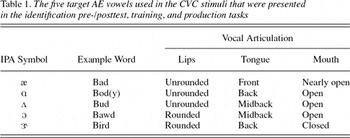
The experimental and control participants were presented a total of 150 tokens (5 vowels × 30 stimuli) in a 5AFC identification task. In the identification pre-/posttest task, the five AE vowels /æ/, /
/, /
/, /
/, and /
/ were presented in a varied consonant–vowel–consonant (CVC) context (Table 1). The CVC utterances consisted of all combinations of the three initial consonants /b/, /m/, /h/ and two final consonants /p/, /d/, for a total of 30 different CVC contexts.
2A majority of the stimuli were nonsense words (e.g., hup, haup). Of the few real words contained in each of the three separate auditory tasks within Experiments 1 and 2 (i.e., the identification pre-/posttest, identification training task, and production task), the five target AE vowels were equally represented throughout.

All of the stimuli were recorded by five AE native speakers (all male) with a mean age of 42.9 years. All of the talkers spoke English with a general American accent and were able to maintain the /
/–/
/ distinction in their spontaneous speech. The average period of residence of the 5 AE talkers in Japan was 5 years, but only one of the AE talkers spoke fluent Japanese.
All of the stimuli in the pre-/posttest identification tasks and training task were recorded in the same manner. The stimuli were recorded binaurally in a large anechoic chamber at the University of Aizu. The talker was positioned at ear level, but slightly off the median plane of the receiver, at an azimuth angle of approximately 15° and at a distance of 2 m. Synthetic reverberation generated by the Yamaha REV-500 was added to the dry binaural signal. Listening to these binaural speech samples via headphones confirmed that this configuration gave a clearly externalized auditory image. This avoided the rather unnatural sensation associated with diotic headphone listening (i.e., the same signal presented to both ears). The samples were recorded at a 48-kHz sampling rate using a Denon model DTR-80P digital audiorecorder.
The “goodness” (or prototypicality) of the stimuli recorded for all of the identification tasks in Experiment 1 was verified during a preliminary pilot study. Two native AE speakers (both trained phoneticians) listened via headphones to each of the stimuli as spoken by the five AE talkers. If a stimulus was regarded as a poor exemplar of a target vowel it was discarded and a new recording was made to ensure that each of the tokens was produced as intended.
Procedure for the pretest/posttest
An answer sheet was passed out to each participant to mark his answers. The answer sheet had 150 rows of five ovals, each row labeled with the five printed single Roman letters A–E. These letters functioned as responses, and participants were instructed to give their responses to the 150 stimuli by darkening one of the five ovals, respectively. Participants chose “A” if they heard /æ/, “B” if they heard /
/, “C” if they heard /
/, “D” if they heard /
/, and “E” if they heard /
/.
During the pre-/posttest listening tasks, the CVC stimuli were presented to participants using a Sony TCD-D8 digital audiorecorder at an average presentation level of 69 dB SPL via Sony HL-90 headphones in a noise-reduced language laboratory. There was a pause of 5 s between the presentation of each stimulus.
An introduction to the five AE vowels was given to the participants beforehand, in the form of practice trials. For this purpose a trained phonetician uttered sample words (all different from those used during any of the listening tasks), containing one of the five AE vowels. These words were presented orthographically on a handout that was passed out to each participant as a reminder of which alphabet letter (A–E) corresponded to which vowel (/æ/, /
/, /
/, /
/, /
/).
Stimuli/procedure for training
The identification training task was administered once per week for a total of 6 weeks. During this 6-week training period, the same five AE vowels (/æ/, /
/, /
/, /
/, /
/) were presented to only the experimental participants in a 5AFC identification task with CVC stimuli that were not included in the pre-/posttest. The CVC stimuli were naturally spoken words recorded by the same five AE talkers. In the training task, the participants heard 75 stimuli (5 speakers × 15 trials), which were presented within a varied CVC context, including two initial consonants /p/, /t/ and two final consonants /b/, /n/. These particular consonants were chosen to provide a reasonably balanced phonetic context in which to present the five target vowels.
During training, immediate feedback was given to participants through their headphones after each response informing them of the correct answer (either A, B, C, D, or E) for each stimulus. There was a pause of seven seconds between each stimulus, and an interval of 5 s between the presentation of each stimulus and the administration of the feedback. No feedback was given during the identification pre-/posttests.
Results
Pretest and posttest identification performance
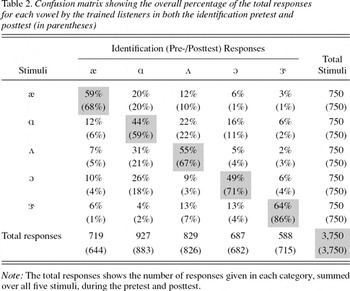
The pretest identification responses of the experimental group were pooled across two variables (consonant and speaker) to form an overall summary in the form of a confusion matrix presented in Table 2. The table shows the overall percentage of the total responses made by the experimental participants for each of the five vowel responses in both the identification pretest (top of each cell) and posttest (bottom of each cell).

The grand total of the correct pretest responses shows an overall identification rate of 54%, much higher than chance would allow. In the pretest, confusion was greatest between the two vowels /
/ and /
/. For example, 31% of /
/ tokens were heard as /
/, and 22% of /
/ tokens were heard as /
/. In the posttest, confusions between vowel stimuli decreased overall, except for a number of noteworthy exceptions: the percentage of /
/ tokens identified as /
/ decreased from 31 to 21%; in contrast, while the overall response rate of /
/ improved in the posttest, the percentage of /
/ tokens identified as /
/ did not decrease.
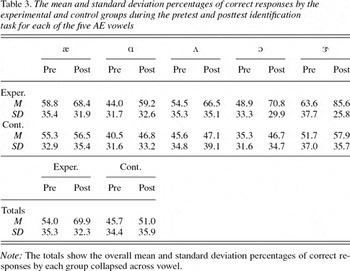
Table 3 shows the mean percent correct of identification responses by each of the two groups of Japanese participants in the pre-/posttest 5AFC identification task for each of the five AE vowels. To confirm whether or not the improvement demonstrated by the experimental group in the posttest was due to training or just simply improvement over time regardless of training, the pre-/posttest identification responses of both groups were submitted to a three-way analysis of variance (ANOVA) in which group (trained vs. untrained) served as a between-subjects factor, and time of test (pre- vs. post-) and vowel (five levels) served as within-subject factors. This analysis revealed main effects of group, F (1,54) = 300.94, p < .01; time of test, F (1,54) = 184.08, p < .01; and vowel, F (4,216) = 58.85, p < .01.

The two-way interaction between group and time of test that would show the benefit of training relative to the improvement over time with no training was significant, F (1,54)=45.68, p < .01. Post hoc t tests revealed that the trained group's improvement from pretest (mean = 54%) to posttest (mean = 70%) was significant (p < .01). A comparison of posttest identification results showed that the overall improvement of the trained group (+16%) was significantly greater than that of the untrained group (+5%, p < .01). In addition, the overall accuracy of the trained group was greater than that of the untrained group for each of the five AE vowels, which was confirmed by the significant two-way interaction between variables group and vowel, F (4,216) = 11.73, p < .01. For the trained group, their overall identification scores ranged from a maximum of 75% for all the /
/ stimuli to 52% for all the /
/ stimuli. Their overall correct response rates for the remaining vowels were /æ/ (64%), /
/ (61%), and /
/ (60%).
The above ANOVA also yielded a significant two-way interaction between time of test and vowel, F (4,216) = 7.78, p < .01. A series of post hoc t tests revealed that the trained group exhibited the greatest improvement in the posttest in identifying both /
/ and /
/ (+22%) in comparison with the other three vowels /
/ (+15%), /
/ (+11%), and /æ/ (+10%; p < .01). In contrast, although the untrained group exhibited varying performance across vowel stimuli, the two-way interaction between time of test and vowel on their performance did not reach significance (p < .05). Thus, we are able to conclude that the effect of the variables time of test and vowel on identification performance depended upon whether the Japanese participants received training or not.
Training task
During the 6-week training period, the five AE vowels were presented to the experimental participants in a task identical to the pre-/posttest identification task, except that each of the target vowels were presented in new CVC words. Another difference was that during training, participants were given feedback immediately after each individual response regarding the correctness of their responses.
During the training task, the experimental participants heard a total of 75 CVC tokens, none of which were used in the pre-/posttest identification task. The training task was presented once per week for a total of six separate sessions, and each session took approximately 20 min to complete.
Training results
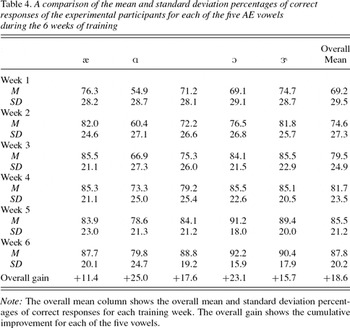
The identification responses of the experimental participants during the 6 weeks of training were submitted to a two-way ANOVA in which week of training (six levels) and vowel (five levels) served as within-subject variables. The ANOVA yielded significant main effects of vowel, F (4,816) = 19.22, p < .01, and week, F (5,170) = 66.80, p < .01. Overall, participants identified /
/ (mean = 85%), /æ/ (mean = 83%), and /
/ (mean = 83%) more accurately than the other two vowels /
/ (mean = 79%) and /
/ (mean = 70%; Table 4). A significant two-way interaction was observed between variables week and vowel, F (20, 680) = 2.90, p < .01. Throughout the six training sessions, participants exhibited the greatest cumulative improvement in identifying /
/ (+25%) and /
/ (+23%) compared with the other three vowels /
/ (+18%), /
/ (+16%), and /æ/ (+11%). These results are displayed in Table 4.

A series of post hoc t tests revealed that the participants' identification accuracy improved each week during the training period, from a mean of 69% in Week 1 to a mean of 88% in Week 6 (p < .01). They exhibited a slightly greater cumulative improvement in performance during the first half of identification training period (+10%) in comparison to the last half (+6%), although the improvement did not reach significance from Weeks 3 to 4 (p > .05) and from Weeks 5 to 6 (p > .05).
EXPERIMENT 2: EVALUATION OF JAPANESE PRODUCTION OF AE VOWELS
The main question addressed in Experiment 2 was whether the highly variable, identification-training procedure with immediate feedback would have a positive effect on the experimental group's production of the target AE vowels. Several previous studies have examined the effects of auditory training on the production of L2 consonants (Bradlow et al., 1997; Rvachew, 1994). Bradlow et al. (1997), for example, investigated the effects of identification training on production of English /r/ and /l/ by adult Japanese speakers. The results indicated the training significantly improved both the identification and production performance of all Japanese participants. Although these studies have provided insights into the effects of perceptual training on L2 production performance, their focus was limited to L2 consonants within a single binary contrast. We were particularly interested in furthering our understanding of the effects of perceptual training on L2 production by extending it to multiple nonnative vowels.
Experimental design
Experiment 2 includes three tasks: a production task, a listening task, and analysis of the spectral and temporal characteristics of the AE vowel stimuli as produced by the Japanese participants and native talkers. In the production task, the experimental and control participants from Experiment 1 produced words containing each of the five target AE vowels within a varied CVC context. This task was performed both before and after the 6-week training period. In the listening task, a group of 26 native AE speakers served as listeners in a 5AFC identification task that included a random sampling of the pre-/posttest productions of both groups of Japanese participants. The purpose of this task was to determine if the AE listeners could reliably identify each of the five AE vowels as produced by the experimental participants, which would help to evaluate the transfer of the identification training to their production. Lastly, the first three formant frequencies and temporal characteristics of the vowel stimuli as produced by both groups of Japanese participants and the five native AE talkers who recorded the CVC stimuli for the identification pre-/posttests were analyzed.
Production task stimuli/procedure
The experimental group consisted of a random subset of 20 Japanese participants from the original experimental group of 34 participants in Experiment 1, and the control group consisted of all 20 Japanese participants who took part in Experiment 1. All of the participants recorded CVC words, each containing one of the five target AE vowels /æ/, /
/, /
/, /
/, or /
/. The five vowels were inserted in /k_d/, /k_p/, /t_d/, and /t_k/ frames, yielding 20 minimal pairs. These were words that the participants had not encountered in any of the previous identification tasks.
The production pretest recordings were carried out before the identification pretest to avoid the possible effects of exposure to the identification stimuli on production. An introduction to the production task was given to the participants beforehand in the form of practice trials. A sheet of paper containing a list of example CVCs, each containing one of the five target AE vowels printed in regular Roman orthography, was passed out to the talkers before the experiment. For the two groups of Japanese participants, a trained phonetician, who was a native speaker of AE, uttered sample words containing each of the five AE vowels, so that participants better understood the pronunciation of each of the AE vowels. However, no explicit instruction in the articulation in any of vowels was administered.
Both groups of Japanese participants were recorded individually in a soundproof room using a Denon Model DTR-80P digital audiorecorder at a 48-kHz sampling rate. Each participant read all of the CVC stimuli from a list and was informed beforehand to produce them with a natural loudness and speaking rate. The individual recordings were later stored on the hard disk of an SGI workstation and reproduced using the standard SGI audio hardware. All of the uttererances were normalized for peak frequency.
Identification of Japanese vowel productions by native AE listeners
Method
LISTENERS. Twenty-six native speakers of American English (17 female, 9 male) served as listeners. All of the listeners (mean age = 21 years) were undergraduates majoring in linguistics at West Chester University (West Chester, PA) who had received training in both phonetics and phonology and were familiar with IPA transcription. None of the AE listeners reported that they had a history of speech or hearing impediments.
Stimuli
The pre-/posttest stimuli produced by the experimental and control groups of Japanese participants were presented in a set of four 5AFC identification tests to the 26 AE listeners. Productions from a random subset of 20 participants of the original 34 experimental participants of Experiment 1 and all 20 of the control subjects of Experiment 1 were included in the 5AFC task. Each test was comprised of words in mixed consonantal contexts, each word containing one of the five target vowels, and blocked for each group: that is, the trained participants' preidentification productions, the trained participants' postidentification productions, the control participants' preidentification productions, and the control participants' postidentification productions. From each of the 40 Japanese participants (20 per group), a random sampling of 8 out of the 20 vowel stimuli they produced were chosen for each of the four identification tasks presented to the 26 AE listeners.
Procedure
The procedure was the same as that of the pre-/postidentification listening task of Experiment 1 except that the four tests were presented in a randomized order. In each test, the 26 AE listeners were presented with 160 tokens (20 talkers × 8 stimuli), and each of the four tests was administered during a separate class meeting. Each stimulus was presented to the AE listeners at an average presentation level of 70 dB SPL via Sennheiser HD590 headphones in a noise-reduced room. In each test, there was a pause of 5 s between the presentation of each stimulus and a longer pause of 15 s after every 20 items to give the AE listeners a short break. Each of the four listening tests took approximately 30 min to complete.
Results
Pre-/posttest identification performance of the AE listeners
The identification responses of the group of 26 AE listeners obtained in four different testing sessions were submitted to a threeway ANOVA in which the factor termed group served as a between-subjects factor (trained vs. untrained participants). Two within-subject factors were termed time of test (pre- vs. posttraining) and vowel (five stimulus vowel sounds). Of course, terming the time of test levels as pre versus post refers to the training that only the experimental group participants received.
The main question addressed in Experiment 2 was whether the identification training would have a positive effect on the experimental group's vowel productions after their exposure to the training program. Better identification performance by native AE listeners given the experimental group's production would help support the conclusion that the experimental group's production accuracy of the five target AE vowels improved as a result of their 6 weeks of identification training.
The ANOVA yielded significant main effects of group, F (1,54) = 14.31, p < .01, test of time, F (1,54)=11.42, p < .01, and vowel, F (4,216)=138.49, p < .01. There were significant two-way interactions between variables group and time of test, F (1,54)=14.33, p < .01, and between group and vowel, F (4,216)=2.28, p < .01, as well as a significant three-way Group × Time × Vowel interaction, F (4,216)=6.26, p < .01. Post hoc t tests revealed the identifiability of the trained group's productions improved from the pretest (mean = 39%) to posttest (mean = 47%; p < .01), whereas the identifiability of the control (untrained) group's productions did not increase from pretest (mean = 36%) to posttest (mean = 35.5%, p = .844).
Table 5 shows a comparison of the mean percentage of correct responses by the AE listeners of both group's pre-/posttest productions for all five AE vowels, respectively. Post hoc t tests revealed the two-way interaction between variables time of test and vowel reached significance for the trained group (p < .01) but not for the untrained group (p > .05). The AE listeners identified the trained group's pretest productions of /
/ (mean = 55%), /æ/ (mean = 49%), and /
/ (mean = 47%) more accurately than the other two vowels /
/ (mean = 25%) and /
/ (mean = 21%). The AE listeners thus showed minimal ability to identify the experimental group's pretest versions of the /
/ and /
/ stimuli, because random guessing would lead the listeners to exhibit a 20% correct identification rate. However, the ability of the AE listeners to identify the trained group's productions of /
/ (+19%) increased considerably more in the posttest than their ability to identify the other four vowels /
/ (+11%), /æ/ (+7%), /
/ (+4%), and /
/ (−2%).

Acoustical analysis of AE vowels
To further evaluate the transfer of identification training to the experimental group's production, the formant frequencies and vowel duration measurements of the vowel stimuli, as produced by both groups of Japanese participants and native AE talkers, were analyzed. We wanted to identify the acoustic properties of the trained talkers' AE vowel productions that might help to determine whether the perceptual training had a positive effect on their production.
Method
The first three formant (F1, F2, F3) frequency and temporal measurements of the pre-/posttest vowels as produced by the five native AE talkers (all male) who recorded the vowel stimuli for the identification pre-/posttest and both groups of Japanese participants (all male) were analyzed using the Praat speech analysis software (Boersma & Weenink, 2002), and the data were stored using a Toshiba notebook computer. Mid-vowel F1, F2, and F3 formant frequency measurements from a 50-ms frame at the midpoint within each vowel were taken from the spectrogram, supplemented by an LPC smoothed spectral display. The smoothed LPC spectrum was used only to confirm the location of the steady state formant frequencies estimated by eye from the spectrogram. The duration of each vowel was measured by hand from dual spectrogram and waveform displays.
Results
The mean values for the frequency of F1 and F2 for each of the AE vowels (/æ/, /
/, /
/, /
/, /
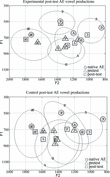
/) as produced by the experimental and control participants are shown in Figure 1. The phonetic symbols in the figure indicate the overall mean values of the five AE vowel categories as produced by the native talkers and Japanese participants in the pretest and posttest. The area of the ellipses cover the data points of each target AE vowel as produced in the posttest by the Japanese participants within each group.

Mid vowel first (F1) and second formant (F2) frequencies of the five AE vowels as produced in the posttest by the experimental group (top) and control group (bottom). The mean F1/F2 values of each of the five AE vowels as produced by native AE talkers are included in the shaded circles
When plotted in an F1 × F2 acoustic space, the experimental group overall produced the AE vowels in the posttest with substantially less spectral overlap than did the control group, and closer to the mean values for each of the vowel categories as produced by the AE talkers. In the posttest, the experimental participants produced /
/, /æ/, and /
/ with clearly less overlap, indicating they were producing acoustically distinct vowel quality targets for these three vowels. However, their posttest productions of /
/ and /
/ revealed a considerable degree of overlap for these two vowels. The control group, in contrast, produced all five AE vowels in the posttest with a great deal more spectral overlap.
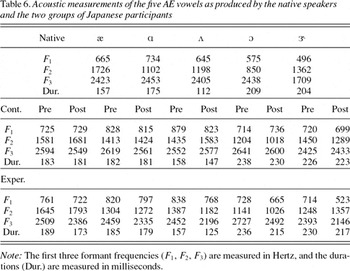
The mean durations and frequencies of the first three formants of the AE vowels (/æ/, /
/, /
/, /
/, /
/) as produced by the native AE talkers and both groups of participants are shown in Table 6. Notice that the mean F3 frequencies of /
/ as produced by the experimental (2393 Hz) and control (2425 Hz) groups were considerably higher in the pretest in comparison to that of the native AE talkers (1709 Hz). In the posttest, however, the mean F3 frequency of /
/ as produced by the experimental group decreased to 2146 Hz, while that of the control group exhibited no change, suggesting that the trained participants were producing a more nativelike /
/ after training. A series of t tests revealed that these differences were significant (p < .01).

The overall temporal results show the native AE talkers and both groups of Japanese participants produced the /æ/, /
/, /
/, and /
/ vowels with considerably longer duration than the /
/ vowel (see Table 6). The experimental group, in particular, produced the /
/ vowel with substantially less duration in the posttest (125 ms) than in the pretest (157 ms); they also produced a nativelike temporal difference in the /
/–/
/ contrast in the posttest. A series of t tests revealed that these durational differences were significant (p < .01).
In terms of vowel quality, therefore, the experimental group's production data reinforced the identification data reported in Experiment 1 in suggesting that the /æ/, /
/, and /
/ vowels are easier to distinguish and develop categories of for native Japanese than the /
/ and /
/ vowels. It also helps to confirm that the identification training had a positive effect on the experimental group's overall production performance.
GENERAL DISCUSSION
The main purpose of this study was to ascertain whether the use of a highly variable identification training procedure with immediate feedback would effectively improve both the identification and production of multiple AE mid and low vowels by native Japanese. Taken as a whole, the results confirm that the identification performance of the experimental (trained) participants improved after identification training with feedback. Overall, the training also had a positive effect on their production of the target AE vowels, even though no explicit articulatory instruction was given about the correct pronunciation of each of the vowels. In contrast, the control (untrained) participants exhibited a nonsignificant increase in vowel identification performance, and there was no indication that their production of the target AE vowels improved. We are thus able to conclude that the effect of the variables time of test and vowel on the identification and production performance of the Japanese participants depended upon whether they received training.
These results confirm previous studies' findings that the use of stimulus variability is important when training in nonnative speech contrasts (Jamieson & Morosan, 1986; Lively et al., 1993; Logan et al., 1991). Strange and Dittmann's study, for example, revealed that discrimination training incorporating tokens from only one context and talker was ineffective in modifying listeners' phonetic perception, especially when generalizing to tokens from other environments. Logan et al. (1991) and Lively et al. (1993), in contrast, used multiple environments and talkers in training listeners in the /r/–/l/ contrast, which successfully produced significant increases in response accuracy from pretest to posttest.
A second factor to consider is that during training, feedback was administered immediately after each trial informing listeners about the correctness of their responses, which may have helped to accelerate their L2 learning (Logan & Pruitt, 1995). Immediate feedback during training is important because it enables subjects to consistently attend to the salient acoustic cues of the target stimuli on a trial to trial basis (Logan et al., 1991; Pisoni, 1977).
A third factor is that the same type of listening task was used during both training and testing, which is important because it allows for a consistent mapping by listeners between stimuli and responses throughout different phases of the experiment (Shiffrin & Schneider, 1977). An additional task-related factor is listener motivation, as prior research has indicated that listeners may prefer identification tasks to other types of training (Flege, 1995b).
We next look at the nature of the learning promoted by the identification training. Did performance improve more for some vowels than others? Was there a more appropriate use of certain vowel response categories, and were patterns of confusions between vowel categories modified in any particular way as a result of training?
The results of the present study showed that the experimental participants exhibited more appropriate use of the /
/, /æ/, and /
/ vowels categories after training, although their improvement varied across task (identification and production). The auditory and phonetic distinctness of the AE vowels /
/ (a rounded, closed mid vowel), /æ/ (a nearly open, low front vowel), and /
/ (a rounded midback vowel) from the native Japanese /a/ vowel (an unrounded, open, low mid vowel) may have assisted the experimental participants to become better attuned to the acoustic representations of these three AE vowels, thus making it easier for them to establish new phonetic categories of these vowels. The rhoticized vowel /
/ is articulated with round lips and a raised tongue, resulting in a unique character associated with its low third formant (Ladefoged, 2001), which may have aided the experimental participants in acquiring it.
3Research by Iverson et al. (2003) has shown that native Japanese rely more on the F2 than F3 formant frequency in distinguishing the English /r/–/l/ contrast. However, there are no real data yet that show whether Japanese adults use the same cue when distinguishing -r colored vowels from other phonemes.
As expected, the experimental participants had the most trouble differentiating between the /
/ and /
/ vowels. The phonetic similarity of /
/, /
/, and Japanese /a/ with respect to lip rounding and tongue height results in all three vowels having a similar spectral structure (Keating & Huffman, 1984; Ladefoged, 2001). This might have contributed to the confusion of the Japanese participants in distinguishing the /
/–/
/ contrast. The temporal differences between AE /
/ and /
/ may have also played an important role. In Japanese, vowel duration is phonemic and the primary perceptual cue to vowel length (Fujisaki, Nakamura, & Imoto, 1975; Ingram & Park, 1997), with variations in formant frequency not playing a significant role when the primary durational cue is present (Kinoshita, Behne & Arai, 2002). Recall the results of the acoustic analysis in Experiment 2, which showed the experimental participants produced a nativelike temporal difference between the /
/ and /
/ vowels in the posttest. However, they might have utilized the durational cue exclusively when attempting to distinguish the /
/–/
/ contrast, as opposed to being sensitive to spectral differences. It could be that more rigorous auditory training in the AE /
/–/
/ contrast is required before Japanese learners can begin to successfully attend to the salient acoustic properties that distinguish these two AE vowels, and thus begin to establish robust categories for them.
These results, in general, would appear to support current theories of nonnative vowel acquisition (i.e., Flege's SLM and Best's PAM). According to the SLM, L2 vowels that are least like any L1 vowel will be easier to establish robust categories of than similar L2 vowels (Flege 1995a). Of the five AE vowels examined in this study, the trained group overall exhibited the greatest improvement in /
/, which is least like any Japanese vowel in terms of phonetic and acoustic quality. In contrast, they had the most difficulty with both /
/ and /
/, which differ only slightly from Japanese /a/. According to PAM (Best, 1995), L2 learners will have more difficulty distinguishing a pair of L2 sounds if both are identified in terms of a single L1 category. Japanese learners must learn to identify AE /
/ as distinct from the nearby /
/, both of which are likely to be assimilated to Japanese /a/ (Strange et al., 1998).
Nevertheless, we hasten to point out that the purpose of this study was not to test directly the validity of speech learning theories as proposed by the SLM or PAM. In fact, such a test would require cross-language mapping, dissimilarity ratings, and/or discrimination data that we did not collect. Also, whereas Best (1995) discusses the possibilities for nonnative binary contrasts in terms of discrimination, this research focused upon multiple-response identification for multiple vowels. This distinction is important, because identification taps into memory for categories, rather than assessing the ability to detect differences between two sounds presented for comparison.
The results of the present study, as a whole, would appear to also support the claim that given sufficient input, adult learners can improve their identification and production of at least some nonnative vowels (Rochet, 1995). The vowel identification training technique we employed was generally successful in improving the trained participants' identification and production of the target AE vowels, which was most likely due to the nature of the task and the variability of the stimuli presented (Logan et al., 1991). Nevertheless, the experimental participants still failed to achieve nativelike levels of performance for each of the target AE vowels, particularly the /
/ and /
/ vowels. It is expected that certain sounds will be more difficult for L2 learners to acquire than others. Not all nonnative sounds are equally identified and produced well. Some can be readily improved, whereas others are inherently more difficult and require more time, input, and training (Bohn & Flege, 1990), which can also be the case for children learning their L1 (Macken & Ferguson, 1981). The ability of L2 learners to pronounce difficult L2 sounds authentically will ultimately depend on their ability to accurately differentiate the auditory characteristics of the sounds and transfer this acoustic information into articulation.
We acknowledge that laboratory training cannot take the place of naturalistic exposure to a target language. Prior research has, in fact, shown that as adult learners gain sufficient experience in the target language they come to perceive and pronounce certain L2 vowels more accurately (Bohn & Flege, 1990; Polka, 1995; Werker, 1994; Yamada, 1995). L2 learners who are involved in conversations with native speakers in naturalistic settings do exhibit better performance in L2 speech skills, which may be due to the fact that it provides them with a wider exposure to speech produced by diverse talkers in a more varied environment than would be the case in laboratory experiments (MacKain et al., 1981).
CONCLUSION
In summary, the results here confirm earlier findings that, despite the effects of prior L1 experience on a learner's phonological system, identification training can facilitate both identification and production performance by a group of adult L2 learners, even without any explicit production training. The results also present new evidence that the use of a highly variable identification training procedure with feedback can be successfully extended to training on a multiple number of L2 vowels, as opposed to merely a single (binary) nonnative consonant contrast. Although the overall accuracy of the experimental group was greater than that of the control group in the identification posttest, their improvement in identification and production performance varied across task and vowel. The results showed that the experimental group's productions were more intelligible than the control group's for each of the five target AE vowels. In addition, an acoustic analysis of the experimental group's posttest vowel productions revealed less spectral overlap between their vowel category formations than the control group's. Taken as a whole, the results of this study successfully demonstrated that high variability identification training with immediate feedback can yield a small but significant improvement in identification and production performance of multiple nonnative vowels by L2 adult learners.
ACKNOWLEDGEMENTS
This work was partially supported by Research Grant R-28-6 of the Fukushima Prefecture. The authors express their gratitude to three anonymous reviewers for their many helpful suggestions. We also thank Youichi Nihei for his technical assistance in the recording of the AE vowel stimuli, as well as Katsuko Kuwada, Ruriko Minegishi, and Yuka Sasaki for their great assistance. Earlier versions of this research were presented at the 2002 Spring Meeting of the Acoustical Society of Japan (Yokohama, Japan) and at the 2002 International Conference on Spoken Language Processing (Denver, CO).
References
Best C. T.
1995.
A direct realist view of cross-language speech perception.
In W. Strange (Ed.),
Speech perception and linguistic experience: Issues in cross-language research
(pp. 171–
204).
Baltimore, MD:
York Press.
Boersma P., &
Weenink D.
2002.
PRAAT: Doing phonetics by computer.
Available on-line at http://www.fon.hum.uva.nl/praat.
Bohn O., &
Flege J. E.
1990.
Interlingual identification and the role of foreign language experience in L2 vowel perception.
Applied Psycholinguistics,
11,
303–
328.Google Scholar
Bradlow A.,
Pisoni D.,
Akahane–Yamada R., &
Tohkura Y.
1997.
Training Japanese listeners to identify English /r/ and /l/: IV. Some effects of perceptual learning on speech production.
Journal of the Acoustical Society of America,
101,
2299–
2310.Google Scholar
Flege J. E.
1987.
The production of “new” and “similar” phones in a foreign language: Evidence for the effect of equivalence classification.
Journal of Phonetics,
15,
47–
65.Google Scholar
Flege J. E.
1988.
The production and perception of foreign language speech sounds.
In H. Winitz (Ed.),
Human communication and its disorders
(pp. 224–
401).
Norwood, NJ:
Ablex.
Flege J. E.
1989.
Chinese subjects' perception of the word-final English /t/–/d/ contrast: Performance before and after training.
Journal of the Acoustical Society of America,
86,
1684–
1697.Google Scholar
Flege J. E.
1995a.
Second language speech learning: Theory, findings, and problems.
In W. Strange (Ed.),
Speech perception and linguistic experience: Issues in cross-language research
(pp. 233–
277).
Baltimore, MD:
York Press.
Flege J. E.
1995b.
Two procedures for training a novel second language phonetic contrast.
Applied Psycholinguistics,
16,
426–
442.Google Scholar
Fujisaki H.,
Nakamura K., &
Imoto T.
1975.
Auditory perception of duration of speech and nonspeech stimuli.
In G. Fant &
M. A. A. Tatham (Eds.),
Auditory analysis and perception of speech
(pp. 197–
219).
London:
Academic Press.
Ingram J., &
Park S. G.
1997.
Cross-language vowel perception and production by Japanese and Korean learners of English.
Journal of Phonetics,
25,
343–
370.Google Scholar
Iverson P.,
Kuhl P. K.,
Akahane–Yamada R.,
Diesch E.,
Tohkura Y.,
Kettermann A., &
Siebert C.
2003.
A perceptual interference account of acquisition difficulties for non-native phonemes.
Cognition,
87,
B47–
B57.Google Scholar
Jamieson D. G., &
Morosan D. E.
1986.
Training non-native speech contrasts in adults: Acquisition of the English /θ/–/ð/ contrast by francophones.
Perception and Psychophysics,
40,
205–
215.Google Scholar
Keating P. A., &
Huffman M. K.
1984.
Vowel variation in Japanese.
Phonetica,
41,
191–
207.Google Scholar
Kinoshita K.,
Behne D. M., &
Arai T.
2002.
Duration and F0 as perceptual cues to Japanese vowel quantity.
In J. Hansen &
B. Pellom (Eds.),
Proceedings of the International Conference on Spoken Language Processing
(pp. 757–
760).
Boulder, CO:
Center for Spoken Language Research.
Ladefoged P.
2001.
Vowels and consonants: An introduction to the sounds of languages.
Oxford:
Blackwell.
Lambacher S.,
Martens W., &
Molholt G.
2000.
A comparison of identification of American English vowels by native speakers of Japanese and English.
In H. Umeda (Ed.),
Proceedings of the Phonetic Society of Japan Meeting
(pp. 213–
218).
Tokyo:
Phonetic Society of Japan.
Lehiste I.
1970.
Suprasegmentals.
Cambridge, MA:
MIT Press.
Lively S.,
Logan J., &
Pisoni D.
1993.
Training Japanese listeners to identify English /r/ and /l/. II: The role of phonetic environments and talker variability in learning new perceptual categories.
Journal of the Acoustical Society of America,
94,
1242–
1255.Google Scholar
Logan J. S.,
Lively S. E., &
Pisoni D. B.
1991.
Training Japanese listeners to identify English /r/ and /l/: A first report.
Journal of the Acoustical Society of America,
89,
874–
886.Google Scholar
Logan J. S., &
Pruitt J. S.
1995.
Methodological issues in training listeners to perceive non-native phonemes.
In W. Strange (Ed.),
Speech perception and linguistic experience: Issues in cross-language research
(pp. 351–
377).
Baltimore, MD:
York Press.
MacKain K. S.,
Best C. T., &
Strange W.
1981.
Categorical perception of English /r/ and /l/ by Japanese bilinguals.
Applied Psycholinguistics,
2,
369–
390.Google Scholar
Macken M., &
Ferguson C.
1981.
Phonological universals in language acquisition.
In H. Winitz (Ed.),
Native language and foreign language acquisition
(pp. 110–
129).
New York:
New York Academy of Sciences.
Major R.
1987.
A model for interlanguage phonology.
In G. L. Ioup &
S. L. Weinberger (Eds.),
Interlanguage phonology
(pp. 101–
124).
Rowley, MA:
Newbury House.
Pisoni D.
1977.
Identification and discrimination of the relative onset time of two component tones: Implications for voicing perception in stops.
Journal of the Acoustical Society of America,
61,
1352–
1361.Google Scholar
Pisoni D.,
Lively S., &
Logan J.
1994.
Perceptual learning of non-native speech contrasts: Implications for theories of speech perception.
In J. Goodman &
H. Nusbaum (Eds.),
The development of speech perception: The transition from speech sounds to spoken words
(pp. 121–
166).
Cambridge, MA:
MIT Press.
Polka L.
1995.
Linguistic influences in adult perception of non-native vowel contrasts.
Journal of the Acoustical Society of America,
97,
1286–
1296.Google Scholar
Rochet B. L.
1995.
Perception and production of second-language speech sounds by adults.
In W. Strange (Ed.),
Speech perception and linguistic experience: Issues in cross-language research
(pp. 379–
410).
Baltimore, MD:
York Press.
Rvachew S.
1994.
Speech perception training can faciliate sound production learning.
Journal of Speech and Hearing Research,
37,
347–
357.Google Scholar
Shiffrin R., &
Schneider W.
1977.
Controlled and automatic human information processing: II. Perceptual learning, automatic attending, and a general theory.
Applied Psycholinguistics,
84,
127–
190.Google Scholar
Strange W.,
Akane–Yamada R.,
Kubo R.,
Trent S.,
Nishi K., &
Jenkins J.
1998.
Perceptual assimilations of American English vowels by Japanese listeners.
Journal of the Acoustical Society of America,
26,
311–
344.Google Scholar
Strange W., &
Dittman S.
1984.
Effects of discrimination training on the perception of /r–l/ by Japanese adults learning English.
Perception & Psychophysics,
36,
131–
145.Google Scholar
Strange W., &
Jenkins J.
1978.
Role of linguistic experience in perception of speech.
In R. D. Walk &
H. L. Pick (Eds.),
Perception and experience
(pp. 125–
169).
New York:
Plenum Press.
Tsukada K.
1999.
An acoustic phonetic analysis of Japanese-accented English.
Doctoral dissertation, Macquarie University
Sydney.
Werker J. F.
1994.
Cross-language speech perception: Development changes does not involve loss.
In J. Goodman &
H. Nusbaum (Eds.),
The development of speech perception: The transition from speech sounds to spoken words
(pp. 93–
120).
Cambridge, MA:
MIT Press.
Yamada R.
1995.
Age and acquisition of speech language sounds: Perception of American English /r/ and /l/ by native speakers of Japanese.
In W. Strange (Ed.),
Speech perception and linguistic experience: Issues in cross-language research
(pp. 305–
320).
Baltimore, MD:
York Press.
Yamada T.,
Yamada R., &
Strange W.
1995.
Perception of English vowels and consonants by Japanese learners of English.
In Proceedings of the Acoustical Society of Japan
(pp. 379–
380).
Utsunomiya, Japan:
Acoustical Society of Japan.
The five target AE vowels used in the CVC stimuli that were presented in the identification pre-/posttest, training, and production tasks
Confusion matrix showing the overall percentage of the total responses for each vowel by the trained listeners in both the identification pretest and posttest (in parentheses)
The mean and standard deviation percentages of correct responses by the experimental and control groups during the pretest and posttest identification task for each of the five AE vowels
A comparison of the mean and standard deviation percentages of correct responses of the experimental participants for each of the five AE vowels during the 6 weeks of training
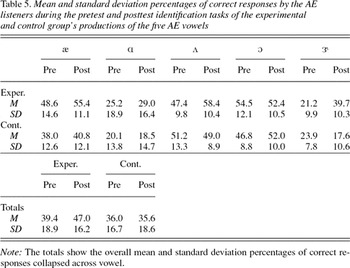
Mean and standard deviation percentages of correct responses by the AE listeners during the pretest and posttest identification tasks of the experimental and control group's productions of the five AE vowels
Mid vowel first (F1) and second formant (F2) frequencies of the five AE vowels as produced in the posttest by the experimental group (top) and control group (bottom). The mean F1/F2 values of each of the five AE vowels as produced by native AE talkers are included in the shaded circles
Acoustic measurements of the five AE vowels as produced by the native speakers and the two groups of Japanese participants
 You have
Access
- 98
- Cited by