Introduction
It is common practice in companies and institutions for employees to receive electronic or paper texts from their colleagues or superiors, and they are then expected to carry out the instructions carried in these texts, or to refer to them in their workplace tasks (Smith Reference Smith2001; Anderson Reference Anderson2004). In many institutions, providing employees with texts is seen as unproblematic, but in call centres this is more controversial, and sociolinguists have often criticised this for deskilling the workers, dehumanising them, and taking away their agency (e.g. Cameron Reference Cameron2000a:91–125; Roy Reference Roy, Bayley and Schecter2003:271; Mirchandani Reference Mirchandani2004:359–62, Reference Mirchandani2012:86–87; Sonntag Reference Sonntag2009:12; Heller Reference Heller2010:109; Alarcón & Heyman Reference Alarcón and Heyman2013:18). In this article, we interrogate this view, and suggest that the discussion of calling scripts has been limited by dualistic analyses of control and resistance, as well as by the lack of close analysis of how these scripts are produced, taken up, and used by call-centre workers (‘agents’). The production, circulation, and uptake of texts is central to approaches such as Smith's (Reference Smith1996, Reference Smith2001) institutional ethnography and Silverstein & Urban's Reference Silverstein, Urban, Silverstein and Urban1996 theory of transposition, but these have never been applied in call centres. By adopting these approaches in this study, the article challenges some of the most common assumptions about the call centre as a workplace, and seeks to generate a different understanding of agency and resistance, issues that have been hotly debated in the call-centre literature.
In the first part of the article, we show how the control and resistance binary has played a prominent part in previous call-centre research, which led to a static and one-dimensional understanding of scripts and their use. Then, we draw on Woydack's ethnographic research, involving four years of participant observation in a multilingual outbound call centre in London, and describe the trajectory of a script, beginning with its initial conception in the contractual negotiation between clients and the call centre's corporate management, following its transition into the space where calls are made, and ending in the script's appropriation and enactment by agents. At each point, the analysis attends closely both to the constraints governing the use of the script and the adaptations to it introduced at different levels of the organisation. In the conclusion, we draw out the significance of our methods and descriptions for our understanding of call centres as sites of work-oriented interaction between staff at different levels, and suggest that the discussion of resistance and deskilling in call centres has been characterised by the kind of reductive oversimplification that ethnographic sociolinguistics has traditionally sought to contest.
The literature on call centres and scripts
Research on call centres has been conducted in many disciplines, including sociolinguistics, linguistic anthropology, sociology, and management studies, but several shared themes have emerged.Footnote 1
The first is a lack of access and opportunity to conduct observational or ethnographic research:
[a]t the time of my research there had recently been a number of critical press reports about working conditions in British call centres, and some managers were wary of my approaches. Often they were eager to show me their centres, which they felt had been unfairly criticised, but reluctant to let me talk to their staff unchaperoned, and insistent on approving what I wrote in advance of publication (a condition I was not prepared to consider). (Cameron Reference Cameron2000a:184; see also e.g. Bain & Taylor Reference Bain and Taylor2000:8)
There are some studies involving fieldwork inside call centres, but long-term ethnographic studies of call centres are rather hard to find. Houlihan (Reference Houlihan2003), working from the perspective of management studies, took on the role of customer service representative and conducted undisclosed participant observation for most of her research; Brannan's fieldwork lasted thirteen months (Reference Brannan2005), Sallaz's lasted six (Reference Sallaz2015), and Roy's four (Reference Roy, Bayley and Schecter2003). But Duchêne's (Reference Duchêne2009) fieldwork lasted ten days, and in other publications the duration of participant observation is unspecified (e.g. Alarcón & Heyman Reference Alarcón and Heyman2013).
As well as being very widespread, according to some estimates employing almost 4% of the UK workforce (Reid Reference Reid2013), call centres are actually quite complex and diverse organisations, and work as a calling agent can involve varied levels and amounts of discretion, skill, teamwork, pay, training, monitoring, and educational qualification (Batt & Moynihan Reference Batt and Moynihan2002). Sallaz, for example, describes a call centre in which ‘agents encounter so many different types of call that no manageable set of routines could encompass them all’ (Reference Sallaz2015:12), and it is the challenge of learning the job that ‘motivates agents to work as hard as they do’ (Reference Sallaz2015:26). Indeed, ‘[b]y far, the most common plaint I heard from workers was that management provided them too little guidance on how to handle their call’ (Reference Sallaz2015:26). But there are also many call centres that employ ‘Taylorist’ methods similar to those originally developed by Frederick Taylor to improve the economic efficiency of manufacturing at the turn of the twentieth century. In call centres, however, the standardisation is achieved through scripts rather than the assembly belt. These are seen as standardising and controlling speech, and
are carefully structured to manage the [agent's phone] transaction in the most efficient way, not only to achieve organisational targets, and also to present a branded corporate persona… [At the same time,] such scripting is designed to achieve process goals of sequencing, clarity, rapport building, and branding, and task goals that include information gathering, information giving, information accuracy, and sales. (Houlihan Reference Houlihan2003:150)
In the literature, ‘scripted Taylorism’ (Mirchandani Reference Mirchandani2012:86–88) of this kind is widely seen as problematic (the second common theme). Scripts are imposed ‘top-down’ (Cameron Reference Cameron2008:143) and are coupled to high tech monitoring that records the calls and every click that agents make on their computers, and this has been compared to Foucault's panopticon (cf. Taylor & Bain Reference Taylor and Bain1999; Bain & Taylor Reference Bain and Taylor2000). It is also often reported that agents are forced to recite the script in a smiley voice (cf. e.g. Cameron Reference Cameron2000b:334; Tomalin Reference Tomalin, Forey and Lockwood2010:182), with monitoring to ensure that they meet the prescribed standards. In this context of surveillance and top-down standardisation, Mirchandani suggests that ‘call centre workers … experience scripts as de-skilling, repetitive, and tedious’ (2012:87), and Cameron characterises call centres as a ‘deskilling and disempowering place to work’ (Reference Cameron2000a:124). Scripts are said to create ‘assembly lines in the head’ (Taylor & Bain Reference Taylor and Bain1999; cf. Mankekar & Gupta Reference Mankekar and Gupta2014:24), and to turn workers into robots, oppressively reducing their capacity to solve problems and make decisions on their own (cf. e.g. Ritzer Reference Ritzer1998:64; Korczynski Reference Korczynski2002:43).
More generally, the diversity of call centres is often overlooked, and they are frequently thought of as the epitome of the standardised workplace, with a bad reputation as ‘communication factories’ (Cameron Reference Cameron2000a:93), ‘electronic panopticons’ (Bain & Taylor Reference Bain and Taylor2000:5), and ‘the new sweatshops’ (Fernie & Metcalf Reference Fernie and Metcalf1998:1). In fact, much of the literature on call centres fits with a wider pattern found in research on workplace standardisation. In a recent review article, Timmermans & Epstein (Reference Timmermans and Epstein2010) note that although ‘standards’ have always had a positive meaning, there is a long history in social theory dating back to Karl Marx and Max Weber that sees standardisation as negative, leading to dehumanisation, homogeneity, and deskilling. Against this background, researchers have been tempted to seek out workers who make changes to the workplace script, celebrating this as a heroic individual resistance (cf. Leidner Reference Leidner1993:5), and in another extensive account of the service sector, Mumby (Reference Mumby2005) notes how frequently resistance is only ever explored in a dualistic framework of resistance and control.
Rather than attending to the less routinised work involved in handling incoming calls (cf. Sallaz Reference Sallaz2015 discussed above), this article focuses on a call centre where agents phone out from the centre, and scripts have a central role, as in the Taylorist characterisation. In doing so, we argue that call-centre research has substantially over-simplified the relationship between workers and scripts, and that this reflects the lack of long-term linguistic ethnography. Admittedly, Houlihan's (Reference Houlihan2003:137) ethnography describes a subversive ritual that agents call the ‘banana game’, in which they vie with each other to see how many times they can get the word banana into a call, unspotted by the customer. But the script remains otherwise complete, and the agents still follow it. Comparably, Cameron notes how her interview informants ‘reported taking liberties with their scripts and ignoring instructions to smile’ (Reference Cameron2000a:113), but there is no detail on how scripts are changed. In what follows, we show that scripts are far less static and inflexible, and that call-centre workers are a lot less drilled or subservient than they have been portrayed as being in the research literature. We do so by attending to the ways in which scripts are adapted and annotated as they travel along the call centre's organisational structure, with staff displaying agency—the ability to ‘act otherwise’ (Giddens Reference Giddens1984:14)—at key points throughout.
Methodology and field-site
The perspective on transposition developed in linguistic anthropology serves as our central methodological framework (Bauman & Briggs Reference Bauman and Briggs1990; Silverstein & Urban Reference Silverstein, Urban, Silverstein and Urban1996; Blommaert Reference Blommaert2005; Agha & Wortham Reference Agha and Wortham2005; Wortham Reference Wortham2005; on theory as methodology in ethnography, see e.g. Rampton, Maybin, & Roberts Reference Rampton, Maybin, Roberts, Snell, Shaw and Copland2015).Footnote 2 In research on transposition, texts are considered to be transportable ‘projectiles’ that travel across contexts, and special attention is given to entextualisation and recontextualisation. Entextualisation refers to the process of selecting, designing, and inscribing forms and meanings in a text that is intended to travel forwards into other settings, and recontextualisation refers to the ways in which these forms and meanings are construed, adapted, and altered in the process of interpretation by the text's recipients. In what follows, we describe the chain of events in which a calling script is first produced/entextualised and then recontextualised, tracing its stage by stage transformation as it moves from the management into the call centre itself, relayed across several briefings to agents on the phone. In doing so, we explore the authority of the script and the orientation of its recipients (Bauman Reference Bauman, Silverstein and Urban1996), issues that are crucial to the way in which script-based call centres are normally characterised in the research literature.
The case study in this article focuses on ‘CallCentral’ (not its real name), which is one of many outbound multilingual call centres located in London and the South East. Woydack worked there for four years, on the phone and as a trainer, conducting participant observation for three years as part of her PhD research. Management accepted her research, seeing it as an opportunity to improve the working climate, and among other things she informed new agents of her research while training them. She also interviewed over sixty staff, including downstairs call-centre managers (three), team leaders (six), and current and former agents, approaching them with consent forms and information sheets ratified within her university's ethics procedure, also guaranteeing anonymity (through pseudonymisation). All of the interviews were semistructured and included questions about local standardisation practices as well as general perceptions of the call centre. Interviews were either conducted in a meeting room in the same building (but outside the call centre), or at venues chosen by the participant (e.g. at home or in a café).
CallCentral makes calls on behalf of external clients in any language requested in any country in the world, and usually at least twenty different languages are being used at any one time. The work ranges from customer service to marketing, and it is usually IT-related. There is an internal hierarchy, and the corporate management is informally referred to as ‘upstairs’, with the call centre itself being ‘downstairs’. Downstairs, there are on average sixty seats and about six call-centre managers.
Scripts formed a central link between upstairs and downstairs, and they were also crucial to training. CallCentral had a high turnover of staff, with almost twenty new agents starting every week. There were constant staff shortages, and most of the agents knew very little about IT, the focus of most of CallCentral's business. Scripts outlined what agents had to say, and they allowed quantitative and qualitative monitoring of their work, feeding into the compilation of statistics.
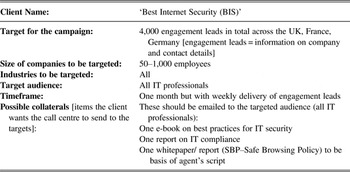
From conception to use, scripts went through three main stages, each reflecting a different level of CallCentral's organisational hierarchy. The first stage would involve the client, the corporate management, and the call-centre manager in the production of what we call the ‘master script’ for a particular campaign. In the second stage, team leaders would adapt the master script and use it to train agents and brief them on the campaign it related to. In the final stage, agents would translate the master script into other languages and work with it on the phone. In what follows, we describe each of these stages, and to facilitate the exposition we contextualise them in a campaign very similar to those that usually drive the production, adaptation, and enactment of scripts. For effective anonymisation, this campaign has to be fictive in part, but the sales brief in Table 1 is highly typical of the work at CallCentral.
Sales brief for the campaign.

We can begin with the first phase of the script's career, exploring what happens once the client, BIS (Best Internet Security), has contacted the call centre about the campaign they would like to run. Woydack never actually attended any of the events that constitute this phase, so in the next section we rely on the accounts given by call-centre managers downstairs, who played a key role in this phase. We address the questions: How is the script composed? What is included, left out, or amended during the meetings and for what reasons? What are the participants’ orientations towards the script?
The first stage: The production of a master script
The first stage in the ‘life’ of a script upstairs is dominated by certain contractual expectations. For the company management, the script is a particular product that is sold to the client, and once the client has bought it, the company management believes in the client's right to transparency and accountability. The client should be able to influence future proceedings, and their demands should be placed at the centre of the campaigning process. The script serves as the primary device for achieving transparency and accountability, and three elements in the contract enable the client to influence the script's production and later use.
First, the script has to be based on ‘collaterals’—items for the call centre to send to the targets—chosen by the client. In the illustrative BIS campaign, the key item is a ‘whitepaper’ on SBP (safe browsing policy), so this should feature prominently in the campaign master script. Second, the contract allows the client the final say on the master script. And third, the company management upstairs provides the client with contractual assurance that call-centre agents will follow the script word for word without individual variation. All of this is written into the contract, and among the control measures that seek to safeguard this, there are two sets of statistics.
To generate these statistics, the managers downstairs in the call centre work out (a) how long each agent's call should take, based on the time it would take to read the client-approved script word for word, (b) how many leads agents can be expected to achieve per day, and (c) what the outcomes of the calls could be. Once the agents start using the script, they should log every call on the computer, and dial report statistics are then generated that measure the computer's record of their performance against their managers’ predictions. Among other resources, these dial reports allow the call-centre management downstairs to monitor agents’ productivity. So if, for example, it has been estimated that the client's script takes three minutes to read but an agent has logged a call that lasted only one minute as successful, the agent can not have been following the script word for word. These dial reports are not themselves shared directly either with the client or with management upstairs, but they represent a quick way for the management downstairs to check whether agents have followed the script. For those upstairs/outside the call centre itself, the data from these dial reports are summarised, analysed in bar charts, and sent to the client, and from time to time, this prompts the client to ask for redrafts of the script if they are not happy with the campaign's progress and results so far. So contractual agreement on agents’ fidelity to the master script matters to the client and the upstairs management because it allows for the production of statistics, which show how the campaign is progressing and demonstrates that CallCentral is committed to fulfilling the client's demands even after the script has been produced and approved.
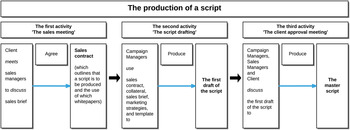
With this account of how client and upstairs management understand the organisational role of the master script in place, we can now turn to three activities involved in its initial production. The first is the sales meeting, where the client and the company's sales person agree on the sales contract and the broad contours of the script. The second, the initial drafting of the script, involves a call-centre manager from downstairs writing a first version of the script, working to notes from the sales meeting. In the third, the client approval meeting, the script is finalised between the client, sales, and call-centre managers. This is summarised in Figure 1.
The production of a master script.

Step 1: The sales meeting
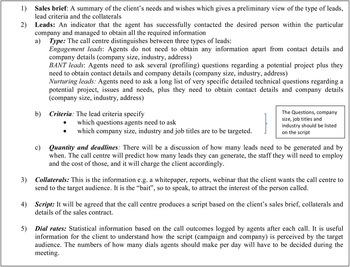
For the initial sales meeting, the client brings a sales brief, summarising their wishes and priorities for the campaign. Figure 2 below lists and explains the main contractual issues that are addressed at this meeting, and apart from the sales brief itself, each element comes with its own price tag, feeding into the overall cost of the campaign. The client will bring a range of collaterals that might be emailed out to support the service or sale that she/he wants to promote, and he/she will then decide with the company's sales person which to focus on. At the end of the meeting, all agreements reached will be summarised in a sales contract that is signed by the two parties, and once this has happened, a call-centre manager from downstairs can start drafting the script. As it is unlikely that the latter will have been present during the sales meeting, the client's sales brief, the sales contract and the agreed collateral(s) are an important reference point in the next stage.
List of contractual terms discussed and agreed on as part of the sales meeting.Footnote 3

Step 2: Drafting the script
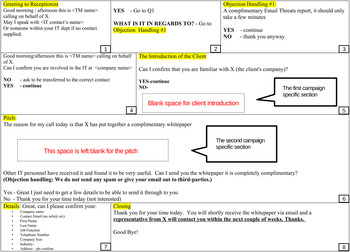
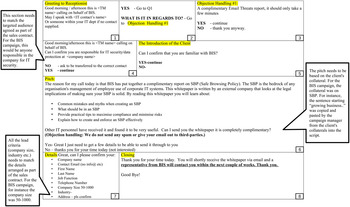
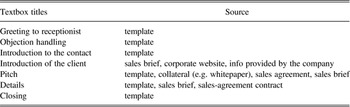
To draft the master calling script, call-centre managers fill in the blank sections of a pre-set template.Footnote 4 The template is illustrated in the document in Figure 3, and its completion for the BIS campaign is shown in the document in Figure 4. In both, there are eight fields/textboxes,Footnote 5 and the first three are intended to address the receptionist or other person who first picks up the call. Textbox 1 involves a greeting, introduction, and request to speak to the relevant contact person within the organisation being phoned, and textboxes 2 and 3 cover the possibility that the initial recipient might query the call (‘objection handling’). In textbox 4, agents introduce themselves and check that they are now through to the desired contact person, and in textbox 5, the agent tells the contact person about the client on behalf of whom he or she is calling. Textbox 6 contains ‘the pitch’, the centrepiece of the script, and this is followed by confirmation of details in textbox 7 and the closing in textbox 8. On the template, textboxes 5 and 6 are left blank, and these are the parts that the call-centre manager composes, referring back to the material generated in the sales meeting. Table 2 summarises the textboxes and their sources.
The template for scripts.

The template completed for the BIS campaign.

Textboxes on the script and their source.

In doing so, call-centre managers follow strategies that are broadly consistent with those advocated in textbooks on business talk. In interviews, Woydack was told that the first and most important step is to identify the main points of the contract and the collaterals. This entails explaining what the collaterals are about and highlighting their benefits to the potential recipient, and it matches the advice in, for example, Lesikar's basic business communication (Lesikar, Pettit, & Flatley Reference Lesikar, Pettit and Flatley2001) and Mike Brooks’ best-selling The ultimate book of phone scripts (Reference Brooks2010). But call-centre managers face significant challenges in the composition process. First, they normally have not been present at the sales meeting, and have not heard all of the details. And second, the documents emerging from the sales meeting—the sales contracts, sales brief, and collaterals—give no recognition to the fact that as they travel, texts may have to be reinterpreted further down the line. As a result, in interviews call-centre managers described these materials as too impractical to be implemented, even though they knew well that contractually, the most important thing was to produce a written script that pleased the client.
-
(1) When we write the script we need to think about the client as well so the client wants to see something in the script that someone on the phone might not necessarily want to hear. (Laura, call-centre manager)
-
(2) Personally I think scripts are essential to the business, but that doesn't mean forcing agents to read word by word, which I consider a very bad industry practice. Each individual has their own way of delivering a message and the whole idea of a script is to set guidelines around what needs to be said and asked. That's why I like calling them ‘Call Guides’ instead. … We need to make sure all relevant questions are asked in a professional manner and for that reason, a flow is devised in the script to help them stay on track. (Anwar, call-centre manager)
Step 3: The client approval meeting
Prior to this meeting, the client is sent the draft script produced by the call-centre manager, and this leads to discussion, with the client's views on what is best normally prevailing over the call-centre manager's doubts about its practicability. The outcome is the master script, which the client then expects agents to read out word for word. But call-centre managers like Laura know that once the script travels further along the system, this will not be possible or necessary:
-
(3) You don't need to read it, you can just make it yours, you can just change and see it's … like maybe, if you are the target audience, maybe talking to you in a conversation you don't say something [from the script] because the conversation just flows in a different way and with me it's different so I expect them to … not to follow it completely word by word. … So I expect agents to [change the script]… because one of the most important things for me is to sound colloquial. (Laura, call-centre manager)
So what happens when the script moves into the call centre downstairs?
The second stage: Adapting the master script in its transition downstairs
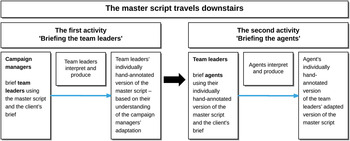
The master script is designed to regulate and co-ordinate ‘courses of actions’ in the call centre itself, but we have already seen that its initial production has been marked by different expectations among the three main parties so far, with call-centre managers anticipating textual transformations not countenanced by either the client or the company management. Empirical observation supports the view of the call-centre managers, and in this section we describe the process of text adaptation in terms of the activities that introduce the script to new users, the attitudes of participants, and changes to the script itself (see Figure 5).
The master script travels downstairs.

But before doing so, it is important to elaborate a little more on monitoring and its effects.
Living with monitoring from management upstairs
The operations manager, the call centre's big boss based upstairs, expects call-centre managers and the team leaders just below them in the hierarchy to ensure, first, that agents read the master script word by word and interpret it as the client intended and, second, that the regulation and co-ordination of agents’ activities downstairs is in line with the set procedure. To achieve this, team leaders are supposed to monitor agents’ performance to see that they meet their targets and generate the statistics. Team leaders themselves do not object to monitoring per se, but they do criticise it for being impersonal, inflexible, and insensitive to individual variability and the particular pressures at certain times. Indeed, interventions by the operations manager are quite often seen as unfairly based on unrealistic expectations, but, for the most part, call-centre managers and team leaders manage this gap between what is possible and what is expected, confident in the knowledge that upstairs can not actually listen to agents’ calling, as this only happens downstairs (see field notes in (4) and (5)).
-
(4) Field note: Visits by the operations manager
The operations manager came downstairs from time to time. He often also came to talk to me as he was my direct line manager since I was responsible for the quality of the campaigns. Prior to my first one-to-one meeting with him, Jenny had warned me that whenever I dealt with him, I needed to remember that he had no idea what was going on in the call centre or what working on the phone involved. He spends all his day looking at numbers and estimating things. At the same time, it is his job to try to lower costs and bring up the call centre's revenue. These are the notes I took of one of my meetings with him:
That day, the operations manager came downstairs to have a chat with me in one of the meeting rooms about targets at the end of the quarter. I was very proud of what we as a group of team leaders had achieved that quarter, as we were in all campaigns on or above target, but without having put too much pressure on agents. However, looking over the results for that day, he pointed at the performance of one of the star performers called Sonia. For that day, she had already hit her target of fifteen leads a day (she had made seventeen leads at that point). He then asked me the rhetorical question of how I would double her performance today, if I were the operations manager. To my horror, he then ordered me to go up to her (it was 4 p.m.) and tell her that she should try to hit thirty leads in the next hour; otherwise she would not get her incentive. After the meeting, I talked to Ada about what had happened. She was rather upset and angry. We agreed that I would talk about it to Jenny, as the most powerful person downstairs. Jenny told me to ignore him and just do my thing. She would talk to him to ensure that he would never bother me again. She is very happy with me and the job I do, that is all that matters. She told me that everybody just ignores him as he is incompetent and I should do the same.
Crucially, the pressure of unrealistic monitoring can mean that the master script has to be pared down:
-
(5) Field note: The impact of monitoring on the master script at the end of the quarter
So far it had not been a very stressful day and the atmosphere in the call centre was very relaxed. The team leaders thought everyone was on track when it came to targets. During lunch, the entire call-centre management goes upstairs for a meeting that lasts two hours. Once they come back downstairs, Jenny calls all the substitute team leaders, team leaders who help out, to the panic room. Following the panic room meeting, the substitute team leaders walked around the call centre with a piece of paper, reprimanding specific agents, all on UK engagement campaigns, such as the BIS campaign, that they needed to make more dials as upstairs had increased the dial rates again (to 250 dials instead of 200). Jenny also shouted some names across the call centre who according to the dial sheet, were not doing well, while swearing about sales upstairs. There was some confusion downstairs among the team leaders about what the actual new targets were with everyone saying something else. Agents also panicked. They complained that the targets were impossible and if the dial rates are so high, they would have to leave out a lot of sentences from the master script and only stick to the skeleton. At one point, Ada came to the bubble room to talk to me about how we were going to handle the even more unrealistic targets and the fact that agents have started leaving out huge chunks from the script, with calls being too short now. We agree on what needs to be mentioned and what can be left out. As Ada says, no one can expect agents to talk for long on the phone with such high targets. We then get all the agents involved to the panic room and de-brief them.
But even in more routine circumstances, the master script needs to be adapted, and we can see this happening at the initial briefings given first to the team leaders and then to the agents.
Step 4: Briefing the team leaders
The briefing of team leaders by call-centre managers is generally very short as team leaders are assumed to be proficient already in the use of master scripts. At the outset of the briefing they are handed a printed copy of the typed master script together with the client's brief, which lists all of the targets and any useful background information (the team leaders are themselves required to bring a pad along for any other notes they need to take, though they often write on the master script instead). The call-centre managers first cover the client's brief, and after this, there is reading of the master script. Team leaders underline words or sentences in the script that they or the call-centre managers consider important, and they also hand-annotate the script with key words mentioned by the call-centre manager or with personal observations. So at the end of the briefing, each team leader has a copy of the master script with individual hand-annotations, and they now consider this their own, subsequently storing it in their pigeon-holes to ensure that it does not get thrown away. So the script is no longer just the master script that was sold to the client. In addition, during the briefing, call-centre managers generally draw attention to either one or two strategies that become relevant as the script moves closer to actual use: (a) personalising the script, while sticking to the basic elements (the eight textboxes in the documents in Figures 3 and 4); and (b) being consultative with the person on the other end of the phone if it is a high- rather than low-end campaign, involving nurturing or BANT rather than just engagement leads (Figure 2). The consultative approach entails good listening; the scripts are long, with many questions and a great deal of information; and it is only agents who are considered ‘good’ at personalisation and fluent in the language of the target market that are trained in this approach. As the BIS campaign described here low-end, we do not dwell on this (though see Woydack Reference Woydack2014:231–34).
Step 5: Briefing the agents
In our illustrative BIS campaign, the four team leaders—Stuart, Siiri, Ada, and Barbara—brief the agents in the panic room, using their own annotated versions of the master script as a personal resource. At the beginning, every agent is handed a copy of the client's brief and the typed BIS master script, and it is often stressed that agents cannot modify or reproduce the printed text and typed format of the master script itself. All of the scripts have price tags, calculated on the number, depth, and detail of the questions they contain, and if any ‘typed questions’ are added to a bespoke master script that has already been agreed, the client would have to pay extra. So any adaptation suggested by the team leaders will have to be either just remembered or hand-annotated on the script or another piece of paper, remaining invisible upstairs.
The briefing itself provides the agents with an overview of the client (via the client's brief), and the entire master script is then read out to them. According to Siiri and Ada, agents are reminded of its eight basic elements and they are told which points to emphasise with call-recipients: the reasons for the call, who it is that they are targeting, and the benefits of the material that they want to send out. All four team leaders said they explained the script's function to the agents in a range of ways, describing it as “a guideline” (Ada), as having “parameters which are not set in stone” (Stuart), as being “a good bible with good and flexible rules” (Siiri), and as “a standard with some leeway around it” (Barbara). With a new script, agents are advised to make any hand-written changes before they actually start to make calls, although they are also allowed to make adjustments in the light of experience once the calling has started.
Like all team leaders, Stuart, Siiri, Ada, and Barbara still work the lines themselves, and in terms of personalisation, they said that they shared their own strategies with other agents, performing solo versions of the master script during the briefings. Siiri said that she writes her own script on a blank piece of paper by hand; Ada mentioned “reshuffling the words” to make it sound really like her; and Stuart reported that he made all of the changes to the script in his head. So personalisation's impact on the master script is likely to be varied, and this was confirmed when three of these team leaders were asked to enact parts of the BIS script in interviews (see Woydack Reference Woydack2014:236–47 for details).
So as the master script moves downstairs, it is received by senior call-centre staff who are sceptical of corporate management's ‘purist’ stance on its use, who try to mitigate the impact of monitoring, who recognise that campaign targets and its verbatim reproduction are often at odds, and who are explicit with more junior staff about the need to personalise the script. Call-centre managers and team leaders are aware of the commercial calculations that underpin the script, respect its basic structure, and recognise that, for example, the closing phrase used to complete a call (textbox 8 in the documents in Figures 3 and 4) is required for legal reasons. But they think of the script as a skeleton to be fleshed out/adjusted according to the situation.
What happens in its appropriation by the agents who actually make the calls?
The third stage: The script's appropriation and enactment by agents
The third and final stage of a script's career involves a number of additional oral and/or written changes, and here it is not only rehearsed, tested, and used by countless agents, but also often translated into other languages. But before describing these practices, it is necessary once again to refer to another aspect of the production and accountability system: data logging.
Data logging
Although its form and significance varies with the types of campaign, all phone calls should lead to agents recording information on the centre's database, and some of this is fed back to the client. If the client thinks that the data being generated is inadequate, they may either ask for a new script or cancel the whole campaign, but the quality of this feedback and the integrity of the database matters to the company as well. First, the database is used by the company's other sites and divisions worldwide, and if an agent accidentally deletes some valuable data, this may have an effect on other parts of its operation. Second, it is more cost-efficient for the company to have agents keep the database clean and up-to-date than to buy expensive new lists of contacts from elsewhere. Third, the database is one of the company's prime assets, inter alia featuring during the initial sales meeting. So a good deal of time is spent training new agents to maintain the integrity of the database, and calling agents understand its importance, especially if they have worked at the company for a little while.
Even so, agents report a tension between data logging, the master script, and dial rates.
-
(6) On the one hand, you have the pressure to make calls and on the other to follow the script, make long calls and do data entry. So I wonder what the price-value relationship is. But I can see a discrepancy between pressure and achievement. … I can tell from what I hear the other agents say on the phone, that the script and quality suffer a lot under the pressure. (Christina, current agent)
The script is designed to complement the data logging, and if agents do not ask all of its questions, the information they obtain and record in their ‘lead remarks’ may have less value. But updating the database is slow and can mean that agents lose time that they need to spend on the phone to meet target dial rates. But if they prioritise dial rates or time on the phone and do not update the database properly, poor data soon makes it more difficult and time consuming for agents themselves to get through to the right people to pitch their script. So they come to see accurate data logging as valuable for their own work, even though its demands need to be juggled against other considerations.
With this important aspect of agents’ work drawn into view, we can return to the illustrative BIS campaign trajectory, resuming our story at the point where agents leave their briefing by team leaders, equipped with the script that they have now individually hand-annotated.
Step 6: Translating and personalising the master script before putting it to use
Most campaigns are aimed not only at the UK but also at other countries, like Germany and France. So the master script needs to be translated, and because of the costs involved in hiring a specialised language agency, CallCentral usually asks agents to do the translation themselves. This they do either individually or as a group (depending on the circumstances of the campaigns and the moment in the quarter) and, occasionally, clients also ask to see translated scripts.
-
(7) Field note: Translating scripts
Around twenty new callers were hired for a new campaign. The campaign was supposed to run in twenty different markets. Thus, nineteen scripts had to be translated. Every agent was given a script template [with the script's eight sections] and told to translate the English master script. Once they had done so, it would be printed for them. However, the issue was that agents did not necessarily know how to translate the master script with its complex IT vocabulary. For instance, there was a Somali agent, who had lived for some time in Norway and was supposed to translate a script into Norwegian as a native speaker. But he told me that he could not to translate the script as he did not know the vocabulary. His solution was to use Google Translate and copy and paste the different sentences into the template. But in the past, there had been many complaints about agents who had done this. Other agents said that the translations were so poor that they had to retranslate the entire script, which also raised the issue of how agents who clearly did not speak the language could make any translations. The new German agent equally struggled. He told me, in German, that he had no idea how to translate words like network convergence or network integrity. Additionally, he was also rather upset that he was even asked to do this. In his words, he was not hired for this and they should pay a language agency for this. My response was to tell him to try his best…
In the meantime, Jenny asked me why everyone was taking so long. I told her that several agents were struggling with translating the technical vocabulary. She looked at me angrily and pointed out that all the new callers are native speakers hired through expensive language agencies. So there should not be any problem. Twenty minutes later, the German agent still had no idea how to translate the script. I told him not to worry and that I would make the translation for him.
The issues identified in this vignette, including the problems associated with cultural norms and technical terms, were often mentioned by the agents that Woydack interviewed, and indeed some agents said that having to retranslate scripts that had already been translated was a frequent occurrence.
All of the agents interviewed also thought that it was natural to personalise the script before starting to use it on the phone, and this could be done either on an extra piece of paper or by scribbling on the master script itself, as discussed in (8) below.
-
(8) [When I was given a new campaign script] I changed the wording of the script. So it was the same message but with different words but I did write down my own script and I had it in front of me with the original script. (Marta, former agent)
Step 7: Experimenting in search of the perfect version, and beyond
Most of the agents interviewed agreed that even though they had partly redrafted the master script in advance of its use, it was not yet perfect and different versions needed to be tried out in practice, as Kadeem states below in (9).
-
(9) I change it [the script] a little bit just to see what the reaction is … So if they understand it fully or they want me to explain again, so I'll just change a few things around … feedback's very important on how to improve scripts all the time. Feedback from yourself and from another person … You could say a ‘work in progress’. (Kadeem, current agent)
Although a lot of agents stressed that none of their modifications would affect the basic content of the master script, most of them said that they would continue to rework the script even after they had found the right version. The pressure of high dial rates was one factor, but agents’ accounts drew attention to a range of different influences. Monotony could be one of them (“It would be too boring to always say exactly the same thing. I need a bit of change from time to time”, Daniela, current agent), but learning from other agents was another (“Some people can get a lot of leads, then just listen to them … how they start to chat with people, and you copy them … in your way”, Tina, current agent). Indeed, team leaders sometimes encouraged this by placing new agents next to experienced ones, and sometimes during a campaign there were debriefings,Footnote 6 which could also be a source of revisions.
Agents also sometimes said they sought to be creatively distinctive: “You have to be colourful with the scripts. You've got to use like the kind of poetic language” (Alex, current agent); “You have to try and make your script unique … You're more selling yourself” (David, current agent). Several, including those who did not work on high-end campaigns, said that they needed to bring in cultural knowledge of the specific countries or regions they were calling, and knowledge of sociolinguistic stereotypes was also said to be useful (“You just say, ‘I'm calling from London’, [when calling Portugal] they'll do anything. They'll transfer me to a person's house just ‘cause I'm calling from London”, Alex, current agent). Gender and sexuality, it seemed, could also be exploited: “If you call as a woman to men, men will listen to women. It's just that gender thing” (Siiri, substitute team leader); “Flirting makes life a lot easier. If you realise that it might work, then by all means use that strategy” (Vanessa, current agent). For others, it sounded as though deviation from the script might be involuntary rather than strategic: “I used a lot of these scripts for one reason and one reason only because, when I started, obviously my level of English was so low…” (Claudia, former team leader); “[The script] has been very helpful, especially for me who doesn't… I mean I understand a lot of German but I can't get the main grammar perfect” (Linnea, current agent). In other words, calling scripts could help with language learning (see Woydack Reference Woydack2014:146–61).
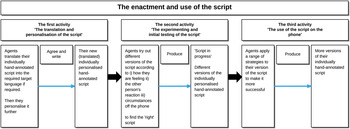
Figure 6 summarises this third major stage in the trajectory of master script—its appropriation and enactment by agents. For most of them, the script seems to be a ‘work in progress’, and they report a wide range of different adjustments in line with a plurality of influences off and on the phone. The script's skeleton structure constrains these alterations and they are monitored by the statistics and the data logging; but downstairs, there is more emphasis on producing a record—a lead remark or data entry—after every call than on following the client's script verbatim. The agents are encouraged to personalise their text, to use the consultative approach in higher-end campaigns, to develop other strategies to meet their targets and to collect and disseminate information for their campaign. Upstairs, the master script is a product that the company sells to the client, but downstairs it is a tool that collectively and/or sequentially the call-centre managers, team leaders, and agents each refashion in pursuit of the data and publicity that they are paid to gather and to spread.
The appropriation and enactment of the script.

We now turn to the theoretical and methodological significance of all of this, starting with the latter.
Discussion
Methodologically, as far as we know, this study is the first to focus on the trajectory of scripts within a call centre. As outlined above, the majority of studies treat scripts as inflexible, standardised, top-down instruments that control calling agents’ conduct, and in doing so, such studies reproduce the ideals of the corporate managers ‘upstairs’. In contrast, a trajectories perspective is very close to how scripts are conceptualised among the staff downstairs in the call centre, and when compared with the interview and questionnaire methods that have dominated research on these workplaces, transpositional/transcontextual analysis has also drawn attention to types of staff participant that nonethnographic studies have tended to overlook. Whereas many other studies have focused exclusively on call agents at the end of the chain, our account has also given a prominent place to call-centre managers and team leaders, and we have seen that they have a substantial influence on the production and interpretation of call-centre scripts (as well as on a great many other proceedings downstairs). And as we have shown, rather than simply being ‘supervisors’ who are part of the system (Taylor Reference Taylor, Thompson and Warhurst1998:95; Fernie & Metcalf Reference Fernie and Metcalf1998; Cameron Reference Cameron2000a:117), team leaders and middle managers have the capacity to diverge from the courses of action specified by their line managers. In fact, the description of text trajectories shows that in real time, all of these participants—agents, team leaders, and call-centre managers—display agency and the capacity to ‘act otherwise’ when they recontextualise the script, and the ‘backstage activities’ (O'Reilly Reference O'Reilly2009:114) that we have observed throw new light on the themes of resistance and deskilling that have featured so prominently in call-centre research.
Traditionally, analysis has interpreted agents’ deviation from their calling scripts as resistance, but the descriptions in this article provide several reasons for questioning this, especially if resistance is understood as self-consciously ‘disruptive behaviour’ (Ackroyd & Thompson Reference Ackroyd and Thompson1999; Cameron Reference Cameron2000a; Bain & Taylor Reference Bain and Taylor2000). First, most calling agents are not only unaware of their corporate managers’ contractual agreement with clients but are also regularly trained to modify the script themselves within a set of well-established procedures and guidelines (stage two, step 5, ‘Briefing the agents’). There are of course many points on which people working in the call centre disagree with the master script arriving from upstairs, but rather than illustrating a simple two-party logic of management control and (individual) worker resistance, deviation from the original text emerges downstairs in a sustained, well-recognised, and collective process of recrafting (stages two and three, steps 4 through 7). So it is with some justification that agents express the conviction that their oral and hand-written alterations of the script are permitted, and that they believe they are doing their job properly when they reword the text while holding to the script's key points. Second, following on from this, agents’ efforts to change the script are a sign of commitment to the work. They employ a great variety of strategies to improve the script, sometimes helping each other to do so, and it would be difficult to reconcile ‘resistance’ with the feeling of agents that they ‘own’ the script they work with, repeatedly attested in phrases like ‘make the script your own’. Agents are certainly not uncritical of their working conditions, but it is inflexible, mandatory, and unrealistic targets that they complain about. What they ask for are lower targets, which would allow them to cover all of the script's referential content on the phone and complete their data entry properly.
Recast in this light, the script emerges as a workplace tool rather than as an instrument of oppressive subordination, and there are good grounds for agreeing when Leidner suggests that ‘rather than assuming that workers who do not resist routines are either miserable or duped, it would seem more fruitful to consider whether there are circumstances in which routines, even imposed routines, can be useful to workers’ (Reference Leidner1993:5; see also Cook-Gumperz Reference Cook-Gumperz, Di Luzio, Günthner and Orletti2001:123). Ethnography shows that in the circumstances downstairs at CallCentral, workers treat the script as a useful tool that they can refashion, and this in turn throws into question the common claim that scripts are deskilling (Ritzer Reference Ritzer1998:64; Stanworth Reference Stanworth2000:29; Belt, Richardson, & Webster Reference Belt, Richardson and Webster2002:22). In interviews, none of the agents or team leaders complained about the existence of scripts, and most described them as helpful or beneficial, making it possible for them to work in an IT call centre even though they did not have any technical training, or to work in a language in which they were not really fluent (stage three, step 7). In a number of their accounts, it sounded as though they quite enjoyed refashioning the script. Indeed within the call centre more generally, improvement in the use of scripts was officially recognised, and agents could only move on to high-end campaigns using the consultative approach to pursue BANT or Nurturing leads when they had become proficient in low-end campaigns focusing on Engagement leads which only required personalisation.
CallCentral certainly was not an ideal or easy place to work, and although scripts were not the principal source of stress there, agents certainly did mention struggling with monotony and repetition. Indeed, we do not seek to extricate call-centre working conditions from political scrutiny and debate, even though we have contested the demonisation of calling scripts in particular, and would be ready to question the wider stigmatisation of call centres as twenty-first century sweatshops (Hudson Reference Hudson2011), together with the devaluation of many people's working lives that this encourages. But political argument normally entails large-scale generalisation and strategic essentialism, and, as in our work on race and ethnicity, we do hold that in the process of abstracting and simplifying, it is vital to refer back continuously to what is ‘lived’ in the everyday, and that, ultimately, both academic and political generalisations should be made accountable to the sorts of ground-level understanding attempted in this article (Hymes Reference Hymes1980; Harris & Rampton Reference Harris, Rampton and Wetherell2010). This is obviously not an isolated stance, and according to the eminent Foucauldian sociologist Nikolas Rose, for example, ‘[t]he notion of resistance, at least as it has conventionally functioned,… is too simple and flattening…[Instead,] one [s]hould examine the [much smaller] ways in which creativity arises out of the situation of human beings engaged in particular relations of force and meaning, and what is made out of the possibilities of that location’ (Reference Rose1999:279). In fact, there is a disciplinary point to add here: by delving into lived experience through the situated details of communicative practice, ethnographic sociolinguistics can reach beyond the horizons of many other disciplines, and this is perhaps its most distinctive contribution both to academic and public discourse. So in holding back from an overall verdict on call centres (actually a rather diverse array of complex organisations), and in leaving out alternative proposals to script-centred working practices (which would surely require a different kind of sustained dialogue with stakeholders), we are not acting as call-centre apologists. Instead, our linguistic ethnography of how scripts travel through the structured institutional relations of a call centre, enacted amidst the ineradicable contingencies of human activity, simply seeks—unapologetically—to strengthen the kind of nuanced account that ethnographic sociolinguists are especially well-equipped to provide.