Social anxiety refers to a cluster of symptoms, including an intense fear of social situations or social scrutiny (Morrison & Heimberg, Reference Morrison and Heimberg2013; Rapee & Heimberg, Reference Rapee and Heimberg1997). These symptoms are most likely to emerge during adolescence (Kessler et al., Reference Kessler, Berglund, Demler, Jin, Merikangas and Walters2005), a developmental window marked by increased social motivation and heightened concern over peer evaluation (Crone & Dahl, Reference Crone and Dahl2012; Dahl, Reference Dahl2004; Parker, Rubin, Erath, Wojslawowicz, & Buskirk, Reference Parker, Rubin, Erath, Wojslawowicz and Buskirk2015; Steinberg & Morris, Reference Steinberg and Morris2001). Cognitive models suggest that social anxiety involves negative biases in cognitive processing, including biases toward internal sources of social threat (committing errors/mistakes, autonomic responses), and greater self-monitoring within social settings, among other cognitive processes (Clark & Wells, Reference Clark and Wells1995; Pineles & Mineka, Reference Pineles and Mineka2005; Rapee & Heimberg, Reference Rapee and Heimberg1997). To extend cognitive models and advance a mechanistic understanding of social anxiety, it is important to identify neurocognitive processes linked to social anxiety symptoms in adolescence. In the current study, we focus on the error-related negativity (ERN) as a theoretically relevant neurocognitive process.
Prior work demonstrates that the ERN, an event-related potential (ERP) elicited by errors of commission (Falkenstein, Hohnsbein, Hoormann, & Blanke, Reference Falkenstein, Hohnsbein, Hoormann and Blanke1991; Gehring, Goss, Coles, Meyer, & Donchin, Reference Gehring, Goss, Coles, Meyer and Donchin1993), can serve as a neural marker of exaggerated error monitoring (self-monitoring) in individuals with general anxiety (Hajcak, Klawohn, & Meyer, Reference Hajcak, Klawohn and Meyer2019; Meyer, Reference Meyer2022; Moser, Moran, Schroder, Donnellan, & Yeung, Reference Moser, Moran, Schroder, Donnellan and Yeung2013; Olvet & Hajcak, Reference Olvet and Hajcak2008) and social anxiety (Endrass, Riesel, Kathmann, & Buhlmann, Reference Endrass, Riesel, Kathmann and Buhlmann2014; Kujawa et al., Reference Kujawa, Weinberg, Bunford, Fitzgerald, Hanna, Monk and Phan2016; Meyer, Carlton, Crisler, & Kallen, Reference Meyer, Carlton, Crisler and Kallen2018). Moreover, the ERN predicts a pattern of error-related autonomic responses that are typically observed in response to threat (Hajcak & Foti, Reference Hajcak and Foti2008; Hajcak, McDonald, & Simons, Reference Hajcak, McDonald and Simons2003). In addition to the ERN, the correct related negativity (CRN) is triggered by correct responses with a similar latency in the response-locked waveform as the ERN but with a smaller amplitude (Ford, Reference Ford1999; Vidal, Hasbroucq, Grapperon, & Bonnet, Reference Vidal, Hasbroucq, Grapperon and Bonnet2000, Reference Vidal, Burle, Bonnet, Grapperon and Hasbroucq2003). The CRN appears to have similar morphological and topographical properties to ERN, and is thought to reflect self-monitoring on correct trials (Allain, Carbonnell, Falkenstein, Burle, & Vidal, Reference Allain, Carbonnell, Falkenstein, Burle and Vidal2004; Suchan, Jokisch, Skotara, & Daum, Reference Suchan, Jokisch, Skotara and Daum2007; Vidal et al., Reference Vidal, Hasbroucq, Grapperon and Bonnet2000).
Emerging work investigates associations between social anxiety and ERN specifically when errors are committed in social (v. nonsocial) settings (Barker, Troller-Renfree, Pine, & Fox, Reference Barker, Troller-Renfree, Pine and Fox2015, 2015; Buzzell et al., Reference Buzzell, Troller-Renfree, Barker, Bowman, Chronis-Tuscano, Henderson and Fox2017b; Voegler et al., Reference Voegler, Peterburs, Lemke, Ocklenburg, Liepelt and Straube2018). Yet such work has yielded mixed results in terms of the link between global social anxiety symptoms and the ERN, and only one study has investigated these relations during adolescence (Buzzell et al., Reference Buzzell, Troller-Renfree, Barker, Bowman, Chronis-Tuscano, Henderson and Fox2017b). Given that social anxiety symptomology is marked by considerable heterogeneity (Hofmann, Heinrichs, & Moscovitch, Reference Hofmann, Heinrichs and Moscovitch2004; Spokas & Cardaciotto, Reference Spokas and Cardaciotto2014; Yu, Zhou, Wang, & Tang, Reference Yu, Zhou, Wang and Tang2020), inconsistent associations between the ERN and social anxiety could arise from prior studies focusing on global measures of social anxiety symptoms that collapse across symptom domains. Fear of negative evaluation (FNE) – which refers to apprehension and distress arising from concerns about being judged negatively by others – is thought to reflect a core, defining symptom of social anxiety (Brown & Larson, Reference Brown, Larson, Lerner and Steinberg2009); Crone & Dahl, Reference Crone and Dahl2012; Dahl, Reference Dahl2004; Gerada, Reference Gerada2020; Nelemans et al., Reference Nelemans, Meeus, Branje, Van Leeuwen, Colpin, Verschueren and Goossens2019; Parker et al., Reference Parker, Rubin, Erath, Wojslawowicz and Buskirk2015; Steinberg & Morris, Reference Steinberg and Morris2001; Westenberg, Gullone, Bokhorst, Heyne, & King, Reference Westenberg, Gullone, Bokhorst, Heyne and King2007), which may more closely relate to ERN variation in social settings. However, the broader cluster of symptoms associated with social anxiety also includes social inhibition/avoidance, feelings of distress within social situations, and less confidence regarding social relationships (Hofmann et al., Reference Hofmann, Heinrichs and Moscovitch2004; Spokas & Cardaciotto, Reference Spokas and Cardaciotto2014; Yu et al., Reference Yu, Zhou, Wang and Tang2020), as well as potential overlap in symptom presentations from generalized anxiety disorder (Showraki, Showraki, & Brown, Reference Showraki, Showraki and Brown2020). Thus, if the link between the ERN and social anxiety is primarily driven by FNE, then composite measures that collapse across FNE and other symptom domains could obscure such a link, leading to inconsistent findings across studies/samples.
Drawing on cognitive models of social anxiety and prior work investigating the ERN, we propose that ERN variation in social settings is more closely associated with FNE, as opposed to social anxiety symptoms more generally. Cognitive models propose a ‘vicious cycle’ in which FNE leads to greater self-focus, self-monitoring and attentional biases toward social threats (i.e. errors/mistakes) within social settings, further exacerbating FNE as the result of a confirmation bias (Clark & Wells, Reference Clark and Wells1995; Rapee & Heimberg, Reference Rapee and Heimberg1997). Thus, cognitive models explicitly predict a close association between FNE and self-monitoring for errors in social settings. Given that the ERN is an established index of self-monitoring for errors, we similarly hypothesize a close association between ERN magnitude within social settings and FNE (as opposed to social anxiety symptoms more generally). Indeed, neural responses associated with anticipated social feedback are correlated with FNE (Topel et al., Reference Topel, van Noordt, Willner, Banz, Wu, Castagna and Crowley2021; Van der Molen et al., Reference Van der Molen, Poppelaars, Van Hartingsveldt, Harrewijn, Gunther Moor and Westenberg2014), although prior work has not directly assessed the link between FNE and the ERN in social settings.
Adolescence is marked by increased social motivation, increased salience of peer relations (Brown & Larson, Reference Brown, Larson, Lerner and Steinberg2009)), and heightened concern over peer evaluation (Parker et al., Reference Parker, Rubin, Erath, Wojslawowicz and Buskirk2015; Steinberg & Morris, Reference Steinberg and Morris2001). FNE not only reflects a hallmark symptom of social anxiety in cognitive models, but also exhibits a normative peak during adolescence (Brown & Larson, Reference Brown, Larson, Lerner and Steinberg2009); Crone & Dahl, Reference Crone and Dahl2012; Dahl, Reference Dahl2004; Gerada, Reference Gerada2020; Nelemans et al., Reference Nelemans, Meeus, Branje, Van Leeuwen, Colpin, Verschueren and Goossens2019; Parker et al., Reference Parker, Rubin, Erath, Wojslawowicz and Buskirk2015; Steinberg & Morris, Reference Steinberg and Morris2001; Westenberg et al., Reference Westenberg, Gullone, Bokhorst, Heyne and King2007). Thus, our focus here on FNE reflects a theoretically relevant and developmentally salient domain of social anxiety in adolescents.
The primary goal of the current study was to extend neurocognitive understandings of social anxiety in adolescence, as the first study to examine relations among the FNE subdomain of social anxiety symptoms and the ERN in peer presence. In the current study, a sample of adolescents (mean age: 16.98 years, s.d. = 0.45) residing in mainland China were assessed for social anxiety symptoms. EEG was recorded while performing a modified flanker task, twice, once while observed by a peer, and once while alone. Our hypotheses were twofold: (1) given normative increases in peer importance during adolescence, participants would exhibit an overall increase in ERN magnitude in peer presence; (2) higher FNE would predict ERN magnitudes in peer presence, whereas global social anxiety symptoms would exhibit diminished or non-significant associations with ERN in peer presence.
Method
Participants and procedure
All participants in this study were recruited from grade 10 at Nanzheng High School, Hanzhong, mainland China. Exclusion criteria were (1) uncorrected visual impairments, (2) a history of head injury with loss of consciousness, and (3) neurological and developmental disorders. All parents and their adolescent children provided written informed consent/assent, and the research procedures were approved by the Shaanxi Normal University Human Research Ethics Board.
The current sample consisted of 30 adolescents (14 male, 16 female; mean age = 16.98 years, s.d. = 0.45, range 15.68–17.91). One participant was excluded as the result of feeling unwell on the day of the assessment; two participants due to technical errors in data collection. In the final analyses, 27 participants (13 male, 14 female) were included in behavioral analyses, and 23 participants (10 male, 13 female) were included in EEG analyses.
Families that agreed to participate were invited to the lab. Upon arrival at the lab site, parents and their adolescent children were provided parental consent and child assent. Then parents were brought to another room to complete a demographic survey and the adolescents were asked to complete a modified flanker task (Eriksen & Eriksen, Reference Eriksen and Eriksen1974) twice, once while they were being observed by a gender-matched peer who was actually the confederate (the social condition), and once while not being observed (the nonsocial condition). The order of the social and nonsocial conditions was counterbalanced across participants.
In the social condition, the child was informed that there was another participant who would conduct the experiment next to them and wanted to observe their performance to learn more about the task. The ages of the female and male confederates were 16.7 and 18.3 years old, respectively. During the social condition, the confederate was brought to the experiment room and introduced to the participant. To increase the ecological validity of the manipulation of social context and create a typical anxiety-provoking social situation, both confederates were trained to greet participants and make eye contact, but not to initiate any further oral communications, and only provide the simplest answers (i.e. yes, no, etc.) while being asked questions by participants. At the end of each block, the confederate read aloud the text feedback presented on the screen without any further comment.
In both conditions, steps were taken to minimize possible social observation effects of the experimenter being in the room while participants completed the flanker task, consistent with prior work (Barker et al., Reference Barker, Troller-Renfree, Pine and Fox2015; Voegler et al., Reference Voegler, Peterburs, Lemke, Ocklenburg, Liepelt and Straube2018). The experimenter informed the participant that they would not observe their performance and was only there in case of unexpected technical problems. The experimenter then sat 4m away from the participant and pretended to read a book while the participant completed the flanker task.
Task, EEG acquisition, and preprocessing
Flanker task
A modified version of the flanker task (Eriksen & Eriksen, Reference Eriksen and Eriksen1974) was administered using e-prime software (Psychology Software Tools, Inc., Sharpsburg, PA, USA). There were eight blocks of 40 trials with a total of 320 trials. The target stimulus was a central arrowhead that pointed to the left or right and was flanked by four additional arrowheads (two on either side of the central arrowhead). Within each block, 50% of trials (20) consisted of target/flanker arrowheads pointing in the same direction (congruent) and 50% trials (20) consisted of arrowheads pointing in the opposite direction (incongruent); congruent and incongruent trials were presented in random order within each block. Arrowheads were presented in Lucida Console, size 240 font. All stimuli were presented for 200 ms followed by a 500 ms response window which ended upon the response. The response–stimulus interval jittered between 1000 and 1300 ms following the response or after 700 ms from stimulus onset. Figure 1 shows examples of stimulus sequences.
Schematic outline of Flanker task paradigm.

To ensure an adequate number of error trials for response-locked EEG analyses, block-level text-based feedback was provided at the end of each trial block contingent on the participant's accuracy performance (Gehring, Liu, Orr, & Carp, Reference Gehring, Liu, Orr and Carp2012). If the accuracy for that block was below 75%, a message of ‘Please improve your accuracy!’ was presented; if the accuracy was above 90%, a message of ‘Please respond a bit faster’ was presented; if the accuracy was in-between 75 and 90%, a message of ‘Good job!’ was presented. Block-level feedback was presented onscreen the same way within both the nonsocial and social conditions; however, the feedback text was additionally read aloud by the confederate in the social condition.
EEG acquisition
Brain vision Recorder was used to record 64-channel EEG data, sampled at 500 Hz and acquired using a BrainVision ActiCHamp Amplifier, a high-impedance EEG system designed to maintain high signal-to-noise ratio at relatively high impedance levels. Before data collection, impedances were reduced to below 30 kΩ, consistent with manufacturer recommendations of 25–60 kΩ (Brain Products GmbH, 2016) and prior work (Laszlo, Ruiz-Blondet, Khalifian, Chu, & Jin, Reference Laszlo, Ruiz-Blondet, Khalifian, Chu and Jin2014). Data were online-referenced to the Cz electrode (note that data were rereferenced to the average of all electrodes as part of later preprocessing to recover EEG variation at/near Cz; Luck, Reference Luck2014).
EEG preprocessing
EEG data were preprocessed in MATLAB (Mathworks, Natick, MA, USA) using the Maryland Analysis of Developmental EEG (MADE) Pipeline (Debnath et al., Reference Debnath, Buzzell, Morales, Bowers, Leach and Fox2020). A detailed description of the preprocessing steps employed can be found in the original MADE publication (Debnath et al., Reference Debnath, Buzzell, Morales, Bowers, Leach and Fox2020). Briefly, MADE consists of a set of MATLAB scripts and EEGLAB (Delorme & Makeig, Reference Delorme and Makeig2004) functions/plugins, including FASTER (Nolan, Whelan, & Reilly, Reference Nolan, Whelan and Reilly2010) and Adjusted-ADJUST (Leach et al., Reference Leach, Morales, Bowers, Buzzell, Debnath, Beall and Fox2020); MADE performs standard EEG preprocessing steps, including artifact removal via independent component analysis for artifact removal (Winkler, Debener, Müller, & Tangermann, Reference Winkler, Debener, Müller and Tangermann2015).
Following preprocessing via MADE, EEG data were epoched into 3000 ms segments starting 1000 ms before the response and baseline-corrected to the −400 to −200 ms window. Epochs that exceeded voltages ±100 μV, if the epochs were recorded from ocular channels (Fp1, Fp2, AF7, and AF8), they were further removed, and if the epochs were recorded from non-ocular channels, they were interpolated at the epoch level. All removed channels were interpolated using the spherical spline interpolation and then the data were referenced to the average of all electrodes. Epochs associated with anticipatory responses (RTs < 200 ms) were removed. Following preprocessing, two participants were removed from all further EEG analyses, as the result of having no usable data in one or more conditions.
Assessment of ERP reliability
To set a minimum threshold for the number of trials required for inclusion in further analyses, ERN reliability in the current dataset was quantified – as a function of trial counts – using the ERP Reliability Analysis (ERA) toolbox (Clayson & Miller, Reference Clayson and Miller2017). These analyses demonstrated that a minimum cut-off of seven error trials were needed to achieve a minimum internal consistency of ≥0.6. Applying this trial count threshold, two additional participants were removed from all further EEG analyses, as the result of having <7 trials in one or more conditions. Altogether, 23 participants were included in the final EEG analyses. The mean numbers of trials-by-condition included in subsequent EEG analyses were as follows: 107.83 nonsocial-correct (s.d. = 22.07; range = 43–148), 28.52 nonsocial-error (s.d. = 11.67; range = 7–49), 108.65 social-correct (s.d. = 22.21; range = 58–146) and 29.83 social-error (s.d. = 12.54; range = 8–55).
Measures
Global social anxiety symptom severity
Self-reports of global social anxiety symptoms were assessed via the Social Phobia subscale of a Chinese translation of Screen for Child Anxiety Related Emotional Disorders (SCARED) (Birmaher et al., Reference Birmaher, Brent, Chiappetta, Bridge, Monga and Baugher1999; Su, Wang, Fan, Su, & Gao, Reference Su, Wang, Fan, Su and Gao2008). Note that use of the term ‘Social Phobia’ is consistent with the original manuscript introducing/validating the SCARED, designed to assess anxiety symptoms in line with the Diagnostic and Statistical Manual (DSM) IV (American Psychiatric Association, 1994; Birmaher et al., Reference Birmaher, Brent, Chiappetta, Bridge, Monga and Baugher1999). The Social Phobia subscale consists of seven items (e.g. ‘It is hard for me to talk with people I don't know well’) assessing global social anxiety symptom severity. Each item is rated on a three-point Likert scale, ranging from 0 (not true) to 2 (very true). Items are summed so that higher scores indicate higher levels of social anxiety symptom severity [total possible range: 0–14; scores ≥8 reflect the established clinical cut-off for social phobia (social anxiety) disorder (Birmaher et al., Reference Birmaher, Brent, Chiappetta, Bridge, Monga and Baugher1999)]. Prior work on the SCARED Social Phobia subscale demonstrates moderate-to-high internal consistency and test–retest reliability, and good discriminant validity within a Chinese population (Su, Wang, Fan, Su, & Gao, Reference Su, Wang, Fan, Su and Gao2008). Normative data collected on the Social Phobia subscale, within a large sample of Chinese adolescents, are as follows: M = 4.10, s.d. = 3.22 (Su et al., Reference Su, Wang, Fan, Su and Gao2008). The internal consistency of the Social Phobia subscale in the current sample was α = 0.85.
Fear of negative evaluation by peers
Self-reports of FNE were assessed via the FNE subscale of a Chinese translation of the Social Anxiety Scale for Adolescents (SAS–A) (La Greca, Reference La Greca1998). The FNE subscale consists of eight items (e.g. ‘I worry about what other kids think of me’) assessing adolescents' subjective experiences of fears, concerns, or worries regarding peers' negative evaluations. Each item is rated on a five-point Likert scale, ranging from 1 (not at all) to 5 (all the time). Items are summed so that higher scores indicate higher levels of FNE (total possible range: 8–40). The Chinese version of the SAS has demonstrated appropriate internal consistency, test–retest reliability, and construct validity (Zhou, Xu, Inglés, Hidalgo, & La Greca, Reference Zhou, Xu, Inglés, Hidalgo and La Greca2008). Normative data collected on the FNE subscale, within a large sample of Chinese adolescents, are as follows: M = 22.73, s.d. = 5.9 (Zhou et al., Reference Zhou, Xu, Inglés, Hidalgo and La Greca2008). The internal consistency of the SAS–FNE subscale in the current sample was α = 0.94.
Flanker task behavior
Mean accuracy (ACC) and response time (RT) in each condition (nonsocial and social conditions) were calculated. Participants were required to have greater than 70% accuracy to be included in further behavioral and EEG analyses (all participants met this criterion, mean ACC = 87.23% for the nonsocial condition, and mean ACC = 87.04% for the social condition). Trial-level accuracy and RT data were extracted for further statistical analyses; RT data were first log-transformed to address positive skew (Luce, Reference Luce1986).
ERPs
Only incongruent trials were included and analyzed (incongruent error trials for ERN, and incongruent correct trials for CRN) in order to isolate error-related effects and avoid stimulus-related confounds (errors are more common on incongruent trials in the flanker task). At the frontocentral electrode (FCz), where error-related brain activity is maximally negative (Meyer, Mehra, & Hajcak, Reference Meyer, Mehra and Hajcak2021), trial-level mean amplitudes for the CRN and ERN were extracted within the 0–100 ms window following correct and incorrect responses, respectively.
Analytic plan
For all behavioral and EEG analyses, we leveraged a mixed-effects framework in R (R Core Team, 2013), given that this approach is capable of providing accurate and unbiased estimates, even in the presence of low or unequal numbers of trials (Heise, Mon, & Bowman, Reference Heise, Mon and Bowman2022). For prediction of continuous outcome variables (ERPs, RT), linear mixed effects (LME) modeling was employed, using the nlme package (Pinheiro, Bates, DebRoy, Heisterkamp & Van Willigen, Reference Pinheiro and Bates2016); for prediction of binary accuracy data, a generalized linear mixed effects (GLME) modeling employed, using the glmer function in the lme4 package (Bates, Mächler, Bolker, & Walker, Reference Bates, Mächler, Bolker and Walker2014). In all analyses, categorical predictors were contrast coded (−1, +1), continuous predictors converted to Z scores, and effects estimated via maximum likelihood. To report p values, the anova function was used; interaction effects were proved via the emmeans package (Lenth, Reference Lenth2019).
Behavioral analyses
Although not a primary focus of the current study, we carried out basic analyses of behavioral data (RT, accuracy) for completeness. Separate mixed-effects models were fit for accuracy and RT as dependent variables. For accuracy, a GLME model was estimated, with trial-level accuracy data as a binary outcome variable, effects of condition (nonsocial v. social), congruency (congruent v. incongruent), and their interaction were estimated as fixed effects, and participant entered as a random effect. For RT, an LME model was estimated, with RT as a continuous dependent variable, effects of condition (nonsocial v. social), congruency (congruent v. incongruent), response (correct v. error), and their interactions estimated as fixed effects, and participants entered as a random effect.
ERP analyses
To investigate effects of peer presence on ERN amplitude, we fit an LME model with trial-level ERP amplitudes as the outcome variable, effects of condition (nonsocial v. social), response (correct v. error), and their interaction estimated as fixed effects, and participant entered as a random effect. As described in the results, this analysis revealed a significant response-by-condition interaction, such that the ERP amplitudes on error trials (i.e. the ERN) but not correct trials (CRN) were increased in the social v. nonsocial context. Thus, subsequent modelling focused on error trials only (ERN).
To examine effects of FNE v. global anxiety symptoms on the ERN in peer presence/absence, we fit two separate LME models employing either FNE or global anxiety symptoms as predictors and directly compared relative model fit via Akaike information criterion (AIC) model selection. In each case, an LME model was fit, with trial-level ERN amplitudes as the outcome variable, condition (nonsocial v. social) included as a fixed effect, and participant entered as a random effect. The FNE model additionally included FNE, as well as its interaction with condition, as fixed effects; the global social anxiety symptoms model included global social anxiety symptoms, as well as its interaction with condition, as fixed effects.
Given that the FNE model exhibited superior fit (see Results), we analyzed/interpreted results of this model; results of the global social anxiety model are reported in the online Supplementary material, for completeness. We additionally carried out an online Supplemental analysis in which global social anxiety symptoms were added to the FNE model as a control variable.
Results
Self-report questionnaires
The mean SCARED social anxiety score was 7.52 (s.d. = 3.50, range = 1–14), and the mean FNE score was 21.11 (s.d. = 8.74, range = 8–40). Although our analyses focus on continuous measures of social anxiety symptoms, consistent with a dimensional approach, it is worth noting that 12 of the 23 participants included in EEG analyses exceeded the established clinical cut-off for social phobia (social anxiety) disorder on the SCARED-SP (Birmaher et al., Reference Birmaher, Brent, Chiappetta, Bridge, Monga and Baugher1999). FNE was significantly correlated with SCARED social anxiety (r = 0.592, p < 0.001).
Behavioral results
The mean [±standard deviation (s.d.)] accuracies in the nonsocial and social conditions were 87.23 ± 4.34% and 87.04 ± 4.61%, respectively (see Table 1). GLME modeling revealed a main effect of congruency, with participants responding less accurately in incongruent trials [t(16 276) = 28.805, p < 0.001]. There was no significant main effect of social condition [t(16 276) = 0.650, p = 0.516], nor a congruency-by-condition interaction [t(16 276) = 1.716, p = 0.086].
Descriptive statistics characterizing behavior and ERPs as a function of condition

Note. Values reflect mean scores (standard deviation in parentheses).
Mean RTs for the nonsocial and social conditions were 343.15 ± 36.36 ms and 343.02 ± 34.49 ms, respectively. LME modeling identified a main effect of response, with participants responding faster in error trials [t(16 272) = 37.374, p < 0.001], and a main effect of congruency, with participants responding faster in congruent trials [t(16 272) = −18.249, p < 0.001]. Moreover, there was a response-by-congruency interaction effect [t(16 272) = −4.295, p < 0.001]; within correct trials, participants responded slower in incongruent responses [t(16 272) = 39.365, p < 0.001], within error trials, participants responded slower in incongruent responses [t(16 272) = 7.273, p < 0.001]. No significant main effect of social condition or other interaction effects were identified (all ps > 0.116). No correlations between behavioral data (accuracy and RT) and self-report questionnaires were statistically significant (all ps > 0.223).
ERP results
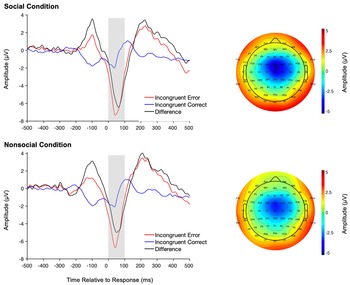
Descriptive statistics for CRN and ERN in the nonsocial and social conditions are reported in Table 1. Figure 2 displays the ERP waveforms and scalp topography for the nonsocial and social conditions across participants at the FCz electrode (where the ERN was maximal).
Averaged ERP and topographic plots for the social and nonsocial conditions. ERP plots depict averaged ERPs for incongruent-error trials (ERN: red), incongruent-correct trials (CRN: blue), and their difference (black), as a function of condition (top: social; bottom: nonsocial). Topographic plots corresponding to the shaded region within each ERP plot (0–100 ms) depict mean amplitude differences between incongruent-error and incongruent-correct trials, separately for each condition (top: social; bottom: nonsocial).

Results of the LME model assessing fixed effects of condition (nonsocial v. social), response (correct v. error), and their interaction on trial-level ERP (ERN/CRN) amplitudes are reported in Table 2. This model revealed a significant main effect of response [β = 0.288, 95% CI (0.260–0.317), s.e. = 0.014, p < 0.001], qualified by a response-by-condition interaction [β = 0.037, 95% CI (0.009–0.065), s.e. = 0.014, p = 0.009]; the nature of this interaction was such that the ERN was significantly larger in the social (compared to nonsocial) condition [t(6295) = 2.393, p = 0.017], whereas the CRN did not differ across conditions [t(6295) = −1.073, p = 0.283]. Given that social context only exhibited a significant effect for error trials (ERN), and not correct trials (CRN), subsequent modelling focused only on error trials (ERN).
Model 1: ERP ~ conditions × response

Observations = 6321, N = 23.
Note: *p < 0.05, **p < 0.01, ***p < 0.001.
We carried out AIC model selection to compare the following LME models: (1) the FNE model, defined by fixed effects of FNE, condition (nonsocial v. social), and their interaction, on trial-level ERN amplitudes; (2) the global social anxiety model, defined by fixed effects of global social anxiety, condition (nonsocial v. social), and their interaction, on trial-level ERN amplitudes. AIC model selection revealed that FNE model, carrying 81% of the cumulative model weight, had lower AIC (AIC = 8933.95) than global social anxiety model (AIC = 8936.83), indicating that the FNE model provided a better fit to the data. Given that the FNE model exhibited superior fit, subsequent analyses focused on interpretation of the results of this model (however, for completeness, see the online Supplementary material for results of the global social anxiety model).
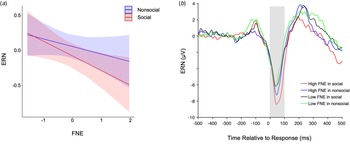
Results of the LME model assessing fixed effects of condition (nonsocial v. social), FNE, and their interaction on trial-level ERN amplitudes are reported in Table 3. This model revealed a significant main effect of condition [t(1317) = −2.672, p = 0.008], qualified by a condition-by-FNE interaction [β = −0.052, 95% CI (−0.102 to −0.002), s.e. = 0.026, p = 0.042]; the nature of this interaction was such that higher levels of FNE were more strongly associated with a larger (more negative) ERN in the social (compared to nonsocial) condition [t(1317) = 2.032, p = 0.042] (See Figure 3). We additionally carried out an online Supplemental analysis in which global social anxiety symptoms were added to the FNE model, described above, as a control variable. As reported in the online Supplementary material, the condition-by-FNE interaction remained significant when controlling for global social anxiety symptoms [β = −0.052, 95% CI (−0.102 to −0.002), s.e. = 0.026, p = 0.042], STATS, demonstrating that FNE predicted unique variance in ERN, while controlling for global social anxiety symptoms.
Association between FNE and ERN. (a) Line plot depicting associations between FNE and the ERN, separately for the nonsocial (red) and social (blue) conditions. (b) ERN ERP plots as a function of FNE group and condition (nonsocial v. social). For plotting purposes only, participants were grouped into high and low FNE groups based on the median value of FNE scores (median = 18). ERN plots depict ERN ERPs for: the high FNE group in the social condition (red), high FNE group in the nonsocial condition (blue), low FNE group in the social condition (black), and low FNE group in the nonsocial condition (green). The shaded region reflects the 0–100 ms time window.

Model 2: ERN ~ conditions × FNE

FNE, fear of negative evaluation.
Observations = 1342, N = 23.
Note: *p < 0.05, **p < 0.01, ***p < 0.001.
Discussion
Consistent with our hypotheses, we observed an overall increase in ERN magnitude in peer presence. Comparing the statistical models involving either FNE or global social anxiety symptoms to predict peer/alone ERN variation revealed a better fit for the FNE model. Moreover, higher levels of FNE were predictive of an increased ERN in the peer (v. alone) setting – an effect that held even when controlling for global social anxiety symptoms. In contrast, global social anxiety symptoms did not significantly relate to the ERN. Results of the current study are consistent with cognitive models of social anxiety (Clark & Wells, Reference Clark and Wells1995; Rapee & Heimberg, Reference Rapee and Heimberg1997), which propose a close link between FNE and self-monitoring for errors within social settings, providing a crucial neurocognitive extension of prior work. Moreover, these findings are consistent with developmental theory describing an increase in the importance of peers and normatively high levels of FNE during adolescence (Brown & Larson, Reference Brown, Larson, Lerner and Steinberg2009); Crone & Dahl, Reference Crone and Dahl2012; Dahl, Reference Dahl2004; Gerada, Reference Gerada2020; Nelemans et al., Reference Nelemans, Meeus, Branje, Van Leeuwen, Colpin, Verschueren and Goossens2019; Parker et al., Reference Parker, Rubin, Erath, Wojslawowicz and Buskirk2015; Steinberg & Morris, Reference Steinberg and Morris2001; Westenberg et al., Reference Westenberg, Gullone, Bokhorst, Heyne and King2007). These findings have implications for theory and measurement of adolescent social anxiety, including the importance of considering error sensitivity (Chong & Meyer, Reference Chong and Meyer2019) and the possibility of targeting error-related processing (Meyer et al., Reference Meyer, Gibby, Wissemann, Klawohn, Hajcak and Schmidt2020) in adolescent social anxiety. These data also highlight the ERN's utility as a neurocognitive index of self-monitoring within social settings, which complements self-report measures and could be leveraged by future studies seeking to examine causal mechanisms predicted by cognitive models of social anxiety. We discuss these ideas in further detail below.
Given that social anxiety is characterized by a cluster of heterogeneous symptoms (Inderbitzen-Nolan & Walters, Reference Inderbitzen-Nolan and Walters2000; La Greca & Lopez, Reference La Greca and Lopez1998; Watson & Friend, Reference Watson and Friend1969), it is reasonable to assume that no single neurocognitive measure would relate to all social anxiety symptoms equally (or at least not reliably across study samples); results of the current study are in line with this notion. Moreover, our data suggest that successful identification of links between symptom domains and neurocognitive measures requires precision at the level of symptom assessment as well as taking into account the situational context of neural assessment and the broader developmental context. Toward these ends, the current study focused on relations between a developmentally salient symptom domain of social anxiety – FNE (e.g. La Greca & Lopez, Reference La Greca and Lopez1998; Watson & Friend, Reference Watson and Friend1969) and neural activity associated with error-monitoring (self-monitoring) under peer observation (e.g. Hajcak, Moser, Yeung, & Simons, Reference Hajcak, Moser, Yeung and Simons2005; Kim, Iwaki, Uno, & Fujita, Reference Kim, Iwaki, Uno and Fujita2005), within the context of adolescence – when FNE and the importance of peers reach peak levels (Brown & Larson, Reference Brown, Larson, Lerner and Steinberg2009); Crone & Dahl, Reference Crone and Dahl2012; Dahl, Reference Dahl2004; Gerada, Reference Gerada2020; Nelemans et al., Reference Nelemans, Meeus, Branje, Van Leeuwen, Colpin, Verschueren and Goossens2019; Parker et al., Reference Parker, Rubin, Erath, Wojslawowicz and Buskirk2015; Steinberg & Morris, Reference Steinberg and Morris2001; Westenberg et al., Reference Westenberg, Gullone, Bokhorst, Heyne and King2007).
Importantly, the current study demonstrates that an increased ERN in social settings is associated with the FNE symptom domain in adolescents. Yet, we do not suggest that the ERN reflects the neurocognitive basis of FNE per se. Prior work demonstrates that the ERN indexes a neurocognitive process underlying error-monitoring (self-monitoring) (Agam et al., Reference Agam, Hämäläinen, Lee, Dyckman, Friedman, Isom and Manoach2011; Buzzell et al., Reference Buzzell, Richards, White, Barker, Pine and Fox2017a; Dehaene, Posner, & Tucker, Reference Dehaene, Posner and Tucker1994; Falkenstein et al., Reference Falkenstein, Hohnsbein, Hoormann and Blanke1991; Gehring et al., Reference Gehring, Goss, Coles, Meyer and Donchin1993; Miltner, Braun, & Coles, Reference Miltner, Braun and Coles1997; Ullsperger, Fischer, Nigbur, & Endrass, Reference Ullsperger, Fischer, Nigbur and Endrass2014). Similarly, we suggest that an increased ERN in social settings indexes increased self-monitoring. As noted, cognitive models propose a vicious cycle whereby greater FNE leads to greater self-monitoring within social settings, which in turn further strengthens/worsens FNE (Clark & Wells, Reference Clark and Wells1995; Rapee & Heimberg, Reference Rapee and Heimberg1997). Thus, we argue that the link between FNE and the ERN in peer presence reflects a neurocognitive extension of cognitive models of social anxiety. These models further state that social anxiety is specifically associated with increased self-monitoring for negative aspects of one's behavior (e.g. errors) as opposed to a general increase in self-monitoring (Clark & Wells, Reference Clark and Wells1995; Rapee & Heimberg, Reference Rapee and Heimberg1997). Our data provide converging neural evidence to support this supposition, as peer presence and FNE predicted larger increases in the ERN (self-monitoring on error trials), as opposed to the CRN (self-monitoring on correct trials). As noted by cognitive models (Clark & Wells, Reference Clark and Wells1995; Rapee & Heimberg, Reference Rapee and Heimberg1997), increased self-monitoring of negative aspects of one's behavior could explain why social anxiety is maintained/worsened across repeated social encounters in daily life: social encounters are experienced through the lens of one's (neuro-) cognitive biases. A bias toward greater self-monitoring for errors in social settings may serve to confirm one's initial fears of negative evaluation, strengthening/worsening FNE.
This is the first study to directly investigate relations between FNE and the ERN in peer presence among adolescents. Given our cross-sectional study design, it remains unknown whether the association between FNE and ERN remains stable across development. Emerging developmental theory on the nature of anxiety–ERN relations argues that whereas the ERN–anxiety link in childhood is primarily driven by external threats/fears, ERN–anxiety relations fundamentally change with the transition to adolescence – to self-conscious shyness and worry about behavioral competence and social evaluation (Meyer, Reference Meyer2017, Reference Meyer2022). Meyer et al. have shown that adolescent ERN–anxiety relations are primarily driven by social anxiety symptoms, as opposed to symptoms of other anxiety disorders (Meyer et al., Reference Meyer, Carlton, Crisler and Kallen2018). Moreover, normative ERN increases during the transition to adolescence are mediated by (normative) increases in subclinical social anxiety symptoms (Meyer et al., Reference Meyer, Carlton, Crisler and Kallen2018). Based on the results of the current study, taken together with the normative increase in FNE during the transition to adolescence (Gerada, Reference Gerada2020; Nelemans et al., Reference Nelemans, Meeus, Branje, Van Leeuwen, Colpin, Verschueren and Goossens2019; Westenberg et al., Reference Westenberg, Gullone, Bokhorst, Heyne and King2007), we propose that ERN variation becomes more closely coupled with individual differences in FNE across adolescence. Longitudinal studies that measure ERN and FNE across the peri-adolescent window are needed to evaluate this proposal.
The current study has several implications for clinical neuroscience research and efforts to develop novel assessment approaches. Broadly, the current findings provide additional emphasis on the importance of understanding error sensitivity (Chong & Meyer, Reference Chong and Meyer2019) and specifically targeting error-related processing (Meyer et al., Reference Meyer, Gibby, Wissemann, Klawohn, Hajcak and Schmidt2020) in pediatric anxiety, particularly during adolescence. Moreover, assessment of the ERN in peer presence may reflect a promising neural marker, indicating the degree to which an individual exhibits greater self-monitoring in social settings. As such the ERN could provide a complement to self-report measures and be particularly useful in settings or participant groups more likely to be impacted by metacognitive awareness, social desirability, or recall biases (Brewin, Andrews, & Gotlib, Reference Brewin, Andrews and Gotlib1993; Van de Mortel, Reference Van de Mortel2008). While we argue that the ERN underlies self-monitoring, as opposed to a direct index of FNE, cognitive models of social anxiety (Clark & Wells, Reference Clark and Wells1995; Rapee & Heimberg, Reference Rapee and Heimberg1997) and converging neurocognitive evidence from the current study establish a close association between self-monitoring in peer presence and FNE. Thus, the ERN could also be employed as an (indirect) neural marker of FNE levels. Going one step further, an intriguing possibility is that repeated assessments of FNE and ERN, at the intraindividual level, could provide the means to directly capture the ‘vicious cycle’ proposed by cognitive models of social anxiety (Clark & Wells, Reference Clark and Wells1995; Rapee & Heimberg, Reference Rapee and Heimberg1997). However, further work examining intraindividual relations among FNE and ERN is needed, to include dissociating trait- v. state-based associations in these constructs. There is also a need for additional work studying these constructs via methods capable of identifying causal pathways (e.g. longitudinal designs or causal manipulation studies). Such work would provide strong evidence for whether/how FNE and the ERN causally influence one another, and a critical test of whether these constructs are implicated in a ‘vicious cycle’ in which they mutually strengthen/worsen one another.
Strengths, limitations, and future directions
Strengths of the current study include the targeted assessment of a theoretically relevant and developmentally salient symptom domain of social anxiety – FNE, inclusion of a non-WEIRD (Western, Educated, Industrialized, Rich and Democratic) (Henrich, Heine, & Norenzayan, Reference Henrich, Heine and Norenzayan2010) sample of adolescents, and at the theoretical level, providing a neurocognitive extension of cognitive models of social anxiety. Yet, this study has several limitations. The first limitation is that our sample size was relatively small, resulting in low statistical power to detect small effects; thus, results of the current report should be interpreted in light of the small sample size. We were also not sufficiently powered to test whether biological sex or gender moderates observed links between ERN, FNE and social context. Similarly, the age range of participants was selected to be narrow in the current study to minimize possible age-related effects, as we would similarly be underpowered to test whether age moderates links between ERN, FNE and social context. Therefore, future work is needed to replicate our findings within a larger sample, and should adopt a broader sampling strategy to investigate whether the reported results are moderated by biological sex, gender, or age. Note that additional limitations of the current study are that, although a priori, hypotheses were not pre-registered, and there were no planned analyses of power to determine sample size. Thus, attempts to replicate the current results could further benefit from pre-registering hypotheses, and leverage effect sizes reported in the current study to carry out a priori power analyses. It is also worth noting that the current study employed a standard, lab-based assessment of error monitoring via the Flanker task, assessed at a single point in time. Future work could extend this approach via repeated, longitudinal assessments within the lab, or even work to develop recording/analysis protocols that would allow for more continuous, in vivo assessment of these constructs outside the laboratory (Caricato et al., Reference Caricato, Della Marca, Ioannoni, Silva, Benzi Markushi, Stival and Melchionda2020). While a strength of the current study is the inclusion of a non-WEIRD sample, it remains unknown whether associations between social anxiety symptomology and the ERN in peer presence are stable across cultures; cross-cultural studies are needed. Lastly, when interpreting the findings, the cross-sectional design of the current study should be taken into account, since it does not allow us to draw conclusions on the causal direction of associations between FNE and ERN. Regardless, the current study has important implications for clinical theory and social anxiety research; it demonstrates the utility of mapping neurocognitive construct(s) onto specific symptom domain(s) of social anxiety, and highlights the importance of carefully considering precision in symptom assessment, the situational context of neural measurement, and the developmental backdrop in which such work is conducted.
Supplementary material
The supplementary material for this article can be found at https://doi.org/10.1017/S0033291723000466
Acknowledgments
The authors would like to thank all families who participated in the study for their time and contribution.
Financial support
This work was supported by National Natural Science Foundation of China (61807023), Humanities and Social Science Fund of Ministry of Education of the People's Republic of China (17XJC190010), Shaanxi Province Natural Science Foundation (2018JQ8015), and Fundamental Research Funds for the Central Universities (CN) (GK201702011) to Jingjing Zhao.
Conflict of interest
None.
Ethical standards
The authors assert that all procedures contributing to this work comply with the ethical standards of the relevant national and institutional committees on human experimentation and with the Helsinki Declaration of 1975, as revised in 2008.