We want to see people coming to this country who are self-sufficient. That’s a core principle of the American Dream. It’s deeply embedded in our history, and particularly our history related to legal immigration.
⸺Ken CucinelliFootnote 1In 2019, the Department of Homeland Security under President Donald Trump announced the final version of a new rule on immigration and so-called “public charges.” The rule makes it more difficult for foreign-born immigrants to enter the United States or to obtain a “green card” (making them a legal permanent resident) by expanding the list of social welfare programs that the Department will consider in making a determination on whether an individual is likely to become a “public charge.” While the new rule brings a slew of non-cash programs (Medicaid, food stamps, some housing programs) under the public charge definition, the public charge policy itself is not new (Kaiser Family Foundation 2019). As Cucinelli’s remarks in the epigraph suggest, such policies reflect long-standing American suspicions that immigrants may take advantage of the welfare state. In the Trump era, however, these considerations have taken an especially prominent place on the public agenda. In his Reference Trump2019 State of the Union Address, Trump himself listed “a depleted social safety net” as one of the consequences of illegal immigration (Trump Reference Trump2019), while his Reference Trump2020 address speculated that universal publicly-funded health care would act “as a powerful lure for illegal immigration” (Trump Reference Trump2020).
When and why do people come to associate social welfare programs with immigrants, and what does this mean for their support of those programs? This has become a crucial question not just in the United States, but also in Europe over the past few decades, as the politics of immigration have begun to encroach on the politics of social provision. While a great deal of existing scholarship has established that there are important consequences when people assume that social welfare programs benefit immigrants, we lack good evidence on what leads them to make this assumption in the first place.
In this study, I hypothesize that Americans are more likely to believe that a social welfare program will benefit immigrants to the exclusion of native-born Americans when they feel a sense of threat from immigration. Using a pre-registered survey experiment on a diverse sample of American citizens, I demonstrate that certain kinds of immigration-related “threat” do make Americans more likely to assume that a social welfare program will benefit immigrants to the exclusion of those born in the United States. Specifically, I find that a message priming fiscal concern about immigrants (that they do not pay enough in taxes) has a significant effect on this assumption, while a prime emphasizing social or demographic changes (the proliferation of non-English speakers) does not. Furthermore, for people who make this assumption, beliefs about immigration and opinions about the social welfare program are tightly linked.
Contrary to my initial hypotheses, the effects of these primes are not conditional on attitudes about immigration⸺rather, they have similar effects among outwardly pro- and anti-immigration respondents. I do find evidence, however, that effects vary by local Hispanic population (notably, the demographic change prime shows a significant effect in high-Hispanic-population areas) and by respondent race, with no evidence of effects of either prime among nonwhites. Finally, I find that, as expected, anti-immigration sentiment plays a much larger role in policy attitudes when respondents assume that immigrants will benefit as compared to when they do not make this assumption. In fact, anti-immigration sentiment may even predict support for social welfare programs in the absence of this assumption, all else equal. These findings suggest that assumptions about social welfare beneficiaries are malleable in politically consequential ways, and that scholars should devote more attention to the process through which individuals arrive at these assumptions.
Immigration and the Politics of Social Welfare
Scholars of the politics of social welfare in the United States have convincingly demonstrated that racial stereotypes and resentment have played a central role in the attitudes of Americans about these programs (Gilens Reference Gilens1996, Reference Gilens1999; Peffley, Hurwitz, and Sniderman Reference Peffley, Hurwitz and Sniderman1997; Soss and Schram Reference Soss and Schram2007; Winter Reference Winter2008). Specifically, many white Americans have associated means-tested programs like cash “welfare” (formerly Aid to Families with Dependent Children, now Temporary Aid for Needy Families) and food stamps with blacks. This literature offers important insights into welfare politics in the United States, but is narrowly focus on black-white racial dynamics, raising the question of how immigrants fit into the story. Moreover, while it establishes the importance of associating social welfare programs with a specific racial or ethnic group, it offers little insight on the conditions under which people make such associations in the first place.
The work of Schneider and Ingram (Reference Schneider and Ingram1993) on the social construction of target populations clearly compliments the literature on race and welfare, with its emphasis on how perceptions of policy beneficiaries shape the politics surrounding that policy. In contrast to the narrow focus of the race and politics literature, Schneider and Ingram’s theory seeks to explain a much wider range of policies with a wider range of (real or imagined) target populations. The central insight of this literature is that policy design corresponds to social constructions of these target groups. The target population for programs like cash welfare and food stamps is viewed as weak and dependent, unable to make choices for itself, and the policies themselves have paternalistic designs that reflect this. The correspondence to negative stereotypes about racial minorities is obvious.
Recently, public perceptions of the ethnic makeup of social welfare target populations have taken on a new importance in the study of European politics, as increased immigration from non-Western countries seems to have altered the politics of some of the world’s most robust welfare states. Drawing on the American race and welfare literature, numerous scholars of European politics (e.g., Oorschot Reference Oorschot2006; Mau and Burkhardt Reference Mau and Burkhardt2009; Eger Reference Eger2010, Larsen Reference Larsen2011; Schmidt-Catran and Spies Reference Schmidt-Catran and Spies2016; Alesina, Miano, and Stantcheva Reference Alesina, Miano and Stantcheva2019) have documented the ways in which the influx of immigrants has undermined natives’ support for social provision. A related literature in European politics (e.g., Andersen and Bjørklund Reference Andersen and Bjørklund1990; Waal et al. Reference Waal, Achterberg, Houtman, Koster and Manevska2010) examines the phenomenon of “welfare chauvinism,” in which citizens strongly support generous social provision as long as it is targeted to in-groups.Footnote 2
Just as some European scholars have argued that the social welfare politics of non-Western immigrants in Europe are analogous to those of blacks in the United States, scholars of American politics have begun to consider the possibility that immigrants and Hispanic Americans in the United States have also become an important target population.Footnote 3 While stereotypes about black dependence and work ethic may have been more salient to the “welfare reform” debates of the 1990s, concerns about immigration certainly played a role. As Brown (Reference Brown2013a, Reference Brown2013b) notes, the discourse about immigrants (or Hispanics and Latinos) and welfare reform in Southwestern states was distinct from the “welfare mother” rhetoric that pervaded states in the Southeast where blacks were the salient target population; discourse in the former states focused on questioning the legality of welfare receipt by immigrants. Soss et al. (Reference Soss, Schram, Vartanian and O’Brien2001) and Hero and Preuhs (Reference Hero and Preuhs2007) find that large Hispanic and immigrant populations were associated with stricter and less generous state welfare policies following the adoption of the 1996 welfare reform law (also see Hawes and McCrea Reference Hawes and McCrea2017). Zhu and Xu (Reference Zhu and Xu2015) demonstrate that state Medicaid policies also vary widely in terms of how open they are to immigrants, with significant consequences for immigrant populations.
Recent public opinion research on welfare and immigration supports the idea that perceptions of immigrants or Latinos and Hispanics are relevant to welfare attitudes. Using American National Election Study data, Garand, Xu, and Davis (Reference Garand, Xu and Davis2017) find that variables capturing Americans’ sentiments about immigrants and immigration are among the most powerful predictors of attitudes about welfare. Abrajano and Hajnal (Reference Abrajano and Hajnal2015, 11), in their study of how the “threat” of immigration has motivated a range of attitudes and behavior in white American voters, identify social welfare as an area that has been politically reshaped by this dynamic. Knoll and Shewmaker (Reference Knoll and Shewmaker2015) find that “nativism” is an important factor in opposition to the Affordable Care Act, a major piece of social legislation.
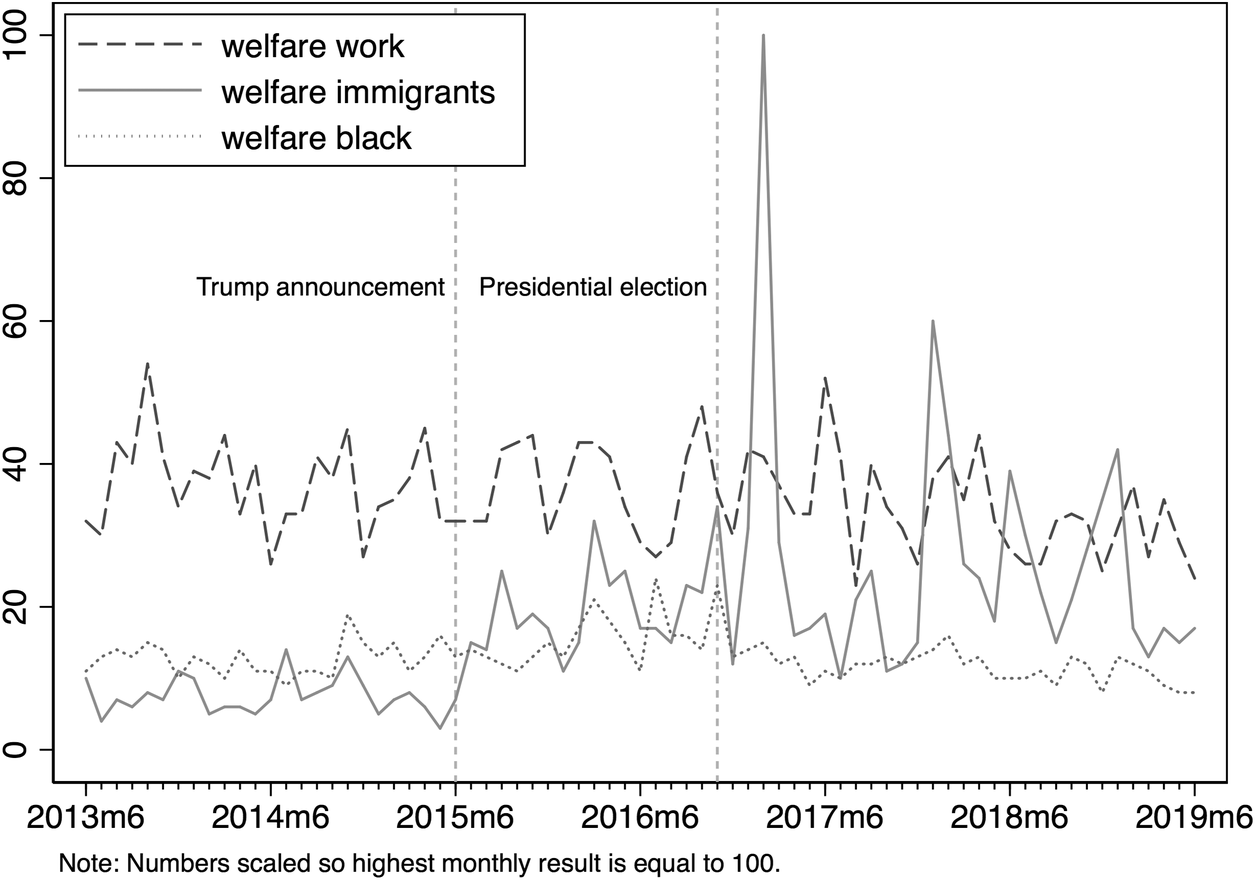
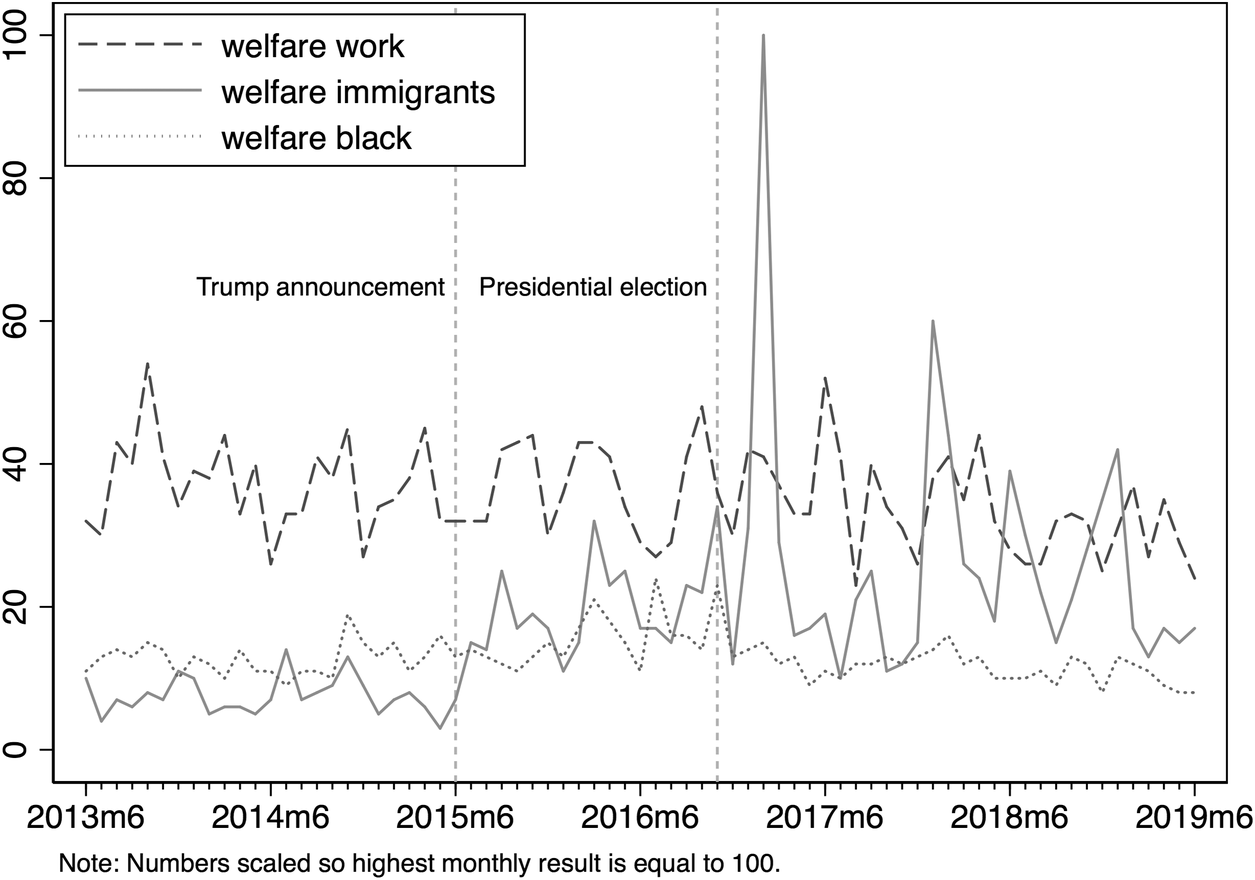
An analysis of internet search behavior underscores the increasing importance of immigrants as a perceived target population of social welfare policies. Figure 1 shows the monthly relative search frequency for three Google searches related to “welfare” for the period of June 2013 through June 2019 in the United States.Footnote 4 In addition to “welfare immigrants,” I include “welfare black,” in reference to a well-established perceived target population, and “welfare work,” since considerations of work and work ethic have been central to social welfare politics in the United States for decades.Footnote 5 The trends are striking⸺at least as measured by Google searches, immigrants have overtaken blacks as a salient target population of “welfare.” It appears that Donald Trump’s presidential campaign, election, and presidency, which have focused heavily on opposition to immigration and occasionally on restricting immigrants’ access to government benefits (e.g., Wegmann Reference Wegmann2019), are an important part of this story. In the twenty-three months prior to Trump’s announcement of his presidential campaign in June of 2015, searches for “welfare immigrants” exceeded searches for “welfare black” only twice.Footnote 6 In forty of the forty-eight succeeding months, “welfare immigrants” searches were more common. Prior to Trump’s election in November of 2016, searches for “welfare immigrants” had never exceeded searches for “welfare work” in the entire history of Google Trends data going back to 2004 (155 months); this happened seven times in the succeeding thirty-two months. Searches for “welfare black” have never exceeded searches for “welfare work.” Perceptions about immigrants and social welfare are clearly in need of greater scholarly attention.
Relative monthly frequency of Google search terms in the United States, June 2013 to June 2019
An important component of the question of how immigration affects welfare politics is whether the effects (if any) result from actual exposure to immigrant populations at the local level or the individual’s understanding of national trends. Some work has found that local-level exposure to immigration reduces welfare support, both in the United States (Abrajano and Hajnal Reference Abrajano and Hajnal2015, 14) and in Europe (Dahlberg, Edmark, and Lundqvist Reference Dahlberg, Edmark and Lundqvist2012; Eger and Breznau Reference Eger and Breznau2017), while some find that such contact reduces stereotypes about laziness (Fox Reference Fox2004) and makes citizens more amenable to redistribution (Burgoon, Koster, and Egmond Reference Burgoon, Koster and Egmond2012).
Most work in this vein, like most work that considers social welfare and immigration attitudes separately, focuses on the attitudes of white Americans. The findings of work on immigration that does contrast whites’ attitudes with those of minorities suggest that whites are unique in their views on that issue (Carter Reference Carter2019; Rocha et al. Reference Rocha, Longoria, Wrinkle, Knoll, Polinard and Wenzel2011). It is likely that they differ from minorities in their views of the relationship between immigration and social welfare as well.
The literature has convincingly established immigration and Latino or Hispanic population growth as important factors in American welfare politics. The missing ingredient, however, remains the same as it has been in the predecessor literatures on race and welfare in America, social construction of target populations, and immigration and welfare in Europe. We lack strong causal evidence about the conditions under which individuals come to associate policies with a given group. When and why do Americans assume welfare policy will benefit immigrants? In the following section, I develop a theoretical framework and offer a series of testable hypotheses related to these questions.
Theory and Hypotheses
I begin with a well-founded theoretical argument: that to form an evaluative opinion of a social welfare policy, many if not all individuals first need some idea of who benefits or would benefit from the policy. Without a picture of who will benefit, it will be difficult for many people to render a judgment on whether those people are deserving of assistance, a key consideration in public opinion on such programs. If explicit information about beneficiaries is not readily available, people will fill in the gaps by making educated guesses or assumptions.Footnote 7 In doing so, I argue that they are more likely to think about out-groups when they are salient or at the “top of one’s mind” (Zaller Reference Zaller1992), and that rhetoric or information that presents the out-group (specifically immigrants) as a threat, à la Abrajano and Hajnal (Reference Abrajano and Hajnal2015),Footnote 8 will raise its salience.
The question is what type of threat is most relevant. There is a debate within broader discussions of immigration politics over whether the more important perceived threat is to values, culture, and demographics, or to job security and wages. In the realm of social welfare, however, the relevant economic threat is not to the labor market, but to public resources⸺the concern is that immigrants will take advantage of the welfare state, and particularly that unauthorized immigrants will do so illegitimately (Brown Reference Brown2013a, Reference Brown2013b). Hainmueller and Hiscox (Reference Hainmueller and Hiscox2010) find that concerns about immigrants consuming social welfare resources drive anti-immigration sentiment,Footnote 9 while Hero and Preuhs (Reference Hero and Preuhs2007) present evidence that states with more inclusive welfare policies toward immigrants also tend to have lower benefit levels, suggesting that immigration has the potential to “erode” benefits for all residents. Anti-immigration advocates have used such arguments, highlighting immigrants’ relatively high use of social welfare programs (e.g., Camorata Reference Camorata2015). This is paired with the argument that immigrants, and particularly unauthorized immigrants, pay less in taxes than native-born Americans, as emphasized in a report from the Heritage Foundation, a prominent conservative think tank (Rector and Richwine Reference Rector and Richwine2013). Survey evidence suggests that Americans are concerned about immigrants paying their fair share in taxes (Crepaz Reference Crepaz2008, 244).
Of course, concerns about the changing culture and demographics of the United States⸺sometimes termed “acculturation fear”⸺ is a powerful force in explaining Anglo-Americans’ views about immigration levels (Branton et al. Reference Branton, Cassese, Jones and Westerland2011), and may also be relevant in the domain of social welfare. To the extent that such cultural fears include stereotypes about poor work ethic among Latinos, Hispanics, or immigrants (Fox Reference Fox2004; Branton et al. Reference Branton, Cassese, Jones and Westerland2011), the link to assumptions about welfare use is clear.
However the assumption is triggered, once an individual associates a specific outgroup with a social welfare policy, their attitudes about the policy will become linked to their attitudes about the group. In the present case, opposition to immigration or hostility to immigrants should be much more tightly linked to social welfare policy attitudes among people who assume policy would benefit immigrants than among people who do not.
Drawing on this framework and the insights of the existing literature, I generate a set of hypotheses that I pre-registered, along with the study design, on the Evidence in Governance and Politics (EGAP) website on July 14, Reference Haselswerdt2017, prior to any data collection (Haselswerdt Reference Haselswerdt2017).
The first two hypotheses deal with the effects of “threat” primes on individuals’ assumptions about social welfare beneficiaries. In particular, I am interested in the assumption that such policies will benefit immigrants to the exclusion of native-born Americans. I argue that this is the key assumption citizens can make regarding social welfare and immigration, since it suggests that an out-group is benefiting at the expense of an in-group. If a respondent assumes that both immigrants and natives will benefit, for example, immigration attitudes are presumably less relevant to evaluation of the program than if he or she assumes only immigrants will benefit.Footnote 10
-
H1: Americans who are primed to think about immigrants in a context of cultural or demographic threat will be more likely to assume that social welfare policies benefit immigrants to the exclusion of native-born Americans than will those who are not primed to think about immigrants.
-
H2: Americans who are primed to think about immigrants in a context of economic threat or fiscal burden will be more likely to assume that social welfare policies benefit immigrants to the exclusion of native-born Americans than will those who are not primed to think about immigrants.Footnote 11
The next two pairs of hypotheses express expectations about the conditionality of these experimental effects. First, I consider the possibility that these effects will be more pronounced among those with anti-immigration views, since such people should be more susceptible to immigration-related “threat” primes. On the other hand, it is also possible that these primes affect people across the spectrum of immigration attitudes in a similar manner⸺Pérez (Reference Pérez2016) demonstrates that implicit or unstated attitudes and stereotypes about immigrants and Latinos may be more important to public opinion than explicit attitudes expressed openly on survey questions, suggesting that many people with more “liberal” attitudes on immigration may nevertheless harbor implicit stereotypes about immigrants and work ethic.
-
H3a : The effect of the cultural/demographic threat prime on the assumption that social welfare policies benefit immigrants to the exclusion of native-born Americans will be strongest among those most opposed to immigration.
-
H3b : The effect of the economic/fiscal threat prime on the assumption that social welfare policies benefit immigrants to the exclusion of native-born Americans will be strongest among those most opposed to immigration.
Next, I consider the ways that experimental effects may vary by local context. The existing literature has produced conflicting arguments and expectations about whether “exposure” to a given out-group will make one more or less likely to view members of that group as a threat or as a relevant target population for social welfare programs (Abrajano and Hajnal Reference Abrajano and Hajnal2015; Burgoon, Koster, and Egmond Reference Burgoon, Koster and Egmond2012; Dahlberg, Edmark, and Lundqvist Reference Dahlberg, Edmark and Lundqvist2012; Eger and Breznau Reference Eger and Breznau2017; Fox Reference Fox2004). In this case, the focus is not on the direct effects of exposure, but whether such exposure makes one more or less susceptible to primes that evoke a threat narrative.
A number of patterns are plausible here. Perhaps people who live around large numbers of immigrants, Latinos, or HispanicsFootnote 12 are relatively tolerant and therefore more resistant to primes that cast immigrants as threatening or dependent. Conversely, perhaps frequent contact with such groups makes immigration salient, to the point where people living in such areas already assume social welfare programs benefit immigrants at the expense of native-born Americans, which would also blunt the effects of primes. I argue for a third possibility⸺contact with large immigrant populations should make immigrant target populations relatively accessible as a consideration in the minds of Americans, making them more susceptible to primes. This argument is similar to the “politicized places” hypothesis advanced by Hopkins (Reference Hopkins2010), which posits that local demographics shape immigration attitudes in combination with political information or frames.
-
H4a: The effect of the cultural/demographic threat prime on the assumption that social welfare policies benefit immigrants to the exclusion of native-born Americans will be strongest among those who live in regions where Latinos or Hispanics make up a relatively large part of the population.
-
H4b : The effect of the economic/fiscal threat prime on the assumption that social welfare policies benefit immigrants to the exclusion of native-born Americans will be strongest among those who live in regions where Latinos or Hispanics make up a relatively large part of the population.
The final hypothesis concerns the impact of assumptions about target populations on policy attitudes. Existing work convincingly establishes that views about immigration are important to Americans’ attitudes about social policy (Garand, Xu, and Davis Reference Garand, Xu and Davis2017). I argue that this relationship should exist only when the individual believes a policy will benefit immigrants, and particularly when it benefits them to the exclusion of native-born Americans. Absent such assumptions, there is no reason nativistic beliefs should influence social welfare attitudes. Indeed, work on so-called “welfare chauvinism” in Europe suggests that opponents of immigration may be especially favorable to social welfare programs if they believe the programs exclude immigrants (Andersen and Bjørklund Reference Andersen and Bjørklund1990; Koster, Achterberg, and Waal Reference Koster, Achterberg and van der Waal2012; Reeskens and Oorschot Reference Reeskens and van Oorschot2012; Waal et al. Reference Waal, Achterberg, Houtman, Koster and Manevska2010).
-
H5: When Americans assume a social welfare policy benefits immigrants to the exclusion of native-born Americans, their attitudes about immigration will become more important to their views of that social welfare policy as compared to similar Americans who do not make this assumption.
Experimental Design and Data
I test these hypotheses with a survey experiment focused on a generic social welfare policy. The experiment randomly exposes respondents to primes of fiscal and cultural threat related to immigration, measures whether these primes make them more likely to believe that immigrants (and not native-born Americans) will benefit from a generic social welfare policy, and allows me to determine if these assumptions make attitudes about immigration more important to respondents’ evaluations of the policy.
After exposing respondents to the randomly assigned primes (described later in this section), I present them with a brief description of the hypothetical policy (which would provide “government assistance in the form of extra money to help with living expenses” to “people with lower incomes”) and ask them whether they would approve or disapprove of the program, using a seven-point Likert scale.
The following question asks respondents what “groups in American society” would be most likely to benefit from the proposed program. Respondents were allowed to select multiple choices from a list of sixteen groups. To avoid forcing respondents to see the question strictly in terms of race, ethnicity, or citizenship, the list includes groups based on gender and economics (e.g., “Women,” “Poor people,” “Big business,” “Labor unions”) as well as race, ethnicity and national origin. The choices of interest are “Immigrants” and “Americans born in the United States.”Footnote 13 Recall that I am interested in the assumption that the policy will benefit immigrants and not Americans born in the United States, so the dependent variable in the analyses is a dichotomous variable coded “1” if the respondent selected “Immigrants” without also selecting “Americans born in the United States.”Footnote 14
A different potential approach would be to offer “illegal,” “unauthorized,” or “undocumented” immigrants, or perhaps “non-citizens,” as one of the categories, since so much rhetoric on immigration focuses on legality and citizenship. It is this very salience, however, that motivates my decision not to add any descriptors to the “immigrants” option. By avoiding loaded language in these response options, I hope to avoid blatantly priming respondents, especially those in the control group, to think about immigration if it is not already on their minds. Nevertheless, “illegal immigrants” are obviously a politically important target population, and an important consideration for future research in this direction.
Prior to these key questions, respondents were randomized into three treatment groups and presented with different combinations of priming questions. The “cultural threat prime” treatment group was asked the following question about driver’s license tests:
According to the U.S. Census, the number of people who speak a language other than English at home has increased by more than 158 percent since 1980.Footnote 15 Because of these changes, some states have begun offering the written portion of driver’s license tests in languages other than English. Do you agree or disagree with the idea that states should offer driver’s license tests in languages other than English?
The focus on languages other than English in this question is meant to prime concerns about the changing demographics of the United States.
The “fiscal threat prime” treatment group was posed the following question about tax enforcement: “A recent report by a policy research organization found that unauthorized immigrants pay much less in taxes than the average taxpayer.Footnote 16 Do you agree or disagree with the idea that the IRS should have greater resources to improve tax enforcement?”
The intention of both the cultural and fiscal threat primes is to evoke a sense of threat in the respondent. Recall that the theoretical argument of the study is that concerns about the threat posed by immigration will make immigrants more salient or accessible in a person’s mind when they think about social welfare programs. Neither prompt directly deals with immigrants’ use of social welfare policies, but both could evoke the connection: the cultural prime via its reference to driver’s licenses (a form of government identification that confers benefits and privileges), and the fiscal prime by raising concerns about immigrants failing to contribute to a state that may benefit them in unstated ways.
The goal of this experiment is to determine the impact of primes that relate to immigration specifically, but both treatments have the potential to raise other considerations about drivers’ licensing in one case and fiscal or tax issues in the other. To more precisely measure the impact of information that is related to immigration per se, the study includes “placebo” questions on driver’s licensing (about raising the minimum age for learner’s permits) and taxes (about generic tax enforcement) that have no content relevant to immigration. In the cultural threat treatment group, respondents also answered the tax enforcement placebo question, while in the tax treatment group, they answered the learner’s permit placebo question. This ensures that the differences between each of the two treatment conditions and the control group offers as clean an estimate as possible of the impact of the immigration-related prime.Footnote 17
Tests of H3a, H3b , and H5 require a measure of anti-immigration sentiment. I construct an index to tap these attitudes using a battery of five questions about immigration issues drawn from the 2012 American National Election Study (ANES).Footnote 18 The questions deal with deportation policy for unauthorized immigrants, allowing people who entered the United States illegally as children to become citizens, allowing immigration status checks on suspected unauthorized immigrants, the likelihood that immigrants will take jobs away from current citizens, and the appropriate level of legal immigration. Importantly, none of these questions deal with social welfare policy, making the index plausibly exogenous to social welfare attitudes. I generate the scale by standardizing the responses to each question to adjust for the varying size of answer scales, reversing scales as necessary so that higher values indicate more opposition to immigration, then adding the responses together and rescaling the resulting variable to range from 0 to 1.Footnote 19
Including a battery of immigration policy questions carries with it the risk of unintentional priming effects. If the immigration policy items make immigration a salient consideration for all respondents, it could interfere with the intentional priming effects of interest in the experimental treatments. To avoid this, I placed the battery of immigration questions at the end of the survey, after the experiment, the beneficiary group question, and the social welfare policy question. This choice carries with it an important trade-off: the potential for post-treatment bias (Montgomery, Nyhan, and Torres Reference Montgomery, Nyhan and Torres2018), where a variable used as a moderator is potentially influenced by the treatment questions. I conducted a follow-up study with a different survey flow to explore the implications of these ordering choices (refer to online appendix F).
Another possible approach to measuring immigration-related opinion would be to directly measure respondents’ attitudes about the relevant target group (immigrants or Latinos and Hispanics) rather than about immigration policy. Immigration policy attitudes may indirectly tap implicit attitudes about Latinos in any case (Pérez Reference Pérez2016), but it is possible that different patterns in assumptions and social policy attitudes would emerge if a more direct measure were used. I use immigration policy attitudes here because I am especially interested in the linkage between immigration policy and social policy in Americans’ minds, but explore an alternative measurement strategy (directly tapping positive or negative feelings about immigrants) in the follow-up study (refer to online appendix).
I test H4a and H4b by including the Hispanic population percentageFootnote 20 in the respondent’s ZIP (postal) code (captured as embedded data), derived from American Community Survey (ACS) ZIP Code Tabulation Area (ZCTA) five-year estimates from 2017, divided by its standard deviation to ease interpretation. I chose this measure, which is included in the pre-registration details, since the size of the local Hispanic or Latino population is likely to be the most visible or salient clue for most citizens about how many actual immigrants live near them. When considering this variable, it may be appropriate to think of individual survey respondents as being nested within geographic regions rather than as independent observations, so I employ state-clustered standard errors and state fixed effects in some specifications.Footnote 21
Of course, anti-immigration attitudes and geographic factors are likely correlated with other factors that could influence policy assumptions and approval, most notably general liberal-conservative ideology, party identification, and attitudes about non-immigrant minority groups. The survey includes measures of ideology and party identification (using seven-point scales), as well as respondent race and ethnicity,Footnote 22 gender, age, income, education, and the national origin of the respondent and his or her parents. I also include the standard battery of four questions used to measure “symbolic racism” or “racial resentment” (Henry and Sears Reference Henry and Sears2002) among whites toward blacks, since this scale is a consistently powerful predictor of welfare attitudes.Footnote 23 Responses to these questions are used as control variables where appropriate.Footnote 24
The completed sample of 2,209 self-reported U.S. citizens was recruited from an online panel with the aid of Qualtrics, a survey research firm. Quotas were used to ensure national representativeness in terms of gender (52% female), age (13% 18–24, 35% 25–44, 35% 45–64, 17% 65 and older), and education (13% some high school or less, 30% high school graduate, 29% some college, 18% college graduate, and 10% graduate school degree). The sample is either representative or close to representative of the American public on key attitudinal dimensions (including anti-immigration attitudes), though the respondents are less partisan than the public. In terms of demographics, Hispanics or Latinos are somewhat underrepresented.Footnote 25 The survey was conducted July 19–25, 2017. The median time to completion was 5 minutes and 39 seconds, and 30 respondents who completed the survey in less than one-third of that time were dropped to ensure the quality of responses.Footnote 26
Results
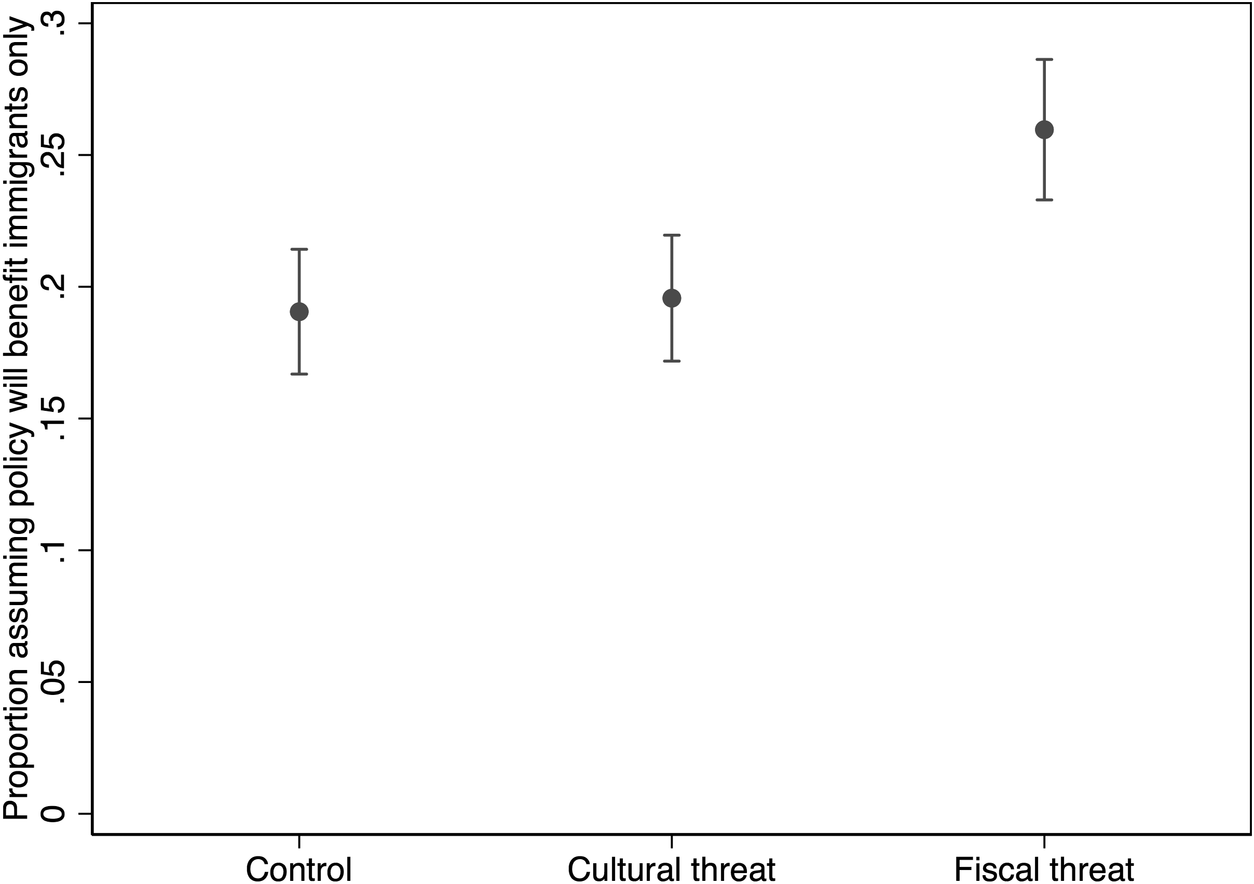
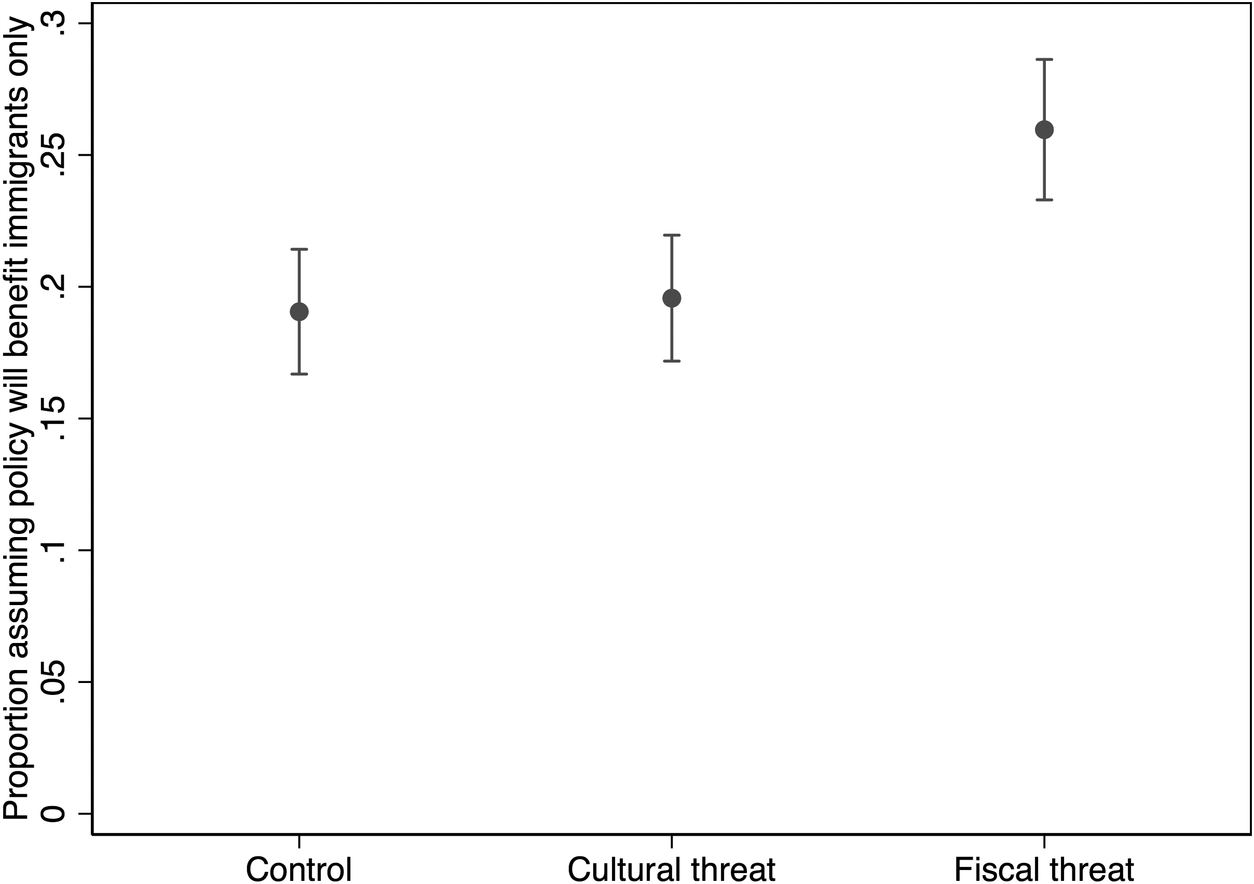
I begin by testing H1 and H2 with a simple comparison of the treatment groups, as displayed in figure 2.Footnote 27 In the control group, about 19% of respondents assumed the described policy would benefit immigrants but not people born in the United States. The cultural threat prime does not seem to have had any appreciable effect on this assumption, indicating that H1 is not supported. Statistics about linguistic trends do not, then, appear to motivate specific concern about immigrants as a target population of social welfare programs.Footnote 28 H2 finds ample support, however⸺almost 26% of the respondents in the fiscal threat group made the assumption, a substantively meaningful and statistically significant (p=.002)Footnote 29 jump of seven percentage points. Priming respondents to consider the fiscal implications of unauthorized immigration, a common argument among right-leaning policy organizations, increases the proportion who consider immigrants a primary target of social welfare policy by more than one third.Footnote 30
Proportions of respondents assuming described policy benefits immigrants to the exclusion of native-born Americans, by experimental condition, with 90% confidence intervals
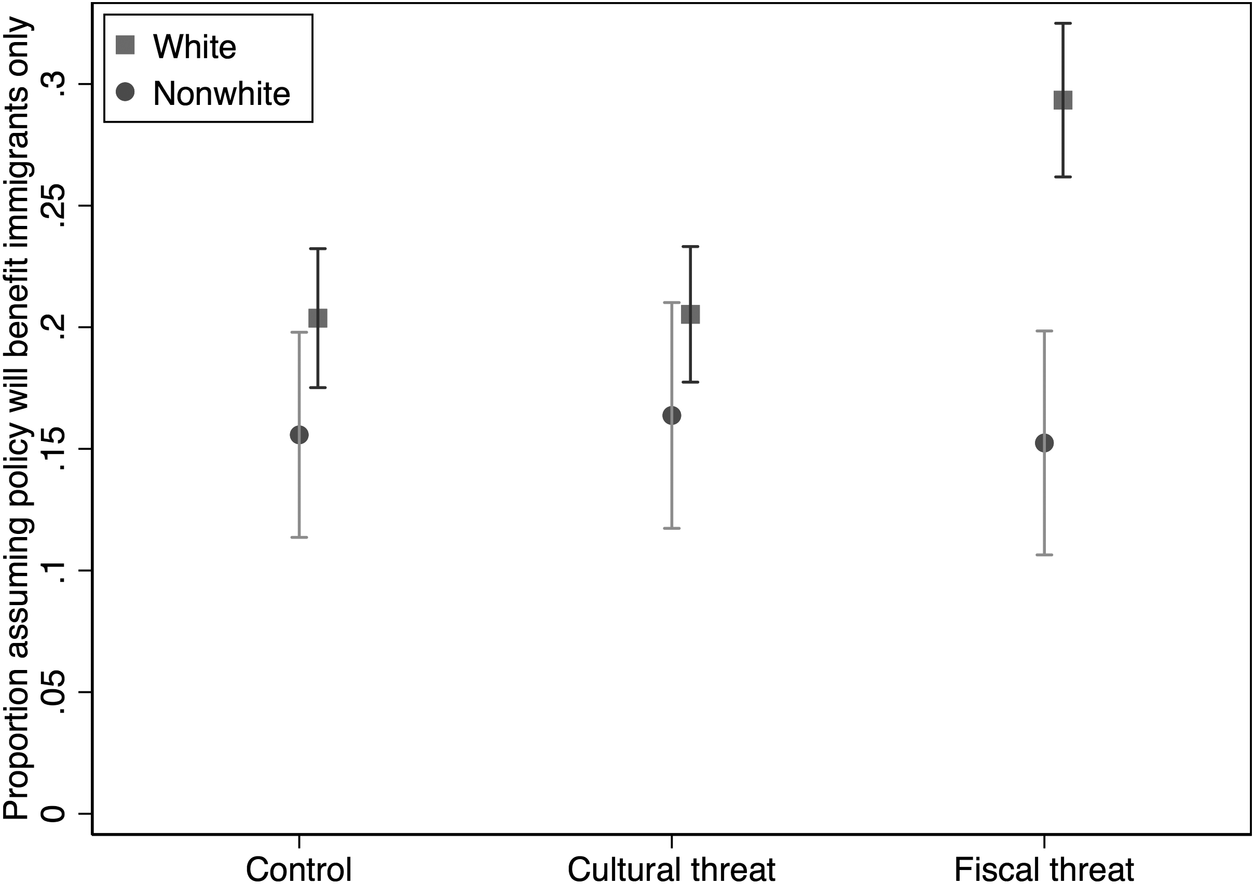
Before moving on, I investigate whether these experimental effects differ among non-Hispanic whites as compared to non-whites.Footnote
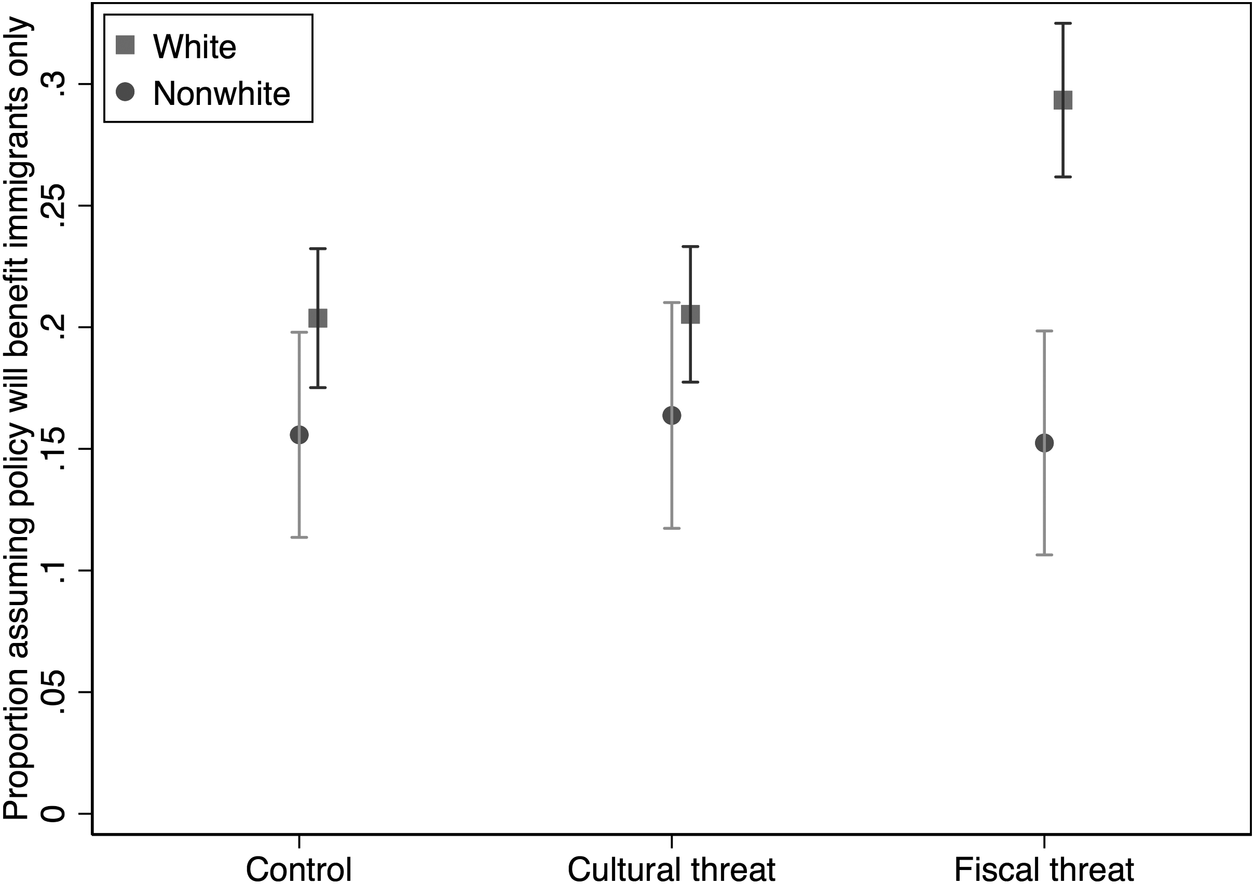
31 Figure 3 displays the proportion of respondents that assumed the policy would benefit immigrants and not native-born Americans by experimental group and race or ethnicity. The experimental effects observed in figure 2 seem to be concentrated among non-Hispanic whites. In the control and cultural threat prime conditions, non-Hispanic whites (20.5%) were modestly more likely to make the relevant assumption than nonwhites (15.9%, p=.06). In the fiscal threat prime condition, this gap widens considerably, with 29.4% of non-Hispanic white respondents assuming the policy will benefit immigrants alone while only 15.2% of non-white respondents do so (p
 $$ < $$
.001). The fiscal threat prime had no discernible effect on non-white respondents but made non-Hispanic whites more than 40% more likely to identify immigrants and not people born in the United States as likely beneficiaries. This is consistent with recent work showing that African Americans (Carter Reference Carter2019) and Hispanic Americans (Rocha et al. Reference Rocha, Longoria, Wrinkle, Knoll, Polinard and Wenzel2011; Abrajano and Lundgren Reference Abrajano and Lundgren2015) have fundamentally different views of immigration than non-Hispanic whites.
Proportions of respondents assuming described policy benefits immigrants to the exclusion of native-born Americans, by experimental condition and race or ethnicity, with 90% confidence intervals
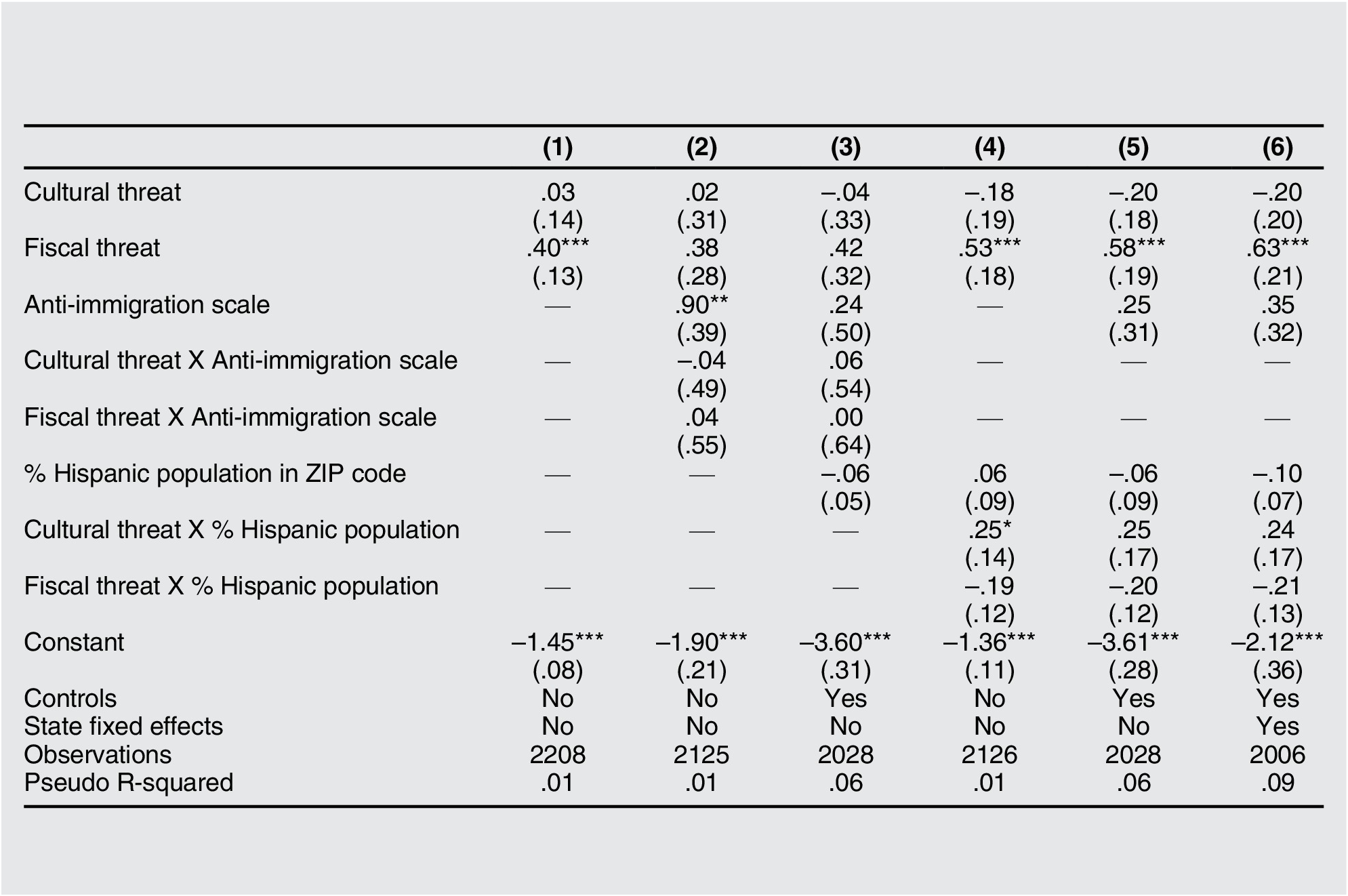
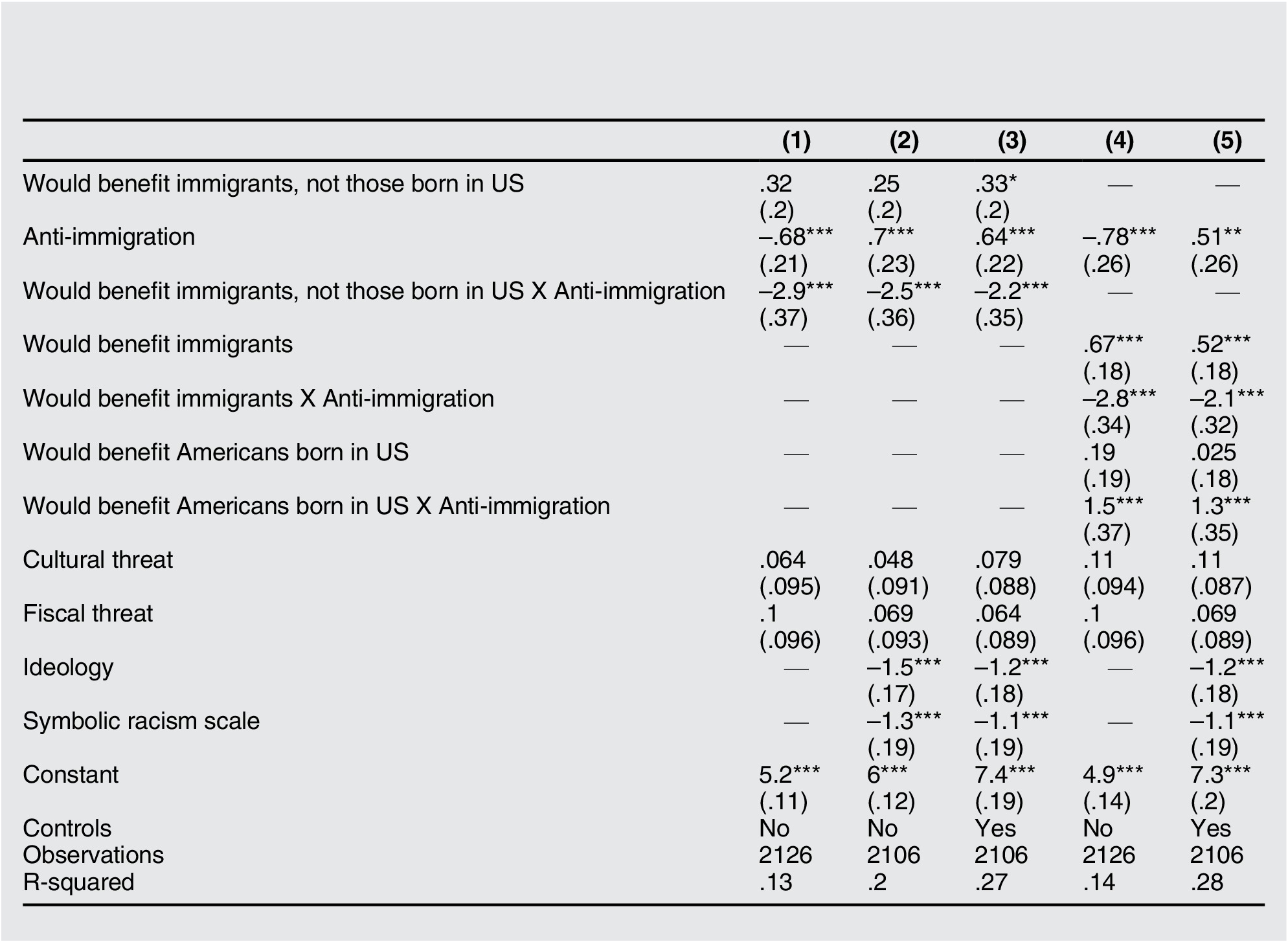
Next, I test for the conditional effects expected by H3a , H3b , H4a , and H4b. Table 1 displays the results of logistic regressions using the assumption that the policy would benefit immigrants to the exclusion of native-born Americans as the dichotomous dependent variable. The results of Model 1, which includes no covariates, mirror the simple tests reported above. Models 2 and 3 test H3a and H3b by investigating possible interactive effects of anti-immigration attitudes with the experimental treatments. These results indicate no support for the hypotheses⸺there is no evidence that those with anti-immigration views were especially susceptible to these primes. This suggests that the cognitive shortcuts that produce assumptions about target populations may be unconditional on seemingly relevant attitudes.Footnote 32 The results of Model 2 suggest a strong direct effect of anti-immigration attitudes on the probability of the assumption, though this apparent effect disappears when control variables are included.Footnote 33
Logit models of the assumption that the described policy will benefit immigrants and not native-born Americans, with state-clustered standard errors
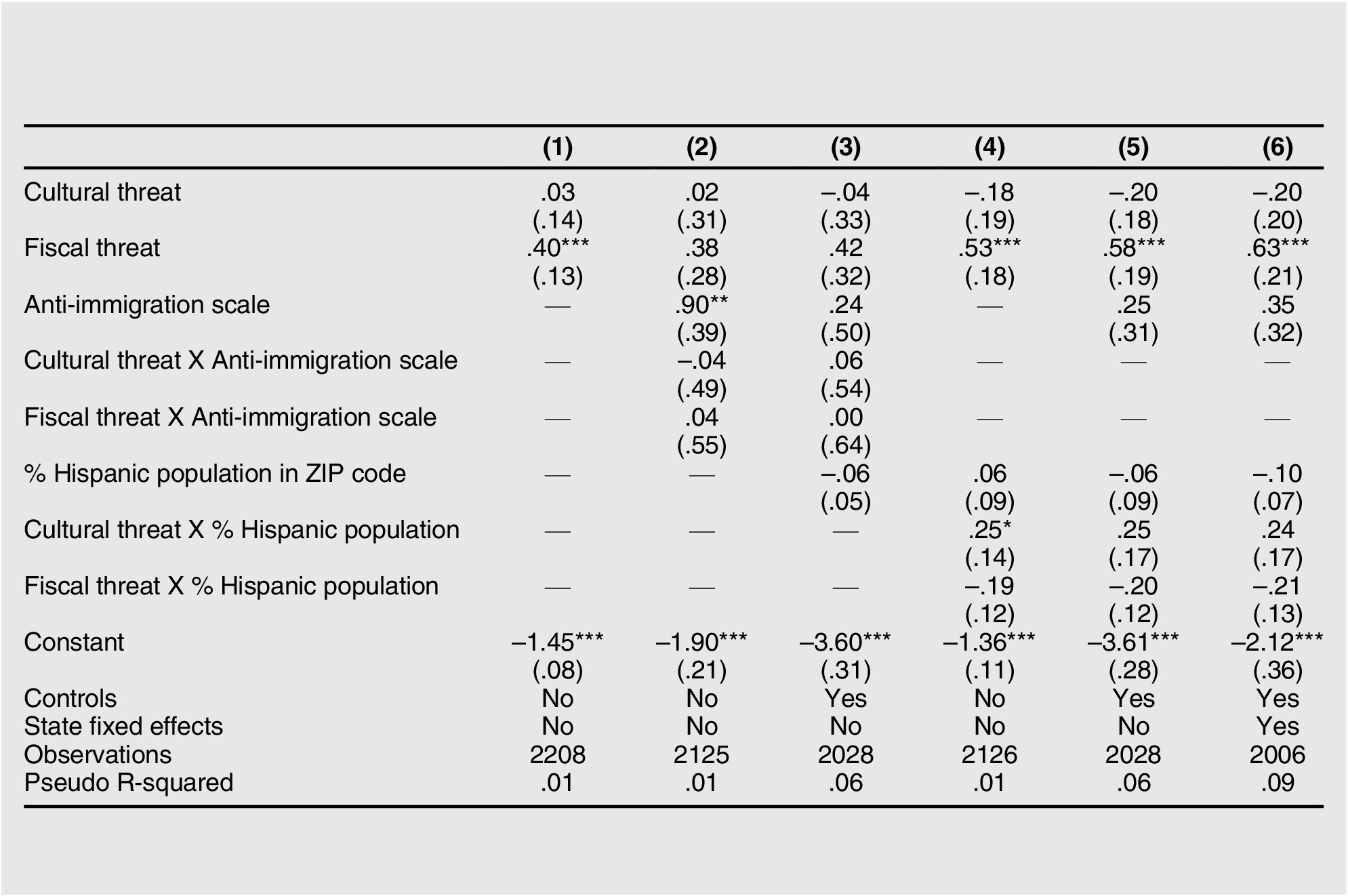
Standard errors in parentheses
Hispanic population percentage measured in standard deviations
* p<0.1, ** p<0.05, *** p<.01
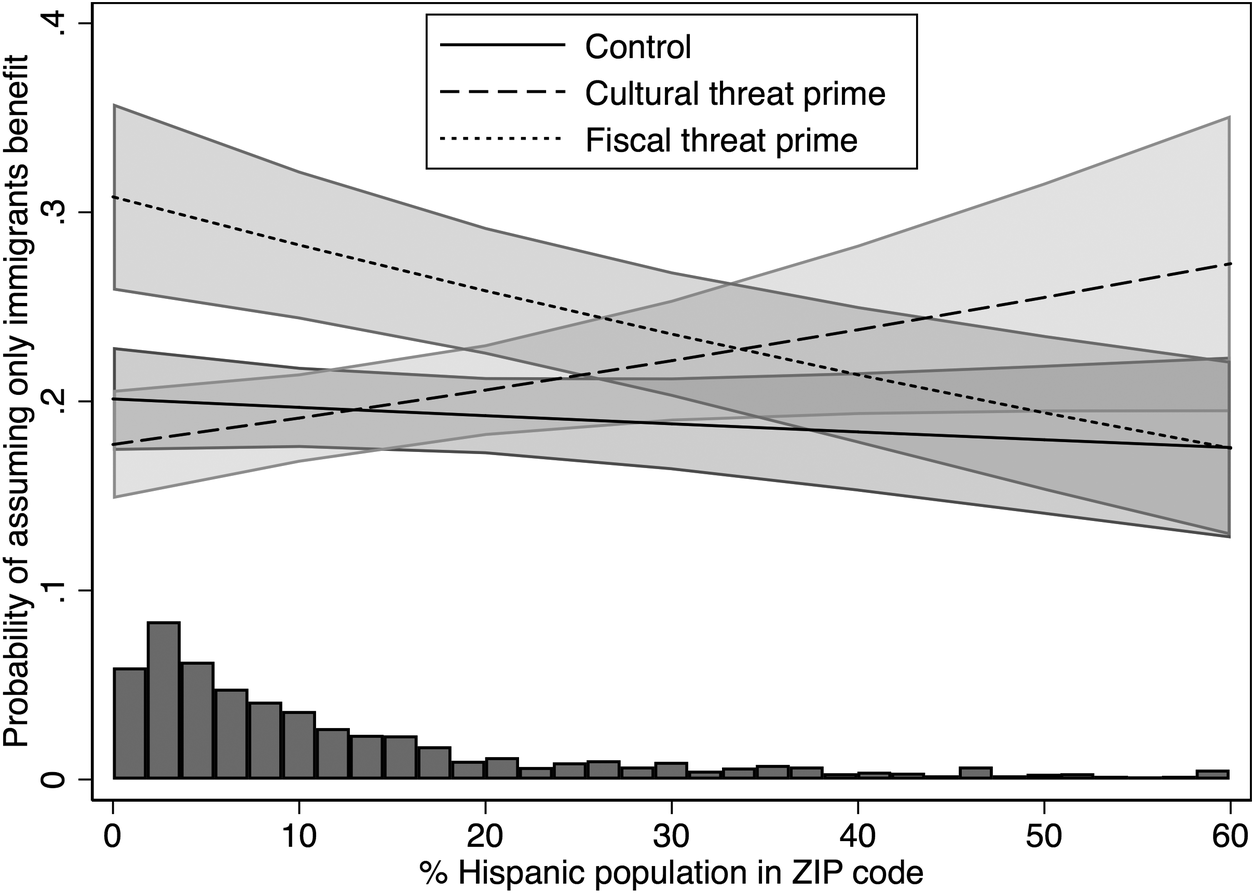
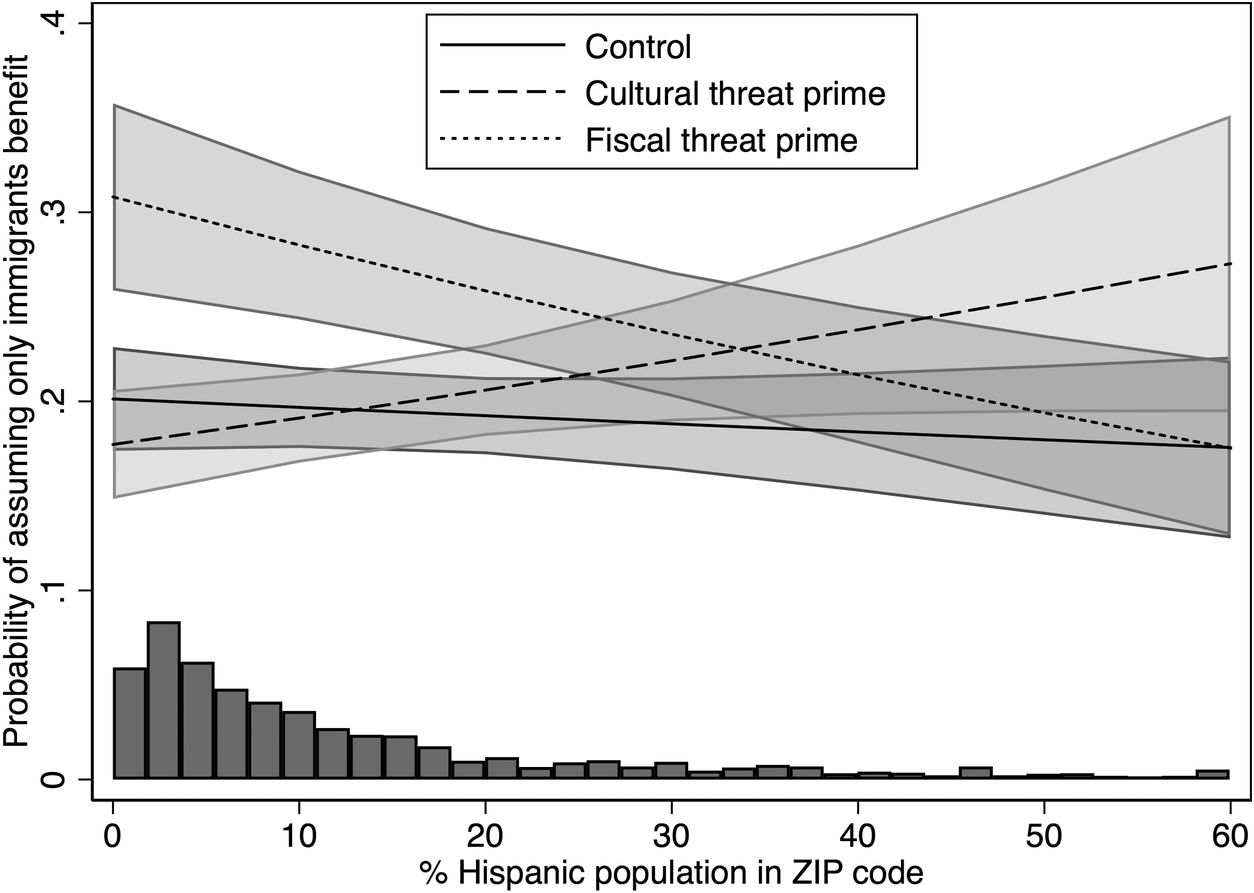
The evidence for conditionality on exposure to Latinos or Hispanics is more compelling. Model 4 presents the results of a model with interaction terms of the treatments with standardized ZIP code Hispanic population, Model 5 adds control variables, and Model 6 adds state fixed effects. The results of these models seem to support H4a : the cultural threat prime, which had a statistically insignificant effect on the full sample, increases the likelihood of assuming that the policy will benefit immigrants for respondents who live in areas with larger Hispanic populations. Interestingly, and contrary to H4b , the coefficient for the fiscal threat prime interaction term is negative. While the p-values for the latter interaction term exceed conventional thresholds for statistical significance,Footnote 34 Brambor, Clark, and Golder (Reference Brambor, Clark and Golder2006) demonstrate that tables and p-values are insufficient for determining statistical significance of categorical-by-continuous interactions. Figure 4 displays predicted probabilities (with 90% confidence intervals) of making the assumption across the three treatment groups and the range of the Hispanic population variable (drawn from Model 5), overlaid with the frequency distribution of that variable (note that the figure uses the unstandarized percentage). The fiscal threat prime has a powerful effect for the majority of respondents who live in low-Hispanic-population areas, but this effect diminishes to insignificance for the minority who live near larger Hispanic populations. By contrast, the cultural threat prime has no effect among those in low-Hispanic-population areas but may make people in very high-Hispanic-population areas more likely to assume that the policy benefits immigrants to the exclusion of native-born Americans. It is also interesting to note that in the absence of either prime, the local Hispanic population has no apparent effect on the assumption (p=.51).Footnote 35 In terms of the magnitude of effects, in a ZIP code with no Hispanic residents, the model predicts that a respondent in control has a 20% chance of making the assumption, compared to a 17% chance for a respondent in the cultural threat condition and a 31% chance for a respondent in the fiscal threat condition. In a ZIP code with a Hispanic population two standard deviations above zero (about 38%), the model predicts that a respondent in control has an 18% chance of making the assumption, compared to 24% in the cultural threat condition and 22% in the fiscal threat condition. These interactions are modest in magnitude and not very reliably estimated, but they suggest the need for more theoretical and empirical work on how economic threat, cultural threat, and exposure to ethnic out-groups work in relation to one another in the realm of social welfare attitudes.Footnote 36
Predicted probability of assuming described policy benefits immigrants to the exclusion of native-born Americans, by experimental condition and local Hispanic Ppopulation, with 90% confidence intervals.
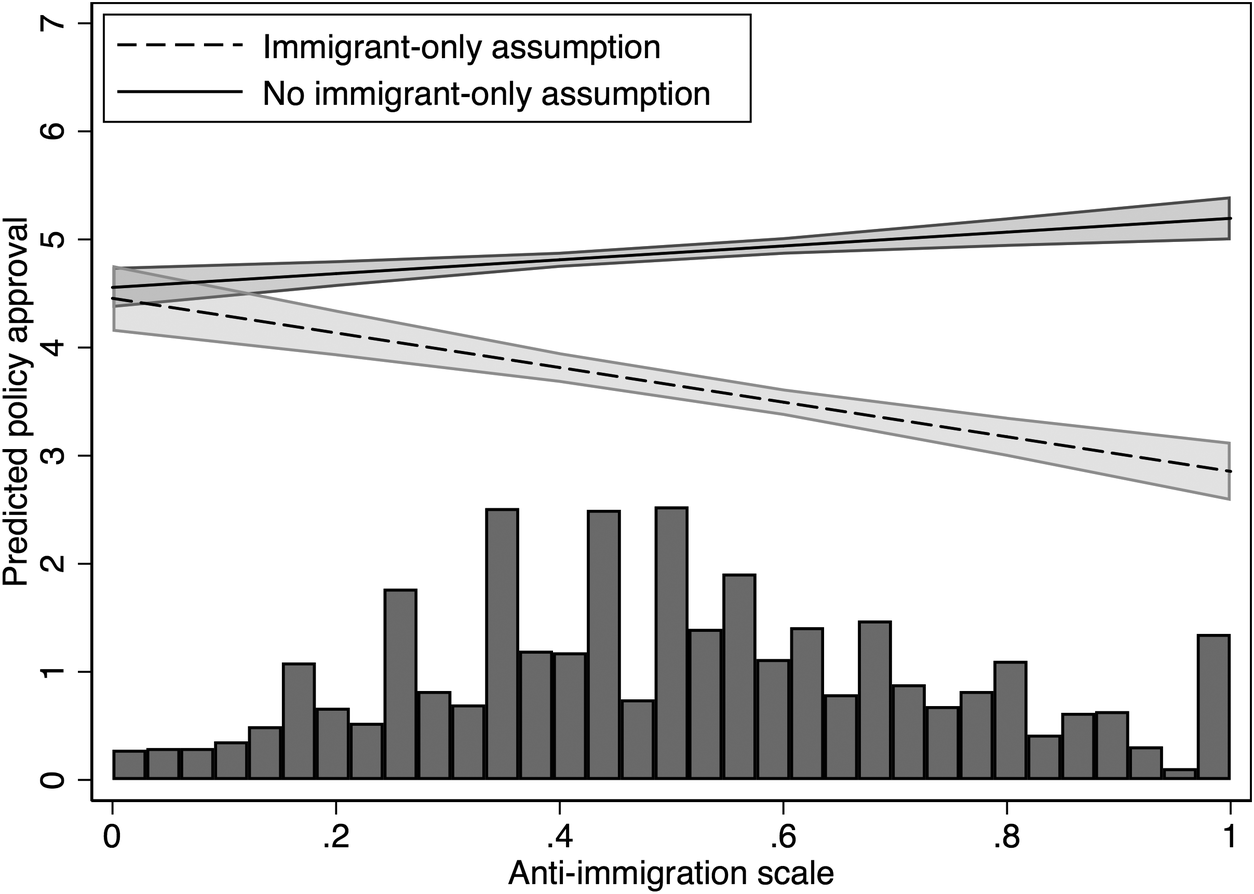
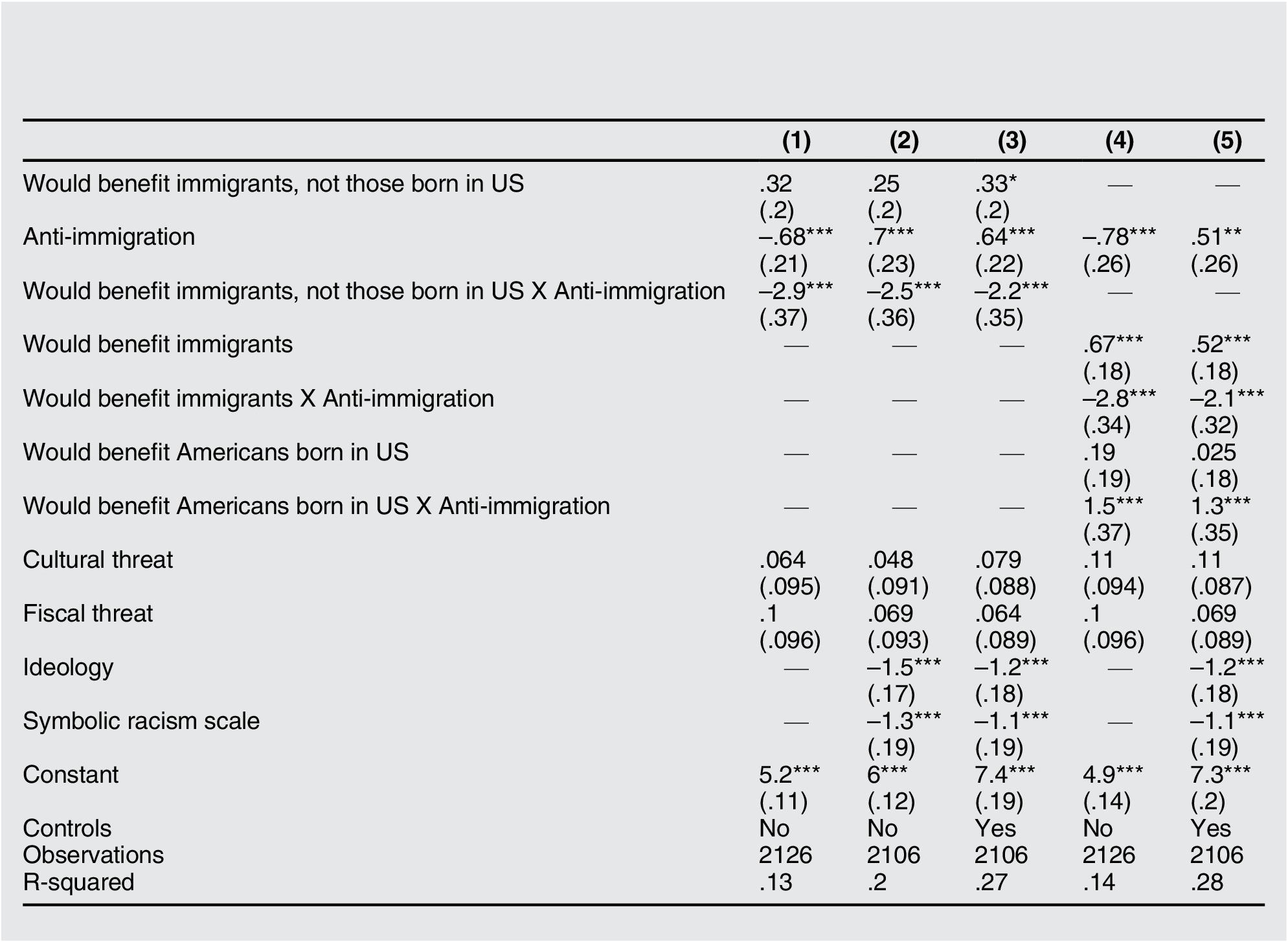
Next, I consider the implications of these target group assumptions for approval of the described policy. Table 2 displays the results of linear regressions (with robust standard errors) of policy approval on the dummy variable indicating the assumption that the policy benefits immigrants to the exclusion of those born in the United States, the anti-immigration attitude scale, and an interaction term of these two variables. Treatment group indicators are also included, along with attitudinal covariates in Model 2 and the full set of controls in Model 3. The results provide strong support for H5: anti-immigration attitudes are far more important to social welfare policy approval when individuals make this assumption about target groups.Footnote 37 At higher levels of opposition to immigration, the assumption has an effect of over two points on the seven-point scale, greater than a full standard deviation. The interactive relationship is illustrated graphically in figure 5, overlaid with the frequency distribution of the anti-immigration scale. The two experimental primes had no direct effects on policy approval; it appears that the only causal pathway through which such primes affect policy approval is by affecting target group assumptions.Footnote 38
Linear regression models of policy approval, with interaction terms and robust standard errors
Standard errors in parentheses
* p<0.1, ** p<0.05, *** p<.01
Predicted policy approval by target group assumption and anti-immigration attitudes, with 90% confidence intervals

The results for the anti-immigration scale constituent term are also noteworthy. In Model 1, with no control variables, it appears that opposition to immigration has a statistically significant negative effect on social welfare policy approval even when the respondent does not make the assumption about immigrant beneficiaries. When ideology and symbolic racism are added in Models 2 and 3, however, the sign reverses and anti-immigration views appear positively related to policy approval. This suggests that the apparent negative relationship in Model 1 was an artifact of the anti-immigration scale’s correlation with other attitudes. When we take general ideology and symbolic racism into account, opposition to immigration does not depress support for social welfare unless the respondent believes the policy will be especially beneficial to immigrants.
If anything, opposition to immigration (as distinct from general conservative ideology and symbolic racism) may predict increased support for social welfare spending when the respondent assumes the primary beneficiaries will be native-born. To further explore this apparent “welfare chauvinism” pattern, Models 4 and 5 in table 2 include separate interaction terms of assumptions with the anti-immigration scale: one for the assumption that the policy would benefit immigrants, and one for the assumption that it would benefit those born in the United States.Footnote 39 The results suggest that the welfare chauvinism pattern is real: not only does assuming immigrants will benefit make anti-immigration respondents less likely to support the policy, the assumption that those born in the United States will benefit makes them more supportive.Footnote 40 Even in the absence of either assumption, anti-immigration attitudes are positively and significantly related with welfare support. Of course, two caveats apply to the Model 4 findings. First, the analysis was not pre-registered. Second, these are ceteris paribus findings, controlling for ideology and symbolic racism.Footnote 41 While the data suggest that there are nontrivial numbers of Americans whose attitudes on immigration are independent of these other factors, they are still correlated. In practice, many immigration opponents would likely oppose social welfare policies due to their general conservatism or their attitudes about blacks, even if they believed immigrants would not benefit and native-born Americans would.
Taken together, these findings underscore the importance of considering attitudes about immigration per se as a distinct factor explaining social welfare attitudes (Garand, Xu, and Davis Reference Garand, Xu and Davis2017), and reinforce the arguments of Schneider and Ingram (Reference Schneider and Ingram1993) that perceptions of target groups are crucial to understanding the way the public thinks about policies.
Discussion and Conclusion
Americans’ perceptions of who benefits from government aid are clearly relevant to the politics of social welfare. This study demonstrates that these perceptions are malleable: certain primes or information can lead some Americans to assume that a social welfare policy will benefit immigrants to the exclusion of native-born Americans. In a pre-registered survey experiment with a national sample that is representative on key dimensions, I find that a common anti-immigration talking point–that unauthorized immigrants pay less in taxes than American citizens–makes respondents more likely to assume that a described social welfare policy benefits immigrants but not native-born Americans.Footnote 42 Information about linguistic changes meant to prime cultural threat may have had a similar effect, but only for certain respondents.Footnote 43 Importantly, these effects were not conditional on attitudes about immigration⸺respondents who expressed general hostility to immigration were not more or less receptive to these primes than pro-immigration respondents. This is consistent with the arguments of Pérez (Reference Pérez2016) on the importance of implicit attitudes or stereotypes in immigration opinion⸺even outwardly “liberal” Americans may harbor such unexpressed stereotypes.
There was evidence that effects varied by local context, however. The effect of the economic threat prime on assumptions was strongest among those in areas with low concentrations of Hispanic residents, and weakened among those in high-Hispanic-population areas. This suggests that it may be easier to shape the perceptions of those with little actual exposure to immigrants (or ethnic populations likely to be perceived as immigrants) with arguments and information about the fiscal impact of immigration. By contrast, while the cultural threat prime had no effect on most respondents, it may have made those near large Hispanic populations more likely to assume that the policy would benefit immigrants to the exclusion of native-born Americans. It is possible that exposure to ethnic (or perhaps linguistic) outgroups makes considerations about cultural change more accessible to citizens, making their assumptions about policy more susceptible to cultural threat primes. These findings are especially interesting in light of the arguments and findings of Hopkins (Reference Hopkins2010) and Abrajano and Hajnal (Reference Abrajano and Hajnal2015) on immigration and threat, and to the larger debate about how exposure to outgroups shapes social welfare attitudes.
Whatever may trigger assumptions about immigrant beneficiaries, there is little doubt that the assumption matters for policy attitudes. Attitudes about immigration appear unrelated to social welfare attitudes (all else equal) when the respondent does not assume that immigrants will benefit, but when they do, opposition to immigration becomes a powerful predictor of opposition to welfare. There is also evidence that anti-immigration attitudes are correlated with social welfare support, all else equal, especially when the respondent assumes native-born Americans will benefit. This pattern is consistent with “welfare chauvinism,” a phenomenon mostly associated with European politics (e.g., Andersen and Bjørklund Reference Andersen and Bjørklund1990; Koster, Achterberg, and Waal Reference Koster, Achterberg and van der Waal2012; Reeskens and Oorschot Reference Reeskens and van Oorschot2012; Waal et al. Reference Waal, Achterberg, Houtman, Koster and Manevska2010). These findings and those of Jardina (Reference Jardina2019) suggest that scholars of American welfare politics should pay attention to beliefs about in-groups as well as prejudice towards out-groups.
How well does this survey experiment generalize to the real-life politics of immigration and social welfare? While there is always some artificiality in the presentation of primes in this sort of study, the primes were selected to be reflective of arguments and data presented by real political actors, such as the Heritage Foundation. The question tapping assumptions of target population was carefully designed to avoid obtrusively forcing considerations of race, ethnicity, or immigration on the respondent. Moreover, the work of Garand, Xu, and Davis (Reference Garand, Xu and Davis2017) and the web search analysis presented in Figure 1 indicate that the patterns discussed in this study are highly relevant to social welfare attitudes in the modern United States.
This research speaks to a larger question: has increasing immigration undermined American political support for the welfare state? These results suggest that it may have, but only for a minority of the population. Recall that the key assumption of the policy benefiting immigrants to the exclusion of those born in the United States was made by only 21.5% of respondents overall, and only 26% of those who received the fiscal threat prime. Overall, support for the generic social welfare policy was moderately strong, with a mean of 4.6 and a median of 5 (“approve somewhat”) on the 7-point scale. Only 27.5% of respondents expressed disapproval, and fewer than 10% strongly disapproved, compared to 21% that strongly approved (the modal answer). Among non-Hispanic whites, these approval numbers are only slightly weaker. Nevertheless, we should not underestimate the importance of these dynamics among the subset of the public that does associate these policies with immigrants and links their social welfare attitudes to their views about immigration. Recent history demonstrates that the most conservative subset of voters and activists wield real power in American politics due to high levels of organization and mobilization, particularly in Republican primary elections. As opposition to immigration becomes a more and more salient part of the Republican platform and conservative ideology, these patterns are likely to become more important to public policy.Footnote 44
For advocates and leaders seeking to promote tolerance of immigrants or support for social welfare programs, the findings suggest an important focus: the perception of immigrants as contributing less than their fair share in taxes. Countering this perception with information about the contributions that documented and undocumented immigrants do make to the tax base (e.g., Gee et al. Reference Gee, Gardner, Hill and Wiehe2017; Denhart Reference Denhart2017) could help to both combat stereotypes about immigrants as a drain on government and distance social welfare from the immigration issue.
These findings also suggest several avenues for future work. Are economic or fiscal arguments generally more powerful than cultural ones in the politics of social welfare and immigration, or is this finding specific to the treatments tested here? What are the mechanisms that link local-level exposure to immigrant populations, rhetoric about threat, and assumptions about social welfare? Do these patterns work differently when Americans are asked to consider “undocumented” or “illegal” immigrants, as opposed to immigrants in general? How real, and how consequential, is American welfare chauvinism, given that so many Americans who are hostile to immigration are also ideologically conservative and supportive of Republican politicians? Future work should also examine where American-born racial and ethnic minorities, including Hispanic or Latino citizens, fit into this story. The findings of the present study suggest that the experimental effects are confined to white non-Hispanic respondents, but studies more squarely focused on minority populations are needed to probe the ways that nonwhites view immigrants relative to social welfare.
A list of permanent links to Supplemental Materials provided by the authors precedes the References section.
Supplementary Materials
To view supplementary material for this article, please visit http://dx.doi.org/10.1017/S1537592720002406.