Introduction
Cancer is considered a “we-disease” (Kayser et al., Reference Kayser, Watson and Andrade2007) given that it affects not only the patient but also the whole family system and its members (Rolland, Reference Rolland2005; Areia et al., Reference Areia, Major and Relvas2017). The terminal phase of a cancer is particularly demanding for the family as a whole (Walsh and McGoldrick, Reference Walsh, McGoldrick, Walsh and McGoldrick2004), and for individual family caregivers in particular, who may experience an emotional impact, psychological morbidity, and poor social, financial, spiritual, and physical well-being (Hudson et al., Reference Hudson, Remedios and Zordan2012).
In this field, recent studies show that family members of people with terminal cancer are susceptible to increased levels of burden, which may be related to a significant deterioration in quality of life (QoL) (Rha et al., Reference Rha, Park and Song2015) and to diminished mental health (Chua et al., Reference Chua, Wu and Wong2016). It is also worth noting that family members, regardless of their caregiving role (Areia et al., Reference Areia, Fonseca and Major2019), are likely to show equal or higher levels of psychological morbidity (e.g., depression) when compared with patients (Nipp et al., Reference Nipp, El-Jawahri and Fishbein2016), and this may be influenced by poorer family functioning (Nissen et al., Reference Nissen, Trevino and Lange2016; Areia et al., Reference Areia, Fonseca and Major2019).
Recognizing the challenges faced by families in the context of end-of-life and palliative care, the World Health Organization (WHO, 2002) advocates that patient and family should be considered a unit of care, and thus, a goal of palliative care must be identified as the improvement of QoL for families and its respective members. However, more than a decade after the establishment of palliative care guidelines (WHO, 2002), how to offer an optimal support to families in palliative care (Hudson et al., Reference Hudson, Remedios and Zordan2012) still remains unclear. Thus, the development and improvement of family/caregiver-focused interventions has become a research priority in palliative care (Hudson and Payne, Reference Hudson and Payne2011; Hudson et al., Reference Hudson, Zordan and Trauer2011).
Based on this evidence, the present study aims to review the current family/caregiver-focused interventions of people with terminal cancer in palliative care. As a specific goal, we sought to discover, describe and critically analyze these kinds of interventions as they are presented in the recent research literature. To attain this goal, systematic reviews of literature on palliative care psychosocial interventions were conducted, from which we retrieved the most significant family/caregiver-focused examples based on a pre-established criteria described in the next section.
Methods
This study contained three main steps: (1) an overview of systematic reviews of family/caregiver-focused psychosocial interventions in oncology contexts, (2) selection of family/caregiver-focused psychosocial interventions on the palliative care, and (3) analysis of the selected intervention programs. Each step is described below.
Step 1: Overview of systematic reviews
Step 1 consisted of an overview of systematic reviews of family/caregiver-focused psychosocial interventions in oncology contexts. Specifically, it was conducted systematic reviews of literature, considering specific guidelines to properly conduct and report overviews of systematic reviews (see Smith et al., Reference Smith, Devane and Begley2011; Li et al., Reference Li, Tian and Tian2012; Lunny et al., Reference Lunny, Brennan and McDonald2016) and the PRISMA statement (Moher et al., Reference Moher, Liberati and Tetzlaff2009) (see Supplementary Material).
The systematic review of literature search was conducted in four databases: Web of Science core collection, PsycINFO, SocIndex, and PubMED. The research strategy focused specifically on systematic reviews of literature of family/caregiver-focused psychosocial interventions in oncology contexts, through a combination of the following keywords: [(“systematic review of literature” OR “systematic review”) AND (“psychosocial interventions” OR “support interventions” OR “intervention programs”) AND (family OR caregiver) AND (“palliative care” OR “end-of-life care”)]. Other sources were considered, particularly additional systematic reviews of literature that were cited in other studies.
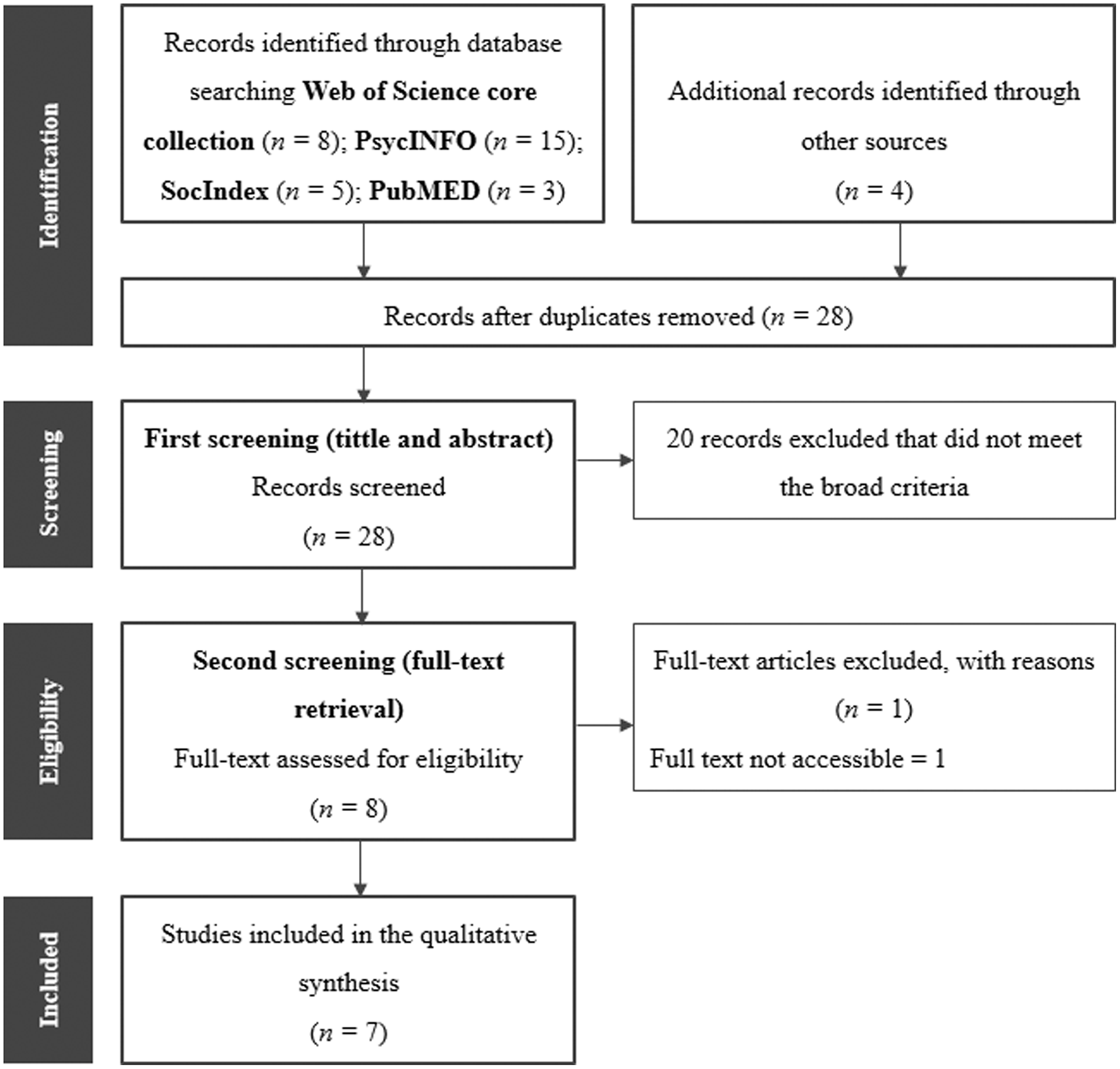
Following the database searches, duplicated records were identified and removed electronically, through EndNote (Thomson Reuters, USA). A total of 28 non-duplicated records were identified, of which 20 were excluded as clearly did not follow the broad goal of this study. The inclusion criteria for the selected studies were as follows: (a) empirical studies following a systematic review of literature design, conducted according PRISMA guidelines, (b) studies focused on family/caregiver-focused interventions, (c) studies focused on interventions developed for adult-cancer contexts, (d) studies that were published between 2008 and 2018, and (e) studies written in English. From the eight eligible studies for full-text examination, only one was excluded as its full text was not accessible. Therefore, seven systematic reviews of literature were included for further detailed analysis. Figure 1 displays a flowchart of the studies selection process.
Flowchart of the systematic reviews of literature studies selection process.

Step 2: Selection of family/caregiver-focused psychosocial interventions programs in palliative care
The seven selected systematic reviews of literature were examined in detail to properly identify and select the family/caregiver-focused psychosocial interventions programs that would be analyzed in Step 3. The following inclusion criteria for intervention programs’ selection were taken into account: (1) being a family/caregiver-focused intervention, (2) being delivered in palliative care contexts (home-based and/or hospice), (3) being delivered to caregivers/families of people with advanced/terminal cancer, and (4) interventions whose efficacy was tested through randomized controlled trials.
Step 3: Analysis of the selected family/caregiver-focused psychosocial interventions programs
Step 3 consisted of the analysis of the selected family/caregiver-focused interventions considering the following topics: (1) framework (e.g., psycho-educational, family-centered); (2) format: target, dosage, setting, professionals responsible for delivering the intervention, and the intervention's key elements (e.g., caregiver skills education); and (3) efficacy: outcomes, post-intervention assessment, and overall efficacy.
The topics selected for analysis were defined by two senior members (J.N.G. and A.P.R.) of the research team with relevant clinical expertise in the field. Topics more frequently appearing in the literature which present and evaluate the quality of psychosocial intervention programs were also addressed.
Each intervention was analyzed based on its author's original publication describing the program and evaluating its efficacy.
Results
Overview of systematic reviews and selection of intervention programs
From the systematic reviews of literature, seven studies were identified (Hudson et al., Reference Hudson, Remedios and Thomas2010; Northouse et al., Reference Northouse, Katapodi and Song2010; Harding et al., Reference Harding, List and Epiphaniou2011; Applebaum and Breitbart, Reference Applebaum and Breitbart2013; Waldron et al., Reference Waldron, Janke and Bechtel2013; Chi et al., Reference Chi, Demiris and Lewis2016; Fu et al., Reference Fu, Zhao and Tong2017) and were indicated by asterisks in the References section.
Nine intervention models met the inclusion criteria for further analysis in the third step of this study (Hudson et al., Reference Hudson, Aranda and Hayman-White2005, Reference Hudson, Trauer and Kelly2013; McMillan et al., Reference McMillan, Small and Weitzner2005; Kissane et al., Reference Kissane, McKenzie and Bloch2006; Walsh et al., Reference Walsh, Jones and Tookman2007; McLean et al., Reference McLean, Walton and Rodin2013; Mitchell et al., Reference Mitchell, Girgis and Jiwa2013; Northouse et al., Reference Northouse, Mood and Schafenacker2013; Dionne-Odom et al., Reference Dionne-Odom, Azuero and Lyons2015).
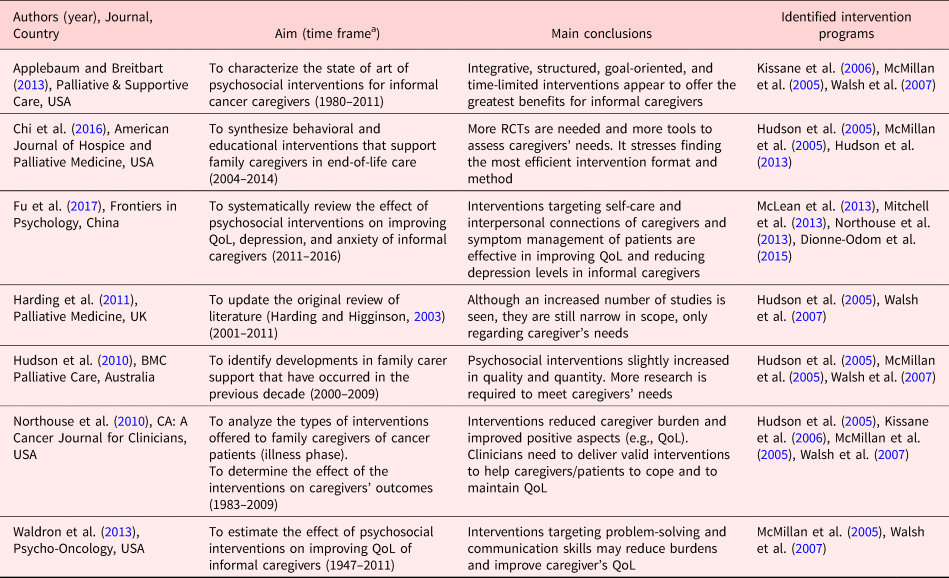
Table 1 displays the main characteristics of the systematic reviews (e.g., aims, main conclusions) and in which were identified the family/caregiver-focused interventions intervention programs.
Summary table of the reviews accounted for the study

a Period between which studies were selected for systematic/meta-analysis reviews.
Analysis of selected intervention programs
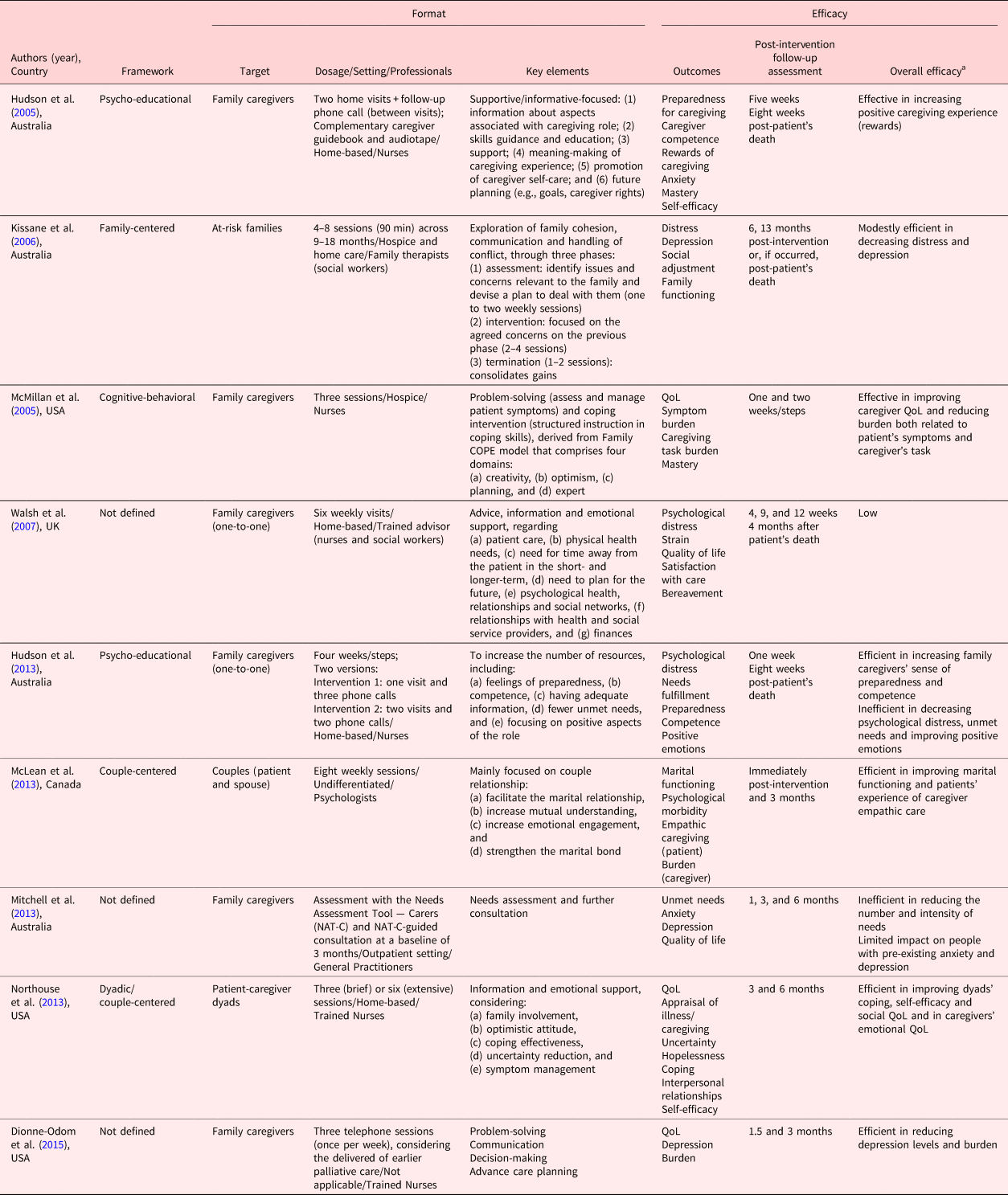
A detailed description of the selected psychosocial interventions is presented in Table 2.
Characteristics of family or caregiver-focused interventions

a Outcomes that showed no intervention effects are not displayed.
Investigation into the literature yielded the following intervention frameworks: two psycho-educational (Hudson et al., Reference Hudson, Aranda and Hayman-White2005, Reference Hudson, Trauer and Kelly2013); one cognitive-behavioral (McMillan et al., Reference McMillan, Small and Weitzner2005); one family-centered, Family-Focused Grief Therapy (FFGT) (Kissane et al., Reference Kissane, McKenzie and Bloch2006), two dyadic-based, Emotionally Focused Therapy (EFT) (McLean et al., Reference McLean, Walton and Rodin2013), and FOCUS (Family involvement, Optimistic attitude, Coping effectiveness, Uncertainty reduction, Symptoms management) (Northouse et al., Reference Northouse, Mood and Schafenacker2013); and three undefined (Walsh et al., Reference Walsh, Jones and Tookman2007; Mitchell et al., Reference Mitchell, Girgis and Jiwa2013; Dionne-Odom et al., Reference Dionne-Odom, Azuero and Lyons2015).
Regarding the format of the intervention programs, only FFGT (Kissane et al., Reference Kissane, McKenzie and Bloch2006) targeted the whole family system, whereas all other interventions targeted the individual primary caregivers (Hudson et al., Reference Hudson, Aranda and Hayman-White2005, Reference Hudson, Trauer and Kelly2013; McMillan et al., Reference McMillan, Small and Weitzner2005; Walsh et al., Reference Walsh, Jones and Tookman2007; Mitchell et al., Reference Mitchell, Girgis and Jiwa2013; Dionne-Odom et al., Reference Dionne-Odom, Azuero and Lyons2015) or the dyad patient-caregiver (McLean et al., Reference McLean, Walton and Rodin2013; Northouse et al., Reference Northouse, Mood and Schafenacker2013). Most of the interventions were brief in duration, specifically less than six sessions (Hudson et al., Reference Hudson, Aranda and Hayman-White2005, Reference Hudson, Trauer and Kelly2013; McMillan et al., Reference McMillan, Small and Weitzner2005; Walsh et al., Reference Walsh, Jones and Tookman2007; Mitchell et al., Reference Mitchell, Girgis and Jiwa2013; Northouse et al., Reference Northouse, Mood and Schafenacker2013; Dionne-Odom et al., Reference Dionne-Odom, Azuero and Lyons2015), home-based (Hudson et al., Reference Hudson, Aranda and Hayman-White2005, Reference Hudson, Trauer and Kelly2013; Walsh et al., Reference Walsh, Jones and Tookman2007; Northouse et al., Reference Northouse, Mood and Schafenacker2013) and delivered by nurses (Hudson et al., Reference Hudson, Aranda and Hayman-White2005, Reference Hudson, Trauer and Kelly2013; McMillan et al., Reference McMillan, Small and Weitzner2005; Walsh et al., Reference Walsh, Jones and Tookman2007; Northouse et al., Reference Northouse, Mood and Schafenacker2013; Dionne-Odom et al., Reference Dionne-Odom, Azuero and Lyons2015). Key elements of intervention models were very heterogeneous. Support, in terms of information (e.g., education for caregiving) was emphasized by Hudson et al. (Reference Hudson, Aranda and Hayman-White2005) and Hudson et al. (Reference Hudson, Trauer and Kelly2013). Coping skills training was the main consideration of McMillan et al. (Reference McMillan, Small and Weitzner2005). The intervention model proposed by Walsh et al. (Reference Walsh, Jones and Tookman2007) aimed at offering support in several areas (e.g., financial and future planning, information on patient care) without a centralized focus. Mitchell et al. (Reference Mitchell, Girgis and Jiwa2013) offered routinely consultations to address and discuss unmet needs. The FFGT (Kissane et al., Reference Kissane, McKenzie and Bloch2006) focused on family functioning, more specifically, on family cohesion, communication, and conflict resolution. The EFT (McLean et al., Reference McLean, Walton and Rodin2013) targeted the couple's dynamics. The FOCUS (Northouse et al., Reference Northouse, Mood and Schafenacker2013) contemplated both information and emotional support. Finally, the ENABLE (Dionne-Odom et al., Reference Dionne-Odom, Azuero and Lyons2015) privileged problem-solving, communication, decision-making, and advance care planning in its telephone sessions.
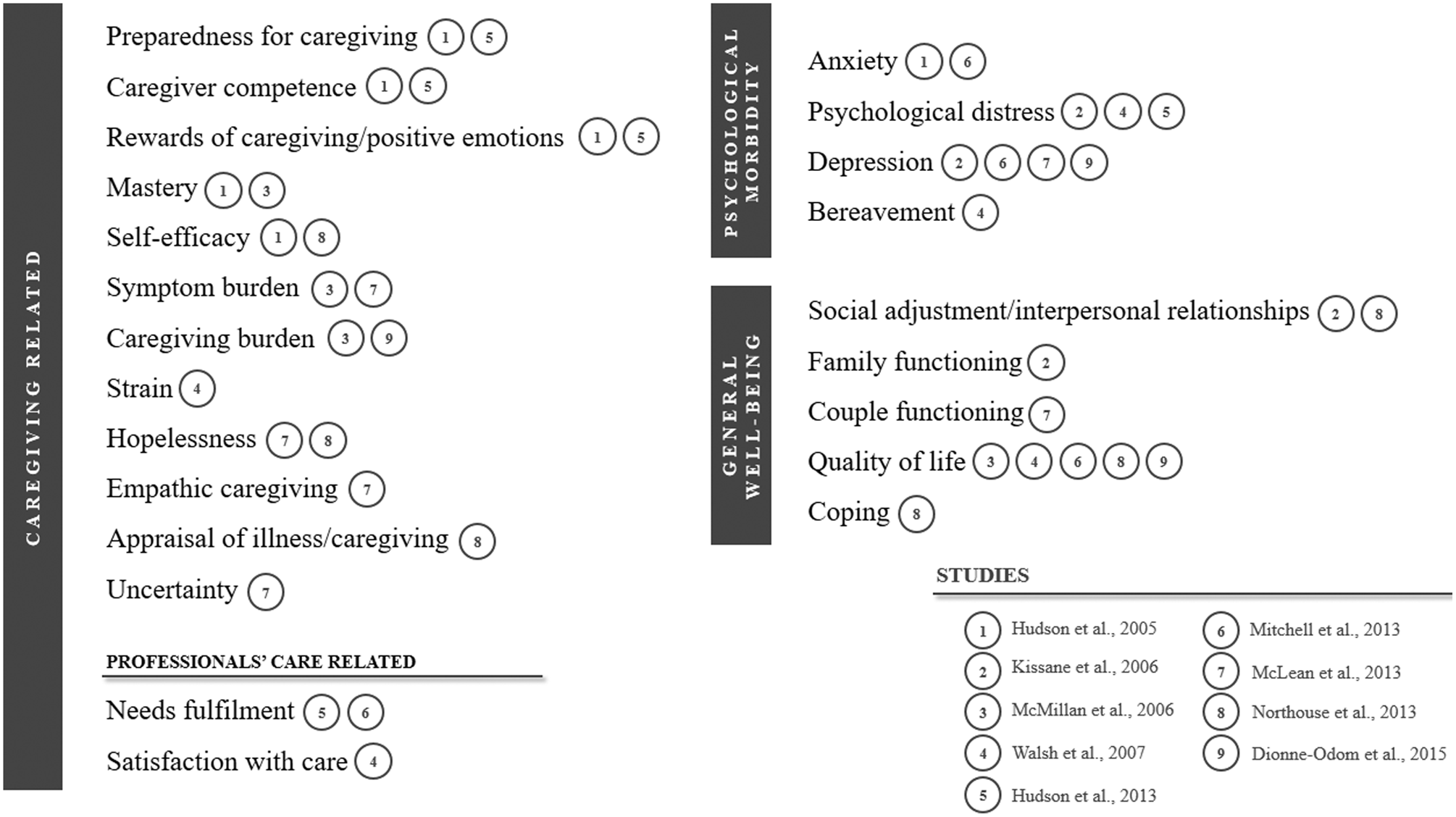
Regarding the indicators to evaluate the efficacy, the variables selected to measure the efficacy were not the same across the studies (Figure 2). Caregiving-related outcomes were more frequently evaluated in the selected studies.
Evaluated outcomes in interventions efficacy studies.

All studies assessed the outcomes through questionnaires (e.g., General Health Questionnaire) that aimed to evaluate the investigated constructs (e.g., psychological distress). The data collection time was different for each study. For instance, the shortest follow-up assessment period was one to two weeks of post-intervention in McMillan et al. (Reference McMillan, Small and Weitzner2005). The longest post-intervention follow-up assessment was the 13-month period after intervention or patient's death seen in Kissane et al. (Reference Kissane, McKenzie and Bloch2006). Other follow-up assessments lasted no longer than 6 months (Hudson et al., Reference Hudson, Aranda and Hayman-White2005, Reference Hudson, Trauer and Kelly2013; McMillan et al., Reference McMillan, Small and Weitzner2005; Walsh et al., Reference Walsh, Jones and Tookman2007; McLean et al., Reference McLean, Walton and Rodin2013; Mitchell et al., Reference Mitchell, Girgis and Jiwa2013; Northouse et al., Reference Northouse, Mood and Schafenacker2013; Dionne-Odom et al., Reference Dionne-Odom, Azuero and Lyons2015).
Regarding the results of the efficacy study, the psycho-educational intervention proposed by Hudson et al. (Reference Hudson, Aranda and Hayman-White2005) only proved to be effective in improving caregivers’ rewards. FFGT (Kissane et al., Reference Kissane, McKenzie and Bloch2006) proved to be modestly efficient by reducing distress and depression. The intervention proposed by McMillan et al. (Reference McMillan, Small and Weitzner2005) was efficient in improving caregiver QoL and reducing the burden associated with the patient's symptomatology and caregiving tasks. The Walsh et al. (Reference Walsh, Jones and Tookman2007) intervention was moderately efficient in reducing only the psychological distress. The psycho-educational intervention proposed by Hudson et al. (Reference Hudson, Trauer and Kelly2013) showed itself to be effective in increasing caregivers’ sense of preparedness and competence. The need-based intervention (Mitchell et al., Reference Mitchell, Girgis and Jiwa2013) demonstrated itself as inefficient in reducing the number and intensity of needs. The EFT showed efficacy in improving marital functioning (McLean et al., Reference McLean, Walton and Rodin2013). The FOCUS was efficient in improving dyads’ coping, self-efficacy, and social QoL and in improving caregivers’ emotional QoL (Northouse et al., Reference Northouse, Mood and Schafenacker2013). Although failing in improving its primary outcome (QoL), the ENABLE proved to be efficient in reducing depression and burden (Dionne-Odom et al., Reference Dionne-Odom, Azuero and Lyons2015).
Discussion
The terminal phase of a cancer and thus the approaching death of a relative is a major crisis for the family system and its elements (Walsh and McGoldrick, Reference Walsh, McGoldrick, Walsh and McGoldrick2004; Rolland, Reference Rolland2005), with disturbing effects on family members (Costa-Requena et al., Reference Costa-Requena, Cristófol and Cañete2012; Nielsen et al., Reference Nielsen, Neergaard and Jensen2016; Nipp et al., Reference Nipp, El-Jawahri and Fishbein2016; Areia et al., Reference Areia, Fonseca and Major2019). The importance of providing support to families who are facing the imminent death of a family member is unquestionable. Thus, the present study has desired to carry out a close examination of the current state of family/caregiver-focused interventions in both oncological and end-of-life care contexts.
Although international guidelines (WHO, 2002) advocate that palliative care should be family-centered (Hudson and Payne, Reference Hudson and Payne2011; WHO, 2002), results of the present study show that family support is still an issue that the literature fails to address, as only nine family/caregiver-focused intervention programs (Hudson et al., Reference Hudson, Aranda and Hayman-White2005, Reference Hudson, Trauer and Kelly2013; McMillan et al., Reference McMillan, Small and Weitzner2005; Kissane et al., Reference Kissane, McKenzie and Bloch2006; Walsh et al., Reference Walsh, Jones and Tookman2007; McLean et al., Reference McLean, Walton and Rodin2013; Mitchell et al., Reference Mitchell, Girgis and Jiwa2013; Northouse et al., Reference Northouse, Mood and Schafenacker2013; Dionne-Odom et al., Reference Dionne-Odom, Azuero and Lyons2015) met the inclusion criteria (cf. Methods section) for the present critical review. Noting which countries have developed and tested interventions, in our study the majority of the interventions were developed and tested in Australia and USA, it becomes important to expand the research on this topic to other nations (e.g., Europe, Latin America), as cultural, racial, and economic diversities (Northouse et al., Reference Northouse, Katapodi and Song2010) may influence the emergence of different challenges placed upon the families of individuals in the terminal stages of cancer.
Although the literature clearly states that cancer and the impending death of a loved one is indeed a family affair, which affects not only the patient but also all his/her relatives (Kissane and Bloch, Reference Kissane and Bloch2002; Rolland, Reference Rolland2005), from the nine interventions programs studied, only one third showed a relational perspective (Kissane et al., Reference Kissane, McKenzie and Bloch2006; McLean et al., Reference McLean, Walton and Rodin2013; Northouse et al., Reference Northouse, Mood and Schafenacker2013), while the others were caregiver-focused (Hudson et al., Reference Hudson, Aranda and Hayman-White2005, Reference Hudson, Trauer and Kelly2013; McMillan et al., Reference McMillan, Small and Weitzner2005; Walsh et al., Reference Walsh, Jones and Tookman2007; Mitchell et al., Reference Mitchell, Girgis and Jiwa2013; Dionne-Odom et al., Reference Dionne-Odom, Azuero and Lyons2015).
As for the duration of the interventions, most were brief, consisting of few sessions over a specified period of time (Hudson et al., Reference Hudson, Aranda and Hayman-White2005, Reference Hudson, Trauer and Kelly2013; McMillan et al., Reference McMillan, Small and Weitzner2005; Walsh et al., Reference Walsh, Jones and Tookman2007; Mitchell et al., Reference Mitchell, Girgis and Jiwa2013; Dionne-Odom et al., Reference Dionne-Odom, Azuero and Lyons2015). Also, they were delivered by non-mental health experts (Hudson et al., Reference Hudson, Aranda and Hayman-White2005, Reference Hudson, Trauer and Kelly2013; McMillan et al., Reference McMillan, Small and Weitzner2005; Walsh et al., Reference Walsh, Jones and Tookman2007; Mitchell et al., Reference Mitchell, Girgis and Jiwa2013; Northouse et al., Reference Northouse, Mood and Schafenacker2013; Dionne-Odom et al., Reference Dionne-Odom, Azuero and Lyons2015) and were mainly focused on caregiver-specific problems (e.g., increasing competences, caregiver education) (Hudson et al., Reference Hudson, Aranda and Hayman-White2005, Reference Hudson, Trauer and Kelly2013; Walsh et al., Reference Walsh, Jones and Tookman2007; Mitchell et al., Reference Mitchell, Girgis and Jiwa2013; Dionne-Odom et al., Reference Dionne-Odom, Azuero and Lyons2015). This general panorama may be somewhat sparse. As Walsh and McGoldrick (Reference Walsh, McGoldrick, Walsh and McGoldrick2004) note, of all human experiences, the death of a loved one, or its imminent arrival, is the most painful challenge for both families and their individual members and may be trauma-producing with manifestations of psychological morbidity (e.g., post-traumatic stress disorder, depression) appearing in one or more family members (Bonanno and Mancini, Reference Bonanno, Mancini, Barbanel and Sternberg2006; Everstine and Everstine, Reference Everstine and Everstine2006). The end-of-life context appears too challenging for interventions that are too restricted in terms of their format (e.g., dosage, goals). We believe that other neglected issues (e.g., anticipatory grief) and other formats (e.g., longer interventions, greater involvement on the part of mental-health professionals) should be considered in the family intervention equation to address the family's most important needs and thus prevent morbid trauma responses (Romito et al., Reference Romito, Goldzweig and Cormio2013; Areia et al., Reference Areia, Fonseca and Major2019).
Regarding the effectiveness of the intervention programs analyzed, results showed an overall modest efficacy. On the one hand, it is undeniable that the approaching death of a family member is extremely demanding and stressful (Walsh and McGoldrick, Reference Walsh, McGoldrick, Walsh and McGoldrick2004; Walsh et al., Reference Walsh, Jones and Tookman2007), and psychosocial support may not improve the situation when the moment of crisis finally arrives (Walsh et al., Reference Walsh, Jones and Tookman2007). This corroborates the hypothesis that support from extended family in time may improve the psychosocial adjustment of the family at the end of the patient's life. On the other hand, we argue that a family intervention in palliative care should aim at preventing abnormal responses over the long term, such as complicated grief during bereavement, rather than reducing present psychological symptomatology (e.g., anticipatory grief) in the terminal phase as this is somewhat expected and, in due terms, functional. More prophylactic intervention programs, such as FFGT (Kissane et al., Reference Kissane, McKenzie and Bloch2006), should be considered and implemented in palliative care contexts.
At this point, it is worth noting that it an important gap still remains between the implementation of intervention programs in clinical practice and what is advocated in research and policy (Hudson et al., Reference Hudson, Remedios and Thomas2010). As far as we know, and similar to the assumption made by Northouse et al. (Reference Northouse, Katapodi and Song2010), none of the analyzed intervention programs have been translated into other languages nor have been applied as a routine procedure in other different countries — such as non-English speaking countries — than the ones in which have been developed. We must, therefore, agree that an articulated collaboration between researchers, clinicians and funding agencies is a pressing need, as this will undoubtedly facilitate the implementation of these empirically tested interventions in clinical settings (Northouse et al., Reference Northouse, Katapodi and Song2010).
The present study has obvious limitations, mainly related to its methodology. Limiting the review to other systematic reviews of literature (Step 1), to further select family/caregiver-focused interventions (Step 2), may have not abled the selection of recent RCT studies on the topic. Additionally, the selection of family/caregiver-focused interventions was somewhat strict, which may not offer a realistic overview of the actual state of family/caregiver-focused interventions in palliative care (e.g., RCTs eventually published after 2016), given the limits of the literature reviews. Additionally, this study was limited to the context of terminal cancer. What is being done for families of individuals suffering from dementias, organ failure, or infectious disease, which are also diseases with recourse to palliative care (WHO, 2002), remains unclear.
Despite these limitations, we consider that including studies with methodological reliability (RCTs) is an important strength of this critical review, as it has enabled a close examination of the content and efficacy of each intervention and a good description of a general panorama of the most significant family/caregiver-focused interventions. Additionally, this study seeks to reinforce the view that the development and improvement of family support in palliative care remains a research priority in the field and highlights the urgent need to include families in the patient's care plan by offering them high-quality psychosocial support.
Conclusion
Few family/caregiver-focused interventions have been validated through broad and rigorous methodologies. At present, interventions still mainly focus on caregiving matters, are brief in duration and delivered by non-mental health professionals, and show modest efficacy. More family interventions programs which consider different formats should be developed in order to identify a more effective way to support families that are facing the death of a loved one.
Supplementary material
The supplementary material for this article can be found at https://doi.org/10.1017/S1478951520000127.
Acknowledgments
This research was undertaken as part of a PhD project entitled “Terminal cancer patients’ family needs in Palliative Care.” PhD doctoral fellowship financed by FCT (Fundação para a Ciência e Tecnologia) (SFRH/BD/86178/2012).