Adolescence has been described as a developmental period during which youth often engage in high-risk health behaviors (Steinberg, Reference Steinberg2008). As such, the initiation of substance use typically begins by age 13 (Arnett, Reference Arnett2005), with engagement in use throughout adolescence associated with negative psychological, cognitive, and behavioral consequences, including lower academic achievement and increased risk for depressive and anxiety symptomatology, aggression, delinquency, and substance addiction (DeWit, Adlaf, Offord, & Ogborne, Reference DeWit, Adlaf, Offord and Ogborne2000; DiFranza et al., Reference DiFranza, Rigotti, McNeill, Ockene, Savageau, St Cyr and Coleman2000; Wu, Schlenger, & Galvin, Reference Wu, Schlenger and Galvin2003). Moreover, risk for such health consequences increases the earlier that youth initiate substance use (Griffin, Bang, & Botvin, Reference Griffin, Bang and Botvin2010; King & Chassin, Reference King and Chassin2007; Odgers et al., Reference Odgers, Caspi, Nagin, Piquero, Slutske, Milne and Moffitt2008; Warner & White, Reference Warner and White2003). For example, Sartor et al. (Reference Sartor, Jackson, McCutcheon, Duncan, Grant, Werner and Bucholz2016) found that early initiators of alcohol (i.e., youth who started drinking at age 14 or younger) were at increased risk for having an alcohol use disorder, whereas late initiators (i.e., youth who started drinking at age 17 or older) were at a reduced risk for having an alcohol use disorder. Dawson et al. (Reference Dawson, Goldstein, Patricia Chou, June Ruan and Grant2008) also noted higher risk for alcohol abuse and dependence symptoms for individuals who began drinking before age 15, as well as those who started drinking between ages 15 and 17, in comparison with those who delayed initiation of drinking until age 18 or older. With respect to marijuana use, Ellickson et al. (Reference Ellickson, D'Amico, Collins and Klein2005) also found, based on a longitudinal study of youth from 8th grade through 12th grade, that earlier age of initiation was associated with greater marijuana consequences and the use of illicit drugs at age 18. Lastly, Hu, Davies, and Kandel (Reference Hu, Davies and Kandel2006) found that age of onset of cigarette use before age 18 was associated with increased daily smoking and lifetime nicotine dependence. Thus, a large body of work has been conducted to better understand risk for substance use initiation during adolescence in order to develop targeted preventative interventions to delay initiation and the associated negative health and behavioral outcomes.
One of the most comprehensive reviews on existing models of adolescent substance use appears in work by Petraitis, Flay, and Miller (Reference Petraitis, Flay and Miller1995), who highlighted three distinct types of risk for substance use: (a) social influences (e.g., parent and peer influences), (b) attitudinal influences (e.g., substance related attitudes or factors that directly influence attitudes, such as low school or religious involvement), and (c) intrapersonal influences (e.g., personality traits, impulsiveness, aggressiveness, emotional distress, and self-esteem). Other more recent reviews have also confirmed the multifactorial structure of risk for substance use initiation (e.g., Dodge et al., Reference Dodge, Malone, Lansford, Miller, Pettit and Bates2009; Donovan, Reference Donovan2004; Schulenberg & Maggs, Reference Schulenberg and Maggs2002). Despite this general consensus, one prominent limitation noted by Petraitis et al. (Reference Petraitis, Flay and Miller1995) was the lack of attention in existing theoretical models to the contribution of race/ethnicity to adolescent substance use, regardless of its significance in understanding variations in child development (Quintana et al., Reference Quintana, Aboud, Chao, Contreras-Grau, Cross, Hudley and Vietze2006).
The need for specific attention to race/ethnicity is further supported by the growing evidence of distinct differences in substance use initiation, patterns of use, and consequences from use across groups. For instance, African American youth, relative to White youth, tend to report lower rates of both alcohol (Chen & Jacobson, Reference Chen and Jacobson2012; Johnston et al., Reference Johnston, O'Malley, Miech, Bachman and Schulenberg2017; Khan, Cleland, Scheidell, & Berger, Reference Khan, Cleland, Scheidell and Berger2014) and cigarette use across development (Brown, Flory, Lynam, Leukefeld, & Clayton, Reference Brown, Flory, Lynam, Leukefeld and Clayton2004; Chen & Jacobson, Reference Chen and Jacobson2012). Conversely, rates for marijuana use have been reported to be comparable or higher among African American youth compared to their White peers (Johnson et al., Reference Johnson, Fairman, Gilreath, Xuan, Rothman, Parnham and Furr-Holden2015). Yet, regardless of the substance used, the consequences associated with use, such as rates of dependence (Zapolski, Pedersen, McCarthy, & Smith, Reference Zapolski, Pedersen, McCarthy and Smith2014), legal problems (Brown, Flory, et al., Reference Brown, Flory, Lynam, Leukefeld and Clayton2004; Nguyen, Reference Nguyen and Reuter2012), and interpersonal problems, (Zapolski et al., Reference Zapolski, Pedersen, McCarthy and Smith2014) are more severe for African American users compared to their White peers.
Thus, given evidence of differences in use and consequences, it has been posited (e.g., Brown, Miller, & Clayton, Reference Brown, Miller and Clayton2004) and empirically supported (e.g., Bersamin, Paschall, & Flewelling, Reference Bersamin, Paschall and Flewelling2005; Vega, Zimmerman, Warheit, Apospori, & Gil, Reference Vega, Zimmerman, Warheit, Apospori and Gil1993; Wallace & Muroff, Reference Wallace and Muroff2002) that risk models constructed and tested among predominately White youth samples do not adequately explain risk for African American youth. It is proposed that in addition to factors, such as social (e.g., parent and peer influences; Clark, Belgrave, & Nasim, Reference Clark, Belgrave and Nasim2008; Elkington, Bauermeister, & Zimmerman, Reference Elkington, Bauermeister and Zimmerman2011); attitudinal (e.g., substance related attitudes, low school and religious involvement; Clark et al., Reference Clark, Belgrave and Nasim2008; Wills, Gibbons, Gerrard, & Brody, Reference Wills, Gibbons, Gerrard and Brody2000); and intrapersonal (e.g., personality traits, impulsiveness, aggressiveness, and self-esteem; Wills et al., Reference Wills, Gibbons, Gerrard and Brody2000; Wright & Fitzpatrick, Reference Wright and Fitzpatrick2004) factors that have been shown to increase risk for substance use within African American youth populations, there are also culturally specific factors, such as exposure to racial discrimination, that may explain risk for substance use initiation in this population.
Over the past several decades, a large body of research has been conducted identifying racial discrimination as an important social mechanism in risk for health outcomes among minority populations (Lewis, Cogburn, & Williams, Reference Lewis, Cogburn and Williams2015; Noonan, Velasco-Mondragon, & Wagner, Reference Noonan, Velasco-Mondragon and Wagner2016; Williams & Williams-Morris, Reference Williams and Williams-Morris2000). This work has been synthesized within several meta-analyses and systematic reviews, documenting a significant negative association between racial discrimination and a range of psychological and physical health outcomes among African American populations (Pieterse, Todd, Neville, & Carter, Reference Pieterse, Todd, Neville and Carter2012; Paradies et al., Reference Paradies, Ben, Denson, Elias, Priest, Pieterse and Gee2015). There is also a growing body of litearture, including a meta-analysis by Carter et al. (Reference Carter, Lau, Johnson and Kirkinis2017), that has provided support for the direct and negative effect of racial discrimiantion on substance use outcomes among African Americans (Clark, Salas-Wright, Vaughn, & Whitfield, Reference Clark, Salas-Wright, Vaughn and Whitfield2015; Gibbons et al., Reference Gibbons, Etcheverry, Stock, Gerrard, Weng, Kiviniemi and O'hara2010; Gibbons, Gerrard, Cleveland, Wills, & Brody, Reference Gibbons, Gerrard, Cleveland, Wills and Brody2004; Gilbert & Zemore, Reference Gilbert and Zemore2016; Guthrie, Young, Williams, Boyd, & Kintner, Reference Guthrie, Young, Williams, Boyd and Kintner2002; Williams, Neighbors, & Jackson, Reference Williams, Neighbors and Jackson2003). Yet, these studies are limited because the effect of racial discrimination was examined in isolation while other well-established risk factors for substance use were excluded. Risk models for substance use that included both racial discrimination and established risk factors are necessary in order to (a) provide a comprehensive undestanding of substance use risk for African Americans, and (b) determine the potentially unique contribution of racial discrimination in relation to other established risk factors. Thus, the first goal of our study is to examine the influence of both established risk factors (i.e., social, attitudinal, and intrapersonal factors) and racial discrimination on substance use initiation among a sample of African American youth. Models will be run separately for alcohol, marijuana, and cigarette initiation given different patterns of use among African American youth populations.
In addition to the need to better understand the multifaceted nature of risk for substance use initiation among African American youth, there is a need to examine risk through a developmental lens (Bronfenbrenner & Morris, Reference Bronfenbrenner, Morris, Damon and Lerner1998; Masten, Faden, Zucker, & Spear, Reference Masten, Faden, Zucker and Spear2009). As noted in work by Cicchetti and Rogosch (Reference Cicchetti and Rogosch2002), adolescence is a dynamic developmental period that is marked by important changes within (i.e., physical, psychological, neurobiological changes) and outside (i.e., environmental and social changes) the individuals. In turn, as youth develop and interact within different systems and environment, the strength of the effect posed by these factors can also vary based on the age of the youth (e.g., Dick et al., Reference Dick, Pagan, Viken, Purcell, Kaprio, Pulkkinen and Rose2007; Schulenberg & Maggs, Reference Schulenberg and Maggs2002). Thus, it is highly plausible that the effects of social, attitudinal, intrapersonal, and racial discrimination factors on substance use initiation varies based on a developmental stage.
However, to date, few studies have been published examining the differential effects of risk factors for substance use or initiation based on age during adolescence (Donovan, Reference Donovan2004; Ellickson, Tucker, Klein, & Saner, Reference Ellickson, Tucker, Klein and Saner2004; Guo, Hill, Hawkins, Catalano, & Abbott, Reference Guo, Hill, Hawkins, Catalano and Abbott2002; Mahabee-Gittens, Xiao, Gordon, & Khoury, Reference Mahabee-Gittens, Xiao, Gordon and Khoury2013). Among available studies, differences have been found. Tang and Orwin (Reference Tang and Orwin2009) examined risk for marijuana initiation among a nationally representative sample of youth ages 10 to 16, finding that both parent and peer factors were influential on marijuana initiation during early (ages 11–13), but not late adolescence. Moreover, academic factors were found to be a fairly consistent predictor across most ages (Tang & Orwin, Reference Tang and Orwin2009). There is also evidence for age-related risk for smoking initiation, with parental smoking only influencing smoking initiation during early adolescence (prior to the age of 15) among a sample of predominantly non-Hispanic, White smokers, whereas academic attainment was predictive at both developmental periods (initiation prior to age 15 and initiation between 15 and 18; Wilkinson, Schabath, Prokhorov, & Spitz, Reference Wilkinson, Schabath, Prokhorov and Spitz2007). O'Loughlin et al. (Reference O'Loughlin, O'Loughlin, Wellman, Sylvestre, Dugas, Chagnon and McGrath2017) also examined age-related differences for cigarette smoking initiation across adolescence among a large sample of Canadian youth, finding that peer smoking was only predictive during early and mid adolescence, whereas depressive symptoms were a risk factor during early and mid adolescence but were protective during late adolescence.
Collectively, these studies demonstrate the dynamic nature of risk factors, suggesting that not all risk factors have the same level of influence across adolescence. However, much of the existing literature is based on predominately White samples, with limited research examining changes in risk among racial/ethnic minority populations (Atherton, Conger, Ferrer, & Robins, Reference Atherton, Conger, Ferrer and Robins2016; Grigsby, Forster, Soto, & Unger, Reference Grigsby, Forster, Soto and Unger2017). Moreover, to date, there are no existing studies that use a developmental perspective to examine variation in risk for substance use initiation among African Americans. Thus, the second goal of the current study is to examine the unique effect of four risk indices (i.e., social risk, attitudinal risk, intrapersonal risk, and racial discrimination risk) on substance use initiation during three developmental periods: early adolescence (age 11–14), mid adolescence (age 16–18), and late adolescence (age 19–21).
In addition to the four risk indices, the models will also examine risk based on two sociodemographic variables: gender and socioeconomic status. With respect to gender, studies generally find higher prevalence rates (Byck, Bolland, Dick, Ashbeck, & Mustanski, Reference Byck, Bolland, Dick, Ashbeck and Mustanski2013; Vidourek, King, & Montgomery, Reference Vidourek, King and Montgomery2017; Lewis, Lee, Kirk, & Redmond, Reference Lewis, Lee, Kirk and Redmond2011) and earlier age of initiation (Doherty, Green, Reisinger, & Ensminger, Reference Doherty, Green, Reisinger and Ensminger2008) among African American male than female youth. However, findings have been mixed as to whether gender differentially predicts substance use risk, with several studies indicating a nonsignificant gender effect (Byck et al., Reference Byck, Bolland, Dick, Ashbeck and Mustanski2013; Elkington et al., Reference Elkington, Bauermeister and Zimmerman2011; Myers, Reference Myers2013; Zapolski, Beutlich, Fisher, & Barnes-Najor, Reference Zapolski, Beutlich, Fisher and Barnes-Najor2018) or a gender effect for being male only for certain substances (Clark et al., Reference Clark, Nguyen and Belgrave2011; Nasim, Utsey, Corona, & Belgrave, Reference Nasim, Utsey, Corona and Belgrave2006). With respect to family socioeconomic status, findings have also been mixed, with some studies indicating greater risk of substance use among youth with lower socioeconomic status (Bachman, O'Malley, Johnston, Schulenberg, & Wallace, Reference Bachman, O'Malley, Johnston, Schulenberg and Wallace2011; Elkingson et al., 2011), while other studies have found a nonsignificant effect (Wallace et al., Reference Wallace, Forman, Guthrie, Bachman, O'Malley and Johnston1999) or an effect only for certain substances (McNeil Smith & Taylor, Reference McNeil Smith and Taylor2015). Previous models that have examined within-group variation in substance use outcomes among African American youth have include at least one of these variables as a control within the analyses (Clark et al., Reference Clark, Belgrave and Nasim2008; Wills et al., Reference Wills, Gibbons, Gerrard and Brody2000).
Method
Participants
The sample for the current study was taken from a longitudinal study of rural African American families that began in 2002 when youth were 11 years of age. The study sampled families residing in small towns and communities in rural Georgia, where poverty rates are among the highest in the nation and unemployment rates are above the national average (DeNavas-Walt, Reference DeNavas-Walt and Proctor2014). From lists that schools provided of 5th-grade students, 667 families were selected randomly for an initial assessment (see Brody et al., Reference Brody, Yu, Chen, Kogan, Evans, Beach and Philibert2013). Follow-up data were completed by participating families on an annual basis over the next 14 years.
Most (75%, n = 500) of the original sample provided data on cigarette, alcohol, and marijuana use status during at least one year from ages 11 to 14, ages 16 to 18, and ages 19 to 21. A little more than half of the final sample of youth were female (54.2%), and a majority of their primary caregivers were mothers (89.2%). Participants' median family income per month was $1740 (SD = $1422), with 42.1% of families living below federal poverty standards.
Procedures
African American youth provided prospective data at 10 assessments from ages 11 to 13 and 16 to 21. At age 14, assessments on substance use outcomes were conducted, but few other variables were assessed. At age 15, no data was collected due to grant funding issues. All procedures were approved by the Institutional Review Board of the sponsoring research institution. At each wave, project staff contacted participants regarding participation in the study. Primary caregivers consented to minor youth's participation in the study, and minor youth assented to their own participation. Youth age 18 and older provided consent for their participation. African American field researchers visited families' homes to administer self-report instruments at each wave of data collection. All assessments, which lasted approximately two hours, were conducted in private, with no other family members present, using a standardized protocol. Child participants were compensated $100 and parents were compensated $80 at each data collection wave.
Measures
Substance use initiation
Each year from age 11 to 21, with the exception of age 15, youth participants provided data on substance use behaviors, including if they had ever smoked a cigarette or marijuana, or had drunk alcohol. Responses to these three items were recoded to a dichotomous variable indicating substance use initiation status at each wave for each substance (0 = never used substance; 1 = ever use substance). The initiation status was summed across three developmental periods, with data from ages 11 to 14 representing early adolescence, 16 to 18 representing mid adolescence, and 19 to 21 representing late adolescence.
Family SES risk index
When participants were 11 to 13, 16 to 18, and 19 to 21 years of age, caregivers of the child participants were asked about their family's socioeconomic status. Six dichotomous variables formed a socioeconomic risk index (see Evans, Reference Evans2003; Kim & Brody, Reference Kim and Brody2005; Rutter, Reference Rutter1993). A score of 1 was assigned to each of the following: family poverty based on federal guidelines, primary caregiver unemployment, receipt of Temporary Assistance for Needy Families, primary caregiver single parenthood, primary caregiver education level less than high school graduation, and caregiver-reported inadequacy of family income. The six dichotomized indicators were summed to form the SES index score, with higher scores indicative of lower family socioeconomic status.
Social risk index
For ages 11–13, social risk was measured by parent's report of parent–child conflict and youth's report of parent social support. Parent–child conflict was measured using an adaptation of the 7-item Ineffective Arguing Inventory (IAI; Kurdek, Reference Kurdek1994), through which respondents rate statements regarding conflicts they have had with their children. Example items include, “You and your child's arguments are left hanging and unsettled,” and “You and your child go for days being mad at each other,” with response options ranging from 1 (disagree strongly) to 5 (agree strongly). Cronbach's alphas for the IAI ranged from .75 to .79 across the three waves. Parental social support was measured using a revised version of the 4-item social support for emotional reasons subscale (Carver, Scheier, and Weintraub, Reference Carver, Scheier and Weintraub1989). Example items include, “I get emotional support from my caregiver” and “I get sympathy and understanding from my caregiver,” with response options ranging from 1 (not at all) to 4 (a lot). Items were reverse-coded such that higher scores indicated lower parental support. Cronbach's alphas ranged from .78 to .87 across the three waves.
For ages 16–18, social risk was measured using the same youth's report of parent–child conflict measure (7 items; IAI; Kurdek, Reference Kurdek1994; Cronbach's alphas ranged from .74 to .83 across the three waves) and parent social support measure (4 items; revised version of the social support for emotional reasons subscale, Carver, Scheier, & Weintraub, Reference Carver, Scheier and Weintraub1989; Cronbach's alphas ranged from .93 to .95 across the three waves). A 4-item measure on substance using peers (developed for the study) was also included to assess the youth's proportion of close friends who engaged in substance use (cigarettes, alcohol, marijuana, and excessive drinking). Response options for the measure were 1 (none), 2 (some), and 3 (all). This measure was first introduced into the study at age 16, and thus was not available for assessments at ages 11–13. Cronbach's alphas ranged from .87 to .90 across the three waves.
For ages 19–21, social risk was measured used the same youth's report of parent–child conflict (7 items; IAI; Kurdek, Reference Kurdek1994; Cronbach's alphas ranged from .82 to .85 across the three waves) and substance using peers (4 items, developed for the study; Cronbach's alphas ranged from .84 to .86 across waves). For ages 19–21, parent social support was measured by youth report using the 9-item Network Relationships Inventory (NRI; Furman & Buhrmester, Reference Furman and Buhrmester1985). The NRI assesses a young person's reported frequency of emotion and instrumental support received and caregiving from parents, with response options ranging 1 (never) to 4 (very often). Cronbach's alpha was .90 across the three waves.
Attitudinal risk index
For ages 11–13, attitudinal risk was measured based on participants' report on attitudes towards risky behaviors and goal orientation and parent's reports of their children's academic competence. Attitudes towards risky behavior was assessed using the 16-item Attitudes Toward Risky Behavior scale (Conger, 1989). Example items include, “It is okay for someone your age to smoke marijuana, use alcohol, hit someone with the idea of hurting them,” with response options ranging from 1 (never) to 5 (always). Cronbach's alphas ranged from .86 to .90 across the three waves. Goal orientation was assessed using the 5-item Future-Oriented Goals scale (Brody et al., Reference Brody, Murry, Gerrard, Gibbons, Molgaard, McNair and Neubaum-Carlan2004), which measures youths' ability to set, sustain, and achieve goals for the future. Example items include “I have thought of some goals I want to reach when I grow up,” and “I know some specific steps to take to reach my goals,” with response options ranging from 0 (not true) to 2 (very or often true). Cronbach's alphas ranged from .60 to .69 across the three waves. Academic competence was assessed using the 7-item measure by Harter (Reference Harter1982) that measures parents' report of their youths' engagement and competence in academic activities. Example items include “the child is very good at his/her school work; the child is just as smart as other kids his/her age; the child does well in class,” with response options ranging from 1 (not at all) to 4 (always). Cronbach's alphas ranged from .83 to .92 across the three waves.
For ages 16–18, attitudinal risk was measured using the same participant's report of goal orientation (5 items; Future-Oriented Goals scale, Brody et al., Reference Brody, Murry, Gerrard, Gibbons, Molgaard, McNair and Neubaum-Carlan2004; Cronbach's alphas ranged from .60 to .69 across the three waves). At ages 16–18, attitudinal risk was also measured using participants' reports of tolerance for deviance, religiosity, and school engagement. Tolerance for deviance was measured using the 10-item Tolerance for Deviance scale (developed for the study), which assessed youths' attitudes toward risky behaviors. Example items include, “How wrong do you think it is to hit someone because you did not like what they said or did, to take things that do not belong to you, and to start a fight,” with response options ranging from 1 (not at all wrong) to 5 (very wrong). Cronbach's alphas ranged from .89 to .92 across the three waves. Religiosity was assessed based on youth's report on the 7-item Religiosity of Emerging Adults Scale (Arnett & Jensen, Reference Arnett and Jensen2002), which measures religious attendance, the importance ascribed to religion, the certainty of the youth's beliefs, and exposure to religion. Cronbach's alphas ranged from .76 to .81 across the three waves. School engagement was assessed using the 20-item Academic Orientation scale developed for use in the Family and Community Health Study (Brody et al., Reference Brody, Ge, Conger, Gibbons, Murry, Gerrard and Simons2001). The measure assesses young persons' academic performance, liking of school, boredom with school, effort at school, completion of homework, and the importance of grades, with response options ranging from 1 (strongly agree) to 5 (strongly disagree). Cronbach's alphas for the scale were .90 to .91.
For ages 19–21, attitudinal risk factor was measured using the same participant's report on school engagement (Academic Orientation; Brody et al., Reference Brody, Ge, Conger, Gibbons, Murry, Gerrard and Simons2001; Cronbach's alphas for the scale were .87 to .92). For ages 19–21, attitudinal risk was also measured using the participant's report on religiosity and future/goal orientation. Religiosity was measured using the 7-item Multidimensional Measure of Religious Involvement (Levin, Taylor, & Chatters, Reference Levin, Taylor and Chatters1995), which assesses individuals' reported religious attendance and the importance ascribed to religion. Cronbach's alphas ranged from .76 to .78 across the three waves. Future/goal orientation was measured using the 12-item future/goal orientation subscale from the MacArthur Reactive Responding Scale (Taylor & Seeman, Reference Taylor, Seeman, Adler, Marmot, McEwen and Stewart1999). Example items include “It is important to me to take time to plan out where I am going in life,” “I have many long-term goals that I will work to achieve,” and “I set goals for my future,” with response options ranging from 1 (strongly disagree) to 5 (strongly agree). Cronbach's alphas ranged from .71 to .77 across the three waves.
Intrapersonal risk index
For ages 11–13, intrapersonal risk was measured based on parents' reports of their children's externalizing behaviors and self-control and child participants' reports of self-esteem. Externalizing behaviors were assessed using the Child Behavior Checklist (CBCL, Achenbach & Edelbrock, Reference Achenbach and Edelbrock1983). We computed a score for the second-order factor of externalizing problems (35 items) that included first-order factors of aggressive behavior and rule breaking behavior. For each item, parents indicated whether the statement was (0) not true for the child, (1) somewhat or sometimes true, or (2) very or often true. Cronbach's alphas ranged from .85 to .92 across the three waves. Self-control was assessed based on parents' reports on the 12-item Self-Control Inventory (Humphrey, Reference Humphrey1982). Example items include “how often the child sticks to what he/she is doing even during long, unpleasant tasks until finished; how often the child works toward a goal; how often the child pays attention to what he/she is doing,” with response options ranging from (0) never to (4) almost always. Cronbach's alphas ranged from .86 to .88 across the three waves. Self-esteem was measured based on child participants' self-reports on the 10-item Rosenberg Self-Esteem scale (Rosenberg, Reference Rosenberg1965). Example items include “I am able to do things as well as most other people” and “I take a positive attitude toward myself,” with response options ranging from 1 (completely false) to 5 (completely true). Cronbach's alphas ranged from .73 to .78 across the three waves.
For ages 16–18 intrapersonal risk was measured using the same parent's report of their children's externalizing behaviors (35 items; second-order factor of externalizing problems CBCL, Achenbach & Edelbrock, Reference Achenbach and Edelbrock1983; Cronbach's alphas ranged from .90 to .92 across the three waves) and self-control (12 items; Self-Control Inventory, Humphrey, Reference Humphrey1982; Cronbach's alphas ranged from .72 to .73). For ages 16–18 intrapersonal risk was also assessed based on child participants' reports of depression and anger. Depression was measured using the 26-item Child Depression Inventory (CDI, Kovacs, Reference Kovacs1985), which assesses for depressed mood, interpersonal problems, ineffectiveness, anhedonia, and negative self-esteem. For each item, individuals indicated (0) absence of symptoms, (1) mild symptoms, or (2) definite symptoms. Cronbach's alphas ranged from .84 to .86. Anger was measured using the 15-item anger subscale taken from the State-Trait Anger Expression Inventory (Spielberger, Jacobs, Russell, & Crane, Reference Spielberger, Jacobs, Russell, Crane, Butcher and Spielberger1983). Respondents are asked about their feelings over the past three months, and they rate discrete emotions (e.g., “I am furious.”; “I feel angry.”) on a scale ranging from 1 (always) to 5 (never). Cronbach's alphas ranged from .91 to .92.
For ages 19–21, intrapersonal risk was measured by the same parents' reports of child participants' self-control (12 items; Self-Control Inventory, Humphrey, Reference Humphrey1982; Cronbach's alphas ranged from .85 to .86). For ages 19–21, intrapersonal risk was also measured by child participants' self-reports of externalizing behaviors, depression, and anger/hostility. Externalizing behaviors were measured using the aggressive, intrusive, and rule breaking subscales from the 36-item Adult Self-Report (Achenbach & Rescorla, Reference Achenbach and Rescorla2003; Cronbach's alpha was .92). Depression was measured using the 20-item Center for Epidemiologic Studies Depression scale (CES–D; Radloff, Reference Radloff1977). Respondents rated each of 20 symptoms on the following scale: 0 (rarely or none of the time), 1 (some or little of the time), 2 (occasionally or a moderate amount of time), or 3 (most or all of the time). Cronbach's alphas ranged from .84 to .86. Anger/Hostility was measured using the 8-item Anger/Hostility Scale (Joe, Broome, Rowan-Szal, & Simpson, Reference Joe, Broome, Rowan-Szal and Simpson2002). Youths were asked about their feelings and directed to rate discrete emotions (e.g., “I feel a lot of anger inside me.”; “I get mad at other people easily.”) on a scale ranging from 1 (strongly disagree) to 5 (strongly agree). Cronbach's alpha was .90.
Racial discrimination
Past year racial discrimination was measured at ages 16–18 and 19–21 using the 9-item Schedule of Racist Events (SRE; Landrine & Klonoff, Reference Landrine and Klonoff1996). This measure was first introduced into the study at age 16, and thus was not available for ages 11–13. The SRE measures perceptions of specific discriminatory events, which were designed to be developmentally appropriate for adolescents, such as racially based slurs and insults, disrespectful treatment from community members, physical threats, and false accusations from business employees or law enforcement officials. Response options for each item range from 0 (never happened) to 2 (happened a lot). Cronbach's alphas ranged from .87 to .92.
Statistical Analyses
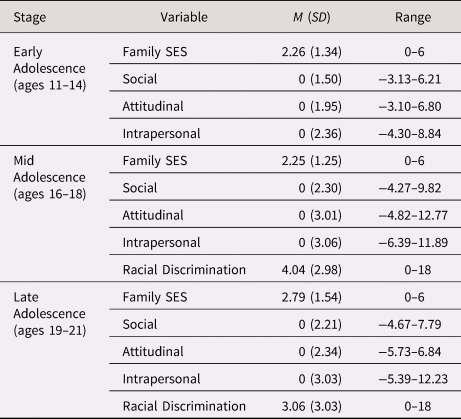
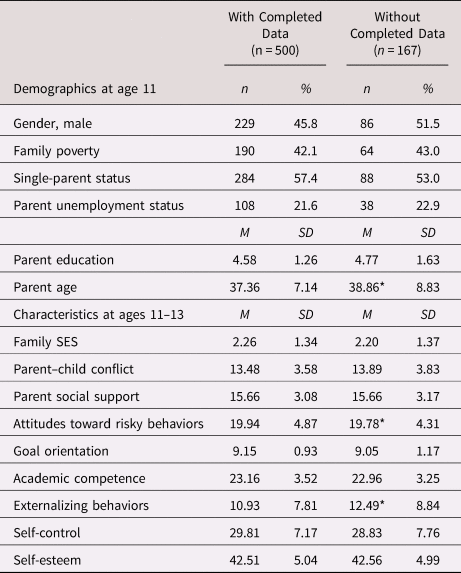
We used the substance use initiation status to identify groups of youths who started to use substances during early adolescence (ages 11–14), mid-adolescence (ages 16–18), and late adolescence (ages 19–21). Table 1 presents the sample characteristics of the risk indices for each developmental period. Attrition across the three developmental periods was low, with 75% of participants providing complete data across all of the developmental periods. Youth were retained in the study and included in the analyses if they provided complete data across the three developmental periods. Compared to youth excluded due to having missing data, our study sample (i.e., those with complete data) had more favorable attitudes towards risky behaviors, but less externalizing behaviors during early adolescence. Attrition analysis suggested that the missing data was not at random, so listwise deletion was used to handle missing data within the analysis. See Table 2 for details regarding comparison on study variables based on youth with complete versus missing data.
Sample characteristics

Note: N = 500.
Characteristics of subjects with complete versus missing data

*Mean differences between completed sample and missing sample were significant (p < .05).
Four indices of risk factors were examined: social risk, attitudinal risk, intrapersonal risk, and racial discrimination risk. The risk indices were created using the following steps: (a) Individual risk measures were scored in the direction with higher scores indicating greater risk, with items summed to create a composite score for each measure; (b) Composite scores for each measure were averaged across all time points within a given developmental period (i.e., three parent–child conflict scores from ages 11 to 13 averaged to produce an early adolescence parent–child conflict score); (c) Each measure within an index was standardized and summed to create a composite standardized risk index score within each developmental period (i.e., the average scores for parent–child conflict and reverse-coded parent support from ages 11 to 13 were standardized and summed to form the social risk index during early adolescence). Items comprising each risk factor index were all significantly correlated (p ≤ .01) with other items in the composite at that time point. Additionally, the risk indices were significantly correlated across developmental periods, with an average correlation of .42 (range = .25–.66) for the social index, .46 (range = .35–.68) for the attitudinal index, .56 (range = .46–.74) for the intrapersonal index, and .77 for the racial discrimination index.
All analyses were conducted using SPSS version 25 (IBM Corp., Armonk, NY, USA). To address the first research objective, a logistic regression model was run that examined the effect of all four risk indices on substance use initiation across developmental period. For the model, group membership of abstainers (coded as 0) vs. substance users (coded as 1) was entered as the dependent variable, with social, attitudinal, and intrapersonal risk factors at early adolescence (ages 11–13) and the racial discrimination risk factor at mid adolescence (ages 16–18, the first time this index was measured) entered simultaneously into the model as predictor variables. Gender and family SES risk index were included as controls.
To address the second research objective, we stratified the sample into early (ages 11–14), mid (ages 16–18), and late (ages 19–21) adolescent initiators for each substance and examined whether the risk indices differentially predicted risk for substance use initiation based on age of initiation. Multinomial regression was run when predicting group membership for more than one group, with logistic regression used when predicting membership of only one group, using the abstainer group as the reference group. Specifically, Model 1 used a multinomial regression analysis to predict the early adolescent risk indices on early, mid, and late adolescence initiation. Similarly, Model 2 used a multinomial regression analysis, which examined mid-adolescent risk indices in the prediction of mid and late adolescent initiation. Lastly, Model 3 used a logistic regression analysis, which examined the prediction of late-adolescence risk indices for late-adolescence initiation. For the regression models, a negative coefficient indicates a greater likelihood of inclusion in the reference group (abstainers), and a positive coefficient indicates a greater likelihood of inclusion in a comparison group.
Results
Substance use initiation groups
A majority of the sample had initiated alcohol (n = 455, 91.0%) and more than half of the sample had initiated cigarette use (n = 263, 52.6%) and marijuana use (n = 257, 51.4%) by late adolescence. Gender differences were also observed within the group distributions for marijuana, χ 2 (3) = 16.505, p = .001, and cigarette, χ 2 (3) = 27.453, p < .001, initiation, with no statistically significant differences found for alcohol initiation, χ 2 (3) = 5.177, p = .159). Specifically, female youth were more likely to be in the abstainers group for both marijuana and cigarette use than were male youth. Conversely, male youth were more likely early adolescent initiators for marijuana and cigarette use, mid-adolescent initiators for marijuana use, and a late-adolescent initiators for cigarette use than were female youth. Figure 1 summarizes these results.
Substance use initiation groups, stratified by gender

Research objective 1: Prediction of substance initiation across adolescence
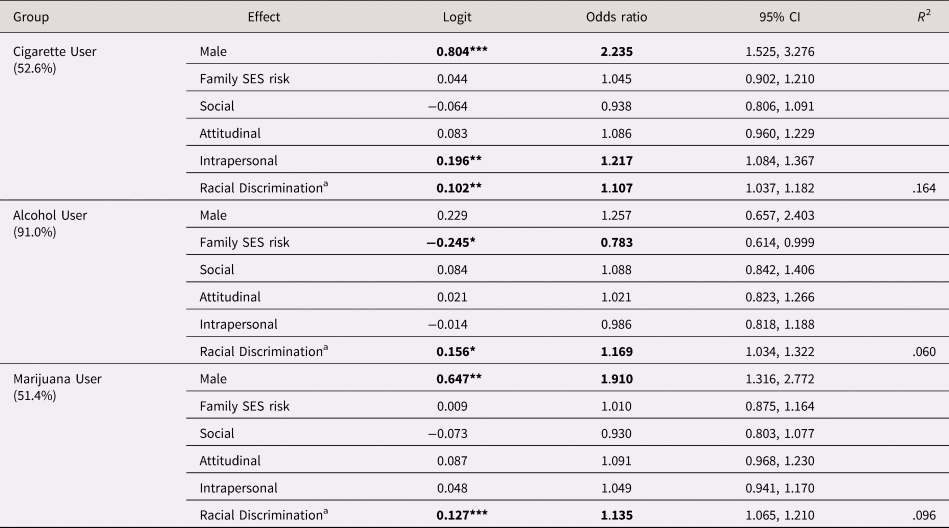
The first models tested the effects of social, attitudinal, and intrapersonal risk factors during early adolescence (ages 11–13) and the racial discrimination risk factor at mid adolescence (ages 16–18) on substance use initiation at any time point; models were run separately for alcohol, marijuana, and cigarette use. Results showed that for alcohol, racial discrimination was the only significant risk factor for initiation by age 21 (OR = 1.169, 95% CI [1.034, 1.322], p = .013). However, lower family socioeconomic status was protective against alcohol initiation (OR = 0.783, 95% CI [0.614, 0.999], p = .049). For marijuana use, being male, OR = 1.910, 95% CI [1.316, 2.772], p = .001, and racial discrimination, OR = 1.135, 95% CI [1.065, 1.210], p < .001, predicted initiation by age 21. For cigarette use, being male, OR = 2.235, 95% CI [1.525, 3.276], p < .001, high levels of intrapersonal risk, OR = 1.217, 95% CI [1.084, 1.367], p = .001, and racial discrimination, OR = 1.107, 95% CI [1.037, 1.182], p = .002, predicted initiation by age 21. A nonsignificant effect was found for all other risk indices. See Table 3 for more detailed results of the analyses.
Log odds coefficients and odds ratio for each type of substance user group with gender, family SES, and risk factors predicting initiation across adolescence

Note: N = 500. Abstainers as reference group; CI: confidence interval; R 2: Nagelkerke R-square; aRacial discrimination was measured at mid adolescence.
*p < .05. **p < .01 ***p < .001.
Research Objective 2: Prediction of initiation at specific developmental stages
Alcohol use
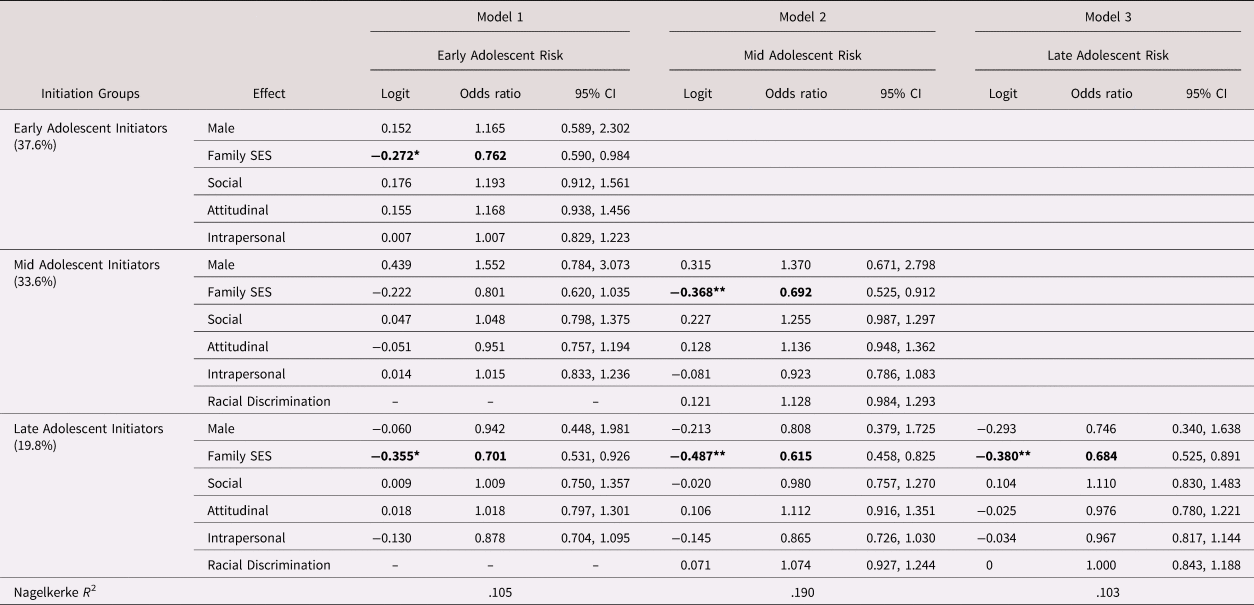
Based on early adolescent risk factors, lower family socioeconomic status was protective against alcohol initiation by age 14, OR = 0.762, 95% CI [0.590, 0.984], p = .037, as well as initiation during late adolescence, OR = 0.701, 95% CI [0.531, 0.926], p = .012. Based on mid-adolescent risk factors, lower family socioeconomic status during mid adolescence was also protective against initiation during mid adolescence, OR = 0.692, 95% CI [0.525, 0.912], p = .009, and during late adolescence, OR = 0.615, 95% CI [0.458, 0.825], p = .001. Lastly, based on late adolescent risk factors, lower family socioeconomic status continued to be protective against alcohol initiation by age 21 (OR = 0.684, 95% CI [0.525, 0.891], p = .005). See Table 4 for more detailed results of the analyses.
Log odds coefficients and odds ratio for alcohol drinking initiation groups with gender, family SES, and risk factors

Note: Reference group is abstainers. Model based on early adolescent risk factors (N = 500); model based on mid adolescent risk factors (N = 312); model based on late adolescent risk factors (N = 144).
*p < .05. **p < .01. CI: confidence interval.
Marijuana use
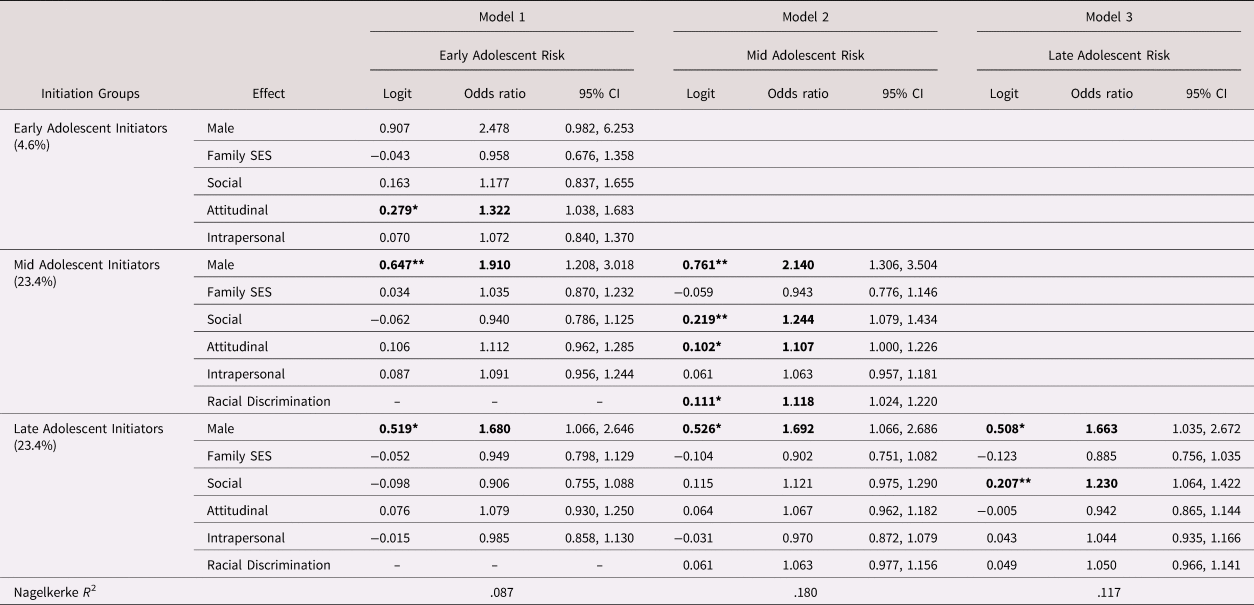
Based on early adolescent risk factors, high levels of attitudinal risk, OR = 1.322, 95% CI [1.038, 1.683], p = .023, predicted marijuana use initiation by age 14. Being male predicted marijuana use initiation during mid adolescence, OR = 1.910, 95% CI [1.208, 3.018], p = .006, and during late adolescence, OR = 1.680, 95% CI [1.066, 2.646], p = .025. Based on mid-adolescent risk factors, being male, OR = 2.140, 95% CI [1.306, 3.504], p = .003, high levels of racial discrimination, OR = 1.118, 95% CI [1.024, 1.220], p = .012, social risk, OR = 1.244, 95% CI [1.079, 1.434], p = .003, and attitudinal risk, OR = 1.107, 95% CI [1.000, 1.226], p = .049, predicted initiation of marijuana use between ages 16 and 18. Moreover, being male also predicted later initiation of marijuana use at ages 19 through 21 (OR = 1.692, 95% CI [1.066, 2.686], p = .026). Based on late adolescent risk factors, being male, OR = 1.663, 95% CI [1.035, 2.672], p = .036, and high levels of social risk, OR = 1.230, 95% CI [1.064, 1.422], p = .005, predicted initiation between ages 19 to 21. See Table 5 for more detailed results of the analyses.
Log odds coefficients and odds ratio for marijuana use initiation groups with gender, family SES, and risk factors

Note: Reference group is abstainers. Model based on early adolescent risk factors (N = 500); model based on mid adolescent risk factors (N = 477); model based on late adolescent risk factors (N = 360)
*p < .05. **p < .01. CI: confidence interval.
Cigarette use
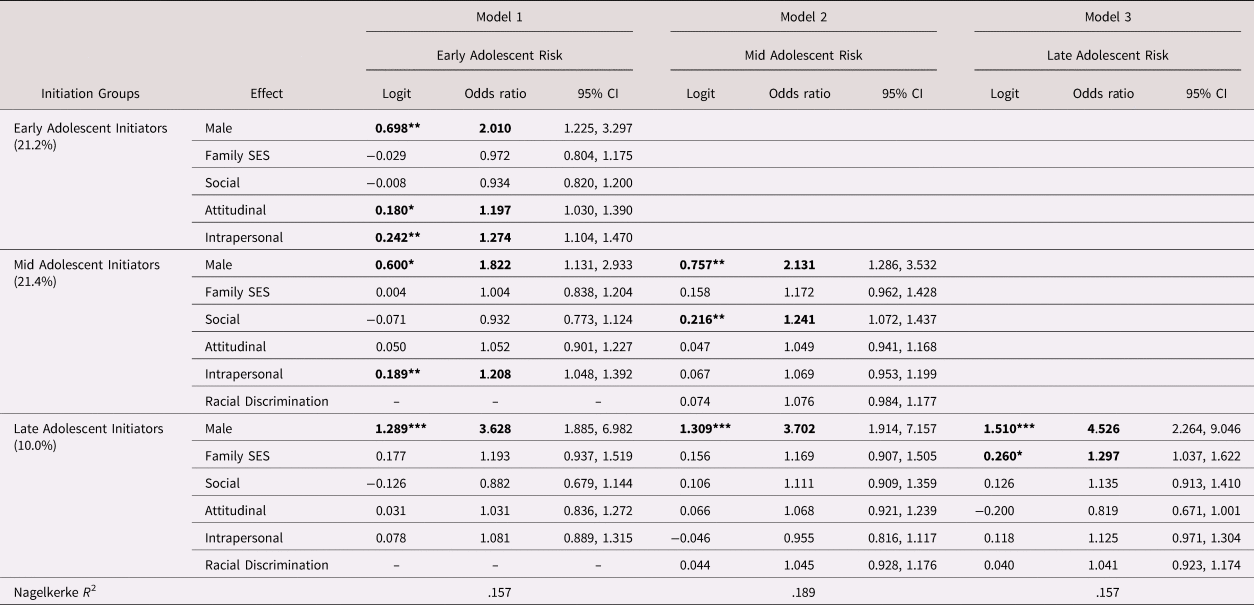
Based on early-adolescent risk factors, being a male, OR = 2.010, 95% CI [1.225, 3.297], p = .006, and high levels of both attitudinal risk, OR = 1.197, 95% CI [1.030, 1.390], p = .019, and intrapersonal risk, OR = 1.274, 95% CI [1.104, 1.470], p = .001, predicted cigarette initiation by age 14. Being a male, OR = 1.822, 95% CI [1.131, 2.933], p = .014, and high levels of intrapersonal risk, OR = 1.208, 95% CI [1.048, 1.392], p = .009, also predicted cigarette initiation between ages 16 and 18. Moreover, being male also predicted later initiation of cigarette use at ages 19 through 21 (OR = 3.628, 95% CI [1.885, 6.982], p < .001). Based on mid-adolescent risk factors, being a male, OR = 2.131, 95% CI [1.286, 3.532], p = .003, and high levels of social risk, OR = 1.241, 95% CI [1.072, 1.437], p = .004, predicted initiation of cigarette use between ages 16 and 18. Being male also predicted later initiation of cigarette use at ages 19 through 21 (OR = 3.702, 95% CI [1.914, 7.157], p < .001). Based on late-adolescent risk factors, being male, OR = 4.526, 95% CI [2.264, 9.046], p < .001, and lower family socioeconomic status, OR = 1.297, 95% CI [1.037, 1.622], p = .023, predicted initiation between ages 19 to 21. See Table 6 for more detailed results of the analyses.
Log odds coefficients and odds ratio for cigarette use initiation groups with gender, family SES, and risk factors

Note: Reference group is abstainers. Model based on early adolescent risk factors (N = 500); model based on mid adolescent risk factors (N = 394); model based on late adolescent risk factors (N = 287)
*p < .05. **p < .01. ***p < .001. CI: confidence interval.
Discussion
The current study provided a comprehensive risk model for African American youths' alcohol, marijuana, and cigarette initiation based on four risk indices (i.e., social risk, attitudinal risk, intrapersonal risk, and racial discrimination risk) and examined variation in risk at three stages of development: early adolescence, mid adolescence, and late adolescence. Findings showed that when developmental periods were combined, racial discrimination was the only factor that predicted initiation for all three substances. This finding provides further evidence on the negative effect experiences of racial discrimination have on health and behavioral outcomes for African American youth (Williams & Mohammed, Reference Williams and Mohammed2009; Williams et al., Reference Williams, Neighbors and Jackson2003), including substance use (Brody, Kogan, & Chen, Reference Brody, Kogan and Chen2012; Fuller-Rowell et al., Reference Fuller-Rowell, Cogburn, Brodish, Peck, Malanchuk and Eccles2012). Moreover, our finding extends previous work by documenting the unique effect of racial discrimination on the above established risk factors, which highlights the importance of acknowledging the influence of racial discrimination on health outcomes for African American youth and developing preventative interventions.
We also examined risk for substance use initiation based on developmental period, and among these findings, the effect of racial discrimination was only found for mid-adolescent marijuana initiation. We believe that the absence of an effect for racial discrimination among the other substance categories is driven by the exclusion of early adolescent initiators, as when mean scores for mid-adolescent racial discrimination were compared across developmental groups, the highest scores tended to be among early adolescent initiators. Given findings by Hurd et al. (Reference Hurd, Varner, Caldwell and Zimmerman2014) and Fuller-Rowel et al (Reference Fuller-Rowell, Cogburn, Brodish, Peck, Malanchuk and Eccles2012) that racial discrimination prospectively predicts substance use with no evidence that earlier substance use predicts later perceptions of racial discrimination among African Americans, we believe our findings suggest that racial discrimination was likely higher among early adolescent initiators than among those who initiate substance use during both early- and mid-adolescence, and that the overall association between racial discrimination and substance initiation is driven by this effect. Future longitudinal studies that assess racial discrimination from early to late adolescence are needed to confirm this hypothesis, as there may be a critical period during adolescence for which the effect of racial discrimination on substance outcomes is the strongest (Seaton et al., Reference Seaton, Gee, Neblett and Spanierman2018).
Moreover, these findings could point to developmental periods when interventions directed at discrimination are most pertinent. Yet, to date, only a limited number of interventions have been developed and empirically tested to specifically address the influence of racial discrimination on substance use outcomes among African American youth. These interventions focus on the stress response to discrimination, as based on theory (e.g., Brondolo, Brady, Pencille, Beatty, & Contrada, Reference Brondolo, Brady, Pencille, Beatty and Contrada2009; Clark et al., Reference Clark, Anderson, Clark and Williams1999; Wills & Shiffman, Reference Wills, Shiffman, Shiffman and Wills1985) and many are supported by empirical evidence (Brody, Kogan, & Chen, Reference Brody, Kogan and Chen2012; Clark, Reference Clark2014; Gibbons, Stock, O'Hara, & Gerrard, Reference Gibbons, Stock, O'Hara and Gerrard2016; Guthrie et al., Reference Guthrie, Young, Williams, Boyd and Kintner2002). Studies have shown that racial discrimination causes physiological and psychological stress responses (e.g., depressive and anxiety symptoms, anger/hostility symptoms) that result in substance use as a coping response to the distress. For example, Brody et al., (Reference Brody, Chen, Kogan, Yu, Molgaard, DiClemente and Wingood2012) developed the Strong African American Families Teen program, which is a family-centered program designed for African Americans that teaches emotion regulation skills to youth and parenting skills, including racial socialization approaches, to parents to aid them in dealing with racial discrimination adaptively. Although this program has shown evidence to reduce substance use risk among African American youth (Brody et al., Reference Brody, Chen, Kogan, Yu, Molgaard, DiClemente and Wingood2012), more research is needed in this area to develop and refine intervention programs that explicitly address racial discrimination and skills that mitigate its effect on health outcomes among African American youth. Our findings highlight the need for policies to decrease biases and discriminatory actions towards African Americans given the substantial effects that such experiences have on health outcomes.
Our findings also documented the effects of social, attitudinal, and intrapersonal risk on substance initiation, although risk varied based on both developmental periods of initiation and substance type. Specifically, among those youth who initiated during early adolescence, attitudinal risk factors (i.e., attitudes toward risky behaviors, low goal orientation, and academic competence) was the only significant predictor for marijuana use, with both attitudinal and intrapersonal risk factors (i.e., externalizing behaviors, low self-control and self-esteem) predicting early initiation for cigarette use. This finding suggests that interventions, such as competence enhancement prevention programs (Botvin, Reference Botvin2000; Botvin, Griffin, Diaz, & Ifill-Williams, Reference Botvin, Griffin, Diaz and Ifill-Williams2001), may be particularly beneficial for African American early adolescents, as they address cognitions associated with risk taking and competency skills that can indirectly increase academic performance and decrease risk for marijuana and cigarette use. Moreover, given risk posed by intrapersonal factors, implementation of competence enhancement prevention programs geared towards teaching youth cognitive-behavioral skills for building self-esteem and self-control could be particularly beneficial for African American youth who are at risk for cigarette initiation (Botvin et al., Reference Botvin, Griffin, Diaz and Ifill-Williams2001). Additionally, given that elevation of intrapersonal risk factors during early adolescence were also significantly predictive for mid-adolescent cigarette initiation, it is plausible that intervening early may have more enduring effects for those who initiate cigarette use during the 16–18 developmental period.
Whereas attitudinal and intrapersonal risk factors were the most robust predictors of substance use during early adolescence, social risk (i.e., parent–child conflict, peer substance use, and low parental social support) was the most consistent predictor during mid adolescence. This finding is consistent with previous literature on the influence of family and peers on adolescent risk behaviors (Bahr, Hoffmann, & Yang, Reference Bahr, Hoffmann and Yang2005; Donovan, Reference Donovan2004; Donovan & Molina, Reference Donovan and Molina2011; Van Ryzin, Fosco, & Dishion, Reference Van Ryzin, Fosco and Dishion2012) and supports the notion that social interactions are a driving force for adolescent substance use initiation. Moreover, Van Ryzin et al. (Reference Van Ryzin, Fosco and Dishion2012) found that greater family relationship quality decreased substance use indirectly by reducing contact with deviant peers. These findings suggest that interventions that specifically target parent–youth relationships may be effective at reducing adolescent substance use, directly and indirectly, through reducing negative influences by risky peers (Van Ryzin et al., Reference Van Ryzin, Fosco and Dishion2012). It should also be noted that for mid-adolescent marijuana initiation, both risk posed by social risk factors and elevations in attitudinal factors and racial discrimination increased risk for use. This finding suggests that during the 16–18 developmental period, risk for marijuana initiation for African American youth is complex, being influenced by individual level factors, social networks, and race-based stress exposure, which may require more multifaceted intervention approaches to address these varying risk factors.
Lastly, during late adolescence, of the four risk indices, only social risk factors were shown to be predictive of initiation, increasing risk for marijuana use. As mentioned above, this finding supports the notion that social interactions are a driving force for adolescent substance use initiation that extends to late adolescence, at least for marijuana initiation for African American youth. Thus, interventions that target youth's social networks may be effective for reducing risk for marijuana use during late adolescence for African American youth (Baer, Kivlahan, Blume, McKnight, & Marlatt, Reference Baer, Kivlahan, Blume, McKnight and Marlatt2001; Reid, Carey, Merrill, & Carey, Reference Reid, Carey, Merrill and Carey2015; Turrisi, Jaccard, Taki, Dunnam & Grimes, Reference Turrisi, Jaccard, Taki, Dunnam and Grimes2001; Van Ryzin, Roseth, Fosco, Lee, & Chen, Reference Van Ryzin, Roseth, Fosco, Lee and Chen2016). However, it should also be noted that our finding contradicts work by Tang and Orwin (Reference Tang and Orwin2009), who found that the effect of parent and peer factors did not extend to late adolescence. However, the Tang and Orwin (Reference Tang and Orwin2009) study was not restricted to only African American youth, suggesting that the influence of parent and peer influences during adolescence may vary across racial/ethnic groups.
Although outside of the four indices of risk, the current study also examined the effects of sociodemographic factors (i.e., gender and family socioeconomic status) on substance use initiation across the developmental periods. Similar to the four risk indices, the influence of the sociodemographic factors varied based on both substance type and developmental period. For gender, it was found that being male increased risk for marijuana and cigarette initiation, with a nonsignificant gender effect for alcohol use. The gender effect for marijuana and cigarette initiation was also fairly consistent across developmental periods, with an effect found for each initiation period except for early adolescent marijuana initiation. These findings suggest that for rural African American youth, males are at greater risk for initiating marijuana and cigarette use than their female counterparts are. It is plausible that these gender effects may also moderate the effect of the observed risk posed by the other risk indices. Future research is needed to examine the potential moderating effect of gender with respect to developmental periods on substance use initiation among African American youth.
As for family socioeconomic status, although low socioeconomic status has been shown to be a risk factor for both substance use initiation (Roberts, Spillane, Colby, & Jackson, Reference Roberts, Spillane, Colby and Jackson2017) and dependence (Meier et al., Reference Meier, Hall, Caspi, Belsky, Cerdá, Harrington and Moffitt2016) among studies comprised of predominately White youth, findings have been less consistent among African American youth, with some studies finding a weaker (Bachman et al., Reference Bachman, O'Malley, Johnston, Schulenberg and Wallace2011) or nonsignificant effect (Wallace et al., Reference Wallace, Forman, Guthrie, Bachman, O'Malley and Johnston1999). Our findings support this mixed effect for African American youth, with low family socioeconomic status only being found to elevate risk for initiation during late adolescence for marijuana use and being found to be protective across all developmental periods for alcohol initiation. As for cigarette use, no significant effect of low socioeconomic status on initiation was observed. It is also plausible that variability in the effect of socioeconomic status may be a byproduct of geographic location, as differences in risk for substance use have been observed among African American youth residing in urban versus rural neighborhoods (Clark, Nguyen, & Belgrave, Reference Clark, Nguyen and Belgrave2011). Thus, low income may be more of a protective factor for alcohol use among rural communities, but it may pose risk in urban communities. We postulate that this protective process among low-income rural African American communities may also operate through community characteristics, such as affiliation with religions traditions (Kim, Harty, Takahashi, & Voisin, Reference Kim, Harty, Takahashi and Voisin2018; Nasim, Fernander, Townsend, Corona, & Belgrave, Reference Nasim, Fernander, Townsend, Corona and Belgrave2011) which tend to discourage substance use. However, based on our findings, the protection from socioeconomic status was only found for alcohol use, thus future studies are needed to determine whether the protective effect extends to other substances, as well as if there are particular environments in which the effect is observed.
Although the current study's findings on the effects of racial discrimination and established risk factors for substance use initiation across three developmental periods among African American youth is novel and significant, there are some limitations to note. First, although efforts were made to use the same measures to assess the four risk indices (i.e., social risk, attitudinal risk, intrapersonal risk, and racial discrimination) at each developmental period, there were some slight differences in measures across waves, and the racial discrimination measure was only available at ages 16–21. We attempted to address this limitation by choosing measures based on theoretical considerations, in that the measures were believed to be assessing similar constructs, which was supported through significant correlations within each index. However, we cannot guarantee that there were no instrumental effects that may have influenced the study results. Future studies are needed to replicate the study findings with repeated measures that are consistent across developmental periods. Moreover, given a lapse in funding, youth did not provide data for substance use and related risk factors at age 15. Second, although our model attempted to provide a comprehensive assessment of risk for substance use, there were factors that were not assessed. Future studies can expand upon the current study by including additional factors, such as family history of substance use as a social risk factor and racial identity as a cultural risk factor. Third, the sample for the current study was recruited from rural communities in the southeastern United States, with participants in our study reporting higher lifetime rates of alcohol, marijuana, and cigarette use than national estimates for African Americans at comparable ages (Substance Abuse and Mental Health Services Administration, 2009; 2013a, 2013b). Additionally, participants who were included in the study analyses differed significantly on some study variables from those individuals excluded from analysis. These factors could influence both power to detect an effect and the generalizability of the findings, thus replicating the present findings is necessary to support the generalizability of these effects to other diverse populations. Fourth, engaging in substance use during late adolescence includes unique experiences that are qualitatively different from those of youth during early and mid-adolescence (e.g., identity exploration, changing social roles and responsibilities, new social groups; Arnett, Reference Arnett2005; Perry et al., Reference Perry, Pérez, Bluestein, Garza, Obinwa, Jackson and Harrell2018; Sussman & Arnett, Reference Sussman and Arnett2014; Wood et al., Reference Wood, Crapnell, Lau, Bennett, Lotstein, Ferris and Kuo2018). During this developmental period, youth are also of legal age to engage in cigarette and alcohol use. These unique circumstances and factors that represent late adolescence, also referred to as emerging adulthood or young adulthood, were not assessed in the current study, and such variables may prove to be stronger risk factors for substance initiation. Thus, future studies are warranted to examine other factors that may predict initiation among this specific developmental period. There is also evidence for within-group variability in risk for substance use among African Americans (Clark, Reference Clark2014) and the effects of racial discrimination on health outcomes (e.g., Seaton, Caldwell, Sellers, & Jackson, Reference Seaton, Caldwell, Sellers and Jackson2008) based on country of origin (i.e., African American versus African Caribbean) and gender. Thus, future studies are warranted examining within-group variation in the proposed risk model.
In summary, the current study is one of the first to investigate a comprehensive risk model for substance use initiation for African Americans across adolescence that includes both racial discrimination and established risk indices (i.e., social risk, attitudinal risk, and intrapersonal risk) within the same model. Moreover, given that adolescence is a dynamic developmental period that is marked by important changes within (i.e., physical, psychological, neurobiological changes) and outside (i.e., environmental and social changes) of the individuals (Cicchetti & Rogosch, Reference Cicchetti and Rogosch2002), we documented the differential effects of risk indices on substance initiation as a function of developmental period and substance type among African American youth. We believe these findings are significant, as they provide a stronger fundamental understanding of the collective and unique contributions of the four risk indices assessed to substance use risk for African American youth, which has to date been understudied in the field. Future research can build on this work and advances in the field of developmental psychopathology by examining how these sets of risk factors predict substance use into emerging and young adulthood, mechanisms involved within the risk process, and interactions among risk/protective variables in predicting risk (e.g., Chassin, Sher, Hussong, & Curran, Reference Chassin, Sher, Hussong and Curran2013; Dodge et al., Reference Dodge, Malone, Lansford, Miller, Pettit and Bates2009; Wang & Dishion, Reference Wang and Dishion2012). Such work can ultimately inform intervention programming for specific developmentally-appropriate targets for reducing substance use risk among African American youth.