Introduction
Old age is commonly a time of enduring undesired changes and irreversible losses, such as bereavement, physical decline, hearing or memory loss, the loss of societal roles through retirement, and for those who have to enter institutional care, the loss of one's home and many possessions (Coleman Reference Coleman, Bond, Coleman and Peace1993; Lazarus and Lazarus Reference Lazarus and Lazarus2006). The possibility or threat of these occurrences is itself a stressor, as is the ever more tangible realisation of the approach of one's death. Older people often have depleted personal resources with which to cope (McFadden Reference McFadden, Birren and Warner Schaie1996), or they may be facing problems with no practical solutions, so dealing with ageing can seem to be an enormous challenge (Lazarus and Lazarus Reference Lazarus and Lazarus2006). Nonetheless, most people adjust well to ageing and develop an acceptance of a more limited life and also of death itself (Coleman Reference Coleman, Bond, Coleman and Peace1993). It has been found that, in comparison to young adults, older people's coping approaches are generally less oriented to problem-solving and more to the emotions, with strategies such as distancing, positive reappraisal, and seeking social support being prominent ways of coping (Coleman Reference Coleman, Bond, Coleman and Peace1993; Folkman et al. Reference Folkman, Lazarus, Pimley and Novacek1987). Many older people use religious belief as a coping resource, particularly when there is seemingly nothing else to turn to (Davie and Vincent Reference Davie and Vincent1998; Dein and Stygall Reference Dein and Stygall1997; Koenig Reference Koenig2006; McFadden Reference McFadden, Paloutzian and Park2005; Pargament Reference Pargament1997). A substantial amount of cross-sectional data on the relationship between age and religiosity has been collected in the United States of America (USA) over the last 50 years, which consistently demonstrates that people tend to become more religious as they get older (McFadden Reference McFadden, Paloutzian and Park2005; Moberg Reference Moberg and Moberg2001). It is thought that this is because the sense of community and belonging that religion provides becomes more important with greater age (Marcoen Reference Marcoen, Johnson, Bengston, Coleman and Kirkwood2005), and because the questions that religions address – of origins, meaning and death – become more pertinent in the twilight of life (Coleman in press; McFadden Reference McFadden, Paloutzian and Park2005). It may also be that older people have more free time than others to devote to religious contemplation and participation.
The psychological and social scientific study of religion and spirituality has bloomed only within the last 25 years (Davie Reference Davie2000; Koenig Reference Koenig2006), following an extended hiatus after William James's pioneering psycho-philosophical text on subjective religious experiences (James 1902/Reference James2004). But this emerging field already boasts some impressive claims: that being religious is associated with various aspects of psychological wellbeing and meaning-making (Crowther et al. Reference Crowther, Parker, Achenbaum, Larimore and Koenig2002; Kirby, Coleman and Daley Reference Kirby, Coleman and Daley2004; Koenig Reference Koenig2000; Krause Reference Krause2003; Park Reference Park, Paloutzian and Park2005), that religion is a coping resource of great importance for the chronically and terminally ill (Dein and Stygall Reference Dein and Stygall1997; Gall and Cornblat Reference Gall and Cornblat2002; McClain-Jacobson et al. Reference McClain-Jacobson, Rosenfeld, Kosinski, Pessin, Cimino and Breitbart2004; Nelson et al. Reference Nelson, Rosenfeld, Breitbart and Galietta2002), that in both the USA and Europe religion is inversely correlated with depression (Braam, Beekman and van Tilburg Reference Braam, Beekman and van Tilburg1999; McCullough and Larson Reference McCullough and Larson1999), and that following a religion might even positively influence physical health (Culliford Reference Culliford2002; Koenig Reference Koenig1993). The Handbook of the Psychology of Religion and Spirituality (Paloutzian and Park Reference Paloutzian and Park2005) provides an accessible overview of the field's accomplishments and may well be paving the way for more sophisticated future research. Despite all this, however, there are major weaknesses in the literature, even on fundamental issues of the definition of terms and the appropriate methodologies (Dein and Stygall Reference Dein and Stygall1997; Kirkpatrick Reference Kirkpatrick2005a, Reference Kirkpatrick, Paloutzian and Park2005b; Miller and Thoreson Reference Miller and Thoresen2003).
Issues of definition
A deft and yet universally applicable definition of religion has long eluded writers in the psychology of religion (Zinnbauer and Pargament Reference Zinnbauer, Pargament, Paloutzian and Park2005). Any definition must be a compromise, to include all forms of what most people understand a religion to be, whilst keeping the concept of religion as distinct from spirituality – another term that has eluded a widely accepted and consistent definition. Many authors have described religion as the more formal, merely social phenomenon (Hill and Pargament Reference Hill and Pargament2003; King, Speck, and Thomas Reference King, Speck and Thomas2001; Zinnbauer and Pargament Reference Zinnbauer, Pargament, Paloutzian and Park2005), but religion cannot be fully understood without reference to its meaning to the individual and its functions in people's lives (Zinnbauer and Pargament Reference Zinnbauer, Pargament, Paloutzian and Park2005). Definitions cannot in all cases encompass everything about the construct, however, and religion's roles at the individual level do not necessarily have to be manifest in its definition. The definition of religion that we advocate is: ‘a shared system of beliefs and associated practices based on a transcendent view of life’ (Coleman in press).
Issues of methodology
Religion has consistently been measured superficially in empirical studies, and frequently in terms only of religious observance and service attendance (McCullough and Larson Reference McCullough and Larson1999; Miller and Thoreson Reference Miller and Thoresen2003). There is also now a recognised lack of longitudinal and qualitative work in the field which, if delivered, would arguably bring more meaningful analyses of the broad subject (Braam, Beekman and van Tilburg Reference Braam, Beekman and van Tilburg1999; Kirby, Coleman and Daley Reference Kirby, Coleman and Daley2004; McFadden Reference McFadden1999, Reference McFadden, Paloutzian and Park2005). Another weakness is that some authors in the field are committed to promoting religion. Richard Dawkins (Reference Dawkins2006), among others, has argued that funds from proselytising organisations like the Templeton Foundation undermine the scientific integrity of the research that they support. It too has been argued that the alleged physical health benefits of religious observance have been grossly exaggerated or presented in a misleading way (Miller and Thoreson Reference Miller and Thoresen2003), although it is generally accepted that any association could arise from intervening factors such as the social contacts entailed in religious observance and the discouragement of unhealthy behaviours (Coleman in press; Powell, Shahabi and Thoresen Reference Powell, Shahabi and Thoresen2003).
Another important problem with the extant literature on religion is that most of the work has been carried out in the USA, and it cannot be assumed that American findings translate to other societies (Coleman Reference Coleman2005; Kirby, Coleman and Daley Reference Kirby, Coleman and Daley2004). Comparing Western Europe with the USA, fewer people believe in God (Koenig Reference Koenig1993) and religion is much less of a ‘cultural force in society’ (Koenig Reference Koenig1999). In the United Kingdom (UK), traditional formal religious practice has been in decline since at least World War Two, and especially since the 1960s (Davie Reference Davie2000), and there is some evidence of a decline in affiliation even among older Christians (Coleman, Ivani-Chalian and Robinson Reference Coleman, Ivani-Chalian and Robinson2004). The result is that many people in the UK today have vague, individualised spiritual beliefs that are unattached to religious doctrines and that may be a relatively poor and untested resource for coping with ageing (Liu Reference Liu2007; McFadden Reference McFadden, Reker and Chamberlain2000).
A noteworthy omission from the psychosocial literature on religion and age has been the absence of comparisons of religious and atheistic belief – the more usual focus has been on comparing strong versus weak religious belief. While it is known that religious coping methods are rarely used to the exclusion of secular methods (Pargament Reference Pargament1997), a few authors have commented that it is not known whether a philosophical belief system derived from atheism is comparable to a religious belief system in helping individuals cope with the problems of advanced age (Coleman, Ivani-Chalian and Robinson Reference Coleman, Ivani-Chalian and Robinson2004; Dein and Stygall Reference Dein and Stygall1997). The positive arguments for an atheistic worldview have been advanced rhetorically by some (Dawkins Reference Dawkins1998, Reference Dawkins2006; Hitchens Reference Hitchens2007), but they have been countered by some US evidence that suggests that non-religious people are at a higher risk of symptoms of depression (McCullough and Larson Reference McCullough and Larson1999). This comparison is flawed, however, because returns from the monotheistic beliefs of the Abrahamic family of religions have not been compared with the returns from the conscious refutation of such transcendental beliefs, namely atheism. If religion is a shared system of beliefs and practices based on a transcendent understanding of life, then atheism can presently be understood as a shared belief system based on a materialist conceptualisation of the universe – incorporating usually a belief in big-bang theory and Darwinist evolution as the best explanations of the origins of the universe and of life as we know it. Derivative beliefs are that humanity's intuitive morality has biological not supernatural origins, that humans are entirely physical matter and on death cease to exist, and that it is enough to do good, to enjoy life, and to cope without drawing on immaterial resources (Dawkins Reference Dawkins2006; Wilkinson and Coleman forthcoming). It is difficult to characterise any particular behaviours as definitive of atheism, so behaviour cannot be an element of its definition.
Aims and methods
The purpose of the present study has been to explore in detail the question of how atheistic beliefs compare to theistic beliefs in helping older people cope with ageing and old age. This general question was translated into three specific aims: firstly, to find out the extent to which people considered their beliefs about the nature of existence to be relevant in helping them cope with the trials of ageing; secondly, to assess the relative success attributable to theistic and atheistic belief-based coping methods; and, thirdly, to ascertain whether there was evidence for the uniqueness of religious coping as an ageing resource compared with other atheistic forms of existential belief, or whether in fact atheism can be analogous to theism in terms of the four recognised functions of religious belief, ‘explanation, guidance, consolation, and inspiration’ (Dawkins Reference Dawkins2006: 347).
It was decided that a case study approach was most appropriate, since the aim was to explore an unaddressed area and to develop theoretical insights. Whilst case study methods do not produce generalisable results, they enable a depth of understanding that is not attained by most studies of large samples (Coleman, Ivani-Chalian and Robinson Reference Coleman, Ivani-Chalian and Robinson1999; Coleman Reference Coleman, Jamieson and Victor2002; Sacks 1973/Reference Sacks1991, Reference Sacks1985). Case study methods also satisfy one of the principle axioms of psychological enquiry, namely to strive towards an understanding of the thoughts and behaviours of the individual, and they are particularly apt when studying older people because it is apparent that the experience of ageing is highly variable – indeed case study research openly embraces rather than tries to conceal outliers and untypical cases (Coleman Reference Coleman, Bond, Coleman and Peace1993, Reference Coleman, Jamieson and Victor2002; Lazarus and Lazarus Reference Lazarus and Lazarus2006; McFadden Reference McFadden1999).
The participants
Two samples of people aged 60 or more years were formed, one of 11 people with strong atheistic convictions, the other of eight with strong religious and theistic beliefs. The two samples were polarised as far as possible in terms of beliefs to maximise the likelihood of revealing the most important differences between the two modalities. The participants were recruited in the south of England from various religious organisations, using databases from previous studies, personal contacts, and a group affiliated to the British Humanist Association – a national atheists' and agnostics' collective (see www.humanism.org.uk). All the religious participants were either Christian or Jewish.
Phase I: The initial interviews
In-depth, open-ended interviews lasting from one to two-and-a-half hours were conducted during 2007–8 with each participant. The interviews were audio-recorded, selectively transcribed and summarised thematically. The interviews covered biographical details, the participants' current beliefs and their changing belief story over time, as well as how their beliefs had helped or hindered them in coping with ageing. Efforts were made to explore the subject using the participants' own terms, to encourage an understanding of the exact nature of their beliefs as they saw them. An interview topic guide provided prompts and direction if a participant was struggling to articulate what they felt or believed, but this was only occasionally required.
Phase II: The follow-up interviews and scales administration
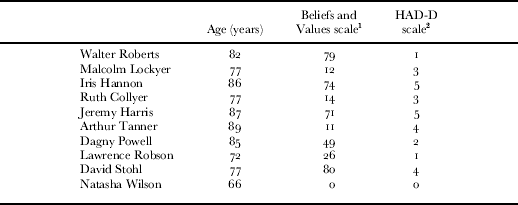
For the second phase of the study, the interview material was reviewed and points of focus chosen for each participant, depending on what they had discussed during the first meeting. Five comparison pairs across the two groups were designated, of two people with different beliefs who recently had had to deal with the same problem or issue. The challenges included some of the most common major stresses, losses and issues of advanced age. The ten participants in the pairs were visited again for more open-ended questioning that filled important gaps in the participants' earlier accounts, and to administer two established instruments, the Royal Free Hospital's Beliefs and Values scale (King et al. Reference King, Jones, Barnes, Low, Walker, Wilkinson, Mason, Sutherland and Tookman2005) and the Hospital Anxiety and Depression (HAD-D) scale (Zigmond and Snaith Reference Zigmond and Snaith1983). The former scores beliefs on a scale between ‘0’, indicating very strong atheistic beliefs, and ‘80’, indicating very strong religious or spiritual beliefs, and it was employed in order to validate quantitatively the classification of the final sample as polarised in terms of belief status. The latter has a range from ‘0’ to ‘21’, with high scores indicating high anxiety and depression. From the wealth of material collected during the interviews, individual profiles were composed with biographical details and notes on how the participants' beliefs had been relevant to coping with many aspects of ageing and, in greater detail, on the particular challenge that was the focus of the comparison.
Richard Lazarus, the distinguished pioneer in research on the psychology of stress and coping, in his posthumously published book Coping with Aging, proposed the following eight principles of successful ageing (Lazarus and Lazarus Reference Lazarus and Lazarus2006: 202):
1. To be clear about the realities of one's situation.
2. To accept those realities and view them in the best light possible.
3. To be able to cope effectively with those realities.
4. To be able to compensate for losses and deficits.
5. To be actively engaged in purposeful striving.
6. To be wisely selective about what one takes on.
7. To maintain close ties to others.
8. To retain positive self-regard despite losses and deficits.
These principles were used as a partially objective outcome measure – a guide by which to judge the success of each participant's coping efforts. Outcomes were evaluated with reference to both Lazarus's yardstick list and by comparison with the paired subject. If participants could be said to have met the principles that were most relevant to their given predicaments, then they were deemed to have coped successfully, and the converse applied.
The case studies
In the following abbreviated accounts, the cases are presented in pairs, beginning with the religious participant's case story before that of the atheistic counterpart. The focus is on the interaction between the subject's existential beliefs and her or his coping, not on all aspects of their coping resources and approach such as social support. The results from the questionnaires and ratings are arrayed in Table 1. Fictitious names are used for the participants to preserve anonymity, and the present tense is used to describe the participants' circumstances at the time of interview and to examine the cases in their pairs.
The participants' scores on the Beliefs and Values and the Hospital Anxiety and Depression scales

Notes: 1. Royal Free Hospital's Beliefs and Values scale, range ‘0’ (strong atheistic beliefs) to ‘80’ (strong religious beliefs) (King et al. Reference King, Jones, Barnes, Low, Walker, Wilkinson, Mason, Sutherland and Tookman2005). 2. Hospital Anxiety and Depression scale, range ‘0’ to ‘21’ with high scores indicating high anxiety and depression (Zigmond and Snaith Reference Zigmond and Snaith1983).
Two bereaved men
Mr Walter Roberts is an 82-year-old former banker. Although he was brought up by non-practising Anglican parents, his faith blossomed throughout his life and he is now a devout Roman Catholic who attends Mass every day. His belief in a loving God is unequivocal: ‘I am convinced that there is a mastermind, who I call God, who is interested in me and is helping me’. Mr Roberts was married for 53 years to Marjorie, who died very suddenly in 2004 of advanced ovarian cancer, which had lain dormant and undiagnosed in her body under the guise of a non-specific illness with bouts of weight loss and gain. Although her death in hospital after two surgeries was rapid, Mr Roberts draws some comfort from the fact that her pain was well controlled and her death fairly peaceful. Because Mr Roberts is absolutely convinced that he and his wife shall meet again in heaven, he finds that it has not been unbearably hard to cope with her death, although a time of profound sadness. Right after she died, he told his children that they must as a family come to terms with her death ‘as God's will’, and that they should be thankful for her long and happy life. Initially, his children and friends provided what he calls ‘a raft of support’, but he was very careful not to display feelings, until bereavement counselling sessions encouraged him to confront his emotions and let the grief flow. He believes that his main source of support through the loss of his wife has been his religion. From the beginning, when things were most grim, going to Mass every day has been a focus in his life that has consistently made him feel rejuvenated and equipped to continue coping.
To this day there are afternoons and evenings that are long and empty for Mr Roberts and the loneliness and sense of loss during these times can still be difficult; but he has a structure to his life and feels he has a purpose – to be there for his children and to continue the voluntary work he does reconditioning old tools that are sent to poor people in Africa. Mr Roberts is thankful to God that he has been able to come to terms with life without his wife and that she died before him, because he thinks she would have found it incredibly difficult on her own. He draws comfort from his beliefs that praying for his wife will get her through purgatory and that she is praying for him. On the whole, Mr Roberts thinks he has coped well with the death of his wife. He has not become depressed or bitter. In fact he believes that, ‘through the loss of the love of my life, I've been drawn much closer to God’.
Mr Malcolm Lockyer was born in 1930. He read the first part of a medical degree as an undergraduate but was not accepted on to any clinical course and so could not continue. Then, after compulsory National Service in the armed forces, he went through a string of what he describes as rather mediocre jobs, including being a school ancillary worker for many years. He and his wife were volunteers with the Samaritans for around 15 years. He retired late at the age of 71 years. Mr Lockyer was raised as Jewish by his parents, but he remembers his mother's left-wing politics having a much greater residing influence on him than her religious views. He has feared anti-Semitism all through his life, and for this reason has tried to hide from acquaintances that he is Jewish. As a young man, Mr Lockyer did not give religion much thought, and he gradually realised that he did not believe in anything that any religion professes, such as a God or any form of life after death. He finds the idea of eternal life ‘disenchanting’ and difficult to conceptualise, and meets people of like mind in a humanist group. He explained, ‘as far as I'm concerned, Humanism is just the ability to make up your own mind, to have freedom of thought. I don't believe in a supernatural being. The probability of there not being a God is much higher than the probability that there is’.
Mr Lockyer's wife died in 2004 from a rare liver cancer, having been through a protracted two-year decline during which Mr Lockyer cared for her every need. She took a paracetamol overdose about nine months before her death in a fit of despair, following the medical mismanagement of an eye problem, but eventually died peacefully at a hospice in a beautiful setting. Mr Lockyer coped with his loss principally by ‘just getting on and doing things’, focusing on the day-to-day. Because he is not a believer, the fact that his wife died in such a way when they had led a healthy life, exercised and eaten well, elicits no sense of conflict or injustice. The way he sees it, it's just ‘the way the cookie crumbles. A split second can alter your life’. Whilst not believing that his deceased wife exists anywhere in any form, Mr Lockyer has a strong feeling of her continuing presence in his and his children's memories. He said, ‘that to me is what immortality is – the continuing of that person as long as our family lasts’. Mr Lockyer has had to adjust to life alone, partly by doing voluntary work. He is not a very sociable person and pities himself a lot because of his bereavement. He misses his wife a great deal. He says that his beliefs are not particularly relevant to how well he has coped; he just thinks his view of life as finite brings with it an extra pressure to use his time well and to continue living a rich and full life.
Both of these bereaved gentlemen appear to have coped similarly regardless of their particular beliefs, by mourning their wives, treasuring their memories of them, and carrying on with day-to-day life. Lazarus's principles of successful ageing can be related to bereavement in old age – particularly the acceptance of the reality of the death and appraising the changed situation as best one can, maintaining significant personal relationships, and compensating for the loss by continuing to have purpose in one's life. On these counts, there is no discernible difference in how the two men have coped. Both have begun regular voluntary work since the bereavement, which provides a routine but may also help confer a raison d'être, and both have continued to have close relationships with others, particularly their offspring. In terms of accepting the reality of the bereavement, atheists might argue that their worldview is more realistic in its attitude to death as the absolute end and that a belief in the afterlife is merely a psychological denial mechanism, but adjusting to the loss of a loved one is about coping with that loss in this life regardless of one's ideas about what might lie beyond the grave. It is unreasonable, therefore, to assert a difference in the two men's acceptance of the reality of their wives' deaths. Both men have viewed this reality in the best light possible but in stylistically different ways, because they have used their contrasting belief systems to ameliorate the pain of the bereavement in individual ways. The final component of Lazarus's check-list, the retention of positive self-regard, is difficult to assess in these two cases, and may be more pertinent for those who are becoming increasingly frail. Nevertheless, when the three principles of successful ageing proposed by Lazarus are applied, both men can be said to have coped well with their bereavements.
Two women coping with painful non-spousal bereavements
Mrs Iris Hannon is 86 years of age. Her husband ran a building business where Iris had a secretarial and supportive role, and she also had a career in charity work. They had two daughters: the eldest, Diana, became a mathematician, and the youngest, Jane, became a general practitioner. Iris's husband died in 1995, and shortly after she moved to be near Jane. Jane died in 2001. Mrs Hannon was brought up as a Methodist and has been a strong Christian ever since, with a firm belief in God and in the afterlife. She thinks that her beliefs have matured as she has aged but that she has also become much more dependent on the support they give her. Mrs Hannon believes that her faith guides her and gives her the strength to cope with whatever may come. She prays both morning and night, and her prayers most commonly take the form of a conversation with God of her own construction. She says that she prays mainly ‘for strength – physically, mentally and spiritually’.
Shortly after Mrs Hannon moved, Jane became ill with the cancer that eventually killed her. Mrs Hannon believes that it was God's will that she should have sold the house so quickly after her husband's death, because she believes she was meant to be there to care for Jane and the family. Indeed, despite her own increasing frailty, she undertook most of the cooking and washing duties in Jane's house and cared for her daughter's every need. After Jane's death, Mrs Hannon has coped principally by focusing on what needs doing for Jane's family. She said, ‘I feel for the family. That's why I want to give so much to the family. That has upset me: the fact that they haven't got a mother’. Jane's death was very difficult to cope with emotionally, because she was relatively young and had much to live for. Mrs Hannon said that it definitely seemed unfair and came as an appalling shock. Losing a daughter has been ‘a tremendous emotional problem. I shall never be the same person; and everyday it doesn't get any different’. She believes, however, that her faith has helped her cope ‘constantly’, and that they will meet each other again in the afterlife. Every day she is reminded of how Jane's spirit continues to live on – in the memories she has and in all the things they chose together in her cottage. She has also grown as a person through the loss of Jane, realising ever more vividly that personal relationships in life are far more important than wealth and material possessions.
Mrs Ruth Collyer is aged 77 years and lives with her husband Will, a retired teacher. Mrs Collyer was brought up in the Church of England tradition and went to a Quaker school for a while – an experience shared by her husband. They were married in a church and all their children have been christened. She thinks that they merely accepted the religious way for a long time and did not consider existential questions about life particularly deeply. Over time, however, the couple gradually began to believe that God ‘was really a myth’ and that they were both probably humanists. Mrs Collyer said, ‘I don't believe in God or gods; I think this is the only life we shall have, and that we ought to make the most of our time here, and I think anything that you leave behind, any afterlife, is really just your connections with other people – the memories that other people have of you or the influence you might have had on them’. Mrs Collyer thinks her beliefs are entirely a product of her reason, that she has just simply accepted what is reality of the adult world. She finds science fascinating and awe-inspiring and the only means by which people can truly understand the universe.
Mrs Collyer's elder brother died two years before at the age of 81 years. Mrs Collyer takes some comfort from the fact that he had a long life and that his brain worked well until the end, but she has still found his death very traumatic. Initially she found it hard to believe that he was not there any more, because he had always been emotionally available for her. Mrs Collyer coped with his death through being close to the rest of her family – sharing the grief ‘and sharing the memories’. As a family, they go on talking about him, and this has been the mainstay of Mrs Collyer's coping approach. She thinks that her atheistic beliefs have not been particularly relevant to how she has coped; it has just been a case of accepting the reality of the situation and not trying to tell herself stories about him ‘looking down on them all from heaven’. In fact, she insists that she just had to cope. She has drawn some comfort from the idea that his legacy lives on in the family's memories. Her atheistic beliefs have remained fixed and firm throughout the affair.
As with the first two case studies, neither woman can be said to have coped better than the other with reference to any of Lazarus's points about coping with ageing. Through terribly sad times, both have accepted their losses and have focused on the positives, namely their wonderful memories of the deceased. Both women have many friends and enjoy meaningful relationships, and both care for other people and undertake what voluntary work their physical conditions permit. Both have low scores on the depression and anxiety scale (Table 1), and both have been coping well despite their contrasting existential beliefs and personal philosophies.
Two men coping with frailty and physical decline
Mr Jeremy Harris was born in 1920. He began training as an architect before the Second World War. After over six years in the Royal Air Force (RAF), he had to give up his architectural ambitions and take over his dying father's sail-making and canvas-produce business, which he ran with his brother for the rest of his working life. He retired through ill health 15 years before the interviews. Mr Harris was brought up in and confirmed into the Anglican faith but, after spells with the RAF in India and Burma, he became interested in Buddhism, and when he returned to the UK undertook training in Theravada Buddhism and later Zen Buddhism. Mr Harris found Buddhism a rationally appealing and intellectually very satisfying religion, and one that equipped him with equanimity in the face of adversity. However, a split with Buddhism came when Mr Harris deepened his study of karma – a belief in cause and effect. He said, ‘if you do a bad deed or a harmful deed, you will suffer the results. And this is absolutely irrevocable. It can't be changed. So you are building your own future all the time, and this I found pretty shattering eventually’. A visit to the Russian Orthodox cathedral in London for a Christmas liturgy brought about a religious conversion for Mr Harris and an escape from the Buddhist religion that now dissatisfied him so. Initially, his conversion to Orthodoxy was more a matter of the heart than the mind but, in time, the authority of the Christian concept of love as consideration and compassion, as well as the view that all things are sacred, became so patently valid and truthful to him that he became intellectually convinced of his new faith.
As far as his beliefs go, Mr Harris is in many ways a man of advanced faith, but he is not too theological or detached about it: his religion is very much a felt thing. Mr Harris considers himself to be a ‘firm believer’ in God, although he regards God as conceptually unknowable. He does believe, however, that one can gain a vicarious understanding of God by studying the life of Jesus Christ. For him, faith is something which ‘demands a total jump into something that you don't really know in full yourself’, but it is also a relationship of trust between one's subordinate self and the obvious authority of God. Mr Harris attends Orthodox liturgies as frequently as he can, although he relies heavily on friends to drive him to the services. He finds this contact with other genuine Christians a ‘lifeline’ because it reinforces his faith. He prays for at least one hour everyday from a book by rote, and tries to go out of himself and feel his imminent relationship with Christ through the heart and not with the mind. He cites the Jesus Prayer as a particularly important prayer in Orthodoxy, ‘a sort of walking-stick prayer’. Mr Harris sees the meaning of life as an ascent towards a goal: the union with Christ that can be achieved through love and prayer and the avoidance of sin. He tries his best to live by the values of honesty and humility. Mr Harris is very interested in the concept of ‘ways of looking’ and he gains a great deal of inspiration from writing on the subject (seeMayne Reference Mayne1995). He believes that, ‘all material things are vehicles of a quality that is divine’ and that this is what is sensed when one has a ‘spiritual’ experience, as when listening to beautiful music or when looking at something natural, free from the constructs and abstractions of language. He said, ‘you forget about all the conventional ideas you've got about it and see the reality of it, and that's a transcendental experience’.
In 1975, Mr Harris underwent open-heart surgery and came close to death. He has since had operations for gallbladder disease, appendicitis and cancer, enduring much suffering over the course of these illnesses. He has outlived both of his parents, however, and he is immensely grateful for the fact that he is still alive ‘in spite of’. Nevertheless an embolism affecting one lung contracted in the aftermath of his heart surgery has left him with residual breathlessness and a general lack of energy. Mr Harris's attitude to physical decline is that you have to accept what is inevitable, and he does not fight against it. By attending the Orthodox liturgies and by reinforcing his faith in the resurrection of Christ and the afterlife, he has become less concerned with the problems of this life and has adopted a distanced view of his own ageing and increasing frailty. For the time being, he is coping with looking after his wife and essential household activities, but is realistic and can foresee the possibility of not being able to cope physically in the future. He also fears physical suffering but believes that the crucifixion of Christ demonstrated that not all suffering is in vain. With his secure faith, he does not fear death and is able to reappraise the ageing process and cope emotionally.
Mr Arthur Tanner is 89 years of age. His father died during the First World War, which left him as an only child to be brought up by his mother and grandparents. He worked in clerical and managerial roles for railway companies throughout his working life. Mr Tanner has been married twice and both wives have died. He says that he has never been a religious person, so has had no concrete faith of any description to lose. He expresses a strong disbelief in any form of God and argues that the rest simply follows from that – his disbelief in an afterlife and so on. Having witnessed two wives die in front of him – they ‘simply expired’ – he is convinced that there is nothing beyond the grave. He recollects that ‘none of my relationships where people have died have resulted in any sort of communication, or feeling even, that anything of them still exists’. Mr Tanner believes that the big-bang theory is the best explanation of the origin and evolution of the universe, and that it was ‘pure chance that the atmosphere on this earth was conducive to our evolution’. He elaborated, ‘I'm at one with the humanists that what we've got is the here and now. Just make the best of it, do what we can and live peacefully with everybody that's prepared to live peacefully with us’.
Mr Tanner cites major illnesses as the foremost difficulty of ageing that he has encountered. Between 2004 and 2006, he had what he calls three anni horribiles in succession: in 2004 he was hospitalised after a car crash (which was terminal for his confidence as a driver), in 2005 he was hospitalised for a collapsed lung, and in 2006 he fell at home and fractured his hip, which required surgery and more days in hospital. He also has emphysema, a heart arrhythmia and a hiatus hernia. At the time of the interviews, he was living alone in his own bungalow, ‘soldiering on’, but still frail and branded by his health conditions – by the trailing tube to an oxygen concentrator and his walking aides. Mr Tanner copes with his physical limitations principally with his indomitable will-power to do the things necessary to keep going, such as washing, dressing and eating well. He does his shopping independently and frequently walks to the local library. In fact, he leads a very contented life, with many hobbies and seeing his family regularly. The only thing that he really misses is taking part in sports, especially bowls. Mr Tanner does not think his beliefs have anything to do with how he views old age. In truth, he does not believe that ageing is affecting him mentally because he does not think about it much; he just gets on with what he wants to do. A belief that once his body ‘packs up, that's it’ is sufficient for him, and he has no regrets that he does not believe in religion.
These two men, although different in many ways, both portray a stoical attitude towards advanced old age: they are determined to keep coping independently until they can definitely no longer do so. Both are totally accepting of the finitude of their lives and the fact that some sort of physical decline leading up to the end is likely if not inevitable. They both draw on their (opposed) beliefs to put their own suffering into perspective and to face further ageing with poise and dignity. Although the extent to which their lives can be purposeful is limited by their physical conditions, they still have self-respect and the respect of others and are able to focus on the positive aspects of their lives. Despite their physical impairments, both men are coping well with increasing frailty.
Two people who have faced their own death
Mrs Dagny Powell is aged 85 years old. She worked for the Department of Employment, conciliating industrial disputes and advising on personnel management. She retired in 1982 to care for her husband, Bob, who had progressing Parkinson's disease and who died in 1994. Later on she re-married, but her second husband died after four years. Since her retirement, Mrs Powell has continued to work hard in the voluntary sector, with stints for Age Concern and Victim Support, and at the time of the interviews as a part-time bereavement services volunteer at a hospice. She was brought up in the Church of England and still follows this tradition. Whilst her commitment to the church waned when she was busy with her career, she has been going to church every Sunday, to an intimate 8 o'clock service. Mrs Powell does not regard herself as a deeply religious person, in the sense of reading the Bible and praying everyday, but says, ‘I think I've got very strong Christian values and, when the chips are down, it matters’.
Having had surgery for bowel cancer in 1990, Mrs Powell was told that her life expectancy was likely to be around one to two years, but only later did she fully realise the gravity of the situation. As she recollected, ‘I don't think I believed it was credible. It sounded quite dramatic, but I didn't feel as if it applied to me. I was going to get on with life; I'd got to look after Bob’. She believes that because she does not have a particularly active imagination, she is freed from worrying about what may be and can just ‘get on with the immediate that is here to be done’. In the event, she got better and returned to caring for her ailing husband. In 2006, however, the bowel cancer returned in the form of an acute bowel obstruction. Much of the experience is unclear for Mrs Powell since she was unconsciousness for several days. Having had emergency surgery and a spell in intensive care, she was discharged home to recover. Only later, especially once her GP had told her how lucky she had been, did she gradually realise how close she had been to death. ‘That did set me thinking’, she said, ‘because I hadn't really thought of myself as liable suddenly to flick out, not that I worry about it’. Mrs Powell now lives with a greater awareness that her lifespan is limited, but is not frightened by the thought – she isn't scared about eternal damnation because she thinks she has led a good enough life, and she isn't scared about there not being a hereafter because there is nothing to be scared of if all death is is non-existence. When asked whether her beliefs came to mind when in extremis, she said,
Looking back, I was much too ill to think about faith. What part of one's mind was still active was concerned about bodily functions and comfort. There was no energy left for spiritual thoughts. When I began to be a bit more coherent, the words that came into my mind quite unexpectedly were, ‘Dear Lord and Father of mankind, forgive our foolish ways’. That was the extent of my prayerfulness, but I don't think it was a bad bit of prayerfulness actually. It's a sort of mantra.
Although she has no idea why those particular words surfaced, Mrs Powell believed they were helpful because just focusing on something was a small, good thing she could do when her mind had nothing else in particular to concentrate on.
Professor Lawrence Robson is 72 years of age. Having once planned to train as a Methodist minister, he lost his faith during his early twenties, a transition that was difficult for him. He has since grown to become a strong but happy atheist and a stern critic of religion, but one who nonetheless fosters a great fascination with the emotive poetry of religious themes. Four years before the interviews, Professor Robson had emergency surgery for a tardily-diagnosed bowel cancer. At that time he had to face the possibility that he might be given his own ‘death sentence’, and he has come through this experience with what he calls ‘a confirmed atheistic position’. Comparing his own experience with that of a late friend of his who converted from atheism back to Catholicism on his deathbed, Professor Robson feels very strongly that he would never accept the ‘insurance policy’ of Christianity and the ministrations of a priest, simply because he believes it would be false consolation and would undermine the man of science and reason that he has become.
At the time of his acute illness in hospital, he did not need religion but instead found much comfort in listening to ‘great music’ and re-reading some of his ‘old friends’ – classic works of literature that he loves. Something else that helped him during his stay in hospital was when The Guardian published a photograph of a galaxy in the outer reaches of space. Aside from finding this fascinating and ‘truly mind-blowing’, Professor Robson – having to face his own mortality head-on at the time – found a great deal of comfort in realising the immense insignificance of his own life and woes in the journal of space and time. As he was recovering at home, however, on one occasion when his wife and family had left him to go to a wedding, he admitted feeling a profound and unprecedented degree of tiredness that prevented him from doing anything intellectual. All he could do was allow himself to sink into the passive role of the patient and just ‘roar’ – he was crying for his mother who had been dead for more than 50 years. Professor Robson felt this episode of severe illness shook his image as the ‘indomitable one’ in the family. To see his wife and two daughters by his bedside so distressed was disconcerting but also very humbling. Four years on, he has received the ‘all clear’ from his doctors and now feels extremely lucky to be alive. Through being seriously ill and facing his own death, Professor Robson feels he has learnt an invaluable life lesson about how radically different people can become when they are severely ill. The recent death of his friend has also reminded him of how near his own fate may be. Professor Robson loves life dearly and feels with a biting melancholy the hard reality of life's finitude and brevity. In a way, he wishes he could have another innings.
When assessing the two cases of Dagny Powell and Lawrence Robson facing death, neither can be said to have coped better or significantly differently from the other, despite their differing views about what is likely to happen when one dies. Both found being critically ill mainly a bodily experience and an episode that altered very fundamentally the role they normally have as people who lead and achieve. Professor Robson was able to accept his potential death sentence in the best light possible by drawing comfort from the aesthetical-scientific worldview he has constructed; Dagny Powell was able to use a religious motif to occupy her idling mind when in extremis. In both cases, their successful recovery arose from modern medicine and the body's recuperative capacities. Now they are both thankful for their survival and have returned to living active and meaningful lives, all the more aware of the reality of their eventual deaths. Both had low depression and anxiety scores and are coping well (see Table 1).
Two people preparing philosophically for advanced old age
Mr David Stohl was born prematurely in 1931 and was fortunate to survive. He worked as a labourer in clothing factories throughout his life. He married at the age of 38 years. When he retired 12 years before the interviews, he moved to be near the sea. When he was growing up, Mr Stohl's family were lapsed Jews and led a largely secular life, and it has been up to him to follow the ‘religious need’ he has felt in life. Eventually this led him to becoming a fully committed Orthodox Jew. Indeed he describes himself and his wife as ‘living Judaism’, because they keep to the strict rules and regulations that their religion preaches. He is certain that he does believe in a God, and he thinks of God as ‘a supreme being who cannot be fathomed, who is certainly greater than anything we can think of, who has to be the creator of the whole universe’. He also firmly believes that ‘there is another world that we do go to when we pass on’. Mr Stohl is personally very interested in the ageing process and believes he thinks about it a lot because he lives in an area that is predominantly inhabited by retired people. He and his wife volunteer to help once a week at a day-centre for Jewish older people, where he observes people who are suffering. His reaction to the most infirm attenders is to try to see them as the people they were 50 years before, to recognise the essence of who they are and not what they have become. His view on the approach of death is that as people get older they become more realistic: death becomes more tangible, understandable and acceptable.
Mr Stohl is very aware and consequently thankful for how relatively healthy he and his wife are for their age. Having retired happily, the only ways that greater age has affected him is that he is slower on his feet than he used to be. He is ever more cognisant of the increasing part that the doctors' surgery plays in their lives. When considering the future and the challenges of ageing that might be insoluble, Mr Stohl just wants to wait until whatever comes. He thinks his faith will be important because it means that he will never fear death itself, although he does worry about suffering, the dying process, possible frailty, not being able to live independently, and financial strain if the couple have to employ professional care. He is also frightened of losing his wife or, even worse to him, dying first and leaving her bereaved. Mr Stohl believes that cultivating a hobby is a useful coping tool that more older people should employ. For him, writing short prose has been a hobby that has developed into an important part of his retired life and self-identity.
Mrs Natasha Wilson is aged 68 years and lives with her husband. She worked as a secondary school drama and French teacher, a freelance trapeze artist, and a medical microbiologist. After retiring, Mrs Wilson trained as a counsellor under Jung's psychoanalytical model following her own ‘life-changing’ Jungian analysis, and she is now a member of the Oxford Philosophy Society and a local psychotherapy society. Although Mrs Wilson was brought up a Baptist, she never acquired great personal belief and began to question religion seriously while at university, where she met people of different cultures and religious backgrounds. She came to the conclusion that she ‘couldn't believe any of it because there was no proof’. She believes that religion is an infantile regression, a crutch for which she has no need. She believes that our minds are entirely a manifestation of matter and that there is no soul or spirit that could possibly continue to exist after death. She said, ‘There's no bit [of the brain] that you can say, “that's where your spirit is located”. It's not an entity as such. So, to me, when people say they're having a spiritual experience, they're having a deeply emotional experience’.
Mrs Wilson's view about her personal ageing and the approach of her own death is that she does not want it to happen: ‘Who'd want to have one's powers diminishing and know that one was approaching the end of life? If you're having something that is wholly enjoyable, you don't want it to come to an end’. She accepts that ageing is a reality that one must face, however, and hopes that she will have the personal and social resources to cope with ageing and be able to confront her emotions as they surface and not resort to escapism of any sort. In the meantime, Mrs Wilson believes her life in retirement has been an entirely positive experience: she is no longer a ‘wage slave’ and enjoys her ample free time. Mrs Wilson does not feel that she has missed anything by being an atheist, but rather that she has enjoyed living an ‘examined life’, richly filled with deep philosophical contemplation and encounters with interesting people. She believes that atheism is a position of maturity and that, if you rely on a religion to provide personal meaning, it might be swept from underneath you at any moment. She said,
I think people who are in the Humanists' [Association], they're not like people who, if asked, claim non-belief but haven't really thought about it. Humanists have really wrestled with the deep issues and have reached a position that is wholly satisfactory for themselves – that we are on our own on this planet – and I think that is a huge maturational position, psychologically, to come to, and therefore you are more grounded to deal with what life throws at you I think.
Mr Stohl and Mrs Wilson were asked to contemplate their personal futures from their present positions, as it were, strolling though the foothills of ageing. Both find that they never dwell very much on all the possible problems that could assail them; instead, they prefer to enjoy retired life in the present, whilst not denying that many difficulties may come. Both reflect positively on what their respective beliefs may bring them in old age, even though their opinions on life after death and existential meaning could hardly be more different. Although they are not themselves yet compromised by the frailties of old age, they are aware of what may come and are wise about what is important in life. Both are engaged in purposeful living and show no signs of failing to cope.
Discussion
The presented case evidence suggests that atheistic belief-based coping can be as effective as religious belief-based coping in helping individuals adapt to various issues that accompany ageing and old age. In the five paired case comparisons, there were no clear-cut differences in the ways that the strongly religious people and the strongly atheistic people coped with ageing, aside from their positive reappraisals of events in the light of their beliefs. All the participants, regardless of their beliefs, appeared to have managed coping well and in accordance with Lazarus's general principles of successful ageing. The HAD-D scale scores indicated that not one of the ten were depressed or at risk of depression (Table 1). These findings support the hypothesis that strong atheistic beliefs are comparable to strong religious beliefs in helping people cope with the rigours of old age. It is important, however, not to exaggerate the role of beliefs in coping, as they may be neither critical nor strongly influential. Indeed, how someone copes is dependent on factors such as their own constitution and social circumstances, and the success of coping may have as much to do with the resources and burdens individuals bring to a situation as their beliefs (Pargament Reference Pargament1997). Ageing successfully day-to-day may be more to do with keeping occupied, being thankful and taking life one step at a time, than trying to deal with questions of existential meaning.
Considering Dawkins's four traditional functions of religious belief, as outlined above, this study provides some evidence that a strong atheistic belief system fulfils the same role in people's lives as a strong religious belief system in terms of the explanations, moral guidance, consolation and inspiration that beliefs bring. While science has arguably long surpassed any religion's explanation of life and the universe, and while man's moral nature is beginning to be examined in terms of evolutionary psychology, Dawkins admits that religion may trump an atheist's worldview when it comes to issues of consolation (Dawkins Reference Dawkins2006). He no more than suggests that an atheistic outlook on life is just as inspiring as a religious one, if not more so (Dawkins Reference Dawkins1998, Reference Dawkins2006). Virtually all the interviewed atheists at some point mentioned how inspiring they find science and that their understanding of one's infinitesimally small position in material reality helped them transcend their own problems. Atheists also find joy and inspiration in the universality of the human condition and the fact that shared experience can be brought to life through art (Wilkinson and Coleman forthcoming).
This study has been but a limited exploration of some original and under-researched questions pertaining to strong beliefs; therefore the extent to which any conclusions can be generalised to the wider population or to people with weaker beliefs is somewhat limited. Moreover, the richness of the case study material made it difficult to tease out the ‘key’ factors from the many dimensions of variability. Case-study research is valuable as an exploratory method because it allows for deep and open questioning of complex issues, but such research requires careful, naturalistic observations during which the researchers must be impartial and not allow their own interests and perspectives to affect what is recorded (Lazarus and Lazarus Reference Lazarus and Lazarus2006). Ideally, in order to maximise its strengths, case study work should be conducted as part of a longitudinal programme of work lasting many years (Coleman Reference Coleman, Jamieson and Victor2002; Coleman, Ivani-Chalian and Robinson Reference Coleman, Ivani-Chalian and Robinson2004).
Adequate choice and pairing of cases for comparison was an important aspect of this research and in this study worked relatively well but not perfectly. For example, the two individuals who had faced their own death, Mrs Dagny Powell and Professor Lawrence Robson, were neither of them unequivocal exemplars of strong belief, whether religious or atheistic, as their moderate scores on the Beliefs and Values scale indicated – although the impression drawn from speaking with them was that they had stronger, deeper beliefs than the scale showed. This illustrates the importance of adequate validation of case exemplars. Interestingly, the two ‘younger’ old persons who were philosophically preparing for advanced old age, Mr David Stohl and Mrs Natasha Wilson, were extreme exemplars of spiritual and atheistic belief, scoring ‘80’ and ‘0’, respectively, on the Beliefs and Values scale. They had evidently thought clearly about what they believed and nothing that they revealed to us suggested that they entertained any doubts.
When clinicians come into contact with older people, it is increasingly recommened that they should address patients holistically and with reference to their beliefs and spiritual needs, the goal being to comfort always (Koenig Reference Koenig2000). Being aware of how beliefs can affect people is also important for psychological therapists, because someone's beliefs might be part of their problem or potentially even a part of the solution (Pargament Reference Pargament1997). Regardless of their background, professionals should be prepared to help the client open up about their beliefs – not to preach, but to remain neutral, so as to open avenues though which the therapist can meet the person's particular needs, possibly with the help of representatives of structured belief systems (Pritchard Reference Pritchard1995).
Researchers in the psychology of religion have long since abandoned Freud's view that religious belief is solely a denial mechanism (Koenig Reference Koenig1993, Reference Koenig2006; Pargament Reference Pargament1997); but there is still a need to increase our understanding of what helps people cope with the decrements of ageing, including the role of beliefs (Coleman in press; Koenig Reference Koenig2006; Lazarus and Lazarus Reference Lazarus and Lazarus2006; McFadden Reference McFadden, Paloutzian and Park2005). This study has made a small but constructive contribution to understanding how strong beliefs are involved in coping with ageing, the conclusion being that strongly-felt atheism can act equivalently to its antithesis, strong religious belief, and that the relative success of coping in ageing appears to be less dependent on the content of belief than one might expect. In other words, while beliefs are defined by their content, their functions may be entirely unrelated.
It may well be that, as Pargament (Reference Pargament1997) explained for the case of religion, how beliefs are used in coping has much more of an effect on outcome than the nature or content of the beliefs themselves. It might be that how beliefs are used in coping depends on the strength or calibre of an individual's belief system: an individual with a clear and strong Weltanschauung, or worldview, may be better equipped to cope, regardless of the specific nuances of belief that the individual entertains. Having said that, this conclusion can currently only be proffered for the kinds of existential beliefs that have been examined here: theistic and atheistic – those concerning ideas of God. Other beliefs, such as strong political or philosophical affiliations, which are critical to the identity and worldview of some, may not interact with coping in comparable ways. More research into various strong beliefs is clearly needed.
If atheism confers a resource for self-support that is comparable to that provided by religious belief, it should be more closely studied, particularly to learn what factors enable and impede atheistic belief-based coping. The same applies to religious coping: the better it is understood, the more people with religious beliefs can be helped through their struggles. In contemporary society, where people are increasingly busy with their careers and tied up with the immediate concerns of daily life, relationships, work and leisure, there is little time or incentive for the necessarily deep exploration of personal beliefs. As a consequence, it may be that few have acquired beliefs that can be helpful in emotional and situational crises (Davie Reference Davie2000; Ricard Reference Ricard2007). Perhaps everyone should be challenged to think deeply and consider what they really believe. Education and the arts can help cultivate people's open minds so that people can reach their own conclusions that are satisfying for them. Once people know what they believe, they may be better equipped to face life, ageing and death.
Acknowledgements
We acknowledge the generous help of Dr Eleanor Tarbox, Mr John Spreadbury and Dr Paul Bass in recruiting participants for this study. We are also grateful to the Reverend Prebendary Peter Speck for his advice on interviewing people about their beliefs and his suggestions for refining the interview topic guide, and to the anonymous reviewers who provided useful insights. Our special thanks are to the study participants, who gave their time and thoughts so generously and who agreed to have their stories presented in this way.