The high rates of aggression and violent behaviors in adolescence have been a matter of social concern in recent decades, and this concern has led to a considerable amount of research. For example, the study performed by Inglés et al. (Reference Inglés, Martínez-Monteagudo, Delgado, Torregrosa, Redondo, Benavides and García-López2008) in Spain showed that 17% of their sample of adolescents were aggressive, and that the prevalence of aggressiveness in boys was higher than in girls, as previous studies in Spain have shown (e.g., Del Barrio, Martín, Montero, Gutiérrez, & Fernández, Reference Del Barrio, Martín, Montero, Gutiérrez and Fernández2003; Toldos, Reference Toldos2005). Likewise, in the study made by Carlyle and Steinman (Reference Carlyle and Steinman2007) in the United Sates, 18.8% of adolescents reported the perpetration of bullying in the previous year. If violence prevention programs for schools and families are to be efficient it is necessary to know the nature of the problem, and which factors are related to which kinds of aggressive behavior. Traditionally, research has focused on direct aggression. However, since the 1980s researchers have studied a wider range of aggressive behaviors, including those behaviors that are not directly manifested against the target person (e.g., Björkqvist, Lagerspetz, & Kaukiainen, Reference Björkqvist, Lagerspetz and Kaukiainen1992). This kind of behavior can be referred to in various ways: for example, indirect, social or relational aggression. These terms have similar definitions and only differ in slight nuances, so they tend to be grouped under the general term indirect aggression, which is the term used in the current study. Indirect aggression, then, harms a target by rejection or exclusion, damaging his/her social position (e.g., gossiping or rumor spreading), manipulating peer relationships (e.g., targets are excluded from activities, ostracized, and have their friendships sabotaged) and using negative nonverbal expressions that do not directly confront the victim. Direct aggression, on the other hand, includes overt verbal attacks such as threatening, insulting or taunting, and physical acts such as pushing or hitting. Several studies show that boys have higher levels of direct aggression than girls in adolescence (see Card, Stucky, Sawalani, & Little’s meta-analysis, 2008), and particularly physical aggression. Some authors have argued that indirect forms of aggression may be more typical of girls (e.g., Björkqvist et al., Reference Björkqvist, Lagerspetz and Kaukiainen1992; Crick, Reference Crick1997). However, while some studies show that girls have higher levels of indirect aggression than boys (e.g., Bjorkqvist, Reference Björkqvist1994; Lagerspetz & Björkqvist, Reference Lagerspetz, Björkqvist and Huesmann1994), others have found few differences (Salmivalli & Kaukiainen, Reference Salmivalli and Kaukiainen2004) or even higher levels in boys (Tomada & Schneider, Reference Tomada and Schneider1997). According to Björkqvist et al. (Reference Björkqvist, Lagerspetz and Kaukiainen1992), indirect aggression is obviously dependent on maturation, because a certain level of both verbal and social skills is needed. Therefore, gross aggressive behaviors are generally replaced by more refined aggressive strategies as people get older. In fact, physical aggression decreases with age (Archer & Côté, Reference Archer, Côté, Tremblay, Hartup, Archer, Tremblay, Hartup and Archer2005; Campbell, Reference Campbell2006; Tremblay & Nagin, Reference Tremblay, Nagin, Tremblay, Hartup, Archer, Tremblay, Hartup and Archer2005), while indirect aggression begins during childhood and progressively increases until it peaks during adolescence and adulthood (Bjorkqvist et al., Reference Björkqvist, Lagerspetz and Kaukiainen1992; Cangas, Gázquez, Pérez-Fuentes, Padilla, & Miras, Reference Cangas, Gázquez, Pérez-Fuentes, Padilla and Miras2007; Tremblay & Nagin, Reference Tremblay, Nagin, Tremblay, Hartup, Archer, Tremblay, Hartup and Archer2005). Taking into account the results obtained in longitudinal studies in different countries, Wahl and Metzer (Reference Wahl and Metzner2012) proposed a “camel humps” curve of the prevalence of (episodic) physical aggression with two peaks in childhood (around 3 years old) and adolescence (between 15 and 20 years old). But it should be taken into account that there is a small group of boys, and a very small group of girls, with particularly high levels of chronic aggression and antisocial behaviors during childhood and adolescence who are at risk of becoming violent criminals in later life (Wahl & Metzer, Reference Wahl and Metzner2012). For this reason, violence-prevention programs should begin in early childhood.
There is very little research on the relationship between psychological maturity and aggressive behavior in adolescence, although the changes in aggressive behavior in the transition to adulthood could be a consequence of maturation. In this paper we will use the definition of maturity put forward by Ellen Greenberger and her colleagues (e.g., Greenberger, Reference Greenberger1984; Greenberger & Sørensen, Reference Greenberger and Sørensen1973): it is the ability to take on obligations and make responsible decisions, taking into consideration one’s own characteristics and needs and accepting the consequences of one’s own actions. This definition refers specifically to the individual adjustment proposed by Ellen Greenberger and her colleagues within their model of psychosocial maturity. They reviewed the previous theories that dealt either directly or indirectly with maturity from different points of view, and formulated a multidimensional model of psychosocial maturity which differentiated between three sub-types: Individual adequacy, Interpersonal adequacy and Social adequacy. Individual adequacy is the individual’s ability to function independently, controlling his or her own life with limited dependence on others. Interpersonal adequacy is the individual’s ability to communicate and interact positively with others, and Social adequacy is the individual’s ability to contribute to the welfare of society. They put forward the term psychosocial maturity because they wanted their model to cover both the social and the psychological features of maturity. However, most studies only assess the subject’s individual adequacy. This is because the aim of these studies, like the aim of the current study, is to determine the level of responsibility and autonomy of adolescents, rather than the social and interpersonal aspects assessed by the other subscales. For this reason, the current study uses the term psychological maturity instead of the term psychosocial maturity. Psychological maturity is divided into three different components: Work Orientation (WO), Self-Reliance (SR) and Identity (ID). Work Orientation (WO) is defined as the individual’s willingness to fulfill his or her own obligations (for example, adolescents begin to do their homework and do not stop until they finish). Self-Reliance (SR) is defined as a person’s willingness to take the initiative, without allowing others to exercise excessive control. And finally, Identity (ID) is defined as the adolescent’s knowledge of him or herself. Adolescents must define their own values and identify their characteristics and needs if they want to carry out a future project (for example, decide whether to study for a degree or not, and, if so, which one). The study performed by Morales-Vives, Camps, and Lorenzo-Seva in Spain (2013) showed no significant differences between girls and boys in any of these components.
Galambos and Tilton-Weaver (Reference Galambos and Tilton-Weaver2000) showed that less mature adolescents tend to display more behavioral problems and antisocial behaviors than those who are more mature. In general, as adolescents become more mature, antisocial behaviors, alcohol abuse and sexual risk behaviors tend to diminish, and they display greater control over their impulses, more planning, greater autonomy and greater resistance to peer group pressure (Adalbjarnardottir, Reference Adalbjarnardottir2002; Galambos & Tilton-Weaver, Reference Galambos and Tilton-Weaver2000; Monahan, Steinberg, Cauffman, & Mulvey, Reference Monahan, Steinberg, Cauffman and Mulvey2009). More specifically, the studies performed by Monahan et al. (Reference Monahan, Steinberg, Cauffman and Mulvey2009) and Cauffman and Steinberg (Reference Cauffman and Steinberg2000) in the United States show that advances in maturity through adolescence contribute to impulse control and suppression of aggression, and that this, in turn, leads a decrease in antisocial behavior throughout adolescence. The study performed by Sanmartín, Carbonell, and Baños (Reference Sanmartín, Carbonell and Baños2011) in Spain shows that adolescents with lower levels of responsibility (less autonomy, less self-control and less responsibility for others) tend to have higher levels of physical and verbal aggression. If it is taken into account that psychological maturity is related to responsibility and impulse control, adolescents with higher psychological maturity are expected to have lower levels of direct aggression. No studies have been made of the relationship between indirect aggression and psychological maturity.
Taking into account that few studies have been performed on the relationship between aggressive behavior and psychological maturity in adolescence and, as far as we know, no studies have focused specifically on indirect aggression, the main objective of the current research is to test the role of psychological maturity in direct (physical and verbal) and indirect aggressiveness. More specifically, the first objective is to determine which components of psychological maturity are related to direct and indirect aggression. The second objective is to find out whether there are any sex differences in the relationship between psychological maturity and both kinds of aggression. With regard to the first objective, more mature adolescents are expected to show less physical and verbal aggressiveness, and less indirect aggressiveness, because mature adolescents would be able to solve their problems without resorting to aggressive behaviors. Moreover, both direct and indirect aggressiveness are related to impulsivity (Anguiano-Carrasco & Vigil-Colet, 2011; Vigil-Colet, Morales-Vives, & Tous, Reference Vigil-Colet, Morales-Vives and Tous2008). Therefore, the greater control of impulses shown by mature adolescents (Monahan et al., Reference Monahan, Steinberg, Cauffman and Mulvey2009) would lead to a reduction of direct and indirect aggressiveness. Moreover, bearing in mind previous studies on this issue, Identity and Self-reliance are the components of psychological maturity that we expect to be most related to direct aggression. In fact, Dumas, Ellis, and Wolfe (Reference Dumas, Ellis and Wolfe2012) found that adolescents who are more committed to their personal identities engaged in less physical violence and vandalism. Sanmartín et al. (Reference Sanmartín, Carbonell and Baños2011) found that adolescents with lower levels of responsibility, which implies low levels of autonomy and self-control, tend to have higher levels of physical and verbal aggression. With regard to the second objective, we expect to find a similar pattern of correlations between psychological maturity and both kinds of aggression for boys and girls. Despite the fact that there are sex differences in the way that boys and girls manifest their aggressiveness (Björkqvist et al., Reference Björkqvist, Lagerspetz and Kaukiainen1992; Card, Stucky, Sawalani, & Little’s meta-analysis, 2008), previous studies show that more mature adolescents engaged in less risk and fewer antisocial behaviors (Cauffman & Steinberg, Reference Cauffman and Steinberg2000; Monahan et al., Reference Monahan, Steinberg, Cauffman and Mulvey2009 ), so we expect more mature boys and girls to show less direct and indirect aggression.
Method
Participants
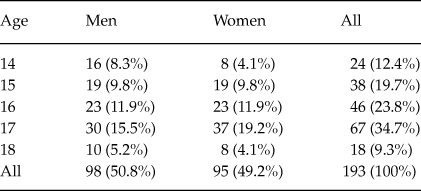
This study involved the participation of 193 students (95 boys and 98 girls) from two Spanish high schools, in Reus (Tarragona, Spain). The sampling error was .07. The participants were between 14 and 18 years old, and the mean age and standard deviation were 16.1 and 1.18, respectively. Table 1 shows the distribution of participants by sex and age. The Chi-squared test for homogeneity of frequency distributions did not show significant differences between the 10 groups of Age x Sex (χ2 = 3.57; p = .47).
Frequency (and percentage) of participants classified by gender and age

Data from 24 participants were removed because they were more than 18 years old or they had left several items unanswered, so the original sample was of 217 participants.
Measures
The Psychological Maturity Assessment Scale (PSYMAS; Morales-Vives, Camps, & Lorenzo-Seva, Reference Morales-Vives, Camps and Lorenzo-Seva2012, Reference Morales-Vives, Camps and Lorenzo-Seva2013): The questionnaire measures three scales: Work-orientation (WO), Self-reliance (SR) and Identity (ID). WO is defined as the individual’s willingness to fulfill his or her own obligations; SR is defined as the person’s willingness to take the initiative, without allowing others to exercise excessive control, and ID is defined as the adolescent’s knowledge of him or herself. It consists of 26 items: seven items for each scale, four items of social desirability and one dummy item. Responses are made on a 5-point Likert-type scale ranging from 1 (strongly disagree) to 5 (strongly agree). This inventory provides the individuals’ scores free of social desirability and acquiescence response biases. The reliability of the total scale is .86 and the reliability of the subscales are .67 for WO, .81 for SR and .84 for ID. Morales-Vives et al. (Reference Morales-Vives, Camps and Lorenzo-Seva2012) reported internal consistency coefficients of.82 for the total scale, .71 for WO, .78 for SR and .77 for ID. Taking into account that scales are just seven items long, these reliabilities can be regarded as adequate.
The reduced Spanish version of the Buss and Perry Aggression Questionnaire (AQ) was also administered (Vigil-Colet, Lorenzo-Seva, Codorniu-Raga, & Morales, Reference Vigil-Colet, Lorenzo-Seva, Codorniu-Raga and Morales2005). The questionnaire measures the four scales proposed by Buss and Perry (Reference Buss and Perry1992): Physical aggression, Verbal aggression, Anger and Hostility. Participants rate each item on a scale of 1 (strongly disagree) to 5 (strongly agree). We administered only the two subscales that measure direct aggression: Physical aggression (PA) and Verbal aggression (VA), with 7 and 4 items, respectively. The internal consistencies for these scales in our sample are .85 for PA and .70 for VA. These internal consistencies can be regarded as adequate, especially taking into account the small number of items of the scales. Vigil-Colet et al. (Reference Vigil-Colet, Lorenzo-Seva, Codorniu-Raga and Morales2005) found internal consistency coefficients of .88 for PA and .71 for VA. This questionnaire is free of sex bias and shows a good fit to the four-factor model initially proposed (Condon, Morales-Vives, Ferrando, & Vigil-Colet, Reference Condon, Morales-Vives, Ferrando and Vigil-Colet2006; Vigil-Colet et al., Reference Vigil-Colet, Lorenzo-Seva, Codorniu-Raga and Morales2005). Overall direct aggression scores are obtained by summing VA and PA.
Finally, we administered the short Spanish version of the Indirect Aggression Scales designed for aggressors (IAS-A; Anguiano-Carrasco & Vigil-Colet, 2011). Indirect aggression refers to social manipulation behaviors in which the aggressor acts on the people around the target with the sole aim of harming him or her without having to come into direct confrontation. This inventory consists of 10 items answered on 5-point Likert scales ranging from 1 (strongly disagree) to 5 (strongly agree). The internal consistency obtained in our sample was .85. Anguiano-Carrasco and Vigil-Colet (2011) reported an internal consistency coefficient of .82. The social desirability response bias was controlled.
Procedure
The tests were administered collectively to groups of 20–30 participants by two professional psychologists with master’s degrees in the measurement and assessment of behavior. Therefore, these psychologists have been specifically trained to administer questionnaires to adolescents. The participants were asked to volunteer to answer the three inventories (PSYMAS, IAS and the two subscales from the short version of AQ) in their classroom. The questionnaires were anonymous, and respondents had to provide only their gender and age. All the participants were also guaranteed confidentiality, and assured that all the information they provided could not be traced back to them as individuals. We also obtained the authorization of the high schools to administer the questionnaires.
The data was analyzed using the SPSS 19 program.
Results
Descriptive statistics and sex differences
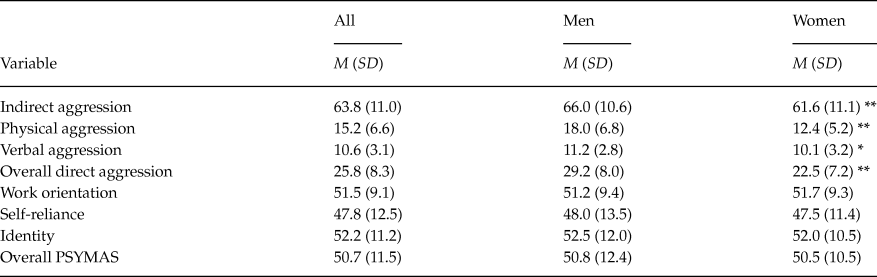
Table 2 shows the descriptive statistics for the AQ, IAS and PSYMAS measures across the whole sample, men and women. As can be seen, men have higher scores than women on Indirect aggression (t(191) = 2.79, p <. 01, Cohen’s d = 0.40), Physical aggression (t(175) = 6.44, p < .01, Cohen’s d = 0.93), Verbal aggression (t(191) = 2.62, p < .05, Cohen’s d = 0.38) and Overall direct aggression (t(191)=6.13, p < .01, Cohen’s d = 0.88). There were no gender differences in the subscales and overall scores of PSYMAS. Moreover, Pearson correlations were performed between age, maturity and aggression measures to determine whether these measures change with age. It should be pointed out, however, that the correlation cannot be large because there is a considerable rank restriction on age (78.2% of the sample was between 15 and 17 years old). As can be seen in Table 3, there were no significant correlations between age and AQ, IAS and PSYMAS measures.
Descriptive statistics for the whole sample, men and women

* p < .05 **p < .01.
Correlations between age and aggression measures

*p < .05 **p < .01.
Correlations between measures and Stepwise multiple regression
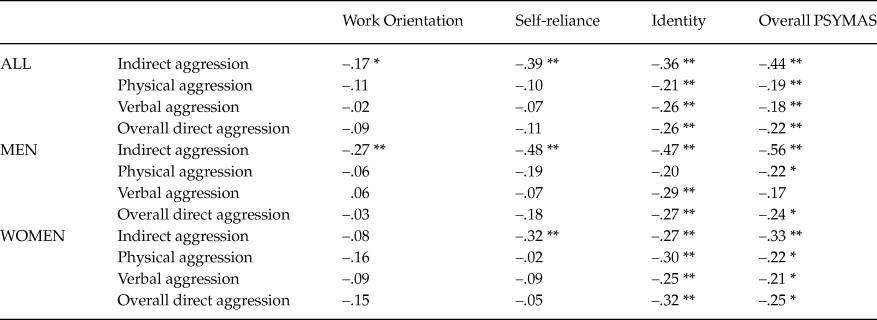
Pearson correlations were performed to analyze the relationship between maturity and aggression measures. Table 4 shows the correlations between psychological maturity and aggression measures for the whole sample, men and women. As can be seen, for the whole sample Identity is significantly related to all the AQ and IAS scales. Self-reliance and Work orientation are only related to Indirect aggression, and the correlation with Self-reliance is higher. Moreover, the overall scores of psychological maturity are particularly correlated to indirect aggression, but they are also correlated to direct aggression (in both cases the correlations are negative). Stepwise multiple regression analyses were also performed to assess which psychological maturity subscales were predictors of direct and indirect aggression. Self-reliance and Identity explain 19% of the variance of indirect aggression, F(2, 190) = 22.51, p < .01. Self-reliance is the best predictor (it explains 15% of the variance), while Identity adds only 4% of the explained variance. Identity is the only significant predictor of direct aggression, explaining 7% of the variance, F(1, 191) = 14.03, p <.01. The regression results are given in Table 5.
Correlations between maturity and aggression measures for the whole sample, men and women

* p < .05 **p < .01.
Stepwise regression results for indirect and direct aggression

As far as the correlations for each gender are concerned, Work orientation is related to Indirect aggression only in men. The correlation between Identity and Indirect aggression is higher in men than in women, although the difference between both correlations is not significant, as Fisher’s Z test shows (z = 1.59, p = .47). Identity is significantly related to Physical aggression in women but not in men, but the difference between both correlations is not significant, as Fisher’s Z test shows (z = –0.73, p = .11). The overall scores of psychological maturity are particularly, and negatively, correlated to indirect aggression in both men and women. However, the correlation between the overall scores of Psychological maturity and Indirect aggression is significantly higher in men than in women, as Fisher’s Z test shows (z = 1.98, p = .048).
Discussion
Taking into account that very few studies have been made on this issue, the current study aims to examine the relationship between psychological maturity and different kinds of aggressiveness. In general terms, this study provides evidence of the relationship between psychological maturity and both direct and indirect aggression. As was expected, more mature adolescents tend to show lower levels of direct aggression (physical and verbal). This result is consistent with the study performed by Sanmartín et al. (Reference Sanmartín, Carbonell and Baños2011), which shows that adolescents with lower levels of responsibility (less autonomy, less self-control and less responsibility for others) tend to have higher levels of physical and verbal aggression. The results also suggest that more mature adolescents tend to show lower levels of indirect aggression, as was expected. In fact, the effect size of the correlation between overall maturity and indirect aggression was moderate, while the effect size for overall direct aggression was small, which suggests that psychological maturity is specially related to indirect aggression. The greater responsibility and greater control of impulses inherent in greater psychological maturity might explain the decrease in both kinds of aggression. More mature adolescents show greater control of their aggressive impulses, and they also tend to take more responsible decisions with regard to other people, and so do not indulge in behaviors such as spreading rumors or excluding others from activities. They are also able to solve their conflicts without resorting to aggressive behaviors. However, no previous studies have been made on the relationship between maturity and indirect aggression, so further studies are needed to confirm these results.
The current study also aims to determine which components of psychological maturity are related to direct and indirect aggression. As expected, the dimensions of psychological maturity most related to aggressiveness are Self-reliance and Identity. In fact, adolescents with less self-reliance (less willingness to take the initiative without allowing others to exercise excessive control) tend to show more indirect aggression than direct aggression. Therefore, these results suggest that less autonomous adolescents, who are more dependent on peer pressure and the opinions of others, do not tend to face others when they feel angry. They tend to show behaviors such as gossiping or rumor spreading, which do not involve direct confrontation with the target. This kind of behavior prevents counter aggression and allows the person to remain unidentified. While self-reliance is the main predictor of indirect aggression, identity is the main predictor of direct aggression. This is consistent with the study performed by Dumas et al. (Reference Dumas, Ellis and Wolfe2012), which shows that adolescents who are more committed to their personal identities engaged in less risk behavior (less substance use and less deviant behaviors such as physical violence, vandalism or school suspension). Moreover, the fact that identity predicts better direct aggression than indirect aggression seems to be consistent with the fact that direct aggressiveness is replaced by other kinds of more socially accepted aggression as people get older (Björkqvist, Lagerspetz, & Kaukiainen, Reference Björkqvist, Lagerspetz and Kaukiainen1992). Therefore, as adolescents become more mature, in the sense that they understand themselves and have personally relevant beliefs and goals to direct their life choices, they tend to be more socially adjusted, and they tend to cope with conflicts in more socially accepted ways (for example, indirect aggression).
Another objective of the study is to find out whether there are sex differences in the relationship between psychological maturity and both kinds of aggression. As we expected, more mature boys and girls show less direct and indirect aggression. However, there are some differences in the pattern of correlations between psychological maturity and aggression measures of girls and boys. In fact, overall psychological maturity is more related to indirect aggression in men than in women, with a large effect size for boys and a moderate effect size for girls, so the increase in psychological maturity implies a greater decrease of indirect aggression in men. This might be explained by the fact that the three psychological maturity subscales are correlated with indirect aggression in men, while work orientation is not related to indirect aggression in women. Identity is related to direct and indirect aggression in both women and men, with a moderate effect size in men and a small effect size in women.
In order to obtain additional information, we also assessed differences between girls and boys in the subscales. Boys obtained higher scores in direct aggression, especially in physical aggression, as previous studies have found (see Card, Stucky, Sawalani, & Little’s meta-analysis, 2008). In fact, the effect size was large for physical aggression and small for verbal aggression. Boys also obtained higher scores in indirect aggression, with a medium effect size, although some authors stated that indirect forms of aggression may be more typical of girls (e.g., Björkqvist et al., Reference Björkqvist, Lagerspetz and Kaukiainen1992; Crick, Reference Crick1997). However, while some studies show higher scores in girls (e.g., Bjorkqvist, Reference Björkqvist1994; Lagerspetz & Björkqvist, Reference Lagerspetz, Björkqvist and Huesmann1994), other studies found few differences or even higher levels in boys (Salmivalli & Kaukiainen, Reference Salmivalli and Kaukiainen2004; Tomada & Schneider, Reference Tomada and Schneider1997). No sex differences were found in psychological maturity subscales or overall scores, which is consistent with the findings of Morales-Vives et al. (Reference Morales-Vives, Camps and Lorenzo-Seva2013) in Spain.
Violence-prevention programs should start in early childhood because boys who are already chronically aggressive in elementary school are at greater risk of developing aggressive and antisocial behaviors during adolescence (Wahl & Metzner, Reference Wahl and Metzner2012). However, these programs should also be applied during adolescence, a period that is characterized by many physical, psychological and social demands in which young people try to establish an individual identity, adapt to society’s demands for behavioral maturity, and prepare for adult roles (Dahlberg, Reference Dahlberg1998). As Dahlberg (Reference Dahlberg1998) pointed out, identifying the factors that increase or reduce the risk of violence and aggressive behaviors is an important first step toward preventing youth violence. The current study provides evidence that psychological maturity is one of the factors that is related to direct and indirect aggression, so this variable should be taken into account in the design of violence-prevention programs for schools and families. In fact, Dahlberg (Reference Dahlberg1998) describes four kinds of approaches to prevent violence: 1. Programs that focus on changing individual attitudes, beliefs and behaviors, which mostly implies cognitive behavior, behavior modification and social-skills training; 2. Programs that include rites-of-passage or manhood development programs, focus on self-esteem, personal responsibility or moral guidance; 3. Programs that focus on changing the nature of peer-group interactions and norms, and changing negative peer influences into positive or prosocial peer influences (i.e., create a positive peer culture); 4. Family interventions that educate and train parents how to effectively discipline, monitor and supervise children. The current study shows that this kind of program should also integrate strategies to foster clear and positive identity. In fact, the second kind of program focuses on youth development to prevent violence, but there should also be a focus on identity development strategies, as well as responsibility, self-esteem, etc. This sort of program could implement those interventions already used in other programs that focus specifically on positive youth development (e.g. the Quantum Opportunities Program, which addresses positive identity among other constructs). The current study also shows that violence-prevention programs should deal with peer-group interactions, because those adolescents who are more dependent on peer pressure and the opinions of others show more indirect aggression, so they harm others by rejection, exclusion, damage of their social position or manipulation of peer relationships. The third kind of program already focuses on peer relationships, but could be more effective if they included a variety of facets, not only youth development, peer interactions and behavior modification separately. However, further studies are needed if the nature of the relationship between psychological maturity and aggression, and its relevance to violence-prevention programs are to be better understood. These new studies should also include other variables related to aggression and maturity, such as impulsiveness, so that the specific contribution of psychological maturity to the prediction of aggression and the relationship between all these variables can be determined. A limitation of the present study is the size of the sample, so further studies should be done with larger samples to replicate the results.
The research was supported by a grant from the Spanish Ministerio de Economía y Competitividad (PSI2011–22683).