INTRODUCTION
The purpose of this experimental study is to contribute a more nuanced understanding of the acquisition of the Spanish Determiner Phrase (DP), especially as concerns adjectival distribution in Sequential and Simultaneous child heritage speakers of Polish in adulthood. Existing literature on adjectival distribution has focused on specific language combinations (i.e., those with differing syntactic configurations) in an attempt to answer questions regarding adult accessibility to Universal Grammar (UG). Two general predictions, each accompanied by their own rationale briefly outlined in the following text, have been explored; they are labeled herein as “non-convergence” and “convergence” accounts. Non-convergence accounts are split between those claiming representational deficits (Hawkins & Chan, Reference Hawkins and Chan1997 and subsequent works by Hawkins and colleagues) and those claiming interface differences (Sorace & Filiaci, Reference Sorace and Filiaci2006). As an explanation for the variability and fossilization seen in adult L2 acquisition, representational deficits accounts (RDA) claim that no new functional categories or features may be acquired by adult second language (L2) learners. Therefore, if the functional projections and features necessary for convergence on a particular property are absent in the first language (L1), learners are predicted to display irreparable differences as compared to native speakers. By contrast, earlier versions of the Interface Hypothesis (IH) provided evidence that new functional categories, features, and parameter settings were within the reach of L2 learners (see Sorace & Filiaci, Reference Sorace and Filiaci2006, p. 363), but that residual optionality remains as a result of the increased processing burden associated with computing interface properties, preventing learners from consistently demonstrating native-like knowledge in all domains. It is important to note that the current instantiation of the IH (Sorace, Reference Sorace2011) does not make predictions about the nature of the underlying syntactic representation of L2 learners. Therefore, the IH does not preclude the possibility that learners may display surface-level convergence (perhaps through rote learning), while still possessing non-native-like underlying representations. Cases in which learners must acquire new functional projections and/or features (e.g., the Null Subject Parameter) to display knowledge of related semantic and/or discursive reflexes (e.g., the Overt Pronoun Constraint and discourse distribution of pronouns) that fallout from the syntax provide good testing ground for this particular portion of the IH. If we assume, as many have (see, e.g., Rothman, Reference Rothman2008; Slabakova, Reference Slabakova2008), that this knowledge falls out from the appropriate underlying syntactic representation, then syntax-semantic and syntax-discourse knowledge strongly indicate accurate syntax. This same logic can be applied to RDAs as well because, without underlying syntax, it is unclear how learners could demonstrate knowledge of subtle semantic and discursive properties, many of which can be labeled as poverty-of-the-stimulus (Chomsky, Reference Chomsky1980) or bankruptcy-of-the-stimulus (Sprouse, Reference Sprouse, Ud Deen, Nomura, Schulz and Schwartz2007).
Perhaps because empirical investigation of “non-convergence” accounts requires testing learners whose L1 would not provide them with the resources necessary for convergence on the L2 property, and also due to their relative accessibility, most experiments have focused on L1 speakers of Germanic languages—most commonly English, sometimes German—learning L2 Romance languages—such as Spanish and French. Relevant examples include Anderson (Reference Anderson2007, Reference Anderson2008) for L1 English-L2 French and Rothman, Judy, Guijarro-Fuentes, and Pires (Reference Rothman, Judy, Guijarro-Fuentes and Pires2010) for L1 English-L2 Spanish. Anderson’s experiments (2007, 2008) tested result and process nominals as well as unique- and non-unique-denoting French adjectives, interpretive constraints claimed to obtain from noun-raising. Because nouns do not raise in English and these properties cannot be deduced from the input, demonstrating interpretive knowledge is taken to ensue from new feature acquisition such that the resulting DP is underlyingly French. The participants of Anderson’s studies completed an Acceptability Judgment Task in which they read short contexts in English favoring a result or a process nominal, or a unique- or non-unique-denoting adjective and then judged how “fine” or “odd” a follow-up sentence in French sounded. Anderson reports that RDAs cannot explain either study’s results because knowledge of the interpretive distinctions was evidenced and a noticeable developmental path suggestive of Full Transfer/Full Access (Schwartz & Sprouse, Reference Schwartz and Sprouse1996) emerged from the data. Similarly, Rothman et al. (Reference Rothman, Judy, Guijarro-Fuentes and Pires2010) examined L2 learners’ ability to acquire new functional features and projections in Spanish (L1 English). Like French, Spanish exhibits nominal word-order alternations that lead to interpretive differences, specifically, prenominal adjectives are kind-denoting while postnominal adjectives are set-denoting. Because the advanced and intermediate proficiency participants tested (determined by a shortened version of the Diploma del Español Lengua Extranjera [DELE]) were all tutored learners explicitly taught adjective position and interpretive differences related to the so-called meaning-changing adjectives (pobre “pitiful/penniless”), following Anderson, “meaning-changing” adjectives were altogether avoided in favor of qualifying adjectives permitted in both positions. The tasks reported on are a Semantic Interpretation Task (SIT), containing pre- and postnominal adjective tokens, and a Context-Based Collocation Task with sentences favoring a kind- or a set-denoting reading, calling for a pre- or a postnominal adjective, respectively. In the former task, participants were instructed to circle their interpretation from two options (provided in English). In the later task, they were instructed to complete a brief context by writing in either a pre- or postnominal adjective. The overall results are interpreted as unfavorable for RDAs because participants demonstrate knowledge of subtle semantic properties that fall out from convergence on the underlying syntax of the Spanish DP not present in their L1, especially at the advanced proficiency level.
Recently, some generativists have begun to explore macro- versus microparameters to explain seemingly subtle variations across similar languages or dialects (see, e.g., Baker, Reference Baker and Biberauer2008; Black & Motapanyane, Reference Black and Motapanyane1996; Kayne, Reference Kayne, Cinque and Kayne2005). This interest has found its way to acquisition studies (see, e.g., Bel & García-Alcaraz, Reference Bel, García-Alcaraz, Judy and Perpiñán2015; Liceras & Alba de la Fuente, 2015; Müller & Arnaus Gil, 2015; Perpiñán, Reference Perpiñán, Judy and Perpiñán2015; Sánchez, Reference Sánchez, Judy and Perpiñan2015) whose authors have argued that much value comes from studying typologically similar languages, such as French and Spanish or Spanish and Catalan, and languages that display slightly different properties such as subjects in Moroccan Arabic and Spanish. The value is that it becomes possible to not only further characterize the implicit grammars investigated, but also provide new testing scenarios for acquisition theories and hypotheses.Footnote 1 One such study that contributes to this research and is related to the current study is that of Androutsopoulou, Español-Echevarría, and Prévost (Reference Androutsopoulou, Español-Echevarría, Prévost, Bruhn de Garavito and Valenzuela2008). Androutsopoulou et al. examined acquisition of evaluative adjectives in Spanish by L1 French speakers, many of which are allowed both pre- and postnominally in both languages, although French is more restrictive in terms of which adjectives are allowed prenominally purportedly due to the absence of a Degree/Focus feature on the strictly postnominal French adjectives. Because other adjectives (shapes, colors, etc.) behave similarly in both languages, the input learners are exposed to is somewhat conflicting in that the languages are similar but not identical for adjective distribution. The authors interpret results from a Grammaticality Judgment Task (GJCT) as demonstrating UG accessibility and a developmental pattern because some participants showed native-like knowledge. Similarly, Rothman, Iverson, Judy, and Guijarro-Fuentes (Reference Rothman, Iverson, Judy, Guijarro-Fuentes, Chandlee, Franchini, Lord and Rheiner2009) investigated convergence on nominal gender and number and adjective interpretations dependent on adjectival position among L2 learners of Spanish with three different L1s—English, German and Italian—to examine L1 effects. Italian shares similar nominal syntax with Spanish, including noun-raising, while English and German do not. Results from a GJCT and a SIT revealed that the intermediate and advanced L1 Italian speakers and the advanced Germanic speakers demonstrated native-like knowledge of the syntactic nominal features and of the interpretive constraints on adjectives in Spanish. The findings from these studies echo previous related studies (e.g., Bruhn de Garavito & White, Reference Bruhn de Garavito, White, Pérez-Leroux and Liceras2002; Parodi, Schwartz, & Clausen, Reference Parodi, Schwartz and Clahsen1997) in that similar syntactic configurations in the nominal domain between the L1 and L2 do not guarantee straightforward or immediate convergence on the L2 property, but this is typically an advantage in the acquisition task.
Lastly, the results and implications of a child bilingual studyFootnote 2 are described. Cuza and Pérez-Tattam (Reference Cuza and Pérez-Tattam2016) examined knowledge of the nominal domain among Spanish-English bilinguals in the United States ages 5;0-10;8 through a Picture-Naming Task designed to elicit full DPs, including strictly postnominal adjectives (e.g., chiquito “small,” amarillo “yellow”). The authors examined the child bilinguals’ production of gender agreement between the determiner and noun, the noun and adjective, the determiner and adjective, and word order between the noun and adjective, which is predicted to fall out from nominal agreement. Ultimately, the findings were partially interpreted as indicating a “lack of [+strong] gender features in the NumP” (p. 54), which resulted in ungrammatical adjectival word order and the overextension of masculine gender on the adjective. However, the authors note that this explanation cannot account for all word-order errors evidenced, and posit, along with others (see sources therein), that crosslinguistic influence from English—which has obligatorily prenominal adjectives—is likely an influencing factor.
Together, the results of the studies described in the preceding text have demonstrated rather convincingly through interpretive constraints that acquisition of new functional features and projections is possible in adult L2 acquisition, and that microparametric differences between typologically similar languages present distinct, yet not necessarily insurmountable, challenges to L2 learners and that input factors, along with parametric differences, affect child bilinguals’ production of DPs. However, the duration of this last effect is undetermined. As far as is known, a missing piece to this vein of research concerns adult bilinguals of typologically distinct languages that share similar, yet not identical, nominal properties.
The following experiment informs to some degree this gap in the literature in that it examines Sequential and Simultaneous child heritage speakers of Polish-Spanish now in adulthood, thus revealing what might be called ultimate attainment effects across the life span of a heritage speaker, or at minimum a snapshot of their knowledge at a later point in time. In this sense, it may be possible to shed light on, albeit in a different population and context, whether the crosslinguistic effects found in the child Spanish-English bilinguals of Cuza and Pérez-Tattam (Reference Cuza and Pérez-Tattam2016) persist or if they are temporary.Footnote 3 As pointed out in Kupisch and Rothman (Reference Kupisch and Rothman2016), many child bilingualism/heritage speaker studies have demonstrated native-like knowledge under favorable conditions, especially as compared to the varying degree of convergence demonstrated in adult heritage speaker studies (see sources cited therein). Because these studies examine the same speakers, in terms of profile, yet at different points in time, it is wise for the overarching field of bilingualism studies to bring these speaker groups together. In doing so, fairer comparisons are made, which increases the explanatory adequacy of the findings and discussion across the discipline. Oftentimes adult heritage speakers are compared to monolingual native speakers of their heritage language, monolinguals that may differ not just in terms of the linguistic systems at their disposal, but also in terms of important socioeconomic and education factors, introducing potentially confounding variables into the equation. This experiment circumvents this issue by examining in adulthood both child Simultaneous and child Sequential heritage speakers of Polish-Spanish, who are members of similar linguistic communities within Misiones, Argentina.
Furthermore, this experiment contributes to the discussion on microparametric differences, in typologically distant languages that share few superficial similarities, grammatical or otherwise. As is discussed in the section titled “Adjectives in Spanish and Polish,” while Spanish and Polish each allow, in specific cases, both pre- and postnominal adjectives and have similar DP syntax, important differences exist between the languages with respect to which adjectives are permitted in each position. In this sense, the property examined in this language pairing is ideal from an empirical standpoint: First, because it purportedly constitutes a poverty-of-the-stimulus property (see Anderson, Reference Anderson2007) in that the subtle semantic reflexes that obtain from the change in word order within the DP are not readily apparent from the input provided to the learners, yet this interpretive knowledge is purportedly a reflex of gender and number, features that are extremely frequent in the input; second because of the microparametric differences between Polish and Spanish that would not allow for simple transfer of the L1 values leading to native-like convergence. Finally, this study is one of very few that examine Spanish in the context of Polish, an understudied, yet important and fruitful, language pairing especially in the case of Argentina.
ADJECTIVES IN SPANISH AND POLISH
In the following, the syntactic and semantic distribution of adjectives in Spanish and Polish, both of which are predicated upon functional features within the DP, are described. Relevant similarities and differences are highlighted.
SYNTACTIC DISTRIBUTION
The unmarked position for adjectives is postnominal in Spanish as in (1) and (2), which contain qualifying (i.e., qualificative, descriptive) adjectives, such as original or red, and classifying (i.e., relational) adjectives,Footnote 4 such as environmental or Japanese, respectively.
(1) Spanish qualifying adjective
una casa roja *una roja casa
a house-n red-adj a red-adj house-n
“a red house”
(2) Spanish classifying adjective
un director general *un general director
a director-n general-adj a general-adj director-n
“a general director”
Differently, the unmarked position in Polish is prenominal (among others, see Cetnarowska, Reference Cetnarowska, Bondaruk, Dalmi and Grosu2014; Rutkowski, Reference Rutkowski, Compton, Goledzinowska and Savchenko2007; Swan, Reference Swan2002). Prenominal adjectives are generally associated with qualifying modifiersFootnote 5 as in (3), whereas postnominal adjectives are generally associated with classifying modifiers as in (4) (Cetnarowska, Reference Cetnarowska, Bondaruk, Dalmi and Grosu2014; Rutkowski, Reference Rutkowski, Compton, Goledzinowska and Savchenko2007).
(3) Polish qualifying adjective
czerwony dom *dom czerwony
red-adj house-n house-n red-adj
“a red house”
(4) Polish classifying adjective (Rutkowski & Progovac, Reference Rutkowski, Progovac, Franks, Gladney and Tasseva-Kurktchieva2005, p. 289)
dyrektor generalny *generalny dyrektor
director-n general-adj general-adj director-n
“a general director”
The picture in both languages, however, is more complicated. One exception to the typical pattern of Spanish is that intensional (i.e., modal, epistemic) adjectives, such as supuesto “alleged” or presunto “presumed” are obligatorily prenominal:
(5) Prenominal intensional adjective
un supuesto delito *un delito supuesto
a supposed-adj crime-n a crime-n supposed-adj
“an alleged crime”
Classifying adjectives, however, follow the typical Spanish pattern in that they are obligatorily postnominal:
(6) Postnominal classifying adjective
cocina española *española cocina
kitchen-n Spanish-adj Spanish-adj kitchen-n
“Spanish cuisine”
Like Spanish, Polish intensional adjectives are obligatorily prenominal while classifying adjectives are postnominal, contradicting the typical Polish pattern:
(7) Prenominal intensional adjective
rzekome przestępstwa *przestepstwa rzekome
supposed-adj crime-n crime-n supposed-adj
“alleged crime”
(8) Postnominal classifying adjective
kuchnia hiszpańska *hiszpańska kuchnia
kitchen-n Spanish-adj Spanish-adj kitchen-n
“Spanish cuisine”
Lastly, in both languages, some adjectives can occupy either prenominal or postnominal positions. In Spanish, it is the qualifying adjectives:
(9) Prenominal qualifying adjective
el cómico actor
the comic-adj actor-n
“(inherently) comical actor”
(10) Postnominal qualifying adjective
el actor cómico
the actor-n comic-adj
“the comedic actor” or “the comical actor”
Yet, while Spanish permits some qualifying adjectives in prenominal and postnominal position, Polish seems to allow some classifying adjectives, such as komiczny “comic,” kulturalny “cultural,” and obcy “foreign,” to alternately appear in both positions:
(11) Prenominal classifying adjective (Rutkowski & Progovac, Reference Rutkowski, Progovac, Franks, Gladney and Tasseva-Kurktchieva2005, p. 291)Footnote 6
komiczny aktor
comic-adj actor-n
“comical actor” (an actor described as funny)
(12) Postnominal classifying adjective
aktor komiczny
actor-n comic-adj
“comedic actor” (a type of actor that could be contrasted with a tragic actor)
In both languages, changes in the syntactic position of the adjective result in interpretive differences of the DP, the focus of the next subsection.
SEMANTIC DISTRIBUTION
As illustrated in (9) through (12), Spanish and Polish allow some adjectives to appear both pre- and postnominally. According to Demonte (Reference Demonte, Kennedy and McNally2008) and others for Romance and Rutkowski and Progovac (Reference Rutkowski, Progovac, Franks, Gladney and Tasseva-Kurktchieva2005) for Slavic languages like Polish and Serbian, the syntactic position—not the semantics of the adjective itself—determines the interpretation. However, as was shown, the languages differ with respect to the type of adjective allowed in both positions (i.e., qualifying vs. classifying adjectives). It will be shown in more detail in the following text that the languages also differ with respect to the entailment (intersective vs. non-intersective) and their denotation (object level vs. kind level) according to syntactic position.
To start, two kinds of qualifying adjectives that can appear both pre- and postnominally in Spanish are considered. The first, which includes adjectives such as bueno “good” and pobre “poor” among others, will be referred to as “meaning-changing adjectives” as they are commonly called in Spanish language textbooks. The second, which includes typical qualifying adjectives such as inteligente “intelligent” and cariñoso “caring,” will be referred to as “typical qualifying adjectives.” For the purpose of comparing the Polish examples in (11) and (12) with Spanish, we will return to examples (9) and (10); however, a special property of the adjective in these examples—namely that it can function as a classifying adjective in postnominal position—will require consideration of an additional Spanish example.
But first, a brief explanation of the intersective and non-intersective nature of adjectives is required. In the words of McNally and Boleda, “[T]he term ‘intersective’ refers to the fact that the semantic composition of the adjective and noun can be characterized in terms of the intersection of their extensions” (2004, p. 179). The effect of this intersection between an adjective and a noun can be easily seen in (13). Specifically, (13b) and (13c) are entailed by (13a) because the meaning of the predicate DP a tall syntactician is composed of the intersection of things that are tall and things that are syntacticians. The same is not true for (14c) as the adjective theoretical is non-intersective; instead of describing the subject of the sentence, it describes a type of syntactician, the theoretical ones and not, for example, the experimental ones.
(13) a. Álvaro is a tall syntactician.
b. Álvaro is a syntactician.
c. Álvaro is tall.
(14) a. Álvaro is a theoretical syntactician.
b. Álvaro is a syntactician.
c. *Álvaro is theoretical.
Returning to examples (9) and (10), the prenominal typical qualifying adjective of (9) (los cómicos actores “the comical actors”) has a non-intersective entailment as is characteristic of prenominal adjectives in Spanish. Differently, the postnominal typical adjective in example (10) (los actores cómicos) is ambiguous.Footnote 7 On the one hand, this adjective is non-intersective in that it describes a type of actor similar to example (14): comedy actors and not tragic ones, for example. On the other hand, the adjective can be intersective in that those referred to are both actors and comical in a similar fashion to example (13). Because (9) and (10) include an adjective that is easily interpreted as classificatory in postnominal position, we will also consider an example of the so-called meaning-changing adjectives in Spanish. In (15), the adjective is non-intersective akin to (14) because the only true entailment is that Manu is a journalist. Only in (16) is the meaning-changing adjective intersective because the entailments that Manu is a journalist and Manu is good are both true. Interestingly, and as discussed in Demonte (Reference Demonte, Kennedy and McNally2008) and Cinque (Reference Cinque2010), example (16) can also be interpreted as non-intersective.Footnote 8
(15) Manu es un buen periodista.
Manu be.3sg.pres a well journalist
“Manu is a good journalist.” (good at the profession of journalism)
(16) Manu es un periodista bueno.
Manu be.3sg.pres a journalist good
“Manu is a good journalist.” (good as a person who happens to be a journalist, good at journalism)
The Polish counterparts in (11) and (12) show that for this classifying adjective, the syntactic position affects the interpretation of the DP. In example (11) (komiczny actor), the prenominal adjective is intersective so the person referred to is both an actor and funny. However, in example (12), the postnominal adjective (actor komiczny), is classificatory in nature, as is typical of Polish, and as such is interpreted as a type of actor, “the comedic actor,” therefore resulting in a non-intersective entailmentFootnote 9 in that the particular actor might hold the professional title of “comedic actor,” but be quite unfunny.
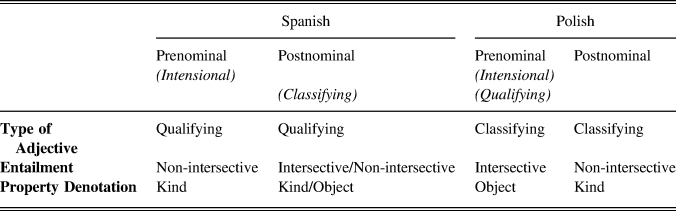
The third and final issue related to the semantics of Spanish and Polish adjectives to be considered is ontological in nature (Cornilescu, Reference Cornilescu, Torck and Leo Wetzels2009) and centers on whether the adjective denotes an object-level or a kind-level entity. The syntactic position of an adjective seems to be tied to its denotation in languages that allow for alternate word orders like Spanish and Polish (Demonte, Reference Demonte, Kennedy and McNally2008, p. 99). In Spanish, prenominal qualifying adjectives whether the “meaning-changing” or “typical” type denote kind-level entities (see [15]), whereas postnominal qualifying adjectives denote largely object-level entities, but can also denote kind-level entities (see [16] and endnote 6). Differently, Polish classifying adjectives in prenominal position denote object-level entities (example [11]) while their postnominal counterparts denote kind-level entities (example [12]; Wągiel, Reference Wągiel, Veselovská and Janebová2014). For more detail on this issue in Romance and Slavic languages, the interested reader is directed to McNally and Boleda (Reference McNally, Boleda, Bonami and Cabredo Hofherr2004), Cornilescu (Reference Cornilescu, Torck and Leo Wetzels2009), and Wągiel (Reference Wągiel, Veselovská and Janebová2014), among others. Table 1 summarizes the relevant semantic differences between alternately pre- and postnominal adjectives in Spanish and Polish, and reiterates, for comparison sake, the position of adjectives that only occupy one position in Spanish and Polish. While the entailments and property denotations apply to the alternating adjectives, the nonalternating adjectives are included herein as a reference for the learning task described in the upcoming section.
Semantic components of prenominal and postnominal adjectives in Spanish and Polish

LEARNING TASK
The syntactic and semantic distribution of adjectives in Spanish and Polish outlined in the preceding text described surface order and interpretations. In the following text, the syntactic machinery assumed to underlie the distributions is depicted, which determines the learning task of the experimental participants.
Like other researchers examining the acquisition of the Spanish DP (Cuza & Pérez-Tattam, Reference Cuza and Pérez-Tattam2016; Guijarro-Fuentes, Parafita Couto, Pérez-Tattam, & Wildeboer 2016, among others), the structure seen in (17) from the Bernstein (Reference Bernstein1993, Reference Bernstein, Baltin and Collins2001) tradition and similar to that of Demonte (Reference Demonte, Kennedy and McNally2008) is assumed.Footnote 10 According to the account, two functional categories reside between the DP and Noun Phrase (NP): Num(ber) Phrase (NumP) and Word Marker Phrase (WMP). In the Minimalist framework, the uninterpretable Number and Word Marker features in the head of each phrase, respectively, trigger obligatory noun-raising first to WMP then to NumP, producing postnominal adjectives typical of Spanish (Carstens, Reference Carstens1991; Zagona, Reference Zagona2002). Prenominal adjectives are obtained from Adjective Phrase (AP) adjoining to NumP instead of merging in NP. Crucially, it is assumed that the different positions available to adjectives (higher and adjoined or lower and in Spec, NP) are related to the semantic characteristics of the adjectives (Bernstein, Reference Bernstein1993; Demonte, Reference Demonte, Kennedy and McNally2008).
(17)
 $$
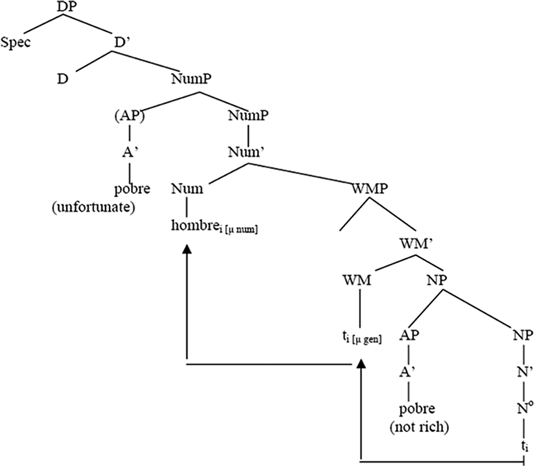
For Polish, Rutkowski and colleagues propose a similar structure seen in (18), which is based on Rutkowski (2012) example (5).
(18)
$$
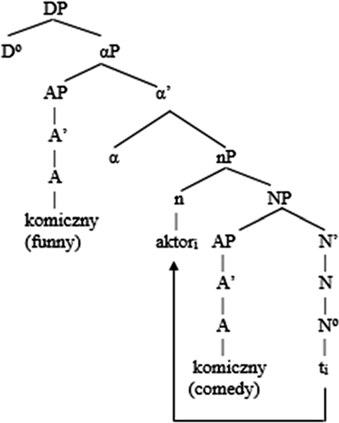
Two differences exist between (17) and (18): The projection the noun raises to in Polish is labeled as ClassP in early instantiations and nP more recently as compared to the separate WMP and NumP in Spanish, which means one feature-checking movementFootnote 11 is purported in Polish as opposed to two in Spanish. Rutkowski (2012) claims that there is a formal feature in nP that can be checked in several ways, one of them being N raising in the presence of a postnominal classifying adjectives.
Thus, the acquisition task of the experimental groups is to converge on some idiosyncratic properties of the Spanish DP, requiring essentially one main task. Despite surface differences in (17) and (18), the internal structure of the DPs is remarkably similar, whereby the WMP and NumP in Spanish are separated in Bernstein’s (Reference Bernstein1993, Reference Bernstein, Baltin and Collins2001) depiction and the Polish equivalents (GenderP and NumP) are conflated under a generic nP in Rutkowski (2012). In both languages, clearly, gender and number are separate functional features, each of which must be checked. Therefore, the primary learning task relates to convergence on differences related to the semantics of adjective type in combination with syntactic distribution. Regarding adjectival distribution, learners of Spanish must come to know that canonical adjectival position is postnominal, but that there are several exceptions: First, some adjectives (intensional) are strictly prenominal; second, certain adjectives (qualifying) can appear prenominally and postnominally, with each position corresponding to a distinct semantic configuration (see Table 1); and finally, not all adjectives (classifying) can appear in both positions. It has been claimed that Spanish does not provide the necessary unambiguous linguistic input for learners to simply induce the subtleties of adjectival distribution in Spanish through frequency or linear learning (Rothman et al., Reference Rothman, Judy, Guijarro-Fuentes and Pires2010). Therefore, as Anderson (Reference Anderson2007) has claimed for L2 learners of French, a UG-constrained mental architecture for language is strongly motivated.
Now, a pertinent issue is that of possible transfer (Schwartz & Sprouse, Reference Schwartz and Sprouse1996) or crosslinguistic influence (Hulk & Müller, Reference Hulk and Müller2000) from Polish and we must ask what properties are present in the grammar of the Sequential Polish-Spanish speakers prior to exposure to Spanish, making them available for transfer/crosslinguistic influence. The literature on the nominal domain in Polish children demonstrates that by age 2;0 Polish children acquire gender, which “serves as the basis for the classification of nouns into declension patterns” (Dąbrowska, 2006; Olma, Reference Olma2007; Smoczyńska, 1985, p. 597). Smoczyńska also showed that “all the … REGULAR case forms are mastered by the age 2;6 or before” (1985, p. 669). Later, Dąbrowska and Szczerbiński (2006) demonstrated that Polish children are largely accurate on gender class when provided with nonce nouns. This is good evidence that the Sequential child bilingual group (age of exposure to Spanish ∼6 years; see section titled “Participants”) would have acquired the basics of the Polish DP structure prior to significant exposure to Spanish, therefore having at their disposal the functional structure to transfer. Specific predictions for the current methodological design are provided in the following text.
To summarize, Polish and Spanish DPs are structurally similar: Both have gender and number with the associated noun-raising for feature checking that results in relatively faithful semantic interpretive differences depending on adjectival position. Idiosyncratic differences in the languages related to specific subtypes of adjectives (qualifying vs. classifying) may constitute the locus of crosslinguistic transfer as they represent the primary learning task and, given the structural properties of the languages, the condition meets Hulk and Muller’s (Reference Hulk and Müller2000) criteria for crosslinguistic difference effects.
METHODOLOGY
RESEARCH QUESTIONS AND PREDICTIONS
Two research questions drove this experimental design:
RQ1: Does the syntactic and semantic distribution of adjectives in Misiones Spanish match standard distribution?
RQ2: Do the experimental groups display native-like distribution and interpretation of adjectives in Spanish?
As this is the only known examination of the syntactic and semantic distribution of adjectives in Misiones, Argentina, the first research question is purely exploratory in nature. It is especially warranted given the geographic and linguistic nature of the province, bordered by Paraguay to the west and Brazil to the north and (south)east. Due to this proximity, as well as relatively easy and frequent communication between the three countries, Misiones Spanish is in contact with Paraguayan Guaraní and Brazilian Portuguese. While adjectival syntax and semantics in Brazilian Portuguese is largely similar to that of standard Spanish, Paraguayan Guaraní is a polysynthetic language with strictly postnominal adjectives. Thus, characterizing the distribution of adjectives in this region is a necessary precursor to the second research question.
The predictions associated with the research questions are as follows. First, although in a contact situation, Misiones Spanish is the dominant, majority language so a standard distribution is predicted. Second, in the case of the Sequential child bilinguals, full transfer of the available Polish DP structure described in the preceding text is assumed (Schwartz & Sprouse, Reference Schwartz and Sprouse1996), yet this alone will not provide the speakers with the appropriate adjectival distribution because adjective position differs in Spanish and Polish (see section titled “Adjectives in Spanish and Polish”). Therefore, a parsing failure is necessary for restructuring to occur. Because intensional adjectives occupy prenominal positions in both languages, and classifying adjectives occupy postnominal positions in both languages,Footnote 12 only a qualifying adjective found in both prenominal and postnominal position in Spanish would provide the necessary trigger for restructuring as they are not permitted in postnominal position in Polish, yet frequently occupy this position in Spanish. Because this occurs naturally in speech, it is predicted to be possible for the Sequential child bilingual group to restructure their grammar to Spanish adjectival distribution as there seems to be evidence that would trigger a restructuring of adjectival position within the DP. An exception may be the continued acceptance of classifying adjectives in prenominal position because there is arguably no positive evidence indicating that they are not permitted prenominally. And while the configuration of each language permits the possibility of semi-convergence on the Spanish DP, previous research has shown that L2 learners experience difficulties, even in typologically similar languages, mapping existing features onto new morphological forms (Lardiere, Reference Lardiere2007, Reference Lardiere, Liceras, Zobl and Goodluck2008; Prévost & White, Reference Prévost and White2000; Rothman Reference Rothman, Baauw, Drijkoningen and Pinto2007, among others). These points make it crucial, therefore, to not simply consider feature acquisition or word order within the DP, but rather to also examine the interpretive constraints on adjectival distribution that are, in this case, unique to Spanish and evidenced differently in Polish. Finally, regarding the Simultaneous bilingual group, differences as compared to the monolingual group are not predicted as this group reported early and equal exposure to both Polish and Spanish, and reside in Spanish-dominant communities. While convergence is predicted for this group, the significance of its inclusion in the study is twofold. First, it becomes possible to compare two very similar groups, whose main distinguishing factor is a narrow difference in age of exposure to the societal language during childhood. Second, it expands the window of examination of bilinguals by building on a recent study demonstrating differences among bilinguals during childhood/adolescent bilinguals (Cuza & Pérez-Tattam, Reference Cuza and Pérez-Tattam2016), ultimately making it possible to determine if any differences present during the developmental years persist into adulthood, or if they are temporary.
PARTICIPANTS
In total, three groups participated in the study. First, a group of 28 first language Spanish speakers. Second, a group of 22 Sequential child bilinguals exposed to Polish in the home and who reported their first meaningful contact with Spanish upon school enrollment at approximately 6 years of age.Footnote 13 As such, these participants were still exposed to Spanish during childhood, and can be considered Sequential child L2 acquirers of Spanish and heritage speakers of Polish (Kupisch & Rothman, Reference Kupisch and Rothman2016). Nonetheless, their age of exposure is later than the third group, which is comprised of eight Simultaneous bilinguals who reported being consistently exposed to quantitatively and qualitatively similar Spanish and Polish from birth. The Simultaneous bilinguals are heritage speakers of Polish given that the minority language, Polish, is spoken at home, while the majority language, Spanish, is spoken throughout the larger community and is the language of instruction in educational settings (Kupisch & Rothman, Reference Kupisch and Rothman2016; Rothman, Reference Rothman2009, p. 156). While all attempts were made to obtain similar numbers in each group, fewer Simultaneous bilinguals reside within the communities tested perhaps due to the historical frequency of Polish speakers marrying amongst themselves.
In addition to the information provided previously regarding the linguistic situation of Misiones, it is worth mentioning that an estimated 250,000 inhabitants (one-quarter of the total population) of Misiones is of Polish descent (El embajador polaco, 2005). This high concentration of Polish descendants contributes to Zubrzycki’s (Reference Zubrzycki2012) characterization of Argentina as containing the second-largest Polish population in Latin America and the sixth largest in the world, outside of Poland. In Misiones, several active Polish associations, museums and archivesFootnote 14 promote maintenance and dissemination of Polish culture and language. Some even sponsor Polish citizens who provide language classes for 1- to 3-year terms. This is all to demonstrate that the Polish language and culture is alive and well within the respective communities of Misiones and that efforts of language maintenance and promotion are in place, creating linguistic space for the existence of both Spanish and Polish.
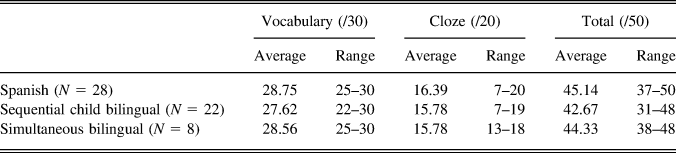
In addition to the three experimental tasks outlined in detail in the following text and the demographic questionnaire that provided information regarding their linguistic background, participants completed a shortened version of the DELE (2002) proficiency task, comprised of 50 items in two sections: vocabulary (n = 30) and cloze (n = 20). Table 2 shows the average and range for each section as well as the total score. Proficiency scores across the groups are similar; the Sequential child bilingual group has a slightly lower overall average and bottom range, while the Spanish and Simultaneous bilingual group are quite similar.
Average and range proficiency scores for DELE

EXPERIMENTAL TASKS
Grammaticality Judgment/Correction Task
To test for knowledge of syntactic and related semantic properties in Spanish, participants completed three experimental tasks. The first was a GJCT testing for knowledge of the syntactically constrained distribution of strictly prenominal and strictly postnominal adjectives. The 16 adjective tokens of the GJCT (+64 fillers) were divided into four conditions (grammatical postnominal, grammatical prenominal, ungrammatical postnominal, and ungrammatical prenominal) with four tokens each. Examples are shown in (19)–(22) in the following text.
(19) Grammatical postnominal adjective (N = 4)
Las chicas tienen amigas españolas.
The girls have.3pl.pres friends Spanish
“The girls have Spanish friends.”
(20) Grammatical prenominal adjective (N = 4)
Leo investiga un supuesto delito.
Leo investigate.3sg.pres a supposed crime
“Leo investigates an alleged crime.”
(21) Ungrammatical postnominal adjective (N = 4)
*Alberto investiga un asesinato supuesto.
Alberto investigate.3sg.pres an assassination supposed
“Alberto investigates an alleged assassination.”
(22) Ungrammatical prenominal adjective (N = 4)
*Las casas tienen españolas cortinas.
The houses have.3pl.pres Spanish curtains
“The houses have Spanish curtains.”
Participants were instructed to read each token and decide whether it is grammatical or ungrammatical; for grammatical tokens, they were instructed to simply continue on, for ungrammatical tokens, they were instructed to correct it any way they saw fit. As the syntactic distribution of strictly prenominal and strictly postnominal adjectives was under investigation, responses to the tokens were coded as correct only when the resulting word order was accurate; that is, other modifications (lexical changes, insertions, or deletions) not relevant to adjectival word order were disregarded.
Semantic Interpretation Task
Next, the SIT tested for interpretation of the semantically constrained distribution of alternating adjectives. Unlike in Task 1, only alternating adjectives were employed. There were five prenominal (non-restrictive) adjectives as seen in (23) and five postnominal (restrictive) adjectives as in (24).

Participants were instructed to mark their interpretation of the sentences. The box for each expected response is bolded for the reader.
Semantic Collocation Task
Finally, the Semantic Collocation Task (SCT) tested placement of adjectives allowed in both prenominal and postnominal position in 16 short contexts favoring either a nonrestrictive reading as in (25) or a restrictive reading as in (26).
(25) Prenominal adjectives (non-restrictive) (N = 8)
No hay super-héroe que no sea conocido por su bondad, coraje y fuerza. Los _______________ super-héroes _______________ del mundo no tienen miedo de nada. (valientes)
“All superheros are known for their goodness, courage and strength. The _______________ superheroes _______________ of the world aren’t scared of anything.” (courageous)
(26) Postnominal adjectives (restrictive) (N = 8)
Algunos padres son más involucrados en la vida de sus hijos que otros. Los _______________ padres _______________ juegan con sus hijos por la noche antes de que se duerman. (cariñosos)
“Some parents are more involved in their kids’ lives than others. The ____________ parents ______________ play with their kids at night before bedtime.” (affectionate)
Participants were instructed to read the context and insert the adjective into the blank they felt best completed the sentence.
RESULTS
GRAMMATICALITY JUDGMENT/CORRECTION TASK RESULTS
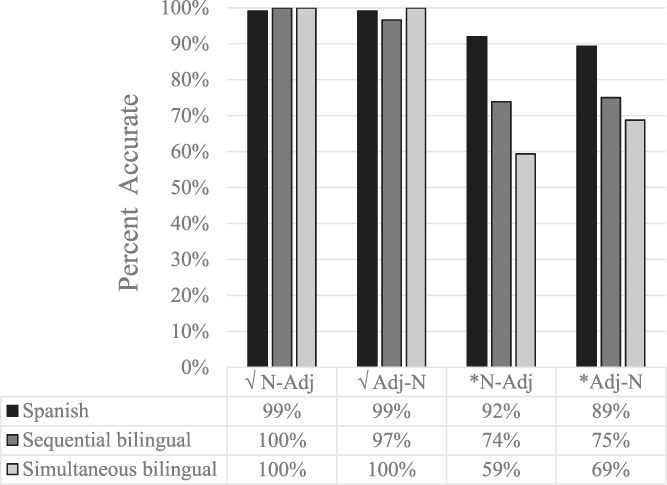
Figure 1 shows the percent accurate for each of the participant groups for the four token types examined in the GJCT. Recall that participants simply indicated if each token was grammatical and corrected ungrammatical tokens only. The first two columns display the % accurate on the grammatical post- and prenominal adjectives: All three groups are highly similar and accurate, reaching ceiling in both categories. The latter two columns display the percent accurate on the ungrammatical post- and prenominal adjectives: Here, there is more variation with only the Spanish group reaching expected accuracy.
GJCT group results: √N-Adj = grammatical postnominal adjective; √Adj-N = grammatical prenominal adjective; *N-Adj = ungrammatical postnominal adjective; *Adj-N = ungrammatical prenominal adjective.

The data were analyzed using a logistic mixed modelFootnote 15,Footnote 16 with pairwise contrasts. Sidak corrections were performed when necessary, as indicated by the model. The final modelFootnote 17 included the factors of Adjective Position, Grammaticality, Group, and Proficiency and relevant two- and three-way interactions. A Main Effect was found for Proficiency (F(1,99) 0.00, p = .001) but not for Adjective Position (F(1,99) 0.00, p = .999), Grammaticality (F(1,99) 0.00, p = .997), or Group (F(2,99) 0.00, p = 1.000). Similarly, no interactions were found for Adjective Position*Grammaticality (F(1,99) 0.00, p = .999), Adjective Position*Group (F(2,99) 0.00, p = 1.000), Grammaticality*Group (F(2,99) 0.00, p = 1.000), or Adjective Position*Grammaticality*Group (F(2,99) 0.00, p = 1.000).
Importantly, planned comparisons (Sidak) revealed no statistically significant differences between each group’s percent accurate on grammatical prenominal versus postnominal adjectives: (p = .999) for the Spanish group, (p = .351) for the Sequential child bilingual group, and (p = 1.000) for the Simultaneous bilingual group; nor on ungrammatical prenominal versus postnominal adjectives: (p = .515) for the Spanish group, (p = 1.000) for the Sequential child bilingual group, or (p = .454) for the Simultaneous bilingual group. This indicates that there is no statistically significant preference (i.e., a default) for prenominal or postnominal adjectives, but rather that the participants accept them equally. Next, differences between the participant groups are considered. Overall, the experimental groups performed rather similarly to the Spanish group in that no statistically significant differences in percent accurate were found between the Spanish and the Sequential child bilingual group for grammatical prenominal adjectives (p = .963), grammatical postnominal adjectives (p = .130), or ungrammatical prenominal adjectives (p = .719). Similarly, no statistically significant differences were found for percent accurate between the Spanish and the Simultaneous bilingual group for grammatical prenominal adjectives (p = .719), grammatical postnominal adjectives (p = .107), or ungrammatical prenominal adjectives (p = .719). However, a statistically significant difference in percent accurate obtained between the Spanish group and the Sequential child bilingual group for ungrammatical postnominal adjectives (p = .034), as well as between the Spanish group and Simultaneous bilingual group (p = .004) for the same token type. The Spanish group performed more standardly on these tokens (92% rejection) than the other two groups (74% and 59% rejection). Closer consideration shows that while one token, una mera funcionaria “a mere employee,” proved especially difficult for both experimental groups (45% and 50% rejection), the Simultaneous bilingual group was at most 63% accurate across this condition. Nonetheless, no significant differences were found between the two bilingual groups nor were any significant differences found for the other token types.
SEMANTIC INTERPRETATION TASK RESULTS
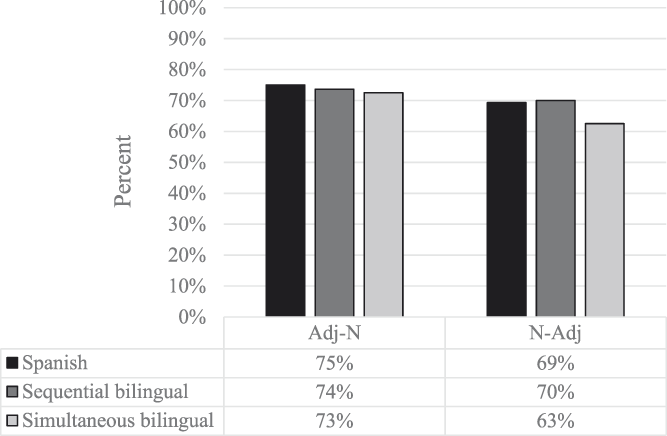
Figure 2 presents the percent interpretation of the pre- and postnominal adjectives employed in the SIT where participants read tokens and chose their interpretation of it from two options. Overall, lower accuracy rates are evidenced by the Spanish group on the SIT than in previous studies also examining adjectival interpretation in Spanish (cf. Guijarro-Fuentes, Judy, & Rothman, Reference Guijarro-Fuentes, Judy, Rothman and Bennati2009; Rothman et al., Reference Rothman, Iverson, Judy, Guijarro-Fuentes, Chandlee, Franchini, Lord and Rheiner2009; Rothman, Iverson, Judy, & Guijarro-Fuentes, 2008): 75% for prenominal (non-restrictive) adjectives and 69% for postnominal (restrictive) adjectives. Nevertheless, the testing stimuli are deemed sensitive enough for the purposes of the experimental design (see Anderson, Reference Anderson2007 for similar results in French). Accuracy rates in both the Sequential child and Simultaneous bilinguals are similar to that of the Spanish group for both token types.
SIT group results: Adj-N = prenominal adjective (nonrestrictive interpretation); N-Adj = postnominal adjective (restrictive interpretation).

Again, the data were analyzed using a logistic mixed model with pairwise contrasts. Sidak corrections were performed when necessary, as indicated by the model. The final model included the factors of Adjective Position, Group, Age of Exposure to Spanish, and Proficiency and one relevant two-way interaction: Adjective Position*Group. Main effects were found for Group (F(2,64) 3.566m p = .034), Age of Exposure to Spanish (F(1,64) 6.819, p = .011), and Proficiency (F(1,64) 10.206, p = .002), while no main effect was found for Adjective Position (F(1,64) 2.535, p = .117). No interaction was found between Adjective Position*Group (F(2,64) 0.314, p = .732).
Planned comparisons (Sidak) revealed two important findings. First, no significant differences between pre- and postnominal adjectives were found for any group, indicating they are equally accurate on both adjective types: (p = .240) for the Spanish group, (p = .710) for Sequential child bilingual group, and (p = .255) for the Simultaneous bilingual group. Second, no statistically significant differences were found between the Spanish and the Sequential child bilingual group for prenominal adjectives (p = .284) or postnominal adjectives (p = .055), between the Spanish and the Simultaneous bilingual group for prenominal adjectives (p = .832) or postnominal adjectives (p = .443), or between the bilingual groups for prenominal adjectives (p = .315), or postnominal adjectives (p = .055), indicating that all groups interpreted the prenominal and postnominal adjectives in a similar fashion.
SEMANTIC COLLOCATION TASK RESULTS
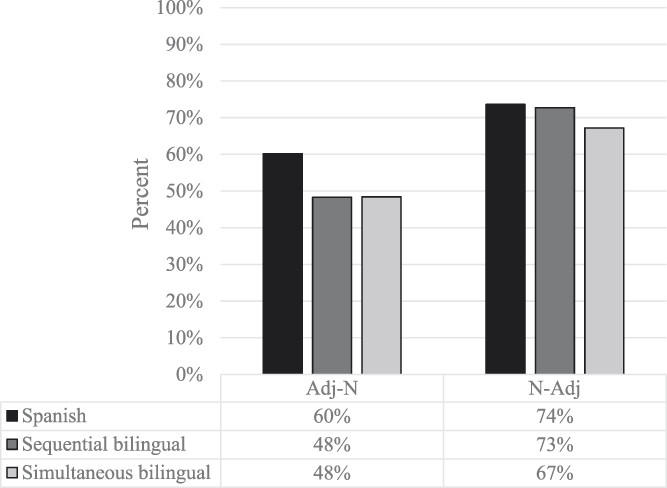
Lastly, Figure 3 shows the percent interpretation for the SCT in which participants chose a prenominal or postnominal adjectival position according to a context that favored a non-restrictive or restrictive reading, respectively. Similar to the SIT results, lower-than-expected accuracy rates obtained, especially for the non-restrictive contexts: 60% for the Spanish group, and hovering near chance at 48% for both bilingual groups. The Spanish group finding for the prenominal position echoes that of Judy, Guijarro-Fuentes, and Rothman (Reference Judy, Guijarro-Fuentes, Rothman, Bowles, Foote, Perpiñán and Bhatt2008) in that the control group of that experiment chose this position in restrictive contexts approximately 61% of the time. However, the Spanish group’s performance on the nonrestrictive contexts differs in that we see a 74% accuracy herein as compared to near ceiling accuracy in Judy et al. (Reference Judy, Guijarro-Fuentes, Rothman, Bowles, Foote, Perpiñán and Bhatt2008).
SCT group results: Adj-N = prenominal adjective (nonrestrictive placement); N-Adj = postnominal adjective (restrictive placement).

Again, a logistic mixed model with pairwise contrasts was employed to analyze the data. As indicated by the model, Sidak corrections were performed when necessary. The final model included the factors of Adjective Position, Group, and Proficiency and one relevant two-way interaction: Adjective Position*Group. Main effects were found for Adjective Position (F(1,49) 29.486, p < .001) but not for Group (F(2,49) 1.422, p = .251) or Proficiency (F(1,49) 0.147, p = .703). No interactions were found for Adjective Position*Group (F(2,49) 0.238, p = .789).
Planned comparisons (Sidak) revealed that each group treated pre- and postnominal adjectives differently, accurately placing more postnominal than prenominal adjectives (p < .001) for the Spanish and Sequential child bilingual group and (p = .032) for the Simultaneous bilingual group. Importantly, no statistically significant differences were found between the Spanish and the Sequential child bilingual group for prenominal adjectives (p = .565) or postnominal adjectives (p = .821), between the Spanish and the Simultaneous bilingual group for prenominal adjectives (p = .565) or postnominal adjectives (p=.610), or between the bilingual groups for prenominal adjectives (p = .798), or postnominal adjectives (p = .610), indicating that all groups interpreted the prenominal and postnominal adjectives in similarly.
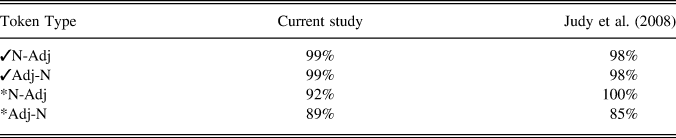
Finally, due to the nature of the first research question, which examined the syntactic and syntax-semantics adjectival distribution of Misiones Spanish, a comparison between native speaker data from this study and that of two previous studies is made. First, the four purely syntactic conditions of the GJCT are considered and compared to the native speakers (N = 12) of Judy et al. (2008, p. 14). As regards the grammatical tokens (pre- and postnominal), Table 3 shows very similar accuracy rates for both groups. There is more variation between the groups, however, for the ungrammatical tokens, especially for the ungrammatical postnominal adjectives for which 22 of the participants were 100% accurate, three were 75% accurate, and three were 50% accurate. The fact that the overwhelming majority of the speakers were 100% accurate in their rejection of ungrammatical postnominal adjectives is a strong indication that the grammar of Misiones Spanish allows for intensional adjectivesFootnote 18 in prenominal positions only.
Spanish speaker comparison of accuracy on GJCT

With respect to semantic interpretation and placement of (qualifying) adjectives in the SIT and SCT, respectively, Tables 4 and 5 show the differences between the current Spanish participants and those of Guijarro-Fuentes et al. (Reference Guijarro-Fuentes, Judy, Rothman and Bennati2009) (N = 12). For adjectival interpretation, considerable differences obtained between the two groups on both prenominal (75% vs. 90%) and postnominal adjectives (69% vs. 85%), with the participants of Guijarro-Fuentes et al. (Reference Guijarro-Fuentes, Judy, Rothman and Bennati2009) performing more expectedly.
Spanish speaker comparison of accuracy on SIT

Spanish speaker comparison of accuracy on SCT

Lastly, as regards the placement of (qualifying) adjectives as in the SCT, Table 5 depicts a curious finding: while the participants of both experiments show very similar, albeit lower, accuracy rates for prenominal adjectives (60% vs. 61%), the participants of Guijarro-Fuentes et al. (Reference Guijarro-Fuentes, Judy, Rothman and Bennati2009) are much more accurate on the postnominal adjectives (74% vs. 97).
DISCUSSION
Having presented the results, we now return to the research questions. The first asked whether Misiones Spanish displayed standard adjectival distribution with respect to pure syntax and syntax-semantics interpretive constraints. As discussed previously, the current study’s Spanish group’s (N = 28) data was compared to that of the native speakers of Judy et al. (Reference Judy, Guijarro-Fuentes, Rothman, Bowles, Foote, Perpiñán and Bhatt2008) and Guijarro-Fuentes et al. (Reference Guijarro-Fuentes, Judy, Rothman and Bennati2009). While the items tested in the previous studies differ from those of the current study in terms of specific tokens, it is worth noting that this difference is a potential, but unlikely, explanatory factor. Another difference between the studies is that the native speakers of Judy et al. (Reference Judy, Guijarro-Fuentes, Rothman, Bowles, Foote, Perpiñán and Bhatt2008) and Guijarro-Fuentes et al. (Reference Guijarro-Fuentes, Judy, Rothman and Bennati2009) are also English speakers living in the United States. The availability of English may have aided the participants’ performance in the SIT because the two possible answers were provided in English, potentially allowing them to more easily distinguish between the interpretations. All things considered, though, unless one presumes task effects, it seems that while Misiones Spanish displays the standard distribution of strictly prenominal and strictly postnominal adjectives, it differs to some degree regarding the interpretation and placement of alternating qualifying adjectives. Further testing, either with a different sample or different materials at different points in time stands to shed light on the direction of these differences.
Regarding the second research question, which asked if the Polish-Spanish bilinguals display native-like distribution and interpretation of adjectives in Spanish, the prediction, barring remapping problems, was that it is possible to converge on the Spanish values, but that a remnant of Polish—prenominal classifying adjectives—may persist in Spanish. In fact, the Polish-Spanish groups showed no significant differences from the Spanish group for ungrammatical prenominal classifying adjectivesFootnote 19 or the grammatical tokens, but rather for the ungrammatical postnominal adjectives only (see section titled “Grammatically Judgement/Correction Task Results”). The one statistically significant difference found is perhaps especially surprising because intensional adjectives are prenominal in both languages. Regarding semantic distribution, no significant differences were found among either of the bilingual groups and the Spanish group for the prenominal or postnominal tokens on the SIT or the SCT, demonstrating native-like performance. Of course, it is not unexpected that the Simultaneous bilingual group perform native-like across these tasks as they reported being exposed to Spanish since birth, live in a majority Spanish-speaking society, were educated in Spanish (see Kupisch & Rothman, Reference Kupisch and Rothman2016), and reported Spanish as their dominant language. It is, however, of importance that no significant differences for any of the tasks previously described were found between the Sequential child bilingual group, who were first exposed to Polish and could transfer the Polish DP, and the Simultaneous bilingual group. This is a valuable finding as it indicates that despite different ages of exposure, both groups display similar knowledge of the distribution of adjectives in Spanish. It also indicates that any differences that may have existed during childhood/adolescence (see Cuza & Pérez-Tattam, Reference Cuza and Pérez-Tattam2016) for these bilinguals were overcome by the time of testing. If convergence on native-like interpretation of adjectives is taken to be indicative of convergence on the underlying syntactic structure of the DP, as has been argued in previous studies (Anderson, Reference Anderson2007, Reference Anderson2008; Guijarro-Fuentes et al., Reference Guijarro-Fuentes, Judy, Rothman and Bennati2009; Judy et al., Reference Judy, Guijarro-Fuentes, Rothman, Bowles, Foote, Perpiñán and Bhatt2008; Rothman et al., Reference Rothman, Judy, Guijarro-Fuentes and Pires2010), then the results of the SIT and the SCT indicate acquisition of the structure of the Spanish DP. While the syntactic structures assumed for both languages described in the section “Adjectives in Spanish and Polish” are rather similar, previous research has shown that even when transfer would be (largely) facilitative, remapping issues can arise (see section titled “Introduction” for relevant studies). What remains a curious finding is the experimental groups’ non-native-like acceptance of ungrammatical postnominal (intensional) adjectives, which are also ungrammatical in Polish, a finding that also obtained in Androutsopoulou et al. (Reference Androutsopoulou, Español-Echevarría, Prévost, Bruhn de Garavito and Valenzuela2008), whose L1 French-L2 Spanish learners, especially the intermediate proficiency learners, accepted prenominal (non-evaluative) low adjectives (e.g., shape, nationality, color, and size) that are ungrammatical both in their L2 Spanish as well as their L1 French. In the case of the Sequential child bilinguals, it is possible that this finding obtains from unfamiliarity with, and subsequent misanalysis of, the adjective mero “mere,” especially considering that their performance on the other three tokens in this condition was far more native-like (82–90%). The same cannot be claimed for the Simultaneous bilingual group, however, as their performance on these tokens ranges from 50% (on mero) to only 63% (on other tokens). If intensional adjectives are less frequent in the input, participants may be more apt to accept them postnominally in a GJCT, possibly misanalyzing them as being of the type that can appear in both syntactic positions; nonetheless, this does not preclude them from accurately employing other intensional adjectives prenominally, perhaps in a different task.
CONCLUSION
Returning to the points outlined in the introduction, like previous studies, the results of this experiment are largely in line with the “convergence” accounts, and against “non-convergence” accounts, for the properties examined because they demonstrate convergence with the Spanish speakers of Misiones, Argentina, and between the Simultaneous bilinguals and the Sequential child bilinguals. The former is interesting for the Sequential child bilinguals in that they arguably had an L1 structure in place that was available for transfer at the time of exposure to Spanish, an L1 configuration that would provide them with some, but crucially not all, necessary knowledge regarding adjectival distribution in Spanish. In essence, no age effects were found for these bilinguals. While it was deemed possible for the Simultaneous and Sequential child bilinguals to converge on adjectival distribution, previous research has shown this is not always an inevitable outcome, especially in the latter case (Lardiere, Reference Lardiere2007, Reference Lardiere, Liceras, Zobl and Goodluck2008; Prévost & White, Reference Prévost and White2000; Rothman, Reference Rothman, Baauw, Drijkoningen and Pinto2007), but also in the former case particularly when examining the heritage, and less dominant, language (Montrul, Reference Montrul2010, Reference Montrul2016). The Polish-Spanish bilinguals of both groups, however, did demonstrate knowledge of the interpretive constraints on adjectival distribution, yet differed from the Spanish speakers not on the predicted ungrammatical prenominal classifying adjectives, but rather on the ungrammatical postnominal intensional adjectives. Unlike in Cuza and Pérez-Tattam (Reference Cuza and Pérez-Tattam2016), where production was examined, this difference cannot easily be explained by crosslinguistic effects, but rather more readily echoes results from Androutsopoulou et al. (Reference Androutsopoulou, Español-Echevarría, Prévost, Bruhn de Garavito and Valenzuela2008) where L2 learners erroneously accepted prenominal non-evaluative adjectives that are ungrammatical in both the L1 and the L2. Future analysis of guided speech production and a wider range of intensional adjectives may shed light on whether this difference is isolated to the GJCT and the tokens tested therein, or if it is pervasive.
This study is indebted to the following Polish associations located in Misiones, as well as their generous community members: Asociación Argentino Polaca de Wanda, Asociación Polaca de Posadas, Centro Cultural Argentino Polaco de Oberá, Colectividad de Polacos en Oberá, Sociedad Polonesa de Apóstoles, Sociedad Polonesa de Azara, and Sociedad Polonesa de Posadas. Additional thanks go to Jason Rothman, Michael Iverson, Ewelina Barski, and Álvaro Recio for helpful comments as well as Wake Forest University Archie Funds for supporting this research.
SUPPLEMENTARY MATERIAL
To view supplementary material for this article, please visit https://doi.org/10.1017/S0272263117000158.