Introduction
Alzheimer's disease (AD) is a progressive neurodegenerative disease characterized by cognitive decline and functional deficits, and behavioral and neuropsychiatric symptoms. The majority of persons with AD are living in their own homes, at least at the mild and the moderate stages of AD, with the care of a spousal caregiver. The consequences of caregiving are diverse and complex (Brodaty and Donkin, Reference Brodaty and Donkin2009). Caring for relatives with dementia is consistently associated with noticeably higher stress levels and a high possibility for psychological and physical health problems (Pinquart and Sörensen, Reference Pinquart and Sörensen2003), which potentially increase the use of social and health care services leading to an even higher societal burden of AD.
Health protective factors could have a direct protective effect on caregivers’ health and well-being (Zarit et al., Reference Zarit, Femia, Kim and Whitlatch2010). Therefore, family caregivers’ management of their own health and health protecting factors could have an impact on the development of burden. Furthermore, it could be assumed that family caregivers’ strong sense of coherence (SOC) in connected to maintaining their good health and, therefore, promotes successful home care of the person with AD (Eriksson and Lindström, Reference Eriksson and Lindström2006).
Sense of coherence
SOC explains life orientation as a capability to comprehend a situation and the capacity to use available resources (Eriksson, Reference Eriksson2007). General Resistance Resources (GRRs) create prerequisites for the development of the SOC (Lindström and Eriksson, Reference Lindström and Eriksson2010). GRRs are physical, biological, and psychosocial factors. These resources can originate within people as personal resources and capacities, but may also be at one's disposal through society. (Antonovsky, Reference Antonovsky1987; Lindström and Eriksson, Reference Lindström and Eriksson2005). SOC is a global view of life that includes cognitive, instrumental, and motivational components (Antonovsky, Reference Antonovsky1993). Furthermore, it is a deeply personal way of thinking, being and acting, an inner trust that things in life will be in order regardless of what may happen (Lindström and Eriksson, Reference Lindström and Eriksson2010). SOC is assumed to be relatively stable in adulthood, with a tendency to increase over time. Furthermore, it tends to increase with age, and men usually score higher ratings on SOC than women (Eriksson, Reference Eriksson2007, Nilsson et al., Reference Nilsson, Leppert, Simonsson and Starrin2010). However, SOC seems to fluctuate moderately within the level on which it has developed (Eriksson, Reference Eriksson2007). Some studies (e.g., Nilsson et al. Reference Nilsson, Holmgren, Stegmayr and Westman2003) have attested to Antonovsky's (Reference Antonovsky1987) hypothesis of the stability of strong SOC over time. Individual conditions and societal changes influence some persons’ SOC. Antonovsky (Reference Antonovsky, McCubbin, Thompson, Thompson and Fromer1998) further pointed out that, confronted with a radical change in life circumstances, people with strong SOC will find a new meaning content appropriate to the occurred change. Contradictory to this stability assumption, Volanen et al. (Reference Volanen, Suominen, Lahelma, Koskenvuo and Silventoinen2007) found in a five-year follow-up in adult population that an initially strong SOC was no more stable than an initially mediocre or weak SOC when a negative life event occurred.
A strong SOC can predict good subjective health, particularly mental health (Eriksson and Lindström, Reference Eriksson and Lindström2006). It has been reported that a strong SOC predicts good health in four-year follow-up in adults (Suominen et al., Reference Suominen, Helenius, Blomberg, Uutela and Koskenvuo2001). Furthermore, in an aged population, a strong SOC was positively associated with subjective health (Wiesmann and Hannich, Reference Wiesmann and Hannich2010) and a lower rate of physical illnesses (Lundman et al., Reference Lundman2010). In exploring relationships between GRRs, SOC, and health, Wiesmann and Hannich (Reference Wiesmann and Hannich2010) discovered that elderly persons’ SOC is resource-dependent. SOC is mainly strengthened by high self-efficacy, high self-esteem, low depressive mood, and low fatalistic locus of control. In a Swedish study (Lövheim et al., 2012) on negative life events of very old people (85+), loss of independence in activities of daily living and decreased cognitive functioning correlated with decrease in SOC scores. However, SOC also increased over five years. Lövheim et al. (2012) suggest that when negative life events accumulate in a relatively short period, there is a risk for decreased SOC.
It has been previously shown that a strong SOC protects individuals against anxiety, depression, and hopelessness (Lindström and Eriksson, Reference Lindström and Eriksson2010). Although previous studies (e.g., Wiesmann and Hannich, Reference Wiesmann and Hannich2011; Dezutter et al., Reference Dezutter, Wiesmann, Apers and Luyckx2013) have emphasized the negative relationship between SOC and depression, less attention has been paid for identifying how depression influences the development of SOC in old age. Based on this, we hypothesize that there is a negative association between caregivers’ depressive symptoms and SOC.
Family caregivers’ SOC in dementia care settings
Thus far, family caregivers’ SOC in dementia settings has been explored in very few studies. In one previously published study, a higher level of SOC was found to associate with a lighter burden (Andrén and Elmståhl, Reference Andrén and Elmståhl2005; Reference Andrén and Elmståhl2008) and better subjective health (Andrén and Elmståhl, Reference Andrén and Elmståhl2005). However, in another study on spousal caregivers, SOC was not associated with satisfaction in caregiving (Ekwall and Hallberg, Reference Ekwall and Hallberg2007). Low SOC was significantly associated with depression (Välimäki et al., Reference Välimäki, Vehviläinen-Julkunen, Pietilä and Pirttilä2009; Orgeta and Lo Sterzo, Reference Orgeta and Lo Sterzo2013), feelings of distress, and low health-related quality of life (HRQoL) in caregivers of persons with recently diagnosed AD (Välimäki et al., Reference Välimäki, Vehviläinen-Julkunen, Pietilä and Pirttilä2009).
Possible threats to family caregivers’ SOC in AD care settings have not yet been studied per se. However, it could be inferred that caregivers’ SOC might be weakened by not having internal or external resources at their disposal. For example, good pre-caregiving and current marital relationship (Quinn et al., Reference Quinn, Clare and Woods2009), not feeling depressed in old age (Wiesmann and Hannich, Reference Wiesmann and Hannich2010) and not feeling isolated (Andrén and Elmståhl, Reference Andrén and Elmståhl2008) can have an impact on the caregivers’ ability to alleviate stress and, in turn, affect the caregiver's health. Correspondingly, persons with Alzheimer's cognitive and behavioral changes and erosion in marital relationship were experienced as significant stressors (Pretorius et al., Reference Pretorius, Walker and Heyns2009). It seems important to further understand the nature of SOC in AD care setting. Having a strong SOC allows a caregiver to trust that they can find resources within themselves and in their environment, and use these resources to their benefit. As aged family caregivers encounter long-lasting stressors while taking care of a family member with progressive AD, it is important to identify the factors that have an effect on their ability to manage tension. Therefore, the level of SOC seems to be a key element in the process of coping with caregiving. SOC seems to be closely connected to interpersonal, affective, and motivational foundations (Wiesmann et al., Reference Wiesmann, Niehärster and Hannich2009), which can determine forthcoming burdens (Orgeta and Lo Sterzo, Reference Orgeta and Lo Sterzo2013). Thus, a low SOC may predispose carers to experience their caring situations as difficult to understand and less manageable, and might be unmotivated to strive.
One limitation related to all previous studies of SOC in family caregiver populations is the cross-sectional study design. To our knowledge, no longitudinal studies on spousal caregivers’ SOC have been published.
Objectives
The objectives of this analysis were: (1) to investigate the change in the trajectory of SOC, (2) to analyze factors that are associated with change in the trajectory of SOC over time in aged spousal caregivers of persons with mild AD in a 3-year follow-up to identify potential baseline factors predicting the risk for deteriorating SOC over time.
Methods
Study design
The Kuopio ALSOVA study is a prospective follow-up AD study. The ethical committee of the Kuopio University Hospital reviewed ethical issues of this study and gave a favorable opinion to the research (No. 64/00). The study was approved by the Finnish National Supervisory Authority for Welfare and Health, and the Finnish Ministry of Social Affairs and Health. The criteria for dropping out of the study were defined as permanent institutionalization or the death of the person with AD. In the event that participants dropped out for other reasons, they were asked for the primary reason for discontinuing their participation in the study. The ALSOVA study included psychosocial intervention courses for one of out of three caregivers and patients during the initial two years after diagnosis and took up a total of 16 days (Välimäki et al., Reference Välimäki, Vehviläinen-Julkunen, Pietilä and Pirttilä2009; Karttunen et al., Reference Karttunen2011).
Participants
The cohort applied in the present study is a subsample of 241 patient and caregiver dyads. The voluntary participants were recruited from the memory clinics of three hospitals. The participants received information on the study and an initial study visit was arranged soon after having been diagnosed. All of the study patients were diagnosed with AD by a geriatrician or neurologist using the NINCDS-ADRDA criteria (McKhann et al., Reference McKhann, Drachman and Folstein1984) and the DSM-IV criteria (APA, 1994). They went through diagnostic evaluation including neurological clinical examination, laboratory screening tests, electrocardiography, brain imaging, and neuropsychological examination. All patients were prescribed a drug treatment with either an anticholinesterase or memantine. An inclusion criterion for patients was that they were 65+ age with very mild or mild Alzheimer's disease (CDR 0.5 or 1.0) at diagnosis. The definition of caregiver included close, possibly daily contact with the person with AD. Only spousal caregivers (n = 170) were included in this analysis. Follow-up visits were conducted annually every 3 years. The informed consent form was signed by both the person with AD and the caregiver. The caregiver also provided proxy consent on behalf of the person with AD as needed.
Measures
Data collected during the interview included socio-demographic details (i.e., age, sex, education, living arrangements, income, and activities) and information on general health (other diseases and use of drugs). All caregiver- and patient-related variables were measured at the baseline and also at each of the follow-up visits (1-2-3 years).
Caregivers’ SOC was assessed using Antonovsky's (Antonovsky, Reference Antonovsky1987) 29-item scale. The SOC scale comprised of a general factor (SOC) with the three dimensions of comprehensibility (11 items), manageability (10 items), and meaningfulness (8 items). Thirteen items were formulated negatively and reversed in the scoring, so that a high total score profiled a strong SOC. (Eriksson and Lindström Reference Eriksson and Lindström2005; Välimäki et al., Reference Välimäki, Vehviläinen-Julkunen, Pietilä and Pirttilä2009.) In previous studies, the Cronbach's alpha α has ranged from 0.70 to 0.95 (Eriksson and Lindström, Reference Eriksson and Lindström2005). Beck's Depression Inventory (BDI) 21-item version was used to assess depressive symptoms (Beck et al., Reference Beck, Ward, Mendelson, Mock and Erbaugh1961). For analysis, the baseline BDI score was condensed into a four-point scale from “no depressive symptoms” to “severe depression” (Raitasalo, Reference Raitasalo2007). Two QoL instruments were used; generic 15D (Sintonen, Reference Sintonen2001) and VAS (visual analogue scale) for general well-being. The 12-item version General Heath Questionnaire (GHQ) (Goldberg and Hillier, Reference Goldberg and Hillier1979) was used to measure the extent of distress.
Persons with AD were assessed using the Mini Mental State Examination (MMSE) (Folstein et al., Reference Folstein, Folstein and McHugh1975). The severity of the disease was rated using the Clinical Dementia Rating (CDR) (Hughes et al., Reference Hughes, Berg, Danziger, Coben and Martin1982; Morris, Reference Morris1993). The structured interview protocol includes six areas, and the scores of each of these sections are combined to obtain a composite score and a sum of boxes (SOB) score. (O'Bryant et al., Reference O'Bryant2008). The ADCS-ADL interview of the caregiver was used to evaluate activities in daily life (Galasko et al., Reference Galasko, Bennet, Sano, Ernesto, Thomas, Grundman and Ferris1997). The 12-item Neuropsychiatric Inventory (NPI) (caregiver interview) was used to assess behavioral symptoms (Cummings et al., Reference Cummings, Mega, Gray, Rosenberg-Thompson, Carusi and Gornbein1994).
Data analysis
Descriptive statistical methods were used to summarize the collected data as percentages, means, standard errors (SE), and 95% confidence intervals (95% CIs).
In order to analyze the associations between the baseline factors and change in the average trajectory of SOC over 3 years, a multivariate linear mixed regression model (LMRM) was applied. In the LMRM analysis, a caregiver was applied as a hierarchical variable to allow within-subject correlation between the annually repeated SOC measurements (i.e., measurements of dependent variable) and baseline values of the factors measured as fixed effects. In addition, the LMRM took into consideration the varying amount of data for each subject (i.e., adjustment for drop-outs) by applying all available measurements of SOC from the time of study participation (i.e., all available measurements of SOC from the 170 caregivers were applied in the analyses of trajectories).
Different covariance matrix and model structures (e.g., random intercept and/or slope models) were tested and Akaike's Information Criterion (AIC), Bayesian Information Criterion (BIC), and likelihood deviance were applied as performance measures (i.e., how well the model fitted the data) in the best model selection. In addition, pseudo-R2 statistic was estimated as a proportion of explained variance in the random effect by the time-invariant baseline factor(s).
The level of statistical significance was defined as p < 0.05. All analyses were performed using the IBM SPSS statistics software (version 19.0, SPSS Inc., Chicago, IL, USA).
Results
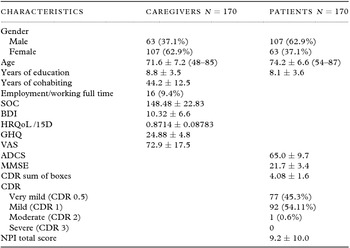
The baseline characteristics of 170 spousal caregivers and persons with AD are provided in Table 1. For study participants with AD, median time between their AD diagnosis and the baseline study visit was 5 months. All but one of the persons with AD were using drug treatment with either an anticholinesterase or memantine at baseline.
Baseline demographic data of the 170 spousal caregivers and 170 patients with Alzheimer's disease

Age and all continuous variables are presented as mean ± standard deviation, others as frequency. SOC = Sense of Coherence Scale; HRQoL = Health Related Quality of Life; BDI = Beck Depression Scale; VAS = Visual Analogical Scale of General Well-being; GHQ = General Health Questionnaire, CDR = Clinical dementia rating; MMSE = Mini Mental State Examination; ADCS-ADL = Activities of Daily Living; NPI = The Neuropsychiatric Inventory. Significance p <0.05.
During the three-year follow-up, overall 75 of 170 (44%) spouse caregivers did not complete all three follow-ups. The most common reasons for withdrawing from the study were caregivers’ and persons’ with AD health complaints (n = 19, 44.2%), caregivers’ fatigue (n = 12, 27.9%), and moving to another city (n = 1, 2.3%). In addition, five spousal caregivers and 20 persons with AD died. More specifically, at 1-, 2-, and 3-year-follow-ups, data were available for 132, 107, and 87 respondents, respectively. However, all available data from the 170 dyads were applied in the LMRM analysis to study the associations between the factors of interest and caregivers’ SOC. The intervention and control groups were statistically equal at the baseline. The intervention could not maintain the SOC score during the follow-up time.
The drop-out analysis showed that caregivers in the three-year SOC follow-up were slightly younger than their counterparts (69.9 vs. 72.2, p < 0.05), and reported fewer depressive symptoms (8.94 vs.11.0, p = <0.05) than their counterparts. However, the baseline SOC score was equivalent.
Annual change of SOC during follow-up
At the baseline, the drop-out adjusted average SOC score was 148.5 (95%CI 144.9 to 152). Corresponding figures for first, second, and third follow-up visits were on average 147.7 (144.2 to 151.1), 144.7 (141.0 to 148.4), and 143.8 (140.0 to 147.7), respectively. Thus, mean SOC decreased by –4.56 (p = 0.002) in 3 years.
Covariates associated with SOC
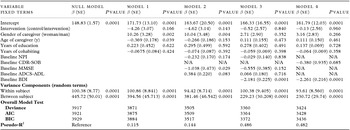
Table 2 summarizes the results of the LMRM analysis. The results presented in Table 2 are based on the random intercept and slope model that demonstrated the best fit for the data according to the selected performance measures. There were four baseline covariates statistically significantly associated with the trajectories of SOC: (1) if caregivers had depressive symptoms at baseline, their SOC decreased statistically significantly (–2.181, p = 0.0001), that is, every one point increase in the baseline BDI was associated with a decrease of –2.181 points in the SOC score, (2) if the baseline depression was not taken into account in the model, caregiver's gender (10.26, p = 0.002), (3) caregiver's age (–0.369, – = 0.039), and (4) the lower baseline level of patient's MMSE (–1.038, p = 0.029) decreased the level of the SOC score over time. Other studied baseline covariates did not statistically significantly associate with the trajectories of SOC change over time in any analyzed LMRM model (Table 2).
Estimated linear mixed models exploring the impact of different caregiver and patient covariates on the average caregivers’ SOC score over time

NPI = Neuropsychiatric Inventory, CDR-SOB = Clinical Dementia Rating Sum of boxes, MMSE = Mini-mental State Examination, ADCS-ADL = Activities of Daily Living, BDI = Deck Depression Scale. AIC = Akaike's Information Criterion, BIC = Bayesian Information Criterion.
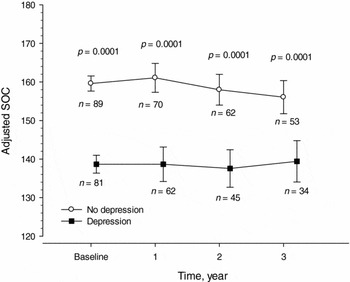
As depressive symptoms proved to be important for the trajectory of SOC, a further analysis for exploring the significance of the severity of depressive symptoms emerged. An added analysis revealed that when compared to nondepressive caregivers (BDI≤9, n = 95, 56%), minor (BDI 10–18, n = 54, 32%), moderate to severe (BDI 19–30, n = 21, 12%), (Raitasalo, Reference Raitasalo2007), depressive symptoms decreased (adjusted for length of follow-up) the level of the SOC score by an average of –19.0 (p = 0.0001), –38.3 (p = 0.0001) points during follow-ups. Figure 1 graphically represents the levels of average SOC scores over 3 years of follow-up in nondepressive spousal caregivers compared to caregivers with depressive symptoms.
Sense of coherence (SOC) and valid sample sizes (n) stratified by depression status during the 3 years follow-up. The SOC values and their 95% confidence intervals are adjusted for caregivers’ age, sex, years of education, and length of follow-up in the study. P values indicate statistical significances of differences between the groups over time. LMRM analysis.

Discussion
This study showed that spousal caregivers’ SOC decreases during caregiving, especially, if a spouse caregiver already has depressive symptoms at the baseline. If depressive symptoms are not taken into account, female gender, caregiver's age, and cognitive performance (measured by MMSE) have an influence on change of SOC in a follow-up.
In this study, the average SOC decreased in all caregivers during the follow-up. In contrast to the earlier reports, SOC was not stable over time even in those with initially strong SOC (Nilsson et al., Reference Nilsson, Holmgren, Stegmayr and Westman2003) nor did it improve with age (Nilsson et al., Reference Nilsson, Leppert, Simonsson and Starrin2010) during caregiving. Our study population of generally aged and retired spousal caregivers does not match with populations previous longitudinal studies on SOC. However, our results corroborate previous findings in a working-age population that argued that SOC is not stable and that the level clearly decreases even in those with a strong SOC after a negative life event, e.g., a family member's death, being a victim of violence (Volanen, 2011), health problems (Nilsson et al., Reference Nilsson, Holmgren, Stegmayr and Westman2003).
We have previously reported that baseline depressive symptoms are associated with the baseline SOC score in spousal caregivers of persons with recently diagnosed AD (Välimäki et al., Reference Välimäki, Vehviläinen-Julkunen, Pietilä and Pirttilä2009). Moreover, other cross-sectional studies on caregivers’ SOC found out that SOC related with low depressive mood (Wiesmann et al., Reference Wiesmann, Niehärster and Hannich2009; Orgeta and Lo Sterzo, Reference Orgeta and Lo Sterzo2013). However, the reduction of depressive symptoms was associated with an improved SOC (Helvik et al., Reference Helvik, Engedal and Selbæk2013). It has been suggested that successful treatment of depression in aged populations might improve SOC (Lundman et al., Reference Lundman2010). In the present study, existence of depressive symptoms at the baseline predicted a decrease in the SOC in all spouse caregivers. Meanwhile, the SOC of spousal caregivers with depressive symptoms recovered during caregiving compared to nondepressive caregivers in whom the influence of a negative life-event, e.g., long-lasting caregiving, resulted in a decreased SOC every year. However, caregivers suffering depressive symptoms could not reach as strong a SOC as nondepressive caregivers during the follow-up time, and their SOC level was lower than in nondepressive caregivers. We hypothesize that strong SOC might shield individuals from the remarkable subjective burden of caregiving, but only when caregivers do not suffer from depressive symptoms in the beginning of caregiving. It is likely that current health care practices cannot detect caregivers’ depressive symptoms during the early stages of patients’ AD.
Previous studies have shown improvement of SOC with age (Helvik et al., Reference Helvik, Engedal and Selbæk2013; Lindmark et al., Reference Lindmark, Stenström, Gerdin and Hugoson2010) in an older population. A Swedish study on old persons without dementia found out that the mean SOC improved in 1 year's follow-up time. In this study, we found that the SOC score decreases over time in an aged caregiver population with a family member with progressive neurodegenerative disease. Thus, we may argue that a continuous, negative life event influences the SOC more than aging protects it. This influence on SOC is important in understanding how caregivers may maintain a good health. In other words, it is an interesting finding that when a family member has a progressive disease, adapting to the new situation will not improve SOC with aging. Consistent with previous findings (Lindmark et al., Reference Lindmark, Stenström, Gerdin and Hugoson2010; Nilsson et al., Reference Nilsson, Leppert, Simonsson and Starrin2010) on gender differences in an aged population, the present study also indicated that men had a statistically higher SOC score compared with women. The reason why female caregivers tend to have lower SOC than men can be speculated about in the light of salutogenic theory. Caregivers have to reunderstand their lives in the light of progressive illness, perceive that they are able to manage handling caring-related demands and, finally, find a meaningful way to carry on with life. It can be considered whether aged female caregivers find these demands more difficult than men. Aged female caregivers could benefit from tailored support programmes delivered at home.
Furthermore, a poor baseline cognitive outcome (MMSE) of persons with AD influenced the SOC of their caregivers in this study. There are no previous studies on the influence of patients’ cognitive performance on caregivers’ SOC. As discussed earlier, SOC influences burden. It is generally thought that caregivers’ burden does not inevitably increase with the severity of dementia (Berger et al., Reference Berger, Bernhardt, Weimer, Peters, Kratzsch and Frolich2005). But Germain et al. (Reference Germain2009) reported a minor impact of cognitive impairment on caregivers’ burden. Thus, we may argue that a decline in the cognitive performance of a person with AD (dementia severity) may have a minor impact on spousal caregivers’ SOC.
However, the abovementioned findings were only significant if we did not include caregiver's depressive symptoms in the analysis model. It can be concluded that if family caregiver reports depressive symptoms at all already at the beginning of caregiving it is a clear indication to possible negative trend. The existence of depressive symptoms plays a major role in the prospective ability to maintain confidence in the idea that life will be in order regardless of what may happen. A caregiver's age and gender predict this negative trend only with nondepressive caregivers.
The results presented here should be considered in the light of some strengths and weaknesses of the present study. Firstly, this study is the first longitudinal study on SOC in a dementia care setting. The previous studies on SOC in family caregiver populations have mostly been cross-sectional (Andrén and Elmståhl, Reference Andrén and Elmståhl2005, Reference Andrén and Elmståhl2008) except for the report on caregivers who have a family member or close friend with stroke (Chumbler et al., Reference Chumbler, Rittman and Wu2008). Thus, the present study gives new information about change in SOC and potential covariates associated with the change of SOC when caring for a person with a progressive disease.
Secondly, the study results were obtained from a homogeneous cohort (i.e., all the persons with AD had very mild, CDR 0.5, or mild, CDR 1.0, AD at the baseline, and only spousal caregivers were included in this study). In addition, the baseline visit was made soon after (on average 5 months later) the diagnosis and followed the start of the AD drug therapy. The annual evaluations of persons with AD and their caregivers were conducted by a neuropsychologist and a study nurse, who were oblivious of each other's results, which could be expected to increase the validity of presented findings.
The fairly high drop-out rate (44.7%) was a potential limitation to the study (i.e., during follow-up, 76 caregivers dropped out of the study, of whom 25 caregivers or persons with AD died). The deaths of persons with AD and caregivers were foreseeable. Other caregivers dropped out because of distress or health problems. However, these dropout rates and reasons for withdrawing from the study are comparable with other caregiver studies (Mittelman et al., Reference Mittelman, Brodaty, Wallen and Burns2008). In addition, the statistical analyses were conducted based on the observed cases. However, one advantage of LMRM is that it can make use of all available data in the estimation of the trajectories of SOC (i.e., the noncompleters also contributed to the estimation of model parameters during their time of participation in the study).
The results of this study indicate that we are able to find possibly vulnerable caregivers already at the beginning of caregiving by evaluating health-protective factors. SOC is one efficacy parameter suitable for clinical trials to estimate health protective factors and efficacy of psychosocial interventions or pharmalogical treatment strategies. Thus, it would be interesting to study SOC in a longitudinal, clinical AD trial setting in association with caregiver's depression, burden, quality of life, and with efficacy parameters related to AD patients.
Based on the results reported here, the evaluation of caregiver's depression at the time of an AD diagnosis of a family member might help social and health care personnel to estimate the need for support in promoting successful home care. Paying attention to family caregivers’ health as well as health-protecting factors and resources widens the viewpoint from that of burden towards a more salutogenic orientation. Hence, interventions for promoting family caregivers’ good health on individual, group and society levels are welcome in health care.
Conclusion
Spousal caregivers’ SOC is not as stable as previously hypothesized, but is weakened during the caregiving of a family member with progressive disease. It seems that depressive symptoms are significant factors explaining changes in SOC. If a spousal caregiver suffers depressive symptoms at the beginning of caregiving, the decrease of SOC is more significant compared to the caregivers without any depressive symptoms.
Conflict of interest
None.
Description of authors’ roles
The first author Tarja Välimäki has analyzed the data and consulted Mikael Fraunberg about correct methods. Janne Martikainen has conducted the linear mixed regression model in co-operation with first author. Ilona Hallikainen and Kristiina Hongisto have collaborated with patient measures and analysis. All the authors have participated in writing and critically commenting on the manuscript. Katri Vehviläinen-Julkunen and Anna-Maija Pietilä have supervised analyses and writing in co operation with Anne Koivisto. Anne Koivisto has supervised and given critical comments on the manuscript and she is the currently the principal researcher in ALSOVA project. All the authors have approved the final paper.
Acknowledgments
We would like to thank study nurse Helena Mäkelä and the ALSOVA research group.
This study was supported by Kuopio University Hospital EVO grant and the Foundation for Municipal Development in Finland.