




No CrossRef data available.
Race and Pregnancy Outcomes in the Twentieth Century: A Long-Term Comparison
Published online by Cambridge University Press: 31 January 2005
Abstract
Untreated syphilis explained one-third of the higher prematurity rates of black relative to white babies born at Johns Hopkins in the early twentieth century. Differences in prematurity rates explained 41 percent of the black-white stillbirth gap and one-quarter of the black-white birth weight gap. Black babies had lower mortality and higher weight gain than white babies during the first ten days of life spent in the hospital because of higher black breast-feeding rates. Historically low birth weights may have a long reach: in 1988 maternal birth weight accounted for 5–8 percent of the gap in black-white birth weights.
Information
- Type
- ARTICLES
- Information
- Copyright
- © 2004 The Economic History Association
Relatively little is known about black health at the beginning of the twentieth century. Mortality data tell us that African-Americans faced a large urban mortality penalty because they lived in the worse parts of cities, had neither the knowledge nor the income to protect themselves against a severe disease environment, and were generally the last to receive sewage connections and clean water supplies.1
Preston and Haines, “Fatal Years”; and Troesken, “Water.”
Steckel, “Birth Weights.”
This article uses records from Johns Hopkins Hospital during the first third of the twentieth century to examine not only birth weights in the past, but also prematurity and stillbirth rates, the probability of surviving the first ten days of life, and weight gain in the first ten days of life. Examining pregnancy outcomes by race is important because it provides evidence on the distribution of well-being. Examining pregnancy outcomes is also important because health differentials in early life may have a long reach. D. J. P. Barker argued that measures of fetal and maternal malnutrition are related to such adult chronic conditions as ischaemic heart disease, adult-onset diabetes, and thyroid conditions.3
Barker, “Mothers.”
Doblhammer and Vaupel, “Lifespan.”
Preston, Hill, and Drevenstedt, “Childhood Conditions.”
Emanuel et al., “Washington State Intergenerational Study.”
This article also uses a 1988 national survey to examine whether black-white differences in maternal birth weight can account for any of the black-white birth weight gap today. This survey, in conjunction with the Johns Hopkins data, enables me to compare what socioeconomic and maternal health factors explained black-white pregnancy outcome differentials in recent times compared to the past. Although the gap in black and white mortality rates had fallen by 1940, in the United States today African-Americans at all ages are still in worse health than whites.7
Collins and Thomasson, “Declining Contribution.”
Copper, “Risk Gactors.”
Manton and Stallard, “Health”; and Smith and Kingston, “Race.”
PRODUCING HEALTHY BABIES
Birth weight depends upon maternal nutrition and health. Women with low prepregnancy weights, women with inadequate weight gain, women who work in hard physical labor, women suffering from infectious disease, and women abusing alcohol and drugs all tend to have smaller babies. Many of these same factors predict prematurity and stillbirths. Preterm births and intrauterine deaths are associated with genital infections, especially syphilis, and smoking. Mother's health may also play a role in stillbirths through placental insufficiency and intrauterine growth restriction.10
Petersson et al., “Diagnostic Evaluation”; and Copper et al., “Risk Factors.”
The effects of maternal nutrition and health may extend across generations. Mother's birth weight predicts children's birth weight. Using all births from the 1958 British birth cohort, Irvin Emanuel, Haroulla Alberman, and Stephen Evans find that each 100 grams of maternal birth weight increases the birth weight of singleton births by 12 grams.11
Emanuel, Alberman, and Evans, “Intergenerational studies.”
Morton, “Inheritance.”
Emanuel et al., “Washington State Intergenerational Study.”
In the United States of the first third of the twentieth century, high disease rates, including those from sexually transmitted disease, were probably important determinants of birth weights, prematurity rates, and stillbirths. During World War I the annual rate of men infected with syphilis entering the army was 5 percent and that of men infected with gonorrhea was 23 percent.14
Brandt, No Magic Bullet, p. 231.
Parran, Shadow on the Land, pp. 161–74.
Brandt, No Magic Bullet, p. 152. Differential syphilis rates by race may explain the high rates of childlessness among ever-married black women observed in metropolitan areas. In Baltimore in 1910, 17 percent of ever-married black women age 40–49 were childless whereas only 8 percent of their white counterparts were. In all metropolitan areas of the United States the respective percentages were 18 and 12. In contrast, in nonmetropolitan areas the proportion of ever-married women age 40–49 who were childless was 9 percent among whites and 8 percent among blacks (estimated from the 1910 integrated public use micro census sample).
In urban areas of the United States in 1920, 11 percent of married black women age 18 to 44 were living with nonfamily members and 13 percent of married black men in the same age group were living with nonfamily members. In contrast, the same figures for whites were 3 and 6 percent, respectively. (Estimated from the 1920 integrated public use census sample.)
Another important determinant of infant mortality in the past was breast feeding. Cities' milk and water supplies were sources of typhoid, dysentery, and diarrhea.18
Troesken, “Water.”
Woodbury, “Causal Factors.”
Woodbury, “Causal Factors.”
Apple, Mothers and Medicine.
Race plays a role in the determination of pregnancy outcomes as a proxy for income, acting as an enabling variable, that is one which permits the purchase of better nutrition, a better disease environment, less work by the mother, or better medical care. It may also be a proxy for health habits, for familial support, for exposure to stress, or for maternal health endowments. Researchers who regress pregnancy outcomes on race and omit these or other inputs will overestimate the impact of race.
Although race may partially proxy for unobservable income characteristics or for maternal nutrition and health, it is still of interest to establish the long-term trend in birth weight by race. In addition, I also examine whether once I control for all observable factors, differences in pregnancy outcomes by race still persist. This enables me to determine what some of the sources of pregnancy outcome inequality by race are.
THE RECORDS OF JOHNS HOPKINS
The proportion of births attended by physicians was rising rapidly in the United States at the beginning of the twentieth century, with most deliveries in major cities attended by a physician even before 1920. In Baltimore in 1915, 74 percent of births to black married mothers were attended by a physician as were 73 percent of births to white, native-born married mothers.22
Rochester, Infant Mortality. According to Anna Rochester, rates among the foreign-born were lower, ranging from a high of 65 percent among Jews to a low of 22 percent among Poles.
Dart, “Maternity.”
Vital Statistics of the United States, 1950.
Johns Hopkins Hospital was one of the foremost teaching hospitals in the country. It ministered to a wide population within Baltimore and the surrounding area, drawing from the nearby neighborhoods for within-hospital births and from a wider area for home births supervised by Johns Hopkins physicians. The records of both the indoor and outdoor departments have been preserved in the hospital archives and the construction of the sample used in this research is described in the Appendix.
The sample used in this research spans the years 1897 to 1935. Fifty-three percent of the sample consists of births to black mothers, at a time when roughly 17 percent of all births in the city of Baltimore were to black women.25
See the 1922 edition of Birth, Stillbirths, and Infant Mortality Statistics.
Loudon, Death.
The clientele of Johns Hopkins was predominately working class. In the late 1910s and 1920s, a period for which some socio-economic data are available, 22 percent of white fathers and 63 percent of black fathers were laborers. No father held a professional occupation. Weekly earnings (in current dollars) were $20 for white fathers and $16 for black fathers. In contrast, in the United States as a whole 20 percent of all nonfarm male workers were laborers and average weekly earnings in manufacturing were $22.27
United States Bureau of the Census, Series D 182–238: 139 and Series D 802–810: 170.
Estimated from the 1920 integrated public use census sample.
The black and white mothers using Johns Hopkins were more closely matched than random samples of the urban population in terms of their labor force participation. In the late 1910s and in the 1920s roughly 12 percent of black mothers using Johns Hopkins worked and 10 percent of white mothers worked. In urban areas of the United States in 1920, 3 percent of white mothers with a child under age one worked compared to 20 percent of black mothers.29
Estimated from the 1920 integrated public use census sample.
Woodbury, “Causal Factors.”
The clientele of Johns Hopkins was somewhat less likely to be married than the U.S. population as a whole and was also heavily foreign-born. Forty-eight percent of white births were to foreign-born mothers and 12 percent of black births were to mothers born abroad in the Caribbean or West Indies. In urban areas of the United States in 1920, 35 percent of white women with a child under age one were foreign-born compared to 4 percent of black women.31
Estimated from the 1920 integrated public use census sample.
Estimated from the 1920 public use micro census data. The figure for rural areas was 97 percent for white children and 86 percent for black children.
The records of Johns Hopkins show no evidence of unequal surgical treatment by race, even though all wards were segregated and served by the white staff. Despite the trend in American obstetrics towards prophylactic forceps operation, the employment of version (manual turning of the fetus) as a routine method of delivery, routine episiotomy (surgical enlargement of the vulval orifice), induction of labor, and Caesarian sections, interference in the labor process at Johns Hopkins was not the norm.33
J. Whitridge Williams, a member of the Johns Hopkins faculty since 1896 who later became chairman of the obstetrics department, denounced this trend at the annual meeting of the Medical Society of the State of New York in 1922. See Louden, Death, p. 352.
The Johns Hopkins records provide information on pregnancies beginning in roughly the seventh month, when it was common for the first prenatal care visit to occur. Prenatal care in this period consisted largely of patient instruction in hygiene, diet, and exercise and of making arrangements for the actual confinement, but there were also checks for pregnancy risks such as toxaemia and eclampsia.34
Speert, Obstetrics.
Like all available hospital data from this period (such as that from New York Lying-In), the Johns Hopkins data provide a glimpse of the health of the urban working class. A potential drawback is that under half of the population lived in urban areas and that blacks were much less likely to live in urban areas. In 1920, 49 percent of white mothers with a child under age one were living in an urban area and 19 percent were living in a city with a population greater than 250,000. Among black mothers 25 percent were living in an urban area and 8 percent were living in a city with a population greater than 250,000.35
Estimated from the 1920 integrated public use census sample.
Preston and Haines, Fatal Years.
Estimated from the 1910 integrated public use census sample for currently married women. Results are based upon a mortality index constructed like that described in Preston and Haines, Fatal Years.
Of course, an urban mortality penalty does not necessarily imply low birth weight because while in the womb many children might have been protected from infectious disease. Claudia Goldin and Robert Margo found relatively high birth rates by modern standards in the Philadelphia Almshouse (Goldin and Margo, “Poor”).
An advantage of examining a working class sample is that it is more comparable on socioeconomic dimensions. A disadvantage is that we cannot infer population means. Because a greater proportion of white than black families were middle class, the gap between black and white urban birth weights may be larger. However, it seems unlikely that mean birth weights of the working class differed so much from those of the middle class. Compared to such earlier samples as those of Boston Lying-In, the clientele was financially better off (coincident with the growing use of hospitals by the middle class), but mean birth weights at Boston Lying-In were similar to those at Johns Hopkins.
The 1988 National Maternal and Infant Health Survey (NMIHS) is used to investigate black-white differentials in a modern population.39
Maureen Sanderson, Irvin Emanuel, and Victoria Holt used this survey to examine the effect of maternal birth weight on child birth weight among blacks and whites separately. But, they do not estimate the percentage of the black-white birth weight gap accounted for by maternal birth weight (Sanderson, Emanual, and Holt, “Intergenerational Relationship”).
The NMIHS is a national survey whereas the Johns Hopkins data are urban data. However, the entire national survey can be used. Full-term live birth weights were higher for both blacks and whites in metropolitan counties but the differences were small and statistically insignificant and of the same order of magnitude for both blacks and whites. Prematurity and stillbirth rates were lower for both blacks and whites in metropolitan counties but the differences were small and statistically insignificant.
PREGNANCY OUTCOME TRENDS
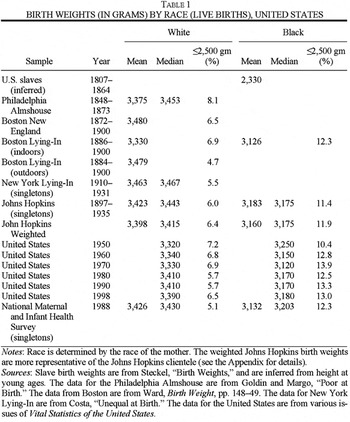
Table 1 illustrates that although the birth weights of both black and white babies born in urban hospitals in the early 1900s compare favorably to those of modern populations, the gap in black and white birth weights is persistent.40
Table 1 also includes Richard Steckel's estimate of the birth weight of slave children inferred from height at young ages (Steckel, “Birth Weights”). Note that the mean is very low, suggesting either that there was very large catch-up growth in birth weights in a short period of time, that hospital physicians attended the births of larger babies, or that slave babies were heavier at birth than Richard Steckel's estimate.
In 1950 the black-white birth weight difference was only 70 grams and black births were up to 100 grams higher than in subsequent years. Why black babies fared so much better in 1950 is unclear.
The weight of black babies was similar to that of babies born in Europe. For example, the mean weight of babies born at the Allgemeines Krankenhaus in Vienna between 1910 and 1930 was 3,143 grams (Ward, Birth Weight).

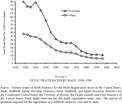
Since 1918, when data on fetal deaths by race became available for the death registration states, fetal death rates have been falling for both races, but the black rate has been roughly twice that of whites (see Figure 1).43
The period of gestation required for a stillbirth varied by year and by state so the data are not strictly comparable over time and place. However, this is unlikely to have a large effect on the time series. The NMIHS shows that most stillbirths do not occur at the very lowest gestational weeks.

FETAL DEATH RATES BY RACE, 1918–1996
Less is known about long-run racial trends in prematurity rates. In 1960, 6 percent of white births were premature (less than 37 weeks gestation) compared to 12 percent of black births. By 1998, 10 percent of white births and 17 percent of black births were premature.44
Vital Statistics of the United States, various issues.
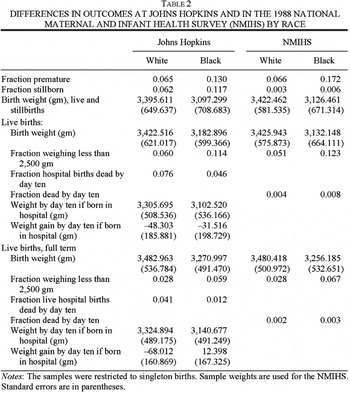
Table 2 uses the Johns Hopkins data and the 1988 NMIHS to illustrate differences in pregnancy outcomes over a span of almost 70 years. The tables show a persistent gap in black and white prematurity rates. The tables also show that intrauterine deaths are rare today, but that in the past they averaged 12 percent of all births (both live and stillborn) among blacks and 6 percent of all births among whites.45
In the Johns Hopkins records the earliest gestation for a recorded stillbirth is 17.8 weeks. In the NMIHS it is ten weeks but even if stillbirths less than 17.8 weeks are excluded from the NMIHS it does not affect the results because these stillbirths constituted less than 1 percent of the sample.
In 1922 the fetal death rate in Baltimore was 126 per 1,000 live births among blacks and 58 per 1,000 live births among whites (see the 1922 edition of Birth, Stillbirth, Infant Mortality Statistics).

Table 2 also shows that death in the first ten days of life is rare today. In the past, these early deaths were more common among whites than among blacks. Eight percent of white babies were dead by day 10 of life, compared to 5 percent of black babies. In addition, weight loss in the first ten days of life was greater among whites than among blacks. Among full-term babies, black babies gained 12.4 gm by day ten whereas white babies lost 68.0 gm.
EMPIRICAL FRAMEWORK
I examine the factors that mediate the effects of race on birth outcomes by running regressions of the form


where yi is the dependent variable, W is a dummy equal to one if the child was white, X is a vector of control variables, and u is an error term. For the Johns Hopkins sample, I estimate probit regressions where the dependent variables are indicator variables equal to one if the child was born premature, was born stillborn, or died within ten days of birth and I estimate OLS regressions where the dependent variables are equal to birth weight or weight gain during the ten days spent in the hospital.
47In the past almost all babies and mothers remained in the hospital for ten days. I cannot observe the mortality experience of babies in the Johns Hopkins sample who were not born in the hospital.
I will examine how δ, the coefficient on the white dummy, changes as I control for additional characteristics. Because the order in which additional characteristics are controlled for will determine whether controlling for one specific characteristic has a large effect, I will test for robustness by varying the order in which characteristics are controlled for. Note that this methodology, while visually appealing, assumes that the black and white birth weight production functions are the same. For the birth weight production functions I will therefore also run separate regressions for blacks and for whites and report the contribution of differences in specific characteristics to the black-white birth weight gap using the Blinder-Oaxaca decomposition.48
Thus if the equation of interest is yri = αr + δrBri + βrXri + uri where r indicates race (w = white, b = black), the contribution of differences in the variable B to the difference in the dependent variable between the two races would be δwBwi – δwBbi using the white regression and δbBwi – δbBbi using the black regression.)
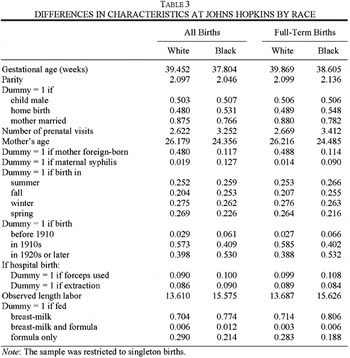
Table 3 lists the control variables in the Johns Hopkins sample used in the regressions and shows how they differ by race. Black births were of lower gestational age, were more likely to be home births, were somewhat more likely to be to unmarried mothers, were to younger mothers, and were to mothers who were more likely to have syphilis. Black mothers were in labor longer and were more likely to breast-feed their children. The higher propensity of black mothers to breast-feed their children relative to white, native-born mothers in Baltimore was noted in the Children's Bureau study of infant mortality among babies born in 1915.49
Rochester, Infant Mortality.

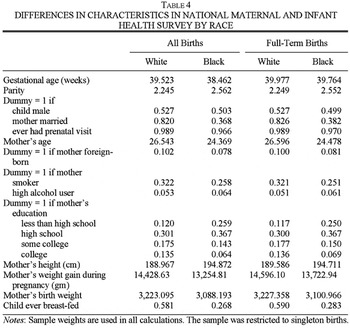
Table 4 shows how black and white mothers differ in terms of their characteristics in the 1988 NMIHS. Black mothers are of higher parity, are much less likely to be married, are younger, are less likely to be smokers, are less well-educated, are taller, gain less weight during their pregnancies, were born with a lower birth weight, and are less likely to breast-feed their children. Breast-feeding is less common among black mothers even controlling for such characteristics as education and income, suggesting that different social norms may be at work in the two groups.

The two samples show a large increase in the proportion of unmarried black mothers, mirroring the trend for the nation as a whole. Steven Ruggles reports that in 1910, 95 percent of white children and 80 percent of black children age 0–4 were living with both parents.50
Ruggles, “Origins.”
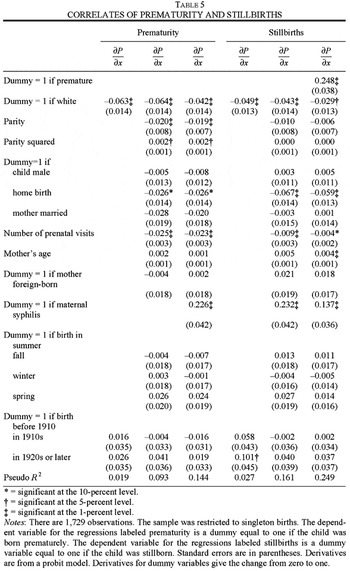
In the Johns Hopkins sample, control variables in the preterm, stillbirth, and birth weight regressions include parity, parity squared, dummy variables equal to one if the child was male, if it was a home birth, and if the mother was married, the number of prenatal visits, the mother's age, a dummy equal to one if the mother was foreign-born, a dummy equal to one if the mother had syphilis, dummies indicating whether the birth was in the summer (June-August), fall (September-November), winter (December-February), and spring (March-May), and dummies indicating the decade of birth (before 1910, in the 1910s, and in the 1920s or later). The stillbirth and birth-weight regressions also control for prematurity using a dummy variable or gestational age in weeks. Control variables in the death-by-day-ten regressions include birth weight, either a dummy variable for prematurity or gestational age in weeks, a dummy equal to one if the child was breast-fed, parity, parity squared, a dummy equal to one if the child was male, a dummy equal to one if the mother was married, the number of prenatal visits, the mother's age, dummy variables equal to one if the mother was foreign-born, if the mother had syphilis, if forceps were used, or if extraction was used, the observed length of labor in hours, seasonal dummies, and a dummy equal to one if the child was born in the 1920s or later. Control variables in the weight gain regressions include dummy variables indicating if the child was fed breast-milk only, breast-milk and formula, or formula only, gestational age in weeks, parity, parity squared, a dummy equal to one if the child was male, a dummy equal to one if the mother was married, the number of prenatal visits, the mother's age, a dummy equal to one if the mother was foreign-born, a dummy equal to one if the mother had syphilis, seasonal dummies, and a dummy equal to one if the birth was in the 1920s or later.
In the NMIHS, control variables in the prematurity regressions are parity, parity squared, dummies equal to one if the child was male or the mother was married, the mothers' age, dummies equal to one if the mother ever had a prenatal visit, was foreign-born, was a smoker, had high alcohol use (more than 8 drinks a week in the 3 months before finding out about the pregnancy), dummies for educational level (less than high school, high school, some college, and college), mother's height, and mother's birth weight. The birth weight regressions control for these factors as well as prematurity, gestational age, mother's weight gain, and mother's birth weight.
BIRTH OUTCOMES AND RACE AT JOHNS HOPKINS
Table 5 shows that maternal syphilis explains 33 percent of the difference in prematurity rates between black and white babies. Although maternal syphilis significantly predicts stillbirths, mechanically it does not explain differences in black-white stillbirth rates. However, because differences in black-white prematurity rates explain 41 percent of the difference in black-white stillbirth rates, the effects of differential syphilis rates probably operate through differential prematurity rates. No other observable factors explained differences in black-white prematurity or stillbirth rates.51
Note that maternal age is entered in linearly in the specification. A quadratic term in age was not a statistically significant predictor of either prematurity, stillbirths, or birth weight.

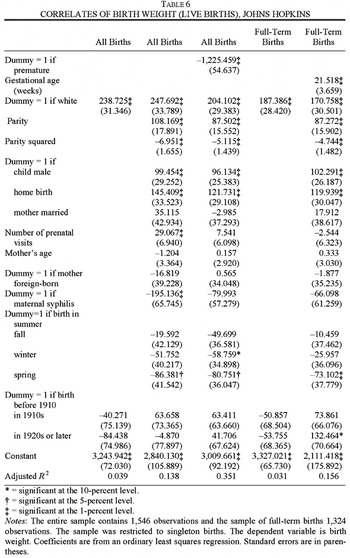
The only observable characteristic that predicted differences in black-white birth weights was prematurity or gestational age (see Table 6). For all births, black-white differences in prematurity rates explained 18 percent of the difference in birth weights controlling for all other observables. Using the Oaxaca-Blinder decomposition suggests that the impact of differences in prematurity rates was even larger, explaining 26 percent of the black-white birth weight gap using the white regression and 24 percent of the black-white birth weight gap using the black regression. Once prematurity was controlled for, maternal syphilis no longer had a statistically significant effect on birth weight, but of course, was still an important determinant of birth weight because of its effect on differential prematurity rates. For full-term births, controlling for gestational age explained 9 percent of the difference between black-white birth weights controlling for all other observables. Using the Oaxaca-Blinder decomposition shows that gestational age explains 3 percent of the black-white birth weight gap using the white function and 9 percent of the gap using the black function.

A strongly significant predictor of birth weight was season of birth (see Table 6). Babies born in the spring (March-May) weighed 73 to 81 grams less than babies born in the summer (June-August), perhaps because of the nutritional stress their mothers experienced during the winter months. A study of a rural North Carolina mill town begun in 1939 found that in spring vitamin levels were at their lowest point.52
Beardsley, History, p. 204.
Claudia Goldin and Robert Margo did not find a statistically significant effect of season of birth on birth weight in the Philadelphia Almshouse (Goldin and Margo, “Poor”). Peter Ward found that babies born in Vienna in the fall during the crisis years of 1916–1922 had higher birth weights than those born in other months (Ward, Birth Weight, p. 62). In the Johns Hopkins data the proportion of full-term births occurring in the spring was the lowest among blacks, but among whites the lowest proportion occurred in the fall. Either preferences or seasonality across occupations are potential explanations.
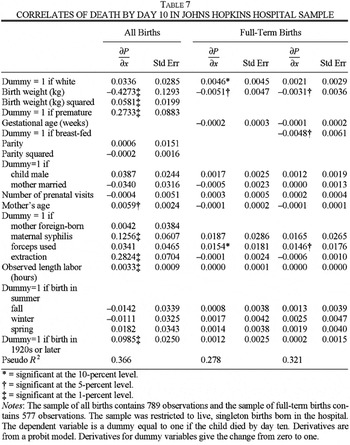
Low birth weight babies were more likely to die within ten days of birth (see Table 7). Each additional kilogram decreased the probability of death of full-term babies by 0.003, a 21 percent decrease from the baseline mortality probability of 0.010.54
This baseline probability is higher than that in the hospital birth sample as a whole because this subsample excludes observations where the type of feeding is unknown.

The relationship between birth weight and death was not linear for babies of all gestational age even though it was for full-term births. The regression results in Table 7 show that the optimal birth weight was 3,677 grams. Using dummy variables rather than a quadratic term in birth weight (not shown) reveals that compared to babies weighing over 2,500 but less than 4,500 grams, babies weighing more than 4,500 grams had a probability of dying within the first ten days of life that was greater by 0.29. Babies weighing less than 2,500 grams had a probability of death that was greater by 0.14. The use of forceps was associated with a higher risk of death of the child, raising the probability of death by 0.01. Although not using forceps may have raised the risk of death to the child by even more (and also increased the mother's risk of death), the results suggest that birth injury was an important determinant of surviving the first ten days of life, consistent with evidence from New York Lying-In and from the Philadelphia Almshouse.55
Costa, “Unequal at Birth”; and Goldin and Margo, “Poor.”
The effects of feeding practices are evident in weight gain in the first ten days of life (see Table 8). White babies gained less weight than black babies, even controlling for birth weight (not shown). But, controlling for feeding practices explains 21 percent of the difference in black-white weight gain. Babies fed only formula lost 247 grams relative to babies fed only breast-milk. Babies fed a combination of breast-milk and formula lost 130 grams relative to babies fed breast-milk only. At the beginning of the century, the prevalence of breast-feeding was falling both in the Johns Hopkins sample and in the United States as a whole, thereby leading to less weight gain among babies born in the 1920s or later relative to babies born earlier.56
Apple, Mothers and Medicine.

The data do not allow me to determine whether it was breast-feeding per se that was beneficial to children or whether breast-feeding was associated with more frequent feeding. At New York Lying-In insufficient feeding, not the type of feeding, predicted poor weight gain.57
Costa, “Unequal at Birth.”
The relatively good fortune of black babies in the first ten days of life spent in the hospital probably did not outlast their stay. The Children's Bureau study of infant mortality in Baltimore in 1915 revealed a steep gradient between infant mortality and family income, because a higher income enabled families to buy lower room congestion, sanitary equipment, and less work away from home for the pregnant mother.58
Rochester, Infant Mortality.
A relatively large proportion of the black-white gap in prematurity rates, stillbirth rates, and birth weights still remains unexplained—two-thirds of the black-white prematurity gap, 59 percent of the black-white stillbirth gap, and 91 percent of the black-white full-term birth weight gap. These differences cannot be explained by socioeconomic differentials. Using the small subsample that contains socioeconomic information shows that controlling for either father's occupational status or income does not affect differences in prematurity or stillbirth rates. Controlling for father's occupational status or income increases the unexplained birth weight advantage of full-term white babies.
BIRTH OUTCOMES AND RACE IN 1988
Recall that although the medical literature has hypothesized that factors such as maternal birth weight can explain the black-white birth weight gap, there has not been an explicit decomposition in the literature. This section calculates this decomposition to assess the importance of maternal birth weight relative to other factors. For ease of comparison, the regressions are very similar to those for the Johns Hopkins sample.
Prematurity was the most important predictor of birth weight for all births (see Table 9). Differences in prematurity rates explain roughly 32 percent of the black-white weight gap for all births. Using the Oaxaca-Blinder decomposition it accounts for 37 percent of the difference in black-white birth weights using the white function and 32 percent of the difference using the black function. For full-term births, the effects of differential gestational age are much smaller. Using the Blinder-Oaxaca decomposition I can explain 4 percent of the black-white birth weight gap using the white function and 3 percent of the gap using the black function. What in turn explains black-white differences in prematurity rates? Probit regressions (not shown) imply that differences in marital status explain 16 percent of the black-white difference in prematurity rates. Marital status could proxy for social support, life-long socio-economic status (and therefore also health), or such unobservable characteristics as the mother's health habits during pregnancy. Other observable factors have very little effect on prematurity rates.

Maternal birth weight has a statistically significant effect on the child's birth weight. An extra 100 grams in maternal birth weight increases child birth weight by 16 grams for all births and by 14 grams for full-term births. In a probit in which the dependent variable is whether the full-term child weighed less than 2,500 grams at birth, each kilogram of maternal birth weight lowers the probability of low birth weight by 0.008. In the OLS regressions racial differences in maternal birth weight explain roughly 5 percent of the difference in black-white birth weights both for all births and for full-term births. If I control for maternal birth weight prior to controlling for marital status, prematurity or gestational age, or maternal weight gain, then birth weight accounts for 8 percent of the difference in black-white birth weights. Using the Oaxaca-Blinder decomposition shows that maternal birth weight accounts for 6 percent of the black-white birth weight gap for all births using either the white or the black birth weight function. It accounts for 7 percent of the black-white birth weight gap for full-term births using the white function and 6 percent using the black function. The effects of maternal birth weight are slightly bigger than those of maternal weight gain which accounts for 4 to 6 percent of the black-white birth weight gap. Maternal birth weight was not a statistically significant predictor of prematurity.
The effect of marital status on birth weight differs by race. The coefficient on marital status in the white birth weight regression was 39.55 (

= 38.03) for all births and 74.61 (
= 37.10) for full-term births. In the black birth weight regressions the respective coefficients were −16.66 (
= 43.21) and 6.94 (
= 44.04). Controlling for income, the coefficients on marital status in the black sample are both highly negative, though insignificant. Using the Blinder-Oaxaca decomposition and the white birth weight function implies that differences in marital status explain 5 percent of the birth weight gap for all births and 14 percent of the birth weight gap for full-term births. Using the black birth weight function implies that differences in marital status explain none of the black-white birth weight gap.
Including the logarithm of total household income (not shown) can further explain the black-white birth weight difference, but the effects are small. (Controlling for income in the prematurity regressions yields a small and insignificant coefficient on income and only a very small reduction in the black-white birth prematurity gap.) For all births, the coefficient on income was insignificant (

= $19.557,
=$14.889) and reduced the coefficient on the white dummy from 165.9 to 159.1, thus suggesting that income differences explain only up to 2 percent of the black-white birth weight difference. For full-term births, the coefficient on income was statistically significant at the 10 percent level (
= $22.414,
= $13.743) and reduced the coefficient on the white dummy from 146.4 to 139.4, thus implying that income differences account for 3 percent of the black-white birth weight differential. However, there were differences in the effect of income between the white and the black sample both for all births and for full-term births. For example, for full-term births in the white sample the coefficient on the logarithm of income was a statistically insignificant 13.18 (
= $15.95), whereas in the black sample it was a statistically significant 60.23 (
= $17.30), perhaps because income matters more in a lower income sample. When I divided the black sample into high and low income samples, income was a statistically significant predictor of birth weight in the low income black sample, but not in the high income black sample. Using the Blinder-Oaxaca decomposition showed that income differentials explain 5 percent of the black-white birth weight gap for full-term births using the white function and 23 percent of the black-white birth weight gap using the black function.
The richer control variables available in the NMIHS compared to the Johns Hopkins data do not permit me to explain a greater proportion of the black-white gap in prematurity rates.59
As an additional test I included state fixed effects in the regressions. Using linear probability models for prematurity showed that the inclusion of state fixed effects left the coefficients virtually unchanged. Including state fixed effects in the birth weight regression lowered the black-white birth weight difference by about 20 grams.
Neggers et al., “Determinants.”
Goldenberg et al., “Medical.”
CONCLUSION
Black babies born under the auspices of Johns Hopkins physicians at the beginning of the twentieth century had live birth weights and prematurity rates comparable to those of black babies born today, but they fared worse than white babies. Their birth weights were lower than those of white babies in part because they were more likely to be born prematurely. Black babies were more likely than white babies to be born prematurely and to be stillborn because of high rates of untreated syphilis among their mothers. Syphilis rates may have been higher among black than white mothers not just because of lack of access to treatment, but also because more black married couples were living apart. However, even controlling for gestational age, syphilis, and other observable characteristics, black full-term babies had lower birth weights than white full-term babies. Although black babies were more likely to survive their first ten days of life within the controlled environment of Johns Hopkins Hospital than white babies because black mothers were more likely than white mothers to breast-feed, this mortality advantage probably did not last.
Did the relatively low birth weights of black babies have long-term consequences? In a recent national survey maternal birth weight accounted for 6 to 7 percent of the gap in black-white birth weights in 1988, a substantial fraction compared to other observables. Although maternal birth weight may proxy for unobserved maternal socioeconomic status or health habits, it may also be an indicator of a poor in utero environment. Ill health may thus be transmitted across generations.
The live birth weights of the children of working-class parents attended by Johns Hopkins physicians in the first third of the century, both white and black, were remarkably similar to the live birth weights of children born in the late twentieth century conditional on race. So were prematurity rates. Can we conclude that the children of the urban working class were remarkably well-nourished at birth? Yes and no. Although there is no evidence of severe nutritional deprivation, birth weights in the past may have compared favorably to those today because many low-birth-weight babies who were stillborn in the past would have survived with modern obstetrical knowledge and a modern disease environment. Stillbirth rates (and also infant mortality rates) fell sharply over the twentieth century, coincident with declines in infectious disease in the first half of the twentieth century and improvements in the technology of birth in the second half of the twentieth century. Stillbirth rates fell much more sharply among black than white mothers, suggesting that differential declines in stillbirths partially explain why the racial gap in live birth weights between black babies born under the auspices of Johns Hopkins physicians at the beginning of the century and babies observed in national samples today has remained constant. Nonetheless, the constancy in live birth weights over the twentieth century suggests that explanations for improvements in health at older ages may need to focus either on other measures of intrauterine growth retardation or on changes in the disease environment, changes that affected all age groups but that were particularly important in the first five years of life.
Appendix
The Johns Hopkins sample consists of 1,911 births, including still-births and infant deaths. The first step in the construction of the sample was the creation of indexes of births that occurred at the Johns Hopkins Hospital or through the Johns Hopkins Out-door Obstetrical Department between 1897 and 1935. Random samples of births were then drawn from the two indexes in proportion to the size of the two indexes. 1,472 hospital births and 990 out-door births were selected for a total sample size of 2,462 births. However, only 1,911 births were then found among the birth records because all births for the same mother at Johns Hopkins Hospital are filed together with that mother's last birth. Thirty-seven percent of births from the hospital sample could not be found and 2 percent of births from the home births sample could not be found. First-born children whose siblings were also born at Johns Hopkins Hospital have a lower probability of being found. Two hundred sibling birth records were also collected for mothers who delivered other children through Johns Hopkins Hospital, but these records were not used in the analysis.
Using sample weights that account for the over-representation of home births in the Johns Hopkins sample does not materially change the results. Mean birth weights are lower by only 20 to 30 grams. Table 1 presented both the unweighted and weighted results. The other tables are all unweighted.
The 1988 National Maternal and Infant Health Survey consists of separate random samples of national live births, fetal deaths, and infant deaths linked to questionnaires mailed to mothers. The response rate on questionnaires was 74 percent for live births, 69 percent for fetal deaths, and 65 percent for infant deaths. Because fetal and infant deaths are over-sampled, sample weights must be used to obtain national estimates.
I have benefited from the comments of members of the March 2003 NBER/DAE meeting and of two anonymous referees. I gratefully acknowledge the support of the Robert Wood Johnson Foundation, the Center for Advanced Study in the Behavioral Sciences, and NIH grants R01 AG19637 and P01 AG10120.
References
Apple Rima D.
1987.
Mothers and Medicine: A Social History of Infant Feeding, 1890–1950.
Madison, WI:
University of Wisconsin Press,
Barker D. J. P., Ed.
1994.
Mothers, Babies, and Disease in Later Life.
London:
British Medical Journal,
Beardsley Edward H.
1987.
A History of Neglect: Health Care for Blacks and Mill Workers in the Twentieth Century South.
Knoxville, TN:
University of Tennessee Press,
Brandt Allan M.
1987.
No Magic Bullet, A Social History of Venereal Disease in the United States Since 1880.
New York-Oxford:
Oxford University Press,
Collins William J. and Melissa A. Thomasson.
2004:
“The Declining Contribution of Socioeconomic Disparities to the Racial Gap.”
Southern Economic Journal
70, no. 4
746–76.Google Scholar
Copper Rachel L., Robert L. GoldenbergRobert K. CreasyMary B. DuBard, Richard O. Davis, Stephen S. Entman, Jay D. Iams, and Suzanne P. Cliver.
1993
“A Multicenter Study of Preterm Birth Weight and Gestational Age-Specific Neonatal Mortality.”
American Journal of Obstetrics and Gynecology
168, no. 1
78–84Google Scholar
Copper R. L., R. L. Goldenberg, M. B. Dubard, and R. O. Davis.
1994
“Risk Factors for Fetal Death in White, Black, and Hispanic Women: Collaborative Group on Preterm Birth Prevention.”
Obstetrics and Gynecology
84, no. 4
490–95Google Scholar
Costa Dora L.
1998:
“Unequal at Birth: A Long-Term Comparison of Income and Birth Weight.”
This Journal
58, no. 4
987–1009.Google Scholar
Dart Helen M.
1921.
“Maternity and Child Care in Selected Rural Areas of Mississippi.”
U.S. Department of Labor. Children's Bureau. Rural Child Welfare Series No. 5. Bureau Publication No. 88.
Washington, DC:
GPO,
Doblhammer Gabriele, and James W. Vaupel.
2001
“Lifespan Depends on Month of Birth.”
Proceedings of the National Academy of Sciences
98, no. 5
2934–39Google Scholar
Emanuel Irvin, Haroulla Filakti, Eva Alberman, and Stephen J. W. Evans.
2001
“Intergenerational Studies of Human Birth Weight from the 1958 Birth Cohort. 1. Evidence for a Multigenerational Effect.”
British Journal of Obstetrics and Gynaecology
99, no. 10
67–74Google Scholar
Emanuel Irvin, Wendy Leisenring, Michelle A. Williams, Christy Kimpo, Sharon Estee, William O'Brien, and Christiane B. Hale.
1999
“The Washington State Inter-generational Study of Birth Outcomes: Methodology and Some Comparisons of Maternal birthweight and Infant Birthweight and Gestation in Four Ethnic Groups.”
Paediatric and Perinatal Epidemiology
13, no. 3
352–71Google Scholar
Goldenberg Robert L., Suzanne P. Cliver, Francis Mulvihill, Carol A. Hickey, Howard J. Hoffman, Lorraine V. Klerman, and Marilyn J. Johnson.
1996
“Medical, Psychosocial, and Behavioral Risk Factors Do Not Explain the Increased Risk of Low Birth Weight Among Black Women.”
American Journal of Obstetrics and Gynecology
175, no. 11
1317–24Google Scholar
Goldin Claudia, and Robert A. Margo.
1989
“The Poor at Birth: Birth Weights and Infant Mortality at Philadelphia's Almshouse Hospital, 1848–1873.”
Explorations in Economic History
26, no. 3
360–79Google Scholar
Louden Irvine.
1992.
Death in Childbirth: An International Study of Maternal Care and Mortality, 1800–1950.
Oxford:
Clarendon Press,
Manton Kenneth G., and Eric Stallard.
1997.
“Health and Disability Differences Among Racial and Ethnic Groups.” In Racial and Ethnic Differences in the Health of Older Americans
edited by Linda G. Martin and Beth J. Soldo,
43–104.
Washington DC:
National Academy Press,
Morton Newton E.
1955:
“The Inheritance of Human Birth Weight.”
Annals of Human Genetics
20
125–34.Google Scholar
Neggers Y. H., R. L. Goldenberg, S. P. Cliver, and R. L. Copper.
1998:
“Determinants of Zinc Intake in Low-Income Black and White Pregnant Women.”
Biological Trace Element Research
64, no. 1–3
221–28.Google Scholar
Parran Thomas.
1937.
Shadow on the Land, Syphilis.
New York:
The American Social Hygiene Association and Reynal and Hitchcock, Inc.,
Petersson Karin, Katarina Bremme, Roger Bottinga, Alexandra Hofsjö, Ingela Hulthén-Varli, Marius Kublickas, Margareta Norman, Nikos Papadogiannakis, Kjell Wanggren, and Kerstin Wolff.
2002
“Diagnostic Evaluation of Intrauterine Fetal Deaths in Stockholm 1998–99.”
Acta obstetricia et gynecologica Scandinavica
81, no. 4
284–92Google Scholar
Preston Samuel H., and Michael Haines.
1991.
The Fatal Years: Child Mortality in Late Nineteenth-Century America.
Princeton, NJ:
Princeton University Press,
Preston Samuel H., Mark E. Hill, and Greg L. Drevenstedt.
1998
“Childhood Conditions That Predict Survival to Advanced Ages Among African-Americans.”
Social Science and Medicine
47, no. 9
231–46Google Scholar
Rochester Anna.
1923.
Infant Mortality: Results of a Field Study in Baltimore, MD. Based on Births in One Year.
U.S. Department of Labor. Children's Bureau. Bureau Publication No. 119. Washington, DC:
GPO,
Ruggles Steven.
1994
“The Origins of African-American Family Structure.”
American Sociological Review
59, no. 1
136–51Google Scholar
Sanderson Maureen, Irvin Emanuel, and Victoria L. Holt.
1995
“The Intergenerational Relationship Between Mother's Birthweight, Infant's Birthweight, and Infant Mortality in Black and White Mothers.”
Paediatric and Perinatal Epidemiology
9, no. 4
391–405Google Scholar
Smith James P., and Raynard S. Kingston.
1997.
“Race, Socioeconomic Status, and Health in Later Life.” In Racial and Ethnic Differences in the Health of Older Americans,
edited by Linda G. Martin and Beth J. Soldo,
105–62.
Washington, DC:
National Academy Press
Speert Harold.
1980.
Obstetrics and Gynecology in America, A History.
Baltimore:
Waverly Press,
Steckel Richard H.
1986
“Birth Weights and Infant Mortality among American Slaves.”
Explorations in Economic History
23, no. 2
173–98Google Scholar
Troesken Werner.
2004.
Race, Water, and Disease.
Cambridge, MA:
MIT Press,
United States Bureau of the Census.
Historical Statistics of the United States, Colonial Times to 1970.
Washington, DC:
GPO,
Vital Statistics of the United States.
Various issues.
Ward W Peter.
Birth Weight and Economic Growth: Women's Living Standards in the Industrializing West.
Chicago:
University of Chicago Press,
1993.
Woodbury Robert Morse.
“Causal Factors in Infant Mortality: A Statistical Study Based on Investigations in Eight Cities.”
U.S. Department of Labor. Children's Bureau. Bureau Publication No. 142.
Washington, DC:
GPO,
1925.
BIRTH WEIGHTS (IN GRAMS) BY RACE (LIVE BIRTHS), UNITED STATES
FETAL DEATH RATES BY RACE, 1918–1996
DIFFERENCES IN OUTCOMES AT JOHNS HOPKINS AND IN THE 1988 NATIONAL MATERNAL AND INFANT HEALTH SURVEY (NMIHS) BY RACE
DIFFERENCES IN CHARACTERISTICS AT JOHNS HOPKINS BY RACE
DIFFERENCES IN CHARACTERISTICS IN NATIONAL MATERNAL AND INFANT HEALTH SURVEY BY RACE
CORRELATES OF PREMATURITY AND STILLBIRTHS
CORRELATES OF BIRTH WEIGHT (LIVE BIRTHS), JOHNS HOPKINS
CORRELATES OF DEATH BY DAY 10 IN JOHNS HOPKINS HOSPITAL SAMPLE
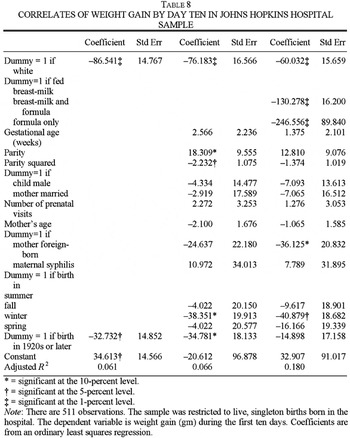
CORRELATES OF WEIGHT GAIN BY DAY TEN IN JOHNS HOPKINS HOSPITAL SAMPLE
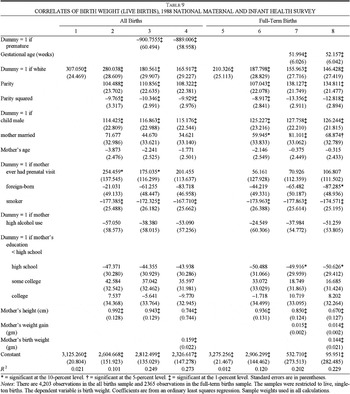
CORRELATES OF BIRTH WEIGHT (LIVE BIRTHS), 1988 NATIONAL MATERNAL AND INFANT HEALTH SURVEY
 You have
Access
- 34
- Cited by