The growth of international arbitration—from an intermittently used institution in the nineteenth century to a common institution that resolves disputes over borders, trade, finance, the environment, and other issues—is often described as one of the critical shifts that contributed to global governance.Footnote 1 For many scholars of international institutions and international law, the success and prevalence of arbitration, as well as other forms of dispute resolution, provide decisive evidence that international institutions can perform many of the judicial functions performed within states, despite the presence of international anarchy.Footnote 2
Most discussions of international arbitration take for granted that the international system is anarchic. Students of hierarchy in international politics, however, have recently begun to posit that hierarchy is much more common in international politics than many have previously supposed. The historical contexts where arbitration is prevalent may also be the moments where hierarchy matters the most. Imperial powers frequently turned to arbitration to manage dependent territories; victors in great power wars frequently performed territorial arbitration in the twentieth century; and commercial arbitration flourished in the post–Cold War international system under US leadership.Footnote 3 In these cases, arbitration appears connected to hierarchy: dominant powers may impose arbitration on subordinate states, or entice them to arbitrate disputes through institutions.
The historical record also points to empirical linkages between hierarchy and institutions of arbitration. When states attempt to build hierarchical political orders—empires, federations, or alliances with hegemonic leaders—they likely also construct judicial institutions because they need some mechanism to resolve disputes between subordinate states. Imperial states, such as the British in India, needed institutions to reduce conflict and resolve disputes among subordinates because conflict is costly and may destabilize hierarchical orders. Moreover, if subordinate states perceive these judicial institutions to be legitimate—because they provide them with benefits or reflect their ideology—then judicial institutions may reduce the costs of political rule.
Hierarchy is necessary for international arbitration, and states choose arbitration because it reduces the legitimacy costs of political rule. We test the argument by analyzing the record of arbitration in Hellenistic Greece. At first glance, this may seem an odd choice, since debates over arbitration usually focus on modern arbitration. However, this period is interesting in the development of modern international arbitration. When arbitration became institutionalized in the late nineteenth and early twentieth centuries, international lawyers looked to the Hellenistic period for precedents.Footnote 4 Hellenistic analogies were appropriate. Similar to the first half of the twentieth century, the Hellenistic period saw nearly constant warfare as several great powers fought for control of the Mediterranean and kings and empires built the largest armies and navies history had yet seen.Footnote 5 Yet, despite intense security competition, the Hellenistic period likely saw the most extensive use of arbitration in world history. The Greeks frequently turned to arbitration to settle disputes; between 338 and 90 bce, the historical record references 114 international arbitrations, making it one of the most pronounced periods of international arbitration.Footnote 6
There is a clear connection between arbitration and hierarchy in Hellenistic Greece. Between the emergence of the Macedonian Empire and Roman control of Greece, the great empire builders frequently turned to arbitration as a tool to manage subordinate cities. The existence of hierarchy in the international system during the periods in which arbitration was common may undermine the central arguments advanced by scholars of international arbitration. If the growth of arbitration is correlated with the growth of hierarchy, then a framework that treats arbitration as a tool to mitigate the effects of anarchy is untenable. This article asks whether hierarchy and institutions such as arbitration are related.
Arbitration and Hierarchy
Interstate arbitration is a means of dispute resolution where political communities voluntarily seek a judgment in a dispute from a third party. International relations (IR) scholars often describe international arbitration as a strategy states use to mitigate the effects of anarchy, and recent scholarship has focused on explaining why states use international arbitration instead of other dispute-settlement devices such as adjudication, mediation, or war. However, the empirical record of arbitration as well as the theoretical literature on hierarchy in international politics cast doubt on the notion that states are contracting under anarchy when they arbitrate their disputes.
Rationalist explanations for international arbitration posit that states use arbitration as a dispute-settlement tool to reduce the costs of reaching agreement. Arbitration can clarify disagreements in the interpretation of international rules, enabling actors to coordinate their expectations of others' conduct.Footnote 7 It can also reduce the domestic political costs of reaching an agreement by providing political cover to policy-makers.Footnote 8 International law scholars also argue that arbitration is more attractive than more stringent alternatives, such as adjudication, because arbitration resolves disputes faster.Footnote 9
Sociological explanations, in contrast, posit that states use arbitration when international norms suggest it is a more appropriate way of resolving international disputes than the use of force. Finnemore finds that the use of arbitration to collect sovereign debt is attributed to a normative shift from force to law as the appropriate means of settling conflict.Footnote 10 Similarly, Reus-Smit suggests that arbitration in the classical Greek system was rooted in Greek understandings of the state's purpose and appropriate procedures for settling disputes. Reus-Smit argues that these understandings were projected onto international politics, making arbitration possible.Footnote 11
Despite their significant differences on the logic of arbitration, these approaches agree that arbitration is a means of settling disputes in an anarchic system. Neither approach seriously questions whether the international system is anarchic during periods when arbitration flourishes. Recent scholarship on international hierarchy, however, questions the assumption that anarchy characterizes the periods described as having high levels of arbitration. IR scholars have begun to take seriously a variety of hierarchical arrangements common in international politics, especially empires.Footnote 12 The central finding in recent discussions of international hierarchy is that the international system is rarely anarchic: most states throughout most of human history have been subordinate to a few great powers, whether empires or hegemons.Footnote 13 Even states that are not formally subordinate to single powers are often subordinate to institutions or federations, which are alternative kinds of hierarchy-building projects.Footnote 14 In sum, this scholarship suggests that anarchy can no longer be treated as an assumption because it is variable and perhaps rare.
Mistakenly assuming an anarchical context for arbitration may have important consequences. The United States and Soviet Union both favored placing arbitration clauses in commercial and maritime agreements. The United States—in building a Western trading system—included dispute resolution mechanisms in agreements between Western powers, such as the General Agreement on Trades and Tariffs (GATT) in 1979. The Soviet Union—in developing economic ties between socialist states—placed arbitration clauses in economic institutions, such as the Council for Mutual Economic Assistance (CMEA). As a result, parallel arbitral institutions were created in Moscow and the West.Footnote 15 Within each hierarchical bloc, arbitrations were common; less common and much more contentious were the arbitrations between blocs where consistent conflict occurred.Footnote 16 In commercial and maritime arbitrations, for example, the Soviets and their Western counterparts frequently criticized the other's favored arbitral institutions as providing biased decisions, making arbitration difficult.Footnote 17 If arbitration was part of two parallel economic order-building projects—one Western and one Soviet—then we should expect arbitration to occur within hierarchical blocs but not between them, which is largely borne out by the historical record.
Ignoring hierarchy's effects on arbitration prevents a fuller understanding of the relationship between power and judicial politics. Not treating hierarchy as a relevant factor means missing the set of powerful political agents, such as the United States and Soviet Union, who may invest in developing institutions that promote peaceful dispute settlement. Only by identifying these pathways to arbitration can we inquire into the incentives for superordinate powers and subordinate states to create and participate in arbitral institutions. Furthermore, omitting the role of hierarchy in studies of arbitration prevents an interrogation of the relationship between political orders and judicial politics. Many IR scholars argue that anarchy is constituted by the lack of effective judicial institutions; when judicial institutions arise, the system has moved toward a hierarchical system because there are legitimate means to address grievances within the political community. The broad relationship between political order and the peaceful resolution of conflicts points to broader, important issues that are missing in an anarchy framework.
Legitimizing Hierarchy
The creation and implementation of judicial institutions may often be part of hierarchy-building projects. The creation of a hierarchical order constitutively requires the creation of judicial institutions. When some power or group of powers decides to create a hierarchical order—Macedonia after the conquest of Greece, Rome after it achieved political dominance in the Mediterranean, or the United States after 1945—it often creates a judicial system perceived as legitimate by subordinate states. These leading powers, however, have a menu of institutional devices from which to choose, and do not necessarily need to rely on arbitration to settle disputes. We present a demand-side theory of arbitration, where leading powers rely on judicial institutions that resonate with the prevailing ideology of the ruled, not the rulers, to minimize the costs of political domination.
International Judicial Politics as Hierarchy
IR scholars broadly agree that judicial politics is a constitutive feature of hierarchy. Realists often posit that judicial institutions are a feature of domestic, not international, society.Footnote 18 If the international system has judicial institutions whose decisions invoke compliance, either because those institutions have material resources for enforcement or because they are perceived to be legitimate by international society, then the system loses its anarchic character.Footnote 19 Liberal institutionalists often agree with this depiction. Milner, for example, argues that the international system is a continuum between anarchy and hierarchy: the international system approaches a hierarchical system when it contains institutions such as judicial institutions. Hurd makes a similar point from a constructivist perspective, arguing that international organizations, such as the United Nations, have achieved enough legitimacy that it makes more sense to describe the international system today as “after anarchy.”Footnote 20
These positions share the presumption that when institutionalized, peaceful means are available to resolve conflicts, one has entered a hierarchical system. In other words, if a constitutive feature of anarchy is the nonperformance of a judicial function, a constitutive feature of hierarchy is its performance. When an international judicial system provides reliable means to dispense with international disputes—and commands the legitimacy to expect its decisions will be complied with—then the system has passed from one in which security competition is the ultima ratio for resolving disputes to one in which informal or formal norms govern international relations. Hierarchy may also provide noninstitutional incentives that encourage disputants to turn to arbitration rather than force to resolve disputes. If hierarchical powers—kings or federations—have a near monopoly on the use of force, it may encourage arbitration by limiting the returns to violence when the superordinate power is committed to preserving the status quo.
In some hierarchical systems, leading states may actively create judicial institutions as part of hierarchical political order-building projects. First, creating a system for the resolution of disputes that appears “fair” to subordinate powers may make subordinate states more likely to enter the order. As Lake argues, a relational conception of authority in international politics posits that dominant states' “right to rule” depends on providing “a social contract in which the ruler provides a political order of value to the ruled, who in turn grant legitimacy to the ruler and comply with the restraints on their behavior necessary for the production of that order.”Footnote 21 Dispute settlement institutions are a useful feature of these social contracts between dominant and subordinate states. As Cox has similarly argued, a state becomes hegemonic by creating “an order which most other states … could find compatible with their interests,” rather than an exploitative order.Footnote 22 This order includes features that would also limit the hegemonic state's ability to behave capriciously. For example, the postwar, US-led international order included dispute settlement mechanisms that limited US power, making entry and compliance with US-led international organizations more likely.Footnote 23
The creation of judicial institutions within a hierarchical order may also prevent intraorder conflicts from sapping the strength of member states. Judicial institutions may reinforce a hegemon's power by ensuring that subordinate members can resolve disputes before they become violent, reducing the financial costs of rule. Otherwise, for example, Alexander the Great frequently had to divert money and soldiers from campaigns in Persia and India to address Greek quarrels.Footnote 24 Moreover, minimizing violent conflict between subordinate members could prevent states from leaving the hierarchic order, thus maintaining the stability and durability of the order. Deudney's work on the growth of US federal power shows that an important reason for crafting the federal constitution was to ensure members were afforded nonviolent means of addressing their concerns, so that exit was less likely.Footnote 25 In international politics, the development of federal institutions may play a similar role.
In other kinds of hierarchical systems, federations may encourage judicial institutions such as arbitration. Federal institutions, such as the Achaian League in the Hellenistic world, the US federal government, and perhaps some supranational European institutions today, are superordinate to state governments because they have the legitimate authority to make decisions on interstate issues. Like empire-building projects, a constitutive feature of these plans is the creation of judicial institutions that regulate conflict between members. To count as a federal state, the government typically needs judicial institutions to prevent its constitutive units from using armed force outside of the legal framework provided by the federal authorities. Thus, managing conflict between subordinate states—replacing the use of force between members with the political direction of the dominant power—is a crucial feature of most hierarchical projects.
In short, the assumption of anarchy does not help explain the emergence of arbitration if arbitration largely occurs in hierarchic contexts. Hence, our first hypothesis is the following:
H1:
The presence of a hierarchical political order—a federation, an empire, or a region with a politically dominant state—is “almost always” a necessary condition for international arbitration
We describe this as a necessary condition because if hierarchy is constitutive of judicial institutions, then we expect an instance of a judicial institution (an instance of arbitration, for example) to occur only within a hierarchic system.Footnote 26
A Demand-Side Theory of Arbitration
Showing that hierarchy is necessary for building judicial institutions does not mean arbitration will be the specific institutional form judicial politics takes. Leading states can adopt from a menu of institutional solutions, including arbitrary decisions by leading powers, adjudication by a standing court, ad hoc arbitration, trial by combat, or taking the auspices. Why rely on arbitration?
One answer to this question is that the political culture of politically dominant states explains the type of international institutions that form. An earlier generation of scholars argued that the types of international institutions created depend on the political culture of their creators. Ruggie, for example, argues that postwar multilateralism is a result of US beliefs in multilateralism. Reus-Smit argues that there is a fit between domestic political culture and international institutions, suggesting that international arbitration in the Hellenistic world was an expression of Greek norms on justice and democratic procedures.Footnote 27 We refer to these as “supply-side” political culture arguments because the political culture of the influential agents who supply the institutions is reflected in those international institutions.
Supply-side theories have two shortcomings. They cannot explain why states use different judicial instruments to rule different subordinate states.Footnote 28 Postwar US foreign policy, for example, uses multilateral instruments to resolve disputes between the United States and its Western allies, but often uses bilateral instruments with its Eastern allies.Footnote 29 Similarly, the British Empire used different strategies to rule in Australia, India, and North America. The supply-side argument cannot explain these variations in strategies because the explanatory factor—the dominant state's political culture—remains the same whereas strategies of rule vary. Second, the supply-side argument assumes a simplistic understanding of the relationship between culture and strategic action. Underlying supply-side arguments is a theory of social action that posits that agents often unreflectively deploy norms in new situations because they believe these norms to be appropriate.Footnote 30 Modern theories of social action, in contrast, often posit that agents creatively deploy cultural ideas to get what they want (for example, by using propaganda). The key insight of this literature, for our purposes, is that agents can deploy or creatively combine norms of appropriate behavior to obtain legitimacy.Footnote 31 However, to understand this process, we have to pay attention not only to action in the politically dominant state, but also to interactions between the politically dominant state and subordinate states because dominant states try to exploit political culture to their advantage.Footnote 32
A demand-side explanation is better equipped to understand variations in hierarchical rule. A demand-side explanation posits that judicial institutions will reflect the political culture of subordinate states. Scholars interested in international hierarchies often describe legitimation problems faced by politically dominant states. Leading powers often need to “legitimize” their actions in the eyes of international society.Footnote 33 Wight, for example, defines international legitimacy as “moral acceptability … to the remainder of international society,” and Reus-Smit suggests that legitimacy depends on the meanings that other actors in a society give to one's actions.Footnote 34 These problems are particularly important in hierarchical systems where legitimacy deficits can create material costs for powerful states.Footnote 35 The demand-side explanation posits that legitimacy costs lead dominant states to rely on (or manipulate) subordinate states' institutions to settle conflicts.
States may desire legitimacy in the eyes of subordinate states for several reasons: they may be concerned about political costs of breaking established norms, they may want to provide reassurances to subordinate powers that entry into a leading state's order will provide tangible benefits, or they may desire recognition by other powers as a “good” or “right” state.Footnote 36 We do not take a position on the reasons states desire legitimacy: all three are important. Regardless of the reason, leading states do not obtain legitimacy through the creation of international judicial institutions by projecting their domestic norms outward; to do so may be seen as illegitimate if their norms do not fit with subordinate states' norms or beliefs. Instead, to enhance legitimacy, we expect states to promote those judicial norms seen as legitimate by the states expected to participate in those institutions.
One advantage of the demand-side explanation is that it can explain variations in the ways a leading state rules various subordinate states: the leading state may perceive that different groups find different types of institutions legitimate. The British Empire, for example, used different systems of government within Britain proper, in its crown colonies, and in India. Unlike in the crown colonies, British imperialists often argued that British values—democracy and self-government—were inapplicable to India, which was more comfortable with a military system of governance. Reflecting what they (wrongly) believed to be the normative worldview of subordinates, they built different kinds of institutions in different regions of the world.Footnote 37 A demand-side explanation makes sense of this variation, drawing on the cultural interaction between leading and subordinate states, which is a challenge for supply-side arguments. Our second hypothesis, therefore, is the following:
H2:
Concerns about legitimacy and security costs cause hierarchical political orders to adopt dispute settlement tools that resonate with the political ideology of the “ruled.”
Arbitration in the Hellenistic Period
To test the relationship between arbitration, hierarchy, and legitimacy, we examine the record of arbitration in Hellenistic Greece. Hellenistic arbitration involved the use of a third party to make decisions in a dispute. Usually, arbitration concerned sensitive questions about borders and jurisdiction, although it also was used to resolve questions pertaining to religious issues or voting rights in intercity councils and leagues. The procedures employed to arbitrate these disputes varied. Some arbitrations were performed by a city's Assembly, where hundreds of judges would evaluate the evidence, following democratic procedures. Others involved one or more arbitration experts who would travel to an area, investigate, and then render a verdict. Many cases also saw an arbitration performed by a single person, often a king.Footnote 38
There are three reasons to focus on these Hellenistic arbitrations. First, arbitration over sensitive security matters, such as borders, likely occurred much more often during the Hellenistic period than in the modern era. Between 338 and 90 bce, the Greeks arbitrated more than one hundred disputes for which we have evidence, and likely arbitrated many more lost to the historical record. The large number of arbitrations makes studying the Hellenistic era in many senses more practical than the modern record. Second, the Hellenistic era is a paradigmatic case. When legal scholars at the beginning of the twentieth century looked for precedents for arbitration in international law, they turned to Greek cases. Were these legal scholars' intuitions—that arbitration is a strategy to mitigate the effects of anarchy—well placed, or did they understate the importance of hierarchy in promoting arbitration?
Even more important, selecting the Hellenistic case maximizes variation in the nature of political rule. Although the modern period contains a large number of arbitrations for which we have reliable information, there are fewer varieties of hierarchical arrangements. US and Soviet political dominance characterizes most of the period and most arbitration was between states under the influence of the United States. Since hierarchy is less variable, evaluating the relationship between hierarchy and arbitration is difficult.Footnote 39 Hellenistic Greece, in contrast, affords an excellent opportunity to study hierarchy. The Greek world is interesting because of the variety of hierarchic arrangements. In the period Thucydides described, for example, a maritime empire (Athens) competed against a hegemonic leader of a tightly organized alliance system (Sparta) as well as land-based empire (Persia). This world of hierarchy amidst anarchy, where hierarchical powers compete against one another, continues in the Hellenistic system. In this latter system, a variety of order-building projects—empires, federations, and military preponderances of power—were engaged in competition. This provides an ideal situation to test hierarchy's relationship to arbitration because we can ask whether arbitration took place between empires and federations, and therefore helped mitigate anarchy, or occurred only within an empire or a federation, suggesting a hierarchical logic. Moreover, the leading states often came from different cultural backgrounds (for example, Macedonia, Rome, and central Greece), providing opportunities to test norms-based arguments. Therefore, studying the Hellenistic period is helpful because there is tremendous variation in the explanatory variables.
Observing the Role of Hierarchy
We test the causal relationship between hierarchy and arbitration with our first hypothesis: international hierarchy is “almost always” a necessary condition for international arbitration. H1 is constructed as a necessary conditions test for two reasons. First, our claim is not that arbitration is likely in the hierarchical world; instead, arbitration requires hierarchy because it provides incentives for powerful states to construct institutions that encourage arbitration. Examining the correlation between arbitration and hierarchy would be inappropriate because the claim is that hierarchy is usually needed to make arbitration possible, not that it makes arbitration likely.Footnote 40 Second, a necessary conditions test is the best possible test given limits in the historical record. Correlational tests require substantial variation on the dependent variable. In our case, to test the relationship between hierarchy and different kinds of dispute settlement mechanisms requires accurate records of adjudication and mediation, as well as failed attempts at arbitration. These data are simply not available.
By “almost always” we mean that the primary causal pathways through which arbitration is generated rely on hierarchy as part of the description of the causal mechanism that produces arbitration. A probabilistic necessary conditions test acknowledges data limitations that may produce measurement error, as well as “random chance” in producing arbitrations by different causal pathways that escape the theory.Footnote 41 In one case that disconfirms our theory, for example, Akrotatos of Sparta is blown off course by a storm on his way to Syracuse, landing him in the middle of a war at an opportune time to arbitrate a dispute.Footnote 42 This episode, drawn from one sentence in a source written 250 years after the event, may be the result of either imperfect historical memory or simply a random event that allowed arbitration to occur without use of the primary causal pathways related to hierarchy. By testing necessary conditions in probabilistic terms, we can use broader patterns to determine whether hierarchy is necessary for arbitration in common causal pathways while acknowledging the possibility that storms or other acts of god exist.
H1 has two major observable implications. First, most arbitrations should occur within political orders; that is, the pairs of states arbitrating disputes should be a subset of the pairs of states comprising a single political order. Second, if hegemons or federations create institutions that include arbitration, then there is evidence for the causal connection between political order-building projects and arbitration.
Our second major empirical claim is that arbitration is used instead of other forms of dispute settlement when it resonates with the ideology of the subordinate states: concerns about legitimacy and security costs cause hierarchical political orders to adopt dispute settlement tools that resonate with the political ideology of the “ruled.” H2 has three observable implications. First, dominant states or other political authorities (for example, a federal government) should perceive that arbitration, when used, resonates with the ideology of the ruled. Second, and conversely, when dominant states or other political authorities perceive that arbitration is not ideologically salient, other dispute settlement techniques should be adopted. Finally, discussions of international arbitration in the historical record—including contemporary histories, constitutions, and records of alliances—should reflect legitimacy concerns.
We also test an alternative hypothesis, related to Reus-Smit's alternative explanation that democratic norms explain international arbitration as an example of a supply-side explanation. We concentrate on Reus-Smit's theory because it is an existing explanation of similar Greek cases.
H3 (Alternative Hypothesis):
Arbitration during the Hellenistic period was caused by Greek domestic norms—related to democracy and democratic procedures—and thus were performed democratically
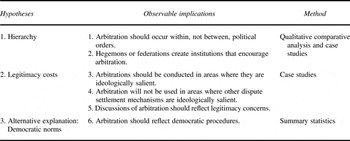
The alternative hypothesis has two observable implications. First, democratic states should be more likely than other regimes to arbitrate conflicts. Unfortunately, measurement of regime type is impossible to do reliably. Therefore, we focus on the second observable implication: Hellenistic-era arbitrations should use democratic procedures. In this context, a democratic procedure means an assembly of citizens, perhaps selected by lot, hears the dispute and renders a verdict. If a king, governor, or panel of experts hears a case, then it is not democratic, based on the Greek definition.Footnote 43 Table 1 describes these hypotheses, the observable implications, and the specific methods used to evaluate these implications.
Table of observable implications

Hellenistic Hierarchies and Arbitration
To test whether hierarchy is “almost always” a necessary condition for arbitration (H1), we turn to qualitative comparative analysis (QCA). QCA identifies set-theoretic relationships between variables to identify causal combinations of necessary and sufficient conditions.Footnote 44 If cases in which a dependent variable is present are a subset of cases where an independent variable is present, then the evidence is consistent with the claim that the independent variable is a necessary condition. For example, to identify whether a body of evidence is consistent with the claim that breathing oxygen is a necessary condition for living, one identifies whether the cases in which a person is living are a subset of cases where oxygen is available. Using QCA to test necessary conditions requires selecting cases on the dependent variable because variation on the dependent variable indicates little about necessary conditions. Finding out, for example, that people die when oxygen is present does not provide any leverage on the question of whether oxygen is necessary for life.Footnote 45 The benefit of using QCA is that it enables leverage on necessary and sufficient conditions in ways that most statistical methods do not: correlations between oxygen and breathing may be weak, but as a necessary condition it is a strong claim.
Our specific claim is that hierarchy is “almost always” necessary for arbitration. As we explained, we use this probabilistic claim because random chances may produce an outcome via unusual causal pathways that are beyond the scope of the theory. Ragin defines the term “almost always” as a case where a necessary or sufficient condition is present in 80 percent of cases. In contrast, “usually” means 65 percent of cases.Footnote 46 The term “almost always” is arbitrary—one might assign different linguistic qualifiers to 80 percent of cases—but we rely on Ragin's terms rather than inventing our own because it makes the results more easily interpretable. We then assess these proportions for statistical significance using a binomial probability test to determine whether we can be confident that the sample of cases is likely to be higher than the 80 percent threshold by chance.Footnote 47
We assembled a data set using Ager's Interstate Arbitrations in the Greek World, 337–90 BC. Ager's compilation includes 171 cases, of which 128 refer to arbitration. Of these 128 cases, fourteen are instances where arbitration is discussed but not performed or left unfinished. We coded the remaining 114 cases to determine whether hierarchy was present. Of these 114 cases, there are eighty-six with sufficient evidence to test the relationship between hierarchy and arbitration, and 104 cases to test the relationship between democracy and arbitration. To count as hierarchical, two states must either be members of the same federation or participate in the same hegemonic order. Using set-theoretic syntax, this is described as H = HP ∪ FM, or in more plain terms, a case is coded as hierarchic if two or more states have either shared federation membership or hegemonic presence.
Shared federation membership means the two parties to a dispute belonged to the same federation or league, such as the Achaian League. These federations are instances of hierarchy because states subordinate to the federation often forgo control over their foreign affairs, and in some cases even their domestic affairs, to a central authority. By hegemonic presence, we mean disputant states' foreign policies were effectively controlled by a foreign power, such as when a city was a subordinate part of a kingdom or empire, garrisoned or occupied, was decisively defeated in a major war, or forced to enter a military alliance in which its forces were held hostage.Footnote 48 This definition, drawn from Doyle's Empires, is consistent with the literature in political science on hegemony, but risks confusion for classicists because the ancient meaning of hegemony was more specific. To be clear, we use the term “hegemonic presence” to mean that disputants had little to no independent foreign policy.Footnote 49
In coding for hegemonic presence, we adopted two coding rules that bias the data against our hypotheses. First, there are several references to instances where a single hegemonic party performed several arbitrations. We code these as a single case, in part because we are unsure how many separate arbitrations were performed. Moreover, we code a case as an instance of hegemonic presence only when the balance of evidence or judgment of classicists point to hegemonic presence. This significantly biases the data against our hypotheses because it can only understate the number of cases consistent with H1. This is more concretely explained later in the discussion of the timing of the Roman empire.
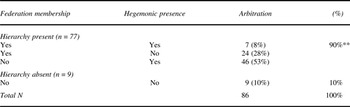
Using QCA to test necessary conditions, one identifies whether the set of cases with an outcome is a subset of the set of cases in which the hypothesized necessary condition is present. Here, we are interested in whether dyads that arbitrate disputes in a year are a subset of dyads in shared hierarchical political orders in a year. Expressed in set-theoretic notation, this implies A ⊆ H, where H = HP ∪ FM.Footnote 50 Table 2 displays these results.
Test of hierarchy as a necessary condition for arbitration

Notes: Percentages are rounded to the nearest whole percent. Significance tested using the binomial test and a probabilistic benchmark of .80, that is, the causal condition is “almost always” observed. When interpreting these results, note that the test of significance in this context means whether the outcome is likely to be higher than the benchmark by chance (that is, comparing 90 percent with 80 percent). Statistical significance: ** for p < .01.
These results show that 90 percent of the cases of arbitration displayed the presence of hierarchy, making hierarchy “almost always” necessary for arbitration (seventy-seven of eighty-six cases). Conversely, in only nine of the eighty-six coded cases is there any evidence of arbitration in an anarchic dyad. Thus, our data challenge the conventional notion that anarchy characterizes international politics when states arbitrate their disputes. Instead, this is strong support for our argument that a hierarchical order is necessary for international arbitration to take place.
There are several limitations to QCA for our purposes. First, the unevenness of data collected from such a remote period may make inference from association problematic, especially given limited evidence related to other variables of interest. Furthermore, the causal processes through which hierarchy produces arbitration are difficult to discern using QCA. A fuller description of the cases, therefore, is necessary to understand the mechanisms and to ensure that the relationship is not spurious. The QCA-based evidence, however, demonstrates that the best evidence, on a conservative test, is consistent with the claim that hierarchy is almost always a necessary condition for arbitration.
Three Case Studies of Empire and Arbitration in the Greek World
This section presents case studies of three types of hierarchical political orders: the Macedonian Kingdom and its successors, Greek federations, and Roman hegemony. In discussing each, we first describe the political relationship between superordinate and subordinate powers, then show the causal connection between hierarchy and arbitration (H1), and describe how arbitration reduced the legitimacy costs for superordinate powers (H2).
Phillip and Alexander as Arbiters
The formation of the Macedonian empire has strong connections to the Greek practice of arbitration. Beginning around 356 bce, Phillip used internecine Greek quarrels to extend his influence down the Greek coast in the Third Sacred War, and after his victory in 338 bce at the Battle of Chaeronea, he obtained hegemony over Athens and Thebes.Footnote 51 In the aftermath of the battle, Philip created the League of Corinth, which included most Greek city-states. After conquering Greece, Philip, and later his son Alexander the Great, intended to move east against Persia. To do so, they needed to reduce the risk of revolt in Greece.
Under Philip's and Alexander's empires, there is evidence for a causal connection between hierarchy and arbitration. We found four recorded cases of arbitration under cities controlled by Philip and Alexander, and no arbitrations performed between Alexander and his rivals (Observable Implication 1).Footnote 52 One reason for intra-empire arbitration was the institutional structure of the empire in Greece. The League of corinth banned war and revolution among its members and placed financial, judicial, and military matters to majority vote. The institutional structure of this alliance included a council as well as a hegemon, the latter spot falling to Philip and then to Alexander.Footnote 53 The League—as the institutional expression of Macedonian hegemony—included provisions for arbitration to ensure that Greece remained stable while Philip (and later Alexander) planned to expand to the east. For example, the League requested that Argos arbitrate a dispute between Kimolos and Melos when all three were under the thumb of Macedonia.Footnote 54 The dominant power, therefore, created the institutional structure that enabled arbitration (Observable Implication 2).
Philip and Alexander sought to use ideological appeals, citing Greek ideals of “freedom and unity” and Pan-Hellenism, to legitimize Macedonian rule through the League. Traditionally, many great Greek cities accrued power by forming federations with cities and villages under their control. Thebes, in particular, used the Boiotian League—a collection of nearby cities and villages—to enhance its military power. Under the banner of “freedom” and “autonomy,” Philip reduced the power of these cities by separating smaller powers from great powers, providing for the former's freedom and autonomy.Footnote 55 Philip's policy of breaking up concentrations of power, legitimized by the rhetoric of “freedom and autonomy,” ensured that “the Greeks had no choice but to accept that they were now living under Macedonian hegemony.”Footnote 56 In addition to freedom and autonomy, Greek political tradition held the importance of Greek unity, positing that Greek disunity created the conditions under which the barbarians (the Persians) were able to invade.
Philip and Alexander may have turned to international arbitration as a means of legitimizing empire in the Greek world, although the evidence is thin. Arbitration as an expression of Greek unity may have played a key part in these ideological appeals. The Macedonians used arbitration where it fit their subjects' political culture; and they used legitimizing rhetoric (freedom, autonomy, and pan-Hellenism) to support and justify the institution (Observable Implications 3 and 5). In contrast, Alexander did not use arbitration in Persia. There, he adapted local techniques of rule to legitimize his power: Alexander maintained the satrapy system, adopted the Persian royal color of purple, and even made his Macedonia troops pay obeisance (bow).Footnote 57 Whereas Alexander used arbitration in Greece, the historical record shows he relied on different institutional devices in the Persian territories (Observable Implication 4). There is, however, no direct evidence of Alexander's or Phillip's rhetoric related to arbitration to show this connection more directly.
The Successors' Arbitrations
After Alexander's death in 323 bce, the Macedonians carved the empire into pieces to create seats of power for several of his former military commanders and advisers. Over the next decades, these successors fought against each other to control Alexander's empire. During this forty-year conflict, his successors competed for control over cities in Greece and Asia Minor, often relying on ideological devices to encourage cities to revolt against an enemy. This period is especially interesting because, after Alexander, more arbitrations occurred in a short period of time than in the preceding several centuries.
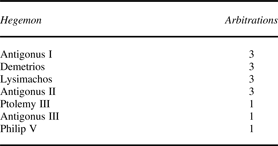
The historical record shows a clear relationship between hierarchical powers and arbitration: many of the arbitrations were performed directly by imperial powers. Table 3 shows a significant number of arbitrations were directly arbitrated by a successor.
Arbitrations under the successors

The involvement of successors in international arbitration bears out the connection between hierarchy and arbitration because successors largely made decisions concerning cities they dominated. Conversely, arbitration between cities ruled by different hegemons was rare, and when it did occur, it usually failed. Between 323 and 250 bce there are no cases where successors were able to arbitrate their disputes. Moreover, three attempts by one powerful party to arbitrate for others' cities were rejected (Observable Implication 1).Footnote 58 We also find significant evidence that the successors incorporated arbitration into the international institutions. Demetrius, for example, included arbitration as a provision in the constitution for the Hellenic League, the league of cities within Greece who were to rebel and fight Cassander (Observable Implication 2).Footnote 59
During this period, there is substantial evidence that legitimacy concerns drove the successors' use of arbitration. First, the Hellenistic monarchs may have tried to enhance their reputations by acting as arbiters. The Hellenistic monarchs—who dedicated most of their time to high politics and war—were unlikely to spend much time judging questions about maiden tributes or religious land disputes; yet Antigonus I and Lysimachus, two especially brutal rulers, spent time on these minor issues.Footnote 60 In making their decisions, the surviving evidence suggests the successors strove to show that their decisions were in keeping with the Greek understanding of freedom and autonomy. In a letter to Teos and Lebedos—two cities Antigonus I unified in an arbitration—Antigonus wrote that his verdict was advisory, disinterested, and did not interfere with their internal laws.Footnote 61 More often, cities under the control of a single monarch litigated their disputes, sometimes with the monarch appointing a third party to render a verdict. This prevented conflicts that might have cost the monarch soldiers and taxes if the cities engaged in costly fighting, while preserving some measure of freedom and autonomy. Third, arbitration may have been a tool to make self-interested decisions appear neutral. Lysimachus, for example, had a strategic interest in Samothrace (it had religious and therefore ideological significance): it is thus no surprise that Lysimachus personally arbitrated a dispute favorably for the city.Footnote 62 In each case, successors either promised disputes would be settled by arbitration to draw a favorable contrast with other successors, or they sought to use arbitration to legitimize unpopular political decisions.
Greek Federations
One interesting element of Greek international society is the prevalence of international federations. Greek federal states are common in Greek history, with recorded instances dating from the earliest recorded periods. Federations played a critical role in Greek life by allowing small cities and villages to grow, creating common military strength and securing economic rights and privileges for citizens of the federal state. By the Hellenistic period, Greek federal states—the Achaian League and the Aitolian League in particular—became major players in international politics.Footnote 63 The growth of Greek federal states in part explains Hellenistic arbitration. Federal states relied on arbitration as a constitutive rule for the federal state. The institution of arbitration provided one practice that made a federal state a federal state, that is, it provided a peaceful means to settle conflict within a hierarchical order.
A federal state governs by dividing responsibility between federal and local groups.Footnote 64 In the Greek experience, following Larsen, we count a political order as a federation if there is an explicit agreement by cities to provide rights and responsibilities to its members beyond those required by symmachies,Footnote 65 which were military organizations that could collect tribute, conscript soldiers, and levy war. The symmachy most likely to be familiar to IR scholars is the Peloponnesian League, led by Sparta in the Peloponnesian War.Footnote 66 Federal states, in contrast, were organizations whose collective decision making extended beyond military matters to include political and economic institutions.Footnote 67
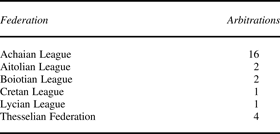
Federal states had an impressive role in international arbitration. Table 4 describes Hellenistic federal arbitrations.
Arbitrations between two or more members of federal states

Note: In our data set, we also include federal arbitration regarding voting rights within federal religious organizations, such as the Ionian League or the Delphic Amphiktyony.
Arbitration within federations was common, but arbitration between federations and other powers was not. The Aitolian League, for example, called for Antiochus to arbitrate a conflict between Aitolia and Rome. Rome rejected the offer.Footnote 68 Similarly, Rome offered to help Philip of Macedon arbitrate his disputes with the Greeks under threat of war. Philip rejected the offer, preferring war over a biased arbitration.Footnote 69 In other words, when third parties offered international arbitration to resolve disputes between federal states and their rivals, it usually failed (Observable Implication 1). Arbitration usually occurred within hierarchical political orders, not between them.
The institutional connection between federal states and judicial institutions is more direct than in empires. Greek federal states had two relevant institutional features. First, federal states often had a centralized military, including a unified commander (the strategos), a single army, and a decision-making body that could authorize the deployment of forces. Second, Greek federal states usually had a judicial system.Footnote 70 The Boiotian League, for example, had a federal judicial system for trying breaches of federal law; the Lycian League had a robust federal court system that it used to call for and help administer arbitrations.Footnote 71 International arbitrations were part of the federal states' judicial systems. To join the league, cities likely pledged to resolve their differences with other league members through arbitration because recourse to military force was not an option.Footnote 72 The federal government itself had an important role: it often called for arbitration, selected the city to arbitrate, and even appointed specific individuals as arbiters in a few cases.Footnote 73 The institutional arrangements that created hierarchical power included arbitration as a judicial tool (Observable Implication 2).
The Rise of Rome
When Rome entered the Greek east, it became embroiled in the Greek institution of arbitration. Rome is a special case because it did not share the Greeks' political culture; in general, Romans found arbitration tiring and cumbersome. As Gruen explains, “the concept was virtually unknown” in Rome until after its involvement in Greece, and even then, the “patres adjudicated with reluctance, made half-hearted gestures, endorsed Greek rulings, and referred matters to Greek Tribunals.”Footnote 74 Yet, during the century after Rome entered Greece, arbitration flourished.
To draw a causal link between arbitration and hierarchy, one needs a reliable measure of the extent of Roman hierarchy in Greece. One difficulty for historians of the period is identifying the timing and extent of Roman influence. The historical questions crucial to our argument are whether Greece was free during this period, and the precise date Greek freedom ended.Footnote 75 At one end of the spectrum is the position that Rome sought and easily obtained political dominion over Greece at an early period. This position—perhaps most forcefully articulated by Harris—posits that Roman domination began early and continued uninterrupted.Footnote 76 This view makes the historical record of arbitrations perfectly consistent with our argument because arbitration occurred after Rome entered the Greek east and established an empire. At the other end of the spectrum is the opinion of Gruen, who argues that Rome sought little influence in Greece. With the exception of brief periods—shortly after wars against Rome's rivals in the region—Gruen suggests Rome did not want to build an empire and tried to reduce its commitments. In Gruen's words, “Roman attention to the East was fragmentary, intermittent, and rarely intense—concentrated short bursts of activity rather than continuous vigilance.”Footnote 77
We analyze Gruen's account because it biases the historical record against our argument. If Roman hegemony was limited to short, intense bursts, then how did Roman attempts to build hierarchy influence arbitration? This interpretation of Greece as mostly free of Roman influence—which should be hard for our argument—actually supports our claim because there is a strong coincidence in timing between these “short bursts” of Roman political influence and bursts of international arbitration. After several conflicts—in particular, after wars against Macedonia, Antiochus, and Achaia—Rome sought to use international arbitration as a tool to reorganize the Greek world in a way that was ideologically appealing to the Greeks.
Four great power wars led to steadily increasing Roman involvement in Greece. Before 205 bce, Rome did not have a hierarchical position over the Greek states.Footnote 78 The first great power conflict that saw Rome enter Greece—the First Macedonian War (214–205 bce)—ended in a stalemate, which was reflected in the peace conference in Phoenice: the settlement granted both sides gains in Illyria.Footnote 79 If Rome were not hegemonic, we expect there should be no successful arbitrations between Rome and the Greeks, nor arbitrations performed by Rome among the Greeks during this period. The evidence bears this out. Rome did not attempt to arbitrate any disputes in the Greek world during this period. Moreover, the Greeks were never able to secure Rome as an arbiter of their conflicts.Footnote 80 Without hierarchy—a necessary condition for most pathways to arbitration—arbitration was difficult.
The first period of brief Roman hierarchy in Greece, according to Gruen's account, occurred after the Second Macedonian War (200–197 bce).Footnote 81 Unlike the first war, Rome decisively won the second war. Not only was Rome the strongest military power in Greece, it also occupied Chalcis, Corinth, and Demetrius, strategic cities so important that they were known as “the fetters of Greece.”Footnote 82 The Roman victory over Macedon meant the Roman representative—Flamininus—was in a strong position to dictate the terms of the peace settlement. At the peace conference to end the war, Flamininus made decisions about whether to depose Philip, how to divide parts of Macedonian territory taken in the war, and which of his allies' claims to support.Footnote 83 Rome's allies and enemies had limited capacity to make foreign policy decisions because of Rome's dominant position.
We expect that the Roman hierarchical position after the Second Macedonian War made arbitration possible. Before the war ended, arbitration failed. In 198 bce—at the Aous conference—Flamininus agreed to end the war if Philip would arbitrate his disputes with his enemies. Philip refused, ending the conference.Footnote 84 Arbitration failed, therefore, when hegemony was not present. After Rome established its dominance, arbitration succeeded. In 196 bce—after the Roman victory—Flamininus again demanded that Philip arbitrate his disputes. With Rome politically and militarily dominant, Philip complied. In 196 bce, the Roman Senate and Flamininus arbitrated disputes between Philip and Rome's allies.Footnote 85
The decade of the 190s bce saw two additional periods where Roman political hegemony corresponded to spurts of international arbitration. Rome maintained troops in Greece until concluding a second war against Sparta, led by Nabis and Antiochus III.Footnote 86 The resulting Peace of Apameia (188 bce) strongly favored Rome. This period of Roman hierarchy saw substantial interstate arbitration. Within Greece, Rome itself helped settle disputes between Amphissa, Delphi, Myania, and Antikyra (190 bce), and likely was called on by Larisa to arbitrate a dispute with Pteleion.Footnote 87 Arbitrations were also carried out by states and federations either created or supported by Rome, such as the boundary dispute adjudicated by the Thessalian League sometime after 196 bce.Footnote 88 In Greek areas of Asia Minor, Rome—through another commission and another proconsul—conducted arbitrations involving Samos and Priene, Chios, Smyrna, Eythrai, Miletos, Phokaia, Mylasa, and Stratonikeia.Footnote 89 In addition, Rome began to arbitrate between stronger powers, such as Rhodes and Lycia.Footnote 90
The final conflict, which saw the Roman Empire enter Greece and finally not leave, in Gruen's account, was the Achaian War (146 bce). The war—caused by a rebellion of the Achaian League, Rome's former ally—ended with a decisive Roman victory and acquisition of the region. The postwar settlement saw a superordinate Rome arbitrate disputes between subordinates, such as Sparta and Messene, and Rome may have had a hand in pushing for arbitrations between Hermione and Troizen, and between Argos and Leonai.Footnote 91 For the next fifty years, as Roman power grew, Roman use of international arbitration also grew. Between 140 and 90 bce, Rome had a hand in at least ten cases of international arbitration. In fact, nearly every case of international arbitration was referred to Rome or one of its close allies (for example, Pergamum), at least the successful arbitrations for which we have sufficient evidence to make sense of the case. Even using the most conservative account of Roman influence in Greece, we find a strong relationship between periods of Roman political hegemony—especially in the wake of great power wars—and the use of international arbitration.
Why did Rome choose to use international arbitration? Despite interpretive differences in responding to this question, there is some crucial evidence for the demand-side account. First, arbitration was clearly a Greek, not a Roman, institution. The Greeks persistently applied to Rome for arbitration and usually delegated cases to Greek institutions, such as the Achaian League.Footnote 92 Rome promoted arbitration because it knew the Greeks viewed arbitration as legitimate (Observable Implication 3). Moreover, Rome did not engage in arbitration in western areas of the empire, such as Spain. This implies that an innate efficiency did not drive arbitration: arbitration occurred because the Greeks clamored for it (Observable Implication 4).
Despite evidence consistent with the demand-side explanation for the choice of arbitration, there are difficulties because the evidence is thin. In general, some classicists believe the Roman Senate did not usually use arbitration to enhance the legitimacy of hierarchy, because Rome ruled Greece only intermittently, during the periods we highlighted. Because we adopted this conservative account of Roman influence in Greece, the crucial question is whether Rome chose to use arbitration to legitimize potentially unpopular decisions during periods that all agree exhibit signs of Roman dominance, such as Flamininus's arbitrations after the Second Macedonian War. These periods were clear instances of hierarchy, with Rome unilaterally making decisions about borders and cities' internal affairs. Eckstein, writing about the arbitrations in 195–194 bce, explains that “Flamininus was reordering the internal affairs and governments of these states, supporting some men over others, to suit his own personal ideas about what constituted pro-Roman stability.”Footnote 93 In Thessaly, for example, Flamininus created a federation, reorganized its political institutions, chose the members of its council, and selected the first federal magistrates.Footnote 94 The most likely explanation for the use of arbitration is that Flamininus wanted the rulings to stick; he therefore couched them in arbitration rather than imperial decree (effectively there is little difference) to make the settlements legitimate and popular. Using the most conservative account of Roman influence, we find that Romans in the field—those entrusted with ensuring that settlements reflected Roman interests—may have used arbitration to legitimize hierarchy even if the Senate was reluctant to employ the institution.
Democracy and Arbitration
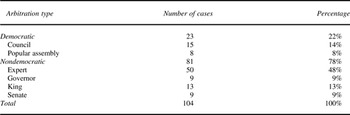
The alternative hypothesis is that democratic norms explain patterns of arbitration in the Greek world. We coded the type of arbitration to indicate the kind of arbitration procedure used, from which we inferred whether the arbitration reflected democratic norms. Cases arbitrated by a large assembly or by a council body (for example, the Delphic Amphiktyony) were coded as democratic. We coded adjudications by international councils as examples of democratic arbitration because these councils may include a large number of voters, although this does not conform to the normal sense of Greek democracy. By counting council arbitrations as a type of democratic arbitration, our coding is biased in favor of Reus-Smit's argument. Nondemocratic arbitrations were those arbitrated by kings or small numbers of appointed expert judges.Footnote 95 A more robust test of the democratic norms hypothesis would include data on the regime type of each disputant, but data on this were too sparse to be empirically useful. Table 5 displays a summary of arbitration, sorted by the kind of arbitration procedure used.
Types of arbitration

Using even our generous coding scheme, only twenty-three out of 104 cases of arbitration were conducted using democratic procedures. A more conservative coding scheme, which treated only popular assemblies as examples of democratic arbitrations, would find only 8 percent of cases to be democratic. Therefore, in the Hellenistic period, we find little support for Reus-Smit's claim that arbitration was an outward projection of democratic norms, because most arbitrations were not conducted democratically.Footnote 96
Arbitration in the Modern World
Contemporary studies of international arbitration usually ignore the role of hierarchy in international politics. Students of arbitration often focus on arbitrations such as Alabama Claims (1871), where the United States and Britain arbitrated a dispute instead of turning to force in an anarchic setting. The study of the Hellenistic world, however, suggests that roads to arbitration such as Alabama Claims may be more unusual than modern IR scholarship suggests. We argue that evidence from the Hellenistic world suggests the role of hierarchy must be taken seriously.
Modern territorial arbitrations—the cases that bear the closest resemblance to Hellenistic cases—show clear stamps of hierarchy. Allee and Huth identify thirty cases where states sought legal resolution of territorial conflicts between 1919 and 1995.Footnote 97 The first eight cases, which closely resemble Roman postwar arbitrations, involved the victorious powers in World War I arbitrating disputes that arose from the breakup of the Russian and Ottoman Empires. These postwar cases, where the politically powerful arbitrate over the war's losers, are common. About 20 percent of arbitration cases listed by Stuyt in his Survey of International Arbitrations, 1794–1989 relate to claims originating in World War II (for example, reparations for damages).Footnote 98 These are straightforward expressions of a form of hierarchy, where winners use arbitration to extract concessions from the weak.
Several other cases described by Allee and Huth show a role for hierarchy. The United States, for example, arbitrated a dispute between Guatemala and Honduras in 1933. Both states have often been described as part of the US Latin American “empire.” In 1933 Guatemala's president had recently been installed with US support and had selected a US officer to lead its armed forces; Honduras had long been under US influence, had dollarized its economy, and was the paradigmatic example of a “banana republic.”Footnote 99 Cases excluded from their discussion also support the connection between hierarchy and arbitration. After the Munich Agreement between Germany and Great Britain in 1938, for example, Germany and Italy arbitrated disputes between Czechoslovakia and Hungary, and between Czechoslovakia and Romania. The First and Second Vienna Awards, framed as international arbitration by the axis powers, were attempts to build a German-led hierarchical order and alliance system in Europe.Footnote 100
Arbitration related to economic matters, broadly conceived, tracks the same pattern of hierarchy, legitimacy, and arbitration. Finnemore's seminal work on sovereign debt collection shows that the United States was instrumental in supporting the growth of arbitration over debt issues in the early twentieth century.Footnote 101 Although Finnemore assumes an anarchical context, the backdrop to the history of sovereign debt arbitrations confirms the role of hierarchy. From the Spanish-American War until 1914, the United States built a hierarchical international order in Latin America, aiding friendly regimes and undermining independent states.Footnote 102 The decision to promote arbitration during a period of hierarchy building was connected to concerns about the legitimacy of the hegemon. International arbitration had resonance in Latin America because important figures, such as Simon Bolivar, had promoted the practice as the appropriate means to solve disputes as early as 1818, and arbitration was frequently cited as an ideal for regional unity. American lobbyists interested in maximizing US economic dominance cited the salience of arbitration in Latin America as a way to enhance the legitimacy of US power. Coates describes how influential lobbyists “emphasized the nations' common republican roots, and praised their work on behalf of arbitration.” William Curtis, an influential figure who was the “marketing agent” for Pan-Americanism, painted this connection in clear terms: “Americans—North and South—were inherently peaceful, he implied. Hence, while the United States must inevitably come to ‘dominate the hemisphere,’ it would do so as the ‘mother of republics.’”Footnote 103 When Elihu Root became President Theodore Roosevelt's secretary of state in 1905, he knew he needed to balance US financial interests against the costs of intervention. Arbitration enabled him to do so because it provided a means to remove decision making from Latin American states without the use of military force.Footnote 104
The connection between institutionalized dispute settlement procedures and hierarchy continued into the Cold War. Earlier we discussed how the United States and the Soviet Union used arbitration, through the GATT and the CMEA, to make their economic systems more attractive as part of their ideological competition. The empirical record of arbitration supports the notion that these institutions mattered. Disputants before the International Chamber of Commerce and the London Court of International Arbitration were largely from the United States and Europe.Footnote 105
Moreover, an examination of imperial histories lends support to our argument that local norms of the ruled subjects shape the judicial institutions that hierarchical powers create to legitimize their rule.Footnote 106 In Africa, colonial bureaucracies preserved or incorporated to various degrees local traditions and institutions into their judicial apparatus.Footnote 107 Compared with the French and Portuguese, the British in particular relied on indigenous authorities and institutions in their indirect rule over African colonies, developing a colonial legal system in which they appointed Africans to adjudicate disputes between Africans. Where traditional leaders and a body of local law already existed, this practice worked well for facilitating Britain's policy of indirect rule, for instance in Northern Nigeria.Footnote 108 British colonial bureaucracies were constrained by “the need to impose hegemony at little or no cost to the British taxpayer” and thus tailored judicial administration to local norms.Footnote 109 Similarly, US rule in the Philippines took into account the customary law of indigenous populations in some areas, as well as Islamic law in Mindanao. As a US judge who served in the Philippines in 1905 noted, this mixing of local legal tradition with European law was conducive to “a spirit of mutual helpfulness and to mutual concessions, which make the work of administering the law far easier and more agreeable.”Footnote 110
In sum, a brief examination of the more recent record on arbitration and dispute settlement lends support to the role of hierarchy. As in the Hellenistic world, this is a probabilistic claim: there may be other pathways to arbitration in exceptional cases. The notion, however, that arbitration occurs in an anarchical context, which modern scholarship often assumes, needs careful reconsideration because there are clear fingerprints from powerful states left in the historical record.
Conclusion
Patterns of arbitration in the Hellenistic world lead to two broad conclusions. First, the practice of international arbitration is strongly linked to the presence of hierarchy. The presence of empires, such as Alexander or the Romans, makes arbitration possible because they limit the benefits of force and have incentives to peacefully resolve conflict. In a similar way, federations, where states hand control over their military to a central power, make arbitration possible by dissolving military options and creating constitutional arrangements that institutionalize the use of arbitration. Second, the choice of arbitration instead of other methods of dispute settlement depends on whether arbitration fits within the broader ideological context of the ruled.
These findings reveal important limitations in contemporary scholarship. Most studies of the intersection between power and international law concentrate on how power may bias specific legal decisions. Debates about the European Court of Justice or the European Court of Human Rights, for example, often hinge on whether powerful states can obtain biased rules or rulings by influencing the court or selecting judges likely to favor a state's interests.Footnote 111 Others ask whether the powerful comply with agreements that may not serve their interests, or whether the powerful use their positions to create institutions or deals that favor themselves.Footnote 112 This way of framing the relationship between law and power asks which matters more, impartial law or partial power. In asking these questions, international law scholarship often focuses on the relative power of disputants or the nationality of judges, presuming that the story of power in international law is about how parties directly influence a judgment or compliance.
The study of the Hellenistic world, however, shows that power may matter greatly, albeit in an indirect way. Recall that hierarchical political powers, such as Rome and Macedonia, encouraged the development of relatively independent arbitral boards to decide disputes in cases in which they did not want to make decisions that may have been unpopular or costly to enforce. Power, in these cases, matters because the hierarchical power creates the framework in which parties may seek impartial judicial settlement of disputes. This means that when looking for the role of power in international law, one should look behind the scenes to those who create and foster law rather than simply focusing on the relative power of those involved in specific disputes.
This insight on power and hierarchy can broaden our understanding of cooperation in IR. Often, political scientists treat centralized state-based cooperation and decentralized voluntary cooperation as mutually exclusive outcomes.Footnote 113 This perspective, however, limits the domain of potential governance solutions to cooperation problems. As Ostrom reminds us, many of the most effective systems of cooperation are polycentric, meaning that they mix government with local, voluntary institutions, such as arbitration. A state may have indirect effects on the probability of successful nonstate arbitration by helping to create institutions, increasing the costs of violence, and enabling the regularized interaction of individuals within political and economic organizations. Voluntary arbitral institutions, therefore, heavily depend on state power to create the context in which they can be successful.Footnote 114 In the same way, some impartial international legal institutions may make sense only when hierarchy is present, barring effective opportunities for war, and making legal institutions successful. In the Hellenistic world, hierarchical powers often did not play a direct role as disputant or judge; therefore, focusing on the relative power of parties in a dispute misses the more fundamental role that power plays. In the modern world, it is worth exploring whether hierarchy has the same indirect effects on the emergence of international legal projects.
Moreover, understanding the connection between hierarchy and international arbitration may contribute to our understanding of the nature of US power today. Scholars, commentators, and even US politicians are increasingly looking to past imperial legacies to understand and describe the contemporary nature of US power, often describing the United States as an informal economic empire, if not a “superempire.”Footnote 115 So far, this debate has neglected the relationship between hierarchy and judicial politics. This is a problematic omission because judicial politics are constitutive of hierarchy. When powerful leading states rule over nominally independent subordinate states, judicial institutions are necessary to resolve disputes between those subordinate states.
Ignoring the role of dispute settlement in contemporary forms of hierarchy may lead to misunderstandings of the nature of US power. Most studies of hierarchy quantify levels of hierarchy by measuring direct instead of indirect effects of power. Lake, the foremost scholar in studies of hierarchy in modern politics, measures security hierarchy by whether there are foreign troops and independent alliances, and measures economic hierarchy by currency policy and trade dependence. These are measures of direct control of one state by another. Lake finds that hierarchy today may be declining because the direct measures—especially the number of military personnel based in subordinate states—are declining. If international judicial politics, however, issues from indirect power, then the seeming loss of “hard power” may signal the rise of indirect rule.Footnote 116 In the Hellenistic context, the League of Corinth allowed Alexander to take troops from Greece to fight in the east; today, the emergence of a global trade regime means the United States need not commit troops to maintain economic openness among most states. Studying the indirect effects of power may therefore lead us to different conclusions about the extent to which the modern system is hierarchic.
Perhaps more important, the study of Hellenistic-era arbitration may help us understand some of the challenges to US primacy that may emerge. Failure to provide judicial institutions that are perceived as legitimate in the eyes of the ruled imposes costs on rulers. Study of the Hellenistic era paints dissimilarities between ancient and contemporary empires. The Romans and Macedonians relied on judicial institutions that appeared legitimate to their subordinates. If the United States adopts a different strategy from the Hellenistic hegemons—trumpeting its own norms and criticizing those of subordinate states, and ignoring or discounting decisions made by international organizations perceived as legitimate by states subordinate to US influence—then the US government could be raising the legitimacy costs of maintaining political dominance in the twentieth-first century.
Supplementary Material
Supplementary material for this article is available at http://dx.doi.org/10.1017/S0020818315000090.