INTRODUCTION
Establishing reference is an interactional achievement, involving actions by both speaker and addressee. Already in choosing a referential expression, the speaker has to take into consideration the participants' respective background knowledge concerning the matter at hand. But what do speakers do when they have projected or produced a referring expression but have come to doubt whether the interlocutor has the required background knowledge? This article describes how interactants deal with potential problems of reference in constructing their turn at talk – that is, without there having been indications of trouble by the interlocutor. It examines practices of turn construction in which speakers expand and modify a turn or a turn-constructional unit (TCU) in progress in order to address a potential problem of reference. The expansion is most commonly produced after the referential expression has been produced, as in example (1), but it may also be produced before it, as in example (2) (these excerpts are analyzed in their sequential context later in the article):
(1)

(2)

In (1), the speaker first produces the referring term ‘catalyst’ and then adds a component (‘they call it’) which marks it as possibly unfamiliar. In (2) a referring term is projected by the initiated clause, but the clause is broken off and an existential construction is inserted, introducing the brand name as an unfamiliar term.
Problems of reference may occur at two levels, either at the level of the linguistic form or at the level of identification of the referent. The first includes using a linguistic expression or a concept that is not familiar to the interlocutor, as in the cases above. The next level involves referring to an entity (a place, a person, or an object) that may not be uniquely identifiable to the interlocutor. This is the case in the next extract:
(3)

Here the problem is not the familiarity of the linguistic expression Rimi (the name of a chain of grocery stores), but the identifiability of the referent, the specific store in question. This practice of inserting an existential clause into an initiated, but not completed, syntactic unit has not previously been described in the literature on reference, and will be given special attention. It will be argued that this constitutes a conventionalized practice for dealing with emergent problems of reference in the construction of a turn at talk.
REFERRING AS AN INTERACTIONAL PRACTICE
This study places itself within a field that has come to be called “Interactional Linguistics,” which has as its main aim to integrate description of lexical and grammatical resources and structures with an account of interactional practices used to perform social actions (cf. Hakulinen & Selting Reference Hakulinen and Selting2005, Linell Reference Linell, Anward and Nordberg2005, Ochs, Schegloff & Thompson Reference Ochs, Schegloff and Thompson1996, Selting & Couper-Kuhlen Reference Selting and Couper-Kuhlen2001). In the following I will give a short sketch of some empirically based studies that have approached reference as an interactional practice and as an action unfolding in a temporal and sequential context.
The basis for studying reference in this perspective is the view that referring is a joint action, performed collaboratively by speaker and addressee (Clark & Wilkes-Gibbs Reference Clark, Wilkes-Gibbs and Clark1992 [1986]). The speaker initiates a joint act of reference by choosing a reference form that is fitted in various ways to the addressee and to the sequential environment, and the addressee displays the degree of success of establishing intersubjectivity by explicitly or implicitly accepting or rejecting the reference made. Ford & Fox Reference Ford, Fox and Fox1996 have shown how choosing a referential expression is highly contingent on sequential context and participation framework, and involves fine-tuned coordination of such things as posture and gaze by the participants.
Establishing reference may be done as an activity in itself, such as checking in advance the interlocutor's knowledge of a referent (“do you know X?”) before producing an utterance referring to it (Auer Reference Auer1984, Hayashi 2005). However, most referring is done as what Auer Reference Auer1984 calls “en passant” reference, that is, in the course of some other action. But even in these cases there are practices whereby speakers may invite displays of recognition from the interlocutor. Auer Reference Auer1984 notes that speakers may invite displays of recognition by creating space for a continuer after a referential expression has been produced turn-internally, or by placing the expression at the end of the TCU, a conventional position for continuers. A conspicuous example of this occurs when complex turns are produced incrementally in separate “installments,” after which the interlocutor is invited to produce an acknowledgment before the speaker continues (Clark & Wilkes-Gibbs Reference Clark, Wilkes-Gibbs and Clark1992 [1986]). Thus, several practices may be employed to check recognition of a referent, and they may be especially important in cases where a potential problem of mutual identification is at issue. For instance, Auer (Reference Auer1984:642) suggests that “terminal position is especially designed for items which may be prone to be problematic.”
In choosing a referential expression, speakers are faced with what Sacks & Schegloff Reference Schegloff and Givon1979 describe as a fundamental tension between a preference for minimization (choosing a single reference form) and a preference for recipient design (establishing intersubjectivity). The practices reviewed above are designed to maximize intersubjectivity by making the process of establishing reference an explicit concern of the talk or by checking the success of a suggested reference form. However, the reason why all reference is not done in this way is that the preference for minimization represents a counterbalance. This preference favors practices of reference that promote the progressivity of the talk or minimize potential disruptions of it. Heritage Reference Heritage, Enfield and Stivers2007 has specified some empirical consequences of this second preference. First, it involves a preference for en passant reference over establishing reference as a prefatory action and prompts for displays of recognition. Second, if a disruption is unavoidable, it promotes sequential progressivity over TCU progressivity. This means that practices of self-initiated expansions of the turn (transition space repair and parenthetical expansions) will be preferred in face of the risk of other-initiated repair.
Several practices have been described for modifying TCUs in progress in order to establish reference as an embedded and subordinate activity, thus minimizing the disruption of the talk. One of them is producing the referring expression as “try marked,” that is, with rising intonation and followed by a brief pause, thus creating an opportunity for the interlocutor to respond (Sacks & Schegloff Reference Schegloff and Givon1979). If the reference is acknowledged by the interlocutor, the speaker may continue with only minimal disruption. If the interlocutor does not display recognition at that point, the problem of establishing reference may be turned into an activity in itself. More specifically, the speaker may expand the sequence by providing additional clues in the form of descriptions – also produced with rising intonation and a following pause – until a display of recognition is produced (Schegloff Reference Schegloff2007:238).
Hayashi 2005 has described two practices used to balance these preferences by integrating an explicit reference negotiation into a TCU in progress. The grammatical resources of Japanese (postpositions and the “place-holding” demonstrative are) allow speakers to latch the side activity of establishing reference onto the syntactic structure embodying the main activity. In this way, they manage to promote sequential progressivity by embedding the reference negotiation in the TCU in progress.
Another way of dealing with a potential problem of reference within the borders of a single turn is inserting an explanation or a description in a parenthetical sequence (Auer Reference Auer, Hakulinen and Selting2005, Mazeland Reference Mazeland2007). Such insertions may come either inside a single TCU or between TCUs in a multi-unit turn, and are presented as self-initiated expansions of the turn in progress. According to Mazeland (Reference Mazeland2007:1836), such sequences are used after referential expressions in order to “clarify … to specify or to exemplify … or to account for the form the speaker is using to make the reference.” Two types of parenthetical sequences described are of direct relevance to establishing reference. Specifying appositive nominals add a noun phrase to an already expressed NP and thereby specify, exemplify, or delimit the set of relevant category members. The other type, characterizing constructions, typically take the form “that is + predicate” and are used to add background information that is relevant for the recipient's understanding of the expression used.
If a TCU is completed, the speaker may still address a potential reference problem in the transition space following it, thus preempting a more serious threat to the progressivity of the talk in the form of other-initiated repair. Heritage Reference Heritage, Enfield and Stivers2007 shows that transition space repair may be used either to add information about a referent that has been referred to in the TCU, or to check the recognizability of it. Checking recognition typically takes the form “you know X?” or “remember X?” in person reference sequences.
The present article contributes to this line of research into the grammatical resources and turn-constructional methods used for integrating non-projected constituents dealing with reference assignment into a turn in progress, thus minimizing the disruption of the main business of talk. It investigates some turn-constructional practices that allow speakers to present identification-relevant information or check the interlocutor's knowledge as a subordinate action within the production of a main, or host, TCU. It explores the grammatical construction types that allow such embedding, such as apokoinou constructions, apposition, nonrestrictive relative clauses, and a previously undescribed construction in which two distinct sentence frames “merge” into a common predicate.
COMMON GROUND AND THE FORM OF REFERRING EXPRESSIONS
The potential reference problems speakers face in online production of utterances are due to uncertainty about the interlocutor's familiarity with either the referent or the linguistic expression itself. In assessing which referential expression may be used on a given occasion, the speaker has to make a decision about what can be counted as already familiar (or inferable) and what needs to be introduced as a new entity. This decision is highly probabilistic and dependent on the participants' common ground. The resources used by the interactants for assessing this are described by Clark & Marshall Reference Clark, Marshall and Clark1992. They note that interactants rely on physical copresence, linguistic copresence (prior conversation), and community membership (knowledge and beliefs held in common by members of a given community). In addition, referents may be identifiable on the basis of inferences from contextual frames or schemas evoked by previously introduced referents (so-called inferables; see Prince Reference Prince and Cole1981). Establishing reference is thus not merely a question of “recognizing” already familiar referents, but also a question of constructing identification in the talk.
According to Clark & Marshall Reference Clark, Marshall and Clark1992, interactants keep track of their common ground with other individuals and groups by logging memories of individual encounters (copresence) in a mental diary and by consulting a mental encyclopedia that contains information about community-specific knowledge. In addition, speakers have a communal lexicon, which indicates which linguistic expressions are known and applicable in which cultural communities (Clark Reference Clark, Malmkjaer and Williams1998).
Language provides resources for signaling whether referents are supposed to be familiar to the interlocutor, or whether a linguistic expression is expected to be in their communal lexicon. The morphological system of languages like Norwegian and English offers speakers alternative morphological forms for marking different degrees of perceived familiarity with the referent. Referents that are assumed to be uniquely identifiable to the participants are presented in the form of pronouns (‘he’, ‘it’), demonstrative pronouns (‘that’, ‘this’), definite noun phrases (‘the N’, ‘this N’, ‘that N’) or proper names (‘South Hall’, ‘Sandy’). Referents that are not assumed to be uniquely identifiable (thus merely type-identifiable) take the form of indefinite noun phrases (‘a N’, indefinite ‘this N’) (Gundel, Hedberg & Zacharski Reference Gundel, Hedberg and Zacharsky1993). Concepts that are not even assumed to be type-identifiable may take the form of an explicit introduction of the linguistic expression (“something called an X”, cf. (6) below).
Neo-Gricean accounts of reference present the interpretation of the various referring expressions as scalar implicatures (Gundel et al. Reference Gundel, Hedberg and Zacharsky1993. Hawkins Reference Hawkins1991. Levinson Reference Levinson2000). In this view, the expressions reviewed above form a scale from strong to weak concerning the givenness of the referent. Speakers choose the strongest expression compatible with their assumptions about their common ground with the interlocutor. A given choice of expression will thus implicate that the stronger expressions are not warranted.
Conversation analysts have made a similar claim with respect to person reference. Sacks & Schegloff Reference Schegloff and Givon1979 and Schegloff Reference Schegloff and Fox1996a claim that there is a preference for recognitional reference forms, such as names, over non-recognitional forms, such as indefinite noun phrases or recognitional descriptions (for instance “the guy you bought your car from”).
Norwegian has some special particles that appear in several of the examples and that indicate some psychological distance from the referents mentioned. One is sånn, which literally translates as ‘such’. According to Lie Reference Lie, Johannessen and Hagen2008, the particle sånn is used as a hedge either to indicate reservations regarding whether the lexical expression is fully correct or appropriate, or to signal that the referent or the lexical item may not be completely familiar to the speaker or the hearer. An example of this is found in (1) above, repeated here:
(4)

The second particle der(re) is based on the distal deictic pronoun der– ‘there’. This particle also marks some sort of psychological distance, especially where the referent may have low accessibility to the interlocutor. Sånn may be used only with indefinite noun phrases, whereas derre may also be used with definite NPs. In such cases, it combines with another distal expression, the distal demonstrative den ‘that’. An example is found in (15) below, cited in abbreviated form here:
(5)

We may interpret the use of the particles here as marking the upcoming referent (‘Gaia theory’) as possibly not immediately accessible, although the use of the proper name itself does presuppose that it is identifiable.
In addition to morphological resources, syntax is also crucial for how referents are introduced in talk. In Norwegian and English, identifiable referents tend to be realized as subjects and placed initially in the utterance, without focal stress (Chafe Reference Chafe1994). New referents occupy other syntactic roles, occur in the final part of the sentence, and frequently carry focal stress. In addition, there is a specific syntactic construction that has as its main function to introduce new referents, namely existential clauses, typically realized as “there is/was a N (+location),” as in (3) above: ‘There's a Rimi down by the stadium’ (cf. Schiffrin Reference Schiffrin1994:239 ff.).
The most common reference problem in spontaneous conversation seems to be that speakers overestimate common ground. Patterns of self-repair analyzed by Schiffrin Reference Schiffrin2006 show that the most common repair type is changing from a definite to an indefinite reference form (from “the N” to “a N”).
This study deals with cases where speakers introduce or project referential expressions as identifiable (represented in the interlocutor's diary, encyclopedia, or communal lexicon), but subsequently refashion the turn-constructional unit in order to provide for the possibility that it is not. The refashioning results in various types of expansions and insertions, in which the speaker deals with the potential reference problem. It distinguishes between practices of expanding the turn after the potentially problematic term has been produced and practices of inserting a clause before the projected term has actually been produced. The first type will be referred to as post-positioned turn expansions, and the latter will be called pre-positioned turn expansions. The analysis describes three types of preemptive practices speakers engage in to avoid a problem of reference. First, they may deal with a problem of identification of the linguistic expression by marking the expression as unfamiliar. Second, they may deal with a problem of identifying the referent by inserting background information that will make it identifiable. And third, they may deal with any of these problems by checking what the interlocutor knows about the expression or the referent.
The data for the study come mainly from three sources. One is a corpus of informal conversations between unacquainted interlocutors, further described in Svennevig Reference Svennevig1999.Footnote 1 Another is a corpus of interviews in various job qualifying centers for immigrants (cf. Svennevig Reference Svennevig2004). The third is the Norwegian corpus of spoken language (Nota Oslo), consisting of sociolinguistic interviews and informal conversations between informants of different ages and social backgrounds from the Oslo area. Some problems seem to be especially common in certain types of data, and this is commented upon in the text. However, the practices and constructions identified constitute general practices that are not restricted to any particular type of interaction or situation.
POST-POSITIONED TURN EXPANSIONS
This section deals with turn expansions that occur after the potentially problematic reference term has been produced. The three types of preemptive practices are dealt with in turn, before I proceed to the same practices applied in expansions before the expression has been produced.
Marking a referential expression as unfamiliar
In a corpus of conversations in Norwegian job qualifying centers for immigrants, the social workers occasionally use linguistic expressions that they consider to be difficult or belonging to a specialized vocabulary (such as ‘sole support’, ‘entrepreneur course’, ‘catalyst’, ‘syntactic error’). In such cases, they may design the turn to introduce this potentially problematic word as something not expected to be identifiable, and there are conventional practices of grammar and turn design for accommodating such an introduction into an ongoing activity. So, before starting to analyze turn expansions, we will look at an example of how unfamiliar referents may be introduced without any expansion or disruption. A typical way of presenting a new and expectedly unfamiliar referring expression is by framing the referent as “something called an x”:
(6) Job qualifying center for immigrants

The social worker here introduces the expression as unfamiliar to the client, and then goes on to explain what an ‘entrepreneur course’ is. This temporarily suspends the activity he was originally engaged in – giving advice about qualifying for jobs. When the explanation is brought to an end, in line 6, he resumes this activity by giving concrete instructions about how to pursue this option.Footnote 2 The explanation thus occurs as a parenthetical expansion. It does not have parenthetical prosody, but it clearly has an “incidental” character in relation to the surrounding main activity of giving advice (Schegloff Reference Schegloff2007:237). This conversational practice of introducing a referent in an ongoing activity thus seems to involve both grammatical means, placing the term in the constructional frame “something called an x,” and means of turn design, adding a parenthetical explanation after the production of the term.
In the previous example, the turn was designed as an introduction of a new and unfamiliar expression. However, in most cases in my data, marking referents as unfamiliar is performed by ad hoc solutions – turn expansions – involving online modifications of the projected turn structure. In the following case, this is done by adding a clause after the projected completion of the original TCU:
(7) Social welfare office for immigrants

Here a noun phrase is projected by the transitive verbal group sprute inn ‘inject’. The upcoming referent is furthermore marked as not immediately familiar by the distal particle sånn. The noun phrase katalysator ‘catalyst’ is then produced, but immediately followed by a new clause ‘they call it’, which constitutes the metacommunicative action of marking the expression as potentially unfamiliar. Here again, this marking is followed by an explanation of the meaning of the referring expression (lines 12–19).Footnote 3
The expansion of the TCU beyond the projected point of completion is performed by an apokoinou construction (Auer Reference Auer, Couper-Kuhlen and Selting1996, Norén Reference Norén2007). This is a construction in which a syntactic constituent is integrated both prosodically and syntactically with two different clauses, one preceding and one following it. The central constituent thus does “double duty” in two clauses and reorients the syntactic and pragmatic course of the utterance in a way that has given it the label “pivot” (Schegloff Reference Schegloff and Givon1979). In the current example, this central constituent is ‘catalyst’: ‘They inject this … catalyst / catalyst they call it’. Syntactically, ‘catalyst’ is the direct object of the verb ‘inject’ in the first clause. In addition, it is the object complement of the object ‘it’ in the following clause. That it is syntactically integrated with the following clause is formally displayed by the inversion of subject and finite verb (kaller de instead of de kaller), which is the rule in Norwegian after initial (“fronted”) complements. Prosodically, in addition, the central constituent ‘catalyst’ is produced as an integrated part of both the preceding and the following intonation unit (cf. Walker Reference Walker2007). There are no cutoffs or pitch disjunctions in the intonation unit leading up to the pivot, only a slight lengthening of the syllable preceding it. Furthermore, the following clause is produced in a continuous intonation contour after the pivot, without any pausing or marker of termination.
One communicative function pivots may have is to reorient the course of action by performing a perspective shift (Norén Reference Norén2007). In this case, the perspective is changed from the assertion being made to a metalinguistic perspective, where the word is presented as an (alleged) medical term – a shift from use to mention of the word.
Whereas in example (6) introducing a new referent was integrated in the syntactic construction, here we get a non-projected and non-integrated expansion, addressing the problem as an emergent phenomenon, a potential problem that emerges as the TCU is being formulated. This may be considered a result of the temporal limitations of online speech production, the linearization problem (cf. Auer Reference Auer, Hakulinen and Selting2005). The speaker is faced with two tasks that cannot both be accommodated into the turn-constructional unit in progress. The first is the sequentially relevant action of telling about x-ray procedures, for which the turn is designed. The second action is a subordinate action of marking the term ‘catalyst’ as non-identifiable. This action is subordinate in that it is not a relevant conversational contribution in itself, but is offered only as support for ensuring the success of the other action. This problem of deploying in real time a complex of actions into a single turn is what creates the types of syntactic blends and TCU expansions that are the topic of this study.
The type of apokoinou construction dealt with here constitutes a practice for redesigning a TCU in order to take into account the state of knowledge of the recipient. However, in certain situations there are multiple recipients with different degrees of knowledge about the topic in question. An interesting example of this is found in Norén Reference Norén2007, rendered in abbreviated and simplified form here. The extract is from a TV talk show, where the interviewer (M) is asking the interviewee (H) about his interest in golf:
(8) Norén (Reference Norén2007:191)

The interviewer here makes a reference to Ryder Cup, which ought not to involve an identification problem to the addressee, who is himself a golfer. However, the reference is made in front of viewers who are not necessarily able to identify the referent. The apokoinou thus involves a shift in footing in that the interviewer turns from addressing the interviewee to addressing the public. As noted by Norén, this shift is also manifested by a shift in gaze. The interviewer's gaze is directed at the interviewee in the beginning but turns toward the camera at the point where the pivot is produced (Norén Reference Norén2007:193).
Making a successful reference in conversation is not just related to whether the interlocutor is able to identify the referring expression. Another problem may be whether it is fully correct or appropriate in the given situation. Commenting on the appropriateness of an expression may also be performed with apokoinou constructions. A conventionalized practice in Norwegian consists in adding the set phrase holdt jeg på å si ‘I was about to say’ or hadde jeg nær sagt ‘I had nearly said’ to a potentially inappropriate or incorrect expression. Here is an example from a sociolinguistic interview:
(9) (Nota-Oslo)

This is a conventionalized apokoinou construction, where the pivot in this case is the noun phrase slummen ‘the slum’. The addition of the metacommunicative comment marks the expression as potentially problematic and thus preempts repair initiation by the interlocutor. We may suspect that the potential problem here might be the exaggerated negative characterization. In contrast to the cases above, the TCU expansion does not purport to solve the potential problem; it just warns the interlocutor that there is one, and thus that she should take this into account in interpreting the utterance (cf. Clark Reference Clark1994 on “warnings”). The very fact that apokoinou constructions like this become conventionalized indicates that speakers do not orient to them as deviant or erroneous.
In the apokoinou constructions, the clause marking the referring expression as potentially unfamiliar or inappropriate is added as a post-positioned expansion of the TCU. The final position of a TCU is especially vulnerable to repair initiation by the interlocutor (Schegloff Reference Schegloff, Ochs, Schegloff and Thompson1996b; cf. Auer Reference Auer1984). The apokoinou construction can be considered a method used to avoid placing a potentially problematic term at a completion point. The prosodic integration of the post-pivot expansion entails that the potentially problematic term is not delivered as “response-ready” at the first possible completion point. And the potential problem may thus be addressed before there is a transition relevance place.
Providing referent identification
In the previous section, the problem was that a linguistic expression was considered potentially problematic. In this section, the potential problem is that the interlocutor might not be able to identify the referent of the expression used. In such cases, speakers will have to find solutions for how to present identifying information in the course of a turn that was not originally designed for that. The result is an emergent and locally occasioned expansion of the turn. A commonly used turn-constructional resource for doing this is transition space repair, and a syntactic resource is apposition, as in the following example:
(10) (Nota Oslo)

Here the problematic expression is The Candidate – the name of a TV show. The noun phrase is already in the initial mention marked with a distal demonstrative (den ‘that’) and a distal deictic particle (derre ‘there’), both signaling some psychological distance from the referent. The TCU containing the referring expression is followed by an apposition providing cues to identifying the referent. The explanation is introduced by du vet ‘you know’, indicating that the speaker seeks to ground the potentially problematic referring expression in shared knowledge (and a typical format for transition-space repair; cf. Heritage Reference Heritage, Enfield and Stivers2007).
The sequential practice used here is a parenthetical sequence (cf. Mazeland Reference Mazeland2007). At the point where the apposition is produced, the turn in progress is recognizably incomplete. The terminal intonation is rising, projecting more to come. Furthermore, the speaker has not yet produced a sequentially relevant action. The topic under discussion prior to the extract is people who use illegitimate means to advance a career. Thus, merely reporting that one has watched a TV program is not sequentially relevant in itself and thus recognizable as merely a preface to a substantial contribution to the topic under discussion.
The parenthetical sequence takes the form of an explanation plus a response by the interlocutor, here a display of recognition (line 3). The interlocutor orients to the potential problem of assessing common ground by informing the speaker about the basis for his recognition, namely that he has ‘heard about it’. This is useful information for the speaker in assessing what can be taken for granted in the following.
The response is rather short, and it comes in early, in overlap with the end of the explanation. This shows the interlocutor's orientation to the parenthetical character of the turn expansion. Once he identifies the referent, he interrupts the explanation to signal that the speaker can resume the original report. As noted by Heritage Reference Heritage, Enfield and Stivers2007, this is a common practice used by recipients of interpolated referential explanations for promoting the progressivity of talk. After the sequence is brought to completion, the speaker makes yet another parenthetical comment about the TV series (line 7) before resuming the original activity of telling about the program (line 9).
Usually, parenthetical insertions are rather short. However, they may also involve longer accounts in the form of full clauses rather than just appositions. Here is an example:
(11) Unacquainted interlocutors

The parenthetical insertion is a long explanation of what the speaker refers to by the definite description min praktik ‘my internship’ (lines 2–6). She is in the process of telling about a report she wrote. This account is recognizably unfinished, both pragmatically (she hasn't come to the point of telling about the report) and prosodically (non-final intonation contour in line 1). She then inserts an explanation of where the internship was and what it consisted of, before she returns to the activity of telling about what she wrote in the report (line 7). In spite of the rather long duration of this parenthesis, the return to the original activity is performed as a “continuation” rather than a “resumption” (cf. Jefferson Reference Jefferson and Sudnow1972). The initial TCU is not recycled or reintroduced, but directly linked back to by the conjunction og ‘and’ and referred back to by the pro-term då ‘then’.
There is yet another parenthesis in extract (11). In line 3 the expression ‘the criminal section in Stockholm’ is further identified as the ‘the criminal section of the police’. This is a more prototypical parenthesis in that it is short and has parenthetical prosody (increased tempo, lowered pitch and volume) (Stoltenburg Reference Stoltenburg2003).
A practice for integrating the expansion syntactically with the preceding clause is to express it in the form of a nonrestrictive relative clause. This can be observed in the next example:
(12) (Nota Oslo)

The initial clause is a preface that prepares the interlocutor for a specific turn shape, namely a list. The first component is a complete list item, produced with rising intonation (line 2). However, at this point the interviewee adds a component that is not part of the list, but rather a piece of information about where the school is located, thus facilitating identification of the referent (line 3). The expansion takes the form of a relative clause and is thus integrated with the preceding clause. However, it is marked as parenthetical in relation to the rest of the list items in that it is produced with slightly quicker pace and lower pitch. The expansion provides information that is relevant to identifying the referent by linking it to a potentially more familiar referent, an “anchor”: the name of the municipality, Asker. After this expansion, the rest of the list items are produced without any further expansions and are thus treated as identifiable.
The problem in this extract was a suspected mismatch in encyclopedic knowledge – that is, knowledge about the world shared by a cultural community (Clark Reference Clark1996). The problem may also concern another type of background knowledge, what Clark calls diary information. This is background knowledge related to personal experiences, as was the case in (11) above. The latter example comes from a corpus of conversations between unacquainted interlocutors (Svennevig Reference Svennevig1999). These interactants were frequently faced with the problem that they did not know parts of each other's life stories that were essential to understanding what they were referring to. Furthermore, they often had difficulties assessing what could be taken for granted in terms of encyclopedic knowledge, given their limited knowledge of the other's interests and areas of expertise. The result was a large number of parenthetical appositions providing referent identification by presenting personal and encyclopedic background information. Expansions such as these may thus be especially frequent in certain types of interaction, but they are not restricted to any particular activity.
In spite of certain differences in the concrete formulation of the expansions above, the pattern in all the examples is that the speaker first uses a definite referring expression, presupposing familiarity of the referent, and then inserts a non-projected expansion, providing information that will identify the referent in question.
Checking the interlocutor's knowledge
In a situation where there is a potential reference problem, speakers may do other things than adding information about the referent. They may check whether or not the interlocutor knows the referent or the referring expression. As noted in the introduction, there are several ways this may be done as a separate action, outside of the TCU where the referring term is used – for instance, as a prefatory sequence (cf. Auer Reference Auer1984, Hayashi 2005). The speaker may also perform a check after the reference has been made and the TCU has been brought to completion – that is, at the transition space. Here is an example of this in connection with a place name:
(13) Unacquainted interlocutors

Here the place Råsunda stadion is first referred to, and then, after a short pause, the speaker inquires whether the interlocutor knows where that is (line 6). This question is produced just as the interlocutor produces a somewhat delayed and elongated acknowledgement token (m:hm, line 7). The speaker treats this as a not fully adequate display of recognition and does not wait for an answer to her question but starts explaining the location. The parenthetical character of this sequence is marked by the change to sotto voce in the initial question (line 6), and the pitch reset after the sequence (line 10), marking a return to the question about the apartment.
A reference problem may be caused not just by the interlocutor's lack of knowledge but also by the speaker's. Thus, checking the correctness of one's own assumptions may also be relevant for avoiding reference problems, especially when one talks about a topic where it is the interlocutor who has first-hand knowledge (a “B-event” in the terms of Labov Reference Labov and Giglioli1972). This is the case in the following example:
(14) Unacquainted interlocutors

The speaker asks the question about the exam but immediately goes on to produce a second question without leaving room to answer the first (line 2). The second question is a metacommunicative question used to check the correctness of her assumption that S had just taken the exam called Ex Phil (short for “examen philosophicum”). Having confirmed this assumption, S proceeds to answering the original question.
In the examples above, the check is performed by the use of a separate clause, a free-standing interrogative. However, more relevant to the topic of investigation here, there is also the possibility of integrating the check syntactically into the TCU in progress. The typical format is to add a conditional clause, typically ‘if you've heard about that’. In the following example, Sven is telling Martha about the biologist Lynn Margulis:
(15) Unacquainted interlocutors

In line 6, the referring expression is a proper name, and thus presented as identifiable to the interlocutor (although it is marked as less than immediately accessible by the distal demonstrative + particle den derre ‘that there’, discussed above). The speaker attaches the question as an integrated part of the TCU by formulating it as a conditional clause, both syntactically and prosodically continuous with the main clause. The only discontinuity is semantic, in that he shifts to a metacommunicative perspective. The interlocutor produces an affirmative response (line 6), but it comes after a micro-pause and is elongated, ending with level rather than falling intonation (a “curled ja”; cf. Lindström Reference Lindström1999). This seems to indicate less than full certainty, and the speaker does the same thing as in (13) above: He starts presenting cues for identifying the referent, first by associating it with the founder of the theory, and then by presenting the gist of it. After this last “hint” Martha claims recognition (line 10), and Sven returns to the initial activity of telling about Margulis and her ‘speculations’.
The next extract is an example of a check that gets a positive response and thus is rather quickly terminated. Here we can also observe how gaze is used in such sequences in order to monitor nonverbal responses:
(16) (Nota Oslo)

In this example, the speaker turns his gaze from the table to his interlocutor on the word sverd ‘swords’, just before he enters the expansion. He keeps his gaze directed at him until he has received the display of recognition, and then returns to the downward gaze position. This gaze movement would allow the interlocutor to nod or show some other nonverbal display of recognition. However, in this example, he needs time before he produces the display, and it is done verbally, in overlap with the speaker's starting to give cues. Once the response is produced, the speaker returns to reporting about his plans for going to the cinema (line 6), by connecting back to the clause occurring before the expansion and continuing it (that is, without recycling).
Speakers thus seem to orient to this possibility of a nonverbal response by turning their gaze toward their interlocutor while producing such expansions. This possibility may further contribute to minimization of the metacommunicative interpolation, since a nonverbal response may be produced simultaneously with the speaker's TCU in progress.
This practice may be considered an emergent TCU expansion beyond the projected transition relevance place that results from the use of a potentially problematic reference form. The speaker redesigns the TCU to take into account the possibility that the interlocutor does not have the required background knowledge. The practice of integrating the check grammatically by placing it in a subordinate clause shows an orientation to minimizing the interruption of the ongoing activity, and consequently to promoting progressivity (Heritage Reference Heritage, Enfield and Stivers2007). The speaker does not need to cut off or abort the TCU in progress, or initiate a separate sequence, as in transition space repair. And in cases where the referent is known to the interlocutor, a minimal acknowledgment or a mere nod will do before the speaker can resume the original activity.
The type of conditional clause used in this practice is rather standardized. The typical format is ‘if you've heard about that (those/him/her/them etc.)’. There might be some variation in the verb phrase, involving other perception verbs as well, such as ‘see’ and ‘read’, depending on how the interlocutor might have come to learn about the referent, or verbs for mental states, such as ‘know’ and ‘remember’. The very conventionalization of the format makes it especially easily recognizable to the interlocutor, and thus customized for minimization of the interruption.
PRE-POSITIONED TCU EXPANSIONS
The syntactic constructions referred to above have all been described in the literature before. They have in common that the turn expansions are post-positioned, that is, placed after the referring term has been produced. However, a construction that has not received any attention – to my knowledge – is a practice by which speakers expand the TCU in progress by inserting a clausal construction before the potentially problematic referring expression.
Marking a referential expression as unfamiliar
In some cases, a referring expression is projected by the syntactic construction initiated, but before the expression is produced, the construction is aborted and a new syntactic construction is initiated that marks the referring expression as unfamiliar. Here is an example; a social worker is commenting on a language test just passed by the job seeker:
(17) Job qualifying center for immigrants

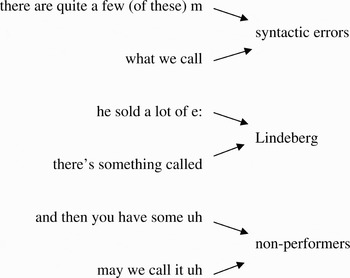
Here the social worker has projected an identifiable expression by producing the quantifier en del ‘a few’ (line 1), which takes as a complement an indefinite noun phrase in the plural. The upcoming referent is marked as not immediately familiar by the particle sånn ‘such’ (as in (7) above). At this point, however, the speaker interrupts the turn and the grammatical construction in progress and switches to a new grammatical construction that is not fitted to the prior talk. This replaces the projected noun phrase with a different construction type that introduces the referent as a non-identifiable entity (‘what we call syntactic errors’). As in the previous example, this in turn generates an expansion of the turn in the form of an explanation of meaning (line 2). The first TCU expansion thus does not purport to solve the potential problem of understanding, just to preempt it by signaling that the interlocutor is not expected to identify the expression. This, in turn, may be seen to pave the way for an explanation of meaning.
This construction is not limited to second-language situations or specialized vocabulary. It may also be a question of using proper names that are potentially unfamiliar, as in the following example:
(18) (Nota Oslo)

In the first line here, we can see that the proper name Alanya (a city in Turkey) is presented as identifiable to the interlocutor. In the next TCU (line 4), a construction is used that also projects an identifiable expression: ‘he sold a lot of’. However, here the construction is broken off and substituted for an existential clause introducing Lindeberg as a non-identifiable (brand) name. The practice used here is thus another example of a TCU expansion occurring before the production of the problematic reference form.
As with the post-positioned TCU expansions analyzed above, we can observe that the speaker's gaze is turned toward the interlocutor while the metacommunicative action of presenting the referent is performed. In this way the speaker can monitor him for nonverbal displays of recognition. In this case the interlocutor does not perform any such display, and the speaker initiates a new expansion into the ongoing report to say that he himself hadn't heard about the brand previously (line 6). Knowing or not knowing things like “hot” brand names can have implications for face, not just for intersubjectivity. And expecting someone to know or not to know such things may also be a delicate issue in that one displays one's impression of them. In this case, the expansion provides legitimization for the interlocutor's not knowing, and for the speaker's not expecting him to know.
As with post-positioned expansions, pre-positioned TCU expansions address not just problems of identification but also questions of the appropriateness of the expression chosen. This can be seen in the next example, from a management meeting in an international company, where English is used as a lingua franca. The manager Peder is commenting on a presentation by Ronnie concerning the economic results of their dealers:
(19) Management meeting

In this example, the expansion deals with the appropriateness of the term chosen. The expansion has interrogative syntax, and Ronnie does respond with a minimal acknowledgment, but Peder does not seem to be eliciting such a response, since he immediately continues his turn in overlap with the response. The construction thus seems to be ambiguous to participants and analysts as to whether it is a genuine check or just a “rhetorical” question.
The remarkable feature of this type of expansion is that the final component of the inserted clause is fitted both to the initial construction and to the inserted one. As with apokoinou constructions, it may thus be said to do double duty, completing two syntactic structures simultaneously (see Figure 1).
Pre-positioned TCU expansions.

This construction may also be seen as fulfilling two communicative actions simultaneously. The first is a sequentially relevant act of reporting about a state of affairs relevant to the topic at hand. The subordinate act is a metacommunicative action dealing with identification of the referring expression or the referent.
This practice of inserting introductory clauses in the course of a TCU has certain common syntactic and prosodic features. The original TCU is broken off at a point where another syntactic constituent is projected. The grammatical construction in progress is thus recognizably incomplete. The interruption occurs at a syntactic boundary but does not interrupt the production of a single constituent. This means that the interruption does generally not involve glottalization or other phonetic signs of cutoff. However, the point where the first grammatical construction is interrupted is commonly marked by hesitation phenomena normally associated with production problems and commonly found in, for instance, word searches (Goodwin & Goodwin Reference Goodwin and Goodwin1986). In the examples above, we can observe such things as lengthening of syllables, pauses, and pause vocalizations such as e: and m:. This provides support to the analysis that the TCU expansion is occasioned by local problems of linearization of complex information.
The inserted clause is most often a short, existential clause as in (18), or some other construction introducing the referent. Although the expansion may introduce a completely new clause, the original TCU is not “canceled” and substituted by a new construction. As we see, the original TCU beginning remains relevant for both the syntactic structure and the semantic content of the following. The construction has some similarities with delayed self-repairs (Auer Reference Auer, Hakulinen and Selting2005; cf. discussion above). An important point about these constructions, according to Auer (Reference Auer, Hakulinen and Selting2005:75), is that the “abandoned/broken off units … are not erased or ‘overwritten’ by the subsequent structure, but their projectional force remains valid and needs to be attended to by recipients.” This seems to be the case in the practice described here as well. The difference from delayed self-repairs is that the beginnings are not recycled, and thus not repaired.
Providing referent identification
Pre-positioned TCU expansions such as these are also used to provide referent identification. In the next example, two Swedish students, Anna and Charlotte, have been complaining about food prices in Norway. Rimi and ICA are supermarket chains.
(20) Unacquainted interlocutors

First, a clause is introduced that projects a definite referring expression. Then, this construction is broken off and an existential construction is inserted in which the referent is introduced (in this case by being located in relation to a presumedly familiar landmark, the stadium).
Note that the action implemented by the first, aborted clause is not pragmatically “canceled” even if the syntactic structure is cut off. The evidence for this is that the interlocutors display an understanding of the turn as including the first action. When Anna links onto her own utterance in line 3, she links onto the activity of giving advice about where to get cheaper food, which was initiated in line 1.
Another instance of this construction is found in line 5. Here, the TCU initiation ‘we were’ is broken off and replaced by an existential clause. Here again, the broken-off structure is consequential for the further progression of the talk. In line 6, Anna responds ‘so you have already checked’, displaying an understanding that Charlotte has actually been to the ICA store (as projected in the first clause).
Referent identification is not done just by existential constructions but may also be performed by relating a new referent to an already established referent, so-called anchoring (Prince Reference Prince and Cole1981).
(21) Unacquainted interlocutors

In line 7, the first clause is broken off at a point where a noun phrase is projected, but what comes next is not an identification of that referent, but rather an explanation of its relation to the speaker. Without this explanation, the clause would have presupposed knowledge about this relation that was not introduced previously. The expansion thus contextualizes the referent simultaneously as it brings the initial action to completion, namely informing his interlocutor that the speaker had a ‘basement band’ at the Music Academy. This can be seen in that he in the next turn he refers back to the band (‘we were a gang’) and goes on to describe their opposition to what they considered a too serious attitude among their fellow students (expressed by the neologism flinketi, based on flink ‘clever’).
The practice of pre-positioned TCU expansion is not limited to Norwegian. There is an English example in (19) above, although it is produced by a non-native speaker. But I have also found the construction in native English data. For instance, in Schiffrin Reference Schiffrin2006 there are two examples of it, although they are not commented upon as such in the book. One of them is reproduced here:
(22) (Schiffrin Reference Schiffrin2006: 116)

The same structure is observed here: A definite reference is projected but is aborted and replaced by an existential clause introducing the referent as a non-identifiable entity. That the original action (telling that he is going to the game) is de facto performed is displayed by Fred's response, questioning how he is going to get in. As in (8) above, this example involves designing a report for different addressees with different amounts of encyclopedic knowledge. As we see, Bob seems to have a lot of background knowledge about this game since he knows that it will be difficult to get a ticket. He also does not respond to the inserted explanation, just to the original announcement. Anne, on the other hand, is a sociolinguistic interviewer not native to Philadelphia. She responds to the explanation – reporting that she did know the team – thereby displaying her understanding that the explanation was addressed to her.
Checking the interlocutor's knowledge
In the extracts above, the speaker provides information about the referent. But the practice of pre-positioned TCU expansion may also be used to check the interlocutor's knowledge. Here is an example from a sociolinguistic interview:
(23) (Nota Oslo) I, Interviewer; Iee, Interviewee.

In line 8 the interviewee checks whether the interviewer has heard about ‘kebab Norwegian’ (a colloquial designation for a multiethnolect in Oslo). However, the original action – answering how he would characterize the language where he grew up – is not abandoned. On the contrary, this complex turn format also constitutes an answer, namely that there is a lot of ‘kebab Norwegian’ there. The remarkable thing about this turn construction is thus that he manages to provide an answer and check the interlocutor's knowledge within a single – albeit complex – TCU. Again we can observe that gaze is centrally involved in checking the interlocutor's state of knowledge. While producing the inserted check, the speaker gazes persistently at the interlocutor and may thus monitor her for displays of recognition.
This construction can also be used for checking the correctness of one's own assumptions. In the following example, Bjørn has been telling Lars about a new band he is starting, featuring a guitar, a bass, and a Hammond organ:
(24) Unacquainted interlocutors

In line 3 Lars projects a noun phrase, but he cuts off the clause and proceeds to make an inquiry about a jazz band. Theoretically, the question may concern either the referring expression – whether he has got the name right – or the referent, whether he is correct in associating the musical style of Bjørn's band with this group. Bjørn's confirmation seems to relate to the latter question, as can be seen by his (aborted) expansion (‘who used to’). After having responded to the question, he proceeds to give a response to the original action, the association of his band with Emerson Lake and Palmer, which he rejects. Again the speaker performs both a check and a sequentially relevant action within the framework of a single, pre-expanded TCU. In this case, however, the potential problem seems primarily to be the correctness of the speaker's assumptions rather than uncertainty about the interlocutor's knowledge.
PREEMPTIVES AS SOCIAL ACTIONS AND GRAMMATICAL CONSTRUCTIONS
In this section the practices described above will be discussed according to how they form communicative actions, how they fit into the organization of turn-taking, and what should be their status in a grammatical description.
As communicative actions, all the interactional practices have in common that they integrate a secondary, subordinate action in the performance of some original communicative action. The secondary action is a non-projected, emergent action that is added onto the original one by redesigning the original turn-constructional unit in progress. The subordinate action is a metacommunicative act that marks a referring expression as unfamiliar, provides referent identification, or checks the interlocutor's familiarity with a referent or an expression. In some cases, it may also comment on the appropriateness of a referring expression. The metacommunicative acts thus deal with issues that might cause problems for the interlocutor, such as not knowing a word, not knowing a referent, or not accepting a way of describing a state of affairs.
Some of these practices are describable as repair, specifically self-initiated self-repair. For instance, some post-positioned turn expansions fall into the subclass of transition space repair, such as examples (10) and (13) above. The pre-positioned expansions also constitute self-repair in that the speaker temporarily aborts one construction (often displaying signs of trouble, such as elongation and hesitation markers) and instead initiates another. However, as has been noted, the original construction is reactualized as the predicate is produced, in that the predicate is fitted to that construction.
What characterizes these expansions is that they are responsive not to manifest problems of formulation, but rather to potential problems with the addressee's identification. They may thus be considered as a separate class of preemptive techniques, which promote the success of some other communicative action that is projected or in progress (cf. Clark Reference Clark1994, Svennevig Reference Svennevig2008). Although they are often manifested in a single speaker's turn, they are inherently interactional in that they deal with the recipient design of the conversational contribution. They preempt repair initiation by the interlocutor by providing “in advance” answers to questions that the interlocutor may have and that may thus be forthcoming.
The different practices described above differ in terms of turn design. Apokoinou constructions, appositions, and appended conditional clauses are all post-positioned; that is, they expand the turn beyond the point of potential completion and deal with the potential reference problem after the production of the referring expression. The practice of inserting a new clause structure into an ongoing TCU, however, is a practice for dealing with the reference problem before the expression is produced. The results are thus pre-positioned expansions rather than incremental ones.
Common to all these practices is that they allow the speaker to produce more than the projected TCU in the course of a single turn at talk. In post-positioned expansions, speakers occasionally use prosodic and syntactic means to avoid creating a transition relevance place after the production of the original, projected TCU. This is done mainly by prosodic means, by not producing the original TCU with utterance-final intonation but instead making a “seamless” prosodic transition into the turn expansion. The apokoinou construction in addition uses syntactic integration to link the expansion to the original TCU. The pre-positioned expansions defer the completion of the original TCU and thus do not create a potential transition relevance place at all. Thus, the constructions may all be considered to be designed to preempt the possibility of the interlocutor's taking the floor and initiating repair.
As noted above, the final position of a TCU has special relevance to the ensuing response by the interlocutor (cf. Schegloff Reference Schegloff, Ochs, Schegloff and Thompson1996b). Dealing with the reference problem in a post-positioned expansion may thus make it more easily available for response than would inserting it into the TCU as a pre-positioned expansion. So even if a pre-positioned expansion interrupts a syntactic unit under production, it may be less interruptive in sequential terms. It contributes to sequential progressivity by dealing with the potential problem as an embedded activity and then returning to the main focus of the talk.
Finally, all the constructions embody an orientation to minimizing the disruption represented by the metacommunicative act (cf. Heritage Reference Heritage, Enfield and Stivers2007, Mazeland Reference Mazeland2007). The subordinate acts of reference are performed en passant and are often backgrounded in various ways. Some are performed as parenthetical sequences (especially appositions and appended conditional clauses) and are iconically backgrounded by reduced prosodic prominence (lower pitch and volume, faster speech rate). In addition, hearers orient to this preference for minimization by displaying recognition as quickly as possible, sometimes even in overlap with the speaker.
As for their relevance to grammar, these constructions are interesting to an interactional approach to language. They constitute some of the linguistic resources available to speakers in order to meet the requirements of online speech production. In this way, this study is a contribution to a type of grammatical description that includes language as process and not just as structure.Footnote 4
First, the study contributes to establishing links between communicative action (function) and syntactic (and prosodic) form. It shows that certain constructions are systematically used for certain metacommunicative acts related to securing successful reference. Second, it shows that what may be considered anomalous from a structural perspective may be systematic and conventional from a process perspective. For instance, apokoinou constructions are conventionalized in certain fixed phrases (cf. (9) above), which is a characteristic of systematic grammatical practices rather than spontaneous speech errors. The pre-positioned expansions are, as mentioned, not even described in the syntactic literature, but they also display systematic constructional features. The inserted clauses are not random but typically involve constructions used for introducing new referents, such as existential clauses. Furthermore, there is a systematic syntactic organization involved, in which two clauses are “merged” by the production of the final constituent, which is syntactically fitted to both clauses. All this points toward describing this practice as a systematic construction conventionally deployed in certain situations where two different actions are required to be produced within the same TCU.