Introduction
Delirium is a common and serious neuropsychiatric syndrome that is highly heterogeneous in etiology, treatment needs, and course (Trzepacz et al., Reference Trzepacz, Meagher, Leonard and Levenson2010). Identification of clinical subtypes can facilitate more targeted research and clinical effort. To date, most attention has focused upon the designation of subtypes according to motor activity profile. Lipowski (Reference Lipowski1983) suggested “hyperactive” and “hypoactive” as labels for delirium subtypes, characterized by increased and decreased motor activity respectively, before adding a third “mixed” category in recognition that many patients experience elements of both within short time frames. A variety of different approaches to defining motor subtypes have emerged that include a wide range of motor and non-motor features (Lipowski, Reference Lipowski1989; Liptzin and Levkoff, Reference Liptzin and Levkoff1992; O’Keefe and Lavan, Reference O’Keeffe and Lavan1999), although none have been validated using non-delirious controls or independent measurements of motor behavior. A recent study of concordance between four commonly used subtyping methods found agreement in subtype classification in only 34% of patients (Meagher et al., Reference Meagher2008a) – a factor that may underpin inconsistencies in research findings to date. Clarifying the relevance of different motor presentations in delirium to pathophysiological mechanisms, treatment needs, and outcomes requires a more focused, readily applicable, and validated methodology (Meagher, Reference Meagher2009).
In order to develop a valid tool for subtyping according to motor presentations of delirium, 30 features previously described in psychomotor checklists were combined as the Delirium Motor Checklist (DMC). This checklist was then applied to studies of palliative care and consultation-liaison (CL) psychiatry populations to investigate the frequency of disturbances of motor activity in delirious patients and non-delirious controls (Meagher et al., Reference Meagher2008a; Grover et al., Reference Grover2013). These studies identified 13/30 DMC items that significantly distinguished between groups and also correlated with independently measured motor activity as per the Delirium Rating Scale-Revised-98 (DRS-R98) motor items. These features were thus incorporated into a new scale called the Delirium Motor Subtype Scale (DMSS; Meagher et al., Reference Meagher2008b; Grover et al., Reference Grover2013), which focuses on actual motor rather than associated psychomotor symptoms. Other work has demonstrated concurrent and predictive validity for this scale, including comparison with objectively measured motor activity levels using bioelectronic methods (Godfrey et al., Reference Godfrey, Leonard, Donnelly, Conroy, O’laighin and Meagher2010; Leonard et al., Reference Leonard, Conroy, Donnelly, Trzepacz and Meagher2011). In addition, the DMSS has been applied to the longitudinal study of motor subtype profile in delirium (Meagher et al., Reference Meagher, Leonard, Donnelly, Conroy, Adamis and Trzepacz2011; Reference Meagher, Leonard, Donnelly, Conroy, Adamis and Trzepacz2012). No other rating scale for motor subtypes of delirium has been developed and validated with such rigor.
In short, the study of clinical subtyping in delirium has been hindered by the absence of well-designed and validated tools that allow for the efficient and reliable attribution of subtype. The original DMSS was developed to address these issues. However, the time pressures of clinical environments are such that the availability of more rapid methods of assessment can promote more consistent documentation of clinical subtype. Moreover, the majority of delirium studies do not report clinical subtype such that a brief reliable means of documenting clinical subtype that could be readily incorporated into assessments alongside other tools would promote better account of clinical variants in research studies. The aims of this study were threefold:
-
1. To identify the best estimate of classes of altered motor activity in a large sample of hospitalized patients with and without delirium.
-
2. To reduce the 30-item DMC (and the sequential 13-item DMSS) to a shorter and reliable checklist that can be readily used in everyday practice by a variety of clinical staff.
-
3. To compare the classes of motor activity with regard to other clinical parameters, including demographics, previous cognitive status, and medication exposure.
Methods
This report includes the prospective assessment of symptoms of delirium in three patient groups from inter-related studies of delirium phenomenology conducted in collaboration with the Cognitive Impairment Research Group at the University of Limerick Medical School. In all studies, phenomenology, demographic, and treatment data were assessed in a consistent manner by raters (D. Meagher, M. Leonard, F. Jabbar, and S. Grover) who were trained by an expert (D. Meagher) in the use of both DRS-R98 and DMC/DMSS. The data reported herein relate to cross-sectional assessments involving all available data and conducted on the first day of recognized delirium.
Study groups
-
1. Palliative care: This group comprised referrals to a CL psychiatry service with possible delirium identified through an active screening programme using the Confusion Assessment Method (CAM) at Milford care Hospice in Limerick, Ireland (see Meagher et al., Reference Meagher2007; Reference Meagher, Leonard, Donnelly, Conroy, Adamis and Trzepacz2011).
-
2. Old age CL psychiatry service: This group consisted of consecutive referrals to old age psychiatry CL services at two centers located in Galway and Limerick in Ireland who were deemed to have delirium as per the American Psychiatric Association's Diagnostic and Statistical Manual, 4th edition (DSM-IV) criteria (Jabbar et al., Reference Jabbar2011)
-
3. General adult CL psychiatry referrals: This group was located at the Postgraduate Institute for Medical Research in Chandigarh, India and consisted of consecutive referrals to the adult CL service (Mattoo et al., Reference Mattoo, Grover, Chakravarty, Trzepacz, Gupta and Meagher2012). Of note, patients with comorbid dementia were excluded from this population.
Measurements
-
1. Demographic data: Age in years, gender, and prior use of antipsychotics in the previous 24 hours (yes/no).
-
2. Revised Delirium Rating Scale (DRS-R98; Trzepacz et al., 2002): It is a widely used instrument to measure symptom profile in delirium, and can be used as both diagnostic and severity assessment tool. It is a 16-item clinician-rated scale with 13 severity items and three diagnostic items. All items are anchored by text descriptions, which guide rating along a continuum from normal (0) to severely impaired (3). The 13-item severity section can be scored separately from the three-item diagnostic section; their sum constitutes the total scale score. Thus, the DRS-R98 severity scores range from 0–39, with higher scores indicating more severe delirium and a cut-off score >15 indicating consistency with the diagnosis of delirium. The DRS-R98 is designed to rate symptoms over the previous 24 hours. The DRS-R98 has high inter-rater reliability, validity, sensitivity, and specificity for distinguishing delirium from mixed neuropsychiatric populations, including dementia, depression, and schizophrenia (Trzepacz et al., Reference Trzepacz, Mittal, Torres, Kanary, Norton and Jimerson2001).
-
3. Diagnostic and Statistical Manual, 4th edition (DSM-IV) criteria for delirium (yes/no): It rated according to all available data for each patient, including clinical assessment, consultation with nursing staff, and collateral history from relatives/carers where available.
-
4. Delirium Motor Checklist (DMC; Meagher et al., Reference Meagher2008a): This comprises features from three published psychomotor subtyping schemas (Lipowski, Reference Lipowski1983; Liptzin and Levkoff, Reference Liptzin and Levkoff1992; O’Keefe and Lavan, Reference O’Keeffe and Lavan1999) that were combined to form a 30-item checklist but without redundant items. Motor activity profile describes the overall pattern of motor activity that takes into account the normal expected amount of movements that a normal human being would produce and then designates a prevailing overall estimate of activity. While some items directly reflect alterations in motor activity (e.g. increased amount or speed of actions), other “psychomotor” items are indirectly related to motor activity (e.g. uncooperativeness, altered speed, or volume of speech). Each item is rated dichotomously as present or absent during the previous 24 hours through observation and discussion with the key nurse responsible for the patient at the time of assessment.
-
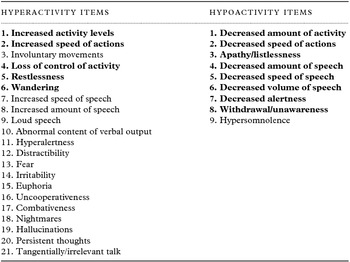
5. Delirium Motor Subtype Scale (DMSS; Meagher et al., Reference Meagher2008b): It is a scale comprising 13 (5 hyperactive and 8 hypoactive) symptoms derived from the 30 items of the DMC that were selected according to their relative specificity for delirium relative to controls, reflection of motor phenomenology, and demonstrated correlation with independent and objective measures of motor behavior (Meagher et al., Reference Meagher2008b; Godfrey et al., Reference Godfrey, Leonard, Donnelly, Conroy, O’laighin and Meagher2010; Grover et al., Reference Grover2013). The DMSS can be rated by any healthcare professional who is familiar with the clinical presentation of delirium. Scoring requires at least two symptoms to be present from either the hyperactive or hypoactive list to meet subtype criteria. Patients meeting both hyperactive and hypoactive criteria are deemed mixed subtype, while patients meeting neither of the criteria are labeled as “no subtype.” The 30 items of the DMC and 13 items of the DMSS are presented in Table 1.
Table 1.Features of psychomotor disturbance included in the Delirium Motor Checklist (DMC) and Delirium Motor Subtype Scale (DMSS) (emboldened)

-
6. Dementia (yes/no): This was defined as the presence of persistent cognitive impairment for at least six months prior to the assessment and as per the DSM-IV criteria based on all available information at the time of assessment, including clinical case notes and collateral history from family and/or carers.

Informed consent
Similar ethical procedures were used for all patient groups. The procedures and rationale for assessments were explained to all patients, but since the majority of patients included in this work had DSM-IV delirium at the time of entry into the study, it was presumed that most would not be capable of giving informed written consent. At each site, local ethics committees approved an approach whereby patient's verbal assent was augmented with proxy consent from next of kin (where possible) or a responsible caregiver. This is in accordance with best practices as outlined in the Helsinki Guidelines for Medical Research involving human participants (World Medical Association, 2004). These assessment procedures did not have any identified significant risks but the patient or the family was informed that they could withdraw participation at any stage.
Statistical analyses
Demographic and rating scale data were expressed as means plus SD. The study involved two phases of analysis: (1) The complete dataset (both delirious and non-delirious patients; n = 487) was analyzed using Latent Class Analysis (LCA) to estimate underlying motor subtypes as well as to reduce the 30-item DMC. LCA is similar to factor analysis but more appropriate for binary categorical data because traditional factor analysis requires the assumption of multivariate normality to justify a linear model, which in patients with binary responses is often violated (McCutcheon, Reference McCutcheon1987). Latent Gold 4.5 software was used for the LCA. (2) Cohen's κ coefficient was used to assess concordance between the 13-item DMSS and the new reduced scale (from the LCA analysis) in patients with DSM-IV delirium (n = 375). In order to explore the third aim, multi-nominal regression analysis was used to investigate the relationship between motor subtype and age, antipsychotic exposure, gender, delirium severity (measured with the DRS-R98), and dementia status. PAWS (SPSS) v18 software was used for this analysis, concurrent validity analysis (κ), and descriptive statistics.
Results
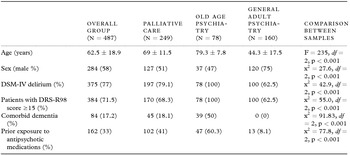
Demographic and clinical data for the entire sample of 487 participants are shown in Table 2. In keeping with the differing sampling methods and treatment settings, the groups differed considerably with regard to age, gender, frequency of comorbid dementia, and prior medication exposure. DSM-IV delirium was present in 375 (78%) patients included. Percentage of motor subtypes according to the original DMSS and different samples were as follows: for palliative care patients – hypoactive (32%), mixed (23%), hyperactive (23%), and no subtype (22%); for the psychiatry of later life CL referral sample – hypoactive (21%), mixed (32.5%), hyperactive (37.5%), and no subtype (9%); and for the general CL psychiatry referral sample – hypoactive (6%), mixed (6%), hyperactive (85%), and no subtype (3%).
Demographic and clinical data for the overall population and subpopulations

Latent class analysis of DMC items
The 30 items of the DMC were entered into LCA in which a variety of models ranging from 1 to 8 underlying classes were generated. The solution with the optimal characteristics according to a combination of the lowest Akaike's Information Criterion (AIC), lowest squared long likelihood (LL2), greatest amount of variance explained from the classes, and bootstrapping comparison between different models was the solution with four classes. These classes corresponded closely with the prevailing concept of motor subtypes, i.e. a no-subtype class with high probability to contain patients with “no” answers in both hypoactive and hyperactive items (29% of patients), a hyperactive subtype with high probability to contain “yes” answers in hyperactive items and “no” in hypoactive items (26% of patients), a hypoactive subtype with high probability to contain patients with “yes” in hypoactive items and “no” in hyperactive items (25% of patients), and finally a mixed subtype with patients that had a high probability of containing “yes” to both hypoactive and hyperactive items (20% of patients). The characteristics of this final model were: AIC = 5700.2, L2 = 6422.2, and number of parameters (Npar) = 123. The classification error was 0.04, which indicates the proportion of patients that are estimated to be misclassified with lower scores (closer to zero) indicative of less misclassification. Reduction of errors (λ = 0.94) and Entropy R2 (0.92) indicate how well one can predict class membership based on the observed variables, with values closer to 1 indicative of better predictive accuracy.
Reduced items version of the DMSS
To identify the reduced version of the DMSS based upon items of the DMC, items (n = 15) with high loadings (≥60%) in the initial four-class model were selected. These items were then further analyzed using LCA to generate possible solutions, which were compared with AIC, LL2, bivariate residuals, and bootstrapping methods. The most parsimonious model (AIC = 8.08, LL2 = 0.08, and bivariate residuals all < 1) included four classes based upon four items – two hyperactive (increased amount of activity and loss of control of actions) and two hypoactive (decreased speed of actions and reduced verbal output). For this model, Npar = 19, classification error = 0.20, reduction of errors = 0.70, and Entropy R2 = 0.65.
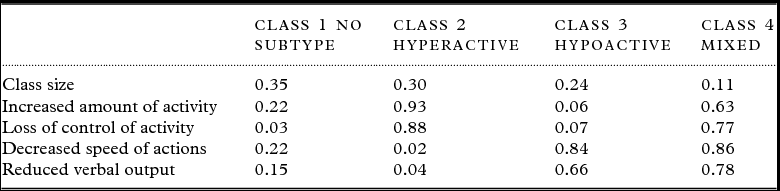
The first class of the final model (35% of patients) represents those with “no subtype” as the conditional probabilities of “no” for all four items were high. The second class (30% of patients) represents those with hyperactive subtype as the probabilities of “no” for hypoactive items and “yes” for hyperactive items were high. The third class (24% of patients) represents those with hypoactive motor type as the probabilities of “yes” for hypoactive items and “no” for hyperactive items were high, while the last class contains 11% of patients and represents the mixed type as the probabilities of “yes” for all items (both hypoactive and hyperactive) were high. The conditional probabilities are shown in Table 3.
Item probabilities for the four classes of motor profile

The loadings (probabilities of association) and the variance of each item (R2) explained by the model were as follows: for hyperactive item 1 (increased activity levels), loading = 0.72, R2 = 0.52; for hyperactive item 4 (loss of control of activity), loading = 0.82, R2 = 0.68; for hypoactive item 2 (decreased speed of actions), loading = 0.72, R2 = 0.52; and for hypoactive item 4 (decreased amount of speech), loading = 0.63, R2 = 0.40.
Concurrent validity of the derived latent classes
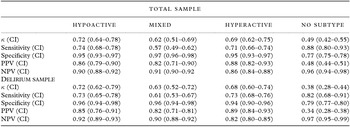
To evaluate the credibility of the derived latent classes, the posterior classification of this model was tested against the classification according to the 13-item DMSS. The agreement between the two scales was high (κ = 0.63; Cramer's V = 0.66). The two scales were in close agreement for all four subtypes, especially with regard to hyperactive and hypoactive subtypes, but less well for mixed and no subtype. Further analysis of the agreement (κ), sensitivity, specificity, positive predictive value (PPV), and negative predictive value (NPV) for each subtype are shown in Table 4.
Agreement, sensitivity, specificity, and predictive values between DMSS-4 and DMSS-13 across each motor subtype

DMSS-4 subtype frequencies and DSM-IV delirium status
We examined the frequency of DMSS-13 subtypes for the complete sample and for delirious versus non-delirious patients. The respective frequencies for each subtype were hyperactive (n = 166; 159 delirious vs. 7 non-delirious), hypoactive (n = 144; 91 delirious vs. 53 non-delirious), mixed (n = 85; 83 delirious vs. 2 non-delirious), and no subtype (n = 92; 42 delirious vs. 50 non-delirious). Of note, the frequency of no subtype was substantially lower in patients with DSM-IV delirium versus those without delirium (11% vs. 45%).
Delirium sample
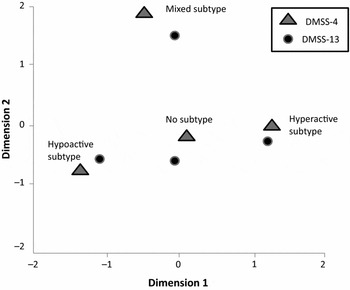
We also explored concurrent validity of the posterior classification of the DMSS-4 against the DMSS-13 in the patients with DSM-IV delirium (n = 375). The agreement of DMSS-4 and DMSS-13 was in the substantial range (κ = 0.61; Cramer's V = 0.64; Viera and Garrett, Reference Viera and Garrett2005). Table 5 compares subtype attribution for DMSS-13 and DMSS-4 for the DSM-IV delirium sample (n = 375). A graphical representation of the correspondence analysis of the two scales for the delirious only subsample is shown in Figure 1. Again, the scales were in close agreement for hypoactive and hyperactive patients, but less for the no subtype and mixed ones. The agreement (κ), sensitivity, specificity, PPV, and NPV for each subtype for the delirium subsample are shown in Table 4.
Motor subtype attribution according to DMSS-13 and DMSS-4 for the delirium sample (n = 375)

Note: Overall κ = 0.61.
Correspondence analysis for DMSS-4 and DMSS-13 in the delirium sample (n = 375).

Relationship to other clinical and demographic characteristics
Finally, we investigated association between age, gender, prior use of antipsychotics, delirium severity, and dementia status upon subtype classification as per DMSS-4 using multinominal regression. More severe delirium (as per the DRS-R98 severity scores) and prior exposure to antipsychotics were significantly (p < 0.001) more likely to be associated with hyper and mixed subtypes. Palliative care patients were more likely to have hypoactive delirium (p = 0.02), while those in old-age liaison psychiatry were more likely to be hyperactive (p < 0.001). A previous history of dementia, age, and gender were not significantly related to delirium subtype as classified with the DMSS-4.
Discussion
This analysis of a large and heterogenous sample of delirious and non-delirious control patients supports prevailing concepts of how patients can be subtyped according to their motor activity profile. The DMC allows for the assessment of a wide range of motor behaviors and associated psychomotoric symptoms that have been linked to delirium and identified that patients were optimally divided into four classes that correspond closely with clinical subtyping into four groups – hyperactive, hypoactive, mixed, and no subtype.
Previous studies have also reported four motor subtypes using a variety of methods – psychomotor checklists, clinical impression, visual-analog scales, and motor items taken from standardized delirium rating scales (de Rooij et al., Reference de Rooij2006; Meagher, Reference Meagher2009) as well as with the assistance of electronic motion analysis (Godfrey et al., Reference Godfrey, Conway, Leonard, Meagher and O’Laighin2008; Van Uitert et al., Reference Van Uitert, de Jonghe, de Gijsel, van Someren, de Rooij and van Munster2011). Another recent study that applied LCA to motor profile in elderly patients in post acute care also found a latent class structure with four underlying motor subtypes (Yang et al., Reference Yang2009). However, the assessment of motor activity in that study was limited to a single item of the Memorial Delirium Assessment Scale and was linked to overall illness severity such that hypoactive patients were divided into mild versus severe, and no distinction was made between hyperactive and mixed patients. More detailed assessment of motor activity using the DMC reported herein is thus better equipped to identify more subtle distinctions and has greater capacity to capture a more complete range of disturbances and symptom combinations that can occur.
Although contrasting hyperactive and hypoactive presentations of delirium have been recognized for centuries, there remains some uncertainty as to the significance of mixed presentations and presentations with minimal disturbance of motor activity classed as “no” subtype. It has been suggested that mixed presentations may reflect a transitional state between hyperactivity and hypoactivity and/or the inherent fluctuating nature of delirium as a syndrome. Recent work (Meagher et al., Reference Meagher, Leonard, Donnelly, Conroy, Adamis and Trzepacz2012) has highlighted the relative stability of motor subtypes over the course of illness in palliative care populations where two-thirds of patients with mixed presentations continued with this profile throughout their delirium. This report provides further support for a discrete mixed category as evidenced by a substantially populated latent class of patients with both hyperactive and hypoactive features prominent and which corresponded closely with mixed subtype patients as defined by the DMSS-13.
In addition, the status of no subtype patients is also somewhat unclear, with studies suggesting that these patients have less severe, or even questionable delirium (Meagher et al., Reference Meagher, Leonard, Donnelly, Conroy, Adamis and Trzepacz2012). Previous work has highlighted how disturbed motor activity is almost invariably present in patients with delirium (Meagher et al., Reference Meagher2008a; Jabbar et al., Reference Jabbar2011; Grover et al., Reference Grover2013). However, the present analysis also emphasises that motor disturbances lack absolute specificity for delirium since they are relatively common in hospitalized patients without delirium and some delirious patients have only minimal motor disturbances. However, the observation that no subtype classification was considerably less common in delirious patients (11%) compared with non-delirious patients with related neuropsychiatric presentations (45%) indicates that the changes to motor behavior that are captured on the DMSS and DMSS-4 are relevant and relatively specific to delirium. Also, where present, these disturbances are similarly captured on the DMSS-13 and the abbreviated DMSS-4.
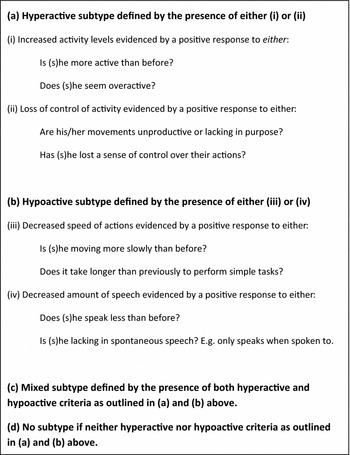
The second aim of this study was to identify an abbreviated version of DMSS from the 30 items of DMC. We found that four items, all of which are included in the original DMSS (increased activity level, loss of control of activity, decreased speed of actions, and decreased amount of speech) generated a scale with good agreement with the longer and well-validated 13-item DMSS. The algorithm for the categorization of motor subtypes with a description of how each item could be assessed for is provided in Figure 2. The simplicity and ease of interpretation of this scale should make for rapid attribution of clinical subtype of delirium in everyday clinical practice and research studies where the frequent failure to account for different clinical subtypes may be an important limitation in studies capacity to identify significant patterns in relation to pathophysiological underpinnings and treatment response in delirious patients (Meagher et al., Reference Meagher, McLoughlin, Leonard, Hannon, Dunne and O’Regan2013). The findings in relation to concordance between the DMSS and the DMSS-4 indicate good but not excellent agreement and as such the longer version may be better for studies where greater accuracy is required or where clinical subtypes are the primary focus of the work, while the abbreviated version is especially well suited for clinical settings and research studies where clinical subtype is a secondary consideration and the DMSS-4 can be readily incorporated into assessments alongside other tools.
The DMSS-4.

We explored motor subtype frequency across populations from a variety of contrasting treatment settings and found that hypoactive subtype is more common in screened patients identified in palliative care, while hyperactive subtype is more frequent in referral samples to CL psychiatry services. These findings are in keeping with a detailed review of 34 studies (Meagher, Reference Meagher2009), but in this work the comparison is for subtypes defined by the same methods, rather than by a variety of approaches as found in the existing literature. The heterogeneity of delirium is such that the relevance of factors such as medication use, etiology, and pathophysiological underpinnings to variations in subtype expression requires investigation using large samples of patients who have been assessed in a consistent manner in relation to these phenomena. The DMSS-4 can provide a convenient means of adding value to research studies by also including the assessment of clinical subtype as a routine measure.
Finally, we examined some clinical variables that may relate to motor subtype classification on the DMSS-4. Some work has suggested that hypoactive subtype may be more frequent in older adults or in those with prior cognitive deficits (Meagher, Reference Meagher2009; Blazer and van Nieuwenhuizenbut, Reference Blazer and van Nieuwenhuizenbut2012), but the present study did not find any association with demographic characteristics or previous history of dementia. We found that the frequency of motor subtypes varied significantly across treatment populations with hypoactive delirium more frequent in palliative care patients and hyperactive subtype more common in adult and old age psychiatry. However, this may simply reflect a selection bias since the latter two groups were identified through referral, while the palliative care sample was identified by active screening and thus is more likely to include hypoactive patients. In addition, greater use of antipsychotics was significantly associated with hyperactive and mixed subtypes, and this is consistent with clinical experience and previous studies (Peterson et al., Reference Peterson2006; MacSweeney et al., Reference MacSweeney2010; Hui et al., Reference Hui, Reddy, Palla and Bruera2011; Meagher et al., Reference Meagher, Leonard, Donnelly, Conroy, Adamis and Trzepacz2012).
Limitations of this study include that it is a post hoc analysis of already collected data from different studies rather than based upon a priori hypotheses. This has allowed the advantage of including data from very differing settings, both clinically and geographically. However, further prospective evaluation of psychometric properties of the DMSS-4 is required. In addition, the sampling methods for the three groups varied and the inclusion of referral samples is likely to have under-represented patients with hypoactive presentations. However, the large number of patients with substantial representation of all four recognized motor presentations allowed for robust development and examination of a brief and simple method of motor subtyping in delirium that is derived from the detailed analysis of motor activity in delirious and non-delirious patients, and that relates closely to the well-validated but longer DMSS. This abbreviated version can allow for rapid assessment of motor subtypes by any healthcare professional who is familiar with delirious presentations and can thus facilitate efficient assessment of clinical subtype in research as well as in routine clinical practice.
Conflict of interest
Dr. P. Trzepacz is a full-time salaried employee and minor shareholder at Eli Lilly and Company. She holds the copyright for the Delirium Rating Scale-Revised-98 but does not charge a fee for a not-for-profit use. No other authors have conflicts of interest to disclose.
Description of authors’ roles
D. Meagher: Formulating the research question, designing the study, data collection, data analysis, and writing the paper. D. Adamis: Formulating the research question, designing the study, data analysis, and writing the paper. M. Leonard: Formulating the research question, designing the study, data collection, data analysis, and writing the paper, P. Trzepacz: Formulating the research question, designing the study, data analysis, and writing the paper. S. Grover: Data collection, data analysis, and writing the paper. F. Jabbar and K Meehan: Data collection, data analysis, and writing the paper. M. O’Connor, C Cronin, and P Reynolds: Data collection, and writing the paper. J. Fitzgerald: Writing the paper. N. O’Regan and S. Timmons: Data analysis, and writing the paper. C. Slor, J. de Jonghe, A. de Jonghe, B. C. van Munster, S. E. de Rooij, and A. Maclullich: Data analysis, and writing the paper.