Wild, or lowbush, blueberry is a perennial, deciduous shrub native to North America (Vander Kloet Reference Vander Kloet1988). It is the most important fruit crop in Nova Scotia (Reference Strik and YarboroughStrik and Yarborough Reference Strik and Yarborough2005), contributing more than Can$22 million to farm gate value in 2011 (Statistics Canada 2012). Commercial fields are developed on abandoned farmland or cleared woodland where native blueberry stands already exist (Agriculture and Agri-Food Canada [AAFC] 2005). Stands are managed primarily on a 2 yr cycle in which fields are pruned to ground level in the first year (nonbearing year) and harvested in the second year (bearing year) (AAFC 2005). Weed management options are limited due to the perennial nature of the crop, and weeds are therefore a major yield-limiting factor (Jensen Reference Jensen1985; McCully et al. Reference McCully, Sampson, Glen and Watson1991). The weed flora of wild blueberry fields have traditionally been dominated by herbaceous and woody perennial species, but the trend since the introduction of hexazinone has been toward shorter-lived weed species that rely on reproduction by seeds for establishment and spread (Jensen and Yarborough Reference Yarborough2004). Herbaceous annual and biennial species, therefore, have become increasingly common in wild blueberry fields.
American burnweed is an annual plant in the Asteraceae family (Darbyshire et al. Reference Darbyshire, Francis, DiTommaso and Clements2012). It is native to deciduous forest regions of North America (Darbyshire et al. Reference Darbyshire, Francis, DiTommaso and Clements2012) and has been introduced to regions of Europe and Asia (Darbyshire et al. Reference Darbyshire, Francis, DiTommaso and Clements2012). The distribution in Canada is from the Maritime Provinces to western Ontario (Darbyshire et al. Reference Darbyshire, Francis, DiTommaso and Clements2012), and the plant is abundant in areas of recently cleared forest (Eaton Reference Eaton1824; Pursh Reference Pursh1814; Torrey Reference Torrey1843). The plant produces copious amounts of seeds, with individual plants reported to produce more than 32,000 seeds (Csiszár Reference Csiszár2006). Seeds form a persistent seedbank in some areas, with up to 89% of seeds germinating following 8 yr of artificial burial (Baskin and Baskin Reference Baskin and Baskin1996). Little is known, however, about the basic seed dormancy characteristics or potential of this weed species to form seedbanks in wild blueberry fields.
Seed dormancy can be regulated by various physiological, morphological, and physical mechanisms (Baskin and Baskin Reference Baskin and Baskin2004). In the absence of morphological limitations on germination, dormancy in most seeds is regulated by physiological or physical mechanisms and can be alleviated through seed exposure to appropriate environmental, chemical, or physical stimuli (Finch-Savage and Leubner-Metzger Reference Finch-Savage and Leubner-Metzger2006; Pons 1988; Rolston Reference Rolston1978). Important environmental factors that may regulate seed dormancy in wild blueberry fields include exposure to cold winter temperatures and light. American burnweed is thought to exhibit primary dormancy that may be regulated by exposure to cold temperatures (Baskin and Baskin Reference Baskin and Baskin1996), but no research has investigated the effect of cold temperatures on dormancy of American burnweed seeds collected from wild blueberry fields. Wild blueberry fields are not tilled, suggesting the majority of weed seeds deposited remain near the soil surface (Cardina et al. Reference Cardina, Herms and Doohan2002; Yenish et al. Reference Yenish, Doll and Buhler1992). American burnweed seeds germinate in complete darkness following exposure to low temperatures in winter (Baskin and Baskin Reference Baskin and Baskin1996). However, it is unclear whether germination of this species is regulated by light in wild blueberry fields. Many exogenous chemicals can overcome seed dormancy, including gibberellic acid (Frankland Reference Frankland1961), chemicals released from decaying or burnt plant material (Chiwocha et al. Reference Chiwocha, Dixon, Flematti, Ghisalberti, Merrit, Nelson, Riseborough, Smith and Steven2009; Keely et al. Reference Keely, Morton, Pedrosa and Trotter1985), or chemical inputs into agricultural systems, such as nitrogen (Hartmann et al. Reference Hartmann, Kester, Davies and Geneve2010). While many of these chemicals would not be routinely applied to agricultural ecosystems, application of nitrogen-based fertilizers is a common practice in wild blueberry production (Eaton Reference Eaton1994) and may therefore affect American burnweed dormancy and germination. Physical dormancy is often regulated by the seed coat (Baskin et al. Reference Baskin, Davis, Baskin, Gleason and Cordell2004), and American burnweed seeds in wild blueberry fields may be exposed to direct flame and dry heat that could rupture the seed coat when fields are pruned by burning. Although this practice is used less frequently than flail mowing (Yarborough Reference Yarborough2004), many growers are revisiting the use of burn pruning for field sanitation and potential control of weed seeds (White and Boyd Reference White and Boyd2016). It is therefore important to determine the effects of direct flame and dry heat on dormancy and germination of this species in blueberry fields.
Although little is known about the competitive effects of American burnweed on wild blueberry, the tall growth habit and high density of this plant in typical infestations would suggest potential impacts on blueberry growth and yield, and plants also inhibit harvesting (D. Yarborough, personal communication, as cited in Darbyshire et al. Reference Darbyshire, Francis, DiTommaso and Clements2012). Increased knowledge of the basic biology of this species is therefore required to begin developing management strategies to limit the spread and impacts of this species in wild blueberry fields in Nova Scotia. The objectives of this research were to determine (1) the potential role of cold moist stratification (CMS) and light in alleviating American burnweed seed dormancy, (2) the potential role of the exogenous chemicals gibberellic acid (GA3) and nitrogen (KNO3) in alleviating American burnweed seed dormancy, and (3) the potential role of seed coat removal and seed exposure to dry heat and direct flame in alleviating American burnweed seed dormancy.
Materials and Methods
Seed Source and Preparation for Experimental Treatments
All seeds used in this research were collected from plants reared in a greenhouse at the Department of Plant, Food, and Environmental Sciences, Faculty of Agriculture, Dalhousie University, during winter and spring of 2015. Greenhouse plants were established from seeds collected from a wild blueberry field in Queen’s County, Nova Scotia, Canada, during September 2014. Seeds collected from the field were stored in the dark at room temperature and were subject to various germination tests during autumn 2014 to explore potential dormancy mechanisms. Successfully germinated seeds were then planted in the greenhouse and grown to maturity to secure an abundant supply of fresh seeds for use in the experiments outlined below. Fresh seeds were collected as they matured, placed in paper envelopes, and stored in the dark at room temperature until use. No seeds were stored for more than 1 mo prior to use. Seeds were surface sterilized before each experiment by placing 25 seeds in 4 ml of 3% sodium hypochlorite solution for 10 s. Experimental units consisted of 25 surface-sterilized seeds in a petri dish lined with two pieces of Whatman No. 1 9-cm-diamater filter paper (Whatman, GE Healthcare companies) moistened with 4 ml of distilled water (unless otherwise stated). Sterilized seeds were placed into petri dishes under green light and aseptic conditions in a fume hood, and dishes were then sealed with Parafilm™ prior to placement in the experimental treatments outlined below.
General Treatment Conditions and Data Collection
Warm conditions for germination were provided in a Conviron G40 Germination Cabinet (Model CMP5090, Conviron Controlled Environments Limited, Winnipeg, MB, Canada) with a temperature regime of 22/15 C (day/night) and a 16 h photoperiod providing a mean photosynthetic photo-flux density (PPFD) of 23±2 µm m−2 s−1. CMS was provided by a low-temperature incubator (Precision Low Temperature Incubator, GCA Corporation, Chicago, IL) set at a constant temperature of 4 C and an 8 h photoperiod provided by fluorescent bulbs providing a mean PPFD of 23±2 µm m−2s−1. The number of germinated seeds in each petri dish in each experiment were counted 4 wk after placement in the warm germination chamber. Data are presented as the percentage of seeds germinated for each treatment, and each experiment was repeated once.
Effect of CMS and Light in Alleviating Dormancy
Effect of CMS Duration, CMS Light, and Light during Warm Conditions on Germination
The objective of this experiment was to determine the effect of CMS and light on American burnweed seed germination. The experiment was a 4 by 2 by 2 factorial arrangement of CMS duration (CMSD; 0, 30, 60, 90 d), CMS light (CMSL; yes, no), and light during warm conditions (LDWC; yes, no) arranged in a completely randomized design with five replications. Light was excluded from dishes in the dark treatments by wrapping petri dishes in two layers of aluminum foil immediately after sealing dishes with Parafilm™. Dishes were moved to the warm germination conditions after cold treatments.
Effect of CMSD on Germination
The objective of this experiment was to determine the effect of CMSD on American burnweed seed germination. Treatments consisted of exposure of seeds to CMSD of 0, 20, 40, 60, 80, and 100 d. The experiment was arranged in a completely randomized design with five replications. Light was excluded from all petri dishes during CMS by wrapping dishes in two layers of aluminum foil immediately after sealing dishes with Parafilm™. Aluminum foil was then removed from each dish prior to placement in the warm germination conditions.
Effect of Exogenous GA3 and Nitrogen in Alleviating Dormancy
Effect of Exogenous GA3 on Germination
The objective of this experiment was to determine the effect of GA3 on American burnweed seed germination. Treatments consisted of an untreated control (filter paper moistened with 4 ml of distilled water) and exposure of seeds to 200, 400, 600, and 800 ppm GA3 solution by moistening filter paper in each dish with 4 ml of the appropriate GA3 solution. The experiment was arranged in a completely randomized design with five replications. Appropriate GA3 solutions were prepared from a stock 1,000 ppm GA3 solution prepared by dissolving 0.1 g GA3 powder (J. T. Baker Chemical Company, Phillipsburg, NJ) in 10 ml 1 M KOH solution and bringing the solution up to 100 ml volume. The stock solution was stored in a brown bottle in a 4 C refrigerator, and a dilution series was used to prepare the solutions for each GA3 treatment. The pH of each GA3 solution was adjusted to 5.8 by addition of HCl prior to use in each treatment, and dishes were placed in the warm germination conditions immediately following the sealing of each Petri dish.
Effect of Exogenous KNO3 on Germination
The objective of this experiment was to determine the effect of nitrogen on American burnweed seed germination. Treatments consisted of an untreated control (filter paper moistened with 4 ml of distilled water) and exposure of seeds to nitrogen (filter paper moistened with 4 ml of 5% KNO3 solution). The experiment was arranged as a completely randomized design with five replications, and dishes were placed in the warm germination conditions immediately following sealing of each Petri dish.
Effect of Seed Coat Removal, Dry Heat, and Direct Flame in Alleviating Dormancy
Effect of Seed Coat Removal on Germination
The objective of this experiment was to determine the effect of seed coat removal on American burnweed seed germination. The experiment was a 2 by 2 factorial arrangement of CMS for 60 d (yes, no) and seed coat removal (yes, no) arranged in a completely randomized design with five replications. Seeds not exposed to CMS were placed directly into the warm germination conditions at the onset of the experiment. The seed coat removal treatment was conducted by surface sterilizing seeds and soaking them in distilled water for 10 min under a fume hood. Softened seed coats were gently removed with forceps to expose the naked embryo, and naked embryos were placed directly onto moistened filter paper in each petri dish. Light was excluded from all petri dishes during CMS by wrapping dishes in two layers of aluminum foil immediately after sealing dishes with Parafilm™. Aluminum foil was then removed from each dish prior to placement in the warm germination conditions.
Effect of Dry Heat and Direct Flame on Germination
The objective of the first experiment was to determine the effect of dry-heat exposure duration on American burnweed seed germination. The experiment was a 3 by 5 factorial arrangement of temperature (100, 200, 300 C) and exposure duration (0, 15, 30, 45, 60 s) arranged in a completely randomized design with five replicates. Each replicate of each treatment consisted of 25 seeds placed in an aluminum dish and exposed to each combination of temperature and exposure time in a laboratory box furnace (Model 51894, Lindberg Manufacturing, Watertown, WI). Seeds exposed to each temperature and exposure time were then placed in petri dishes lined with moistened filter paper, as described above, and incubated in warm germination conditions.
The objective of the second experiment was to determine the effect of exposure time to direct flame on American burnweed seed germination and consisted of exposure of 25 individual American burnweed seeds to direct flame for durations of 0, 1, 2, and 4 s. Seeds were clasped by forceps, and the direct flame was provided by a Bunsen burner providing an average temperature in the upper portion of the flame of 497±35 C. The 25 exposed seeds were then placed in petri dishes lined with moistened filter paper, as described above, and incubated in warm germination conditions.
Statistical Analysis
Effect of CMS and Light in Alleviating Dormancy
Percent germination data for Experiment 1 were analyzed using ANOVA in PROC MIXED in SAS for Windows (Statistical Analysis System, v. 9.2, SAS Institute, Cary, NC). CMSD, CMSL, LDWC, experimental run, and the interactions between these factors were modeled as fixed effects in the analysis. Percent germination data in Experiment 2 were analyzed using ANOVA in PROC MIXED in SAS. CMSD, experimental run, and the subsequent interactions were modeled as fixed effects in the analysis, and polynomial contrasts and lack-of-fit variance partitions in PROC MIXED were used to determine the significance of polynomial regression relationships between percent germination and CMSD. Significant differences among treatments in each experiment were determined using Tukey’s honestly significant difference means comparison test at a probability level of P<0.05. Data were transformed as required to meet normality and constant variance assumptions for the ANOVA for each analysis, and transformations are indicated in subsequent data tables.
Effect of Exogenous GA3 and Nitrogen in Alleviating Dormancy
Percent germination data for each experiment were not analyzed statistically due to violations of assumptions for the ANOVA analysis that could not be remedied through data transformation. Means and standard errors were determined for each treatment in each experiment and were plotted as a function of GA3 concentration in Experiment 1 and are provided and discussed for Experiment 2.
Effect of Seed Coat Removal, Dry Heat, and Direct Flame in Alleviating Dormancy
Percent germination data for the seed coat removal and direct flame–exposure experiments were analyzed using ANOVA in PROC MIXED in SAS. Seed coat removal, CMS, experimental run, and the interactions between these factors were modeled as fixed effects in the analysis in the seed coat experiment. Direct flame–exposure duration and experimental run and the interactions between these factors were modeled as fixed effects in the analysis in the direct flame–exposure experiment. Significant differences among treatments in each experiment were determined using Tukey’s honestly significant difference means comparison test at a probability level of P<0.05. Data were transformed as required to meet normality and constant variance assumptions for the ANOVA for each analysis, and transformations are indicated in subsequent data tables. Percent germination data for the dry-heat experiment were not analyzed statistically due to violations of assumptions for the ANOVA analysis that could not be remedied through data transformation. Means and standard errors were determined for each treatment in each experiment and are presented and discussed.
Results and Discussion
Effect of CMS and Light in Alleviating Dormancy
Effect of CMSD, CMSL, and LDWC on Germination
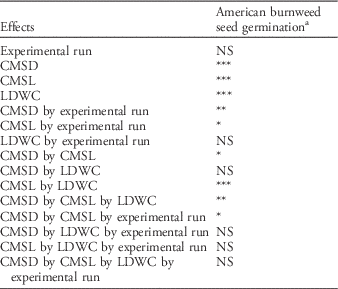
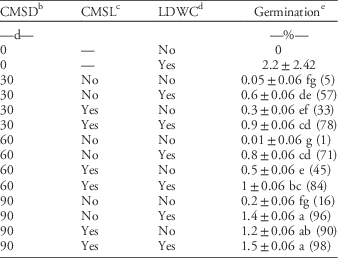
There was no effect of experimental run or the CMSD by CMSL by LDWC by experimental run interaction on American burnweed seed germination (Table 1). Data were therefore combined across experimental runs for the analysis. There was an effect of CMSD (P<0.0001), CMSL (P<0.0001), LDWC (P<0.0001), and the CMSD by CMSL by LDWC interaction (P<0.0001) on American burnweed seed germination in the combined data set. No seeds germinated when maintained in darkness without CMS, and less than 5% of seeds germinated in light without CMS (Table 2). Seeds denied light during both CMS and warm conditions had low germination, regardless of CMSD (Table 2). Germination increased with increasing CMSD in seeds denied light during CMS but exposed to LDWC, and maximum germination occurred following 90 d of CMS (Table 2). Seed exposure to light during CMS only did not increase germination until 90 d of CMS (Table 2), indicating that light during the cold treatment does not overcome the requirement for light under warm conditions. Seed exposure to light during both CMS and warm conditions did not increase germination relative to light exposure during warm conditions only (Table 2), further confirming the lack of additional benefit of light during CMS at the durations used in this experiment. Stratification and incubation of seeds in light has been found to increase germination over seeds stratified in darkness and incubated in light for some plant species (Baskin et al. Reference Baskin, Baskin and Hoffman1992; Baskin et al. Reference Baskin, Milberg, Andersson and Baskin2001; Romero et al. Reference Romero, Delate and Hannapel2005), indicating that light during periods of cold temperatures under field conditions can contribute to breaking of seed dormancy. Our results, however, suggest that light exposure during the cold period does not contribute to breaking American burnweed seed dormancy in wild blueberry fields. Light is, however, required for germination to occur following stratification. This is important, as seeds of this species likely remain close to the soil surface in wild blueberry fields and will therefore be exposed to the cold conditions required to break dormancy and the light conditions required to facilitate germination.
Test of main and interactive effects of cold moist stratification duration (CMSD), cold moist stratification light (CMSL), light during warm conditions (LDWC), and experimental run on American burnweed seed germination.

a Levels of significance obtained with PROC MIXED in SAS.
*P<0.05.
**P<0.01.
***P<0.001.
Effect of cold moist stratification duration (CMSD), cold moist stratification light (CMSL), and light during warm conditions (LDWC) on American burnweed seed germination.Footnote a

a Percent germination data were arcsine square-root transformed prior to the analysis of variance. Transformed means are provided for means comparisons and variance estimates, and back-transformed means are provided in parentheses.
b Storage in low-temperature incubator maintained at constant 4 C.
c An 8 h photoperiod provided by fluorescent bulbs providing a mean photosynthetic photon flux density (PPFD) of 23±2 µm m−2 s−1.
d A 16 h photoperiod provided by fluorescent bulbs providing a mean PPFD of 23±2 µm m−2 s−1.
e Values represent the mean±1 SE. Values in parentheses are back-transformed means. Means followed by the same letter do not differ significantly according to a Tukey’s multiple-means comparison at the 0.05 level of significance.
Effect of CMSD on Germination
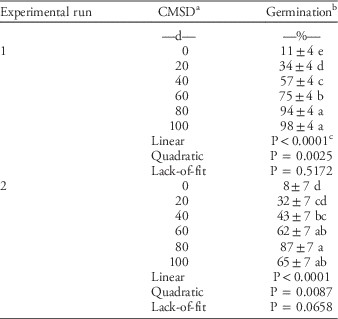
There was an effect of experimental run (P=0.0001) and the experimental run by CMSD interaction (P=0.0109) on American burnweed seed germination. Data for each experimental run were therefore analyzed separately. There was an effect of CMSD (P<0.0001) on American burnweed seed germination in both experimental runs. Germination increased quadratically with increasing CMSD (P ≥ 0.0025), and maximum germination occurred by 80 d CMS in each experimental run (Table 3). Germination decreased following 100 d CMS in Run 2, however, though reasons for this are unclear. Seeds were exposed to CMS in darkness, which should have optimized results (see Table 2). It is possible that prolonged exposure to CMS under experimental conditions reduced survival of some seeds. For example, germination of some Pacific silver fir (Abies amabilis) seed lots decreased when CMS was extended from 4 to 8 wk due to reduced germination of presumably low-vigor seeds (Leadem Reference Leadem1986). It is unclear whether seed vigor affected our results, particularly given the high levels of germination in successful treatments in most experiments. Nonetheless, data indicate that 80 to 100 d of CMS at the temperature used in this experiment are required to maximize American burnweed seed germination, and results are in general agreement with those reported above (Table 2). The duration of CMS required to release seed dormancy varies among plant species, but ranges from as low as 14 d in rigput brome (Bromus diandrus) (Kleeman and Gill Reference Kleeman and Gill2013) to >120 d in English sundew (Drosera anglica) and caterpillar flower (Phacelia secunda) (Baskin et al. Reference Baskin, Milberg, Andersson and Baskin2001; Cavieres and Arroyo Reference Cavieres and Arroyo2000). Baskin and Baskin (Reference Baskin and Baskin1996) reported that American burnweed seeds required extensive periods of burial and exposure to seasonal winter temperatures to break dormancy in Kentucky, United States, and our results support this finding and indicate that American burnweed seeds from wild blueberry fields in Nova Scotia, Canada, require extensive periods of cold stratification to break dormancy.
Effect of cold moist stratification duration (CMSD) on American burnweed seed germination.

a Storage in low-temperature incubator maintained at constant 4 C.
b Values represent the mean±1 SE. Means followed by the same letter do not differ significantly according to a Tukey’s multiple means comparison at the 0.05 level of significance.
c P-values obtained from polynomial contrasts of CMSD in PROC MIXED in SAS.
Effect of Exogenous GA3 and Nitrogen in Alleviating Dormancy
Effect of Exogenous GA3 on Germination
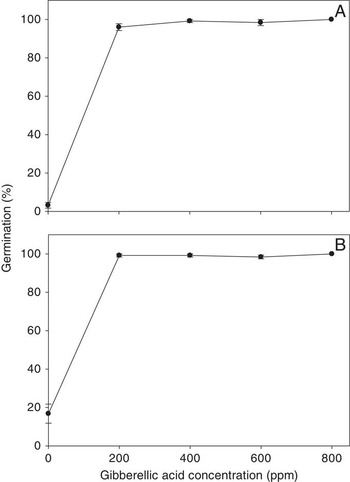
Germination data could not be analyzed due to lack of normality and constant variance, therefore data are presented separately for each experimental run. Seed treatment with GA3 at all concentrations increased germination of American burnweed seeds relative to the untreated control (Figure. 1). Germination was rapid, and more than 95% of seeds germinated by 15 d after initiation of the experiment in most of the GA3 treatments (unpublished data). In contrast, seeds treated with distilled water germinated slowly and had low final germination (<20%) (Figure. 1). The results of this experiment suggested that GA3 broke dormancy of American burnweed seeds and replaced the requirement for CMS. The GA3 concentrations used were also similar to those used to promote seed germination in other plant species (Balaguera-López et al. Reference Balaguera-López, Cárdenas-Hernández and Álvarez-Herrera2009; Page and Nurse Reference Page and Nurse2015). Combined with results of the physiological dormancy experiments above, American burnweed seeds exhibited non–deep physiological dormancy, defined as a form of physiological seed dormancy released by exogenous GA3 or stratification in cold or warm conditions (Baskin and Baskin Reference Baskin and Baskin2004; Finch-Savage and Leubner-Metzger Reference Finch-Savage and Leubner-Metzger2006).
Effect of gibberellic acid (GA3) concentration on American burnweed seed germination in (A) experimental Run 1 and (B) experimental Run 2.

Effect of Exogenous KNO3 on Germination
Germination data could not be analyzed due to lack of normality and constant variance; however, seed treatment with 5% KNO3 did not stimulate germination. Germination in the untreated control treatment ranged from 6 to 11%, but no seeds germinated following treatment with 5% KNO3 (unpublished data). Nitrogen stimulates seed germination in many plants (Cetinbas and Koyuncu Reference Cetinbas and Koyuncu2006; Wei et al Reference Wei, Zhang, Chen, Li, Sui, Huang, Cui, Liu, Zhang and Guo2010) and is thought to be a “gap detection” mechanism by which seeds of some plant species detect the absence of aboveground plants (Pons Reference Pons1989). The rapid occurrence of American burnweed following removal of established plant communities would suggest a potential role of this mechanism in regulating seed dormancy and germination, but our data suggest that light, rather than nitrogen availability, is probably the primary factor facilitating the detection of open ground by American burnweed seeds (Table 2). Fertilizer application in wild blueberry fields may therefore affect growth of established American burnweed plants but should not be expected to promote increases in germination and seedling density. It should be cautioned, however, that our results are limited to one KNO3 concentration. Dose–response experiments could be conducted to ensure lack of a role of nitrogen in regulating American burnweed seed dormancy, as fertilizer rates in wild blueberry can vary depending on nutritional requirements of the crop (Eaton et al. Reference Eaton, Sanderson and Fillmore2009).
Effect of Seed Coat Removal, Dry Heat, and Direct Flame in Alleviating Dormancy
Effect of Seed Coat Removal on Germination
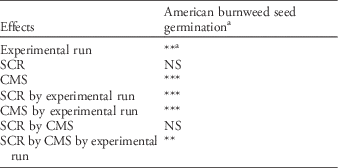
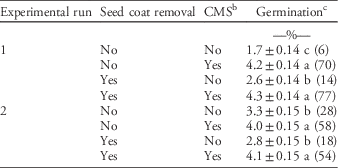
There were effects of experimental run and the interactions between fixed effects and experimental run on American burnweed seed germination (Table 4). Data were therefore analyzed separately for each run of the experiment. There was an effect of seed coat removal (P=0.0027), CMS (P<0.0001), and seed coat removal by CMS interaction (P=0.0092) on American burnweed seed germination in Run 1 of the experiment, but only an effect of CMS (P<0.0001) in Run 2 of the experiment. Seed coat removal without CMS increased germination slightly relative to untreated seeds in Run 1, but germination was highest in the CMS treatments regardless of seed coat removal (Table 5). In contrast, seed coat removal did not affect germination in the second run of the experiment, and germination was once again highest in seeds exposed to CMS regardless of seed coat removal (Table 5). The seed coat can play a role in dormancy control in seeds, as this impermeable layer regulates water and gas movement into the seed (Finch-Savage and Leubner-Metzger Reference Finch-Savage and Leubner-Metzger2006). Removal of the seed coat did not promote germination in our experiments, and physical dormancy therefore does not appear to be a dormancy mechanism regulating germination of American burnweed seeds in wild blueberry fields. Reasons for the slight differences in treatment effects across each run appear to be due to higher germination of untreated seeds in the second run relative to the first (Table 5), though reasons for this are unknown. Additional experiments could be conducted, but the effect of CMS is generally consistent across experiments, and seeds with true physical dormancy often do not respond to CMS until scarification of the seed coat (Pipinis et al. Reference Pipinis, Milios, Smiris and Gioumousidis2011). Furthermore, GA3 promoted germination (Figure. 1), which also generally does not occur in seeds with physical dormancy until after scarification (Fang et al. Reference Fang, Wang, Wei and Zhu2006; Rehman and Park Reference Rehman and Park2000). The role of physical dormancy in regulating American burnweed seed germination is therefore likely minimal.
Test of main and interactive effects of seed coat removal (SCR), cold moist stratification (CMS), and experimental run on American burnweed seed germination.

a Levels of significance obtained with PROC MIXED in SAS.
*P<0.05.
**P<0.01.
***P<0.001.
Effect of seed coat removal and cold moist stratification (CMS) on American burnweed seed germination.Footnote a

a Percent germination data were log transformed prior to the variance analysis. Transformed means are provided for means comparisons and variance estimates, and back-transformed means are provided in parentheses.
b Storage in low-temperature incubator maintained at constant 4 C.
c Values represent the mean±1 SE. Values in parentheses are back-transformed means. Means followed by the same letter do not differ significantly according to a Tukey’s multiple-means comparison at the 0.05 level of significance.
Effect of Dry Heat and Direct Flame on Germination
Germination data in the dry-heat experiment could not be analyzed due to lack of normality and constant variance, and data are therefore presented separately for each experimental run. Seed exposure to dry heat did not stimulate American burnweed seed germination. Germination ranged from 2 to 8% in the unheated treatments and was similar to untreated control treatments in other experiments, but no seeds germinated following exposure to 15, 30, 45, or 60 s of dry heat at the temperatures used (unpublished data). Duration of dry heat required to break physical dormancy can range from 1 to 60 min, depending on temperature (Baskin et al. Reference Baskin, Davis, Baskin, Gleason and Cordell2004). Seeds with dormancy that can be broken by dry heat, however, generally germinate following temperatures and durations similar to those used in our experiment (Baskin et al. Reference Baskin, Davis, Baskin, Gleason and Cordell2004; Herranz et al. Reference Herranz, Ferrandis and Martínez-Sánchez1998).
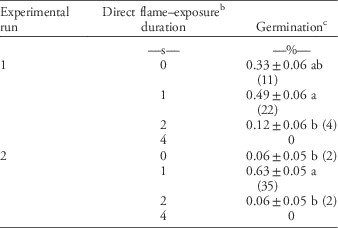
There was an effect of the experimental run by direct flame–exposure interaction on American burnweed seed germination (P=0.0043). Data were therefore analyzed separately for each experimental run. There was an effect of direct-flame exposure on germination in each experimental run (P≤0.0032). Germination increased following exposure to 1 s of direct flame (Table 6), indicating potential stimulation of germination by fire. This increase, however, was minimal when compared with increases following CMS (Tables 2, 3, and 5) and treatment with GA3 (Figure. 1). In addition, removal of the seed coat did not promote germination (Table 5), further supporting a lack of physical dormancy in American burnweed seeds. American burnweed occurs primarily in early successional environments following removal of established plant communities, particularly when plant communities are removed by fire (Eaton Reference Eaton1824; Pursh Reference Pursh1814; Torrey Reference Torrey1843). Our data, however, indicate that heat does not contribute to breaking American burnweed seed dormancy and that pruning wild blueberry fields by burning likely will not increase germination of this weed species. It should be noted, however, that other aspects of fire, particularly compounds released from smoke or charred wood, can stimulate seed germination (Dixon et al. Reference Dixon, Roche and Pate1995; Keely et al. Reference Keely, Morton, Pedrosa and Trotter1985). In addition, fires in field conditions would likely occur before or after exposure of some seeds to factors such as CMS, so potential interactive effects of dry heat, direct flame, and CMS on seed germination should also be investigated before ruling out potential effects of burning on germination.
Effect of direct-flame exposure on American burnweed seed germination.Footnote a

a Percent germination data were arcsine square-root transformed prior to the variance analysis. Transformed means are provided for means comparisons and variance estimates, and back-transformed means are provided in parentheses.
b Direct flame provided by bunsen burner with mean temperature of 497±35 C at top of flame.
c Values represent the mean±1 SE. Values in parentheses are back-transformed means. Means followed by the same letter do not differ significantly according to a Tukey’s multiple-means comparison at the 0.05 level of significance.
Investigations of potential physiological, chemical, and physical dormancy mechanisms indicate that American burnweed seeds collected from wild blueberry fields exhibit non–deep physiological dormancy. Seeds exposed to 90 d CMS followed by incubation in warm conditions and light had >90% germination, and germination was maximized following 80 d of CMS. Treatment with GA3 caused >95% germination in the absence of CMS, indicating that GA3 can overcome the requirement for CMS, a common characteristic of seeds with non–deep physiological dormancy. In contrast, seed treatment with exogenous KNO3, exposure to dry heat or direct flame, and removal of the seed coat, did not cause considerable increases in germination. Seeds therefore exhibited limited signs of significant chemical or physical dormancy mechanisms based on factors examined in this study, further supporting the presence of non–deep physiological dormancy as the primary dormancy-regulating mechanism in American burnweed seeds in wild blueberry fields.
Acknowledgments
We acknowledge the assistance of Fred Fergus in programming the low-temperature incubators, Debbie Mellish for providing the aseptic fume hood for preparing seeds, and Raj Lada for providing greenhouse space for rearing plant material required for the experiments.