

Introduction
The spread of information, communication and digital technologies can be used not only to promote social relations but also crime. In today’s environment, the number of tools and approaches for disruption is growing daily. This requires a prompt response on the part of internal affairs bodies (IAB) to such negative manifestations to eliminate and prevent them. In this case, the level of competence and skills of law enforcement officers, on which they base their activities, plays an essential role (Lai and Lisnek Reference Lai and Lisnek2023). The effectiveness of professional training of officers of IAB affects the development of a structured, competent and responsible workforce. Proceeding from this, it can be established that the issue of improving IAB personnel policy is a key issue in the context of ensuring public order and protection of the rights and freedoms of citizens in Kazakhstan and is relevant in the context of socio-political modernization.
Notably, IAB personnel policy encompasses different processes, namely recruitment, selection, training, career development and organizational management of law enforcers (Thielgen, Schade, and Niegisch Reference Thielgen, Schade and Niegisch2022). The essence of this policy is to attract professional staff into the public service based on developed values and skills. Thus, it is a priority to investigate the system of goals and objectives of legal support for the professional training of IAB personnel in Kazakhstan. This issue relates to standards and procedures in various law enforcement agencies, as well as attracting and retaining qualified officers. Furthermore, it reveals the vectors of personnel policy, which is the basis for controlling personnel work and improving the law enforcement management information system (Koerner and Staller Reference Koerner and Staller2021).
A problematic issue is the effective development of training programmes, according to which professional training and continuous professional development of law enforcement officers in Kazakhstan are carried out. Its solution will make it possible to raise the level of competence of IAB officers, as well as to ensure quality protection of public order in general. In scientific doctrine, this question is common among researchers who analyse its various elements. Biekenov, Nurushev, and Karakushev (Reference Biekenov, Nurushev and Karakushev2020) proved the expediency of organizational reform of the IAB educational training programme in connection with the spread of digital technologies. Therewith, the researchers did not provide concrete examples of tools and mechanisms based on which educational programmes should be reformed. Saitbekov and Khroni (Reference Saitbekov and Khroni2020) emphasized that improving the training of IAB officers in Kazakhstan impacts the country’s overall human resources policy. They believe that this process plays a significant role in the context of consolidating professionalism, integrity and productivity in law enforcement. The question of the main vectors, based on which the improvement of professional development of law enforcement personnel should take place, was not covered.
Biekenov, Tulkinbaev, and Brimzhanova (Reference Biekenov, Tulkinbaev and Brimzhanova2021) concluded that it is necessary to update the legislative framework regulating the procedure of professional training of law enforcers. Therewith, they did not cover the principles based on which the implementation of the law-making process should take place. Abilmazhinov (Reference Abilmazhinov2021) noted that the priority approach is to develop integrated educational strategies and programmes in areas such as criminal investigation, community policing, human rights, ethics and new technological developments. The issue of adapting the updated training programmes to the specific needs of IAB personnel remains unresolved. Shalgimbayev and Ualiev (Reference Shalgimbayev and Ualiev2020) concluded that the improvement of professional training of law enforcement officers should be based on the implementation of research activities and introduction of innovative teaching methodologies. However, they did not cover the mechanism of cooperation of the IAB with educational institutions as well as research centres.
Proceeding from the above, the purpose of this study was to examine the measures aimed at ensuring the professional training of IAB personnel, as well as improving their legal support. Several tasks were formed in this study: to determine the current vectors of professional development of law enforcement officers in Kazakhstan; to investigate their components; to reveal promising vectors for their improvement; and increase the professionalism of IAB officers in Kazakhstan.
Materials and Methods
The method of analysis was used to investigate the structure of the process of professional training of IAB personnel in Kazakhstan. On its basis, the study revealed the general principles of legal support of personnel policy of the law enforcement system in Kazakhstan. The analysis made it possible to cover the system of measures based on which primary training of IAB officers and advanced training of current employees takes place. This method was used in the study of tools to provide professional training for IAB personnel in Kazakhstan.
The method of synthesis was employed to express the dependence between the level of competence of law enforcers and the degree of protection of the population and public order in society. Based on this method, the system of personnel policy was characterized and the mechanisms providing its legal support in Kazakhstan were covered. Synthesis is necessary to form a unified approach to improving and reforming educational and professional policy in the context of training and retraining of law enforcement officers.
The deduction method was used to investigate the specifics of the process of professional development of IAB personnel. Based on general knowledge about educational and professional training of specialists, the specific features of law enforcement activity and professional skills necessary for its qualitative realization were covered. In addition, by means of deduction, the study identified concrete educational areas, mastering of which is a mandatory component of educational and professional training of law enforcers.
The formal–legal method was used to investigate the provisions of various regulations, which consolidate the provisions on training and competence development of law enforcers in Kazakhstan. Specifically, the following acts were considered in this study: the Law of the Republic of Kazakhstan No. 199-V ZRK “On Internal Affairs Bodies of the Republic of Kazakhstan” (2014);Footnote 1 the Law of the Republic of Kazakhstan No. 319-III “On Education” (2007);Footnote 2 the Decree of the Government of the Republic of Kazakhstan No. 125 “On Approval of the Rules for Training, Retraining and Advanced Training of Civil Servants, Requirements for Educational Organizations Providing Advanced Training for Civil Servants” (2018);Footnote 3 and the Decree of the Government of the Republic of Kazakhstan No. 249 “On Approval of the Concept for the Development of Preschool, Secondary, Technical, and Vocational Education of the Republic of Kazakhstan for 2023–2029” (2023).Footnote 4
The method of comparison was used to study the practices of other countries concerning the professional training of law enforcement officers. On its basis, the study identified the specifics of the development of professional competence of IAB personnel in France, Poland and Germany. Accordingly, training approaches were cited, as well as tools different from those used in Kazakhstan.
The method of generalization was employed to identify promising vectors of improvement of the current personnel policy in the law enforcement sphere of Kazakhstan. Based on this method, the study identified the shortcomings that should be eliminated to improve the efficiency of the IAB training process, as well as to improve the performance of the entire law enforcement system.
The abstraction method was used to investigate the essence of professional activity of IAB personnel. Based on this, the study expressed the skills that law enforcers must acquire in their professional development as well as advanced training.
Results
The system of approaches to developing and improving the effectiveness of legal support for the professional training of IAB personnel in the Republic of Kazakhstan (RK) consists of two main vectors, namely the legislative framework and the development of training programmes. This list is not exhaustive, as its components are broadly structured and include various mechanisms and instruments. Accordingly, the legislative framework underlies the process of developing programmes and principles of professional development of police officers of the RK. It defines not only the priority objectives of the process, but also regulates how it is to be implemented. The system of the legislative framework includes laws and regulations, as well as instructions directly related to the specifics of professional training of IAB personnel. The content of the above-mentioned regulations includes provisions that imply ensuring the competence, professionalism, as well as honesty of law enforcement officers.
For instance, it is advisable to cite the Law of the Republic of Kazakhstan No. 199-V ZRK “On Internal Affairs Bodies of the Republic of Kazakhstan” (2014),Footnote 5 which establishes the basic values and foundations of the activities of employees of IAB of the RK. This regulation concerns not only the training stage, but also the direct fulfillment of professional competence by IAB personnel. Thus, it contains the role of law enforcement officers to ensure public order, protect public safety, and prevent and combat crime. The above-mentioned law provides the legal foundation for the recruitment, professional training and advanced training of IAB personnel.
Another element of the legislative framework covering the sphere of professional qualification of law enforcers of Kazakhstan is the Law of the Republic of Kazakhstan No. 319-III “On Education” (2007).Footnote 6 This regulation defines the general principles and methods of developing educational programmes, including in the context of IAB training. The specified law covers requirements for the provision of vocational education as well as the development of standards for curricula. It is on their basis that the methodology of professional training of police officers in educational institutions of law enforcement agencies of the RK is formed.
Special rules, manuals and instructions detailing the provisions of the above-mentioned laws are also widespread in the RK vocational training system. Notably, they are presented by authorized bodies to improve the effectiveness of the implementation of the general principles of developing professional competence among law enforcement officers; for example, the Rules contained in the Decree of the Government of the Republic of Kazakhstan No. 125 “On Approval of the Rules for Training, Retraining and Advanced Training of Civil Servants, Requirements for Educational Organizations Providing Advanced Training for Civil Servants” (2018).Footnote 7 The main provisions prescribed in this document are aimed at consolidating the idea of continuous training, continuous professional growth and development of service activities in the personnel of the IAB of the RK. Importantly, these Rules define not only vocational training programmes, but also retraining and professional development programmes. They contribute to the training of qualified and competent law enforcement officers, whose level of knowledge and skills directly affects the effectiveness of their professional tasks. Thus, there is a direct correlation between the level of professional training of RK police officers and the degree of implementation of the State law enforcement function. Accordingly, through the approval of such Rules, the Government of RK ensures the development of the institution of professional development of civil servants, including representatives of law enforcement agencies. This decree also stipulates specific requirements according to which vocational schools must implement their activities. An example of such principles is the relevance and high quality of study programmes, which should be constantly updated and meet the interests of education seekers.
The implementation of the processes of training, retraining and advanced training of civil servants can take place only on the bases of accredited educational organizations that meet certain standards. In these institutions, training programmes are developed considering the specific needs and demands of IAB civil servants. This helps to effectively define vectors of professional training, specificity of training plans and tools for qualitative assessment of training effectiveness. Thus, there is a combination of a systematic and scientific approach to providing professional learning for IAB staff and aligning them with the strategic goals of the IAB (Wolfe et al. Reference Wolfe, McLean, Rojek, Alpert and Smith2022).
As for the content of the training programmes developed for the professional training of police officers in Kazakhstan, the programmes are based on an integrated and interdisciplinary approach. Thus, they cover such educational areas as law enforcement, human rights, ethics, leadership, modern technology and forensics. An essential part of the educational and professional process is the assessment of the level of student learning and the quality of the entire curriculum. In this regard, there are bodies in Kazakhstan to ensure that educational institutions are monitored for compliance with certain standards (e.g. analysis of the functional and organizational structure of staff training in the Ministry of Internal Affairs of the Republic of Kazakhstan). Examples of such compliance monitoring include regular assessments, audits, and monitoring of the effectiveness of the training programmes and the conditions in which the training takes place. Based on the results of these activities and assessments, problems and areas of training that require improvement are identified, thus not only eliminating shortcomings, but also increasing accountability and transparency in the IAB personnel system.
Importantly, the legislative framework has formed prerequisites and mechanisms for the implementation of not only educational and professional training of future law enforcers, but also professional development of current employees. This is evidence of the development and spread of the idea of continuous training of IAB personnel in the RK. The requirement to constantly update and improve the level of professional competence of law enforcement officers has a positive impact on the overall development of the IAB system. Through seminars, workshops and conferences, IAB personnel representatives can acquire new knowledge necessary for the successful fulfilment of their professional duties in the modern information society. As a result, it is possible to maintain the level of training of the police in Kazakhstan at a prominent level, which implies mastery of the latest methods, technologies and legal developments.
The described regulations prove the priority of continuous training of civil servants in the RK, including law enforcement officers. This is necessary for these actors to acquire the suitable level of knowledge and skills based on which they will be able to perform their professional and official duties in a quality manner. In doing so, it is important to follow a systemic approach that combines such processes as training, retraining and professional development of IAB personnel. At each of them, it is necessary to update the scope and nature of tasks to meet the current conditions of socio-political modernization of the State.
Special attention should be paid to the mechanism for developing training programmes, as it is also an essential element of the process of educational and professional training of IAB personnel, as well as their retraining. Its essence is to create and continuously update the content of training materials and standards based on which the professional development of law enforcement officers in Kazakhstan takes place. When developing training programmes, it is important to properly define the goals and objectives so that they fully encompass the vectors of law enforcement activities.
For example, it is expedient to cite the Decree of the Government of the Republic of Kazakhstan No. 249 “On Approval of the Concept for the Development of Preschool, Secondary, Technical and Vocational Education of the Republic of Kazakhstan for 2023–2029” (2023),Footnote 8 which laid the foundation for the development of vocational education for the future. Its provisions consider the specific features of the provision of different branches of education, which makes it possible to use the standards of activity of technical and professional educational institutions. The Concept pays special attention to international experience, namely its priority importance for the integration of the best foreign practices in higher education into the educational environment of the RK. These provisions also include the sphere of professional training and retraining of the IAB personnel, as they define the principles and tools for its effective implementation.
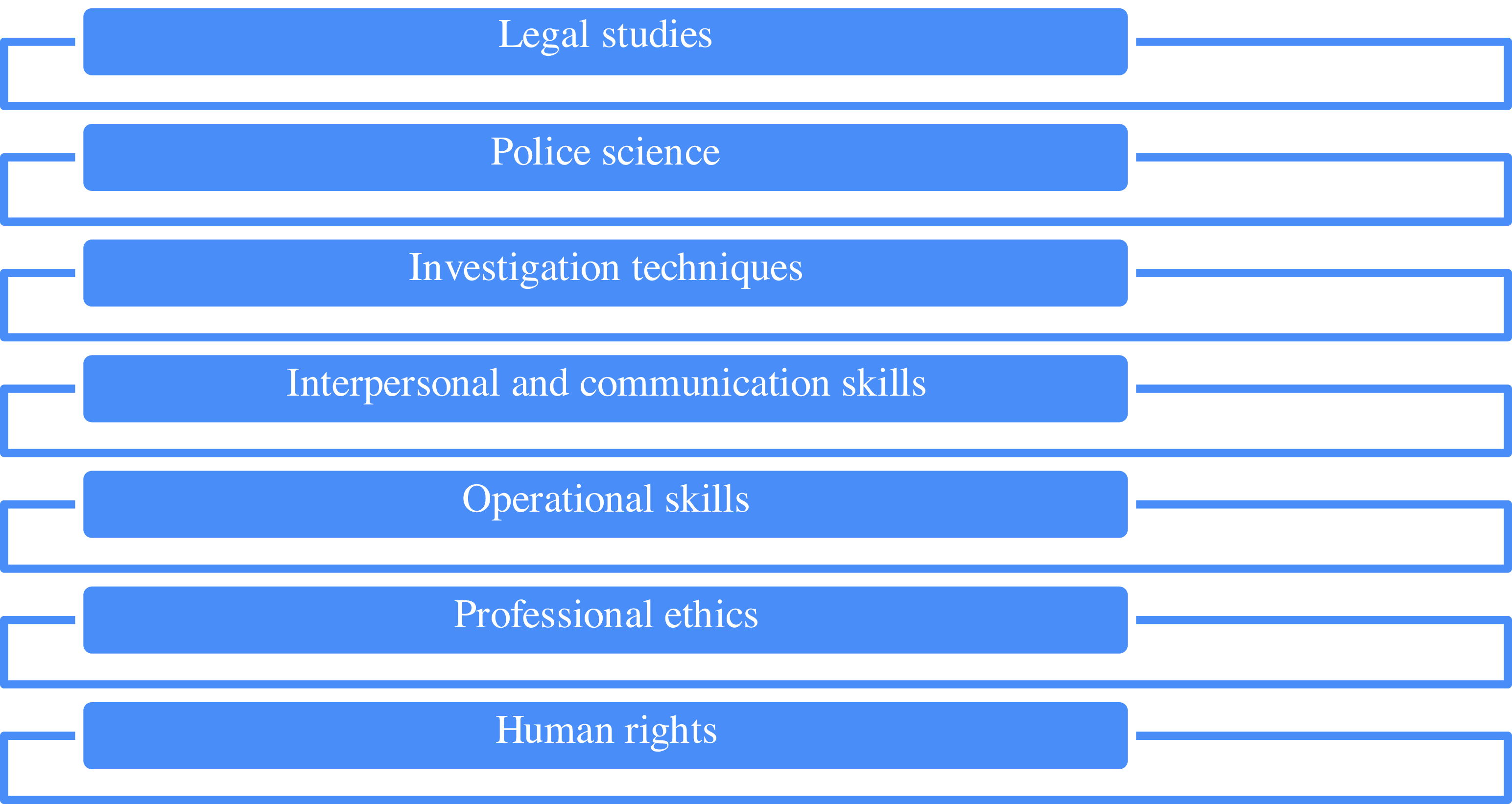
As for the IAB RK training programme itself, they are aimed at both their initial professional training and advanced training. The curriculum is structured around a set of theoretical, practical and field exercises. Concrete training disciplines may differ from one educational institution to another, due to the specific nature of the law enforcement agency and the position for which persons are being trained. Apart from specific training disciplines, the Concept identifies common training vectors for law enforcers (Figure 1).
General educational areas of professional training of internal affairs bodies personnel in the Republic of Kazakhstan.
Source: Compiled by the authors of this study.

The first category includes the process of researching the provisions of national and international legal instruments, criminal law, procedure and justice systems. As for police science, it involves studying the structure and tasks of the police; the specifics of its interaction with the public; approaches to preventing criminal offences; and mastering police ethics. The purpose of this training vector is to consolidate the foundations and practices of effective implementation of police work. When mastering investigative techniques, law enforcement officers explore the methodology that is the foundation for solving criminal cases. This process includes: work with criminals caught in the act; collecting and preserving evidence; forensics; learning interrogation techniques; and managing a criminal case. Operational skills include patrolling, traffic law enforcement, use of firearms where appropriate and tactical training. In addition, during IAB personnel training, special attention is paid to the development of their communication and interpersonal skills. This is necessary to ensure effective interaction of law enforcers with the public, colleagues and other actors. Such skills can be used not only as effective methods of communication but also for conflict resolution. A related educational area is the subject of professional ethics and human rights, in which law enforcement officers learn the principles of ethical behaviour, integrity and respect for human rights. In this way, qualities such as professionalism and responsibility are nurtured in IAB personnel (Cohen Reference Cohen2022). Proceeding from the above, it can be established that the law enforcement training programme, as well as the improvement of their professional competence, aims to provide the IAB personnel system with competent, moral and responsible professionals (Harris et al. Reference Harris, Borcan, Serra, Telli, Schettini and Dercon2022). This is a vital component of the effective future development of the RK, namely ensuring its security, defence and welfare.
Having investigated the approaches to improving the legal support of professional training of law enforcement officers in the RK, it is advisable to pay attention to international practices, namely of France, Poland and Germany. In France, the police function is performed by two bodies, namely, The National Police and the National Gendarmerie (Kleygrewe et al. Reference Kleygrewe, Oudejans, Koedijk and Hutter2022). The requirements for the implementation of the training process for police officers of all ranks and categories are enshrined in various regulations. For example, police commissioners are obliged not only to obtain a master’s degree from any European Union civilian institution of higher education, but also to take an operational police course at the French Higher Normal School. Thus, the law enforcement training system in France consists of two links after which individuals can obtain such titles: commissioners; chief commissioners; and divisional commissioners. The functions of the French police are comparable to those assigned to IAB personnel in Kazakhstan, as they relate to the prevention of offences as well as their investigation. Thus, they are involved in the search for persons, their apprehension and the transfer of the accused to the judicial authorities.
In Poland, the police have the status of an armed organization whose main purpose is to serve the public, ensure the safety of citizens, and maintain law and order in society. Law enforcement training is phased and takes place in field and training units. Within the framework of this process, they are first interviewed, then solve general knowledge tests, demonstrate fitness levels, solve psychological tests and undergo a specialized medical examination (Bertrandt et al. Reference Bertrandt, Anyżewska, Łakomy, Lepionka, Szarska, Tomczak, Gaździńska, Bertrandt-Tomaszewska, Kłos and Maculewicz2022). Based on the results of professional training, law enforcers may be appointed for the period of preparatory or candidate service; for the period of contract service; or indefinitely. Thus, a person receives their first police rank in the junior officer corps of the Polish police. To obtain it, several conditions must be fulfilled, namely: compliance with the above conditions; and successful completion of training at the Higher School of Police.
The training system for police officers in Germany is based at the German Federal Police Academy. The latter includes five federal police training and development centres; two federal police sports schools; a maritime police training centre; two schools for the training of cinematographers; and a specialist team training centre (Staller et al. Reference Staller, Koerner, Heil, Abraham and Poolton2023). The academy is structured with five academy selection offices. Just as in Kazakhstan, police training in Germany is based on a defined curriculum. The duration of its implementation is two and a half years. Educational and professional training involves learning the basics of law enforcement theory and practice. After this stage, the law enforcers serve in practical police units and later take a police officer exam.
Proceeding from the above, it can be established that the process of professional training of IAB personnel, as well as improvement of their competence, is an essential component of the protection of society in different countries. Law enforcers are entrusted with duties aimed at ensuring the safety of the population and respect for their rights and freedoms.
Discussion
The process of professional training of IAB personnel has an impact on the level of protection of the population, as well as the observance of law and order in it. Thus, the development of highly qualified law enforcers is a critical condition for ensuring the activity of IAB and the security function of the State. There are different opinions in the scientific doctrine concerning the issue of improving the legal support of professional training in the IAB. Lockie et al. (Reference Lockie, Dawes, Orr and Dulla2020) believe that to improve the effectiveness of law enforcement training, continuous updating and improvement of standards must be implemented. They substantiate this position by the fact that modern socio-political relations are dynamic and require specific legal regulation. That is why researchers believe that professional training of IAB personnel should take place based on up-to-date regulatory framework and standards, respectively, establishing the procedure for the implementation of this process. An analogous conclusion was obtained within the framework of this study, as it also noted the priority of updating the norms of legislation, as well as bringing them in line with the challenges existing in the modern legal society. Researchers have found that an effective way to update regulations and standards is to utilize foreign best practices. Thus, common between the findings of both studies is the position on the necessity to investigate international standards in the field of development and provision of training programmes for law enforcement officers in order to implement them in the system of professional education in Kazakhstan.
Accreditation and quality control of education are also a vital part of the activities of educational institutions. This position is held by Hilal and Litsey (Reference Hilal and Litsey2020), who believe that to improve professional training and retraining of law enforcers, it is advisable to strengthen accreditation mechanisms. In their study, the researchers argue for the priority of identifying and fixing clear criteria for the training programmes, in which IAB personnel receive knowledge and skills. The article also highlighted the importance of monitoring and evaluating the quality of professional training to objectively establish whether curricula and arrangements meet the established standards. Accordingly, the conclusion common to both studies is that through systematic monitoring and inspection of educational institutions designed for professional training and advanced training of law enforcement officers, it is possible to identify shortcomings in them in a timely manner and take measures to eliminate them. Furthermore, this approach will highlight new educational vectors within which law enforcement officers can update their skills and knowledge to effectively perform their professional tasks in the modern environment.
It should be established that the organization of effective training implies the creation of appropriate conditions for applicants for professional training. A similar position is held by Okhrimenko et al. (Reference Okhrimenko, Yevdokimova, Shvets, Pakhomova and Fediy2020), who focused on the development of learning infrastructure. According to researchers, this is an essential prerequisite for improving the entire system of professional training of law enforcers, as well as improving their qualifications. They point out that the level of provision of learning spaces, as well as the development of educational tools, directly affects the motivation of education seekers. This position is common with the one revealed in this study, which also highlighted the priority of upgrading and renewing specialized educational institutions that train and retrain police officers. Importantly, the infrastructure of learning has a substantial impact on one stage of learning, namely the practical stage. Accordingly, its implementation requires modern equipment and technology to enable law enforcement officers to hone their skills through practical exercises. The joint conclusion between these studies is that investments in training infrastructure lead to the implementation of innovative mechanisms and educational devices, which is reflected in the improvement of the educational and professional training process.
Partnerships, communication and exchange of experience form an integral part of the training process for professionals, including law enforcement officers. According to McLean et al. (Reference McLean, Wolfe, Rojek, Alpert and Smith2020), the interaction of IAB with educational and training institutions is one of the key links in improving the professional training of active police officers. Researchers found that partially integrating the activities of different law enforcement agencies can have a positive effect on their overall effectiveness. This study also found that involving stakeholders in the training process is an effective approach in the context of improving legal support for law enforcement training. Researchers showed that developing and securing partnerships are an element of the global process of sharing best practices, knowledge and skills. Thus, what the two studies have in common is that they prove the priority of using collaborative efforts of different institutions in shaping specialized curricula. Examples of such educational activities could be various exchange programmes, the organization of team research initiatives, and the holding of scientific and practical conferences to identify vectors for improving the overall quality of professional training for law enforcement officers.
The work of IAB personnel is specific, as it requires constant adaptation to dramatic changes in approaches to the fulfilment of professional duties. Gundhus, Talberg, and Wathne (Reference Gundhus, Talberg and Wathne2022) argued that this relates to digitalization processes that affect not only the progress of social relations, but also the expansion of tools for committing crimes. In this regard, researchers note the priority of continuous training and professional development of IAB personnel. This was also mentioned in the present paper, and it was also noted that updating the body of knowledge and skills contributes to the effectiveness of a law enforcement officer’s work activities. According to the researchers, it is possible to ensure continuous learning by implementing systematic and structured programmes that include exercises and resources for professional development and related career progression. Thus, what is common between the findings in both papers is that they reveal a direct link between the encouragement of lifelong learning and the consequent entrenchment of a culture of professional development. As a result, it is possible to ensure not only the improvement of competence of an individual law enforcer, but also to improve the efficiency of the entire IAB personnel system.
The various approaches to improving the legal support for the professional training of law enforcement officers involve highlighting problems and shortcomings in current training programmes. The same opinion is held by Henning (Reference Henning2023), who believes that regular evaluation and supervision are an integral element of the educational and professional process. Henning (Reference Henning2023) substantiates this position by arguing that to identify the necessary vectors of improvement in plans and standards, it is necessary to first highlight the areas that require updating. This is a joint finding between both studies as the present paper also highlighted the priority of obtaining feedback in establishing the level of effectiveness of training programmes. Henning (Reference Henning2023) proved that implementing regular monitoring activities can help to identify problems promptly and prevent them from spreading further. The common conclusion in the studies is that monitoring can be carried out based on a survey, analysis, interviews and observation. The results obtained during these activities can be used to develop updated training programmes and standards for the professional training of law enforcement officers and their professional development.
Proceeding from the above, it can be established that legal support of professional training in IAB plays a crucial role in the context of improving the competence, ethics and professionalism of law enforcement officers in general. Researchers take the common position that the level of training has an impact on the entire law enforcement system.
Conclusions
As a result of the conducted study, it was found that the development of personnel policy in the system of IAB of the RK has an impact on the effectiveness of law enforcement officers and the protection of the population as a whole. Ensuring the professional development of law enforcement officers involves the following processes: planning, monitoring, analysing and developing standards related to the qualifications of employees and the specifics of the law enforcement agency’s activities. It was found that a unified personnel policy in the IAB system has been developed and is in force in the RK, which makes it possible to ensure the management of specialists according to the general vectors of development of the State personnel policy. The study also highlighted the priority of systemic monitoring to assess the effectiveness of IAB professional training. When deficiencies are identified, measures are implemented to optimize human resources and the entire educational environment.
The study paid special attention to the processes of development and updating of standards and regulations, based on which the educational and professional training of law enforcers takes place, as well as improvement of their qualification level. It was established that a prerequisite for the qualitative development of IAB personnel is the constant reforming of training programmes to adapt them to the variable needs of society. The study also highlighted the importance of training infrastructure, namely the creation of a quality environment in which theoretical, practical and field training can be effectively combined. It is essential to create appropriate conditions not only for training, but also for the future activities of law enforcement officers, to provide them with the opportunity for continuous professional development.
Proceeding from the above, the qualitative determination of vectors of IAB personnel policy development will ensure the professional, ideological and moral development of law enforcers. As a result of individual improvement of the level of professional competence of law enforcement officers, it is possible to influence the efficiency and success of the entire structure of the IAB of the RK. Protection of the constantly changing socio-political situation in the RK depends on the activities of the IAB. Future research should identify ways of involving artificial intelligence in professional training for IAB personnel to improve their competence.
Competing interests
None.
Kalizhan Koblandin is a researcher at the Faculty of Postgraduate Education, Karaganda Academy of the Ministry of Internal Affairs of the Republic of Kazakhstan named after Barimbek Beisenov. Research interests include security, human rights and law.
Zhanatbek Kanatbekuly is a researcher at the Faculty of Postgraduate Education, Karaganda Academy of the Ministry of Internal Affairs of the Republic of Kazakhstan named after Barimbek Beisenov. Research interests include protection of society, principles of justice and the rule of law.