South Africa, a country with a checkered colonial and post-colonial past, achieved an inclusive human-rights-based Constitution (Republic of South Africa [RSA], 1996) that promised a new equitable socioeconomic order and, of particular interest here, the promotion and development of multilingualism. One arm of government, the Department of Arts, Culture, Science and Technology (DACST) was tasked with setting out the terms of reference for new language policy across various domains of the public sector. A consultative national Language Plan Task Group (LANGTAG) drew together linguists, sociolinguists, and applied linguists who charted a new orientation towards multilingualism (DACST, 1996)
One of the most urgent projects of the new government was to articulate new education policy based on the principles of equal access, provision, and respect for languages, particularly the 11 designated as official languages in the Constitution plus South African Sign Language. The two most significant policy documents for this discussion, one for language (Department of Education [DoE], 1997a) and one for new curriculum policy (DoE, 1997b), followed shortly thereafter. This iteration of multilingual education policy followed the earlier missionary provision of education in several African languages from the late 19th century onwards and a more elaborate, ideologically motivated and segregationist version of multilingual education during apartheid (1948–1994). Whereas multilingual education, then conceived of as separate schools for speakers of different mother tongues (mother-tongue education in multiple forms), was designed to support political and socioeconomic segregation, post-apartheid multilingual education was intended to support nation building and socioeconomic equity (DoE, 1997a, 1997b; Department of Basic Education [DBE], 2013b).
Ideological fault lines, language education policy, and curriculum changes and research that have led to the most recent developments are traced in this article. It concludes with a brief discussion of the most recent reconsiderations within government of how to implement multilingualism in education subsequent to two decades of ineffective measures (DBE, 2011a, 2013b).
Owing to the complexity of the debates in South Africa, it is necessary to offer some contextual knowledge of the past in order to understand the present. The discussion begins therefore with a brief historical discussion of multilingual education under apartheid and subsequent late 20th-century political and educational change. This is followed by an analysis of a failure of articulation between the language in education policy (DoE 1997a) and three iterations of new curriculum and assessment policy between 1997 and 2012: Curriculum 2005 (DoE 1997b), the Revised National Curriculum Statement (DoE, 2002), and the Curriculum and Assessment Policy Statement (CAPS) (DBE, 2011a). Following its own commissioned research on the causes of student failure (DBE, 2013a), the DBE unexpectedly announced a new iteration of (draft) language education policy (DBE, 2013b). In this, there is a re-emphasis of a commitment to the teaching of African languages and an explication of the principles of the 1997 policy contextualized in relation to the last decade of research on mother-tongue, bilingual, and multilingual models of education in Africa (e.g., Ouane & Glanz, Reference Ouane and Glanz2010, Reference Ouane and Glanz2011).
LINGUISTIC DIVERSITY: A CONTESTED SITE
Competing Interests
Language education policy (monolingual, bilingual, and multilingual) and its implementation through the schooling system of South Africa has been a controversial matter for more than a century. Since 1953, the point at which education policy shifted towards a particularly segregationist paradigm, it has been contested by civil society, policymakers, political stakeholders, and educators. The origins of contested positions towards and understanding of the nature of linguistic diversity lie within a colonial history in which there were competing interests in education between indigenous communities and those of colonial migrants to the country. See also du Plessis (Reference Du Plessis, Cuvelier, du Plessis and Teck2003) and Webb (Reference Webb, Cuvelier, du Plessis, Meeuwis, Vanderkerckhove and Webb2010).
The first area of contestation has to do with the mechanisms used to identify and codify written forms of African languages by various missionary groups in the 19th century. This has led to claims and growing argument that African identities and languages were invented or at least constructed as discrete language forms through unscientific linguistic endeavor. (The origins of this debate may be traced to Makoni, Reference Makoni, Makoni, Smitherman, Ball and Spears2003, and more recently to Makoni & Pennycook, Reference Makoni, Pennycook, Martin-Jones, Blackledge and Creese2012.) Apartheid government made convenient use of the missionary and arguably flawed constructions of African languages to keep ethnolinguistic communities separate from one another through an education policy based on the use of the mother tongue as the medium of instruction throughout primary school for each ethnolinguistic group between 1955 and 1976 (e.g., Stroud & Heugh, Reference Stroud, Heugh, Freeland and Patrick2004).
The second area of contestation has to do with the prominence of English within the ecology of languages in education. Following the Anglo-Boer War (1899–1901), resistance from the “White” Dutch- (later Afrikaans-) speaking community contributed to an attempt to limit opportunities for access to English through education for African children. In addition to mother-tongue medium in primary school, between 1955 and 1976, African language-speaking students were obliged to take half of their secondary school subjects through the medium of Afrikaans, thus minimizing the use of English. African students, however, wished to study entirely through English in secondary school and to begin the transition to English by the fifth grade of primary. African resistance, which escalated against apartheid education from the late 1970s, is associated with a rejection of mother-tongue education (i.e., in the upper primary years), antipathy towards Afrikaans, and a particularly strong aspiration towards English (e.g., Alexander & Heugh, Reference Heugh1999; Fleisch, Reference Fleisch2008; Ridge, Reference Ridge and Ricento2000).
During the constitutional negotiations between 1992 and 1995, three ideological views of language were placed on the table: segregationist, assimilationist, and integrationist (Heugh, Reference Heugh and Mesthrie1995). The co-existence of many languages, viewed as discrete entities, was regarded as a problem, yet languages were also regarded as part of a set of human rights. Within this political context, it was likely the ideological framing of language would continue within the first ideology, a separatist paradigm in which the rights of each ethnolinguistic group, even if this construct were flawed, would be protected. A second possibility was that owing to concerns that multiple languages might be difficult to manage, and a co-occurring view that English was the language of greatest aspiration, an assimilation-to-English paradigm was also likely. The third possibility was that if languages were to be regarded as resources, then the functional use of multilingual systems of communication (both vertical and horizontal, i.e., conventionally understood language systems and the channels of communication between language systems) might prevail (DACST, 1996; Heugh, Reference Heugh and Mesthrie1995, Reference Heugh1999). This last option was least likely. Sociolinguistic critiques of the ideologies of language as constructed for school education were in their infancy both in the South African context and elsewhere at the time (see also Stroud & Heugh, Reference Stroud, Heugh, Freeland and Patrick2004).
The constitutional framing of language was such that it fell into the multiple parallel understanding of language(s) and that within this framing, multilingualism was to be promoted and developed. The emphasis of responsibility was towards previously disadvantaged languages and particularly those African languages designated official and previously identified under apartheid. In practice, the government opted for a combination of the first two perspectives: A continuation of the segregationist apartheid view of languages as separate entities, but since it was thought that the use of 11 official languages might be impractical, gradual assimilation to English was inevitable (Alexander & Heugh, Reference Heugh1999). Multilingualism was to be viewed, at least in education, as multiple forms of monolingualism, or parallel and separate systems (Heugh, Reference Heugh2003; Makoni, Reference Makoni, Makoni, Smitherman, Ball and Spears2003; Makoni & Pennycook, Reference Makoni, Pennycook, Martin-Jones, Blackledge and Creese2012) and understood as such more recently by other scholars (e.g., Prinsloo, Reference Prinsloo, Leung and Street2012). African languages were to be supported to the end of the third year of primary school. Thereafter, African language-speaking students were to be led via the curriculum towards a switch from home language medium to English medium education, thus implementing a model with both separatist and assimilationist trajectories (Heugh, Reference Heugh and Rassool2007).
A long-term consequence of apartheid language policy has been that owing to the privileging of Afrikaans and the insistence that African students should have mother-tongue education through primary school until 1976, mother-tongue education came to be stigmatized. It was seen as designed to limit the socioeconomic opportunities of African people as well as to limit access to English. As is the case elsewhere (e.g., Coleman, Reference Coleman2011), English, however, was positioned as the language that would provide access to socioeconomic empowerment and access to the concerns of global citizens. Despite the Constitution (RSA, 1996), which sets out the principles of linguistic equality and of 11 official languages, policy documents—until the most recent document from DBE (2013b)—have positioned English, rather than African languages, as the avenue towards what Bourdieu (Reference Bourdieu1991) might term symbolic and material capital (e.g., Heugh, Reference Heugh2009a). A lingering ambiguity regarding the role and value of African languages as evident in government education policy documentation (as discussed below) compromised the implementation of contemporary language education policy between 1994 and 2013. In essence, the segregationist and assimilationist views were conflated and together have influenced the trajectory of the way multilingual education policy has been understood and implemented (or not) since 1994 (e.g., Heugh, Reference Heugh and Rassool2007, Reference Heugh2009a).
Cleavage Between Language and Curriculum Policy
The language education policy and curriculum policy documents were originally influenced and drafted by two sets of stakeholders, with very different understandings of multilingualism (De Klerk, Reference De Klerk2002). Drafting of language education policy emerged subsequent to the consultative LANGTAG process, in which a broad range of socio- and applied linguists contributed to discussions about the nature of multilingualism and the trajectory of implementing a policy of multilingualism. Here the view of language as a resource and functional multilingualism, which includes both the channels of communication between languages communities and the conventionally perceived constructs, prevailed (DACST, 1996; G. De Klerk, Reference De Klerk2002). Socio- and applied linguists involved in the LANGTAG process were included in the drafting of the language education policy, but excluded from the curriculum discussions where languages were considered to pose challenges for teaching and to be a series of separated entities, as had been the case during apartheid (e.g., G. De Klerk, Reference De Klerk2002; Heugh, Reference Heugh2003).
A fundamental principle that informed the language in education policy document was that school students should have equal access to the curriculum, and that this might be best achieved through a national system of additive bilingual or multilingual education. In theory, this would also offer African students the most viable opportunity to develop their English language proficiency (DoE, 1997a; G. De Klerk Reference De Klerk2002). While the policy document included these principles, the explanatory texts that contextualized what this might mean in practice were removed from the document during the editing processes within the national DoEFootnote 1 on the basis that these would be incorporated in a language in education implementation plan that was to follow. Despite consultative meetings including a wide range of stakeholders in 1998 (e.g., Heugh, Reference Heugh1998), this implementation plan was never finalized. Contributions to the implementation plan had been informed by classroom-based research in relatively linguistically homogeneous settings as well as in more linguistically diverse urban settings (e.g., Agnihotri, Reference Agnihotri, Heugh, Siegrühn and Plüddemann1995; Robb, Reference Robb, Heugh, Siegrühn and Plüddemann1995; Versfeld, Reference Versfeld, Heugh, Siegrühn and Plüddemann1995).Footnote 2 However, although the term “mother tongue” was replaced in the new education policy documentation by the term “home language,” the residual stigma of apartheid mother-tongue education led to a misunderstanding that a policy that advanced the use of the home language as the language of learning and teaching (LoLT) alongside English was too close to policy of the previous regime (e.g., Fleisch, Reference Fleisch2008; Ridge, Reference Ridge and Ricento2000).
While there is ample evidence of the educational efficacy of bi- and multilingual education in the use of African languages alongside English in South Africa and elsewhere in Africa and beyond (e.g., Bamgbose, Reference Bamgbose2000), and included along with more recent research (Ouane & Glanz, Reference Ouane and Glanz2010, Reference Ouane and Glanz2011; Skutnabb-Kangas & Heugh, Reference Skutnabb-Kangas and Heugh2012), this evidence has been difficult to accept for many stakeholders in South Africa (e.g., Fleisch, Reference Fleisch2008; Murray, Reference Murray and Mesthrie2002; Ridge, Reference Ridge and Ricento2000; Taylor & Vinjevold, Reference Taylor and Vinjevold1999). The result has been that although the principle of additive multilingual education has found its way into the initial pages of each iteration of new curriculum documentation, it has not been implemented as such (e.g., Plüddemann, Reference Plüddemann2013), as will be discussed below.
CURRICULUM CHANGES AND MULTILINGUAL POLICY
Between 1994 and 2013, there have been three attempts to modernize and transform curriculum and assessment policy, and until June 2013, only one attempt to change language policy. The first two attempts at curriculum change and the attempt to change language policy were resounding failures (Dada et al., Reference Dada, Dipholo, Hoadley, Khembo, Muller and Volmink2009; Ramphele, Reference Ramphele2008). As discussed below, the third attempt at curriculum transformation has some promising dimensions to it; however, serious flaws in regard the interpretation of language learning theory continue to be evident in curriculum documentation emerging from the national DBE (Dada et al., Reference Dada, Dipholo, Hoadley, Khembo, Muller and Volmink2009; DBE, 2011a).
Good Intentions, Mistaken Remedies
As suggested above, the first strategic mistake was that the language education policy (DoE, 1997a) discussions were kept separate from and not included within debates on curriculum (DoE, 1997b) and assessment change (e.g., Heugh, Reference Heugh1999, Reference Heugh and Rassool2007). A second mistake was that within the curriculum discussions, language was treated as a subject, while its role as a language of learning across the curriculum received little attention. The third, related, error was that in the curriculum documentation literacy was conceptualized as largely independent of the language(s) through which reading and writing take place in school. A fourth error has to do with terminological slippage in relation to what is meant and what is understood by “multilingual education,” “multilingual schools,” “home language” conflated with apartheid “mother-tongue education,” “additive bilingual,” and “additive multilingual” education. Terminological confusion precipitated misunderstandings where educationists misinterpreted additive bilingual education (based on the home language plus English) to mean either the home language or English (e.g., Fleisch, Reference Fleisch2008; Ridge, Reference Ridge and Ricento2000; Taylor & Vinjevold, Reference Taylor and Vinjevold1999).Footnote 3 The concern that the provision of home language education alongside English for African school students would be interpreted as a return of apartheid education was evident even at the level of senior advisors on literacy to the national Minister of Education (Heugh, Reference Heugh, Skutnabb-Kangas, Phillipson, Mohanty and Panda2009c). These matters are discussed in more detail below.
The language in education policy (DoE, 1997a), based on an additive notion of bi- and multilingualism was informed by decades of research on bi- and multilingual education in South Africa, across Africa, and in the international sphere (e.g., Alexander & Heugh, Reference Heugh1999; G. De Klerk, Reference De Klerk2002). Further, substantial research in sub-Saharan Africa supports the prolonged use of the first language as medium of instruction alongside competent teaching of an international language of wider communication, such as English, as an additional language. It is now evident that in Africa the switch to English medium is successful only when students have sufficient academic literacy in both languages to facilitate this safely, usually after 6–8 years of learning the additional language as a subject (e.g., Alidou et al., Reference Alidou, Boly, Brock-Utne, Diallo, Heugh and Wolff2006; Bamgbose, Reference Bamgbose2000; Ouane & Glanz, Reference Ouane and Glanz2010, Reference Ouane and Glanz2011; Skutnabb-Kangas & Heugh, Reference Skutnabb-Kangas and Heugh2012).
Curriculum 2005 (DoE, 1997b) and its subsequent revisions (DoE, 2002; DBE, 2011a), however, continue to be based on early transition to English, and thus are in theoretical contradiction to an additive bi- and multilingual policy. Although the prefaces to the curriculum documents include passing reference to the language policy and the principles of additive bilingual or multilingual education, until June 2013, there had been no provision for a continued use of African languages as languages of learning and teaching beyond the third grade. The implicit assumption is that most speakers of African languages would change to English medium by the fourth grade as evident in the following reference to the language of textbooks: “Textbooks in Grade 4 demand a reading vocabulary of several thousand words. One of the main tasks of the Additional Language class is to help learners develop this vocabulary” (DoE, 2002, p. 9).
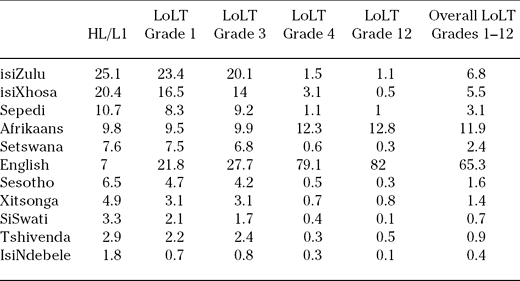
The effect of this may be seen in official data that show the relationship between home language and LoLT at various points of the schooling system (see Table 1).
Percentage of School Students by Home Language or First Language (HL/L1), and Language of Learning and Teaching (LoLT) in 2007

Note. Data extrapolated from DoE 2010: 12, 13, 14, 15, 16.
Even if one assumes that students only have one home language (which is unlikely in urban settings), Table 1 shows that although most students receive home language instruction in Grade 1, the shift towards English begins before students have completed the third grade. The dramatic change of medium in Grade 4, mostly towards English, demonstrates quite clearly that the system is implementing transition to English. In African settings, transition in or by the fourth grade is considered to be early transition (Ouane & Glanz, Reference Ouane and Glanz2011). By the fourth grade, 79.1% of students study through the medium of English. The last column shows the LoLT of students across the whole school system, as reported by schools.
It needs to be pointed out that even if schools report the medium of instruction policy within each of their schools to be English, this is largely inaccurate. At best, students are taught through code-mixing and code-switching practices in the spoken communication, but expected to read and write in English (e.g., Plüddemann, Reference Plüddemann2013; Plüddemann, Braam, October, & Wababa, Reference Plüddemann, Braam, October and Wababa2004; Probyn, Reference Probyn2009). An optimistic view would be that this is translanguaging, a term popularized by García (Reference García2009), and hence a contemporary manifestation of the fluidity of language practices. However, as in every other setting in the world, the school exit examinations and entry to university education are predicated on a particular view of proficiency in the language of higher education. In South Africa, neither most students nor most teachers are equipped to accomplish the English medium target of the secondary school examinations, nor are they able to ensure reading and writing skills that match those of students in other poorer countries of Africa, as evident in the following discussion.
Languages in the Curriculum
Curriculum documentation for the General Education and Training band of education is divided into early primary (Foundation Phase, Grades R/0–3), middle primary (Intermediate Phase, Grades 4–6), and junior secondary (Senior Phase, Grades 7–9). It was intended that a communicative approach to teaching languages would be nested within the Languages Learning Area (language as subject) of the constructivist curriculum. The Foundation Phase documentation makes frequent reference to the use of the home language as the medium of early primary education. Literacy is one of three areas of focus in the early primary curriculum, and there is an intersection between literacy and the use of the home language at this point. In the South African context literacy came to be understood by some as potentially disconnected from language (e.g., Pretorius, Reference Pretorius2002; Pretorius & Ribbens, Reference Pretorius and Ribbens2005). As long as literacy were taught well, it could be taught in any language, such as English, and by implication this would include children who live in informal settlements on the outskirts of the large urban centers as well as those in rural and remote settings (e.g., Murray, Reference Murray and Mesthrie2002; Ridge, Reference Ridge and Ricento2000). However, English has limited functional use in daily social practices in such contexts (Heugh, Reference Heugh and Rassool2007; Pan South African Language Board [PANSALB], 2000), and literacy as construed in terms of reading and writing texts related to school curriculum is not possible for learners who have neither the spoken vocabulary nor practice-based use of the language. Prior to 2011, the absence in the curriculum documentation of a clearly defined connection between the kind of literacy privileged in the early primary curriculum (i.e., learning to read simple narrative texts and learning to write words, lists, and sentences) and the language through which such reading and writing might be taught seemed to support the idea that transition to English medium for African students by, or even before, Grade 4 was desirable or possible (see discussions in Murray, Reference Murray and Mesthrie2002; Pretorius, Reference Pretorius2002; Pretorius & Ribbens, Reference Pretorius and Ribbens2005; and as cited in DBE, 2011b). Although the curriculum documents encourage literacy in the home language to the end of Grade 3, the policy documentation discussions about literacy in the period between 1997 and 2011 (Dada et al., Reference Dada, Dipholo, Hoadley, Khembo, Muller and Volmink2009; DBE, 2011a; DoE, 1997b, 2002) suggest that this is optional; and the use of the home language in order to develop literacy further and its use as medium beyond Grade 3 receives little attention. Thus, despite the curriculum documentation referring to additive bilingual and multilingual education within the curriculum, the way the documentation is written leads junior education officials, teachers, materials’ writers, and the general public to understand, incorrectly, that additive bilingual (or multilingual) education and early transition to English are one and the same (Heugh, Reference Heugh2009a), as evident in the following:
The Languages Learning Area is in line with the . . . language in education policy. . . . It follows an additive approach to multilingualism. . . .
It is recommended that the learner's home language should be used for learning and teaching wherever possible. This is particularly important in the Foundation Phase [Grade R-3] where children learn to read and write. Where learners have to make a transition from their home language to an additional language. (DoE, 2002, p. 4–5, 35)
A new Minister of Education called for a revised curriculum (DoE, 2002) in which the principle of outcomes-based principles was retained, but with greater curriculum specification for teachers. Recommendations for language policy revision alongside and integrated with curriculum revision were not taken up.Footnote 4 The disjuncture between the theoretical basis of language teaching in the language policy and the curriculum continued. The implication was that most students would transition to English medium by or before Grade 4. As seen in Table 1, the situation became one in which approximately 80% of students receive English as a second language (ESL) medium education from Grade 4 onwards, while the 7% of English speakers receive English L1 throughout, and approximately 12 % of students receive Afrikaans L1 throughout. The use of African languages as mediums of instruction therefore lost further ground. Instead of this being an education policy in which African languages and multilingualism were implemented, it became one in which the trajectory was towards one language, English, as quickly as possible. This was to have a far-reaching effect, in which the numbers of university students studying African languages declined, as did the number of African language-speaking students in primary school teacher education (e.g., Green, Parker, Deacon, & Hall, Reference Green, Parker, Deacon and Hall2011).
Nevertheless, the authors of the English-First Additional Language (i.e., ESL) document, within the Revised National Curriculum Statement Grades R-9 (DoE 2002), added specifications to each grade level. One of the specifications was in regard to the number of words required by ESL learners per grade. One of the assessment standards for reading was that Grade 3 students should demonstrate “a reading vocabulary of between 700Footnote 5 and 1500 common words. Learners who will study some Learning Areas through their additional language should aim for 1500 words” (DoE, 2002, p. 35). This was to increase to 2,500 words at the end of Grade 4; 3,500 words at the end of Grade 5; and 5,000 words at the end of Grade 6 (DoE, 2002). While a focus on lexical items has many limitations, attention to this is drawn here because of comparisons with the apartheid period. Macdonald (Reference Macdonald1990) showed that students required a vocabulary of about 7,000 words in order to negotiate the Grade 5 curriculum during the latter days of apartheid. Wababa (Reference Wababa2009) demonstrated, however, that within the new curriculum for one subject, physical science, students require 4,500 words by Grade 6. This suggests that the whole curriculum at this level would require far more than the 5,000 words suggested in the revised curriculum for students who would have to transition to English medium. The ESL curriculum specifications therefore seriously underestimated the vocabulary requirements in English for those students who have to use their second language (L2) as medium of instruction. By way of comparison, English and Afrikaans L1 speakers have fewer and less onerous expectations placed on their L2 requirements, simply because they are not expected to learn through their L2. In terms of a curriculum designed to establish equal access to education, the revised curriculum fails African language speakers on two grounds: the curriculum and ESL learning conditions are inadequate to facilitate transition to English medium by Grade 4, and those privileged under the previous government, English and Afrikaans speakers, continue to be privileged under the new system. The linguistic demands for the latter are less burdensome than for African students. Of particular concern here is that the curriculum for African students during the apartheid years was thought to be cognitively impoverished compared with that for English- and Afrikaans-speaking students. However, it turns out that given the lexical specifications for African children in English, the Revised National Curriculum Statement (DoE, 2002) indicates a lower cognitive expectation than those of the apartheid years.
Issues Contributing to Weak Provision of Literacy
The resourcing of adequate literacy teaching has been hampered by lack of guidance to teachers, falling numbers of students of African languages in universities, and an inadequate supply of teachers of African languages. The revised curriculum (DoE, 2002) offered little guidance on how to teach reading and writing for literacy or language teachers. There were no guidelines to advise teachers on how to ensure that students develop their reading and writing beyond early simple narrative texts framed in the active voice and in the simple present, past, and future tenses by the end of the third grade. The curriculum assumes that in the school setting students are actually given books to read on a daily basis, and that these books will be taken home for further reading at home. And it assumes that school students will be given frequent writing tasks each day. Although the latest version of the curriculum (DBE, 2011a) does provide far greater guidance to teachers, DBE research finds that foundation phase teachers continue to have low expectations of students’ progress, and writing tasks are inadequate and infrequent (DBE, 2013a). Nevertheless, students are expected to read, understand, and respond to complex texts across the curriculum from Grade 4 onwards. Such texts would require knowledge of a wider range of genres, especially expository texts including syntax employed in cause and effect, comparative, and hypothetical text (DBE, 2013a; see also critiques in Macdonald, Reference Macdonald2002; Pretorius, Reference Pretorius2002; Pretorius & Ribbens, Reference Pretorius and Ribbens2005).
With the introduction of curriculum changes in 1997 and 2002, the focus in both pre- and in-service teacher education has been on the curriculum changes and the administrative procedures associated with outcome-based, constructivist systems rather than on classroom practice. This has added to the burden of those teachers most likely to teach African-language-speaking students in rural and township settings and who typically teach very large classes (Dada et al., Reference Dada, Dipholo, Hoadley, Khembo, Muller and Volmink2009; DBE, 2013a; Reeves et al., Reference Reeves, Heugh, Prinsloo, Macdonald, Netshitangani, Alidou and Herbst2008).
As mentioned above, the number of students studying African languages in universities has declined since the late 1990s, and this has an effect on the number of students who then go into teacher education. The impact for provision of teachers in schools has been exacerbated by a dramatic decrease in numbers of African language speakers who have enrolled in and completed teacher education programs, particularly for early primary education. To illustrate this, 87% (1,007) of teachers graduating and qualified to teach foundation phase (Grade R/0–3) in 2009 were speakers of Afrikaans and English, while only 13% (168) were speakers of African languages. Whereas this was adequate for the needs of Afrikaans- and English-speaking students (20% of the learner cohort) African-language-speaking school students would be short of approximately 3,530 teachers in Grades 1–3 (Green et al., Reference Green, Parker, Deacon and Hall2011).
Given that all the learning and teaching materials in African languages produced prior to 1994 were destroyed (Mahlalela-Thusi & Heugh, Reference Mahlalela-Thusi, Heugh, Brock-Utne, Desai, Qorro and Pitman2010), new reading and other learning materials had to be produced in African languages. This has given rise to a host of additional concerns. First, the new materials have been expensive: on glossy paper and in color. When schools do purchase these, teachers are made responsible for their safekeeping and any premature losses that may occur. The result is that teachers are reluctant to allow students to take them home, make them grubby, or lose them. In many cases, textbooks and readers are simply locked away in a cupboard in the classroom—seldom, if ever, to be used (DBE, 2013a; Heugh Reference Heugh2009b; Reeves et al., Reference Reeves, Heugh, Prinsloo, Macdonald, Netshitangani, Alidou and Herbst2008). Second, having destroyed all of the pre-1994 materials in African languages, trying to build up sets of expensive reading resources from scratch has given rise to the complaint that there are insufficient reading resources to facilitate literacy in African languages (e.g., DBE, 2013a).
Student Achievement
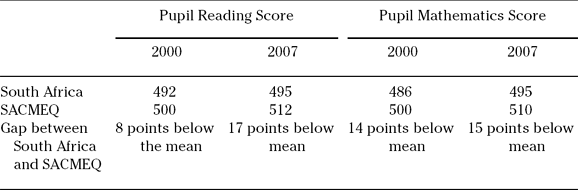
Student achievement has not improved, but rather has declined, since the introduction of Curriculum 2005 (DoE 1997b), which was also accompanied by the reduction of home language medium school to three years followed by English as the LoLT (e.g., DBE, 2013a; Prinsloo & Kanjee, Reference Prinsloo and Kanjee2005). This has been a matter of considerable concern for the DoE. In order to keep track of achievement, and in the hope of finding evidence of improvement, the DoE has enthusiastically engaged in regular systemwide assessment of literacy and numeracy of students between Grades 3 and 9 (e.g., DoE 2005; Prinsloo & Kanjee, Reference Prinsloo and Kanjee2005). These have recently come to be known as Annual National Assessments (ANA; e.g., DBE, 2011a, 2012). The department has also ensured South African participation in multicountry and internationally benchmarked assessments since 1995 (e.g., Progress in International Reading Study [PIRLS] and Trends in International Mathematics and Science Study [TIMSS]). In each of these, South African students have underachieved, and they have been less successful than students in other African countries (e.g., Howie, Van Staden, Tshele, Dowse, & Zimmerman, Reference Howie, Staden, Tshele, Dowse and Zimmerman2012; Howie, Venter, & Van Staden, Reference Howie, Venter and Van Staden2008; Howie et al., Reference Howie, Venter, Van Staden, Zimmerman, Long, Scherman and Archer2007; Jordaan, Reference Jordaan2011; Moloi & Chetty, Reference Moloi and Chetty2011; Moloi & Strauss, Reference Moloi and Strauss2005; Reddy, Reference Reddy2006; Reddy, Van der Berg, Janse van Rensburg, & Taylor, Reference Reddy, Van der Berg, Janse van Rensburg and Taylor2012). For example, in the third Southern and Eastern Africa Consortium for Monitoring Educational Quality (SACMEQ III), South African students in Grade 6 performed below the SACMEQ countries’ mean in 2007, as they had done in 2000. Although South African students appear to have improved slightly in both literacy and numeracy between 2000 and 2007, the improved achievement of students in other SACMEQ countries has exceeded that of South African students (see Table 2).
Comparison of South African Relative to SACMEQ Student Achievement (Grade 6)
Note. Table adapted from Moloi and Chetty (Reference Moloi and Chetty2011). The figure 500 was determined as the mean achievement of students across the SACMEQ countries in 2000.
While the gap for mathematics narrowed slightly by two points, the gap in reading achievement doubled.
Arguments Concerning Multilingual Education and Literacy
Government officials repeatedly claim that most African parents and students do not support home language or extended bilingual education in the school system, and this claim is reproduced in texts intended to inform educational change (e.g., Taylor & Vinjevold, Reference Taylor and Vinjevold1999; and implied in Fleisch, Reference Fleisch2008). As mentioned earlier, the claim stems from the historical association between mother-tongue education and apartheid education. Yet, as Setati (Reference Setati2008) and others have pointed out, there is little documented evidence to support this claim beyond the aspirational middle-class contexts of the larger urban centers. The only significant data at hand are from the Pan South African Language Board's National Sociolinguistic Survey (PANSALB, 2000), which show, much to the surprise of many, 88% of South Africans over age 15 indicate support both strong mother-tongue education and strong teaching of ESL, not only through the school system, but also in higher education (PANSALB, 2000). Only 12% support English-only or English-mainly, including the 9% of English speakers at the time of the survey. Anecdotal reports that the majority of people in the country want English-only or English-mainly were reported in documents designed to influence government policy (e.g., Murray, Reference Murray and Mesthrie2002; Ridge, Reference Ridge and Ricento2000; Taylor & Vinjevold, Reference Taylor and Vinjevold1999).
It is certainly the case that middle-class African parents, including government officials, are able to afford to send their children to private (independent) schools or to the former so-called White schools in the middle-class urban settings, and this naturally encourages aspirations towards the educational capital of such institutions, symbolically conceptualized in English. Research that delves beneath the surface-level appearances by V. De Klerk (Reference De Klerk2002) shows, however, that while urban parents may articulate a preference for English medium education, this is more because English serves as a proxy for the best-resourced educational opportunities for their children. It is more about access to better trained teachers and schools that are functional, rather than a rejection of the home or community language. The independent and English medium schools that formerly catered to White middle-class children remain the best resourced in the country, and these are therefore the most desirable schools. More recent research, for example, by Dixon and Peake (Reference Dixon and Peake2008), questions the validity of school surveys that report parental choice of medium. African parents are often silenced and do not actually express an opinion on language policy or language choice matters, simply because they are not able to complete surveys conducted in English, so they remain silent and the school makes or reports on decisions on their behalf.
Poor achievement in reading and numeracy among speakers of African languages has been used to advance reasons why it is probably best to default to reading and educational materials in English. Critics of multilingual education focus on the so-called failure of multilingualism to deliver achievement in literacy: “Not all South African educational researchers have been convinced that learning in the ‘wrong language’ is a crucial factor in poor achievement” (Fleisch, Reference Fleisch2008, p. 113). Murray continued this line of argument as recently as 2010 in a national education department colloquium on language issues:
Ms. Murray raised three issues. . . .Firstly, she questioned whether the notion of additive bilingualism was always useful in multilingual urban contexts in South Africa. . . .Secondly, Ms. Murray presented some research which showed that middle class children could learn successfully in English, while learners in township and rural schools do not get sufficient access to English to use it as a medium. . . .Thirdly, Ms. Murray looked at the problem of early literacy in African languages. She noted that. . .the overwhelming majority of these learners were unable to read with understanding in their home language by the end of Grade 3. She attributed this to the unavailability of reading books in African languages. (DBE, 2011b, no pages)
Murray's comments illustrate three contemporary issues. First is a continuation of theoretical misunderstandings of multilingualism and additive bilingual education. Murray had played a significant role in the revision of the languages area curriculum (DoE, 2002), yet, even in the colloquium of 2010, she mistook early transition from the home language to English by the end of the third grade, as implemented via the curriculum, to equate with additive bilingualism. Murray's comments also point towards a residual misunderstanding of the nature of multilingualism, as if it were restricted to multiple forms of languages that exist in parallel. This is despite the earlier and more recent research that demonstrates the provision and practices of multilingual education in linguistically diverse urban classrooms (e.g., Agnihotri, Reference Agnihotri, Heugh, Siegrühn and Plüddemann1995; Desai, Reference Desai, Brock-Utne, Desai and Qorro2006; Nomlomo, Reference Nomlomo, Brock-Utne, Desai and Qorro2003; Plüddemann et al., Reference Plüddemann, Braam, October and Wababa2004; Stein, Reference Stein2008; Versfeld, Reference Versfeld, Heugh, Siegrühn and Plüddemann1995). That Murray's contributions are highlighted in the report of this colloquium by the DBE indicates that confused representations of multilingual education continue to be (mis)understood as limited to parallel sets of classrooms in which children remain in hermetically sealed language communities. While such an arrangement might be workable in many rural and semirural areas of the country, owing to increasing urbanization, linguistically diverse communities are increasingly in evidence. This means that alternative modes of multilingual schooling, which include tapping into the linguistic repertoires of students, as already trialled and practiced (e.g., Agnihotri, Reference Agnihotri, Heugh, Siegrühn and Plüddemann1995, Reference Agnihotri2007; Desai, Reference Desai, Brock-Utne, Desai and Qorro2006; Nomlomo, Reference Nomlomo, Brock-Utne, Desai and Qorro2003; Versfeld, Reference Versfeld, Heugh, Siegrühn and Plüddemann1995) and observed (e.g., Makoe & McKinney, Reference Makoe and McKinney2009; McKinney, Reference McKinney2010; Stein, Reference Stein2008) are already in the mix, even if they require further exploration and explication (Stroud & Heugh, Reference Stroud, Heugh and Mesthrie2011).
That the discourse on additive multilingual education seems to be misunderstood both as transitional bilingual education and also possibly essentialized in multiple forms of monolingual schools is partly a misunderstanding of the language ideological choices made by government rather than an understanding of the sociolinguistic background and debates that were current and which informed language policy debates in the 1990s, as discussed earlier.
Murray did make a significant point in her comments on the failure of early primary school literacy in African languages. It is undoubtedly the case that most children who are supposed to learn to read and write in African languages in early primary are unsuccessful. However, what not pointed out is that there is systemic failure of literacy achievement across the South African school system in all languages, including Afrikaans and English. Literacy in whichever language is not being taught well and is under-resourced (DBE, 2013a; Heugh, Diedericks, Prinsloo, & Herbst, Reference Heugh and Rassool2007; Howie et al., Reference Howie, Venter and Van Staden2008, Reference Howie, Staden, Tshele, Dowse and Zimmerman2012; Reeves et al., Reference Reeves, Heugh, Prinsloo, Macdonald, Netshitangani, Alidou and Herbst2008). The multi-country studies discussed earlier show that in general South African students are not meeting the reading and writing levels of achievement that their peers in other countries are reaching, even in other less well-resourced countries of Africa.
Following Abadzi (Reference Abadzi2006), it is argued here that poor reading and writing in South African primary schools may be partly attributed to a naïve dependency on constructivist curriculum. Such a curriculum assumes well-resourced Western contexts, and it is not compatible with weak attempts at teaching literacy in schools (Heugh, Reference Heugh, Skutnabb-Kangas, Phillipson, Mohanty and Panda2009b). Literacy development across all language groups, including for speakers of English and Afrikaans, has become a matter of serious concern. In a study of 75,000 students in the Western Cape, it was found that the majority of students across all language backgrounds were unable to read or write beyond the most minimal basic level by Grade 8; the study concluded that they were unlikely to be able to proceed into higher education, which has far-reaching implications for the economy (Heugh et al., Reference Heugh, Diedericks, Prinsloo and Herbst2007). The language and literacy questions are connected, but the reason for the failure of children across all sectors of the system is not because of the use of the home language for all children in the foundation phase, or a policy of additive multilingual education that has yet to be implemented. Rather, it is because of poorly resourced teaching of reading and writing in each of the languages that are used for this purpose in the early grades, and identified as such in the most recent of official documents (DBE, 2013a). What makes it worse for children who have received poor reading and writing instruction and inadequate provision of reading materials in their home language is that they are expected to switch over, and to read, write, and navigate their way, from the fourth grade on, through a curriculum in English that they barely understand.
SOCIOLINGUISTIC RESEARCH AND CONTRIBUTIONS
Beyond the research on the problematic implementation of multilingualism within education policy and student achievement, there is a substantial chronological body of research that has focused on the linguistic practices of African students in urban schools and on the implementation of multilingual education in these settings, as mentioned earlier (e.g., Agnihotri, Reference Agnihotri, Heugh, Siegrühn and Plüddemann1995; Desai, Reference Desai, Brock-Utne, Desai and Qorro2006; Nomlomo, Reference Nomlomo, Brock-Utne, Desai and Qorro2003; Plüddemann, Reference Plüddemann2010, Reference Plüddemann2013; Plüddemann et al., Reference Plüddemann, Braam, October and Wababa2004; Probyn, Reference Probyn2009; Versfeld, Reference Versfeld, Heugh, Siegrühn and Plüddemann1995; Wababa, Reference Wababa2009). This includes research on the literacy practices of children in early childhood education (e.g., Prinsloo, Reference Prinsloo, Leung and Street2012; Robb, Reference Robb, Heugh, Siegrühn and Plüddemann1995; Stein, Reference Stein2008). There is a further body of work in which linguistically diverse students were found to position themselves as global citizens with multiple opportunities to express agency (e.g., Makoe & McKinney, Reference Makoe and McKinney2009; McKinney, Reference McKinney2007; McKinney & Norton, Reference McKinney, Norton, Hult and Spolsky2008) or linguistic citizenship (Stroud & Mpendukana, Reference Stroud and Mpendukana2009). These are students from diverse linguistic communities, and the research offers valuable insights into contemporary mobility and creative agency of students who move between languages and codes of their repertoires. It also needs to be noted that the socioeconomic and political circumstances in urban contexts differ in significant ways from those in rural and remote settings in southern contexts. The ways in which children are socialized into multilingual repertoires, with significant access to English in the visual media and social exchanges in cities, are very different from the ways in which children who seldom encounter English in the repertoires of their villages are socialized. The implication is that a viable language education policy would need to take into consideration the different contexts of multilingual practices, and thus there is no one-size-fits-all solution.
The complexity of the situation is that multilingualism carries different meanings for different people in different contexts of the country. There are significant areas of the country where people live in relatively linguistically homogeneous communities and other significant areas where people live in relatively linguistically heterogeneous communities. All the same, as most linguists in Africa have pointed out for decades, the African reality is a multilingual one, and researchers even in the rural and village contexts recognize multilingual repertoires as normal (e.g., Djité, Reference Djité2008). Regular use of English across a wide range of domains and for a wide range of functions, and literacy, however, is seldom in evidence in rural and many poor urban contexts.
CHANGING DIRECTION: CLOSER PROXIMITY TO MULTILINGUAL EDUCATION?
Fifteen years after the change of government and in the context of a continuing decline in student achievement, the renamed Department of Basic Education (DBE) began a third round of critical evaluations of education policy and its implementation. One of these involved a second review of post-apartheid curriculum, “Review of the Implementation of the National Curriculum Statement” (Dada et al., Reference Dada, Dipholo, Hoadley, Khembo, Muller and Volmink2009, for the DBE). Even as late as this, the DBE did not include an applied linguist or a sociolinguist with a specialization in language acquisition in linguistically complex settings on the team. Unsurprisingly, the misunderstanding of the additive bi- and multilingual policy continues:
While the Home Language plays the primary role in developing literacy and thinking skills and is of importance in enhancing the protection and further development of the indigenous language, the Language of Learning (in particular English) is the one in which students must master educational concepts. (Dada et al., Reference Dada, Dipholo, Hoadley, Khembo, Muller and Volmink2009, p. 41)
If the home language is not considered to be suited for the learning of educational concepts in this curriculum review, then this has serious implications.
Another evaluation involved an overview of “The Status of the Language of Learning and Teaching (LoLT) in South African Schools” (DBE, 2010), data from which show the rapid transition to English (see Table 1). This report was followed by a Colloquium on Language in the Schooling System in 2010 and yet another report (DBE, 2011b). Twelve years after the DoE's first National Conference on the Implementation of the Language in Education Policy in 1998, exactly the same recommendations that were made for implementation then were again put on the table, including appropriate teacher education provision and piloting of different multilingual models (DBE, 2011b; Heugh, Reference Heugh1998). No new proposals were put forward, even though increasing mobility of people has altered the demographic and socioeconomic contexts in the interim. These documents therefore do not indicate any change of direction in regard to the trajectory of premature transition to English with minimal attention to the use of African languages in early primary.
Somewhat surprisingly, during the first half of 2013, two new DBE documents have been released, and these indicate that government has shifted its position towards multilingual education. The first is a national report on “The State of Literacy Teaching in the Foundation Phase” (DBE, 2013a), in which the findings of earlier research by a range of stakeholders including Howie et al. (Reference Howie, Staden, Tshele, Dowse and Zimmerman2012) and Reeves et al. (Reference Reeves, Heugh, Prinsloo, Macdonald, Netshitangani, Alidou and Herbst2008) were confirmed. This was followed shortly thereafter with a draft policy document, “The Incremental Introduction of African Languages in South African Schools” (DBE, 2013b). There are several significant features of this last document. First, it spells out more clearly what was intended in the 1997 language in education policy, particularly in relation to additive bilingual and multilingual education. Second, this document refers to a 25-country study of mother-tongue and bilingual education in sub-Saharan Africa conducted on behalf of UNESCO and the Association for the Development of Education in Africa (ADEA; Alidou et al., Reference Alidou, Boly, Brock-Utne, Diallo, Heugh and Wolff2006) and a study of the medium of instruction in the primary schools in Ethiopia as included in a recent UNESCO publication (Ouane & Glanz, Reference Ouane and Glanz2010). This research is used as a backdrop to explain why there ought to be a more robust teaching of African languages in South African schools, both as LoLT for students who use African languages at home or within their immediate communities. The primary reason is to offer students a better chance of access to meaningful education and hence better opportunities in the workplace. Third, this document applies to speakers of other languages. In the interest of national unity, every South African student would be obliged to learn an African language while at school and for the 12 years of general and further education. Effectively, this increases the number of languages to be studied by South African students to three from Grades 1–12, and it extends home language as LoLT from 3 years to at least 6 years, with provision to extend this even further to 12 years, where appropriate. If this draft policy is ratified and becomes the template for new policy and is in fact implemented through the curriculum, this would constitute a major shift in policy. A policy that requires all students to learn three languages may be considered to be a multilingual policy, particularly when it makes provision for numerous variations within this policy.
There remains one potential weakness, however. This is that the ideological construction of African languages in the South African situation has not been problematized or resolved in this document (i.e., DBE, 2013b). This also means that contemporary urban phenomena, in which communities, particularly students, experiment with and make use of their linguistic repertoires, have not yet been addressed in the policy document. While sociolinguists may point to this frailty, it is also true that if there are other educational policies that do take into account contemporary manifestations of multilingualism, particularly as these occur in the global south, then these are not well-known or understood by policymakers.
CONCLUSION
The discussion in this article shows that despite promising beginnings, curriculum and assessment changes between 1994 and 2012 did not align with multilingual education policy. It also shows a history of competing interests between different sets of stakeholders involved in curriculum and language policy development, as well as misunderstandings of the theoretical basis of the nature of multilingual education. After nearly 20 years of systemwide studies at provincial, national and multicountry level, the national DBE came to a realization in 2013 that one of the key factors in student underachievement had to do with the failure to teach literacy well enough and long enough in the language best understood by students. The two recent documents of national significance (DBE, 2013a, 2013b) are potential game-changers in South African education; however, since they are so recent, it is not possible at this stage to discuss their efficacy and how they are likely to be received by the plethora of stakeholders whose interests are intimately associated with them. The new draft language policy for African languages does offer significant promise in that it is premised on the recommendations of substantial multicountry research in Africa of UNESCO and ADEA (e.g., Ouane & Glanz, Reference Ouane and Glanz2010). It also offers a mechanism to ensure that speakers of English and Afrikaans have an opportunity to learn at least one African language in school, and this provides an opportunity to advance national social cohesion for all groups in the country. Two areas of potential vulnerability are that multilingualism continues to be understood in educational documentation as the sum of several languages seen as separate entities and that African languages continue to be identified as they were by the missionaries and under apartheid, whereas this remains an area of contestation. These are matters that will require pragmatic solutions, and ones that articulate with solutions for school students in other international settings where linguistic diversity predominates, if the interests of school students are to be served well in the future.
ACKNOWLEDGMENTS
I should like to express appreciation to Charlene Polio and two reviewers who have contributed valuable insights which have strengthened this article.