INTRODUCTION
The adult stages of tapeworms belonging to the family Taeniidae parasitize the intestine of humans (Taenia) and carnivores (Taenia and Echinococcus), causing little harm to these hosts. In contrast, the larval (metacestode) stages of some of these parasites can cause severe disease or even death in the intermediate mammalian hosts, including humans as accidental hosts. The infection of intermediate and aberrant hosts occurs by the ingestion of infective eggs which are morphologically indistinguishable among taeniid tapeworms. The specific identification of E. granulosus eggs using monoclonal antibodies has been described (Craig et al. Reference Craig, Macpherson and Nelson1986), but this method has not been utilized in further epidemiological studies. Molecular biological methods have also been used to determine species or genotypes of taeniids using ‘pure’ parasite DNA obtained from adult worms or metacestodes from intermediate hosts (Scott and McManus, Reference Scott and McManus1994; Gasser and Chilton, Reference Gasser and Chilton1995; McManus and Bowles, Reference McManus and Bowles1996; Gasser et al. Reference Gasser, Zhu and Woods1999; Haag et al. Reference Haag, Araujo, Gottstein, Siles-Lucas, Thompson and Zaha1999; von Nickisch-Rosenegk et al. Reference von Nickisch-Rosenegk, Silva-Gonzalez and Lucius1999b). However, the potential of these approaches to identify or differentiate among species of taeniid eggs in faecal or environmental samples had not been evaluated. Several polymerase chain reaction (PCR) assays have been developed for the specific identification of E. multilocularis from such samples (reviewed by Mathis and Deplazes, Reference Mathis and Deplazes2006). A recent study describes a ‘copro-PCR’ for the simultaneous detection of the human tapeworms T. solium and T. saginata (see Yamasaki et al. Reference Yamasaki, Allan, Sato, Nakao, Sako, Nakaya, Qiu, Mamuti, Craig and Ito2004). Others reported oligonucleotide primers which have been evaluated in the PCR for the coprological diagnosis of E. granulosus infection in dogs (Abbasi et al. Reference Abbasi, Branzburg, Campos-Ponce, Abdel Hafez, Raoul, Craig and Hamburger2003; Stefanic et al. Reference Stefanic, Shaikenov, Deplazes, Dinkel, Torgerson and Mathis2004). Both assays provide the possibility of identifying the ‘sheep strain’ of E. granulosus. In addition, 2 research groups have reported PCR-based tests for the identification of several E. granulosus strains (Cabrera et al. Reference Cabrera, Canova, Rosenzvit and Guarnera2002; Dinkel et al. Reference Dinkel, Njoroge, Zimmermann, Walz, Zeyhle, Elmahdi, Mackenstedt and Romig2004). However, these tests have not been further validated for their diagnostic applicability to faecal or environmental samples.
Additional coprological tests with specificities for other taeniids are needed. However, this is not straightforward, as there are many different taeniid species, and there is significant genetic diversity within some species. For instance, within E. granulosus, some genotypes are proposed to represent species, whereas other, closely related ones are now thought to constitute genotype clusters (Thompson and McManus, Reference Thompson and McManus2002; Eckert and Deplazes, Reference Eckert and Deplazes2004; Obwaller et al. Reference Obwaller, Schneider, Walochnik, Gollackner, Deutz, Janitschke, Aspock and Auer2004). Based on mitochondrial sequences, 5 genetically distinct clusters are presently recognized, namely cluster G1-3 (‘sheep strain’, ‘Tasmanian sheep strain’ and ‘Indian buffalo strain’), G4 (‘horse strain’, E. equinus), G5 (‘cattle strain’, E. ortleppi), G6/7 (‘camel strain’ and ‘pig strain’) and G8/10 (‘cervid strain’) (see Thompson and McManus, Reference Thompson and McManus2002; Obwaller et al. Reference Obwaller, Schneider, Walochnik, Gollackner, Deutz, Janitschke, Aspock and Auer2004).
Echinococcus and Taenia spp. from carnivores vary in their infectivity to humans. Therefore, improved technology to differentiate animals infected with zoonotic tapeworms from those infected with non-zoonotic ones is required for both individual animals and population studies. The aim of this study was to develop a multiplex PCR which allows the differentiation among E. multilocularis, E. granulosus (all genetic variants) and Taenia spp. infections, with the option of being able to specifically identify the organism (E. granulosus strains/species and Taenia species) following additional analysis of the amplicons by sequencing or restriction fragment length polymorphism (RFLP).
MATERIALS AND METHODS
Parasite material
Samples of metacestodes (cyst fluid or parasite material from host tissue) or adult worms were collected from definitive or intermediate hosts and washed extensively in phosphate-buffered saline (PBS; pH 7·2). Cestodes included E. granulosus cluster G1-3 (3 isolates), genotype G4 (n=2), genotype G5 (n=2), cluster G6/7 (n=5), genotype G10 (n=1), E. multilocularis (n=4), E. vogeli (n=1), Taenia multiceps (n=2), T. crassiceps (n=4), T. taeniaeformis (n=3), T. ovis (n=2), T. hydatigena (n=1), T. pisiformis (n=2), T. polyacantha (n=4), Diphyllobothrium latum (n=2), Dipylidium caninum (n=2), Mesocestoides spp. (n=2). Nematodes included Toxocara canis (n=3), Toxascaris leonina (n=1), Ancylostoma caninum (n=1), Uncinaria stenocephala (n=3), Angiostrongylus vasorum (n=1), Trichuris vulpis (n=4) and Capillaria plica (n=1). Worms were identified morphologically by light microscopy and, if necessary, by PCR-based sequencing (Bowles et al. Reference Bowles, Blair and McManus1992; von Nickisch-Rosenegk et al. Reference von Nickisch-Rosenegk, Lucius and Loos-Frank1999a).
Faecal samples
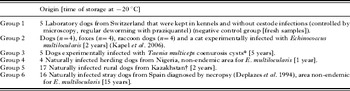
Faecal samples from carnivores (Table 1) were chosen for the validation of the multiplex PCR. The samples were frozen at −80°C for at least 3 days for safety reasons and kept at −20°C, before being processed using a combination of sedimentation, flotation with zinc chloride and sequential sieving with sieves of different mesh sizes, allowing taeniid eggs to be concentrated and excluding the co-isolation of non-taeniid eggs (see Mathis et al. Reference Mathis, Deplazes and Eckert1996). A panel of 55 taeniid egg-positive samples and 5 negative control samples was established (Table 1). The absence of eggs of other cestodes was verified by means of a bifocal, inverted microscope (Leica, Glattbrugg, Switzerland).
Origins of faecal samples of carnivores

* Cysts from locally slaughtered sheep morphologically identified as T. multiceps; inoculation of dogs after deworming with praziquantel (Torgerson and Abdybekova, unpublished).
† Diagnosed by means of purgation; the purged taeniids were appointed to belong to either the genus Echinococcus or Taenia (Stefanic et al. Reference Stefanic, Shaikenov, Deplazes, Dinkel, Torgerson and Mathis2004).
DNA isolation
Genomic DNA was isolated from parasites using a commercial kit, according to the manufacturer's instructions (QiAmp DNA mini kit, Qiagen, Hilden, Germany), and stored at −80°C. The concentration of DNA in each sample was measured by a spectrophotometer (ND, Nano Drop Technologies, DE, USA), and the suitability for DNA amplification was confirmed by PCR using primers with a relatively broad specificity (Kocher et al. Reference Kocher, Thomas, Meyer, Edwards, Paabo, Villablanca and Wilson1989; Liu et al. Reference Liu, Blaxter and Shi1996). DNA extraction from individual faecal samples (Table 1) was carried out as described by Stefanic et al. (Reference Stefanic, Shaikenov, Deplazes, Dinkel, Torgerson and Mathis2004).
Single-target PCR, cloning and sequencing
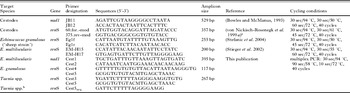
Single target PCRs, using primer pairs and conditions listed in Table 2, were performed to identify additional mitochondrial sequences (Bowles et al. Reference Bowles, Blair and McManus1992; Bowles and McManus, Reference Bowles and McManus1993; von Nickisch-Rosenegk et al. Reference von Nickisch-Rosenegk, Lucius and Loos-Frank1999a) required for the primer design for the multiplex PCR. Also, single PCRs confirmed infections with E. multilocularis or E. granulosus ‘sheep strain’ (Stefanic et al. Reference Stefanic, Shaikenov, Deplazes, Dinkel, Torgerson and Mathis2004; Stieger et al. Reference Stieger, Hegglin, Schwarzenbach, Mathis and Deplazes2002) based on the testing of faecal samples.
Primer sequences and PCR conditions

a Primers modified.
b Sequencing primer for the 267 bp amplicon of the multiplex PCR.
All PCRs were performed in 100 μl, as described previously (Stefanic et al. Reference Stefanic, Shaikenov, Deplazes, Dinkel, Torgerson and Mathis2004) with 2 μl of template DNA (20–400 ng/μl) using the uracil DNA glycosylase (UDG) system (Sigma-Aldrich, Switzerland) to prevent carry-over contamination (Longo et al. Reference Longo, Berninger and Hartley1990). If cloning was required, the PCR was repeated with dNTPs containing dTTP, and the purified (Qiagen PCR purification kit, Qiagen, Hilden, Germany) amplicon was cloned into the Topo-TA-cloning vector, according to the manufacturer's instruction (Invitrogen, Carlsbad, CA).
For automated DNA sequencing via a private service company (Microsynth, Balgach, Switzerland), amplicons were purified with the aforementioned kit, either directly from the PCR sample or after excision from agarose gels. Plasmids were purified using the Qiaprep spin miniprep kit (Qiagen, Hilden, Germany).
Multiplex PCR
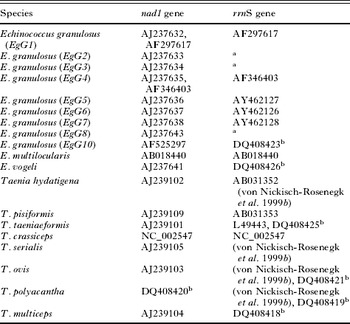
Sequences of part of the mitochondrial genes for NADH dehydrogenase subunit 1 (nad1), cytochrome oxidase subunit 1 (cox1) and the small subunit of ribosomal RNA (rrnS) were either retrieved from GenBank, from the literature (von Nickisch-Rosenegk et al. Reference von Nickisch-Rosenegk, Silva-Gonzalez and Lucius1999b) or were determined in this study (GenBank Accession numbers given in Table 3). The respective sequences were aligned (according to Corpet, Reference Corpet1988) and primer candidates of the desired specificity derived.
GenBank Accession numbers and references for mitochondrial gene sequences used for the design of primers for the multiplex PCR

a No sequence available.
b Determined in this study.
The multiplex PCR was conducted using a commercial kit (Qiagen multiplex kit, Qiagen, Hilden, Germany). The amplification reaction mixture (50 μl) consisted of 25 μl of master mix, 5 μl of primer mix (2 μm of primers Cest1, Cest2, Cest3, Cest4 and 16 μm of primer Cest5 in Tris-EDTA or H2O; Table 2), 18 μl H2O and 2 μl of template DNA. Initially, a 15 min Taq DNA polymerase activation step was performed at 95°C. Further cycling conditions are given in Table 2. Amplicons were detected on 2% agarose gels, following staining with ethidium bromide.
The analytical specificity of the PCR was assessed by in silico analysis (http://www.ncbi.nlm.nih.gov/BLAST/) and by PCR from DNA from the helminths listed above. To assess the analytical sensitivity of the PCR, single taeniid eggs from a sieved faecal sample were isolated with a pipette under microscopic control. DNA was isolated (Stefanic et al. Reference Stefanic, Shaikenov, Deplazes, Dinkel, Torgerson and Mathis2004) and subjected to multiplex PCR. Eggs were identified by direct sequencing of the amplicon. Also, plasmids containing inserts of parts of the mitochondrial nad1 and rrnS gene sequences (Bowles et al. Reference Bowles, Blair and McManus1992; von Nickisch-Rosenegk et al. Reference von Nickisch-Rosenegk, Lucius and Loos-Frank1999a) from E. multilocularis, E. granulosus (cluster G1-3) and T. hydatigena were produced and subjected to multiplex PCR (in a dilution series).
The multiplex PCR was validated using the DNA from the 55 faecal samples containing taeniid eggs and the 5 ‘negative controls’. In addition, the presence of E. multilocularis and of E. granulosus ‘sheep strain’ in these samples was investigated by specific, single target PCRs (Stieger et al. Reference Stieger, Hegglin, Schwarzenbach, Mathis and Deplazes2002; Stefanic et al. Reference Stefanic, Shaikenov, Deplazes, Dinkel, Torgerson and Mathis2004).
Further analyses
The 117 bp amplicons representing E. granulosus derived from 5 faecal samples were cloned and sequenced. The 267 bp amplicons representing Taenia spp. produced from 7 faecal samples were sequenced directly using an internal sequencing primer Cest5seq (see Table 2). To evaluate whether restriction fragment length polymorphism (RFLP) analysis could be a useful additional tool to further characterize the 267 bp amplicon produced in the multiplex PCR, a NEBcutter analysis (Vincze et al. Reference Vincze, Posfai and Roberts2003) was performed.
Quantitative PCR
The PCR was conducted employing a commercial kit (Quantitect sybr green, Qiagen, Hilden, Germany). The amplification reaction mixture (25 μl) consisted of 12·5 μl of master mix, 0·3 μm of each primer (Cest3, Cest5) and 2 μl of template DNA. Initially, a 15 min Taq DNA polymerase activation step was performed at 95°C, followed by 40 cycles of 15 sec at 95°C, 25 sec annealing at 58°C and 35 sec at 72°C. Melting curve analysis was carried out over a temperature range of 58°C to 98°C. The cycling was performed in an iCycler (Bio-Rad, Hercules, CA). DNA from target plasmids (in serial dilutions) and from 3 individual eggs were subjected to PCR. Reactions were performed in duplicate, and the experiment was repeated.
RESULTS
Defining primers for use in the PCR
Parts of 3 mitochondrial genes (nad1, cox1 and rrnS) of a wide range of cestodes were analysed for their suitability as primer targets for developing a multiplex PCR, yielding specific products for E. multilocularis, E. granulosus (all genotypes/species) and Taenia spp. from carnivores. The cox1 was not further considered because of a lack of sufficient sequence divergence, as revealed based on preliminary analyses. Several primers candidates targeting the 2 other genes were evaluated using DNA from metacestodes, faecal specimens (including mixed infections of Taenia/Echinococcus), and plasmids containing the cloned target sequences. The results were compared with PCRs containing single primer pairs. The reaction conditions in relation to primer concentrations and cycling parameters were optimized. Eventually, the multiplex assay (as detailed in Table 2) was established utilizing primer concentrations of 0·2 μm (primers Cest1, Cest2, Cest3, Cest4) and 1·6 μm (primer Cest5).
Specificity of primers in the PCR
The specificity of the primer pair Cest1/Cest2 for E. multilocularis was 100% when a range of DNA samples from different species of cestodes and nematodes (see Materials and Methods section). The primer pair Cest3/Cest5 was able to detect all E. granulosus genotypes/species. Furthermore, the respective sequence of E. vogeli, which was determined towards the end of this study, revealed that the forward primer Cest3 has only 2 mismatches (4th and 10th positions from the 3′-end) with the target locus of this species from South America, whereas the reverse primer Cest5 had a perfect match. Multiplex PCR from E. vogeli DNA using the optimized conditions indeed yielded an amplicon of the size expected for E. granulosus. The primer pair Cest4/Cest5 detected all of the Taenia spp. tested but also some other cestodes from carnivores, including Mesocestoides spp., Dipylidium caninum and Diphyllobothrium latum.
Estimation of the analytical sensitivity of the multiplex PCR
The multiplex PCR was able to detect DNA from single eggs of T. hydatigena. In reactions spiked with cloned target sequences, the detection limit was 3·3×101 for all targets (E. multilocularis, E. granulosus and different species of Taenia) (not shown). Quantitative PCR, using 10-fold dilutions of a cloned target sequence as a standard, predicted ∼7100 (standard deviation: ∼1900) mitochondrial targets to be present in a single egg of T. hydatigena.
In order to test the effectiveness of the multiplex PCR to detect mixed infections, cloned targets of E. granulosus or E. multilocularis were mixed in different ratios with the respective target of Taenia spp. Hence, 100 targets of both Echinococcus species yielded the expected amplicons in reactions containing the Taenia target in excess of a 100 or a 1000 times (not shown).
Confirmation of the specificity of amplicons from the multiplex PCR
Sequence analyses (after cloning) of the 117 bp diagnostic amplicon produced using primer pair Cest3/Cest5 revealed that E. vogeli can be discriminated readily from E. granulosus. Furthermore, within E. granulosus, it is possible to delineate cluster G1-3, genotypes G4 and G5. The corresponding sequence of the E. granulosus cluster G6/7 allows it to be discriminated from these genotypes but not from genotype G10. All sequences within a genotype or a genotype cluster, either retrieved from GenBank or determined in this study, were identical.
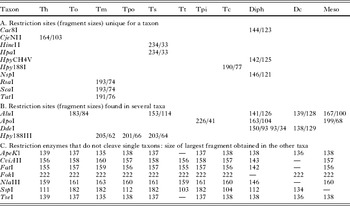
Sequence analyses (direct sequencing) of the 267 bp amplicon using the internal sequencing primer Cest5seq can identify unequivocally all target species. Furthermore, a NEBcutter analysis revealed that RFLP can be used identify most of these parasites (Table 4). Hence, the PCR products of T. hydatigena, T. multiceps, T. serialis, T. crassiceps and Diphyllobothrium spp. were exclusively cleaved by different commercially available endonucleases (Table 4A). Other enzymes cleaved the amplicons of several of the target organisms (Table 4B), and the digestion patterns using different enzymes can be used to deduce the identity of the organism. For example, T. ovis can be identified by combining an AluI digestion (yielding fragments of 183 and 84 bp, which might not be distinguishable upon gel electrophoresis from the corresponding amplicons of 167 and 100 bp of M. corti) with an ApoI digestion (which cleaved the amplicon of M. corti but not the one of T. ovis). Finally, some enzymes cleaved the amplicons of all but 1 of the target organisms (Table 4C), allowing the identification of T. taeniaeformis (TseI), Diphyllobothrium spp. (FokI), Dipylidium caninum (CviAII, FatI, NlaIII) and M. corti (SspI) based on the absence of cleavage with the specific enzymes given in parentheses.
Restriction fragment length polymorphism (RFLP) analysis of the 267 bp amplicon from multiplex PCR: useful restriction endonucleases which are commercially available and organisms identifiable
(Th: Taenia hydatigena (n=3): AB027135, AB031352, IPZ11 (adult, Kazakhstan, collection Institute of Parasitology, Zurich); To: T. ovis (n=3): T. ovis1, 2 (von Nickisch-Rosenegk et al. Reference von Nickisch-Rosenegk, Silva-Gonzalez and Lucius1999b), DQ408421; Tm: T. multiceps (n=1): DQ408418; Tpo: T. polyacantha (n=2): T. polyacantha (von Nickisch-Rosenegk et al. Reference von Nickisch-Rosenegk, Silva-Gonzalez and Lucius1999b), DQ408419; Ts: T. serialis (n=1): T. serialis (von Nickisch-Rosenegk et al. Reference von Nickisch-Rosenegk, Silva-Gonzalez and Lucius1999b); Tt: T. taeniaeformis (n=7): AB120128, AB031354, AB027134, L49443, DQ408425, IPZ45, IPZ46 (metacestodes from Arvicola terrestris, Switzerland). Sequence L49442 which shows a considerable different restriction pattern than the other 7 available sequences of this species was omitted from the analysis; Tpi: T. pisiformis (n=2): AB031353, IPZ3 (adult, Kazakhstan); Tc: T. crassiceps (n=2): AB031358, NC002547; Diph: (n=2): Diphyllobothrium ditremum (AB031366), Diphyllobothrium sp. (L49458); Dc: Dipylidium caninum (n=2): L49460, AB031362; Meso: Mesocestoides corti (n=1): AB031363.)

Validation of the multiplex PCR using DNA from faecal samples
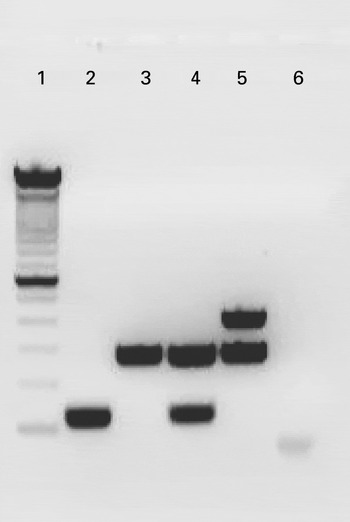
In all 55 samples microscopically positive for taeniid eggs, the assay produced at least 1 band after gel electrophoresis and was able to detect mixed infections (Table 5; Fig. 1).
Multiplex PCR using DNA from taeniid eggs from faecal samples from naturally infected dogs from Kazakhstan (primer sequences and reaction conditions; see Table 2). Lane 1, 100 bp ladder; lane 2, infection with Echinococcus granulosus only; lane 3, single infection with Taenia spp.; lane 4, mixed infection of E. granulosus and Taenia spp.; lane 5, mixed infection with E. multilocularis and Taenia spp. (for further information on these samples; see Table 5); lane 6, negative control reaction.

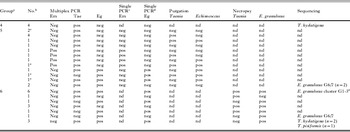
Validation of the multiplex PCR with faecal samples from naturally infected dogs from Nigeria (group 4), Kazakhstan (group 5) and Spain (group 6): results of multiplex PCR, single target PCR, purgation/necropsy data and sequence analysis

a See Table 1.
b Number of investigated dogs.
c Single target PCR specific for E. multilocularis (Stieger et al. Reference Stieger, Hegglin, Schwarzenbach, Mathis and Deplazes2002).
d Single target PCR specific for granulosus ‘sheep strain’ (Stefanic et al. Reference Stefanic, Shaikenov, Deplazes, Dinkel, Torgerson and Mathis2004).
e Gel electrophoresis of 4 of these sample is shown in Fig. 1.
f Two samples were verified for checking purposes.
nd, not done.
Multiplex PCR gave negative results using DNAs from faecal samples from 5 helminth-free dogs (group 1, Table 1). The expected results were obtained using samples from 2 groups of animals experimentally infected with E. multilocularis or T. multiceps (Table 1, groups 2 and 3). The results for group 2 (E. multilocularis) were independently verified using an established, specific single-target PCR.
The multiplex PCR results achieved using DNA from faecal samples from 3 different groups of naturally infected dogs are given in Table 5. Four dogs from Nigeria (group 4) yielded amplicons of 267 bp only, and sequencing revealed the presence of T. hydatigena in all cases.
From the 17 taeniid egg-positive samples from the Kazakh dogs (group 5), multiplex PCR identified Taenia spp. in 16, and E. multilocularis or E. granulosus in each of 4 dogs. Except for 1 infection with E. granulosus, all Echinococcus spp. infections were double infections with Taenia spp. All 4 infections with E. multilocularis were confirmed using the single-target PCR. E. granulosus infection was verified in 3 of 5 samples by the single-target PCR specific for E. granulosus ‘sheep strain’. Sequencing of the multiplex PCR amplicons of the other 2 samples revealed the presence of another genotype of E. granulosus (representing cluster G6/G7), which, to the best or our knowledge, is the first report of this genotype from Kazakhstan. The results of arecoline hydrobromide purgation (cf. Stefanic et al. Reference Stefanic, Shaikenov, Deplazes, Dinkel, Torgerson and Mathis2004) correlated only weakly with the PCR results (Table 5). Hence, 6 of the 17 dogs investigated were negative for taeniids upon purgation, but did shed taeniid eggs based on microscopical examination after the sieving procedure. From 4 dogs diagnosed with E. multilocularis infection by the PCRs, this tapeworm had been diagnosed in only 2 of them by purgation. Also, Taenia spp. had been identified by purgation in only 4 of 16 dogs infected. In contrast, purgation revealed the presence of (most probably immature) Taenia spp. or Echinococcus spp. in one dog which tested negative by the PCRs.
As expected, all samples from Spain (group 6) were negative for E. multilocularis in the multiplex PCR. Of the 12 samples positive for E. granulosus in this PCR, 11 were positive in the single-target PCR for E. granulosus ‘sheep strain’, and another represented E. granulosus (cluster G6/7) by sequence analysis. These 12 samples originated from dogs known to be infected based on necropsy. Two samples with (possibly immature) worms at necropsy did not show any band in the multiplex PCR. Three samples which were negative at necropsy were positive for Taenia spp. using the multiplex PCR, results which were confirmed by sequencing (T. hydatigena and T. pisiformis being detected).
DISCUSSION
Multiplex PCR is being widely used for the diagnosis of bacterial and viral diseases, but has infrequently been used for the diagnosis of parasitic helminth infections. Its applicability to simultaneously detect several organisms has, to the best of our knowledge, been demonstrated once for the diagnosis of cestodes from faecal material. Yamasaki and colleagues (Reference Yamasaki, Allan, Sato, Nakao, Sako, Nakaya, Qiu, Mamuti, Craig and Ito2004) devised a multiplex PCR for differential diagnosis of taeniasis and cysticercosis of humans (T. saginata, T. asiatica and T. solium).
The principal aim of this work, namely the development of a multiplex PCR for unequivocal identification of taeniids (Echinococcus spp. and Taenia spp.) from carnivores was not entirely achieved. Both the primers for detecting Taenia spp. or E. granulosus are not strictly specific for their intended target organisms. The Taenia spp. primers also detect some non-taeniid cestodes, whereas the E. granulosus primers also amplify DNA from E. vogeli. In addition, we cannot exclude the possibility that DNA from E. oligarthrus or from the recently described E. shiquicus (Xiao et al. Reference Xiao, Qiu, Nakao, Li, Yang, Chen, Schantz, Craig and Ito2005) can be amplified, as neither sequence information nor DNA samples were available.
The mitochondrial genome was chosen as target, as the most information was available for its sequences (cf. McManus et al. Reference McManus, Le and Blair2004). As the mitochondrial genes of the species of the genus Taenia differ considerably, it was not possible, despite extensive in silico analyses and optimization of the reaction conditions, to derive primers which recognize all Taenia spp. but not other non-taeniid cestodes. DNA from Mesocestoides spp., Dipylidium caninum and Diphyllobothrium latum yielded fragments of the expected sizes in the multiplex PCR, despite the fact that the forward primer (Cest3) has a mismatch at the 3′-end and/or several internal ones and the reverse primer (Cest5) has 2 internal mismatches compared with the sequence for Dipylidium caninum (no sequence information is yet available about the region of this primer of the other organisms). Nonetheless, our diagnostic approach consists of an initial isolation of taeniid eggs by sequential sieving (Mathis et al. Reference Mathis, Deplazes and Eckert1996) and subsequent, careful microscopical examination of the samples, with only taeniid egg-positive samples being tested further. This isolation procedure removes eggs of the other carnivore cestodes which would be positive by multiplex PCR (Mesocestoides spp., Dipylidium caninum, Diphyllobothrium latum). Nevertheless, in samples containing taeniid as well as other cestode eggs, a definitive diagnosis can be achieved by further analyses of the amplicons from the multiplex PCR (sequencing of cloned amplicons or RFLP in some instances; see Table 4). Similarly, sequence analysis can identify E. vogeli, which gives rise to an amplicon with the primers originally designed to be specific for E. granulosus.
The validation process with faecal samples of different origins showed that the multiplex PCR detected all samples positive in the single target PCRs specific for E. multilocularis or E. granulosus ‘sheep strain’. The comparison with traditional diagnosis after purgation (Stefanic et al. Reference Stefanic, Shaikenov, Deplazes, Dinkel, Torgerson and Mathis2004) proved to be very difficult in some cases. The present PCR approach (which is reliant on the amplification of DNA from taeniid eggs) does not detect pre-patent infections. Also, shedding of eggs does not occur consistently during patency, particularly for Taenia spp. Moreover, the sensitivity of purgation has been shown to be ∼65% for E. granulosus (see Schantz, Reference Schantz, Anderson, Ouhelli and Kachani1997) and has not been determined for E. multilocularis. In 6 of the 17 samples from Kazakhstan, which were positive for taeniid eggs, no worm had been found upon purgation. The multiplex assay detected Taenia spp. in all 6 samples and mixed infections with Echinococcus spp. in 3 of them. Necropsy, which served as a reference procedure in previous studies, yielded conflicting results in 3 of 16 samples. The 3 dogs negative for Taenia spp. by necropsy revealed eggs of T. hydatigena and T. pisiformis based on multiplex PCR and sequence analyses. In such cases, an intestinal passage of eggs after coprophagy is most likely to have occurred, as the presence of adult Taenia spp. cannot be overlooked upon necropsy of fresh carcases.
The optimized multiplex PCR is highly sensitive, as single taeniid eggs could be detected, in accordance with other single-target PCR-based tests (Dinkel et al. Reference Dinkel, von Nickisch-Rosenegk, Bilger, Merli, Lucius and Romig1998; Abbasi et al. Reference Abbasi, Branzburg, Campos-Ponce, Abdel Hafez, Raoul, Craig and Hamburger2003). As few as 3·3×101 targets could be reliably amplified in the multiplex PCR, as assessed by spiking reactions with cloned targets. In order to determine how many of the mitochondrial target sequences are present in a single taeniid egg, a quantitative PCR was performed revealing ∼7000 copies for T. hydatigena. Correspondingly, ∼140 target copies are present in a multiplex PCR sample using 1/50 (2 of 100 μl) of the DNA isolated from a single egg. This number is somewhat higher than the detection limit. Therefore, a single egg should be readily identified with our approach. These data corroborate our diagnostic strategy to sieve all faecal samples, allowing to both concentrate taeniid eggs from large amounts of faeces or environmental samples and also to remove PCR-inhibitory components which are of major concern when investigating such samples (cf. Mathis et al. Reference Mathis, Deplazes and Eckert1996). Indeed, all the 55 samples positive herein for taeniid eggs based on microscopical examination were also positive by multiplex PCR.
This assay, combining sieving and PCR, is relatively labour intensive and may not be suitable for routine diagnostic or large-scale purposes. However, the present multiplex PCR assay might serve as the method of choice for identification of taeniid eggs recovered from faecal specimens by the classical methods performed in diagnostic laboratories. The presence of eggs is directly related to the risk of infection and, therefore, egg identification is of particular interest in the context of diagnosis in individual carnivores as well as for epidemiological studies. Eggs are resistant and can be identified by PCR after prolonged storage at −20°C (as shown in this study using samples stored for more than 10 years) as well as from environmental specimens (Stieger et al. Reference Stieger, Hegglin, Schwarzenbach, Mathis and Deplazes2002). Coproantigen tests have a low positive predictive value in populations with a low prevalence of Echinococcus spp. (Christofi et al. Reference Christofi, Deplazes, Christofi, Tanner, Economides and Eckert2002; Hegglin et al. Reference Hegglin, Ward and Deplazes2003). Therefore, in successful control programs, PCR is of significant value for confirmatory purposes. The present multiplex PCR can detect mixed infections of E. granulosus, E. multilocularis and Taenia spp. and, thus, is of great value in areas of co-endemicity.
This work was supported by the Federal Veterinary Office BVET in the context of its financial support of our Institute as National Reference Laboratory for echinococcosis. This work represents the dissertation of Daniela Trachsel, veterinarian. For providing parasite material, we would like thank Antti Oksanen (E. granulosus, genotype 10), Voitto Haukisalmi (T. polyacantha), Andrew Hemphill (E. vogeli), Paul Torgerson and Aida Abdybekova (faecal samples containing T. multiceps), Abdullahi Magaji (faecal sample from Nigeria) and Daniel Hegglin (T. taeniaeformis). We gratefully acknowledge the support from Sandra Stäbler, Sasha Stefani, Isabelle Tanner and Jeannine Hauri. We highly appreciate the perusal by Paul Torgerson.