Introduction
Peritonsillar abscess, defined as a collection of pus located between the tonsil capsule and the pharyngeal constrictor muscles,Reference Mazur, Czerwinska, Korona Glowniak, Grochowalska and Koziol-Montewka 1 is the most common deep infection of the head and neck in young adults, despite the widespread use of antibiotics for the treatment of tonsillitis and pharyngitis.Reference Petruzzelli and Johnson 2 Although peritonsillar abscess is generally considered to be a purulent complication of acute tonsillitis, other mechanisms have been proposed, such as obstruction of the supratonsillar Weber's glands.Reference Mazur, Czerwinska, Korona Glowniak, Grochowalska and Koziol-Montewka 1
Symptoms include fever, malaise, sore throat, dysphagia and otalgia, while physical findings include trismus, and tense swelling and erythema of the anterior tonsillar pillar and soft palate.Reference Galioto 3 Drainage is mandatory, either by needle puncture or scalpel incision, and is sometimes required repeatedly.Reference Petruzzelli and Johnson 2 , Reference Segal, El-Saied and Puterman 4
This disease is most commonly described in children, adolescents and young adults, aged between 10 and 40 years.Reference Mazur, Czerwinska, Korona Glowniak, Grochowalska and Koziol-Montewka 1 , Reference Galioto 3 , Reference Marom, Cinamon, Itskoviz and Roth 5
There is no consensus as to whether there is seasonal variation in peritonsillar abscess incidence. Many studies have reported seasonality,Reference Galioto 3 , Reference Segal, El-Saied and Puterman 4 while others have reported only insignificant variation.Reference Mazur, Czerwinska, Korona Glowniak, Grochowalska and Koziol-Montewka 1 , Reference Ong, Goh and Lee 6 – Reference Kordeluk, Novack, Puterman, Kraus and Joshua 8 Moreover, several such studies mention seasons (autumn, spring), but do not provide objective climate or weather data, such as temperature and relative humidity.
Within this context, the goals of the present study were to explore the epidemiology of peritonsillar abscess (with particular emphasis on age, gender, incidence rates and hospital stay) and examine its potential association with seasonal variations in a range of climate factors (monthly average relative humidity, insolation, precipitation, and maximum, medium and minimum temperature).
Materials and methods
This was an observational, descriptive, retrospective study. We analysed data on patients admitted with peritonsillar abscess, between January 2007 and December 2011, from the emergency otolaryngology service of a tertiary hospital. This hospital is the tertiary referral centre for a large area, serving a population of about 3 715 688, 9 and it is the only public hospital in this area providing 24-hour emergency otolaryngology care. All procedures contributing to this work complied with the ethical standards of the relevant national and institutional guidelines on human experimentation, as set forth by the Brazilian Federal District Human Research Ethics Committee.
Medical records were retrospectively reviewed for age, gender, patient origin, admission diagnosis, length of stay and affected side. The diagnosis of peritonsillar abscess is often made based on a thorough history and physical examination. The most common procedures performed were diagnostic needle aspiration, or abscess incision and drainage, combined with intravenous antibiotic therapy.
Climate data (monthly averages of insolation, precipitation, relative air humidity, and maximum, minimum and medium temperature over the year) were obtained from the National Institute of Meteorology (‘INMET’). 10 The hospital is located in a tropical climate region, with temperatures highest in the summer and lowest in the winter. Rains occur in the summer and autumn, while winter is excessively dry because precipitation is very rare. 10
Statistical analysis was performed in SPSS Statistics for Windows version 20.0 software, using chi-square and two-tailed t-tests. Pearson correlation coefficients were used to assess potential associations between peritonsillar abscess cases and climate factors (monthly average relative humidity, and average, maximum and minimum temperature). P-values of 0.05 or less were considered significant.
Results
The emergency otolaryngology unit admitted 2738 patients between January 2007 and December 2011. Peritonsillar abscess accounted for 19.2 per cent of this total (528 hospitalisations).
Mean patient age was 26.63 years. The vast majority of patients (86.36 per cent) were in the 10–40-year age range. Age frequency distribution is shown in Figure 1. There were 225 males (42.61 per cent) and 303 females (57.38 per cent). The male-to-female ratio was 1:1.3. A total of 178 patients (51.5 per cent) had a left-sided peritonsillar abscess, while 181 (48.3 per cent) had a right-sided abscess. Information about the affected side was unavailable in 169 patients.
Distribution of peritonsillar abscess cases by age group. PTA = peritonsillar abscess

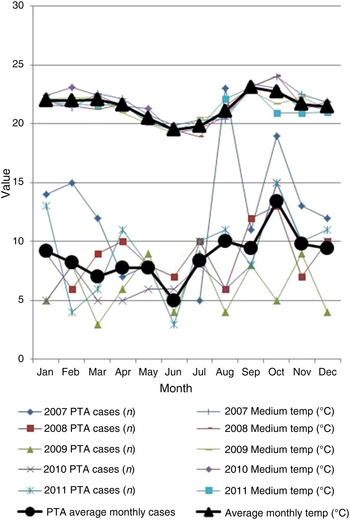
The peritonsillar abscess patients were hospitalised for a total of 820 bed days. October had the highest average number of hospitalisations associated with peritonsillar abscess. The mean length of stay was 1.6 days. Female patients had significantly longer hospital stays (1.65 days vs 1.55 days, p = 0.0001). Age did not correlate with length of stay (Pearson = −0.008, p = 0.583).
We found moderate positive correlations between peritonsillar abscess incidence and monthly average temperature (Pearson = 0.605, p = 0.037) (Table I) and maximum temperature (Pearson = 0.593, p = 0.042). More peritonsillar abscess cases occurred in the warmer months.
Correlation of peritonsillar abscess incidence with temperature and humidity

*Monthly average. †Moderate positive correlation with peritonsillar abscess incidence
Conversely, there were no correlations with relative air humidity (Pearson = –0.076, p = 0.816) (Table I), minimum temperature (Pearson = 0.429, p = 0.164), insolation (Pearson = 0.290, p = 0.360) or precipitation (Pearson = 0.291, p = 0.359).
The relationships between the average monthly number of hospitalisations for peritonsillar abscess and the average monthly temperature and relative humidity over the five-year study period are shown in Figure 2.
Monthly distribution of peritonsillar abscess cases in each year (lower lines) and monthly average temperatures in each year (upper lines), 2007–2011. PTA = peritonsillar abscess; temp = temperature

We found a significant positive correlation between the warm weather months and length of hospital stay (Pearson = 0.560, p = 0.029).
Discussion
Cases of peritonsillar abscess accounted for almost 20 per cent of admissions to our emergency service, which highlights the relevance of this disease to ENT practice.
The age pattern of admissions for peritonsillar abscess was consistent with the literature, with a peak in the third decade of life.Reference Mazur, Czerwinska, Korona Glowniak, Grochowalska and Koziol-Montewka 1 – Reference Segal, El-Saied and Puterman 4 There was no difference in laterality of peritonsillar abscess, as expected. A similar distribution has been reported in other studies.Reference Mazur, Czerwinska, Korona Glowniak, Grochowalska and Koziol-Montewka 1 , Reference Segal, El-Saied and Puterman 4 , Reference Ong, Goh and Lee 6
The mean length of hospital stay, usually determined by the severity of dysphagia, was 1.6 days. There was no influence of age on length of stay. Female patients had a slightly, though statistically significant, increased length of stay compared to men.
The majority of studies have reported a male predominance of peritonsillar abscess.Reference Mazur, Czerwinska, Korona Glowniak, Grochowalska and Koziol-Montewka 1 , Reference Marom, Cinamon, Itskoviz and Roth 5 – Reference Klug 7 However, female predominance or equal ratios have been described.Reference Segal, El-Saied and Puterman 4 In our series, the male-to-female ratio was 1:1.3.
The moderate correlation between hospitalisations for peritonsillar abscess and monthly temperature differs from some published studies that reported uniform incidence throughout the yearReference Mazur, Czerwinska, Korona Glowniak, Grochowalska and Koziol-Montewka 1 , Reference Ong, Goh and Lee 6 – Reference Kordeluk, Novack, Puterman, Kraus and Joshua 8 or peaks in the cold months.Reference Galioto 3 , Reference Segal, El-Saied and Puterman 4 In the present study, more peritonsillar abscess cases were found in warmer weather months.
This correlation corroborates the theory that peritonsillar abscess is not a direct complication of acute tonsillitis or upper respiratory tract infection,Reference Mazur, Czerwinska, Korona Glowniak, Grochowalska and Koziol-Montewka 1 , Reference Ong, Goh and Lee 6 – Reference Kordeluk, Novack, Puterman, Kraus and Joshua 8 given that the incidence of the latter seems to be higher in the colder months.Reference Ong, Goh and Lee 6 , Reference Klug 7 Peritonsillar abscess cases following respiratory tract infections have been documented,Reference Segal, El-Saied and Puterman 4 but peritonsillar abscess following acute tonsillitis outbreaks has not.Reference Kordeluk, Novack, Puterman, Kraus and Joshua 8
No significant correlations between peritonsillar abscess incidence and insolation, precipitation, humidity or minimum temperature were found.
-
• Peritonsillar abscess is the most common deep infection of the head and neck in young adults
-
• It is considered a purulent complication of acute tonsillitis, but other mechanisms have been proposed
-
• There is no consensus as to whether seasonality affects peritonsillar abscess incidence
-
• This study explored peritonsillar abscess epidemiology and its relationship with seasonal variations in a tropical region
-
• This large sample study is the first to provide epidemiological data on peritonsillar abscess incidence
-
• The findings enhance understanding of peritonsillar abscess aetiology
Almost all previous studies on peritonsillar abscess evaluated its association with seasons, rather than temperature or relative air humidity. They did not use a set of objective climate data. Furthermore, seasons differ around the world, especially between the north and south hemispheres.
In this study, cases of peritonsillar abscess accounted for almost one-fifth of admissions to an ENT emergency service. Hospitalisation as a result of peritonsillar abscess correlated with warm months and maximum temperature, which were also associated with longer hospitalisation. Female patients also had longer hospital stays. Age did not correlate with length of stay.
The correlation between peritonsillar abscess incidence and high ambient temperature corroborates the theory that peritonsillar abscess is not a direct complication of acute tonsillitis or upper respiratory tract infection.
Conclusion
This study included a total of 528 patients, with a mean age of 26.63 years and a female predominance. In this sample, peritonsillar abscess was more likely to occur in warmer months. Our findings corroborate the theory that peritonsillar abscess is not a direct complication of acute tonsillitis or upper respiratory tract infection, and may improve understanding of peritonsillar abscess aetiology.