A central tenet of family systems theory is that individual dyads operate within a hierarchy of subsystems such as the parent–child subsystem, the parent–parent subsystem, and the family considered as a unit (Cox & Paley, Reference Cox and Payley2003). The individuals composing these subsystems can be further examined with regard to their genetic, psychophysiological, and cognitive activity, and with attention to the codependencies they establish in the organization of this activity with other members of the family (Cairns, Reference Cairns1997). The current study was prompted by our previous research on the genetic and parental contributions to the organization of vagal regulation early in infancy (Propper et al., in press). In the present report we examine how allelic polymorphisms of the dopamine receptor D2 gene (DRD2) in mothers and children may influence parenting behaviors and subsequent child outcomes.
Systemic Influences on Parenting Behaviors
Belsky (Reference Belsky1984) suggested that parenting behaviors are a joint function of the psychological resources available to the parents, the contextual sources of support and stress they experience, and the characteristics of the child. The evidence obtained in this regard shows that sensitive parenting is reduced among depressed or clinically challenged mothers (Brody, Murry, Kim, & Brown, Reference Brody, Murry, Kim and Brown2002; Crockenberg & Leerkes, Reference Crockenberg and Leerkes2003; Espinosa, Beckwith, Howard, Tyler, Swanson, Reference Espinosa, Beckwith, Howard, Tyler and Swanson2001) and among mothers without personal support (Belsky, Reference Belsky1984; Hummer & Samuels, Reference Hummer, Samuels and Altshcul1988; Leerkes & Crockenberg, Reference Leerkes and Crockenberg2002). From the child's side, Crockenberg (Reference Crockenberg1981) and van den Boom (Reference van den Boom1994) reported that highly irritable infants tend to receive less sensitive care and are at greater risk for developing insecure relationships. Further investigations into the child's contribution to attachment processes showed that sensitive parenting can be challenged and reduced by infant negativity, but enhanced when the child positively stimulates the mother and responds to her bids for interaction (see also Atkinson et al., Reference Atkinson, Chisholm, Scott, Goldberg, Vaughn and Blackwell1999; Cox, Owen, Henderson, & Margand, Reference Cox, Owen, Henderson and Margand1992; Kochanska, Reference Kochanska2001; Thompson, Reference Thompson1997; van den Boom, Reference van den Boom1997).
In general, research shows that child behavior has a consolidating effect on parenting. For instance, attentive children who respond positively to their mother's bids for interaction tend to elicit more sensitive caring, warmth, and attention from them than children who are highly reactive and not easily soothed (Shamir-Essakow, Ungerer, Rapee, & Safier, Reference Shamir-Essakow, Ungerer, Rapee and Safier2004; Thompson, Reference Thompson1997; van den Boom, Reference van den Boom1997). Although reports of this nature are now common in the literature, little is known concerning the dyadic conditions likely to minimize or exacerbate such effects. Given the consolidating effect of child temperament on parenting styles, it would be worthwhile to determine what role, if any, genetic polymorphisms known for their association with specific temperamental traits play in this process, and whether their presence in the child, the mother, or both affects parenting behaviors. To this end, extant research already suggests that behaviors associated with a child's genetics may evoke specific styles of parenting. For example, O'Connor, Deater-Deckard, Fulker, Rutter, and Plomin (Reference O'Connor, Deater-Deckard, Fulker, Rutter and Plomin1998) found that children born to antisocial mothers were more likely to receive negative parenting from their adoptive caregivers, but this association was mediated by the child's disruptive behavior. In replicating these findings, Riggins-Caspers, Cadoret, Knutson, and Langbehn (Reference Riggins-Caspers, Cadoret, Knutson and Langbehn2003) found that such evocative child effects were limited to high-risk families. Although adoption and twin studies have been fruitful in identifying children's genetic variability as a potential source of variation in parenting behaviors, the ability to directly examine candidate genes and their effects on the family system is a relatively new approach to examining gene–environment correlations and interactions (Rutter, Reference Rutter2006).
Several studies are now showing that genetic polymorphisms that may affect the development of key neurological systems are associated with measurable differences in temperament. For instance, polymorphic variations in the dopamine D4 receptor gene (DRD4) were shown to be associated with individual differences in infant engagement and activity levels. In other studies, allelic variations in the same gene have been associated with group differences in novelty seeking in both adults (Benjamin, Li, Patterson, Greenberg, Murphy, & Hamer, Reference Benjamin, Li, Patterson, Greenberg, Murphy and Hamer1996) and children (Ebstein et al., Reference Ebstein, Levine, Geller, Auerbach, Gritsenko and Belmaker1998), although a recent investigation found these effects to be moderated by environmental influences (Lahti et al., Reference Lahti, Räikkönen, Ekelund, Peltonen, Raitakari and Keltikangas-Järvinen2005). Although replications of these findings have been limited (Gehlernter et al., Reference Gelernter, Kranzler, Coccaro, Siever, New and Mulgrew1997; Jonsson et al., Reference Jonsson, Nothen, Gustavsson and Neidt1997; Pogue-Geile, Ferrell, Deka, Debski, & Manuck, Reference Pogue-Geile, Ferrell, Deka, Debski and Manuck1998), variations in these genes appear to be associated with different behavioral styles in children (Cloniger, Reference Cloninger1987).
The current study examines a different dopaminergic receptor polymorphism. Variations in DRD2 have been related to sensitivity to reward because the gene is considered to be a central component of the way in which the brain registers a response to reward and pleasure. More specifically, the minor Taq1 A1 allele of DRD2 (DRD2 A1+) has been related to high novelty seeking (Noble et al., Reference Noble, Ozkaragoz, Ritchie, Zhang, Belin and Sparkes1998; Suhara et al., Reference Suhara, Yasuno, Sudo, Yamamoto, Inoue and Okubo2001) and is implicated in a number of substance use disorders, particularly alcoholism (Bowirrat & Oscar-Berman, Reference Bowirrat and Oscar-Berman2005; Noble, Reference Noble2003). The Taq A1 variant of the gene is associated with reduced dopamine binding affinity and thereby a deficiency in the neural response to reward. Although DRD2 research in children is very limited at this point, previous analyses with the current sample (Propper et al., in press) found that the DRD2 A1+ was associated with lower vagal withdrawal during the first year of life, although by 1 year of age this effect was limited to children of highly insensitive mothers. Given that previous research has found lower vagal withdrawal to be associated with more aggressive behavior in young children (Calkins & Dedmon, Reference Calkins and Dedmon2000), the findings by Propper and colleagues provide evidence for potential biobehavioral associations with DRD2 A1+ in children that are comparable to adults.
In the present research we hypothesized that the DRD2 A1+ polymorphism affects parenting behavior via two complimentary paths. First, we suggest that mothers with DRD2 A1+ might be at risk for less sensitive parenting behaviors due to genetic differences in personality, such as aggressiveness (Noble et al., Reference Noble, Ozkaragoz, Ritchie, Zhang, Belin and Sparkes1998), extraversion (Ozkaragoz & Noble, Reference Ozkaragoz and Noble2000) impulsivity (Wiers, Sergeant, & Gunning, Reference Wiers, Sergeant and Gunning1994) and disinhibition (McGue, Slutske, Taylor, & Iacono, Reference McGue, Slutske, Taylor and Iacono1997), or propensity for substance abuse (Noble, Reference Noble2003). In addition, potential psychiatric problems associated with DRD2 A1+, such as severe alcoholism (for meta-analyses, see Gurling & Cook, Reference Gurling and Cook1999; Noble, Reference Noble1998), illicit drug use (Lawford et al., Reference Lawford, Young, Noble, Sargent, Rowell and Shadforth2000; Noble, Blum, Kalsa, & Ritchie, Reference Noble, Blum, Khalsa and Ritchie1993; Ohara et al., Reference O'Hara, Smith, Bird, Persico, Suarez and Cutting1993), gambling (Comings, Muhleman, & Gysin, Reference Comings, Muhleman and Gysin1996), mood disorders (Li et al., Reference Li, Liu, Sham, Aitchison, Cai and Arranz1999); and posttraumatic stress disorder (Comings, Rosenthal, et al., Reference Comings, Rosenthal, Lesieur, Rugle, Muhleman and Chiu1996), could likewise compromise sensitive and nurturing parenting behaviors. An alternative, or complimentary, pathway might be via her child's expression of the behavioral correlates of DRD2 A1+. For instance, if mothers with DRD2 A1+ are more likely to have children with the same polymorphism, then the behavioral manifestations of this gene in the infant could affect the interactive style of the child–parent dyad by eliciting and reinforcing specific parenting behaviors in the mother. This would be consistent with Propper et al.'s (in press) findings that children with DRD2 A1+ have lower vagal withdrawal in response to challenge, and the work by Moore and Calkins (Reference Moore and Calkins2004) that infants with lower vagal withdrawal show less positive affect, higher reactivity in play, and lower synchrony in play with mothers. Thus, DRD2 A1+ has the potential to influence parenting behavior via its expression in the mother or the child.
Genetic and Parenting Influences on Later Behavioral and Affective Problems
Genetic variation in dopaminergic function has largely been investigated in relation to the dopamine D4 receptor gene (DRD4). Specifically, variation in the exon III 48-base pair (bp) repeat DRD4 polymorphism has been related to hyperactive–impulsive–inattention (for meta-analyses, see Faraone, Doyle, Mick, & Biederman, Reference Faraone, Doyle, Mick and Biederman2001), oppositional defiant behaviors (Kirley et al., Reference Kirley, Lowe, Mullins, McCarron, Daly and Waldman2004), and aggressive behaviors (Benjamin, Ebstein, & Belmaker, Reference Benjamin, Ebstein and Belmaker2002). Similarly, other studies have found that L-DRD4 was associated with maternal report of aggressive behavior (Schmidt, Fox, Rubin, Hu, & Hamer, Reference Schmidt, Fox, Rubin, Hu and Hamer2002) and externalizing behavior (Bakermans-Kranenburg & van IJzendoorn, Reference Bakermans-Kranenburg and van IJzendoorn2006). To our knowledge, research on the associations of polymorphic variations in DRD2 and behavioral characteristics has largely been limited to adolescent and adult samples. Variations in DRD2 have been related to several dimensions of adult personality including novelty seeking, sensation seeking, and aggressiveness (Cloninger, Sigvardsson, & Bohman, Reference Cloninger, Sigvardsson and Bohman1996; Noble et al., Reference Noble, Ozkaragoz, Ritchie, Zhang, Belin and Sparkes1998; Zuckerman, Reference Zuckerman1993). It has been suggested, however, that possessing the DRD2 A1+ polymorphism is a risk factor for conduct disorder (Lu, Lee, Ko, & Lin, 2001), which is not surprising considering its association with impulsivity (Wiers et al., Reference Wiers, Sergeant and Gunning1994), disinhibition (McGue et al., Reference McGue, Slutske, Taylor and Iacono1997), and sensitivity to pleasure and reward (Bowirrat & Oscar-Berman, Reference Bowirrat and Oscar-Berman2005) in adults. Only one study has found associations with the DRD2 A1+ polymorphism and child behavior (Marino et al., Reference Marino, Vanzin, Giorda, Frigerio, Lorusso and Nobile2004), which consisted of a nearly significant association between DRD2 A1+ and social withdrawal.
The associations between child genetics and behavioral outcomes are unlikely to be as simple as a direct effects model would suggest. Several innovative studies have demonstrated the value of considering both genotype and early environmental stressors as predictors of later pathological outcomes (Caspi et al., Reference Caspi, McClay, Moffitt, Mill, Martin and Craig2002, Reference Caspi, Sugden, Moffitt, Taylor, Craig and Harrington2003). Following a review of the extant literature, we found only two studies that investigated the joint contributions of variation in dopaminergic receptor genes (in these cases both examined DRD4) and environmental influences in the development of externalizing behaviors (Bakermans-Kranenburg & van IJzendoorn, Reference Bakermans-Kranenburg and van IJzendoorn2006; Propper, Willoughby, Halpern, Cox, & Carbone, in press). These studies examined the interplay of DRD4 and observed parental insensitivity as predictors of externalizing problem behaviors during toddlerhood. Each study found interactions between the specific DRD4 polymorphisms and parenting that predicted externalizing behaviors in children. These results suggest that children may be differentially susceptible to insensitive parenting partly as a function of their individual genetic makeup. The current study extends this research by examining a similar model for child affective problems at 36 months of age as a function of early maternal sensitivity and the presence or absence of the DRD2 A1+ polymorphism.
Goals of the Current Study
Several studies have proposed bivariate associations between variations in dopaminergic receptor genes and both child and adult behaviors. The current study attempts to contextualize these associations within the family system by examining the associations between the presence of the DRD2 A1+ polymorphism in mothers and children and maternal sensitivity, maternal and child characteristics that might mediate these associations, and the subsequent interaction between maternal sensitivity and child DRD2 A1+ as a predictor of later child affective problems. This study is one of the first to consider the role of DRD2 as it influences behaviors within dyadic subsystems of the family. In doing so, we consider the joint effects of genetic variability among mothers as well as the inherited genetic variations in their children as potential influences on parenting behavior. This study is also one of the first to examine interactions between DRD2 and environmental factors in the epigenesis of early child affective problems.
Methods
Participants
Participants were drawn from the Durham Child Health and Development Study, a longitudinal sample consisting of 206 healthy, full-term infants recruited at 3 months of age. The current sample includes 172 of these infants and their biological mothers seen at approximately 6, 12, and 36 months. Reasons for participant exclusion from the current analyses include missing data due to attrition from 3 to 36 months of child age as well as a small number of mothers who refused to consent to genetic analyses for either or both themselves or their children. Mothers' mean age at the 6-month visit was 28.75 (SD = 5.68). Of the infants in the analysis sample, 87 were male (50%), 85 (50%) were female, 94 (55%) were African American, and 78 (44%) were European American. Eighty-five families (50%) were defined as being below two times the poverty level.
Procedure
Dyads were part of a longitudinal study from 3 months to 3 years of age. The current analyses examine observational and questionnaire data from laboratory visits that occurred when the infants were 6, 12, and 36 months of age. At each of these visits, infants and their mothers participated in several joint and individual tasks followed by a standardized interview and completion of demographic questionnaires by the mother. Parenting and child behavioral data were gathered at the 6 and 12 month visit during a 10-min videotaped free-play interaction during which mothers were provided a standardized set of toys and asked to play as they normally would during the day given an extra 10 min. Parenting and child behaviors were later coded by trained and reliable coders.
Measures
Maternal sensitivity
Free-play interactions were coded by two independent coders who were unaware of the study's hypotheses. Coders were trained to reliability using selected video recorded free-play episodes that had been previously coded by criterion coders. To reach interrater agreement, coders continued training until an interclass correlation coefficient of .80 was reached for each coder on each construct with the criterion coders. Overall, coders' interrater reliability on all subscales remained above .80.
Seven subscales were used to evaluate maternal behavior during the free-play task for a global rating of maternal sensitivity. The following qualitative ratings have been used in previous studies (Mills-Koonce et al., Reference Mills-Koonce, Gariépy, Propper, Sutton, Calkins and Moore2007; NICHD Early Child Care Research Network, 1999) to assess parent–child interaction during free-play sessions and include: sensitivity/responsiveness, detachment/disengagement, intrusiveness, positive regard, animation, stimulation of development, and negative regard. For each subscale, mothers received a score between 1 and 5, where 1 = being not at all characteristic of their behavior during the dyadic interaction and 5 = highly characteristic of this interaction. Factor analyses suggested two factors that guided the creation of two composites variables. The first composite, labeled maternal sensitivity, involved summing the scale scores for sensitivity/responsiveness, detachment/disengagement (reverse scored), positive regard, animation, and stimulation of development (factor loadings = .89, .88, .85, .89, and .71, respectively). The second composite was a summation of negative regard and intrusiveness and was labeled negative intrusiveness (factor loadings = .92 and .77, respectively).
Child observed behavior
As with maternal sensitivity, free-play interactions were coded by two independent coders who were trained to reliability and maintained interrater reliability on all subscales at .80 or greater. Child positive mood was coded as the extent to which the child was satisfied, content, and pleased with the interaction with the mother. Child negative mood assessed the extent to which the child cried, fussed, frowned, tensed body, or otherwise expressed his or her discontentment during the interaction. Child sustained attention assessed the extent to which the child maintained focus on the activities that the mother and child were engaged in during the interaction. For each subscale, children received a score between 1 and 5, where 1 = being not at all characteristic of their behavior during the dyadic interaction and 5 = being highly characteristic of this interaction.
Child fear
A temperamental measure of fear was assessed using the 16-item fear subscale of the Infant Behavior Questionnaire—Revised (IBQ-R; Goldsmith & Rothbart, Reference Goldsmith, Rothbart, Angleitner and Strelau1991). This questionnaire was completed by mothers at the 6 and 12 month visits, and contained questions regarding daily behaviors such as startle or distress to sudden changes in stimulation, novel physical objects, or social stimuli, and inhibited approach to novelty on a 7-point Likert scale. Internal consistency for the IBQ-R range from .70 to .90 on the individual subscales (Gartstein & Rothbart, in press) and convergence between the IBQ and other measures of temperament suggest adequate validity (e.g., Goldsmith & Rothbart, Reference Goldsmith, Rothbart, Angleitner and Strelau1991).
Maternal depressive symptoms
The Brief Symptom Inventory (BSI; Derogatis & Spencer, Reference Derogatis and Spencer1982) was administered to mothers at the 6- and 12-month visits. The BSI is a 53-item self-report symptom inventory designed to reflect the psychological symptom patterns of normative and psychiatric respondents. Each item of the BSI is rated on a 5-point scale of distress, ranging from 0 = not at all to 4 = extremely. The BSI has nine subscales, including somatization, obsessive–compulsive, interpersonal sensitivity, depression, anxiety, hostility, phobic anxiety, paranoid ideation, and psychoticism. The current study uses the depression subscale in analyses. The BSI has been normed on four populations, including adult nonpatients, adult psychiatric outpatients, adult psychiatric inpatients, and adolescent nonpatients. Internal consistency is relatively high (α = .71–.85; Aroian & Patsdaughter, Reference Aroian and Patsdaughter1989; Croog, Levine, Testa, & Brown, Reference Croog, Levine, Testa and Brown1986), as is test–retest reliability (coefficient range = .68–.91; Derogatis & Spencer, Reference Derogatis and Spencer1982).
Parenting stress
The Parenting Stress Index—Short Form (PSI; Abidin, Reference Abidin1995) was administered to mothers when children were 6 and 12 months of age. The PSI consists of 36 items derived directly from the PSI full-length test. The PSI is designed to identify potentially dysfunctional parent–child systems, including questions targeting three major sources of stress: child characteristics, parent characteristics, and situational/demographic life stress. The instrument consists of three subscales. The parental distress subscale focuses on the distress a parent is experiencing in his or her role as a parent. The parent–child dysfunctional interaction subscale focuses on the parent's perception that the child does not meet the parent's expectations, and the interactions with the child are not reinforcing to the parent. The difficult child subscale focuses on the perceptions of behavioral characteristics of children that make them either easy or difficult to manage. A composite score of total parenting stress is derived by summing each of the three subscales. Abidin (Reference Abidin1995) reported a high test–retest reliability of 0.91 for the total parenting stress composite.
Child affective problems
Mothers were given the Child Behavior Checklist (CBCL; Achenbach & Rescorla, Reference Achenbach and Rescorla2000) within a packet of questionnaires to complete at the 36-month visit. The CBCL is a standardized assessment that indexes children's behavioral/emotional problems by having caregivers rate their child on items describing the child currently or within the last 2 months. This version of the CBCL consists of 99 items describing behavioral/emotional problems, plus an open-ended item for additional problems. In addition to traditional composites of internalizing and externalizing behaviors, a new feature in the CBCL scoring is a profile of DSM-oriented scales, which comprise items that experienced psychiatrists and psychologists from 10 cultures rated as being very consistent with DSM diagnostic categories. The affective problems subscale included items consistent with dysthymia and major depressive disorder, such as crying, troubled eating and sleeping, underactive, and sadness.
Buccal cell collection (12-month visit)
DNA was obtained from mothers and children through the collection of buccal cells (i.e., cheek cells). The experimenter began collection by putting on a pair of latex gloves before handling any supplies, ensuring that the experimenter's own skin cells would not come into contact with the collection materials. The experimenter rubbed the inside of the infants' inner cheek and gums for at least 20 s with a Q-tip. The Q-tip was then immediately placed into a pint-sized zip-loc bag, sealed, and put into a storage freezer where it remained until cells were sent to the laboratory for processing. Cheek cells for DNA isolation and analysis were sent to a genetics laboratory at North Carolina State University (Raleigh, NC). All of the genotyping was done blind to the study's hypotheses and outcomes.
Saliva samples yielded DNA in adequate quantities for genotyping (approximately 200 µg/ml). Genomic DNA was extracted from each salivary sample using the Puregene DNA extraction kit by following the manufacturer's protocol for DNA isolation from 1 ml of body fluid. Genomic DNA (20 ng) was polymerase chain reaction (PCR) amplified using RedTaq DNA polymerase and 35 cycles of 94°C for 30 s, 55°C for 30 s, and 72°C for 30 s, followed by a 4-min extension at 72°C. All primers were purchased from MWG Biotech (High Point, NC). The PCR products were run on a 3% agarose gel stained with ethidium bromide, imaged with the Bio-Rad ChemiDoc System PC RS-170 (Bio-Rad, Hercules, CA) using Quantity One (version 4.2.1) software, and manually genotyped.
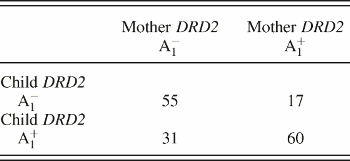
Genotyping of DRD2 was performed by PCR amplification using the forward and reverse primers: 5′-CCGTCGACGGCTGGCCAAGTTGTCTA (D2F1) and 5′-CCGTCGACCCTTCCTGAGTGTCATCA (D2R1; Miyake et. al., Reference Miyake, Nagashima, Onigata, Nagashima, Takano and Morikawa1999). The amplicon was subsequently digested with the restriction enzyme, Taq1 (New England Biolabs, Beverly, MA). This results in digestion products of the A1 allele (310 bp) and the A2 allele (180 + 130 bp). The allele status of DRD2 A1+ (A1/A1 and A1/A2 genotypes) and A1– (A2/A2 genotype) were assigned to each individual based on previous studies (see Noble, Reference Noble2003; see Table 1 for allelic frequencies). DRD2 genotyping was in Hardy–Weinberg equilibrium, suggesting that the frequencies of allelic distributions of DRD2 in this sample are consistent with expectations of gene frequencies from a random breeding population.
Distribution of mother and child dopamine receptor D2 (DRD2) polymorphisms
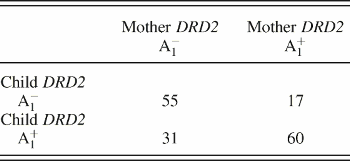
Note: Mothers with DRD2 A1+ are more likely to have children with DRD2 A1+ (χ2 = 28.89, p < .001).
Results
Distributions of DRD2 polymorphisms
As seen in Table 1, mothers with the DRD2 A1+ polymorphism were approximately twice as likely to have children with the A1+ polymorphism (χ2 = 28.89, p < .001). Similarly, mothers with the DRD2 A1− polymorphism were twice as likely to have children with the A1− polymorphism. The distribution of these alleles also differed significantly across races for both mothers and children. African American mothers (63%) were more likely to be carriers of the A1− allele of the D2 receptor gene than were European American mothers (37%; χ2 = 6.18, p < .05). Likewise, African American children (63%) were more likely to carry the A1− allele of the same gene than were European American children (37%; χ2 = 4.27, p < .05). The likelihood of having the same DRD2 alleles within infant–mother dyads did not differ as a function of race.
Descriptive statistics and correlations among covariates
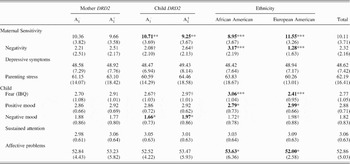
Means and standard deviations are presented in Table 2 as a function of race and type of child and mother DRD2 polymorphism. There were no significant differences in model covariates as a function of maternal DRD2 polymorphisms. However, several differences were observed as a function of child DRD2 polymorphism. Children with the A1+ allele exhibited greater negative mood during parent–child interactions, t (171) = 2.56, p < .05, had mothers who were less sensitive, t (171) = −2.60, p < .01, and who tended to perceive them as more fearful, t (171) = 1.94, p = .054. There were no differences in negative parenting as a function of child DRD2 polymorphism. There were also significant differences in model covariates as a function of family ethnicity such that African American mothers were observed to be less sensitive, t (171) = −5.10, p < .001, and more negative, t (171) = 6.63, p < .001, than European American mothers. They also reported higher levels of child fear, t (171) = 4.40, p < .001, on the IBQ and higher levels of affective problem symptoms, t (171) = 2.13, p < .05, on the CBCL than did European American mothers, and they showed less positive mood, t (171) = −1.99, p < .05, during parent–child interactions.
Means (standard deviations) of covariates by mother and child dopamine receptor D2 (DRD2) polymorphisms and ethnicity

Note: Significant group differences are in bold. †p < .1. *p < .05. **p < .01. ***p < .001.
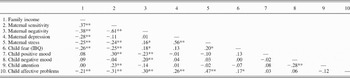
Correlations among model covariates are presented in Table 3. Family income was positively correlated with maternal sensitivity and was negatively correlated with maternal negative intrusiveness, maternal depressive symptoms, maternal parenting stress, and maternal report of child fear. Maternal sensitivity was negatively correlated with maternal negative intrusiveness, parenting stress, and report of child fear. Sensitivity was positively correlated with child positive mood and sustained attention during the parent–child interaction. Likewise, maternal negative intrusiveness was positively correlated with parenting stress report of child fear, and observed child negative mood; maternal negative intrusiveness was negatively associated with child positive mood. Maternal depressive symptoms were associated with mother's report of parenting stress, but were not associated with parenting or child behaviors. Last, parenting stress was positively correlated with mother's report of child fear, and child negative mood was negatively correlated with sustained attention.
Bivariate correlation among model covariates

* p < .05. **p < .01.
Child and mother predictors of parenting behaviors
Hierarchical regression analyses were conducted for maternal sensitivity and maternal negativity. In each case these analyses consisted of six steps. The first step included family income and ethnicity and demographic characteristics. The second step included mothers report of child temperament, specifically the fear subscale of the IBQ. The third step included psychological characteristics of the mothers, specifically self-report of depressive symptoms and parenting stress. The fourth step added observed child behaviors during the parent–child interaction, including positive mood, negative mood, and sustained attention. The fifth step introduced the separate contributions of mother and child DRD2 polymorphisms, and the sixth step included the interaction between these polymorphisms and with other model covariates.
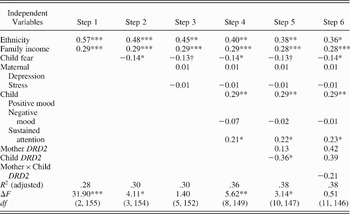
The regression coefficients for maternal sensitivity are presented in Table 4. There was a significant effect of ethnicity and family income that was replicated in each step of the model. This finding was consistent with previous individual t tests and bivariate correlations indicating less sensitive parenting among African American families and families with lower incomes. In addition, consistent with previous analyses was the negative association between maternal sensitivity and child fearfulness. This effect was significant, or approaching significance, for each entry into the model. The addition of maternal self-report of depressive symptoms and parenting stress in Step 3 did not significantly increase the variance accounted for in the model. Furthermore, at no point in the hierarchical regression was either variable significantly associated with maternal sensitivity. Thus, controlling for demographic variables and child temperament eliminated the bivariate association between parenting stress and sensitivity from the current analyses. In Step 4 child positive mood and sustained attention were each positively associated with maternal sensitivity and jointly increased the overall variance accounted for in sensitivity by approximately 6%. In Step 5 the presence of the A1+ allele of the D2 receptor gene in the child, but not in the mother was shown to be associated with a significant decrease in maternal sensitivity. The single contribution of the child A1+ allele, however, significantly increased the variance accounted for in maternal sensitivity by 3%. Finally, in Step 6 interactions between mother and child DRD2 polymorphisms and other model covariates were entered. This last addition to the model was not significant. The presence of the same A1+ allele in the mother had no additional effect on maternal sensitivity above and beyond its presence in the child, nor did any other demographic, maternal, or child characteristic moderate this association.
Hierarchical regression coefficients for maternal sensitivity

Note: Standardized partial regression coefficients for each predictor were included at each step.
† p < .1. *p < .05. **p < .01.
The same hierarchical regression model was performed for maternal negativity. As with sensitivity in the previous analysis, there were significant effects of ethnicity, t (155) = −6.00, p < .001, and family income, t (155) = −3.65, p < .001, on maternal negativity. Together, these demographic characteristics accounted for approximately 32%, F (2, 155) = 31.9, p < .001, of the variance in parental negativity. The magnitude of these associations was fairly consistent for each subsequent step in the model. None of the maternal and child variables entered in Steps 2 and 3 contributed to the prediction of maternal negativity. In Step 4 child negative mood was positively associated with maternal negativity, t (149) = 3.65, p < .001, and accounted for an additional 7% of the variance in maternal negativity, F (3, 149) = 5.59, p < .001. The addition of mother and child DRD2 polymorphisms in Step 5 and their interaction with other covariates in Step 6 did not significantly contribute to the model.
Child and mother predictors of later affective problems
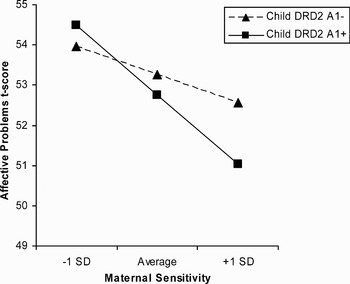
A univariate analysis of variance was conduced to examine the interactive effects of child DRD2 polymorphisms and parenting behavior during infancy on child affective problems at 3 years of age. Ethnicity and family income were entered as control variables; child DRD2 polymorphism, maternal sensitivity, and their interaction were entered as predictors of affective problems. Although child DRD2 polymorphism was not associated with later affective problems, the negative bivariate association with maternal sensitivity was maintained, F (1, 157) = 5.94, p < .05. There was, however, a significant interaction between child DRD2 and sensitivity, F (1, 157) = 4.19, p < .05, such that higher levels of sensitivity were correlated with lower affective problems only for children with the DRD2 A1+ polymorphism, β = −1.73, F (1, 74) = 5.96, p < .05. As seen in Figure 1, this effect is particularly noticeable at higher levels of sensitivity. It should be noted, however, that only 8.3% of children with the DRD2 A1+ polymorphism have mothers that are above 1.0 SD in maternal sensitivity, compared to 19.5% of children with A1−.
Higher levels of maternal sensitivity during infancy were associated with less affective problems at age 3 for children who possessed the dopamine receptor D2 gene (DRD2) A1+ polymorphism. No effect of maternal sensitivity was found for children with the DRD2 A1− polymorphism.

Discussion
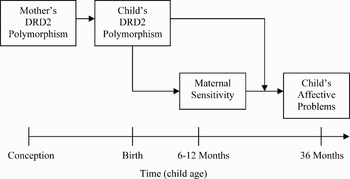
The goals of this study were to examine how the presence of the A1+ allele of the D2 receptor gene in mothers and children relates to maternal sensitivity, to determine how maternal and child characteristics might mediate this relation, and to evaluate whether maternal sensitivity moderates the association between DRD2 A1+ and child affective problems at 3 years of age. To our knowledge, this is one of the first studies to examine how the transmission of a common genetic polymorphism affects behavioral synchrony within the infant–mother dyad. The conceptual model by which we interpret our findings is presented in Figure 2.
The proposed model for bidirectional genetic and environmental influences on mother and child behavior emphasizes the importance of examining multiple levels of analyses across individuals within the family system. Although the current study was unable to find a behavioral mediator of child's genetic effects on parenting behavior, it is hypothesized that the effects of the dopamine receptor D2 gene (DRD2) A1+ polymorphism on infant behavior may result in parent–child interaction that inhibits the consolidation of sensitive parenting in mothers. In such cases children would be particularly vulnerable to later affective problems.

It was not surprising that the likelihood that the child possessed the DRD2 A1+ polymorphism was significantly greater if the mother possessed the same allelic variation of the DRD2 receptor gene. Consistent with previous findings, the presence of DRD2 A1+ was greater in African American children and mothers than it was in European American children and mothers (Barr & Kidd, Reference Barr and Kidd1993). None of the independent or dependent variables differed as a function of the DRD2 alleles carried by mothers. There were, however, significant differences between children carrying the DRD2 A1+ or the DRD2 A1− alleles, with the former group receiving less sensitive care, showing more negative mood with their parents, and being rated moderately higher on the IBQ dimension of fear than children in the DRD2 A1− group. It should also be highlighted that there was no difference between these two groups of children in harsh and negative parenting, suggesting that the association between DRD2 A1+ and parenting is rather specific and possibly limited to the propensity to respond sensitively to the child. As indicated in Figure 2, this finding suggests no direct pathway linking polymorphic variations in maternal DRD2 to sensitive parenting behavior. Rather, there appears to be an indirect pathway via the child, who, possessing an inherited allelic form of the DRD2 gene, evokes differential responses from the parent. This finding is of particular importance because it reinforces the necessity of adopting a systems perspective for understanding the role of genetic influence within a family.
In the present study we were unable to identify a mediating pathway by which DRD2 A1+ expression in the child could influence maternal behavior. A hierarchical regression was performed to consider the possible child characteristics and mother characteristics that could mediate or moderate the association between child DRD2 polymorphism and maternal sensitivity. No mediating variables were identified, nor were any interactions between child DRD2 A1+ and other child or parent characteristics found that might moderate this association. It was the most surprising that, after accounting for variance in maternal sensitivity due to race, income, child temperament, maternal psychological functioning, child behavior, and even the presence of DRD2 A1+ in the mother, child DRD2 A1+ still accounted for an independent and significant amount of variance in maternal sensitivity. Future research in this domain should consider findings from Pohjalainen and colleagues (1998), indicating that the human DRD2 A1+ gene predicts low D2 dopamine receptor availability (as found in an in vivo study using positron-electron tomography and radiolabeled raclopride). Given that D2-like dopamine receptors, as a group, have an inhibitory function in the dopaminergic system, a lower availability of these receptors may translate into less behavioral control. In this light it may be worthwhile to continue addressing the question of mediation in future research using a variety of measures designed to index child behavioral control.
That maternal sensitivity was associated with the presence of DRD2 A1+ in children, but not in the mother herself, is an interesting finding. Most mothers in this study were at least 20 years of age, meaning that their phenotypic behaviors, unlike that of their child, have been influenced by a long history of environmental experiences. Given this, it is not surprising that a single-gene polymorphism fails to markedly affect a behavioral system as complicated as parenting, which has many known and interactive environmental, cognitive, and psychophysiological correlates. By contrast, the interactive styles of young children in the first year of life may appear more heavily influenced by genetic variation because of a limited degree of environmental experiences and more limited resources, physiological or cognitive, for control at that age. Thus, in the absence of complex supragenetic systems such as those available to the parent, the DRD2 A1+ polymorphism may more directly affect child behavior, and thereby have the capacity to exert an evocative influence on parenting behavior. Although the evocative effects of child behavior on parenting have been previously demonstrated (Atkinson et al., Reference Atkinson, Chisholm, Scott, Goldberg, Vaughn and Blackwell1999; Thompson, Reference Thompson1997; van den Boom, Reference van den Boom1997), this study is the first to connect these processes with a specific intergenerational genetic transmission.
The last goal of the study was to examine whether differences in parenting could moderate or mediate a link between DRD2 allelic differences and later affective problems. Again, as seen in Figure 2, rather than finding a mediating or moderating effect of sensitivity on the hypothesized relationship between DRD2 A1+ and child outcome, we found that the child's polymorphism moderated the effect of sensitivity on affective problems. Although there was not a DRD2 group difference in child affective problems, there was a significant main effect of early maternal sensitivity on later child affective problems. This effect was limited, however, to children with DRD2 A1+, such that overall levels of affective problems were lower only for children who had sensitive mothers and DRD2 A1+, indicating a possible difference in susceptibility to caregiving effects among children with this genetic polymorphism. The notion of differential susceptibility to parenting effects is consistent with Belsky, Rha, and Park's (Reference Belsky, Rha and Park2000) hypothesis that the consequences of specific parenting behaviors are not universal for all children. It is also important to note that the association between DRD2 A1+ and maternal sensitivity means that fewer children with DRD2 A1+ experience sensitive care, and thus in this sample a limited percentage of children who might benefit from maternal sensitivity actually experience that type of caregiving from their mothers. Of those that do, however, the receipt of sensitive caregiving may be particularly important for their affective development.
The current research highlights the interdependency of subsystems within the family as a critical component for understanding how Gene × Environment interactions affect behaviors of both mothers and children. Indeed, this is a limited window into a vastly complex and multilevel system. The current analyses are limited to one genetic polymorphism, a narrow range of child and parent characteristics, early parenting during infancy, and one behavioral outcome during toddlerhood. However, these analyses begin to address many long-standing questions regarding the role of genetics in family functioning, the role of the child as an organizer of parenting behavior, and the role of family experience in genetic expression. Unfortunately, a critical piece of the puzzle in these analyses remains missing. Despite examination of mother-reported temperament and observed child behavior, we were unable to identify a behavioral process by which children with DRD2 A1+ differentially evoke less sensitive caregiving. For now, that process remains to be elucidated and should be the focus of future work in this domain.
Of course, all of these findings require replication to inspire confidence, especially given previous inconsistencies in linking molecular genetics to complex behavioral systems. In addition, given the possibility of measuring in vivo (e.g., Pohjalainen et al., Reference Pohjalainen, Rinne, Nâgren, Lehikoinen, Anttila and Syvalahti1998) the neurological phenotype associated with the DRD2 A1+ polymorphism, it may be possible for future research to test the hypotheses that (a) in infancy the A1/A2 allele is associated with a downregulation of D2 receptors among most children that have inherited this allelic form of the gene; (b) in mothers there is a greater variability in the extent to which the A1/A2 predicts D2 dopamine receptor downregulation; and (c) the association between the DRD2 A1+ polymorphism in mothers and maternal sensitivity will depend on environmental constraints, including (but not limited to) child characteristics. The necessary replication and extension of the current findings will require increased sample sizes and a sharpening of the measures by which we attempt to capture the interactive processes that give rise to the family system. Hopefully, the current study, although limited in many ways, provides a heuristic model for other researchers to build upon as developmental research begins to simultaneously address interactive processes within an individual and within the family.