1. Introduction
The Jurassic deposits of the Sichuan Basin have yielded abundant turtle remains, which consist predominantly of archaic turtles (sichuanchelyids and bashuchelyids) in the Middle Jurassic and primitive eucryptodiran turtles (xinjiangchelyids) in the Upper Jurassic (Tong et al. Reference Tong, Danilov, Ye, Ouyang and Peng2012a ,Reference Tong, Danilov, Ye, Ouyang, Peng and Li b ), while trionychoid remains are scarce. Two trionychoid taxa have been hitherto described from that basin: Sinaspideretes wimani Young & Chow, Reference Young and Chow1953 and Yehguia tatsuensis (Ye, Reference Ye1963). Both of them are based on a single specimen and both have a rather complex story. In 1953, Young and Chow studied a series of turtle specimens collected along the railway between Chengdu and Chongqing (Chengyu Railway) during its construction and the clearing away of building foundations in Datianwan, in the suburbs of Chongqing. The specimens from the Chengyu Railway are presumably of Middle or Late Jurassic age, but the exact location and horizon are unknown. One incomplete shell was named Sinaspideretes wimani and placed in the family Trionychidae based on the morphology of the neurals and the ornamentation on the shell surface (Young & Chow, Reference Young and Chow1953). This was long considered as the oldest member of that family (Young & Chow, Reference Young and Chow1953; Ye, Reference Ye1963; Mlynarsky, Reference Mlynarsky1976; Pritchard, Reference Pritchard1979; Ernst & Barbour, Reference Ernst and Barbour1989; Ye, Reference Ye1994; Zhang, Zong & Ma, Reference Zhang, Zong and Ma1998; Lucas, Reference Lucas2001). Alternatively, S. wimani was placed in a separate family, Sinaspideretidae, and considered as intermediate between Adocidae and Trionychidae (Chkhikvadze, Reference Chkhikvadze1987). It was also thought to be intermediate between Trionychidae and Carettochelyidae, or even a primitive carettochelyid (de Broin, Reference de Broin1977). More than 30 years after the first description, Meylan and Gaffney examined a cast and the photographs of S. wimani and concluded that the specimen had been interpreted in an incorrect orientation, with the posterior end at the front. The new interpretation led to S. wimani being tentatively placed in the family Carettochelyidae (Meylan & Gaffney, Reference Meylan and Gaffney1992), a conclusion generally accepted (Sukhanov, Reference Sukhanov, Benton, Shishkin, Unwin and Kurochkin2000; Brinkman, Li & Ye, Reference Brinkman, Li, Ye, Li, Wu and Zhang2008), but contested recently (Tong, Zhang & Li, Reference Tong, Zhang and Li2010).
The second trionychoid turtle from the Jurassic of the Sichuan Basin, Yehguia tatsuensis (Ye, Reference Ye1963), was originally described as Plesiochelys tatsuensis Ye, Reference Ye1963 (Plesiochelyidae), based on a shell with a poorly preserved carapace, complete plastron and other appendicular elements from the Upper Jurassic deposits of Dazu, between Chongqing and Chengdu (Ye, Reference Ye1963). The systematic position of P. tatsuensis was first questioned by Nessov, who considered it as a member of Adocidae (Nessov & Julinen, Reference Nessov and Julinen1977). It was even included in the adocid subfamily Shachemydinae, because a primitive hinge was supposed to be present between the epiplastra and entoplastron/hyoplastra (de Lapparent de Broin, Reference de Lapparent de Broin2004). Danilov & Parham (Reference Danilov and Parham2006) re-studied P. tatsuensis. Their phylogenetic analysis placed it in a group of basal Trionychoidae named Adocusia, which comprised also Adocidae and Nanhsiungchelyidae, but a subsequent analysis placed this taxon within Adocidae, in the basalmost position within that family (Danilov & Syromyatnikova, Reference Danilov and Syromyatnikova2009).
The type and only specimen of S. wimani (CQMNH C.994) consists of an incomplete carapace with articulated plastron. The plastron, being only slightly exposed, had attracted little attention in the previous studies (Young & Chow, Reference Young and Chow1953; Meylan & Gaffney, Reference Meylan and Gaffney1992) and a comparison between S. wimani and Y. tatsuensis had never been attempted because of the lack of overlapping parts. For the present study, the left half of the plastron of S. wimani was prepared. In addition, we have found recently in the Chongqing Museum of Natural History collections a new specimen of Trionychoidae from the Upper Jurassic of the Sichuan Basin which consists of a nearly complete carapace. The detailed description of the type specimen of S. wimani (CQMNH C.994) and the new specimen (CQMNH C.1000) are presented herein. They are compared with the type specimen of Y. tatsuensis (IVPP V996), based on the revision by Danilov & Parham (Reference Danilov and Parham2006) and first-hand observations by one of us (H. Tong). Our study reveals that S. wimani Young & Chow, Reference Young and Chow1953 and Y. tatsuensis (Ye, Reference Ye1963) belong to a single taxon.
Institutional abbreviations. CQMNH – Chongqing Museum of Natural History, Chongqing; IVPP – Institute of Vertebrate Palaeontology and Palaeoanthropology, Chinese Academy of Sciences, Beijing.
2. Geological and geographical settings
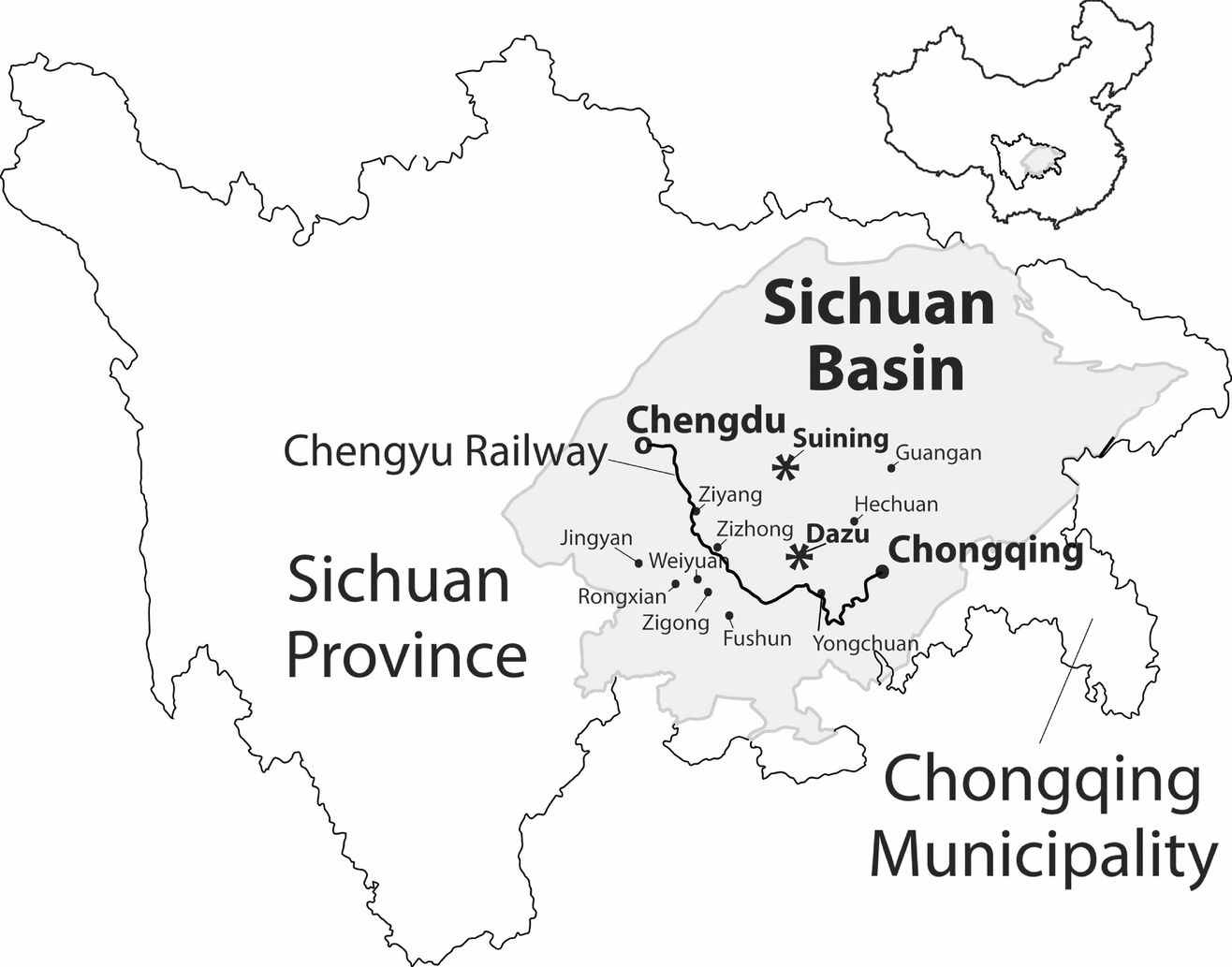
The geology of the Sichuan Basin was summarized in Tong et al. (Reference Tong, Danilov, Ye, Ouyang and Peng2012a ). Figure 1 shows the path of the Chengyu Railway and places which yielded Jurassic turtles in the Sichuan Basin. The holotype of S. wimani Young & Chow, Reference Young and Chow1953 (CQMNH C.994) was collected along the Chengyu Railway, without record of an exact location and horizon. It was considered as (?) Late Jurassic by Young & Chow (Reference Young and Chow1953). The series of turtle specimens originally described by Young & Chow (Reference Young and Chow1953) consists of six shells. Except for CQMNH C.994, all belong to Xinjiangchelyidae and based on their morphology, they are likely to be from the Upper Jurassic Shangshaximiao Formation (Tong et al. Reference Tong, Danilov, Ye, Ouyang and Peng2012a ,Reference Tong, Danilov, Ye, Ouyang, Peng and Li b ).
Map showing the Sichuan Basin, Chengyu Railway and Jurassic turtle localities. Dazu (IVPP V996) and Suining (CQMNH C.1000) are indicated by stars; other Jurassic turtle localities are marked by dots.

The type specimen of Y. tatsuensis (Ye, Reference Ye1963), IVPP V996, was collected from the Upper Jurassic beds at Gaofeng Mountain, Daan road, Dazu, Sichuan Province and sent to the IVPP by Mr Deng Yuncong in 1956 (Ye, Reference Ye1963).
According to the registration documents in the Chongqing Museum of Natural History, CQMNH C.1000 was collected in June 1977 from the Upper Jurassic Shangshaximiao Formation of Suining, Sichuan Province, some 80 km north of Dazu where the type specimen of Y. tatsuensis comes from.
3. Description
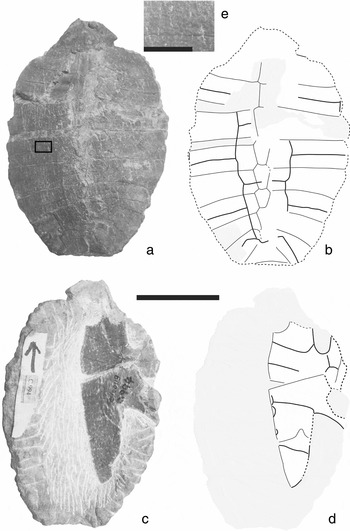
3.a. Type specimen of Sinaspideretes wimani (CQMNH C. 994; V. 709 in Young & Chow, Reference Young and Chow1953; Fig. 2)
The shell is incomplete, lacking all the peripheral region of the carapace. The specimen is dorsoventrally crushed, with some plates of the carapace disarticulated and part of the shell surface damaged (see Fig. 2). The plastron is pushed dorsally and the left half is disarticulated from the right one along the midline. To avoid damaging the specimen, only the left half of the plastron was prepared; it is almost complete, lacking only the left epiplastron and entoplastron.
Holotype of Sinaspideretes wimani Young & Chow, Reference Young and Chow1953 (CQMNH C.994) from the Jurassic of the Sichuan Basin in dorsal (a, b) and ventral (c, d) views and detail of ornamentation (e). Scale bar represents 5 cm for (a–d) and 1 cm for (e).

Our orientation of the shell agrees with that of Meylan & Gaffney (Reference Meylan and Gaffney1992), which is further confirmed by the prepared plastron (see Fig. 2). The close examination of the specimen reveals more details on the carapace, in comparison with previous studies (Young & Chow, Reference Young and Chow1953; Meylan & Gaffney, Reference Meylan and Gaffney1992). Although the carapace surface is worn, an ornamentation is clearly present and comparable to that of Y. tatsuensis (IVPP V996) and CQMNH C.1000 (Fig. 2e). On the carapace, most sutures are preserved, except those of the nuchal. The first to third neurals are missing, and the seventh and eighth neurals are incomplete, but their outline can partly be reconstructed from the imprint on the internal mould. The complete series of eight neurals reaches the suprapygal, with the neural formula of 6<4>6>6>6>6>6>6. All neurals are longer than wide. The first neural appears to be hexagonal with short posterolateral sides. The second neural is rectangular and shorter than the third neural. The third to eighth neurals are all hexagonal with short anterolateral sides. The eighth neural appears, however, to be shorter than the seventh. The first suprapygal is complete, triangular and quite large. A transversal and anteriorly convex suture on the posterior end of the carapace indicates the presence of a large second suprapygal plate. The costal plates, eight in number, have almost parallel anterior and posterior margins. The rib head of the left second costal is visible on the internal mould; it is unreduced as in Y. tatsuensis (Danilov & Parham, Reference Danilov and Parham2006). No peripherals are preserved.
The scute sulci are visible on the carapace where the surface is not damaged. Nearly complete third and fourth vertebrals and part of the second and fifth vertebrals are preserved. The second and third vertebrals are narrow, the third vertebral being slightly longer than wide. The fourth vertebral is more elongate and narrower than the third, being clearly longer than wide. The fifth vertebral is wider than the fourth at its anterior margin. The unusual shape of the fifth vertebral scute is likely an anomaly of development. The intervertebral sulci pass through the third, the fifth and the eighth neurals, respectively. There are four pleural scutes, with the interpleural sulci running parallel to the intercostal sutures. At the lateral end of the right second costal, an anteroposteriorly directed short sulcus is visible, indicating that the fifth marginal extends onto the costal plate.
On the plastron, the left hyoplastron, hypoplastron and xiphiplastron were exposed after the preparation; they are almost complete, with the bridge and the lateral margin of the posterior lobe damaged. The hyoplastron and hypoplastron are disarticulated and the hyoplastron has its posterior end hidden by the hypoplastron. Although the bridge region is damaged, enough is preserved on the left side to show that the plastron is sutured to the carapace. The surface of the plastron is rough as in Y. tatsuensis. The anterior lobe is wide. The bridge is relatively long, being roughly as long as the posterior lobe as in Y. tatsuensis. The posterior lobe is relatively narrow, with rather straight lateral margins. The axillary buttress, even though incomplete, is long, in contrast to the very short buttress in carettochelyids such as Anosteira maomingensis (Tong, Zhang & Li, Reference Tong, Zhang and Li2010). The axillary notch is narrow and the inguinal notch is wider than the axillary notch. The anal notch is absent. Although the entoplastron is not preserved, the preserved entoplastron/hyoplastron suture indicates that the entoplastron is a large element, which is likely wider than long.
The scute sulci are clearly visible on the plastron. The humeropectoral sulcus is slightly convex anteriorly in the middle with the lateral end turned anteriorly. It is located at the base of the anterior lobe and far posterior to the entoplastron. The pectoral scute is shorter than the abdominal scute. The pectoroabdominal sulcus is almost straight and transverse. The abdominofemoral sulcus is convex anteriorly. The femoroanal sulcus is convex anteriorly but does not reach the hypoplastron/xiphiplastron suture. Two anterior inframarginals are preserved on the hyoplastron. The midline sulcus is sinuous.
3.b. IVPP V996 (holotype of Yehguia tatsuensis (Ye, Reference Ye1963), Fig. 3)
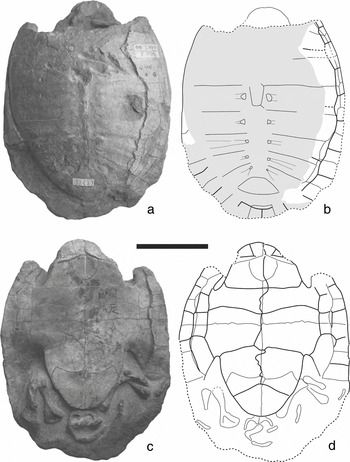
Danilov & Parham (Reference Danilov and Parham2006) provided a detailed redescription of IVPP V996. Only additional observations are provided here. Although the posterolateral portion of the carapace margin is damaged on both sides, the better preserved left margin indicates that the carapace is slightly expanded posteriorly. The lateral margin of the carapace is not upturned on the peripherals 3–4 and the anterior part of the peripheral 5; a very slightly upturned lateral margin is observed from the posterior part of the peripheral 5 to peripheral 7. Two large suprapygals of similar width are distinguishable on the internal mould. Although the posterior margin is damaged, the pygal is certainly wider than long, with the lateral margins convergent forward. The marginals 4–7 extend onto the costals, from the posterior part of costal 1 to the anterolateral tip of costal 5; the marginal 8 is restricted to the peripheral. Our interpretation of the carapace and plastron of IVPP V996 is shown in Figure 3.
Sinaspideretes wimani Young & Chow, Reference Young and Chow1953 (IVPP V996, holotype of Yehguia tatsuensis (Ye, Reference Ye1963)) from the Upper Jurassic of Dazu, Sichuan Basin in dorsal (a, b) and ventral (c, d) views. Scale bar represents 5 cm.

3.c. New specimen (CQMNH C.1000; Fig. 4)
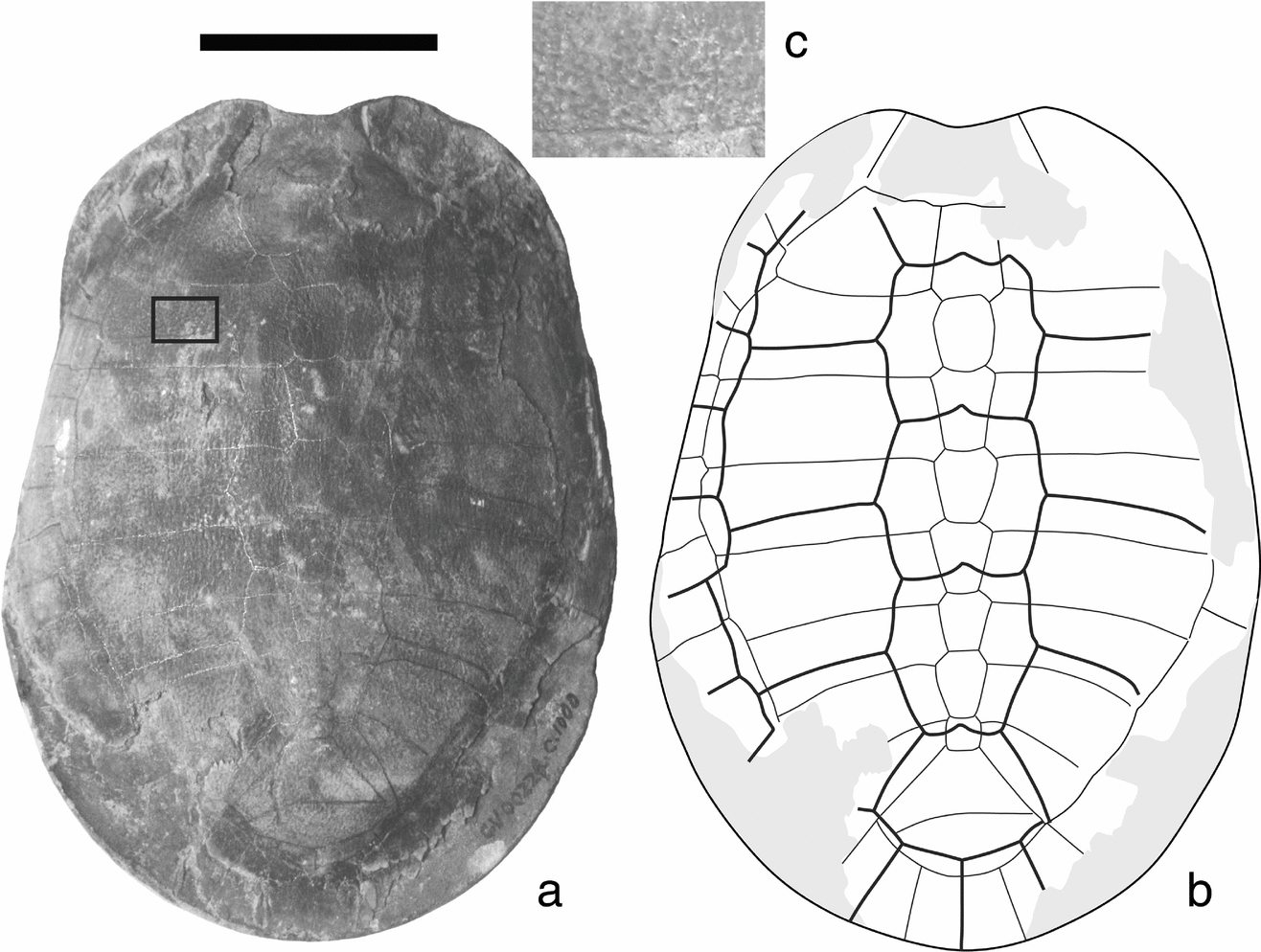
CQMNH C.1000 is an almost complete carapace without a plastron. The specimen is well preserved without deformation, although the margin area is damaged (see Fig. 4).
Sinaspideretes wimani Young & Chow, Reference Young and Chow1953 (CQMNH C. 1000) from the Upper Jurassic of Suining, Sichuan Basin in dorsal view (a, b) and detail of ornamentation (c). Scale bar represents 5 cm.

The shell is low. The carapace has an oval outline which is slightly expanded posteriorly, with a wide and rather deep cervical notch. The anterolateral edge is slightly upturned, but not forming a clear gutter. The surface of the shell is covered with a pitted ornamentation (Fig. 4c). The nuchal is damaged, but the outline can be made out; it is trapezoidal in shape. The complete neural series reaches the suprapygal, with a neural formula of 6<4>6>6>6>6>6>6. The first neural is hexagonal, with short posterolateral sides. The second neural is rectangular and clearly shorter than the third neural. The third to eighth neurals are hexagonal, with short anterolateral sides. The first to seventh neurals are longer than wide, while the eighth one is short and roughly as long as wide. There are two large triangular suprapygals of roughly equal size. The pygal is slightly wider than long. The peripherals from the fourth to the sixth are narrow, while the seventh to eleventh are greatly expanded mesiolaterally.
The scute sulci are clearly visible. The cervical is not preserved. All vertebrals are relatively narrow. The second and third vertebrals are roughly as wide as long, though the fourth vertebral is longer than wide. The intervertebral sulci pass through the first, the third, the fifth and the eighth neurals, respectively. The first costal scute is longer than wide and the second to the third costal scutes are roughly as long as wide. The marginals 4–7 extend onto the second to fifth costal plates, and the eleventh and twelfth marginals are mesiolaterally expanded, overlapping the suprapygals.
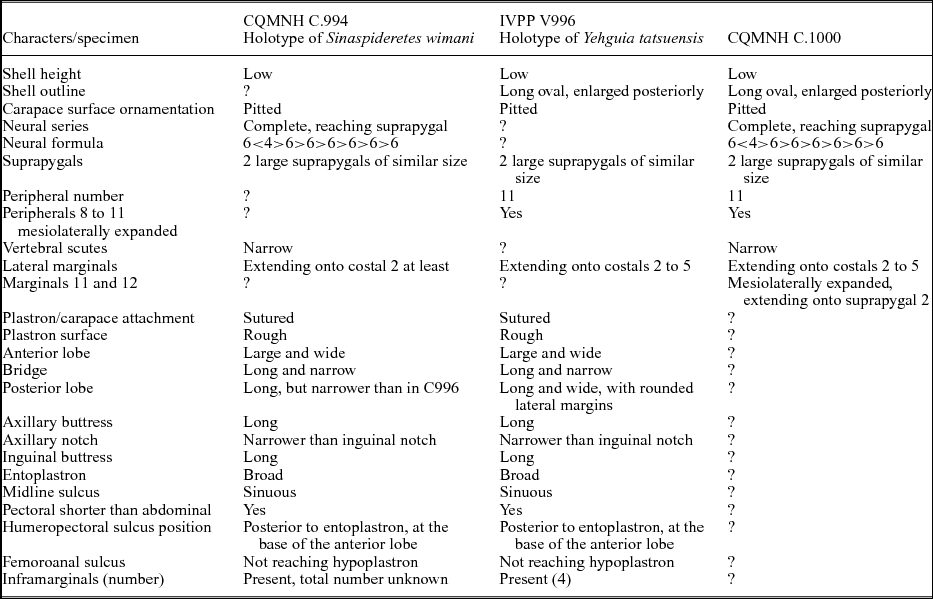
4. Comparisons (Table 2)
The shells of CQMNH C.994, CQMNH C.1000 and IVPP V996 are similar in their small size and in their sculptured carapace surface. The general shape of the carapace is also comparable, with a low dome and oval outline. Both CQMNH C.1000 and IVPP V996 have a slightly upturned anterolateral carapace margin. The carapaces of CQMNH C.1000 and IVPP V996 are slightly expanded posteriorly, although the posterolateral carapacial margins of IVPP V996 are damaged (see Section 3).
The carapaces of CQMNH C.994 and CQMNH C.1000 have a similar shape and proportion of the neurals, with a neural formula of 6<4>6>6>6>6>6>6, neural 2 being clearly smaller than neural 3, and neural 7 larger than neural 6. There are two large suprapygals of similar size. The vertebral scutes are narrow, with vertebral 3 as wide as long and an elongate vertebral 4.
Although the carapace of IVPP V996 is mostly missing, the morphology of the preserved peripherals and lateral portion of the costals perfectly matches those of CQMNH C.1000: the anterior peripherals, from the third to the sixth, are mesiolaterally narrow, and the seventh to eleventh peripherals are mesiolaterally expanded; the fourth marginal scute is restricted to the peripheral plate anteriorly, but extends onto the second costal plate posteriorly; the fifth to seventh marginals extend onto the costals, and the eighth to tenth marginals are again restricted to the peripherals. In CQMNH C.994, the pleuromarginal sulcus is visible on the right second costal.
The plastron of CQMNH C.994, as exposed, is similar to that of IVPP V996 in the following features: plastron sutured to the carapace; relatively long and narrow bridge; long axillary buttress; broad entoplastron; humeropectoral sulcus located at the base of the anterior lobe; pectoral shorter than abdominal; femoroanal sulcus not reaching hypoplastron/xiphiplastron suture; sinuous midline sulcus of plastron; and presence of inframarginals. However, compared with IVPP V996, CQMNH C.994 seems to have a slightly narrower posterior lobe of the plastron, with straighter lateral margins.
5. Systematic palaeontology
Order TESTUDINES Linnaeus, Reference Linnaeus1758
Infraorder CRYPTODIRA Cope, Reference Cope1868
Superfamily Trionychoidae Fitzinger, Reference Fitzinger1826
Genus Sinaspideretes Young & Chow, Reference Young and Chow1953
-
1963 Plesiochelys tatsuensis Ye, p. 9, fig. 7, pl. I, 3–4.
-
1994 Plesiochelys tatsuensis Ye, p. 21, fig. 8.
-
2006 Yehguia tatsuensis Danilov & Parham, p. 573, figs 2–3.
-
2008 Yehguia tatsuensis Brinkman, Li & Ye, p. 62, fig. 64.
Type species. Sinaspideretes wimani Young & Chow, Reference Young and Chow1953.
Type locality and horizon. Along Chengyu Railway, exact location and horizon unknown.
Emended diagnosis. Trionychoid of small size, with a carapace length of about 165 mm; carapace low, with a shallow cervical notch and an oval outline which is slightly expanded posteriorly; characterized by the following combination of features: carapace surface with pitted ornamentation, plastron surface rough; complete neural series reaching suprapygal, with a neural formula of 6<4>6>6>6>6>6>6; two suprapygals of equal size; vertebral scutes narrow, with the second and third vertebrals roughly as long as wide; plastron sutured to carapace; relatively large epiplastron; large entoplastron which is roughly as wide as long; pair of intergulars present, extending slightly onto entoplastron; pectoral shorter than abdominal; anal scute restricted to xiphiplastron; four pairs of inframarginal scutes; midline sulcus of plastron sinuous.
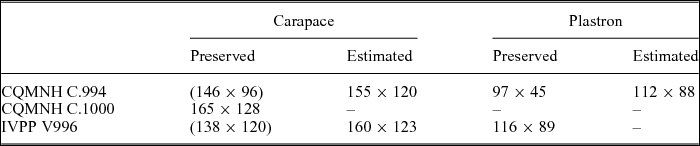
Measurements. See Table 1.
Measurements of Sinaspideretes wimani Young & Chow, Reference Young and Chow1953

Length × width, in millimetres.
Comparisons between CQMNH C.994, IVPP V996 and CQMNH C.1000

Distribution. Upper Jurassic Shangshaximiao Formation; Sichuan Basin, China.
6. Discussion
Based on the comparisons above, Y. tatsuensis (Ye, Reference Ye1963) is synonymized with S. wimani Young & Chow, Reference Young and Chow1953. Slight differences, such as the narrower posterior plastral lobe of CQMNH C.994 relative to IVPP V996 are probably owing to individual variation or might also reflect sexual dimorphism.
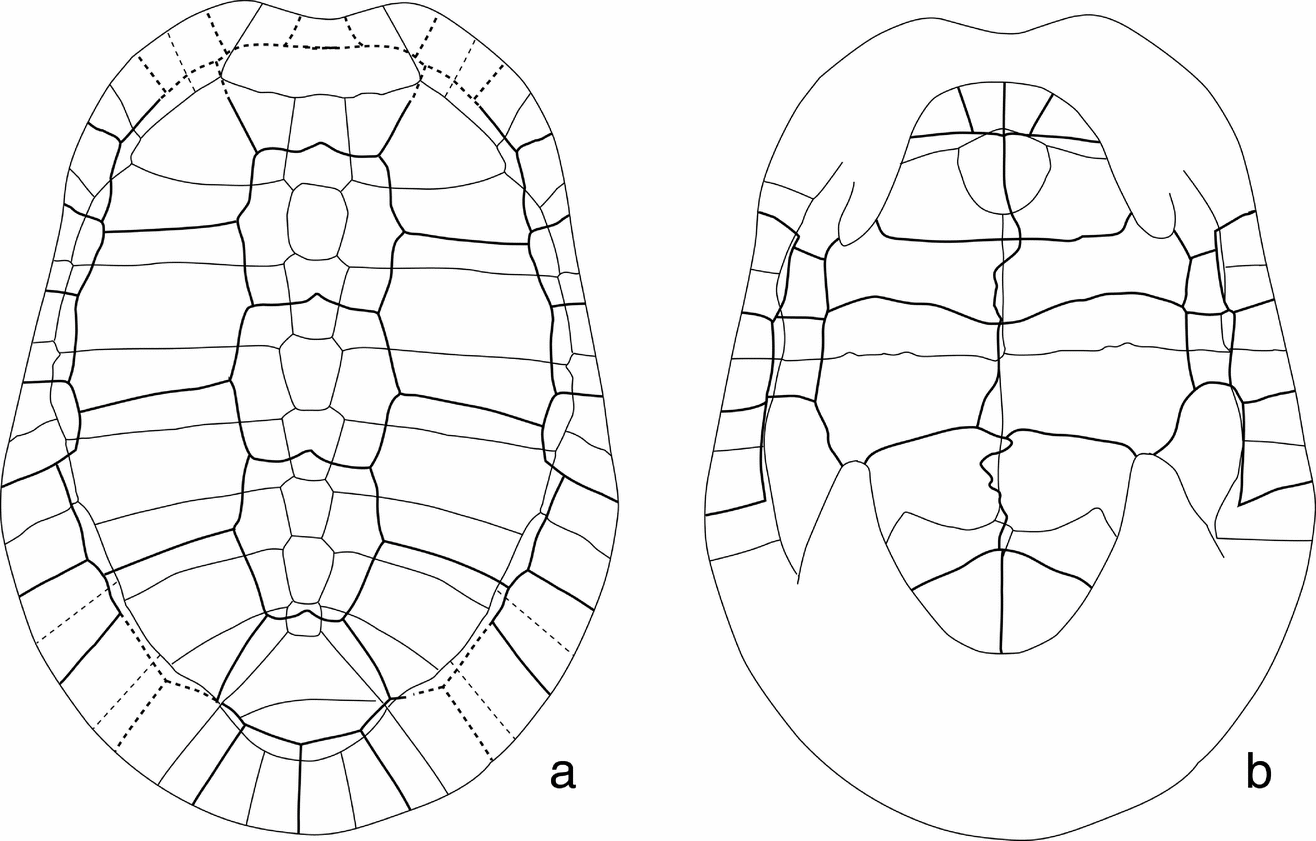
The species S. wimani now includes three specimens which provide an almost complete aspect of the shell. A reconstruction is shown in Figure 5. In agreement with previous opinions (Young & Chow, Reference Young and Chow1953; Meylan & Gaffney, Reference Meylan and Gaffney1992; Danilov & Parham, Reference Danilov and Parham2006), S. wimani is a member of Trionychoidae. The trionychoid synapomorphies observed in S. wimani include the carapace surface covered with a pitted sculpture, the neural formula of 6<4>6>6>6>6>6>6 and a broad entoplastron. The pitted ornamentation of S. wimani is reminiscent of the adocids Ferganemys spp., Adocus spp. and Isanemys srisuki (Tong, Buffetaut & Suteethorn, Reference Tong, Buffetaut, Suteethorn, Danilov and Parham2006; Syromyatnikova & Danilov, Reference Syromyatnikova and Danilov2009; Danilov, Sukhanov & Syromyatnikova, Reference Syromyatnikova2011; Syromyatnikova, Reference Syromyatnikova2011). The neural pattern with a hexagonal first neural with short posterolateral sides followed by a rectangular second neural is present in nearly all Adocidae (with one exception: Isanemys) and Nanhsiungchelyidae. It is also observed in some xinjiangchelyids as intraspecific variation, such as Chengyuchelys latimarginalis (Young & Chow, Reference Young and Chow1953) from the Upper Jurassic of the Sichuan Basin and Xinjiangchelys from the Upper Jurassic of Pinfengshan, Junggar Basin, China (Peng & Brinkman, Reference Peng and Brinkman1993; Tong et al. Reference Tong, Danilov, Ye, Ouyang, Peng and Li2012b ). A broad entoplastron is present in Trionychoidae, and also in Testudinoidea (Tong et al. Reference Tong, Claude, Naksri, Suteethorn, Buffetaut, Khansubha, Wongko, Yuangdetkla, Buffetaut, Cuny, Loeuff and Suteethorn2009). The entoplastron is oval in Xinjiangchelyidae and triangular in ‘Macrobaenidae’; in both cases it is clearly longer than wide. In addition, the pectoral being shorter than the abdominal and the anal scute being restricted onto the xiphiplastron are also characters shared with basal trionychoids but distinct from xinjiangchelyids.
Reconstruction of Sinaspideretes wimani Young & Chow, Reference Young and Chow1953, in dorsal (a) and ventral (b) views.

S. wimani was originally included in Trionychidae but was later tentatively placed in Carettochelyidae by Meylan & Gaffney (Reference Meylan and Gaffney1992), where it was the oldest member of that family. Contrary to the opinion of Meylan & Gaffney (Reference Meylan and Gaffney1992), we exclude S. wimani from Carettochelyidae. The relatively wide neurals, complete series of neurals reaching the suprapygal, two large suprapygals, 11 pairs of peripherals, unreduced scutes, plastron sutured to the carapace with a long and narrow bridge and long axillary and inguinal buttresses, broad epiplastron and a diamond-shaped entoplastron which is located clearly anterior to the base of the anterior lobe seen in S. wimani are all inconsistent with Carettochelyidae. The family Carettochelyidae, known since the mid Cretaceous of SE Asia (de Lapparent de Broin, Reference de Lapparent de Broin2004; Tong et al. Reference Tong, Buffetaut, Suteethorn, Srisuk, Ostal, Gregorova and Ivanov2004, Reference Tong, Suteethorn, Claude, Buffetaut, Jintasakul, Wannakao, Youngme, Srisuk and Lertsirivorakul2005), represents a relatively homogenous group. In this family, the neurals are slender, the neural series is reduced, with the posterior costal plates meeting at the midline; a single large suprapygal is present; there are ten pairs of peripherals; the plastron is attached to the carapace by ligaments; the bridge is short with reduced axillary and inguinal buttresses; the epiplastron is elongate; and the entoplastron is triangular and located at the base of the anterior lobe. The scutes are extremely reduced in Carettochelyidae; they are greatly modified in Anosterinae and totally lost in adults of Carettochelyinae.
The recent revision of Y. tatsuensis placed this taxon at first in a group of basal Trionychoidae named Adocusia, which includes also Adocidae and Nanhsiungchelyidae (Danilov & Parham, Reference Danilov and Parham2006), while subsequent phylogenetic analyses placed it in a basalmost position among Adocidae because of the presence of three synapomorphies: a longer than wide pygal, shell surface sculpture consisting of small and regular pits or dots, and shallow and narrow scute sulci (Danilov & Syromyatnikova, Reference Danilov and Syromyatnikova2009). Although S. wimani has a pitted shell surface ornamentation like adocids, a series of primitive characters seems to support its more basal position relative to Adocidae and Nanhsiungchelydiae within Trionychoidae: two large suprapygals of similar size; a roughly as wide as long entoplastron which is located anteriorly; and the humeropectoral sulcus located at the base of the anterior lobe. Adocidae and Nanhsiungchelyidae share a number of derived characters such as a reduced first suprapygal, an entoplastron clearly wider than long and located posteriorly, and the humeropectoral sulcus posterior to the anterior lobe.
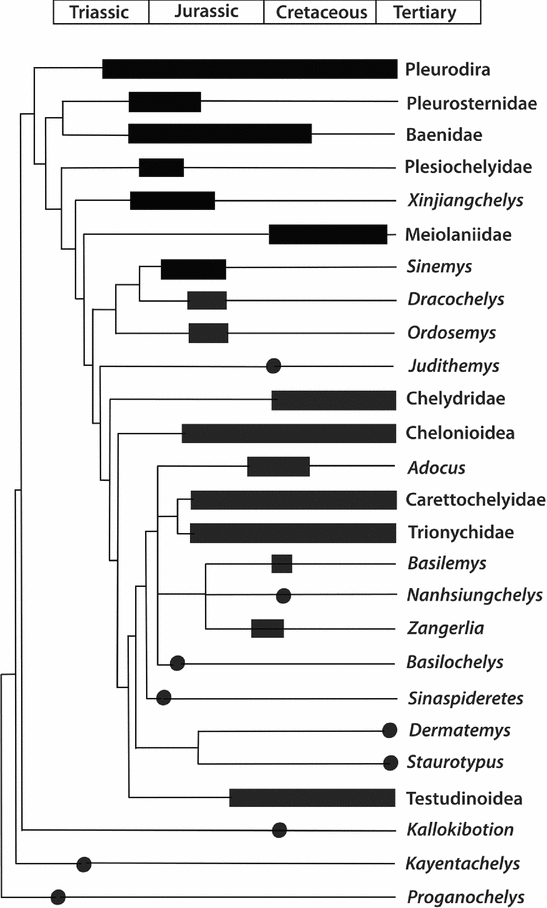
We performed a phylogenetic analysis adding in the data from S. wimani (Table 3) to the data matrix used in Tong et al. (Reference Tong, Claude, Naksri, Suteethorn, Buffetaut, Khansubha, Wongko, Yuangdetkla, Buffetaut, Cuny, Loeuff and Suteethorn2009). Twenty-seven of 74 characters were coded in S. wimani. Based on the recent works on Xinjiangchelyidae (Tong et al. Reference Tong, Danilov, Ye, Ouyang and Peng2012a ,Reference Tong, Danilov, Ye, Ouyang, Peng and Li b ), one character coding in Xinjiangchelys (character 50: marginal scutes reaching costal plates) was changed to 2. Ten most parsimonious trees were produced using Paup 4.0b10, with a tree length of 183 steps, consistency index of 0.45 and retention index of 0.73. The general topography of the strict consensus tree remains comparable to that of Tong et al. (Reference Tong, Claude, Naksri, Suteethorn, Buffetaut, Khansubha, Wongko, Yuangdetkla, Buffetaut, Cuny, Loeuff and Suteethorn2009), except that the position of Adocus, nanhsiungchelyids and Basilochelys relative to Trionychia within Trionychoidea is unresolved. S. wimani is placed in the basalmost position among Trionychoidae (Fig. 6) in contrast to the recent phylogenetic analysis by Danilov & Syromyatnikova (Reference Danilov and Syromyatnikova2009), which placed Y. tatsuensis within the family Adocidae.
Data matrix of Sinaspideretes wimani Young & Chow, Reference Young and Chow1953

Strict consensus tree produced using data matrix of Tong et al. (Reference Tong, Claude, Naksri, Suteethorn, Buffetaut, Khansubha, Wongko, Yuangdetkla, Buffetaut, Cuny, Loeuff and Suteethorn2009) with S. wimani included.

7. Conclusion
S. wimani Young & Chow, Reference Young and Chow1953 is the only trionychoid turtle in the Jurassic of the Sichuan Basin. Although the original information about the exact stratigraphical level and geographical origin of the holotype (CQMNH C.994) is missing, given that two other referred specimens (IVPP V996 and CQMNH C.1000) are both from the Upper Jurassic Shangshaximiao Formation, CQMNH C.994 is likely from the same stratigraphical unit.
S. wimani is excluded here from Carettochelyidae since it lacks all synapomorphic features of that group. The family Carettochelyidae, as currently documented, first occurs in the mid Cretaceous, with the oldest representatives being from the Lower Cretaceous Sao Khua Formation (Barremian) of Thailand (Tong et al. Reference Tong, Buffetaut, Suteethorn, Srisuk, Ostal, Gregorova and Ivanov2004). S. wimani is considered as the most basal member of Trionychoidae. The presence of trionychoids in the Upper Jurassic adds to the evidence from the fossil record for the antiquity of the group, thus is in agreement with the early split of Trionychoidae among the crown Testudines suggested by the phylogeny of turtles based on the molecular data, which places Trionychia (Carettochelyidae and Trionychidae) in the basalmost position among Cryptodira (Krenz et al. Reference Krenz, Naylor, Shaffer and Janzen2005; Near, Meylan & Shaffer, Reference Near, Meylan and Shaffer2005; Lourenço et al. Reference Lourenço, Claude, Galtier and Chiari2012), although the analysis using morphological characters alone does not suggest the same scenario.
Acknowledgements
We thank Fang Zheng and Yuan Wang (IVPP, Beijing), Songlin Zhu and Jiangbo Tong (CQMNH, Chongqing) for access to the specimens in their care; Julien Claude (Montpellier) and Donald Brinkman (Drumheller) for review and Eric Buffetaut (Paris) for improving the manuscript. This work is supported by a National Natural Science Foundation of China (Grant 41172017) to H. T. and L. L.