Repetition has multiple functions in conversation (see e.g. Johnstone, Reference Johnstone1994; Walker, Reference Walker1996; Brown, Reference Brown1998; Svennevig, Reference Svennevig2004). One pervasive use, for example, is when a speaker adds to common ground new information offered by another. Here, the speaker's repetition, typically of a content word or a whole phrase, achieves two things: it acknowledges or ratifies the contribution of the other, and, in so doing, signals that a specific piece of information is now in common ground. Speakers can also use less specific means to mark new information as given: they can use pronouns like he for continuity of reference to the same protagonist, for instance, and in adult narratives they rely on pronouns (rather than lexical noun phrases) 60% to 87% of the time (see Francik, Reference Francik1985; Gundel, Hedberg & Zacharski, Reference Gundel, Hedberg and Zacharski1993). Or they can simply use general acknowledgements like mhh or yeah. But before any information can be added to common ground, speakers must agree on what the other person said. Adults use repetition, typically with rising intonation, with children, to check on the intention being expressed by the child, and to initiate any repairs needed. The adult repeat itself contains the correction (Sacks, Schegloff & Jefferson, Reference Sacks, Schegloff and Jefferson1974; Jefferson, Reference Jefferson1982).
Adult initiations of repair and ratification may be particularly important with young children because children make errors of all kinds and frequently violate two Gricean maxims that contribute to the Cooperative Principle in conversation. When they make errors of omission – leaving out words, grammatical morphemes, agreement markers and so on – from the adult's perspective, they violate the maxim of quantity, ‘say as much as necessary’. For example, the utterance of the word Milk on its own, with no prefatory question like ‘What do you want?’ from the parent, in many contexts doesn't clearly indicate whether the child wants milk (compare the more informative Want milk), can see a bottle of milk (compare See milk) or has just split milk on the floor (compare Milk floor). And when children make errors of commission, using the wrong words or morphemes, again from the adult perspective, they violate the maxim of manner, ‘make yourself clear’ (Grice, Reference Grice1989). In both cases, children's errors make them hard for their addressees to understand. Adults could use repetition to clarify children's intentions and so preserve the Cooperative Principle. They could also repeat what the child has just said in order to ratify what children say when their intentions are clear, thereby simultaneously indicating to the child exactly what it is that the adult has understood. Simple acknowledgements like Uh-huh or yeah are less informative than the repeat of a specific word or phrase. Repeats of actual words are also more informative about continuity in an exchange for children than uses of pronouns which contain ‘minimal descriptive content’ and so offer much less basis for identifying the intended referent (Gundel et al., Reference Gundel, Hedberg and Zacharski1993). One goal of this study is establish how adults use repetition with young children, and to see what functions children's uses of repetition have with adults.
Some adult repetitions have been characterized as ‘reformulations’. These are repetitions of erroneous child utterances in which adult speakers, in repeating, have corrected the child errors, underlined, as in (1):
(1)
CHILD (2 ; 4.29, being carried): Don't fall me downstairs!
PARENT: oh, I wouldn't drop you downstairs.
[Clark, unpublished diary]CHILD: Don't drop me downstairs.
The parent, in repeating the child's utterance, makes the relevant deictic shifts (this is typical in adult repeats) and substitutes the suppletive causative drop (new information) for the child's erroneous intransitive fall. The child takes up the adult's correction in the next turn. Such reformulations are typically produced in the next turn after the child has made an error (Chouinard & Clark, Reference Chouinard and Clark2003). Research on such reformulations in English has shown that, first, adults correct child errors frequently, up to 60% of the time before ages 3 ; 0 to 3 ; 6; second, they correct all kinds of errors – phonological, morphological, syntactic and lexical; and third, they rely mostly on side sequences within the exchange in producing their reformulations, as in (2), where the adult repeats the child's utterance with rising intonation and with the error(s) corrected, and the child then acknowledges the adult's version (Kuczaj, Reference Kuczaj1976). (The side sequence is contained in the lines marked by an initial ||, with the repeated word underlined; see further Schegloff, Reference Schegloff and Sudnow1972.)
(2) Side sequence
ABE (2 ; 6.4): Milk. Milk.
‖ FATHER: You want milk?
‖ ABE: Uh-huh.
[CHILDES: Kuczaj corpus]FATHER: Ok. Just a second and I'll get you some.
They also make some embedded corrections (Jefferson, Reference Jefferson1982), as in (3), where the correction of the verb form (fell) is offered in the next turn by the father:
(3) Embedded correction
ABE (2 ; 4.24): He falled, he falled again.
[CHILDES: Kuczaj corpus]FATHER: Ok he fell, but no, he's at the boat, now put him in front of the car.
Children give evidence of attending to the adult reformulations they hear: they repeat a number of corrected forms, and also acknowledge them with responses like yeah or uh-huh, as in (2), but these are much less frequent than their repeats of corrected forms (Chouinard & Clark, Reference Chouinard and Clark2003; see also Demetras, Post & Snow, Reference Demetras, Post and Snow1986; Farrar, Reference Farrar1992; Saxton, Reference Saxton2000; Otomo, Reference Otomo2001).
But when children repeat, what are they doing? Do they focus on words and constructions that are unfamiliar, or on forms already known? Their repetitions, traditionally viewed as imitations (see Speidel & Nelson, Reference Speidel and Nelson1989), have been counted as playing little role in the acquisition of language per se (e.g. Bloom, Hood & Lightbown, Reference Bloom, Hood and Lightbown1974). Yet they repeat unfamiliar words presented as new, with stress in clause-final position (e.g. Réger, Reference Réger1986; Clark, Reference Clark2007). In fact, they repeat new words at twice the rate that they repeat new information (Veneziano, Reference Veneziano2001; Clark, Reference Clark2007). This suggests that children use repetition to signal attention to what is new, by picking out a single word or some longer expression. They also use repetition when responding to requests for clarification (e.g. Ochs, Reference Ochs, Ervin-Tripp and Mitchell1977). In summary, repetition signals that the speaker, adult or child, is attending to what the other just said, and identifies the (formerly new) information now shared in common.
Repetition offers a primary means for signalling what new information has been taken up by the other and so added to common ground. That is, once speaker-1 offers some information, speaker-2 can take up what is new, and by repeating it, identify it explicitly, acknowledge it and so count it as given, and place it in common ground. Typically, speaker-2's utterance would also contain further new information to be accepted by the next speaker (see Clark & Haviland, Reference Clark, Haviland and Freedle1977). Repetition, of course, is just one way to acknowledge what the preceding speaker said. Speakers can also note the other's contribution by using general expressions like yes, uh-huh or mmh instead, for the utterance as a whole, or rely on pronouns to mark continuity of reference to the same entity across several turns. But general acknowledgements, like pronouns, are non-specific and so cannot identify the particular information now in common ground (see Clark & Haviland, Reference Clark, Haviland and Freedle1977; Francik, Reference Francik1985; Gundel et al., Reference Gundel, Hedberg and Zacharski1993; Brennan & Clark, Reference Brennan and Clark1996).
In this study, we focus on how uses of repetition might be similar or differ for adults and children. We looked in particular at the following hypotheses:
1. Adults will repeat, using reformulations, in order to check up on what children intended to say.
2. In doing this, adults may also offer children corrections – conventional ways to say what they apparently intended to say – in side sequences and embedded repairs. They may also re-repeat after their children's repeats in order to ratify child attempts at making a correction.
3. The content of adult repeats will change with age: with younger children, adults will need to check on both form and usage; with older ones, only on usage, because the children's forms will be largely understandable.
4. Children will repeat to acknowledge and so ratify what the adult has just said. They will also sometimes follow up adult repeats, and re-repeat in order to ratify. They will thereby indicate that they have noticed the adult's correction in the previous turn.
We tested these hypotheses with extensive data drawn from adult and child repeats in spontaneous conversation.
METHOD
In this study, we drew on transcripts of 41 children acquiring French (see Bernicot & Roux, Reference Bernicot, Roux and Verschueren1999; Marcos, Salazar Orvig, Bernicot, Guidetti, Hudelot & Préneron, Reference Marcos, Salazar Orvig, Bernicot, Guidetti, Hudelot and Préneron2004).
Participants
The children came from two age groups: The younger group consisted of 24 middle-class first-born children (12 boys and 12 girls), aged 2 ; 2 to 2 ; 4 (mean age 2 ; 3). Half had been in full-time daycare with an Assistante Maternelle (a licensed daycare provider who typically looks after three children) since age 1 ; 0, and the rest attended a Crèche (a daycare centre) at least four full days a week. All the children could produce utterances of two or more words in combination.
The older group consisted of 17 middle- and upper-middle-class children (10 girls and 7 boys: 8 first-born children and 9 second-born) aged between 3 ; 1 and 4 ; 2 (mean age 3 ; 6). All had been attending an École Maternelle (a nursery school) for four to eight months prior to being recorded. All the children were comfortable interacting with children and adults outside their immediate family circle, and spending time away from their parents.
Procedure
All the children in this study were recorded at home while having their usual afternoon snack with their mothers. This context elicited typical meal-time discussions of food and drink, and was the occasion for adults to find out about events in their children's day, from topics volunteered by the children, or from answers to parental questions. The younger children were recorded (and filmed) twice in this setting, for eight minutes each time; the older children were tape-recorded in a single ten-minute session.
The film and tape sessions were transcribed by trained assistants (Bernicot, Comeau & Feider, Reference Bernicot, Comeau and Feider1994). The transcribers indicated turns in the exchanges as follows: (a) a change of speaker; (b) a silence lasting more than two seconds: if the same speaker then resumed speaking, that next utterance was counted as a new turn. They also marked utterances within turns by the intonation at the end of the sentence as follows: falling., rising ?, emphatic !; a level tone then silence /; an incomplete intonation (interrupted by the next speaker) –, or by paralinguistic features like a laugh, a cough or a nod, noted in square brackets after the utterance.
Two readers (the first author and a graduate assistant) went through all 41 transcripts by hand and identified every repetition by either the mother or the child. We counted as adult repetitions all cases where the mother repeated all or part of what the child had just said. The repeat could consist of a single content word or a longer expression (e.g. an article+noun, a clitic pronoun+inflected verb, or the entire utterance). As long as there was coincidence in at least one content term used from one speaker to the next, we counted it as a repetition, as can be seen in the following cases. For adult repetitions, we extracted the sequence of two turns (Child-1+Mother-2), as in (4):
(4)
CAMILLE (2 ; 4): Font dodo / ‘Are sleeping’
>MOTHER: Ils font dodo / ‘They are sleeping’
where the line marked with > contains the target utterance containing the repeat plus any corrections (here, the addition of the clitic subject pronoun ils). If the exchange continued with an acknowledgment or a further repetition from the first speaker (here, the child), we also extracted a third turn, again marked with >, as in (5):
(5)
ANTHONIN (2 ; 3): Périgny! ‘Périgny!’
>MOTHER: A Périgny! ‘To Périgny!’
>ANTHONIN: Mm. ‘Mm.’
We counted as child repetitions those cases where the child repeated all or part of what the mother had just said (as before, with uses of the same content words). Again, we extracted two successive turns (Mother-1+Child-2), as in (6):
(6)
MOTHER: Tu fais attention de ne pas en mettre partout.
‘You be careful not to get it everywhere.’
>AGATHE (2 ; 2): Mets pas de l'yo patoumets pas de tomadine patou.
Mets pas de l'eau partout mets pas de grenadine partout.
‘Don't get water everywhere don't get juice everywhere.’
(English translations of each utterance are given in single quotes, sometimes preceded by an adult version, in French, of what the child was trying to say, as in the lines following the child's utterance in (6).) As the child's repeat in (6) shows, we counted as repeats uses of the same verb (here, mettre ‘to put’) even if it occurred in a different form from one speaker to the next. Again, we added further turns in each exchange where warranted, for example, when there was a further repetition by one or both speakers, as in (7):
(7)
MOTHER: Y'a du riz dedans regarde / Hof / J'en mis / Un morceau par terre.
‘There's rice inside look / Oops / I put some / A bit on the floor.’
> ELODIE B (2 ; 3): Du lli dedans /
Du riz dedans
‘some rice inside’
>MOTHER: Oui y'a du riz dedans.
‘Yes there's rice inside.’
In (7), the first repetition is by the child of a whole phrase (Du riz dedans), followed up by the mother's confirmation (Oui, y'a du riz dedans). The very few disagreements about an exchange were resolved by discussion.
Coding
In coding the repeats for each dyad, we coded for: (a) checking on intended meaning; and (b) correcting the form produced. That is, the repetition of any word-form or phrase, corrected if the child had made an error in producing it, counted as a repeat. We also included as repeats instances where the adult, or the child, made the relevant deictic shifts in pronoun form from first person (je) to second person (tu) with the shift in turn. And we counted as repetitions cases where either the adult or child used a different form of the verb (third person plural vs. third person singular, for example) or of the noun (an article switched from masculine to feminine, say). The continuity of each repetition showed in the other speaker's re-use of a noun or verb stem, sometimes in different form (especially where the parent reformulated to correct a child error).
Both checking on intention and correcting erroneous forms were considered types of ratification. We also coded for (c) any addition that completed the turn containing a repeat in some way, typically with the addition of new information relevant to the first utterance in the exchange, as in (8), where the child also adds et après l'été ‘and then summer’ as new information:
(8)
MOTHER: Après t'as le printemps.
‘Then you get spring.’
>ZOË (3 ; 2): 'temps et après l'été!
‘Spring and then summer.’
These categories were used for coding both mothers' and children's repeats in each exchange.
We also coded third turn follow-ups, by both mothers and children, after second turn repeats. The response-types here consisted of: (i) no follow-up at all, as in (8) above; (ii) a minimal acknowledgement (mm, hum), as in (5) above; (iii) a full acknowledgement (oui, ouais, alors), as in (9):
(9)
AUDRIC (3 ; 5): Regarde la mer.
‘Look at the sea.’
>MOTHER: Elle est dans ton verre la mer?
‘It's in your glass, the sea?’
AUDRIC: Ouais.
‘Yeah.’
or (iv) a simple repeat (a re-repeat of a word or phrase), as in (10):
(10)
CORENTHIN (2 ; 3): Cé po bo to voitou /
c'est xxx ton voiture
‘it's xxx your car’
>MOTHER: On fait le petit tour en voiture?
‘Shall we go on a little trip in the car?’
>CORENTHIN: Ouais un tou voitou /
Ouais un tour voiture
‘yeah a trip car’
or (v) an expanded repeat, with some new information, as in (11) where the child adds où ‘where’, or a reply that follows semantically from the preceding utterance, as in (12), where the child adds the onomatopoeic chut ‘shh’:
(11)
ANTHONIN (2 ; 3): Mm mm mm l'est partie la dame?
‘Mm mm mm the woman has left?’
>MOTHER: Ah elle est partie la dame / Elle va revenir.
‘Ah the woman has left / She's going to come back.’
>ANTHONIN: Est partie où?
‘Has gone where?’
(12)
CAMILLE (2 ; 4): Font dodo /
‘are sleeping’
> MOTHER: Ils font dodo / ouais / ben oui.
‘They're sleeping / yeah / yes indeed.’
CAMILLE: Chut! [child raises her finger to her lips]
‘Shh!’
Comments in the transcriptions, as in (12), are in square brackets.
We computed reliability by looking at agreement for two independent coders on each code for each utterance, with every utterance receiving between two and five codes. This procedure was applied for fourteen of the eighty-two files (17% of the corpus), with an initial 93% agreement rate (298 codes out of 321), and all cases of disagreement resolved by discussion. All the remaining files were coded by two people independently (the first author and the graduate assistant), then compared for agreement, with each mismatch in coding resolved by discussion. The subsequent analyses were based on the fully coded data, namely the 978 exchanges containing either a turn-2 repetition by the mother of her child, or a turn-2 repetition by a child of his or her mother. We included all turn-3 responses in the analyses of third turns.
RESULTS
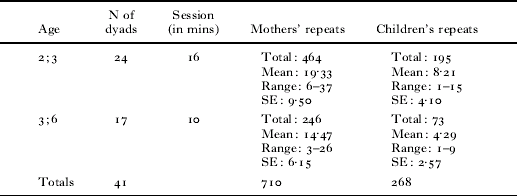
We analysed 978 exchanges (with between two and four turns in each), drawn from over nine hours (554 minutes) of mother–child interactions, in which either the mother repeated what the child had just said, or the child repeated what the mother had just said. These repetitions were distributed by age as shown in Table 1. Since the younger children (mean age 2 ; 3) were recorded for sixteen minutes, and the older ones (mean age 3 ; 6) for ten minutes, we normalized the means for the older group, multiplying them by 1·6 for statistical purposes, so our analyses are all based on standardized scores for each session.
Number of exchanges with repeats by mother and by child, by age
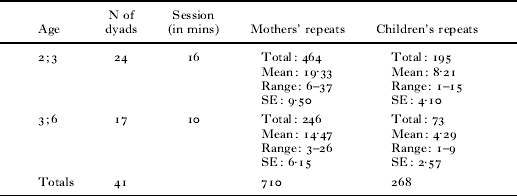
Overall, repetitions were frequent: With the younger group (2 ; 3), mothers repeated their children 1·21 times per minute while the children repeated their mothers 0·51 times per minute. With the older group, these rates were 1·45 times per minute, compared to 0·43 times per minute.
In child-initiated exchanges, the adult repeated some or all of the child's utterance from the first turn (repeated element(s) underlined), in the second turn, as shown in (13):
(13)
AUDRIC (3 ; 5): J'aimais pas les enfants avec leurs masques.
‘I didn't like the children with the masks.’
> MOTHER: Ah! C'est les masques qui te f'saient peur?
‘Ah! it's the masks that scared you?’
In adult-initiated exchanges, the child repeated some or all of the adult's first turn utterance, in the second turn, as shown in (14), where the child takes up the first verb used by the adult:
(14)
MOTHER: Faut pas renifler justement faut moucher.
‘Mustn't sniff, just wipe your nose.’
>CÉLIA (3 ; 8): Ben moi j'renifle.
‘Well, me, I sniff.’
We take up the findings for adult repeats first, and then turn to child repeats. All the comparisons between the two age groups used Mann-Whitney tests, with z values (to take account of any unequal n's). In a few cases we also report chi-square values.
Adult repeats
Adults repeated words or phrases from the preceding turn two or three times as often as their children did. Adult repeats were coded for whether they repeated to check: (a) on the intention displayed in the child's utterance; (b) on one or more of the forms in the child's utterance; (c) on both intention and form; or (d) to add new information (see Table 2).
Adult repeats to check on intention, form, both, or to add new information: mean number of occurrences by age and session (normalized)

note: * p<0·05; ** p<0·001; *** p<0·0001, for the figures in that column.
First, the mothers repeated significantly more often to check up on what the child meant to say for children in the younger group (2 ; 3) than for those in the older group (3 ; 6), by 9·79 to 3·2 times per session (z=3·47, p=0·0005). They also repeated significantly more often to check on the forms used by children in the younger group compared to the older one, by 15·83 to 7·15 (z=3·41, p=0·0009). Overall, adults were significantly more likely to repeat to check on and correct both meaning and form for the younger group (2 ; 3) compared to the older one (3 ; 6), with means of 6·71 versus 1·88 (z=3·76, p=0·0002).
The mothers' repeats typically took the form of side sequences with rising intonation, in which they checked on what the child apparently intended to say. Mothers also produced side sequences to check on the forms children used where these were spoken too softly, mispronounced, misinflected or involved inappropriate lexical or syntactic choices. The adults' repeats in these cases were reformulations, i.e. conventional utterances based on the child's utterance but with the child's error(s) corrected (Chouinard & Clark, Reference Chouinard and Clark2003).
Lastly, when mothers repeated, they were less likely to combine any further new material with their repeat when they talked to the younger children than when they talked to the older ones, by 4·92 to 11·76 (z=3·97, p=0·00008).
Children's third turns after adult repeats
After the mother repeated what the child had said, the child often followed up in the third turn. They sometimes offered an uncertain acknowledgment (mh), a full acknowledgment on its own (ouais ‘yeah’), a simple repeat of the word or phrase just corrected by the adult, or an expanded repeat with some new information added. The results are shown in Table 3.
Children's third turn responses after an adult repeat: mean number of uses by age and session (normalized)

note: * p<0·05; ** p<0·001; *** p<0·0001, for the figures in that column.
The younger children were less likely to provide a follow-up turn at this point than were the older children, by 7·61 to 11·76 (z=2·14, p=0·03). At the same time, the younger children, at 2 ; 3, were significantly more likely to repeat the target form repaired in the adult's repeat, by 3·79 to 0·56 (z=4·05, p=0·0005). The older children, at 3 ; 6, offered semantically relevant new information significantly more often, along with any re-repeat to mark uptake, in their third turns (2·26 to 0·67) (z=2·20, p=0·03).
Child repeats
Children's repeats in the second turn typically acknowledged and thereby ratified part or all of what the adult had said. These repeats departed from adult repeats in that they rarely checked on intention or form, but appeared with level (/) or falling (.) intonation. Typical child repeats are shown in (15) and (16):
(15)
MOTHER: Hum / C'est trop sucré.
‘Hmm. It's too sweet.’
>ELODIE A (2 ; 3): Uké /
Sucré
‘Sweet’
(16)
MOTHER: Oui on ira au manège mais demain / On ira au manège /
‘Yes we'll go riding but tomorrow / We'll go riding / ’
>ESTELLE (2 ; 3): Domain.
Demain.
‘Tomorrow.’
As Table 4 shows, the only instances of checking on intention came from ten of the younger children (with nine producing one query about intention each and one producing two such queries) for a mean of 0·46 compared to none from the older group of children (z=2·25, p=0·02). And only one child, again from the younger group, repeated once to check on a form in an adult utterance.
Children's repeats to check on intention, form, or both, or to add new information: mean number by age and session (normalized)

Note: * p<0·05; ** p<0·001; *** p<0·0001, for the figures in that column.
Unlike adults, children used their second turn repeats to mark agreement with the adult, and thereby ratify what the adult had just said. In the younger group, twelve of the twenty-four children did this at least once, compared to fourteen of seventeen in the older group, where most of the children used repeats this way just over four times per session.
Overall, the older children repeated part of the preceding adult utterance along with an additional piece of new information significantly more often than the younger ones did, by 3·48 to 0·86 (z=3·36, p=0·0008). The older children, then, used such expanded repeats to advance the exchange while the younger ones typically stopped after their repeat, simply ratifying what the adult had said but not adding any new information to the exchange.
Adults' third turns after child repeats
In the third turn, after the child's repeat, mothers often re-repeated the form picked up by the child, and in doing so offered a further ratification, as in (17):
(17)
MOTHER: Et là c'est un petit bol? Hein?
‘And there that's a little bowl? Eh?’
>CAMILLE (2 ; 4): Un bo /
‘A bowl.’
>MOTHER: C'est un bol oui.
‘It's a bowl yes.’
They were more likely to respond with a further repeat of a target word or phrase to the younger children than to the older ones, by 2·17 to 0·66 (z=3·14, p=0·0017), as shown in Table 5. That is, they re-ratified the child's uptake of the form or information originally provided by the adult, but didn't advance the exchange with the addition of any new information, as in (17).
Mothers' third turn responses after a child repeat: mean number of uses by age and session (normalized)

note:* p<0·05; ** p<0·001; *** p<0·0001, for the figures in that column.
They also followed up their children's repeats by offering some semantically relevant material in the third turn, combined with their own re-repeat, and so advancing the conversation where the child had just failed to do so, as in (18), where the child asks about the location of the bakery (mispronounced in her repeat) and the mother, after re-repeating boulangerie ‘bakery’ supplies the (new) information requested:
(18)
MOTHER: Il est un p'tit peu plus blanc parc'que je ne l'ai pas acheté à la même boulangerie.
‘It's little bit whiter because I didn't buy it at the same bakery.’
>DAPHNÉE (3 ; 9): C'était où cette boulanzerie?
‘Where was this bakery?’
>MOTHER: C'est la boulangerie qui se trouve euh derrière l'église, la place Schoelcher.
‘It's the bakery that's eh behind the church, in Schoelcher square.’
Adults did this more often to the younger children than to the older ones (1·75 versus 1·04), but the difference just missed significance (z=1·84, p=0·06). This tendency (see Table 6) was supported by the number of mothers above the median (1·6): they comprised 14 of 24 in the younger group, compared to only 1 in 17 in the older group (χ2 (1)=11·80, p=0·0006). Even when they did not re-repeat, mothers offered semantically appropriate additions slightly more often (but not significantly so) in third turns addressed to the younger children than to the older ones (0·92 versus 0·38) (z=1·91, p=0·06). This tendency was again supported by the number of mothers with scores above the median (0): they comprised 16 of 24 in younger group compared to just 4 of 17 in the older one (χ2 (1)=7·41, p=0·0065). Mothers typically used these third turns to relate the term or phrase repeated earlier by the child to other information pertinent to that occasion.
Mothers' third turn responses after a child repeat: number of mothers above the median for ‘Repeat+new information’ and ‘Semantic follow-on’ by age and session (normalized)

Note:* p<0·05; ** p<0·001; *** p<0·0001, for the figures in that column.
DISCUSSION
Both adults and children as young as two rely on repetition as they talk to place information in common ground. By repeating what someone else has said, the person repeating both acknowledges having heard the other person and identifies the specific information in play. Our findings show that mothers repeated what their children said (along with corrections) at a rate of eighty-one times an hour. And children repeated their mothers at a rate of twenty-eight times an hour. This reliance on repetition helps both adults and children observe Grice's Cooperative Principle. When one speaker repeats what the other has just said, the other can be sure of exactly what has been taken into account. A repeat is more explicit than a bare acknowledgment like oui ‘yes’, ouais ‘yeah’ or just mh ‘uh-huh’. In effect, repeats provide a way to observe the maxims of quantity (say as much as is necessary) and manner (make yourself clear) when conversing with a novice speaker.
When adults repeat what their children say, they indicate that they are attending and have picked up on what the child is trying to say. Equally, when children repeat some part of what the adult has said, they show they are attending to it. For the younger children (2 ; 3), parental repeats revolved around issues of language use and the forms for intended meanings. These repeats often contained corrections of pronunciation, word choice, morphology and syntax relevant to the meaning apparently aimed at. For the older children (3 ; 6), both adult and child repetitions focussed more on the content of an exchange. Here, repetitions signalled attention to what had been said by the adult or child. At both ages, repetition signals the elements being added to common ground. Children's repeats typically show that they are attending to the adult's utterance, and show preliminary uptake of forms used or endorsed by the adult. Finally, third turn repeats by the original speaker offer further evidence for attention to and uptake of pertinent information. In short, repetition is an important device in adult–child exchanges for marking additions to common ground.
Our results showed that, for the younger dyads (2 ; 3), parents made sure they had understood their children, by checking up with repetition, on what the child had intended. Children this age repeated to signal they were attending to specific parts of what the adult was saying. For the older dyads (3 ; 6), both parent and child repetitions signalled attention to what the other had said, thereby placing it in common ground, and typically adding other new information as well (see Tables 2 and 4). After mothers repeated, the younger children used the third turn to take up these repeats more often than the older ones did (Table 3). The younger children typically indicated uptake with a minimal acknowledgment or a further repeat of the target word or phrase only. They added information to common ground this way, but didn't advance the conversational exchange. When the older children took up their mothers' repeats, they did so with full acknowledgments, or with a repeat plus new information that expanded the current topic. These third turn follow-ups lend further support to our proposal that while two-year-olds are more concerned with understanding, three-and-a-half-year-olds have begun to contribute actively to common ground when it is their turn in an exchange.
When mothers took the third turn after their child's repeat (Table 5), they responded differently to the younger and older children. Mothers of two-year-olds confirmed the child's uptake with a further repeat of the child's repeat, and so ratified the child's attempt at adult-like usage. But in third turns to older children, they combined repeats with new information, and used further semantically coherent utterances to add to the current topic. In short, mothers’ third turns tended to confirm facts of usage for younger children, but added new information about the topic for the older ones.
In summary, repetition as a conversational device allows both expert and novice speakers to add information to common ground. Repetition is also central to making sure one has understood what the other person intended to communicate. While understanding the other and advancing the conversation are both important for conversational exchanges, adults and children exemplify them to different degrees. In the present study, mothers used repeats mainly to give the younger children feedback about how to convey specific meanings and so make themselves understood. With older children, their repeats more often marked formerly new information as given and so in common ground.
Common ground
Speakers used repetition to add to common ground in two ways: in order to correct errors, and to mark uptake. In some cases, repeats could have both functions at once. For instance, mothers’ second turn repeats of something their children had just said both signalled uptake and added that information to common ground. In effect, speakers add to common ground by acknowledging new information from the preceding speaker's utterance. Acknowledgments in the form of repeats mark what's repeated as given and indicate that it is now part of common ground.
In using repetition, both parents and children observed the Cooperative Principle (Grice, Reference Grice1989) by adhering to the maxims of quantity and manner. Speakers need to provide enough information to make themselves understood. This is where young children often fail because they violate the maxim of quantity in not providing enough information for current purposes. When their utterances are marked by errors of omission – for instance, failures to pronounce a word recognizably or leaving out critical words – this may obscure the meaning intended, as in the utterances in (19). (The adult target, according to the mother's subsequent interpretation, appears before the translation.)
(19a)
ELODIE A (2 ; 3): aiasser foua.
ramasser les feuilles
‘to pick up the leaves’
(19b)
AGATHE (2 ; 2): on poua éki u a t—u la tabe?
on pourra écrire sur la table
‘we could write on the table’
The children's intended meanings could also be obscured by errors of commission – uses of the wrong inflected form, or wrong word order, for example – that therefore violate the maxim of manner. Again, this often makes young children hard to understand, as in the utterances in (20):
(20a)
EDOUARD (3 ; 6): pas attachée la fille.
elle est pas attachée, la fille
‘the girl didn't have her seatbelt on’
(20b)
LORÈNE (3 ; 4): vais la lécher moi la cuillère.
je vais la lécher, moi, la cuillère
‘me, I'm going to lick it, the spoon’
Adult repeats-as-reformulations of children's utterances under these circumstances serve to check up on the child's intention where it is not fully discernible from the form of the child's utterance on its own, as shown in the exchange in (21) where the mother checks up on the child's repeat of eu boi ‘veux boire=want drink’ to make sure he does now want to have a drink:
(21)
MOTHER: Tu veux pas boire? Mange alors /
‘You don't want to drink? Eat then.’
>CORENTHIN (2 ; 3): Hum. Eu boi //
‘hum. veux boire
‘want drink’
>MOTHER: Tu veux boire /?
‘You want to drink?’
CORENTHIN: Hum.
‘Hum.’
In short, both adult and child repeats of material offered by a prior speaker help establish the accumulation of common ground in each exchange. Once children's language becomes more comprehensible, by age 3 ; 6 to 4 ; 0, say, they produce many fewer violations, from the adult point of view, of the maxims of quantity and manner in their talk to others. Children's growing skill with language also means that they can make more use of pronouns and deictics, as alternatives to repeats, when they add information to common ground.
Repeats as feedback
One way adults smooth the way for young children in conversation is to check up on what they meant to say. They do this by reformulating what they have understood, but in conventional form, without the errors two- and three-year-olds make. In fact, adults reformulate as much as 60% of child errors from young children (Chouinard & Clark, Reference Chouinard and Clark2003). Reformulations typically involve repeats of what the child had apparently intended to say, either in a side sequence with question intonation (rising) or in an embedded repair. These repeats present children with conventional forms for their intended meanings. They include corrections to phonology, offering adult pronunciations of specific words, as in (22) for s'en:
(22)
CHLOÉ (2 ; 3): Apé y ch'en va /
‘Afterwards he goes away.’
>MOTHER: Et après il s'en va /
‘And afterwards he goes away.’
to morphology, as in (23), with un lapin and le mets à la bouche:
(23a)
MOTHER: Tu l'as vu?
‘Did you see it?’
>CORENTHIN (2 ; 3): Oui j'ai vu lapin /
‘Yes I saw rabbit.’
>MOTHER: Oui tu as vuun lapin.
‘Yes you saw a rabbit.’
(23b)
ESTELLE (2 ; 3): Ze mets à bouche.
‘I put in mouth.’
>MOTHER: Tu le mets à la bouche.
‘You put it in your mouth.’
>ESTELLE: Oui ze metsà la bouche.
‘Yes I put in my mouth.’
to word choice, with offers of more felicitous terms in context, as in (24) with la graisse, la brioche and des tartines:
(24a)
SARAH (3 ; 6): T'enlèves, t'enlèves la crème?
‘You're taking off, you're taking off the cream?’
>MOTHER: J'enlève pas la crème, j'enlève la graisse.
‘I'm not taking off the cream, I'm taking off the grease.’
(24b)
MAX (3 ; 11): Une grioche!
‘A grioche.’
>MOTHER: Une bri-oche, pas une grioche. Une brioche.
‘A bri-oche, not a grioche. A brioche.’
(24c)
ANAÏS (4 ; 0): Moi je mange, deux tartes. Deux grosses tartes comme ça. D'accord?
‘I want to eat two tarts. two big tarts like that. Okay?’
>MOTHER: Des, des tartines.
‘Sandwiches.’
>ANAÏS: Deux grosses tartines comme ça.
‘Two big sandwiches like that.’
MOTHER: D'accord.
‘Okay.’
and to syntax, offering more appropriate, or filled out, constructions, as in (25):
(25a)
HUGHES (2 ; 4): Tombé.
‘Fell down.’
>MOTHER: C'est tombé.
‘It fell down.’
(25b)
CÉLIA (3 ; 8): Crois qu'tu fais penser.
‘Think that you make think.’
>MOTHER: Faudra qu' j' t'y fasse penser, d'accord.
‘I would have to make you think about it, sure.’
Whether used to check on meaning or form, adult repeats (with corrections) offer children models of how to express specific intentions. While providing a conventional form for that meaning, they simultaneously offer feedback on what was wrong with the child version. Consider the exchange in (26):
(26)
ELODIE B (2 ; 4): Boîte d'orange /
‘Box of orange.’
MOTHER: Hein?
‘Eh?’
ELODIE B: un boîte d'orange /
‘a box of orange’
>MOTHER: La boîte de jus d'orange là /
‘The box of orange juice there.’
The adult's counter-offer of la boîte with the appropriate feminine article la for boîte followed immediately after the child's use of un boîte (the masculine article un ‘a’ used with the feminine noun), and so presented her in the next turn with the conventional form needed. Such repeats allow immediate comparison with children's own earlier utterance, so they can identify the locus of any errors.
The essential point here is that when adults do this, the two utterances on display (the child's utterance followed by adult's, in the next turn) differ in form although they are intended to express the same meaning. One form can of course carry more than one meaning, but by the Principle of Contrast, the same meaning cannot be carried by more than one form (Clark Reference Clark and MacWhinney1987, Reference Clark1993). The child must therefore make a choice. And since adults are the more expert speakers, their forms take priority over and so pre-empt the child's. Notice that even if children don't make corrections immediately, they could simply store the adult version in memory, in strengthened form each time, and thus add to their potential for managing later corrections to their own productions. They may require some threshold level of exposure before they fully adopt an adult form to replace one of their own (see Marchman & Bates, Reference Marchman and Bates1994). Eventually, though, children drop their own erroneous forms in favour of the conventional adult ones.
Repeats and continuity
Repeats also offer a way to contribute coherently to an exchange. When adults repeat their children, the children can accept the adult's form (by repeating it again), and so leave the path open for the adult to add something further. Or children can reject the adult interpretation offered in the repeat, and try again to express what they wanted to say. In both cases, children would be treating what had been new as given, and therefore grounded for both participants. Within utterances, both adults and children typically present some information that is already given (known) along with some that is new (e.g. Clark & Haviland, Reference Clark, Haviland and Freedle1977; Clark & Schaefer, Reference Clark and Schaefer1989). When two people talk to each other, they systematically convert new information into given information. They can mark this change in status in several ways. They can use a pronoun or a demonstrative in subsequent references (e.g. Gundel et al., Reference Gundel, Hedberg and Zacharski1993), or repeat a portion of what the preceding speaker said (e.g. Walker, Reference Walker1996). Each of these options indicates to the other speaker that the information in question is now being treated as ‘given’ rather than ‘new’.
Adults use all of these options in adult–adult conversation, but they can choose pronouns and demonstratives over repeats as they continue to talk about a particular object or event. In exchanges with young children, though, they appear to rely heavily on repeats, perhaps because they identify specific pieces of information. As we have seen here, they repeat what children say nearly three times as often as children repeat what adults have said. Repeats play an important role for both adult and child in indicating to the other precisely which information can be assumed from now on. Repeats can ground information, and do so in a way that indicates to both participants just what has been added to common ground (see also Greenfield & Savage-Rumbaugh, Reference Greenfield and Savage-Rumbaugh1993).
The younger children were more likely to repeat information from the preceding speaker without adding anything new. These repeats allow two-year-olds to play the role of participant in an exchange. Moreover, when they repeat, they tend to repeat what was new in the prior utterance (see also Bloom, Rocissano & Hood, Reference Bloom, Rocissano and Hood1976; Veneziano, Reference Veneziano2001). This is particularly clear when they repeat new words, something they do at twice the rate of new information (Clark, Reference Clark2007). By grounding new information from the prior speaker's utterance, children contribute to the exchange even though they don't add much, or any, new information themselves. The two-year-olds here rarely added new information when they repeated in the second turn. However, adults would then use re-repeats in the third turn and often combined a repeat with some new information. In short, it is the adults who maintain continuity throughout exchanges with two-year-olds. But the older children, like adults, often contributed new information as well as repeats.
In summary, continuity in any exchange requires that the participants pay attention to each other. This in turn demands that they keep track of the topic and attend to what is being contributed by other speakers. One way for young children to indicate this is to repeat some of what they have just heard in the preceding turn. This, in fact, is probably the first option children learn for ratifying what the preceding speaker said. Later, they learn how to use pronouns and demonstratives as well, as devices for maintaining continuity of reference (see McTear, Reference McTear1985). Adults can use a variety of devices in order to assure continuity of reference while also taking care of marking what is given and what new in each utterance, but they rely particularly on repetition when talking to young children. Repetition may well be cognitively less demanding for children to understand than use of pronouns or demonstratives, and by using repeats, adults clearly identify the linguistic elements that are being attended to.
Finally, note that our generalizations here are based on analyses of exchanges in Western middle-class families. Other social classes and other cultures may depend on different kinds of exchange to demonstrate how to convey the relevant meanings on specific occasions. Yet all will depend on such factors as joint attention in conversational exchanges (see further Brice Heath, Reference Brice Heath1983; Chavajay & Rogoff, Reference Chavajay and Rogoff1999; Hoff, Reference Hoff and Bornstein2003; Childers, Vaughan & Burquest, Reference Childers, Vaughan and Burquest2007; Estigarribia & Clark, Reference Clark2007), and all may well rely on options similar to those of repetition, if not on repetition per se.