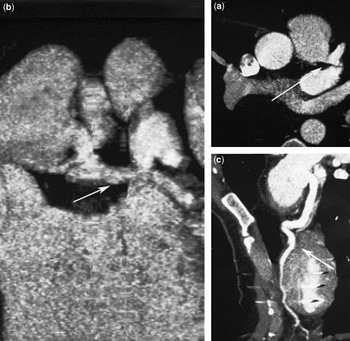
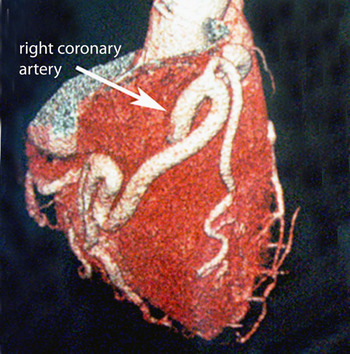
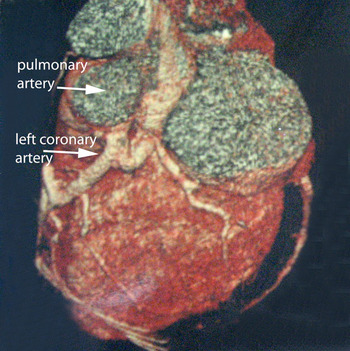
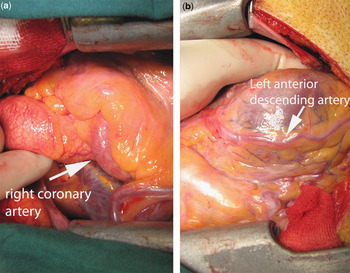
A 27-year-old man who suffered progressive cardiac failure from childhood due to mitral regurgitation presented with dyspnoea. Echocardiography showed an ejection fraction of 25% global left ventricular hypokinesia and severe mitral regurgitation due to leaflet retraction by displaced papillary muscles. Contrast-enhanced 64 slice computed tomography (Fig 1) in the axial view (a) curved multi-planar reconstruction views (b, c) revealed a left coronary artery (arrows) arising from the pulmonary artery. Both anterior interventricular and circumflex branches were dilated (Fig 2). The right coronary artery was dominant and severely ecstatic (Fig 3). An operation through a midline sternotomy confirmed these findings (Fig 4). The patient underwent mitral valve ring annuloplasty and anastomosis of the left internal mammary artery to the left main coronary artery. We ligated the left coronary artery at its origin from the pulmonary artery. The patient’s recovery was uncomplicated and his ejection fraction increased to 50%.
Figure 1

Figure 2

Figure 3

Figure 4

Anomalous origin of the left coronary artery usually presents with cardiac failure and mitral regurgitation early in life. However, it should be considered also in the differential diagnosis of similar symptoms in young adults. Multi-detector computed tomography now provides a valuable, non-invasive tool for the detection of such coronary artery anomalies.Reference Manghat, Morgan-Hughes, Marshall and Roobottom1