Introduction
The aim of this study is to explore the mechanisms that allow bilingual speakers to control their two languages during language processing – mechanisms often referred to as bilingual language control. A large body of research has shown that bilingual language control is maintained by a complex network of neural circuitry involving classical language areas and executive control areas. Of particular relevance in this context are the basal ganglia, a conglomerate of brain structures that has been argued to be fundamental in the control of two or more languages (Abutalebi, Annoni, Zimine, Pegna, Seghier, Lee-Jahnke, Lazeyras, Cappa & Khateb, Reference Abutalebi, Annoni, Zimine, Pegna, Seghier, Lee-Jahnke, Lazeyras, Cappa and Khateb2008; Abutalebi & Green, Reference Abutalebi and Green2007; Abutalebi, Della Rosa, Ding, Weekes, Costa & Green, Reference Abutalebi, Della Rosa, Ding, Weekes, Costa and Green2013; Branzi, Della Rosa, Canini, Costa & Abutalebi, Reference Branzi, Della Rosa, Canini, Costa and Abutalebi2016; Calabria, Costa, Green & Abutalebi, Reference Calabria, Costa, Green and Abutalebi2018; Crinion, Turner, Grogan, Hanakawa, Noppeney, Devlin, Aso, Urayama, Fukuyama, Stockton, Usui, Green & Price, Reference Crinion, Turner, Grogan, Hanakawa, Noppeney, Devlin, Aso, Urayama, Fukuyama, Stockton, Usui, Green and Price2006; Lehtonen, Laine, Niemi, Thomsen, Vorobyev & Hugdahl, Reference Lehtonen, Laine, Niemi, Thomsen, Vorobyev and Hugdahl2005; Price, Green & Von Studnitz, Reference Price, Green and Von Studnitz1999; Zou, Ding, Abutalebi, Shu & Peng, Reference Zou, Ding, Abutalebi, Shu and Peng2012). For example, damage to these structures sometimes results in the inability to control the two languages at will, producing involuntary mixing of them during discourse, known as pathological switching (for a review in aphasic patients see Ansaldo & Marcotte, Reference Ansaldo, Marcotte, Centeno, Obler and Anderson2007). Similarly, tasks that involve mixing languages tend to activate the left caudate to a larger extent than tasks involving just one language (Crinion et al., Reference Crinion, Turner, Grogan, Hanakawa, Noppeney, Devlin, Aso, Urayama, Fukuyama, Stockton, Usui, Green and Price2006; Seo, Stocco & Prat, Reference Seo, Stocco and Prat2018).
We further explore the involvement and specificity of these structures in bilingual language control by assessing the performance of patients with basal ganglia dysfunctions as a consequence of Parkinson's disease (PD). These patients showed deficits, as compared to healthy controls, in tasks involving two languages such as a language switching task (as we recently showed in Cattaneo, Calabria, Marne, Gironell, Abutalebi & Costa, Reference Cattaneo, Calabria, Marne, Gironell, Abutalebi and Costa2015). Interestingly, some of these deficits were not always present when the task involved switching between non-linguistic task sets, suggesting a more specific role of basal ganglia structures in language control. There is, however, a remaining question about specificity: are the basal ganglia involved in language control, be it that of a monolingual or bilingual individual, or is it especially relevant in bilingual language control? In more practical terms, will bilingual PD patients show deficits in any task that involves language control or only on those involving the control of two languages?
To answer this question, we asked participants to perform two switching tasks: a) a switching task that involved switching between two languages; and b) a switching task that involved switching within a single language, such as changing the grammatical category within a language. In fact, these two tasks have been shown to elicit different activity in basal ganglia structures (specifically the left caudate), suggesting certain structural specificity in controlling the two languages (Abutalebi & Green, Reference Abutalebi and Green2008; Marian, Bartolotti, Rochanavibhata, Bradley & Hernandez, Reference Marian, Bartolotti, Rochanavibhata, Bradley and Hernandez2017). Hence, if this observation can be understood as revealing that basal ganglia structures are fundamental for bilingual language control and not just for language control in general, then it is expected that PD patients’ performance on the within-language switching task would be better than on the between-language switching task.
Bilingual language processing in PD patients
Few studies have explored the linguistic performance of Parkinson's disease patients in bilingual contexts. In two studies, Zanini, Tavano, Vorano, Schiavo, Gigli, Aglioti, and Fabbro (Reference Zanini, Tavano, Vorano, Schiavo, Gigli, Aglioti and Fabbro2004) and Zanini, Tavano & Fabbro, (Reference Zanini, Tavano and Fabbro2010) showed that PD leads to difficulties in sentence and syntactic comprehension as well as spontaneous speech production. Moreover, in these studies, performance on an executive control (EC) task correlated with the performance on their sentence comprehension task, suggesting a link between grammatical processing and executive functions. Similar results were replicated recently by Johari, Ashrafi Zali, Ashayeri, Fabbro and Zanini (Reference Johari, Ashrafi, Zali, Ashayeri, Fabbro and Zanini2013) in Azari–Farsi bilinguals.
As for bilingual language control, in our previous study with bilingual PD patients, we found that patients were impaired in between-language switching when their performance was compared to healthy controls (Cattaneo et al., Reference Cattaneo, Calabria, Marne, Gironell, Abutalebi and Costa2015). However, we were unable to determine whether these linguistic deficits, likely due to basal ganglia pathology, were limited to switching between languages or if they also extend to single-language conditions. Based on previous neuroimaging studies that showed the involvement of basal ganglia in switching between languages, but not within one language, we would predict impaired language control for PD patients when they need to control two languages and not in other single-language switching tasks (Abutalebi et al., Reference Abutalebi, Annoni, Zimine, Pegna, Seghier, Lee-Jahnke, Lazeyras, Cappa and Khateb2008). However, in our previous study we found that the domain-specificity of bilingual language control abilities was dependent on the index of control that we measured (switch vs. mixing). In order to account for this, we employ both of these measures in this study to explore the extent to which the underlying processes of language control overlap between the two linguistic domains (dual-language and single-language).
Control measures in switching tasks
The switching tasks that we have used in previous experiments can be utilized to calculate two different control measures: switch cost and mixing cost (Cattaneo et al., Reference Cattaneo, Calabria, Marne, Gironell, Abutalebi and Costa2015; but see also Ma, Li & Guo, Reference Ma, Li and Guo2016; Weissberger, Wierenga, Bondi & Gollan, Reference Weissberger, Wierenga, Bondi and Gollan2012). Consider an experimental block in which the participant is asked to name pictures in language A (if the picture appears in blue) or in language B (if it is in red); this would be defined as a mixing block. Within said block, there would be some trials in which the target language is the same as in the trial immediately encountered before, and other trials in which the target language is different from before. The first type of trial would be considered a “repeat trial” whereas the second one would be a “switch trial”, and the switch cost is the difference in reaction times between these types of trials. Now consider an experimental block in which the language to be used is always the same (single block), and hence all trials could be considered as repeated. The difference in reaction times between the repeat trials in the mixing blocks with those in the single blocks would be the mixing cost.
In the present study, we used the design described above. For the between-language switching task, participants were asked to switch between languages (Catalan and Spanish). For the within-language switching task, participants were asked to switch between grammatical classes but maintaining just one language. That is, they were asked to name a given picture (broom) either with the noun it represents (broom) or with the verb corresponding to the action that it evokes (to sweep), according to the provided cue.
Our main experimental question is whether patient's performance on these two tasks would be comparable to that of healthy controls. In particular, we are especially interested in determining whether patients show deficits in the within-language switching condition, given that deficits for the between-language condition have already been reported (Cattaneo et al., Reference Cattaneo, Calabria, Marne, Gironell, Abutalebi and Costa2015). In our previous study, we found that, when compared to healthy controls, the magnitude of the switch cost was specifically affected in PD patients when switching between languages but not when switching between non-linguistic tasks (sorting by colour or shape). On the other hand, mixing costs were equally affected by the disease in both tasks. These two costs have been associated with two different types of control in the context of dual-mechanisms of control (DMC) framework (Braver, Reference Braver2013; De Pisapia & Braver, Reference De Pisapia and Braver2006). That is, reactive control, measured in both tasks by switch cost (calculated as the difference between switch and repeat trials in a mixed block), is defined as a bottom-up, transient and stimulus-driven type of control. Proactive control instead, measured by mixing cost (calculated as the difference between repeat trials in single and mixed blocks), is top-down, more sustained and goal-directed (for bilingual language control see Ma et al., Reference Ma, Li and Guo2016).
Methods
Participants
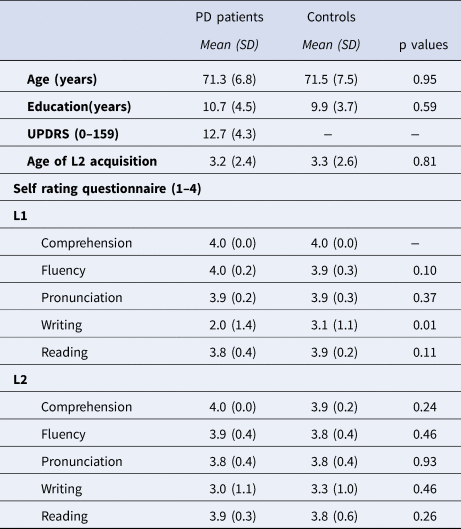
24 bilinguals with a diagnosis of PD (12 female, mean age = 71.3 ± 6.8, mean education = 10.7 ± 4.5) and 17 matched healthy controls (12 female, mean age = 71.5 ± 7.5, p = 0.95; mean education = 9.9 ± 3.7, p = 0.59) took part in this study. Participants were early and highly proficient Catalan–Spanish bilinguals. Participants self-rated as highly proficient in both languages (Table 1) and their residence in the metropolitan area of Barcelona, a highly bilingual context, regularly exposed them to both languages. Seven patients and four controls considered themselves Spanish dominant, while the others were Catalan dominant.
Socio-demographic characteristics of the participants and clinical data of the PD patients.

All individuals with PD were diagnosed according to the clinical criteria of the UK Parkinson's Disease Brain Bank (Hughes, Daniel, Kilford & Lees, Reference Hughes, Daniel, Kilford and Lees1992) by a senior neurologist (A.G.) who specializes in movement disorders. Based on the Unified Parkinson Disease Rating Scale (UPDRS, mean = 12.8 ± 4.4 out of 159, range = 8–21; Fahn, Elton & Members of the UPDRS Development Committee, Reference Fahn, Elton, Fahn, Marsden, Calne and Goldstein1987) and Hoehn and Yahr score (all rating from I to IIa; Hoehn & Yahr, Reference Hoehn and Yahr1967), all patients were in the mild stage of disease, and their Mini Mental State Examination (MMSE) scores indicated that they did not have dementia (Folstein, Folstein & McHugh, Reference Folstein, Folstein and McHugh1975; mean 28.7 ± 1.1, range = 26–30). All patients were stable, without motor fluctuations, and receiving anti-Parkinsonian pharmacological treatment. The study excluded patients with psychiatric and neurological disorders other than PD, clinically recognized hearing or vision impairments, or a past history of alcohol abuse.
The ethics committee of the Pompeu Fabra University (CEIC, Parc de Salut MAR) approved the study procedure. Informed consent was obtained from patients and caregivers prior to testing and following a full explanation of the study.
Neuropsychological Assessment
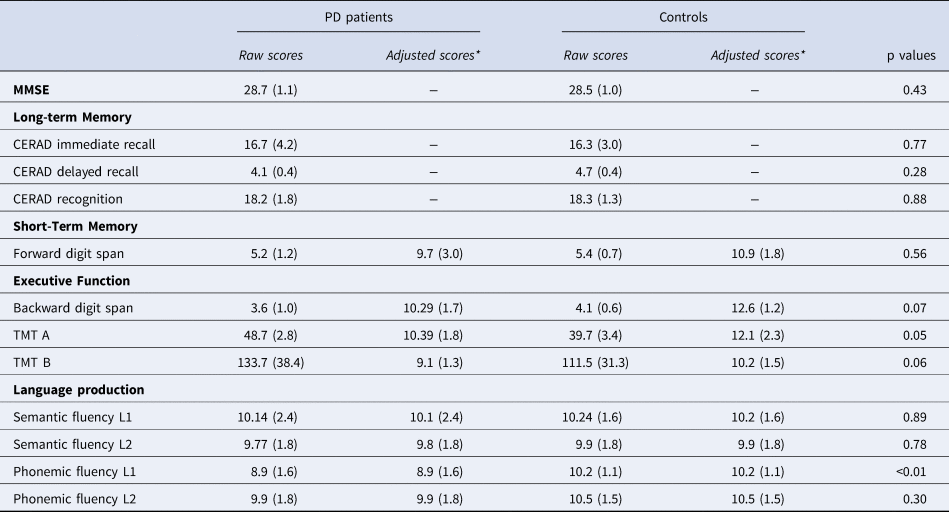
Participants were administered a neuropsychological assessment (see Table 2) that included a Mini Mental State Examination (Folstein et al., Reference Folstein, Folstein and McHugh1975), a word list test from the Consortium to establish a registry for Alzheimer's disease (CERAD; Morris, Heyman, Mohs, Hughes, van Belle, Fillenbaum, Mellits & Clark, Reference Morris, Heyman, Mohs, Hughes, van Belle, Fillenbaum, Mellits and Clark1989), Digit Span Test Forward and Backward (Test Barcelona, Peña-Casanova, Reference Peña-Casanova2005), Parts A and B of the Trail Making Test (Reitan & Wolfson, Reference Reitan and Wolfson1985), and semantic and letter fluencies.
Neuropsychological assessment of participants. Means and standard deviations (in parenthesis) of raw and adjusted scores for age and educations.

* Mean scores adjusted for age and education on the basis of the “Spanish multicenter Normative studies (NEURONORMA PROJECT)” (Peña- Casanova et al., 2009).
Materials and Procedures
Participants were tested on two switching tasks: a within-language switching task (in their dominant language as well as in their second language) and a between-language switching task. All tasks were administered on a laptop (screen 15.6” and resolution of 1280 × 800) and vocal responses were recorded by the DMDX software (Forster & Forster, Reference Forster and Forster2003). Responses were analyzed offline, and naming latencies were measured through Checkvocal software (Protopapas, Reference Protopapas2007).
Within-language switching task
Eight pictures of objects were selected from Snodgrass and Vanderwart (Reference Snodgrass and Vanderwart1980). Participants were required to name the pictures or produce the related verb as quickly as possible. All the pictures were selected in such a way to ensure that the noun and the verb that participants had to produce did not phonologically overlap within the same language (Catalan and Spanish: “Got/Beure” and “Vaso/Beber” [Glass/to Drink]; “Ocell/Volar” and “Pájaro/Volar” [Bird/to Fly]; “Paella/Fregir” and “Sartén/Freir” [Pan/to Fry]; “Piano/Tocar” and “Piano/Tocar'” [Piano/to Play Piano]; “Tren/Viatjar” and “Tren/Viajar” [Train/to Travel]; “Cigarreta/Fumar” and “Cigarro/Fumar” [Cigarette/to Smoke]; “Plat/Menjar” and “Plato/Comer” [Dish/to Eat]; and “Ganivet/Tallar” and “Cuchillo/Cortar” [Knife/to Cut]).
There were two types of blocks: single and mixed. In the single blocks, the grammatical category to produce (name or verb) was always the same; whereas in mixed blocks, participants had to name the pictures or produce the related verb according to a cue that appeared on the screen. Therefore, there were two types of trials in the mixed blocks: repeat trials, wherein participants had to respond according to the same grammatical category that the previous trial used, and switch trials, which required participants to answer according to a grammatical category that differed from that of the previous trial. The order of blocks had a sandwich design in which participants completed two single blocks, three mixed blocks and then two more single blocks. There were a total of 96 trials (48 for nouns and 48 for verbs) in the single-block condition and 96 in the mixed-block condition (33 noun repeat trials, 33 verb repeat trials, 15 noun switch trials, and 15 verb switch trials). The proportions of switch and repeat trials were 31% and 69%, respectively.
Every trial started with a fixation point (a white cross) in the center of the screen that appeared for 500 ms and was followed by a cue of 500 ms (“NOM”/“NOMBRE” for nouns and “VERB”/“VERBO’” for verbs). Then, the screen displayed the picture for a maximum of 2,500 ms. At the beginning of each block, the screen presented a word cue for 1,000 ms to indicate the grammatical category with which participants must start.
Between-language switching task
Eight pictures of objects were selected from Snodgrass and Vanderwart (Reference Snodgrass and Vanderwart1980). All objects were non-cognate words (Spanish/Catalan names: “Manzana/Poma” [Apple]; “Calcetín/Mitjó” [Sock]; “Queso/Formatge” [Cheese]; “Silla/Cadira” [Chair]; “Zanahoria/Pastanaga” [Carrot]; “Cepillo/Raspall” [Brush]; “Tenedor/Forquilla” [Fork]; and “Mariposa/Papallona” [Butterfly]). Participants were required to name the pictures in Catalan or in Spanish as quickly as possible according to a cue, presented as a flag.
The task structure, type and number of blocks, and type and number of trials were the same as for the within-language switching task.
Results
We compared the performance of PD patients and older adults on the two linguistic tasks, and correlated the costs between them in order to explore similarities between the control mechanisms that are engaged in the two language context conditions. As previously reported, we calculated switch and mixing costs for both tasks. Switch costs were calculated as the difference in naming latencies between switch and repeat trials in a mixed-language condition, while mixing costs were calculated as the difference between repeat trials (in the mixed condition) and trials in a blocked naming condition.
The analysis excluded naming latencies that exceeded three standard deviations (SDs) above or below a given participant's mean in addition to incorrect responses.
Within-language switching task
The task was performed in both L1 and L2 for all participants. Repeated measures analyses of variance (ANOVAs) were run on accuracy and reaction times (RTs) with variables of type of trial (single, repeat, switch), language (L1, L2), and category (noun, verb) as within-subject factors and the group (controls, PD patients) as a between-subjects factor.
Reaction times
Participants were slower in switch trials (1,092 ms) than in repeat trials (1,045 ms, p < 0.01) and slower in repeat trials than in single trials (959 ms, p < 0.01) (type of trial: F [2, 78] = 41.14, p < 0.01, ηp2 = 0.51) (see Figure 1). The main effect of the category was also significant (F [1, 39] = 30.63, p < 0.01, ηp2 = 0.44), which indicates that participants produced nouns (1,007 ms) more quickly than verbs (1,057 ms). However, the language used in the task did not modulate participants’ naming latencies (language: F [1, 39] = 0.89, p = 0.35, ηp2 = 0.02).
Reaction times and switch and mixing costs in the within language switching task.

The main effect of the group was significant, as individuals with PD were slower overall (1,106 ms) than controls (957 ms) (F [1, 39] = 6.65, p < 0.05, ηp2 = 0.15). Finally, the interaction between the group and the type of trial was significant (F [2, 78] = 6.73, p < 0.01, ηp2=0.15), which suggests a difference in the magnitude of the costs (mixing, switch, or both) between the two groups.
To further analyze this interaction, we calculated the magnitude of the costs and then performed a separate one-way ANOVA for each cost, with the group as a between-subjects factor. In order to avoid bias due to different baseline RTs for the two groups, we calculated the costs as proportions. Proportional switch costs were calculated as the difference between RTs in switch trials and repeat trials (mixed blocks) divided by RTs in repeat trials. Proportional mixing costs were calculated as the difference between RTs in repeat and single trials divided by RTs in single trials.
The results revealed that individuals with PD had increased mixing costs compared to controls (13.4% and 4.0%; F [1, 39] = 10.58, p < 0.01, ηp2 = 0.21) but not increased switch costs (3.4% and 4.8%, respectively; F [1, 39] = 1.00, p = 0.33, ηp2 = 0.02). No other significant interaction resulted.
Accuracy
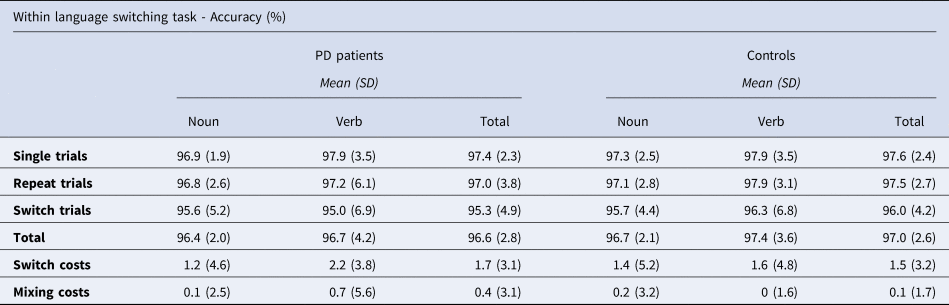
The main effect of the type of trial was significant (F [2, 78] = 9.59, p < 0.01, ηp2=0.20), and post-hoc analysis revealed that participants were less accurate in switch trials (95.6%) than in repeat (97.3%, p < 0.01) and single trials (97.5%, p < 0.01), but they performed with the same accuracy in the two latter types (p = 0.39; see Table 3). There was no difference in accuracy between L1 (96.6%) and L2 (97.0%) (language: F [1,39] = 0.58, p = 0.45, ηp2=0.01) or between nouns (97.2%) and verbs (96.5%) (category: F [1, 39] = 1.81, p = 0.19, ηp2=0.04). No other significant main effect or interaction resulted.
Accuracy (%) of participants in the within language switching task.

Between-language switching task
A repeated measures ANOVA was performed on accuracy and RTs that considered the type of trial (single, repeat, switch) and language (L1, L2) as within-subject factors and the group (controls, PD) as a between-subjects factor.
Reaction times
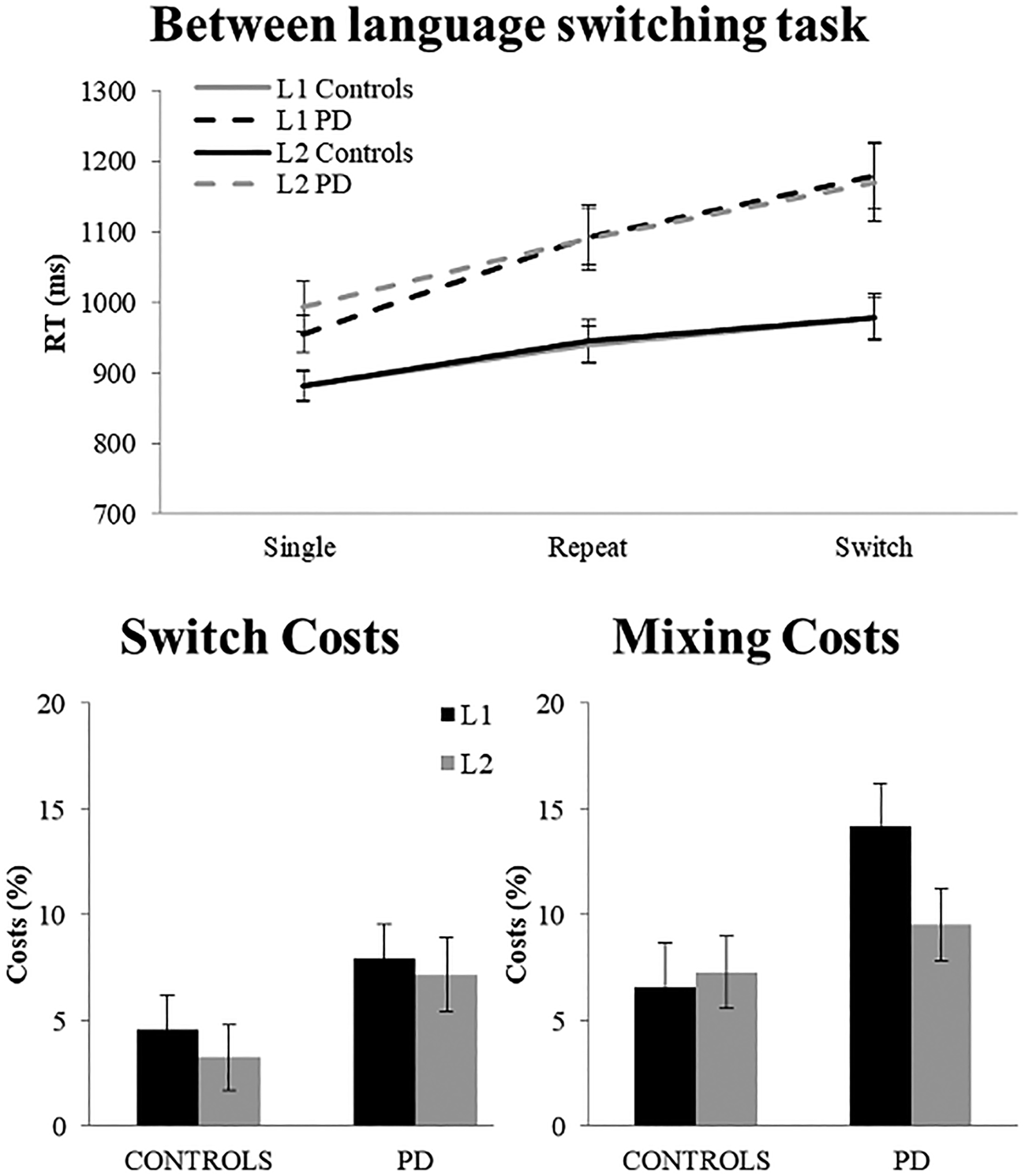
The main effect of the type of trial was significant (F [2, 78] = 70.45, p < 0.01, ηp2 = 0.64). Post-hoc analyses indicated that single trials were the fastest (928 ms), switch trials were the slowest (1076 ms; p < 0.01), and repeat trials were inbetween (1,017 ms, ps < 0.01; see Figure 2). The main effect of the group was also significant, which suggests that individuals with PD were slower (1,080 ms) overall than controls (934 ms) (F [1, 39] = 8.45, p < 0.01, ηp2 = 0.18). Moreover, the interaction between the group and type of trial was significant (F [2, 78] = 8.47, p < 0.01, ηp2 = 0.18), which signifies a difference in the magnitude of the costs between the two groups.
Reaction times and switch and mixing costs in the between language switching task.

We therefore analyzed the magnitude of the proportional switch costs and mixing costs with an ANOVA with group as a between-subjects factor. The results revealed that individuals with PD had increased switch costs compared to controls (7.4% and 3.7%, respectively; F [1, 39] = 5.26, p < 0.05, ηp2=0.12) as well as increased mixing costs (11.7% and 6.8%; F [1, 39] = 4.69, p < 0.05, ηp2 = 0.11). No other interaction or main effect was significant.
Accuracy
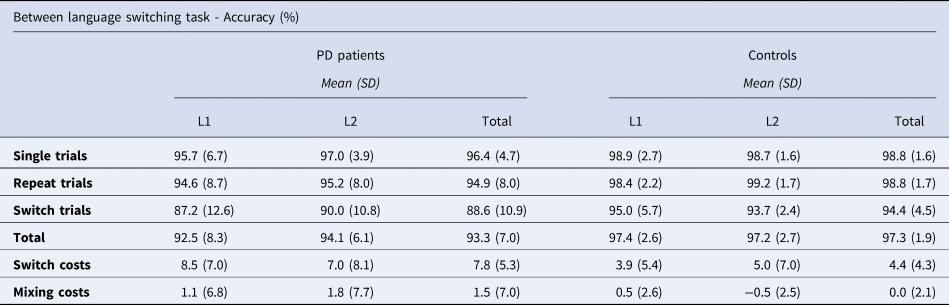
The main effect of the type of trial was significant (type of trial: F [2, 78] = 22.64, p < 0.01, ηp2 = 0.37), and post-hoc analysis revealed that participants were less accurate in switch trials (91.5%) than in repeat (96.8%, p < 0.01) and single (97.5%, p < 0.01) trials, and they performed similarly in the latter two trial conditions (p = 0.41; see Table 4). Moreover, individuals with PD were less accurate (93.1%) than controls (97.3%) (group: F [1, 39] = 5.27, p < 0.05, ηp2 = 0.12). No other interaction or main effect was significant.
Accuracy (%) of participants in the between language switching task.

Linguistic control tasks: correlations
To explore the relationship between the mechanisms involved in the two language control tasks, we correlated the costs (switch and mixing) that we obtained.
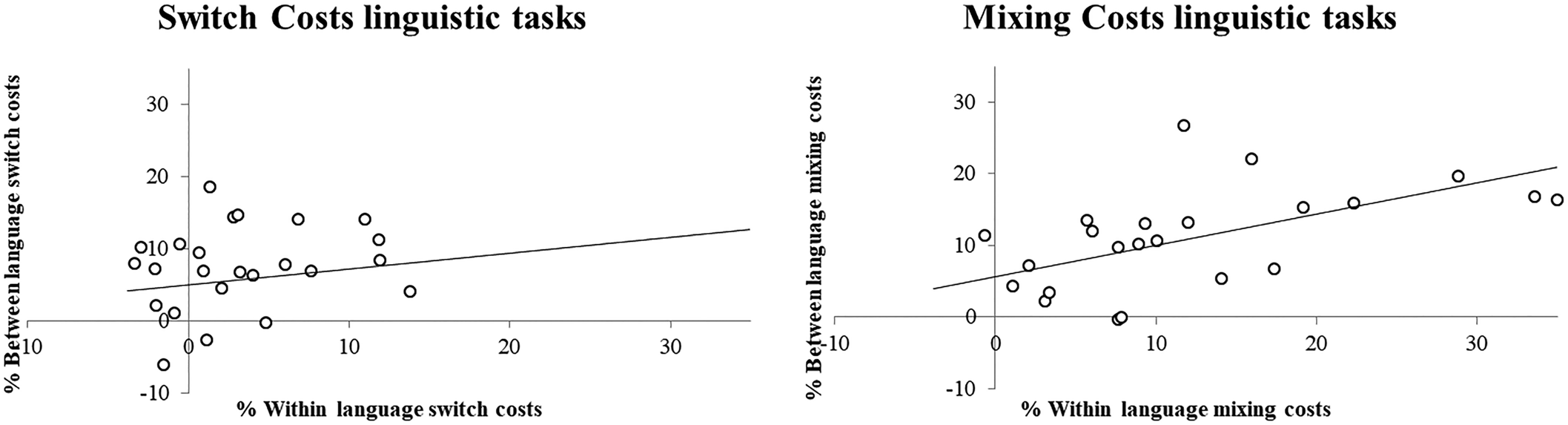
When we ran correlations with all participants, we found a non-significant correlation between the switch costs in the two linguistic tasks (r = 0.20, p = 0.22) but a significant positive correlation between the two mixing costs (r = 0.59, p < 0.01, see Figure 3).
Correlations of the switch costs and mixing costs of PD patients in the two linguistic tasks.

For PD patients, we confirmed these results (r = 0.22, p = 0.30 and r = 0.63, p < 0.01, respectively, see Figure 3), while for the control group, neither the switch costs (r = 0.40, p = 0.11) nor the mixing costs (r = 0.19, p = 0.48) were significantly correlated across tasks.
Discussion
The present study investigates the relationship between mechanisms that are involved in different contexts of language control by examining associations and dissociations of control deficits in bilingual PD patients.
We explored two measures of control (switch and mixing costs) following up on our previous study (Cattaneo et al., Reference Cattaneo, Calabria, Marne, Gironell, Abutalebi and Costa2015) with PD in which we found dissociations between these costs and between control domains (linguistic and non-linguistic). The literature on language switching has primarily focused on the reactive control (inhibitory) mechanism and measured it in terms of switching costs; however, researchers have recently proposed that a second mechanism underlies language control: namely proactive control, which can be measured with mixing costs (Braver, Reference Braver2013; Christoffels, Firk & Schiller, Reference Christoffels, Firk and Schiller2007; Green & Abutalebi, Reference Green and Abutalebi2013; Ma et al., Reference Ma, Li and Guo2016; Misra, Guo, Bobb & Kroll, Reference Misra, Guo, Bobb and Kroll2012).
Moreover, we investigated dissociations and associations of these two types of control in two linguistic switching tasks: one that engages bilingual language control (between-language switching task) and one that involves mechanisms of language control in general – that is, the set of control mechanisms that operate in situations in which two languages are not mixed (within-language switching).
In the next paragraphs we discuss what our findings suggest for the domain-general and domain-specific nature of language control.
Reactive control and its domain specificity
Our findings indicate that, compared to controls, PD patients were impaired in reactive control in the between-language switching task, but not in the within-language switching task. Moreover, reactive control indexes (switch costs) did not correlate in the two tasks. In our previous study with bilingual PD patients, we similarly determined that reactive control was selectively impaired in the between-language task but not in the non-linguistic switching task (Cattaneo et al., Reference Cattaneo, Calabria, Marne, Gironell, Abutalebi and Costa2015). Both results suggest that reactive bilingual language control processes are domain-specific, revealed in situations that require bilinguals to switch back and forth between languages.
The specific activation of the left caudate when bilinguals switch between languages supports the domain specificity of bilingual language control. The results of a study by Abutalebi et al. (Reference Abutalebi, Annoni, Zimine, Pegna, Seghier, Lee-Jahnke, Lazeyras, Cappa and Khateb2008) has evidenced that the left caudate was specifically activated when bilinguals performed a language-switching task, but not when participants were asked to switch between naming objects or actions in the same language. Similarly, Marian et al. (Reference Marian, Bartolotti, Rochanavibhata, Bradley and Hernandez2017) found the activation of the same subcortical area in a task of visual word recognition with auditory stimuli when bilinguals performed it in a between-language condition, but not when words belonged to same language.
One possible interpretation from Abutalebi and Green (Reference Abutalebi and Green2008, Reference Abutalebi and Green2016) is that the basal ganglia would be responsible for managing cross-language interference and supervising the selection of the correct language, and they would therefore be sensitive to language-switching deficits, as appears to be the case in our PD patients. These structures activate and inhibit languages in cooperation with frontal areas for conflict resolution and parietal areas for maintaining language representations (see Branzi et al., Reference Branzi, Della Rosa, Canini, Costa and Abutalebi2016; Calabria et al., Reference Calabria, Costa, Green and Abutalebi2018; Seo et al., Reference Seo, Stocco and Prat2018; Zou et al., Reference Zou, Ding, Abutalebi, Shu and Peng2012). Alternatively, and specifically in relation to executive control deficits related to striatal degeneration, it has been proposed that longer switch costs in non-linguistic tasks are indexes of impaired response suppression at selection level, as in the case of two languages (e.g., Lawrence, Sahakian & Robbins, Reference Lawrence, Sahakian and Robbins1998).
This is in line with previous evidence of the selectivity of the basal ganglia's involvement in cross-language interference (Abutalebi et al., Reference Abutalebi, Annoni, Zimine, Pegna, Seghier, Lee-Jahnke, Lazeyras, Cappa and Khateb2008; Crinion et al., Reference Crinion, Turner, Grogan, Hanakawa, Noppeney, Devlin, Aso, Urayama, Fukuyama, Stockton, Usui, Green and Price2006) as well as of pathological behaviors due to damage to the subcortical (basal ganglia and subthalamic) regions and their connections with striatal structures. For example, Abutalebi, Miozzo, and Cappa (Reference Abutalebi, Miozzo and Cappa2000) reported a case of a trilingual (Armenian–English–Italian) female (A.H.) who, after a subcortical white matter infarction adjacent to the left caudate nucleus, developed a non-fluent aphasia which was characterized by pathological language switching between these languages in speech production. Similarly, Aglioti, Beltramello, Girardi, and Fabbro (Reference Aglioti, Beltramello, Girardi and Fabbro1996) have discussed a bilingual patient (E.M.) who, after a stroke in the left capsular-putaminal region, suffered cross-language intrusions during spontaneous speech (see also Mariën, Abutalebi, Engelborghs & De Deyn, Reference Mariën, Abutalebi, Engelborghs and De Deyn2005).
Proactive control and its domain-general nature
In addition to our findings on reactive control, we observed that proactive control was similarly impaired in PD patients, compared to healthy controls, in both linguistic tasks. This suggests that this type of control is generalized across domains and that it is a control process elicited by conditions that require the active maintenance of two memory-related tasks. Indeed, the effects on non-linguistic proactive control are comparable to those on linguistic control in PD patients, which implies that proactive control is not sensitive to the domain (e.g., linguistic; Cattaneo et al., Reference Cattaneo, Calabria, Marne, Gironell, Abutalebi and Costa2015). Therefore, such control may be related to certain sub-components of working memory mechanisms, such as the demand to maintain task goals and update information in a dual-task situation (Braver, Reynolds & Donaldson, Reference Braver, Reynolds and Donaldson2003; Kray & Lindenberger, Reference Kray and Lindenberger2000; Pettigrew & Martin, Reference Pettigrew and Martin2015; Rogers & Monsell, Reference Rogers and Monsell1995). Alternatively, proactive control may relate to monitoring and resolving interferences without working memory involvement as other researchers have suggested (Philipp, Kalinich, Koch & Schubotz, Reference Philipp, Kalinich, Koch and Schubotz2008; Prior & Gollan, Reference Prior and Gollan2013; Prior & Macwhinney, Reference Prior and Macwhinney2010; Rubin & Meiran, Reference Rubin and Meiran2005).
The relationship between these two control types and the dysfunction of the striatum is only speculative in our study, seeing that we do not have measures in our PD patients to qualify/quantify their subcortical degeneration. Moreover, although numerous proposals have related both proactive and reactive inhibitory control to the basal ganglia (e.g., Jahanshahi, Obeso, Rothwell & Obeso, Reference Jahanshahi, Obeso, Rothwell and Obeso2015), others have demonstrated that they are unrelated (e.g., van Belle, Vink, Durston & Zandbelt, Reference van Belle, Vink, Durston and Zandbelt2014). The concept of reactive control that we use in this study might resemble that which Jahanshahi et al. (Reference Jahanshahi, Obeso, Rothwell and Obeso2015) have used for reactive inhibition, which defines it as stimulus-driven and useful for avoiding interference from distracting stimuli. However, in light of our results, a direct relationship between basal ganglia and specific control processes is only speculative and beyond the scope of this study.
Conclusion
In conclusion, this study contributes further knowledge of the relationship between different language control deficits in bilinguals experiencing PD. We demonstrated a dissociation of impairments in reactive mechanisms engaged during language control in different language contexts and an association of impairment for proactive language control mechanisms. Therefore, this suggests that bilingual language control abilities are domain-specific for reactive control, whereas they are domain-general for proactive control. However, we found a positive correlation between proactive control mechanisms in the two tasks in PD patients and not in controls. This might indicate that brain pathology increases the variability in performance and the statistical power for cross-task correlations.
Further research is needed to better understand the nature of reactive and proactive control, and how they can be related to qualitatively different mechanisms such as inhibition, working memory, or conflict monitoring.
Author ORCIDs
Gabriele Cattaneo, 0000-0002-7411-6829.
Acknowledgements
This work was supported by grants from Agencia Estatal de Investigación (AEI) and Fondo Europeo de Desarrollo Regional (FEDER) (PSI2011-23033, PSI2014-52210-P, PSI2017-87784-R), the Catalan Government (SGR 2014-1210, 2017SGR268), and the European Research Council (Cooperation grant agreement n. 613465 - AThEME) as well as by La Marató-TV3 Foundation (935422602). Marco Calabria is supported by the Ramón y Cajal Program from the Spanish Government (RYC-2013-14013). A special thanks is extended to all participants for their invaluable collaboration.