INTRODUCTION
Recent ethnographic work on the state has exposed a crack in one of the founding myths of modern political power. Despite the state's transcendental claim to wielding absolute, exclusive authority within national territory, scholars have shown that in much of the world there are, in fact, “too many actors competing to perform as state,” sites where various power blocs “are acting as the state and producing the same powerful effects” (Aretxaga Reference Aretxaga2003: 396, 398) Achille Mbembe (Reference Mbembe2001: 74), writing of the external fiscal controls imposed upon African countries during the late 1980s, has termed this a condition of “fractionated sovereignty”—the dispersal of official state functions among various non-state actors. There is, as Mbembe suggests, “nothing particularly African” about this situation (ibid.). Around the world, the power of various “shadow” organizations like arms dealers and paramilitary groups seems increasingly to depend upon their ability to out-perform the state in many of its definitive functions, from the provision of security and welfare to the collection of taxes and administration of justice (Nugent Reference Nugent and Heyman1999; Nordstrom Reference Nordstrom2004; Hansen Reference Hansen, Hansen and Stepputat2005). These observations present a serious challenge to conventional state theory. They force us to consider whether such conditions of fragmented, competitive statecraft might be better understood not as deviant exceptions to otherwise centralized political systems but, rather, as the way that government is actually experienced in much of the world today.
This paper traces the production of a privatized arena of government in the northern Andes of Ecuador, a form of rule I refer to as “state-by-proxy.” It suggests a way of attending to the more nuanced political struggles that may underlie economic restructuring initiatives around the globe, particularly those occurring in rural areas thought to sit at the so-called “margins” of the state (Das and Poole Reference Das, Poole, Das and Poole2004). Reports from these “frontiers” generally show an excess, rather than absence, of state investment in local affairs, but demand that we appreciate the rather unorthodox forms in which state power might be manifested in them (Gupta and Sharma Reference Gupta and Sharma2006). The highland region of Cayambe is no exception. There, a small group of agrarian capitalists have used their involvement in regional political networks to transform an otherwise indigenous and peasant enclave, only 70 kilometers from the capital city of Quito, into the core production zone for Ecuador's booming cut-flower industry. Less than twenty years before this industry took off in the late 1980s, rural Cayambe was dominated from top to bottom by hacienda complexes—agrarian estates worked for over two centuries by resident indigenous families. Throughout this time, hacienda owners, or hacendados, developed a curious relationship with the state, blocking, on the one hand, governmental intrusion upon their lands and yet reproducing, on the other, the dominant conventions of state rule in their productive relations with workers, including everything from the organization of tribute collection and public works programs to ways of expressing paternalistic authority. What interests me in this paper is how the legacy of these overlapping relations of state and class rule that defined the hacienda system for centuries influences those structuring the production of agro-exports in Cayambe today. Have neoliberal ideologies of state reductionism, market-oriented governance, and political decentralization—the conditions under which flower production emerged in Ecuador—allowed the new landowning class to run its enterprises free of governmental mimicry, or have they merely updated its performative lexicon for the neoliberal era?
To assess such questions, the following analysis builds upon an emerging scholarship of what are often called “para-” or “quasi-” state formations in post-colonial societies (Jackson Reference Jackson1990; Gill Reference Gill2009), yet suggests that the distinction between these forms and presumably more “authentic” and “official” state institutions may be considerably blurred in practice. Given the collaborative and mimetic relations shown to develop between ruling powers in places like rural Ecuador—in which private groups are often contracted by the central state to carry out certain of its functions, may act independently in its name, or simply copy its basic administrative techniques—by what terms are analysts, let alone governed populations, to identify the more truly “state” apparatus from its deviant, quasi, stand-in? Such questions may be circumvented by shifting the register of analysis from that of “state” to something like “sovereignty,” as a number of authors recently have done in insightful works addressing the proliferation of “de facto,” “nested,” “localized,” “outsourced,” “graded,” and “flexible” forms of sovereignty growing up below national-territorial boundaries (see Humphrey Reference Humphrey, Nugent and Vincent2004; Ong Reference Ong2006; Hansen and Stepputat Reference Hansen and Stepputat2006). In spite of their many ethnographic and theoretical contributions, such approaches threaten to leave the notion of state intact, and may unwittingly reproduce the state's claim upon political exceptionalism as well as the very boundary between legitimate and illegitimate modes of rule they are otherwise striving to overcome. To appreciate such ambiguities, this paper works outward from the more phenomenological ground of lived governmental encounters, asking about the conditions that make the state appear present in everyday social relations and how it is apprehended—granted objective status, known, “seen” and experienced as such—by populations administered by it or its “proxies.” It was a tragic moment during my fieldwork that encouraged me to understand Ecuadorian experiences with statecraft in such a way.
Scene One: A Death in the Andes
In February of 2002, a year into my research in Cayambe, I was sent on a mission to investigate a murder. The bodies of two young men had been found, riddled with stab wounds, in a shallow gorge running parallel to the Pan-American Highway that winds snakelike through the lower valleys of the region. One of the victims was an indigenous man named José Umaquinga, who had lived until his death in the high altitude “peasant” community of Carrera where I also had been residing for much of the previous year. José was one of the 154 people from Carrera, roughly half its adult population, who made a living by cutting roses in Cayambe's cut-flower sector. As news of the killing spread, details started to surface that increasingly connected it with the local export economy. It was determined that all three of the men involved—José, the second victim, and their accused killer—had worked together for many years on a rose plantation called Florentera Roses, located only steps from where the bodies were uncovered.Footnote 1 A local newspaper noted that one of the only objects found on the deceased were their flower clipping shears, an item that most employees are required to purchase and thus guard protectively (Diario del Norte 14 Feb. 2002). And because the man accused of the murders was identified as an Afro-Ecuadorian migrant from the coast, one of thousands who have sought employment in Cayambe over the last decade, the killings were quickly interpreted by many local residents as emblematic of the sorts of social conflicts and racial tensions engendered by the rapid industrialization of the region. But in the long hours spent acompañando (accompanying) José's body through his wake, the victim's father, a soft-spoken man who pastures sheep for a living, expressed great misgivings about how such a facile explanation might derail any hopes he and the community had for reaching a deeper understanding of his son's death and for bringing the killer to justice. As we passed a bottle around, Sr. Umaquinga and the community president asked if I, as a friend and known question-asker, might poke around a little to find out some of the missing details and encourage an earnest search for the accused, who had since disappeared. With some reluctance, I obliged and proposed starting my investigation by speaking with the local police officers who recovered José's body from the gorge. “The police?,” they responded. “Whatever for?”
Scene Two: State Mimesis
It turns out that my search for clues and petition for justice were expected to have only one stop: Florentera Roses, where I was to solicit a meeting with el patrón, the boss. Obediently, I went to the plantation the next day and presented the comuneros' appeal to the general manager, Jairo Suarez, who expressed his condolences for the deceased and explained his plans to bus the plantation's entire staff to the parish cemetery on the day of José's funeral. But Suarez skirted the comuneros' request that he head a criminal investigation into the murder; instead, he offered me a guided tour of his plantation. At our final stop, the medical center, Suarez stood beaming over boxes of new medicines and equipment that crowded the single room, apparently in the midst of a major upgrade. He explained that Florentera Roses went far beyond the common practice of providing free health care to its workers by allowing the families of employees to also use the clinic at a subsidized rate. This was, however, only the start of a much more ambitious plan. The extended health care system was intended both to encourage other plantations to provide care to the families of their workers, whom he regarded as a rather neglected lot, and to be the first step in designing a project to coordinate all flower growers in the area into a single integrated medical network, culminating in the construction of a major hospital in the city of Cayambe—all financed and controlled by plantation owners. Invoking the double murder in a rather unfortunate way, Suarez made his point explicit: “See?,” he said: “we could wait here forever for the state to come and build a good hospital, build a good clinic, but how many would have to die, waiting?”
It is tempting to read such conflations of private enterprise with public government as indicative of the sorts of alternative political subjectivities being produced at the margins of bureaucratic rule—misrecognitions of the boundaries between the rule of capital and that of the state that we could call non-state effects. However, might there not be something more fundamental being revealed here, in the rather fluid convergence of such typical state functions upon an atypical agent,Footnote 2 about the work of recognition—or misrecognition—that lies at the heart of state power itself?
A MATERIALIST THEORY OF THE CLAIM
In a 1991 lecture on the state, Pierre Bourdieu asked his audience to consider the fine line separating the figure of the president from that of the lunatic. “The President of the country,” he suggested, “is someone who claims to be the President but who differs from the madman who claims to be Napoleon by the fact that he is recognized to do so” (repr. in Bourdieu Reference Bourdieu and Steinmetz1999: 66). Bourdieu's point is to underscore the very tenuous and arbitrary nature of state rule; lacking any unique grounds for its authority, it is a power at once tautological (powerful only because decreed as such) and bound, like the Hegelian master to his slave, by its subjects' capacity to recognize it as something much more. Carolyn Nordstrom has put this in starker terms: “Governments, like militaries,” she argues, “exist not by the raw brute fact of power—but because people believe in this power … the state's power is not preeminent, but a carefully crafted illusion that exists only because a population chooses to grant it believability” (Reference Nordstrom2004: 234–35). The question, then, is how such “believability” gets produced.
As Bourdieu and Nordstrom suggest, the most elementary unit of state power, whether wielded by a president, a madman, or a plantation owner, is not an object but rather a claim. It is Weber who should receive credit for first noting this. Contrary to how he is often read, Weber did not define the state by its monopoly on legitimate force, but by its ability to back up its claim upon such a monopoly. As he wrote a century ago: “A compulsory political organization with continuous operations … will be called a ‘state’ insofar as its administrative staff successfully upholds the claim to the monopoly of the legitimate use of physical force in enforcement of its order” (Reference Weber, Roth and Wittich1978: 54). This subtle shift of emphasis encourages a new understanding of the state, for it pushes us to treat even the most brutally material manifestations of state power—the means of force, taxes, bureaucracies, border patrols—not as examples of the state's true power but as merely the evidence, or “symbolic capital,” upon which such claims aspire to legitimacy (Bourdieu Reference Bourdieu and Steinmetz1999). Philip Abrams (Reference Abrams1988 [1977]: 77), echoing Weber, makes this point clearly: “Armies and prisons are the back-up instruments of the burden of legitimacy,” he argued. “The state for its part never emerges except as a claim to domination.” Different historical conditions will necessarily determine the sorts of proof that must be marshaled to make any such claim believable (and the consequences suffered if not): here an army, there a property regime, each a claim made in material form. The point, however, is that the state-as-such cannot be found in any of the “things” that appear to reify it, but rather in the ever-dynamic synaptic relays of claim and recognition that insinuate state power into the material relations of everyday life. It is by intervening into these relations and substituting themselves in the location of “state” that emergent power blocs have been most able to justify their command over local populations—this is the groundwork of proxy state formation.
It is important to note that although this theory of the state rests on certain communicative (claims) and ideational (believability) practices, it embraces a thoroughly materialist perspective on political performativity. Not only are requests for recognition most often made through the transfer of things (like land taxes which, once paid, confirm the state's right to define property lines), but the major work of studying the state ethnographically or historically comes down to unpacking the production of its sense of objective presence, an apparent center of governmental gravity, out of the social relations internalized by it. As the vignettes above show, the arenas of justice and health may contain great potential for legitimizing rule in northern Ecuador today. But if they do, in fact, carry such effects in Cayambe it is not simply because these services condition new governmental subjectivities among the rural poor but, rather, because they absorb a widening range of governmental relations on which these populations depend into the administrative orbit of private enterprise. The “state-effects” we are referring to here are primarily structural, not subjective. They concern the elaboration of new forms of political organization and action around ostensibly non-political relations.
And yet the state trick, pace Weber, amounts to showing not only influence over such meaningful political domains but the apparent monopolization of them. Bourdieu (Reference Bourdieu and Steinmetz1999: 72) referred to this fundamental feature of state formation as the “monopolization of the monopoly” or the “monopolization of the universal,” meaning at once the hoarding of material faculties carrying legitimation-effects—the canonization of law, the provisioning of services, the institutionalization of security, etcetera—and the demand for a “submission to the universal” among administered populations—making, for instance, a flower plantation the sole site of health care in Cayambe simply a matter of common sense.
It is in this sense that we might better appreciate Hegel's widely criticized depiction of the state as the terrestrial form of what he called the Totality, that metaphysical Whole that coordinates and grants causality to all its constituent parts, if we heed Sartre's caution that totalities are always just, in his words, projects, not achievements, better defined as desires for totalization which “can only exist in the imaginary” (Reference Sartre, Reé and Sheridan-Smith2004 [1960]: 45). As Jameson (Reference Jameson1971) has suggested, the drive for totalization may be the political counterpoint to surplus accumulation in capitalist societies since, like capital's compulsive need to turn ever-greater profit margins to survive, the act of political accumulation, once initiated, is always a “developing activity which cannot cease without the multiplicity reverting to its original statute” (Sartre Reference Sartre, Reé and Sheridan-Smith2004: 47)—in this case, populations that could, in fact, get by well enough without it. This provides an extremely important clue to understanding the art of political domination in highland Ecuador. Plantation owners may have inherited from their forefathers an agrarian model that fused productive relations with those of government. Yet, as I discuss below, the indigenous “multitude” they claim a degree of administrative responsibility for has since pursued an alternative political trajectory that, left to its own devices, threatens to overturn the basis of class rule in the highlands. Could the compulsion to statecraft, with all its intended legitimation-effects, be understood even at this regional scale as simply part of the security apparatus that gets trucked out when other projects (like profit making) seem fragile and unstable?
The remainder of this paper traces the blurring of agrarian and state power in Ecuador from the colonial era to the present. It pays particular attention to the ways that landowners, past and present, have modeled their performances of regional authority and class status on the dominant conventions of statecraft of their era.
TWO IMAGES OF GOVERNANCE
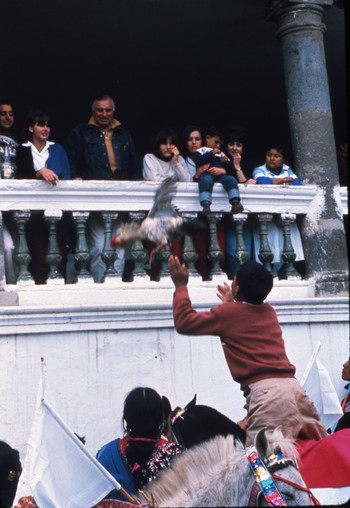
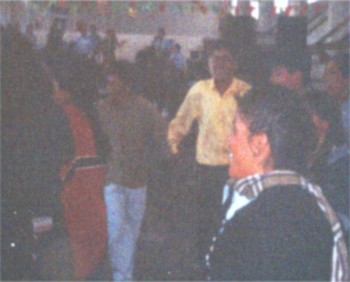
We can summarize many of these conventions up front by looking to the point in Cayambe's agrarian cycle when its governing principles are laid out most clearly for workers—namely, the post-harvest fiestas, when landowners and workers come together to dramatize, in a highly idealized way, the proper comportment to be observed by each throughout the year (Lyons Reference Lyons2006: 53). Compare, for instance, the different constructions of agrarian authority shown by landowners in two photographs culled from such events in Cayambe, taken nearly forty years apart, on nearly the same plot of land (see figs. 1 and 2). The former, taken from a 1968 edition of National Geographic, shows hacendado and ex-president Galo Plaza surrounded by his family on the balcony of his most prized estate, Zuleta receiving a chicken thrown up to him by one of his resident indigenous workers during the annual San Pedro festival.Footnote 3 The caption reads: “Tribute to a popular patron: Former President Galo Plaza reaches to catch a rooster, tossed by a lad on horseback.” The scene is complemented by a photo to the right, which we are told shows a “Rider-less horse [that] bears the offering of respect” (McIntyre Reference McIntyre1968: 276). The second photo, taken by me in 2001, shows flower grower Jorge Castellano dancing cheek and jowl with his workers to a band playing música nacional (“national music”) in the cleared out post-harvest and packaging room of TerraNova Farms, one of three rose plantations he owns in Cayambe. The dance is the culmination of a fictitious annual harvest festival created by Castellano to replace the traditional San Pedro celebrations with a day of games and festivities in the down-cycle of flower production that occurs in September.Footnote 4
Hacendado Power. Galo Plaza receives a gift of “tribute” from his workers during a San Pedro festival at hacienda Zuleta, 1968. Photo by Loren McIntyre. ©Loren McIntyre/www.lorenmcintyre.com (used with permission).

Flower Power. Jorge Castellano (at center, in bright shirt) dances with his workers at a “post-harvest” festival in the packaging room of his TerraNova rose plantation, 2001. Author's photo.

Like spectacles of rule generally, these are also rituals of legitimation, which condense the shifting grammars of claim and recognition that underlie Cayambe's agrarian formations into stylistic features of the fiestas themselves. The first of these images, captured in the declining years of hacienda rule (see below), underscores the rigid vertical hierarchy separating master from subject, a gap traversable only by quasi-tributary exchanges meant to confer upon power a degree of “respect.” The second fiesta, by contrast, seems rather ostentatiously to have dispensed with such formalities; Castellano is not only showcasing his ability to dance to the beat of the same drum as his indigenous workers but has also notably left his family at home, replacing the appeal to ancestry and lineage that so legitimated power's beneficence in the hacienda years with a more renegade model of solitary entrepreneurialism. As the celebrations have moved indoors, away from the dirt and mess of agriculture and toward the most sterilized and consumer-oriented point on plantation grounds, so too has something shifted over these years in the role that land itself plays in Ecuador's symbolic and spatial economies of power. Plaza's position on the balcony orients the fiesta not only around the centrifocal celebration of the elevated patron, but also around the centrifugal proprietary gaze he casts out over the land, his land, the primary basis of rural power in this period. By contrast, all Castellano sees, whirling at the center of his investment, are people—his people, barely out of uniform, encouraged to move, as co-participants, to a repeating refrain of “national music” at the end of a boom in the global market. These different performances of landed power—one working through land, the other through people—signal important shifts in the quotidian practices of rule as well as how such practices might, at various conjunctures, extend, replace, or challenge that advanced in the name of state. The following sections elaborate upon this point, beginning with a study of hacienda politics.
HACIENDA AS STATE
The political power that hacendados exerted over the Ecuadorian highlands, from the mid-1600s to the 1960s, was tied to their early monopolization of productive land in the countryside. In the early 1600s, individual Spaniards and clerical orders began to privatize Crown lands and attract indigenous families to them with promises, often fraudulent, of shelter from the heavy tribute and labor demands of the colonial state (Lyons Reference Lyons2006: 44). As a result, Hurtado claims, by at least “the seventeenth century, the hacienda controlled the major part of workable lands and became the axis of society and economy in Quito” (Reference Hurtado1980: 47). It also meant, as Galo Ramón has added, that “the majority of Indians had to inscribe themselves in the haciendas in order to reproduce themselves and comply with their tribute obligations,” transforming haciendas quickly into “the hegemonic power over Indian society” (Reference Ramón Valarezo1993: 56–57).
So total was the hacienda's absorption of indigenous populations in Cayambe that by 1720, 86 percent of indigenous people arriving from elsewhere wound up as indentured workers (conciertos, from concertaje, or debt peonage) on haciendas, and that, by 1830, over 75 percent of the entire indigenous population of Cayambe was bound to them (Ramón Valarezo Reference Ramón Valarezo2003: 27). The conditions of life and work on Ecuadorian haciendas are well documented, generally amounting to a “reciprocal exchange” of six days of family labor per week for usufruct access to a small plot (called a huasipungo) on which to build a home and raise crops (later accompanied by a small wage). But even formally “free” indigenous communities living around haciendas, of which there were no more than nine at any time in Cayambe, were completely dependent on haciendas for their livelihood. For instance, older members of the region's first independent community of Pucará (formerly Paccha-Pucará, legalized 30 December 1944) often spoke with me in 2002 about how they and previous generations, irrespective of their political and territorial autonomy, had to work continually as yanaperos (day laborers) for the nearby hacienda San Antonio to access the forests for firewood, the páramos (high altitude grasslands) for pasture, and the water sources for irrigation and domestic use, all of which were under hacienda control. Pucará members joined resident workers (huasipungueros) in the annual fiestas acknowledging hacendado “lordship,” yet were deprived of the gifts of grain (socorros), protection, and so on that resident workers received in return.
These powerful expressions of hacendados' ability to totalize both land (including that which they do not technically own) and indigenous life-worlds (including those claiming juridical autonomy) under their control brought landlord and state into relations that were at once complementary, mimetic, and competitive. As Guerrero has shown, the Republican state, which continued to demand indigenous tribute for twenty-seven years after independence, simply passed the responsibility for its collection over to hacendados. As in the colonial period, tributary relations implied a broader set of political conditions. In “return for paying the tribute of their indigenous workers,” Guerrero notes, “The republican state adjudicated to landowners a modality of rule over a space and its inhabitants,” codifying in law (passed 18 November 1831) “a sort of delegation of republican sovereignty to a “master-citizen” (patrón ciudadano) for the administration of indigenous persons who … inhabited his private property” (Reference Guerrero, Thurner and Guerrero2003: 284).
This system of “delegated” sovereignty outlasted the tribute system and often put hacendados into direct conflict with the central state's efforts to bring the rural highlands under its jurisdiction.Footnote 5 For instance, the 1843 plan to extend the office of teniente político (political lieutenant), state agents of dispute resolution, to the local parish level was largely ineffective in hacienda-controlled areas. Guerrero's (Reference Guerrero1990) study of the 1843–1845 records in Otavalo (which then oversaw the parish of Cayambe) shows that only 2 percent of recorded disputes express conflicts between Indians and representatives of haciendas, something Guerrero reads as evidence that haciendas had already come to constitute an autonomous sphere of authority with forms of “conflict resolution which escaped state intervention” (Reference Guerrero1990: 32). Haciendas, he suggests, were governed by a distinct mode of “justice managed by the patrones and the ‘servants’ of the hacienda … who used their own codes [of law,] organized around unequal reciprocity,” to administer worker grievances on their own terms. If republican officials had seen the administration of justice and the application of law as the first lines of state conquest in rural Ecuador, what they found, it seems, is that another form of sovereign power had already beaten them to it.
These tensions between decentralized and centralized strategies of state formation were common in the early republican years. As Derek Williams has noted, the Ecuadorian state up through the mid-nineteenth century was actually composed of various independent bodies, each of which “possessed a similar nature to the state (exercising varyingly, executive, judicial, fiscal, military, and in some cases legislative roles) while maintaining its own hierarchy and its autonomy from central government” (Reference Williams2001: 152). It was the theocratic president Gabriel Garcia Moreno (1861–1865; 1869–1875), Williams argues, who first attempted to coordinate a unified state system in Ecuador, which he advanced along two lines. First, he gave the Catholic Church a whole array of new functions, from rural education to vigilance against concubinage and non-Catholic religious celebrations. At the same time, new regional ordinances expanded the bureaucratic powers of cantonal, municipal, and parish governments by enlisting them in the service of procuring workers for massive road-building projects throughout the highlands. Both of these attempts to centralize government actually had the reverse effect by helping haciendas expand their rule over areas like Cayambe. As one of the main landowners in the region, the Church's assumption of indigenous education and moral instruction became part of the general modus operandi of all hacendados, many of whom rushed to build churches and schools for their workers on private hacienda grounds. The same can be said of the municipal works projects, which were intended to erode the power of local elites by consolidating a more direct relationship between Indians and the state. Yet, as Guerrero notes, the state's labor bosses found it “difficult to find workers, since a significant quantity of comuneros [indigenous people] … had been sheltered under the protection of the haciendas,” forcing them to make clandestine “nocturnal incursions” onto haciendas to capture by force their quota of indigenous workers (Reference Guerrero1990: 58). Publicly, hacendados were able to claim their workers' compliance with state labor demands by showing that they were already performing infrastructural improvements for the nation by building roads, churches, and schools on hacienda lands.
These strategies, which persisted into the second half of the twentieth century, reveal much about how landowners came to capture state practice as part of their apparatus of worker control, but they tell us little about the forms of indigenous political consciousness that developed alongside them. Speaking to this, Hurtado argues that because “a large portion of the population was ignorant of the existence of the state or was unaware of its attributes and responsibilities, and since the majority was accustomed to associating in a single individual the qualities of patron and ruler, the people learned about political authority through the orders given and the sanctions imposed by the hacendado” (Reference Hurtado1980: 54). Hurtado may well express the sort of landlord aspirations I am documenting here, but his suggestion that hacienda Indians knew nothing of the state beyond the hacendado is, in historical terms, entirely false. Kim Clark (Reference Clark, Clark and Becker2007) has documented a number of instances throughout the early twentieth century in which hacienda Indians strategically manipulated the “language of paternalism” between the president and the hacendado, appealing to one to discipline the other when benevolence through power turned to abuse of it. And Marc Becker (Reference Becker2008) has uncovered hundreds of instances in the nineteenth and twentieth centuries in which hacienda-bound Indians in Cayambe successfully pressured the central state to develop labor laws applicable to haciendas, studied and debated these codes in detail, and marshaled them in legal battles with hacendados who failed to respect their terms.
These legal challenges had mixed results, leading at times to ministerial intervention and landlord sanctions, at others to open protest by indigenous federations and violent repression by local police. Yet, as Becker's work makes clear, these local conflicts between haciendas and Indians must be seen within a much larger political context of widespread pressure for radical change in the national political economy. Urban-based socialists were instrumental contributors to the formation in 1944 of Ecuador's first national indigenous movement, the Federación Ecuatoriana de Indios (Ecuadorian Federation of Indians, FEI) and participated as advisors, brokers, and co-participants in most indigenous struggles over the following decades. Landlords who appealed to the state for armed protection of their private property frequently presented these disputes as evidence of the communist threat to national sovereignty, citing them as evidence of massive hacienda expropriations, violent indigenous takeovers, race wars, and even the rape of white women to follow.
Such were the conditions that led a squadron of police officers from Cayambe, in but one instance, to fire machine guns at a group of indigenous workers (killing four) who led protests to the Ministry of Labor over three months of unpaid wages at hacienda Guachalá in 1954 (see Becker Reference Becker2008: 105–22). Remarkably, workers and FEI leaders blamed the hacienda administrator, César Troya Salazar, for the Labor Code violations and resulting violence, not the owner, Neptalí Bonifaz, who was still regarded by Indians of the area as “one of the most generous of Ecuador's hacendados” (ibid.: 117). Bonifaz, whose family had owned Guachalá for much of the century, had perfected the arts of the buen patrón, the benevolent paternalism practiced by one who “has to stoically support his often complicated children, his workers, his Indians … with a firm hand, with the whip as well as the ‘kind ways’ of a just father” (Ramón Valarezo Reference Ramón Valarezo1993: 59). Such familial idioms were more than metaphorical. As Becker notes, the Bonifaz family had “mastered paternalistic administrative methods to avoid protests,” including their willingness to participate with workers in “the fictive kinship compadrazgo (godparent) system to keep open dissent in check” (Reference Becker2008: 105). By maintaining such postures, hacendados like Bonifaz and Plaza were able not only to weather the growing threats of land expropriation and struggles for agrarian reform raging in the countryside, but also, when such reforms appeared inevitable in the mid-twentieth century, to again steal the state's fire by gifting workers with land themselves. Bonifaz started his voluntary land transfers in 1959 at Pitaná, the location of the massacre five years earlier. Plaza began the redistribution of Zuleta in 1962, saying, “I want to demonstrate that it is possible to convert the huasipunguero into a property owner. I know that what benefits my workers also benefits me” (in Barsky Reference Barsky1988: 97). As the caption under his National Geographic photo continues, “In festivities starting each June 24, Indians bestow such gifts on landowners. Galo Plaza merits the tribute. His 6,000-acre hacienda pioneers a program of education, medical aid, and land grants to end the near-serfdom of many Indians” (McIntyre Reference McIntyre1968: 276).
These early struggles for land reform show an entanglement, within the hacienda system itself, of two very different sorts of gift economies with two different sorts of state systems, one gravitating around the residue of the paternalistic-master relations sketched above, the other pushing toward an emergent bureaucratic-developmentalism focusing on property, rights, universal health care, and educated citizenship. Yet, if paternalism was the dominant idiom through which hacendados came to express their claims to being the legitimate authorities over highland indigenous society, it was through a similar language, particularly, that central state officials, especially after the Liberal Revolution of 1895, advanced these claims. As many scholars have noted, the Labor Laws, ban on debt peonage, legalization of indigenous community structures, and other progressive policies implemented in the early twentieth century were guided by a governmental agenda to “destroy the forces of backwardness, redeem the ‘passive Indian,’ and take him by the hand toward civilization” (Guerrero Reference Guerrero1991: 334–35). The legitimacy of any project of state formation is necessarily fragile, depending as it does on acknowledgement by those subjected to it. But in the twentieth century, any such recognition was increasingly being withheld by Indians who, in leading revolts and launching legal disputes, pressed less for the radicalization of the countryside than to be shown the hard evidence supporting these claims. Once the threat of leftist agitation articulated with these demands, however, a new urgency emerged among landed elites to further appropriate the idea of state, that open signifier of rightful domination, as their, not Indians', political project. A similar process, I argue, is occurring today on Cayambe's cut-flower plantations, although the entire political and economic landscape in which they are embedded has been dramatically altered. Most of these changes owe their origin to the agrarian reforms that began in 1964.
THE INTERMISSION: AGRARIAN REFORM AS POLITICAL RESTRUCTURING
One of the great ironies of Ecuador's agrarian reform period is that many of the same hacendados who were voluntarily distributing land to their workers in the countryside were simultaneously blocking its legislation by the central state. Emilio Bonifaz, who led these initiatives, presented countless petitions to the Chamber of Agriculture throughout the 1950s and early 1960s about the detrimental effects any reform of the hacienda system would have on the Ecuadorian economy (see Barsky Reference Barsky1988: 105–22). What landlords feared was expropriation from both ends, above and below. Their voluntary land distributions sought to quell the threat of indigenous takeovers while their control over the state sought to restrict its meddling in their countryside. As Osvaldo Barsky notes, to landowners of this era, “Modernization … implies the loss of power, particularly to the growth of a nation-state apparatus that is coming to play an increasingly important role in the control of agrarian resources and in the regulation of certain social relations” (Reference Barsky1988: 106).
It is thus highly significant that Ecuador's major agrarian reform laws of 1964 and 1973 were passed by military juntas, formed from urban middle-class families whose political aspirations had been blocked by highland and coastal elites since Independence (Martz Reference Martz1988: 13, Isaacs Reference Isaacs1993: 2). Taking power by coups, the military advanced their reforms as part of a broader mission to formally separate political power from class interest and initiate a progressive plan of national development guided not by the particular interests of regional elites but by a strong central state.Footnote 6 The military governments dissolved congress in 1964, where disputes between economic elites were most traditionally played out. New institutions were created to plan and implement economic policy, such as the Superintendencia de Precios (formed in 1973), or completely reined into the state, such as the Junta Nacional de Planificación (formed in 1950), and staffed entirely with middle class professionals. Members of the private sector were sometimes allowed to sit in on meetings, but were denied voting rights and were regularly stripped of ministerial positions (Conaghan Reference Conaghan1988: 103). In new forums, like the social clubs growing up around Quito and Guayaquil, economic elites from the coast and highlands converged and discovered, perhaps for the first time in Ecuadorian history, that they had much in common, including a newfound resentment for state-centered models of national development.
This quick transformation of local and national government helps explain the shift among traditionally conservative highland elites to a highly orthodox brand of anti-statist liberalism in the late 1970s. As Conaghan, Malloy, and Abugattas argue in their study of the late-twentieth-century Andes, in “rallying against unreliable military regimes, … business groups resurrected elements of classical liberalism as part of their ideological discourse. Democracy was posed as the alternative political formula and the market as the cure for the social and economic ‘disease’ caused by an overly obtrusive state” (Reference Conaghan, Malloy and Abugattas1990: 8). It was the hacendados' own children, coming of age during this period, who became Ecuador's first flower growers. With direct access to the remaining lands of their parents' generation, flower growers' rapid rise to wealth in the mid-1980s epitomized not so much a nouveau riche class as a nouveau entrepreneurial generation of old money that celebrated its return to being able to make a profit again in the countryside. The anti-statist, “entrepreneurial, buckaroo spirit” that so perplexed Sawers (Reference Sawers2005: 57) in his interviews with Ecuador's flower growers, all of whom “complained bitterly of governmental policies [being] still an obstacle for their industry,” is living legacy to the political readjustments advanced under military rule.
One other effect of the reforms, however, provides an important counterpoint to the reconfigurations of landlord power that occurred during this period. It was under the reforms that the “peasant community,” an essential unit of indigenous political struggle in the highlands today, was first standardized and given real substance. The reforms allowed resident workers to buy title to portions of expropriated hacienda land on the condition that they group themselves into territorialized communities that, to this day, often carry the name of their hacienda of origin. Unlike similar post-reform rural collectivities tried out in places like Velasco's Peru, however, these units were designed to fulfill more political than productive ambitions, in that their main purpose was to extend the state's administrative power into areas previously under hacienda control. Communities are juridical units, administered by a number of government ministries, including the Ministry of Agriculture and Ranching and the Ministry of Social Welfare. Comuneros must submit annual lists to these agencies of all adult members, allow state representatives to supervise community meetings and sanction the succession of its directorate (which, composed of a president, vice-president, secretary, and so forth, mimics state, not indigenous, systems of authority), and, under ministerial instruction, produce a set of governing statutes (a mini-constitution of sorts) outlining the rights and obligations of all members. In return, communities are given a degree of autonomy over such things as residency decisions, property transfers, utility (electricity and water) distribution, and member sanctions within their territories. Across Cayambe, comuneros spend many unremunerated hours each week doing things like digging water canals, upgrading rural schools, voting on community initiatives, electing their governing bodies, and petitioning ministries to loan infrastructural equipment, all as a condition of membership.
In many ways, these rural communities, which grow in number each year,Footnote 7 continue to reproduce within the neoliberal landscape key elements of the plans for state expansion developed by reformist juntas in the 1960s and 1970s. They involve their members daily in practices that bring the central state very directly into the administration of rural life and, at the same time, make the work of community reproduction itself a somewhat proxied performance of statecraft—a much less dismissive perspective on bureaucratic power than that espoused by flower growers. This has undoubtedly influenced the direction that indigenous activism has taken over the last two decades, particularly in its persistent focus on the actions of the central state—in demanding constitutional amendments, fastidiously studying policy changes, occupying ministries, ousting presidents, and forming its own political party, Pachakutik, in 1996—even as real power in many areas the movement claims to represent is being increasingly hoarded by new landed elites, as we shall see. This cannot be seen as merely residual practice designed under an archaic political imaginary or as evidence of entrapment in the state's own reifying magic. The mystique of the “state idea” represents a possible challenge to the more amorphous and location-less power that defines the neoliberal present, and whose terms, as expressed by poor and debilitating labor conditions in export plantations, seem to merely reproduce those of the hacienda years. Such was the banner under which the Pachakutik party, victorious in Cayambe's municipal elections of 2000 and 2005, wove together various articles of the new state decentralization laws in 2002 and increased land taxes for flower growers by over 500 percent. Indigenous members of municipal government publicly described this effort as an act of retribution against centuries of landlord exploitation.
In this regard, the anti-statist ideologies of Cayambe's flower growers seem, like the strategies of hacendados before them, to be part of an attempt to claim sovereignty over a territory and a people imagined to be under their exclusive jurisdiction. They at once deny the possibility of governmental regulation of their profit-making activities and undercut the basis of very active indigenous struggles for more just and redistributive relations of agrarian and political production. At the same time, however, such discourses resonate closely with many of those that guide dominant neoliberal agendas today, including the emphases on state reductionism, private and decentralized government, and independent capacity-building initiatives.Footnote 8 As Cayambe entered the twenty-first century, its landowning elite was claiming, as it had a century before, to be practicing the arts of state better than the state itself.
PLANTATION AS/INSTEAD OF STATE
It was approaching 2:00 a.m. on 12 February 2002 when work on Jorge Castellano's TerraNova plantation finally stopped. Workers had been plied with bread and grainy colada drinks to keep them packaging flowers for eleven hours past the normal end of their work day on this, the final night of production for the annual Valentine's Day production cycle, when growers either make 60–75 percent of their yearly profits or lose it all. Castellano himself had been on the farm until around ten o'clock that evening, edging himself in amongst his workers and encouraging them by megaphone to uphold, in spite of fatigue, his company's high standards of product quality. Castellano reminded everyone that this long night was a collective sacrifice in the future for all—for themselves, the patria (nation, homeland), Cayambe, and their guaguas (Quichua for “children”). If in doubt, he told them, remember the company slogan mejoramiento continuo, or “continual betterment,” boldly printed on their uniforms where normally a name patch might be found. At the end of the night one of the company's cargo trucks backed up into the post-harvest room and opened its doors to reveal hundreds of boxes of new dinner plates that were madly distributed among workers. Here was a curious entrepreneurial composition. If Castellano's motivational speech and company logo mimic corporate strategies used today in the North, his closing of a production cycle with gift transfers resembled more the customary socorros (usually a sack of grain) that hacendados gave to their workers after a major annual harvest. In the hacienda years, such ritualized transfers were, like fiesta performances, instrumental to the overall reproduction of highland class structures, evidence that the discipline offered was really that of a just and kind father or at least one who fulfilled his obligations. Have flower growers like Castellano really overcome the paternalistic styles of agrarian rule of the past—as his dance number might suggest—or have they merely adapted them to the new class dynamics and production routines of capitalist agriculture? And in what ways are their plantations run, like haciendas were, as private arenas of government—model state proxies—for the neoliberal era?
The New Claim: A Finca de Personas
Throughout my research in Ecuador, plantation owners and their administrative staff tended to substitute my questions about their economic returns with a phrase that soon appeared axiomatic in the industry. The real mission of flower growers, they said, was not to generate profit—the risks were too high and the returns too low for anyone to believe that—but rather to hacer patria, build a proper homeland, or nation, in Cayambe. Ecuadorian elites have long justified their personal ambitions with appeals to national integration, and have targeted Indians as the primary “non-national” objects needing to be integrated. Plaza's own national agrarian census in 1950 was implemented, in the words of its director, primarily “to incorporate the Indian into economic and social relations” of the nation (in Becker Reference Becker2008: 107). And Liberal governments' ban on hacienda debt bondage in the late nineteenth century—intended, without doubt, to undercut the resource base of their highland political rivals—was expressed in the aforementioned idiom of “redeeming” and “civilizing” Indians by freeing them into national society. Throughout this period, such redemptive-nationalist work, irrespective of its class interest, could only be expressed through the framework of state, the only location of rule that by definition speaks a language of disinterested universalism and which is able to credibly offer the socio-legal condition of universality within a nation—citizenship—as the antidote to the (racial-political) ravages of sub- or extra-national particularism.
Previous sections have shown how bound the process of identifying the Indian “condition” and then solving it was to the meta-narrative of paternalism that inflected all forms of governmental practice in the period. Neoliberal modes of citizenship have shifted the terms by which Indians are presently approached with the promise of entering into the national community of rights-bearing citizens. On the one hand, neoliberal orthodoxy the world over has reframed citizenship as an ongoing process of “citizen formation,” something bound up in the “practices, techniques and styles of self-reflection and self-management necessary for the active construction of an ethical life” (Rose Reference Rose1999: 191). Rights are no longer framed as automatic conditions of nationality ascribed by an overarching state, but as rewards earned by comporting one's self within the ethico-political code of conduct its charters outline. Ecuador's 1998 pluriculturalized constitution expanded the range of choices Indians could pursue to earn these rewards. New articles legally recognized the autonomy of indigenous communities to practice “traditional” forms of health care, decision-making, and justice in their territories. However major these achievements were for indigenous activists, they may also have flattened out the more radical potentials of indigenous political practice by validating only its expressions that fit within the “new normativity” of peaceful, democratic, and cultural citizenship (Walsh Reference Walsh and Salgado2002: 28). As Enrique Ayala Mora regrets, “The very legislation that is arguably in favor of indigenous rights, conceives of them from within a national, unified judicial system” (Reference Ayala Mora and Salgado2002: 108). In other words, Indians wishing to be recognized as citizens can stay Indians only insofar as they relearn its proper forms of conduct.
On the other hand, state decentralization laws passed from 1997–2001 (under the “Modernization of the State” umbrella program) and state reduction initiatives advanced throughout the 1980s and 1990s down-scaled the governmental sphere in which such rights can be conferred and activated, effectively dispersing and diversifying the locations where reciprocal recognition between “state” and “citizen” can occur (see Hey and Klak Reference Hey and Klak1999). These measures opened up new opportunities for flower growers to pursue privatized forms of government similar to those that secured their forefathers' rule in hacienda years. Their claim to be doing the work of patria-building in Cayambe casts a cynical perception of extra-nationality over the region and its inhabitants, awkwardly denying comuneros' struggles for political participation in the nation-state, and it positions capitalist expansion, like hacienda bondage, as the real vanguard for complete social and civic equality in Ecuador. As the lead claim of the proxy state for neoliberal times, haciendo patria works through both techniques outlined above: the localization of state practice in the enterprise and the promotion in its operating procedures of a particular art of learned, self-made political citizenship among its workforce. It is in the practice of wage labor routines themselves that indigenous Cayambeños are imagined to most decisively be remade into truly “national” political subjects.
As Elena Terán, long-time general manager of the extensive Florequisa enterprise put this matter, flower growing is “not like traditional [read: “peasant”] agriculture, the agriculture that we do is a technified agriculture, where first, the worker enters to learn the oficio [trade/station] of flowers, then to be a person in development.”Footnote 9 Neptalí Bonifaz, one of three inheritors of hacienda Gauchalá and Ecuador's self-proclaimed first flower grower, expressed this transformation to me through the idiom of an acquired expertise among his indigenous workers. This expertise, he claimed, extends well beyond the plantation and into a new condition of freedom workers develop from it. “Look,” he said,
in three months these people are experts in flowers. I have a bus that goes up to [the indigenous community of] Carrera and brings down the people from Carrera, and in three months [hits fist] they're experts. And not just this. In three months they're not working for me anymore, but rather they go to other plantations where perhaps they pay better, or … where they can work with their family members. […] For them, this is freedom. For them, it's freedom to … for example, live in Cayambe [the city] and have a television and access to the cinema or a discothèque or a video store, this is a lot more free than to live in Carrera and not have anything. Geez, what's there to do, only to go to bed at seven at night, wake up at three in the morning, and do what? This sense of liberty is the mission of the flower growers.Footnote 10
But this freedom—to choose where to work or live and practice urban consumer habits—is freedom from what, exactly?
Victor Sánchez, a senior labor organizer in Castellano's TerraNova plantation, clarified this aspect of “freedom” in a discussion of his managerial goals. “We are trying to make people more sensible, more intelligent,” he said, “and this comes by valuing real work.” Without pause, Sánchez explained this distinction: “The [indigenous] protests that happen, happen because the people don't have a true consciousness…. The people don't come down [from the communities to block roads, etcetera] by their own choice, but rather because of obligation. This is the thing. If you don't come down, your water will be cut off, if you don't come down you'll have your electricity cut off, [or] something else will be taken away, or there is a fine. And things can't remain this way, they simply can't.”Footnote 11
Bonifaz and Sánchez both imagine the indigenous community to be a space of overwhelming social control, drudgery, and personal unfulfillment, remedied by the personal values of freedom and choice their workers are expected to learn in their submission to waged labor routines. The product of this learning is a new ethos of political comportment. Such fetishizations of freedom under conditions of subordination have been flagged by Anglo-Foucauldians as the cornerstone of neoliberal ethics. As Mitchell Dean argues, the neoliberal subject is “a subject whose freedom is a condition of subjection,” and who, “in order to act freely, … must first be shaped, guided and molded into one capable of responsibly exercising that freedom through systems of domination” (Reference Dean1999: 165). It is this disciplined acquisition of freedom that was most stressed by Friedrich Hayek, often regarded as the founder of intellectual neoliberalism, in his debates with natural rights theorists. Freedom, to Hayek, is not an organic component of human existence, waiting to be released by laissez-faire policies, but rather something only “made possible by the gradual evolution of the discipline of civilization which is at the same time the discipline of freedom” (Reference Hayek1979: 163, original emphasis).
It is rather fortuitous in this regard that Cayambe's most prized neoliberal commodity is a flower, that most eloquent unifier of “culture's” triple reference to cultivation, comportment, and civilization. As Jack Goody notes, flowers have always been associated with advancing culture's association with “the ‘civilization’ of manners, of ways of behaving, especially of elaborated ways, those that have been carefully tended” (Reference Goody1993: 26). Cayambe's agro-capitalists have not missed this symbolic resonance between their commodity and the civilizing mission they are imparting upon their workforce. As Victor Sánchez continued to speak with me about his administrative style, he noted that on Castellano's farm, supervisors are instructed to maintain “friendly relations with the [workers] because, in reality, this has to be a farm of people [una finca de personas], not flowers, because people are the motor here…. This may be a flower farm, but it's a human farm too.” He evidenced the success of such careful tending to his workers' self-cultivation by noting, “Thanks to the inter-relations that the plantations are causing among us, the [indigenous] people are learning more every day, are developing more… . It's not like before when most of the time they would simply stand to one side, hunched over. But now this is a people who are speaking with their head held high… . Things are different now.”Footnote 12
Managers over the years have implemented a wide array of more formalized practices to structure labor relations around the cultivation of a new sort of indigenous workforce on Castellano's plantations. In 2001 these were standardized under what was called a programa conductiva, or “program of conduct,” designed by Castellano himself to assess the entirety of workers' comportment on the plantation, from the moment they step off the bus in the morning to the moment they get back on it late in the afternoon. Supervisors are to fill out weekly scorecards that evaluate the degree to which workers fulfill seven new expectations, categorized under headings like “Doesn't argue over orders when they're given” (10 percent of score), “Doesn't quarrel frequently with his workmates” (10 percent), and “Shows an interest in learning from his work” (15 percent). These rather amorphous evaluations of conduct carry real weight among workers, since high scores are rewarded with poker chips that they can use to “buy” vacation days. Management frequently denies workers the chance to cash in these tokens, however, when they suspect the free day will be used to attend community work projects (which often spill over into successive days) or protests called by the national or regional indigenous movement. This evidences the rather tight control that the plantation's administrative staff exerted over which freedoms are to be encouraged and which are to be constrained among citizens in the sort of patria they intend Cayambe to become.
This point is critical to understanding the work that flower growers put into making labor a practice of political pedagogy. Like growers' anti-statist rhetoric, their claims to be offering Indians the chance at personal fulfillment and true freedom through market participation share much with directions in neoliberal thought that are influencing state restructuring initiatives throughout Latin America today. But plantation owners are at the same time entangled in a much more localized struggle over the sources of influence and opportunities for change in indigenous society, many of which show the potential to radically destabilize elite status and capital accumulation in the countryside, or which, put another way, show different ways a subaltern population may express its claims upon political citizenship. As Florequisa manager Elena Terán stated, “We have tried to show respect and to not marginalize the indigenous groups. However, we are afraid of the reactions lately, of the indígenas. They are very radical when they go out and protest. Who knows … ever since they have found their rights, they have become very conflictive. And for this I would say that I feel they now have more resentment. For example, one can say that apart from all the political problems there are, we now have the problem of the indígena, of an indigeneity felt more radically. And the flowers, being a perishable product and not conservable, have many risks.”Footnote 13
We need to see the investments that flower growers make in their workers as interventions into the situation Terán describes. They are attempts to give security to their own risky and potentially perishable position in a radicalized indigenous territory by attempting to convince Indians that their own desires are better fulfilled through labor's promise than by being abandoned by it. As indigenous activism has started to work from inside the official halls of state, as the above taxation example shows, plantation owners ultimately have to demonstrate that they, in fact, can do the state's work in the region more effectively than any of their rivals. They must, in other words, work to monopolize the evidence showing a legitimate right to rule over Cayambe.
Serving like a State
In July 2007, a celebration was organized in Cayambe's municipal square to mark its 124th anniversary of cantonal status.Footnote 14 Mayor Diego Bonifaz, himself partial inheritor of hacienda Guachalá, sat on a platform in the town plaza flanked by his senior staff, the young Miss Cayambe, and his council members, many of whom were members of surrounding indigenous communities. For two hours, before a crowd of thousands, Bonifaz was feted with a parade of organizations acknowledging his two terms of service to Cayambe and thanking him personally for specific projects completed under his administration—a water canal for the community of Chaupiestancia, an organized vending structure for the street markets, and so on. Surely this was the true pomp of the bureaucratic state, an orchestration of public recognition of its presence and power over the region. The highlight of the show, however, was the final group in the procession, a private security company called INVIN that marched past the mayor in successive ranks: around two hundred armed men in bulletproof vests, a squadron with Rottweilers who attempted a few tricks (like jumping through rings of fire), a few guards on horseback, about thirty on motorcycles, then some in pickup trucks, and others in an armored van. The parade turned out to be a massive show of armed control over the region's security. INVIN, however, is not funded by the municipality, but rather is contracted exclusively by flower growers to protect their properties. “Where are the police?,” I wondered aloud. A comunero from Carrera turned to me and made the rotating hand gesture that in Ecuador means “no hay”—there aren't any. “Oh wait,” he corrected, “there he is,” pointing to a crisp-uniformed officer resting sleepily against a loudspeaker.
Four years earlier, following the highly publicized public lynching in Cayambe of a coastal labor migrant (see Krupa Reference Krupa2009), the national media explained the incident as exemplary of the sorts of violent behaviors that can erupt in “pueblos [peoples, towns] far removed from central powers” (El Comercio 2003b). Newspapers evidenced Cayambe's political marginality with figures showing that it only had somewhere between five and fourteen police officers available for its seventy thousands inhabitants, paled by the estimated 250 private security guards working for the plantation sector (Últimas Noticias 2003; El Comerico 2003a). Mayor Bonifaz was even quoted in U.S. news sources as saying the lynching proved that there “is no God, no law, no judge to issue arrest warrants, no prosecutors” in Cayambe (CBS News 2003). Might not the spectacular appearance of INVIN's security forces at the 2007 commemoration—like Carrereños' turn to a plantation owner to help capture a murderer—point to a different interpretation? Perhaps to many Cayambeños the mechanisms for enforcing justice are not absent in the region but, rather, have simply been monopolized by a different power.
Instances such as these exemplify the ambiguous and unsettled tensions between class rule and state power in Cayambe today. Were the plantation's security guards sent to show the municipal state the power of its ally or of its rival? Were Carrereños really recognizing the plantation manager's command over regional justice by asking him to lead a murder investigation, or accusing him of bearing responsibility for the death of one of their sons? What we do see clearly are efforts by flower growers, who lack the monopoly on land that gave hacendados their power, to extend their influence over the private lives of Cayambeños by assembling the services they depend upon under their control. As suggested earlier, these services must be understood as the evidence that flower growers marshal to legitimate their power over the region, as part of the security apparatus brought out when conditions of rule become fragile. The priority growers give to providing certain services over others is itself an important guide to the terms of struggle occurring around capitalist expansion in the region. Their emphasis on controlling Cayambe's health care system, evidenced at the start of this paper, is significant in this regard since the most scathing global condemnations of Ecuador's flower industry are those which highlight the negative impacts it has had on the health of workers and surrounding communities (Thompson Reference Thompson2003; Wehner Reference Wehner2003). But plantation owners have worked equally hard to control a wide array of typically state-administered services in Cayambe, most notably those pertaining to the care and instruction of its youth.
Flower workers often expressed to me the hope that education would provide their children with an alternative to what they considered degrading and dangerous work in flower farms. Plantation owners have captured this desire for education by striking accords with local high schools that make labor on their enterprises a mandatory condition for earning a diploma. For instance, classes at Cayambe's Colegio Técnico were suspended for one month in 2002 so that forty-one students could help the INLANDES plantation meet its Valentine's Day production quotas.Footnote 15 Castellano's plantations have drawn such associations between labor and education by pulling workers regularly from their posts for short bursts of “schooling” in everything from basic math and Spanish skills to plantation hierarchy and making success in exams that follow a condition of continued employment.
Day care centers have also become a priority for flower growers, who tend to set them up not on plantation grounds but in indigenous communities and small rural towns. Castellano himself orchestrated the construction of a large day care center on the outskirts of the semi-rural town of Ascazubi, a parish in which many workers on one of his plantations live. Notably, it bears the name of his wife which, like his preference for naming his plantation units after his female children and nieces, continues the gendered tradition among male landowners across Latin America to feminize their claims upon territory (Gordillo Reference Gordillo2004: 111). This very symbolic act of micro-imperial expansion quite literally domesticates the social reproduction of Castellano's workers and greater Cayambe under his proprietary gaze.
Early in 2002, the director of Rosas del Ecuador informed the neighboring indigenous community of La Josefina of his plans to build a day care in their community. But comuneros were in disagreement about whether to accept the offer or reject it. At a community meeting called to discuss the proposal, the community secretary (himself an ex-worker of the plantation) voted to reject it (which in the end they did), saying: “They say they're going to be in charge of our children. We need to be very careful with this word. They're our children, the community's. We have to ask ourselves why they want to put the day care here. Is it because they know how much damage they're causing? Or is it that behind this day care lies something more? I say enough with the plantation! They'll want to put a plantation on top of our houses soon. All night, all morning, burning our eyes, our noses [with chemicals]. We can't allow this. We have to impose some parameters.”Footnote 16
The secretary's comments sought to expose the dangers inherent in the patrón who offers a gift and the consequences that come with accepting it. They show how thoroughly intertwined the questions that comuneros ask about the future of their communities, their security, and the reproduction of their domestic spaces have become with the administrative decisions of the cut-flower industry. The stakes involved in resolving these questions entangle the rural poor in a bind between the chance of receiving basic services promised but forever denied them and the threat of total absorption into the plantation itself, an image that resonates sharply with still-fresh memories of hacienda peonage, as my final example will show.
THE SAN ESTEBAN CONFLICT
In June 1997, Jorge Castellano bought the remnants of hacienda San José, located in the high reaches of the Ayora parish in northern Cayambe, and immediately started building greenhouses on the land. Comuneros from the neighboring community of Nuevos Horizontes de San Esteban unanimously opposed the construction and, in collaboration with the Federation of Popular Organizations of Ayora-Cayambe (UNOPAC), demanded that the municipal government of Cayambe (then led by Mayor Fausto Jarrín, himself a descendent of a major landowning family) produce an environmental impact study of the proposed development. In September the municipality washed its hands of the matter, saying it would allow the plantation to be built when an agreement had been reached between the two parties. Castellano sent two high-ranking representatives of his company to a meeting in San Esteban, where they spoke of their boss' moral character and the projects he would undertake for the community if it allowed the plantation to be built. Castellano would finance the completion of their unfinished soccer stadium. He would build a primary school, a day care center, and a medical facility in their community. He would revamp their irrigation canal, La Compañía, plant trees along the plantation-community border, and provide everyone in the community who wanted a job with one in his plantation.Footnote 17Comuneros agreed to consider the offer but remained skeptical.
The situation grew tense the following year when, still lacking an agreement or environmental assessment, Castellano brought tractors up to the production site and resumed construction of the greenhouses. This time comuneros took more direct action. They tore up the roads, built a blockade and camped out at it, preventing work crews from accessing Castellano's lands. They also circulated a petition internationally, receiving over 350 electronic signatures from U.S. citizens supporting their protest. The municipal government intervened in the conflict in as flaccid a capacity as the year before, simply offering its meeting halls to the contending parties as a neutral arena for them to work things out. There, the proposed administrator of Castellano's new plantation, Wilfrido Casagrande, resumed his attempt to convince dissenters of the benefits they would receive by allowing the plantation to be built. He described Castellano as a progressive “humanist,” shown in the highly advanced technologies he used in his other enterprises, who wanted only to help hacer patria in Cayambe. The gifts offered were not bribes but a model of “development” that begins with soccer fields, schools, and day care centers, and leads to a lifelong guarantee of wages, the latter two morphing into a single issue, as a way of preparing and caring for “our children and future employees of the company TerraNova Flowers.” This was no run of the mill flower company, he said: “You will see eternal employment and, what is more, TerraNova Flowers will have eternal life. … What we want is that TerraNova Flowers, from this country located in Latin America, will be known in Europe, Asia, Africa, which will allow you to say that here, in San Esteban, belonging to the humble and hardworking pueblo of Cayambe, you have realized this with your production, which will activate this country, as we become the number one [seller] of roses not just in Ecuador but in the world.”Footnote 18
Despite Casagrande's hyperbole, his claim reinforces the general strategy adopted by flower growers to expand their operations across Cayambe by aiming to convince the rural poor that they have something life-changing to gain with every step closer the plantations take into their intimate worlds. Castellano's plantation was eventually built and began operations in 2000. In June 2002 I met an old woman named Tránsito Andrango from San Esteban who scavenged bread not consumed in the plantation's breakfast services, her only source of income. Sitting with me just outside the plantation's administrative offices, Andrango spoke passionately about the all-night roadblocks, or “controls” that members of her community erected and the inflated promises the company offered them if they would abandon them.Footnote 19 “My god, what a story this is to tell,” she said.
A massive rain fell, and there we sat down, one by one saying we were not in favor of where this is going. And so we went inside. We didn't know, we didn't know. We wanted to know if there was work for everybody in the plantation. But we didn't even know what a plantation was. We said if there isn't work for everybody then there isn't work for anybody. And so el señor said he'll give us plots of land, of what's left over, he said. And in the space up above he said he'd put a high school, that they're going to give us a school. That they'd give us a machine [tractor], a car, and … some millions of sucres [old Ecuadorian currency]. But the community wanted nothing to do with it.Footnote 20
Andrango's recollections confirm that agrarian capitalists in Cayambe are using a very different method to expand their operations than that adopted by hacendados centuries earlier. This new approach relies less on the control over land than over people, particularly those who have most to lose from such expansions, by engaging them as rational, desiring subjects and fusing their individual and collective desires with those of enterprise. This is a process of accumulation that works less through “dispossession” (Harvey Reference Harvey2003) than through “possession,” akin to a spirit that enters the body and encourages it to move (or perhaps dance) in certain (perhaps “national”) ways. It presents a world of possibility to people as if they were partners embarking on a new entrepreneurial venture themselves. Andrango's testimony interjects a suspicious counterpoint to the utopian promises offered by Castellano's administrators. Yet it also forecasts how the grounds for any resolution between comuneros and plantation officials would be found not in the somewhat archaic and hacendado-like gift offerings but in the more modern guarantee of wage labor, what Casagrande presented as “eternal employment” and what Andrango's comuneros demanded as “work for everybody.” This completely flips the hacienda model on its head. Endless labor has become the founding condition of social domination rather than its result. Throughout this transformation, however, the location of “state” has remained relatively stable, appearing as little more than an authoritative stage on which conflicts between landlords and indigenous communities could unfold and where legitimacy could be conferred. But what might be the key acts of state under such circumstances—the regulation of agreements and the control of social welfare—were largely absorbed by Castellano and his enterprise. Ultimately, San Esteban and TerraNova were left to work out the terms of an accord on their own which, once done, received the state's seal of approval. This deferral allowed Castellano to present the very acts of regulation and welfare as evidence of his capacity as a landowner to properly administer his resident workers, to offer all the benefits of state without really having to deal much with one. This might be the true legacy of the hacienda system in neoliberal Cayambe.
CONCLUSION: STATE BY PROXY
This paper has sought to advance a phenomenological approach to studying the state that focuses on understanding how it comes to appear as a tangible, material force within the social relations of everyday life. This has meant stepping outside the dominant conventions of state realism, which locate state power only in those objects or agents bearing its seal of approval, and attending to the ways that it might show up completely unannounced and be embodied in highly unorthodox forms. For if, as I have argued, the state's claim upon transcendental authority is only a result of a continual enactment of very concrete techniques of rule—claims, requests for recognition, and totalization attempts—then we need to attend to the ways these same practices might be copied or out-performed by actors bearing no official designation to do so, and perhaps, as Aretxaga (Reference Aretxaga2003) suggests, carrying much the same effect. Most consequential are the legitimation-effects that may be derived from superimposing seemingly neutral or beneficent governmental relations over ones constructed around other, more obviously exploitative, terms of class, race, and so on. It is in this sense that statecraft becomes a technique of security that various power blocs might adopt when their rule becomes threatened or unstable.
The history of proxy state formation in Ecuador challenges two assumptions that may be read into the ways that privatized systems of government have been studied around the world: first, that such “unofficial” political configurations arise only when centralized and functionally integrated state systems are said to fail, collapse, or become weakened by internal or external conflict (Reno Reference Reno1998; Bejarano and Pizarro Reference Bejarano, Pizarro, Kingston and Spears2004); and second that, lacking such conditions, they must exist as “shadow” operations lurking in the illicit underbelly of governmental regulation (Nordstrom Reference Nordstrom2004). Haciendas and export plantations have been integral components of Ecuadorian state formation from the colonial era to the neoliberal present, advancing dense networks of governmental relations into indigenous societies that have at times worked in concert with national-bureaucratic powers and at others have competed openly with them. It is this very conspicuous and non-occulted practice of private statecraft, which has helped spread governmental agendas across the country and instruct many Ecuadorians in proper forms of subjection to them, that makes these two agrarian complexes not merely the state's rivals but also, at the same time, its proxies.