The molecular and cellular consequences of activating BRAF mutations
BRAF mutations have been identified in ~8% of all cancers (Ref. Reference Davies1). Interestingly, the two highly related ARAF and CRAF isoforms only vary rarely harbour activating mutations. Greater than 95% of BRAF mutant tumours have a missense mutation resulting in an amino-acid substitution in the kinase domain. Approximately 70–90% of the total BRAF mutant cancer population are characterised by a specific substitution of glutamate for valine at the 600 position in the amino-acid sequence (V600EBRAF) (Refs Reference Long2, Reference Jakob3). These mutations cause the kinase protein to remain constitutively in their activated form, which results in continuous phosphorylation of MEK and downstream MAP kinases. Of the many cancer types analysed, melanoma was thought to have the highest prevalence of BRAF mutations, until a recent report indicated that essentially all cases of hairy cell leukaemia have the same activating V600 mutations as those found in 50% of melanoma cases (Ref. Reference Tiacci4).
Far less is known about less common mutations that affect an upstream domain of the BRAF kinase domain (such as G469A and others). The available biochemical evidence suggests that these mutated forms are poorly able to phosphorylate MEK directly, but activate CRAF, which can subsequently activate MEK (Ref. Reference Smalley5). However, in addition to MEK activation, CRAF localises to the mitochondrial membrane where it associates with BCL-2 and phosphorylates BAD, which has a net pro-survival effect (Ref. Reference Smalley5). CRAF also appears to localise to the mitotic spindle where it associates with Aurora A and regulates metaphase (Ref. Reference Mielgo6). Thus, the downstream consequences of these ‘low-activity’ BRAF mutations, in the sense that they have low direct MEK phosphorylating capacity, may be more difficult to dissect than the more common activating V600 position mutations which appear to mediate all of their oncogenic effects through MEK. Of note, the BRAF inhibitors that have demonstrated efficacy in V600 mutant cancers do not manifest growth inhibitory effects in cancer cells with low-activity BRAF mutations (Ref. Reference Roring7).
Given the prevalence of melanoma and the availability of large numbers of BRAF mutant melanoma cell lines, the deepest understanding has been gained regarding the proximate and downstream consequences of activating BRAF mutation in this setting. The features of melanocyte biology may offer an explanation for the high frequency of BRAF mutations in melanoma relative to other cancer types. Alpha melanocyte-stimulating hormone (MSH) and other related propiomelanocortin-derived peptides upregulate cyclic AMP, which regulates growth events through the activation of BRAF, whereas many other cell types seem to utilise CRAF as the primary conduit of RAS-mediated proliferation (Ref. Reference Dumaz8). In the appropriate genetic context, activating BRAF mutations confer MSH-independent growth and survival. In melanoma, activating BRAF mutations also downregulate the expression of the MITF, the master regulator of melanocyte differentiation, and lead to relatively de-differentiated state (Ref. Reference Wellbrock9).
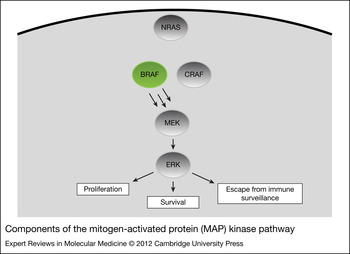
Unlike the wild-type BRAF and CRAF isoforms which signal as dimers in the setting of high RAS-GTP (activated RAS), when BRAF is mutated, it can signal in low RAS-GTP conditions (Ref. Reference Poulikakos10) (Fig. 1). This makes mutated BRAF essentially impervious to upstream regulation and no effect is observed when oncogenic RAS is transfected into BRAF mutant cells (Ref. Reference Davies1). MEK is the only known substrate of BRAF and it has been demonstrated that the set of genes that are regulated by the mitogen-activated protein kinase (MAPK) pathway are essentially equally affected when a BRAF mutant melanoma cell lines has either BRAF or MEK depleted by siRNA (Ref. Reference Pratilas11). Similarly, selective BRAF and MEK inhibitors seem to affect the MAPK transcriptional output in an identical fashion. These observations led to the hypothesis that BRAF and MEK inhibitors should be equally efficacious in the clinical setting. However, this has not been borne out in large clinical trials.
Components of the mitogen-activated protein (MAP) kinase pathway. In cancers harbouring an activating BRAF mutation, regulation of downstream components of the MAP kinase pathway, such as MEK and ERK are under the control of BRAF and independent of CRAF or RAS activation. Constitutive activity of mutated BRAF result in inactivation of the downstream programmes regulated by the MAP kinase pathway, including proliferation, survival and escape from immune surveillance.

A series of preclinical observations have shed light into the disparate signalling effects of BRAF and MEK inhibitors in BRAF mutant versus BRAF wild-type cell that likely explains the difference in efficacy observed between these two classes of MAPK inhibitors. Specifically, selective BRAF inhibitors block MEK activation in cells that harbour an activating BRAF mutation, but not in BRAF wild-type cells (Refs Reference Poulikakos10, Reference Heidorn12). All currently available BRAF inhibitors also have some direct CRAF kinase inhibitory activity. At low concentrations, selective BRAF inhibitors stimulate CRAF–CRAF dimers and likely BRAF–CRAF dimers. In the context of dimers, BRAF and CRAF kinase activity regulates activity of the other RAF monomer. Inhibiting the kinase activity of one monomer results in derepression of the other monomer and net activation. This was demonstrated most convincingly in experiments in which a kinase-dead form of RAF was transfected into cells with wild-type RAF (Ref. Reference Heidorn12). The presence of the kinase-dead isoform stimulated RAF-MEK signalling even in the absence of pharmacologic agents. In cells with high RAS-GTP or activating RAS mutations, BRAF inhibitors have a particularly potent stimulatory effect on MEK activation (Ref. Reference Poulikakos10). This paradoxical activation of the MAPK pathway by selective BRAF inhibitors permits the high concentrations of drug to be administered to patients without causing inhibition of the MAPK pathway in normal tissues. This explains the unique therapeutic index of these agents. MEK inhibitors inhibit the MAP kinase pathway equally efficiently in BRAF mutant or wild-type cells and appear to mediate their toxicity via inhibition of the pathway in normal tissues (Refs Reference Gilmartin13, Reference Schad14). The doses that can be administered safely are limited by the tolerance of normal tissues to pathway inhibition, which then limits their therapeutic index.
BRAF inhibitors
With the successful development of a selective BRAF inhibitor as a new treatment standard for patients with metastatic melanoma harbouring activating V600 mutations, it is clear in retrospect that only the most selective agents have a higher therapeutic index (Refs Reference Flaherty15, Reference Sharfman16, Reference Eisen17, Reference Schwartz18, Reference Falchook19). At the time that BRAF mutations were first reported in 2002, sorafenib was the only available kinase inhibitor with reasonable potency against mutated in wild-type BRAF. Preclinical studies suggested that sorafenib could inhibit BRAF not only in isola ted kinase assays, but also in cells harbouring BRAF mutation (Refs Reference Karasarides20, Reference Whittaker21). However, low micromolar concentrations were needed to inhibit MEK and ERK activation, and at such concentrations, sorafenib would be expected to impact numerous additional kinase targets (Ref. Reference Wilhelm22). This hypothesis was supported by the observation that MEK and ERK phosphorylation could be inhibited in RAS-mutated and BRAF/RAS wild-type cancer cell lines at the same concentrations needed to achieve pathway inhibition in BRAF mutant cells. Selective depletion of mutated or wild-type BRAF with siRNA, on the other hand, only impaired MEK activation in cells harbouring BRAF mutation (Ref. Reference Wellbrock23). Additional broad-spectrum BRAF inhibitors (RAF-265 and XL-281) have been evaluated in early phase clinical trials, but none has shown significant clinical activity of single agents in BRAF mutant cancers (Refs Reference Sharfman16,Reference Schwartz18).
The selective BRAF inhibitors for which the greatest amount of clinical data has been generated, vemurafenib and dabrafenib, are not completely selective for RAF kinases. Each agent has a largely nonoverlapping spectrum of ‘off-target’ kinases which are inhibited at higher concentrations than those needed to inhibit mutated BRAF, wild-type BRAF or CRAF as isolated kinases (Refs Reference Bollag24, Reference Greger25). However, what distinguishes these agents from less selective BRAF inhibitors is their ability to inhibit MEK and ERK activation only in cells that harbour and activate BRAF mutation. In this sense, these agents mirror the results of V600EBRAF depletion with siRNA. Furthermore, the selective BRAF inhibitors can activate MEK and ERK cells being activated by growth factors through mechanisms described previously (Ref. Reference Poulikakos10). Although it has not been definitively proven, many of the toxicities observed in the clinic with elected BRAF inhibitors are likely to derive from activation of the MAPK pathway as opposed to inhibition.
The clinical efficacy of vemurafenib and dabrafenib in patients with metastatic melanoma bearing the V600EBRAF or V600KBRAF was demonstrated in the first-in-human trials with each agent (Refs Reference Flaherty15, Reference Falchook19). With patients being preselected on the basis of having an activating V600BRAF mutation, there was the opportunity to observe efficacy in these trials once therapeutic doses were being administered and adequate concentrations being achieved. In the vemurafenib phase 1 trial, 81% of patients with V600EBRAF melanoma (n = 32) enrolled at the maximum tolerated dose of 960 mg twice daily, dose-complete or partial responses were observed (Ref. Reference Flaherty15). Several of these responses were too short lived to be confirmed on subsequent radiographic re-evaluation, leaving a 56% rate of confirmed objective response. This result was corroborated in phase II and phase III trials, in which the confirmed objective responses were documented in 53 and 48%, respectively (Refs Reference Sosman26, Reference Chapman27). In parallel, in the phase I clinical trial of dabrafenib, a similarly high objective response rate was observed among V600BRAF mutant melanoma patients enrolled at the highest doses administered (Ref. Reference Falchook19).
In the phase I clinical trial, patient tumour biopsies were examined at baseline, and 2 weeks after, vemurafenib was initiated to investigate the degree of ERK phosphorylation. These biases were performed in patients receiving both low and high doses of vemurafenib. Patients with tumour regression exhibited greater than 80% inhibition of pERK, with many having greater than 90–95% inhibition by semiquantitative immunohistochemistry methods (Ref. Reference Bollag24). These data established the benchmark that near-complete inhibition of MAPK output was needed to translate into antitumour efficacy. In retrospect, less selective BRAF inhibitors were not able to achieve this degree of pathway inhibition, probably because of dose-limiting toxicities mediated by non-RAF targets (Ref. Reference Ott28). Even more selective BRAF inhibitors than the vemurafenib and dabrafenib may be feasible to develop and one such agent is currently in early phase clinical trials (NCT01436656).
The duration of response to single-agent selective BRAF inhibitor therapy is highly variable, ranging from 2 months to more than 2 years (Ref. Reference Kim29). The median duration of response in a cohort of vemurafenib-treated patients with relatively mature follow-up, is 6.7 months (Ref. Reference Sosman26). This relatively short duration of response compared with other standard oncogene-directed therapies, such as epidermal growth factor receptor (EGFR) small molecule inhibitors in EGFR mutated and an anaplastic lymphoma receptor tyrosine kinase (ALK) inhibitor in EML4-ALK translocated nonsmall cell lung cancer (Refs Reference Lynch30, Reference Kwak31). The early emergence of resistance to single-agent BRAF inhibitor therapy has spawned an intensive pursuit of acquired resistance mechanisms. However, despite early escape in some instances, the overall duration of disease control is sufficient to translate into a profound survival advantage in comparison with the previously standard single-agent chemotherapy dacarbazine. On the basis of this observation in the vemurafenib phase III trial, vemurafenib has been established as a new treatment standard for patients with V600BRAF mutant melanoma (Ref. Reference Chapman27).
Far less is known about utility of selective BRAF inhibitors in cancer types other than melanoma that harbour the same activating mutations. There is evidence from a small phase 2 cohort of V600EBRAF mutant metastatic colon cancer patients that responses are less frequently seen in that setting compared with melanoma (Ref. Reference Kopetz32). This suggests that in another genetic context, other pathways compensate for BRAF inhibition. Preclinical evidence suggests that signalling through CRAF can restore MEK and ERK activation (Ref. Reference Corcoran33). Recently, two independent investigations suggested that EGFR activation is responsible for this CRAF-mediated resistance (Refs Reference Prahallad34, Reference Corcoran35).
Three patients with V600EBRAF papillary thyroid cancer were included in the vemurafenib phase I trial, one of whom achieved an objective response, with the other two patients remaining on therapy for ~1 year without a significant change in their tumour burden (Ref. Reference Flaherty15). This very preliminary evidence of activity is being pursued further in ongoing phase II trials.
Resistance
The initial focus of BRAF inhibitor resistance research using patient tumour samples collected from the time of disease progression was to assess the status of MAPK pathway activation (Ref. Reference McArthur36). Using the same semiquantitative immunohistochemistry measures of ERK phosphorylation, it was demonstrated that at least two-thirds of patients restored ERK phosphorylation in their tumours. Among the same patients whose tumours have been biopsied at baseline and after 2 weeks of therapy, it was clear that the marked inhibition observed early in the course of therapy have been lost. In some cases, ERK phosphorylation was demonstrably higher even when compared with pre-treatment baseline.
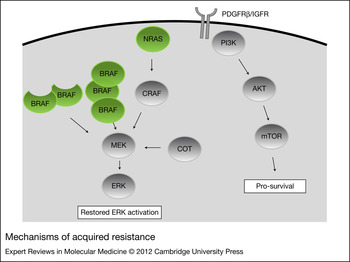
Laboratory-based investigations utilising V600BRAF mutant melanoma cell lines discovered that with chronic exposure to a selective BRAF inhibitor, ERK phosphorylation could be restored after initial suppression (Ref. Reference Paraiso37). Molecular mechanisms described in this setting included the de novo appearance of activating NRAS mutation (Ref. Reference Nazarian38), increased expression of another MAP kinase (COT/TPL2) (Ref. Reference Johannessen39), appearance of a splice variant of BRAF (Ref. Reference Poulikakos40), and amplification of BRAF or CRAF (Refs Reference Shi41, Reference Montagut42) (Fig. 2). All but CRAF amplification have been corroborated in at least a few patient tumour samples analysed at the time of disease progression and compared with baseline. Notably, new mutations in the kinase domain of BRAF have not been identified to date. For this reason, it seems that the biochemistry within the MAPK pathway for the unique molecular consequences of selective BRAF inhibition create the opportunity for BRAF inhibition to be overcome without the need for resistance mutations in BRAF itself. Next-generation BRAF inhibitors may or may not be able to prevent the emergence of these described resistance mechanisms. For this reason, the field has shifted its focus to the investigation of MEK or ERK inhibitors as agents that might either prevent MAPK reactivation or intercept some of the mediators of BRAF inhibitor resistance and thus be useful as salvage therapies. This topic will be revisited.
Mechanisms of acquired resistance. BRAF inhibitor resistance is commonly associated with reactivation of the mitogen-activated protein (MAP) kinase pathway, as a result of the appearance of activating NRAS mutation, amplification of BRAF or CRAF, expression of a BRAF inhibitor resistant splice variant of BRAF, or overexpression of COT. In a minority of cases, activation of the PI3 K pathway as a consequence of activated receptor tyrosine kinases, such as PDGFR and IGFR, has been described.

In addition to reactivation of MEK and ERK, some investigators have observed the emergence of resistance in vitro despite continued suppression of MAPK signalling. Increased expression of platelet-derived growth factor receptor β and insulin-like growth factor receptor 1 have been documented in resistant cell lines and in some patient tumour samples procured at the time of disease progression (Refs Reference Nazarian38, Reference Villanueva43). Functional evidence to support potential combination efficacy by targeting these receptors in conjunction with BRAF is less compelling (Ref. Reference Shi44). However, biochemical evidence supports activation of the PI3 K-AKT pathway in such instances. A single case of acquired PTEN deletion was observed in a patient whose tumour had intact PTEN at baseline (Ref. Reference Villanueva43). Given the large amount preclinical data supporting the relevance of PTEN deletion in the pathogenesis of BRAF mutant melanoma, this seems highly plausible as a mechanism of tumour escape in the setting of chronic BRAF inhibition (Refs Reference Paraiso45, Reference Xing46). These mechanisms of resistance highlighted the fact that, in addition to dependence on oncogenic BRAF, these tumours have both genetic and epigenetic mechanisms by which additional signal transduction pathways are activated and probably have a role in de novo resistance to BRAF inhibitor therapy. Relatively less is known about de novo resistance to BRAF inhibitor therapy compared with acquired resistance, but numerous lines of evidence support code targeting of BRAF and PI3 K or AKT in tumours characterised by an activating BRAF mutation as well as PTEN deletion. Although many small molecule PI3 K inhibitors are currently in clinical development, recent preclinical evidence suggests that the β-isoform of PI3 K is the most critical target in the setting of PTEN deletion (Ref. Reference Jia47). The vast majority of PI3 K pathway inhibitors currently in clinical development are either broad-spectrum inhibitors of numerous PI3 K family members or purposely spare the β-isoform (Ref. Reference Engelman48). Thus, the field awaits selective PI3Kβ inhibitors as experimental and clinical reagents for evaluation in this setting. Undoubtedly, there will be additional mechanisms of de novo resistance and this remains a high priority in clinical research with the goal of developing combination targeted therapy regimens tailored mediators of de novo BRAF inhibitor resistance that can be identified at baseline.
MEK inhibitors
Although MEK inhibitors may be limited by the fact that they inhibit ERK signalling in both BRAF mutant and BRAF wild-type cells, there is a clear evidence of single-agent efficacy in V600BRAF mutant, BRAF inhibitor naive melanoma patients. Although there are many selective, allosteric MEK inhibitors in the clinical development, trametinib is the agent with the most compelling clinical data so far. In a phase I clinical trial in which patients with V600BRAF mutant, BRAF inhibitor naive metastatic melanoma treated at the maximum tolerated dose, objective responses were observed (Ref. Reference Infante49). In a phase II clinical trial among this patient population, a 25% confirmed objective response rate was observed (Ref. Reference Kim50). A separate cohort of V600BRAF mutant, BRAF inhibitor refractory melanoma patients were enrolled in this phase II trial and very little clinical activity was observed. However, a recent phase I/II trial combining dabrafenib and trametinib found a 19% objective response rate among 26 V600BRAF mutant, BRAF inhibitor refractory melanoma patients and 62% of patients having at least a minor degree of tumour regression (Ref. Reference Flaherty51). These data suggest that single-agent MEK inhibition is not capable of overcoming the various mechanisms of BRAF inhibitor resistance mechanisms that reactivate the MAPK pathway, whereas the combination of BRAF and MEK inhibition can overcome some of them.
Arguably, the greater interest in a BRAF/MEK combination strategy is focused on the possibility that this regimen could suppress some mechanisms of MAPK reactivation and result in greater duration of response and disease control. Preliminary evidence from the ongoing phase I/II trial of dabrafenib and trametinib suggests that this may, in fact, be the case (Ref. Reference Infante52). With the relatively short duration of follow-up, patients received various doses of these two agents in combination seemed less likely to have very short durations of response than the patients treated with either vemurafenib or dabrafenib in previously conducted single-agent trials. As ERK inhibitors emerge in clinical development, their utility in BRAF inhibitor-resistant disease as well as in combination with a BRAF inhibitor in the BRAF inhibitor naive setting will be of significant interest. MEK and ERK have distinct functions within the MAPK pathway and are regulated by different feedback mechanisms (Ref. Reference Pratilas11). Thus, it is plausible that ERK inhibitors will have a superior therapeutic index to MEK inhibitors.
Novel strategies to build upon BRAF inhibition
The most well-developed rationale for BRAF inhibitor-based combination therapy exists for combined BRAF/MEK and BRAF/PI3 K pathway inhibitors, as discussed previously. However, combining BRAF inhibitor with an inhibitor of either MEK or ERK would not address mechanisms of resistance that derived from pre-existing or acquired activation of other pathways. Only a minority of BRAF mutant melanoma tumours have coexisting PTEN deletion (Ref. Reference Guldberg53). Thus, optimal inhibition of the MAPK pathway combined with an optimal PI3 K, a pathway inhibitor, would be anticipated to be relevant for only this minority of patients. There is a need to develop additional combination regimens that would extend the benefits of BRAF inhibitor therapy for other patient subpopulations.
Many BRAF mutant melanomas harbour concomitant genetic aberrations that affect the p16 tumour suppressor gene, cyclin D or CDK4 (Ref. Reference McArthur54). Each of these abnormalities has been demonstrated in various settings to result in loss of control of CDK4-regulated entry into the cell cycle. Even though cyclin D expression is partially regulated by the MAPK pathway, it seems that cyclin D and CDK4 can still contribute to BRAF inhibitor resistance (Ref. Reference Smalley55). p16 deletion or mutation is particularly common in melanoma, and can occur in conjunction with BRAF mutation. Recent data suggest that selective CDK4 inhibitors can potently induce senescence in p16-deleted melanoma cell lines and would be anticipated to be potentially useful in conjunction with BRAF inhibitor therapy (Ref. Reference Anders56). This approach has yet to be explored clinically.
One exciting prospect for developing combination therapy for BRAF mutant melanoma stem from the observation that selective BRAF inhibitors restore MITF expression and, therefore, increased expression of MITF target genes (Ref. Reference Boni57). These include melanocyte-associated antigens, such as gp100, MART-1 and tyrosinase-related protein 1 and 2. This could plausibly make melanoma more immunogenic and provides one rationale for combining BRAF-targeted therapy with immunotherapy. Importantly, selective BRAF inhibitors do not seem to suppress the activation of antitumour CD8+ T cells ex vivo. Lastly, examination of patient tumour biopsies early in the course of BRAF inhibitor therapy has revealed robust CD8+ T cell infiltrates in metastatic lesions in some patients (Ref. Reference Wilmott58). Significantly more work will be required to understand the optimal type of immunotherapy to investigating combination with BRAF inhibitors, but nonetheless, a basis has been established to support this approach.
Another strategy that has been examined preclinically, but not yet clinically, is the concept of attacking a putative melanoma stem cell population which would be anticipated to survive BRAF inhibitor therapy in that such cells are less likely to be proliferating at any given time. Several markers of such a class in subpopulation have been proposed, such as JARID1B and ABCB5, but therapeutics taking advantage of the presence of these markers have not yet been developed (Refs Reference Roesch59, Reference Frank60). A unique approach was taken by one group, screening for chemical entities that could selectively poison the melanocyte precursor population, neural crest stem cells, in zebrafish (Ref. Reference White61). This screen uncovered to compounds with a shared molecular target, dihydrooritate dehydrogenase (DHODH). DHODH have been previously described as an important contributor to de novo nucleotide synthesis but, in the context of this investigation, was found to also have a role in transcriptional elongation of a large set of messenger RNAs. Surprisingly, inhibiting this enzyme had a selectively toxic effect on neural crest progenitor cells as well as human melanoma cells. As leflunomide is currently an FDA-approved anti-inflammatory drug for the treatment of rheumatoid arthritis, it could be investigated in combination with BRAF inhibition for this purpose.
Clinical implications/applications
Based on available evidence and the U.S. Food and Drug Administration (FDA) approval, vemurafenib represents the currently available targeted therapy for which there is clear evidence of clinical benefit. Early onset of response and palliation (for symptomatic patients) are the moniker of this therapy. After initial response, the duration of response is highly variable and is not predicted by clinical features present at the start of therapy. The current standard is to treat patients until there is clear evidence of disease progression. Based on emerging evidence, dabrafenib and trametinib may also become standard treatment options, but more data and FDA review are needed.
Research in progress and outstanding research questions
The emergence of selective BRAF inhibitors has created not only conical evidence in BRAF mutant melanoma that constitutes a new treatment standard for patients with metastatic disease, but has provided the opportunity to elucidate the hierarchy of tumour cell dependencies beyond oncogenic BRAF. It is clear that to achieve clinical efficacy, a profound degree of MAPK pathway suppression is needed and that mechanisms that restore even a moderate amount of MEK and ERK activation can limit tumour control. These observations have clarified the direction of ongoing clinical research which aims to optimise MAPK pathway inhibition beyond what is achievable with currently available selective BRAF inhibitors given as single agents. The largest amount of data has been generated along these lines in BRAF mutant melanoma, it is possible that further advances made in this area will benefit other BRAF mutant cancers as well. Beyond the MAPK pathway, the potential mechanisms of de novo or acquired resistance probably depend on genetic aberrations that may be unique to certain subsets of BRAF mutant cancers, including melanoma. In some BRAF mutant melanoma tumours, PTEN is deleted, making inhibition of the PI3 K pathway a potentially important therapeutic approach. In others, inactivation of p16, or overexpression or activation of cyclin D or CDK4 itself, make CDK for inhibition and attractive strategy in combination with BRAF inhibition. Exploration of BRAF inhibitor/immunotherapy combinations and pharmacologic agents that target primordial neural crest biology represent additional directions for near-term clinical investigation. In colon cancer, there is a rationale for combining EGFR-targeted therapy with BRAF inhibitors and this concept is ready for translation, given the availability of validated inhibitors. With a foot-in-the-door provided by effective BRAF inhibition, delineating the second layers of tumour biology in BRAF mutant cancers will be the focus for the next several years.