Introduction
The South American tomato pinworm, Phthorimaea absoluta (Meyrick, 1917) (Lepidoptera: Gelechiidae), is a notorious agricultural pest with a broad distribution from South America to Europe, Africa, and the Middle East (Soares and Campos, Reference Soares and Campos2025). It primarily feeds on tomato crops but can also infest other solanaceous crops of high economic value, including potato, pepper, eggplant, and tobacco, in both open fields and greenhouse environments (Desneux et al., Reference Desneux, Luna, Guillemaud and Urbaneja2011; Biondi et al., Reference Biondi, Guedes, Wan and Desneux2018). Although biological control agents such as Nesidiocoris tenuis and Bacillus thuringiensis are used to control P. absoluta, its main control often relies on the use of chemical insecticides worldwide (Desneux et al., Reference Desneux, Han, Mansour, Arnó, Brévault, Campos, Chailleux, Guedes, Karimi, Konan, Lavoir, Luna, Perez-Hedo, Urbaneja, Verheggen, Zappalà, Abbes, Ali, Bayram, Cantor, Cuthbertson, De Vis, Erler, Firake, Haddi, Hajjar, Ismoilov, Jaworski, Kenis, Liu, Madadi, Martin, Mazih, Messelink, Mohamed, Nofemela, Oke, Ramos, Ricupero, Roditakis, Shashank, Wan, Wang, Wang, S and Biondi2022). However, due to the biological traits of P. absoluta, such as high fecundity, multiple generations per season, and frequent insecticide use, P. absoluta has developed resistance to a wide range of insecticides (Guedes et al., Reference Guedes, Roditakis, Campos, Haddi, Bielza, Siqueira, Tsagkarakou, Vontas and Nauen2019).
Chlorantraniliprole, an anthranilic diamide, acts as a selective activator of insect ryanodine receptors (RyRs) (Du and Hu, Reference Du and Hu2023). RyRs, as members of a superfamily of intracellular Ca2⁺ channels, are primarily located in the endoplasmic and sarcoplasmic reticula, where they mediate the release of luminal Ca2⁺ ions into the cytoplasm (Inui et al., Reference Inui, Saito and Fleischer1987). Chlorantraniliprole binds to RyR, leading to uncontrolled release of Ca2⁺, which triggers feeding cessation, paralysis, and eventually death in the insect (Cordova et al., Reference Cordova, Benner, Sacher, Rauh, Sopa, Lahm, Selby, Stevenson, Flexner, Gutteridge, Rhoades, Wu, Smith and Tao2006; Ebbinghaus-Kintscher et al., Reference Ebbinghaus-Kintscher, Luemmen, Lobitz, Schulte, Funke, Fischer, Masaki, Yasokawa and Tohnishi2006). In contrast to mammals (RyR1, RyR2, and RyR3) and other vertebrates (RyRA and RyRB), insect RyRs are encoded by a single gene with an open reading frame (ORF) of more than 15 kb (Troczka et al., Reference Troczka, Richardson, Homem and Davies2018). So far, the full-length RyR gene has been characterised in many insects, including Plutella xylostella, Spodoptera exigua, Sesamia inferens, and Diaphorina citri (Guo et al., Reference Guo, Tang, Dong, Liang and Gao2012; Sun et al., Reference Sun, Qiu, Cui, Ma and Yuan2015; Wu et al., Reference Wu, Zhao, Huang, Zhao, Zhou and Gao2018; Liu et al., Reference Liu, Sun, Bin, Yi and Zhang2022).
Insecticide resistance can develop via pharmacodynamic and pharmacokinetic mechanisms. Pharmacodynamic mechanisms involve target-site mutations or genetic alterations, which reduce the binding affinity of insecticides, as well as changes in copy number and/or expression of the target-site (Feyereisen et al., Reference Feyereisen, Dermauw and Van Leeuwen2015). Pharmacokinetic mechanisms, on the other hand, include enhanced metabolic degradation, sequestration, and/or transportation before the insecticide reaches its target-site, and altered cuticular penetration, which reduces insecticide penetration (Bass and Field, Reference Bass and Field2011; Balabanidou et al., Reference Balabanidou, Grigoraki and Vontas2018; Ingham et al., Reference Ingham, Anthousi, Douris, Harding, Lycett, Morris, Vontas and Ranson2020; Amezian et al., Reference Amezian, Nauen and Van Leeuwen2024). In the case of chlorantraniliprole resistance, it has been mainly associated with reduced sensitivity of the target site and enhanced metabolic detoxification (Guedes et al., Reference Guedes, Roditakis, Campos, Haddi, Bielza, Siqueira, Tsagkarakou, Vontas and Nauen2019; Richardson et al., Reference Richardson, Troczka, Gutbrod, Davies and Nauen2020). More specifically, four RyR mutations are of particular significance: I4790M, I4790K, G4946E, and G4946V (Guo et al., Reference Guo, Liang, Zhou and Gao2014; Steinbach et al., Reference Steinbach, Gutbrod, Lümmen, Matthiesen, Schorn and Nauen2015; Qin et al., Reference Qin, Wang, Wang, Sun, Wang and Xue2018; Jouraku et al., Reference Jouraku, Kuwazaki, Miyamoto, Uchiyama, Kurokawa, Mori, Mori, Mori and Sonoda2020). Radioligand binding studies and CRISPR/Cas9 gene editing confirmed that these mutations alter RyR affinity for diamides and confer resistance (Douris et al., Reference Douris, Papapostolou, Ilias, Roditakis, Kounadi, Riga, Nauen and Vontas2017; Roditakis et al., Reference Roditakis, Steinbach, Moritz, Vasakis, Stavrakaki, Ilias, García-Vidal, Martínez-Aguirre, Bielza, Morou, Silva, Silva, Siqueira, Iqbal, Troczka, Williamson, Bass, Tsagkarakou, Vontas and Nauen2017; Zuo et al., Reference Zuo, Wang, Xu, Huang, Wu, Wu and Yang2017). In addition to target-site resistance, involvement of detoxification enzymes such as cytochrome P450s monooxygenases, carboxyl/cholinesterases (CCEs), and UDP-glycosyltransferases, as well as ATP-binding cassette transporters in chlorantraniliprole resistance has also been documented (Li et al., Reference Li, Li, Zhu, Gao and Liang2018; Sun et al., Reference Sun, Xu, Chen, Qin, Huang, Jiang and Qin2018; Meng et al., Reference Meng, Yang, Wu, Shen, Miao, Zheng, Qian and Wang2020; Grant et al., Reference Grant, Singh, Hayward, Hunt, Troczka, Pym, Ahn, Zeng, Gao, Leroux, Daum, Süess, Souza, Elias, Ffrench-Constant, Vontas, Roditakis, Bielza, Zimmer and Bass2023).
Monitoring insecticide resistance and underlying mechanisms is crucial for ensuring effective use of compounds and designing resistance management programs. Therefore, in the present study, we aimed (1) to investigate the resistance status of P. absoluta to chlorantraniliprole in nine field populations from Türkiye, (2) to elucidate the biochemical and molecular mechanisms underlying this resistance, and (3) to analyse the structural features of the RyR gene in P. absoluta. These findings will provide essential insights for designing evidence-based resistance management strategies in the field.
Material and methods
Insects and insecticides
A total of nine P. absoluta populations were collected from tomato greenhouses in different locations across Türkiye (table 1). The Konya–Cihanbeyli population, collected from a greenhouse maintained exclusively with biological control for at least 5 years, exhibited the highest susceptibility to chlorantraniliprole and was therefore designated as a relatively susceptible reference population (see results). Insects were maintained under controlled conditions at 25 ± 1°C, 60 ± 5% relative humidity, and a 16:8 h light/dark cycle, reared on tomato plants (Solanum lycopersicum cv Rio Grande) in insect-proof cages. A commercial formulation of chlorantraniliprole (35 WG, Altacor, FMC) was used in bioassays, while analytical grade chemicals were used for biochemical and molecular assays.
Collection sites of P. absoluta populations from tomato in Türkiye

Susceptibility of P. absoluta to chlorantraniliprole
Leaf-dip bioassays were conducted according to the IRAC method 022. Briefly, tomato leaves were dipped in insecticide solutions containing Triton X-100 (0.1 g/L) for 5 s and allowed to dry for approximately 1 h. They were transferred to a moistened filter paper in a multi-well repli-dish. A single second-instar larva was placed in each well. A minimum of five serially diluted insecticide concentrations were tested, with 30 larvae used per concentration. All bioassays were incubated at 25 ± 1°C, 60 ± 5% relative humidity, and a 16:8 h light/dark cycle. Larval mortality was assessed after 72 h. Larvae were considered dead if they failed to move their own body length when prodded with a fine brush.
Metabolic enzyme assays
The activities of three key metabolic enzymes, namely carboxylesterase (CCE), glutathione S-transferase (GST), and cytochrome P450 monooxygenase (P450), were measured in second-stage larvae of P. absoluta. Four biological replicates were used for each enzyme assay.
For the determination of CCE activities, the method described by Kranthi (2005) was used with minor modifications. Larvae were homogenised in 500 μL sodium phosphate buffer (40 mM, pH 6.8) (containing 0.1% Triton X-100). This homogenate was used as an enzyme source after centrifugation at 10,000 g, at 4°C for 15 min. 30 μL enzyme and 1000 μL α-NA (final concentration; 1 mM) were mixed in the microcentrifuge (2 mL) tube. After it was incubated for 20 min at 30°C on a thermal block, and the reaction was started. The reaction was stopped by the addition of 1 mL of stop solution mix (% 0.06 Fast Blue RR, % 3 sodium dodecyl sulphate within 40 mM Na-P buffer, pH 6.8) and incubated for 5 min in the dark conditions. Reading was carried out with end point method in a microplate reader at 590 nm and 26°C (Multiskan GO, Thermo Fisher Scientific). The control cells were read without adding the homogenate. The activity levels were determined by comparison to the controls.
For GST activities, Larvae were homogenised in 400 µL (100 mM Na-P, 1 mM EDTA, pH 6.5) sodium phosphate buffer, centrifuged at 12,000g +4°C for 10 min, and the supernatant was used as an enzyme source. 50 μL CDNB (12 mM 1-Chloro-2,4-dinitrobenzoic acid within 100 mM Na-P buffer, pH 6.5), 150 μL GST (reduced glutathione 12 mM within 100 mM Na-P buffer, pH 6.5) were added to the 100 µL enzyme sample. The enzyme mixture was diluted in 300 μL of phosphate buffer (0.1 M, pH 6.5) and incubated at 26°C for 5 min. The diluted mixture was transferred to microplates for spectrophotometer readings. The enzyme-free blank sample was measured as a control without homogenate. The change in absorbance was recorded by reading at 340 nm wavelength for 8 min (Habig et al., Reference Habig, Pabst and Jakoby1974; Kranthi 2005).
P450 enzyme activity was determined by the method described by Lee and Scott (Reference Lee and Scott1989) and Kranthi (2005). Larvae were homogenised in 500 µL Tris-HCI buffer (50 mM Tris-HCI, 1 mM EDTA, pH 7.7), centrifuged at 12,000g +4°C for 20 min, and the supernatant was used as an enzyme source. Accordingly, 200 μL of the enzyme from stock solutions and 50 μL 2 mM p-nitroanisole (substrate) were added to each of the microplate wells. After incubating for 5 min at 35°C, 100 μL of 10 mM nicotinamide adenine dinucleotide phosphate was added to initiate the reaction. Measurement of P450 enzyme activity was made in a microplate reader at 405 nm at 35°C for 15 min at intervals of 15 s with three replicates. The enzyme activity was determined using the extinction coefficient of p-nitrophenol.
Total protein contents were determined by the method of Bradford (Reference Bradford1976). Absorbances were read at 620 nm, and protein concentrations were calculated based on the basis of the standard curve.
Identification of target-site mutations
RNA was extracted from three independent pools of 10 larvae using the GeneMATRIX Universal RNA Purification Kit (Eurx, Poland). The quality and quantity of RNA were assessed by a spectrophotometer (Thermo Scientific NanoDrop 2000, USA) and gel electrophoresis. For cDNA synthesis, 1 μg of total RNA was used with RevertAid First Strand cDNA Synthesis Kit (Thermo Scientific, USA) following the manufacturer’s instructions. The partial C-terminal region of the RyR of P. absoluta (PaRyR), covering the mutation sites, was amplified by PCR using 5× HOT FIREPol® Blend Master Mix (Solis BioDyne, Estonia). The primers used in the study are listed in table S1. Each PCR reaction was prepared in a 30 μL final volume, containing 2 μL of template DNA, 1 μL of each primer (10 μM), 6 μL of Master Mix, and 20 μL of nuclease-free water. The PCR amplification followed a touchdown thermal cycling protocol: an initial denaturation at 95°C for 15 min, 10 cycles at 94°C for 30 s, 62–53°C for 30 s (−1°C/cycle), and 72°C for 70 s; 25 cycles at 94°C for 30 s, 52°C for 30 s, and 72°C for 70 s; with a final extension at 72°C for 8 min. Agarose gel electrophoresis (1.5%) of PCR products for 45 min at 100 V was carried out in 1× TAE buffer to evaluate post-PCR products. Bidirectional sequencing of all PCR products was performed using the same primers. The presence of insecticide resistance mutations was determined by inspecting sequencing chromatograms in BioEdit v7.2.5 (Hall, Reference Hall1999) and categorised as ‘absent’, ‘fixed’, or ‘present’ (Khajehali et al., Reference Khajehali, Van Nieuwenhuyse, Demaeght, Tirry and Van Leeuwen2011).
Target-site expression analysis
The relative expression levels of PaRyR were analysed using real-time quantitative PCR (RT-qPCR). Total RNA extraction and cDNA synthesis were performed as described above. Each PCR reaction (20 µL) contained 10 µL of SsoAdvanced Universal SYBR Green Supermix (Bio-Rad, USA), 1 µL of each primer, 100 ng/µL of cDNA, and 7 µL of nuclease-free water. The reactions were carried out on a CFX96 Touch™ real-time PCR system (Bio-Rad, USA) under the following thermal cycling conditions: an initial denaturation at 98°C for 3 min, followed by 39 cycles of 95°C for 10 s and 55°C for 30 s. At the end, melting curve analysis was performed by gradually increasing the temperature from 60°C to 95°C at a rate of 0.5°C per second to verify the specificity and consistency of the amplified products. Each experiment included three biological replicates, with three technical replicates for each. Gene expression levels were normalised to the geometric mean of two reference genes, Rp18 and RPS13, following the approach described by Vandesompele et al. (Reference Vandesompele, De Preter, Pattyn, Poppe, Van Roy, De Paepe and Speleman2002) and Yang et al. (Reference Yang, Wang, Huang, Lv, Liu, Bi, Wan, Wu and Zhang2021). Amplification efficiency of PCR for each primer pair was assessed using the equation E = 10(−1/slope), where the slope was derived from a standard curve based on Ct values obtained from fourfold serial dilutions of cDNA templates. The primers used in the RT-qPCR are listed in table S1.
Characterisation of the RyR
To gain a deeper understanding of the P. absoluta RyR was manually curated from an unpublished transcriptome data of this species, generated by Illumina sequencing followed by de novo assembly using Trinity (Grabherr et al., Reference Grabherr, Haas, Yassour, Levin, Thompson, Amit, Adiconis, Fan, Raychowdhury, Zeng, Chen, Mauceli, Hacohen, Gnirke, Rhind, Di Palma, Birren, Nusbaum, Lindblad-Toh, Friedman and Regev2011). In addition, a full-length RyR was also retrieved from the public GenBank database (accession number: APC65631; Roditakis et al., Reference Roditakis, Steinbach, Moritz, Vasakis, Stavrakaki, Ilias, García-Vidal, Martínez-Aguirre, Bielza, Morou, Silva, Silva, Siqueira, Iqbal, Troczka, Williamson, Bass, Tsagkarakou, Vontas and Nauen2017) and included in the analyses. Molecular weight and isoelectric point of deduced protein sequences were predicted by ProtParam (http://web.expasy.org/protparam/) (accessed on 16 October 2023). Possible transmembrane (TM) domains were predicted by TMHMM Server v2.0 (http://www.cbs.dtu.dk/services/TMHMM-2.0) (accessed on 16 October 2023) and the NCBI conserved domain database (Lu et al., Reference Lu, Wang, Chitsaz, Derbyshire, Geer, Gonzales, Gwadz, Hurwitz, Marchler, Song, Thanki, Yamashita, Yang, Zhang, Zheng, Lanczycki and Marchler-Bauer2020). RyR identity and similarity (Blosum 90, threshold 0) between P. absoluta and other species was calculated using Geneious Prime. Hydropathy profiles were generated using ExPASy ProtScale (https://web.expasy.org/protscale/) (accessed on 18 October 2023) according to the Kyte–Doolittle method (Kyte and Doolittle, Reference Kyte and Doolittle1982), with a window size of 17 amino acids. For the phylogenetic analysis, RyR protein sequences from other species were obtained from NCBI via Geneious Prime. Sequences were aligned using mafft (Katoh et al., Reference Katoh, Rozewicki and Yamada2019) and edited with Jalview software (Waterhouse et al., Reference Waterhouse, Procter, Martin, Clamp and Barton2009). A phylogenetic tree was constructed by MEGA 5.0 applying the maximum likelihood method and the bootstrap values were calculated on 1,000 replications (Tamura et al., Reference Tamura, Peterson, Peterson, Stecher, Nei and Kumar2011). A consensus tree was displayed and edited with iTOL (Letunic and Bork, Reference Letunic and Bork2021).
Statistical analysis
Bioassay data were analysed with PoloPlus (LeOra Software, USA) by using probit analyses to determine 50% mortality (LC50) values with 95% confidence limit (CL). The LC50 values were considered not significant if their 95% CLs overlapped. Resistance was classified as low (RR = 2–10), moderate (RR = 11–30), high (RR = 31–100), and very high (RR = > 100) according to resistance ratio (RR) values (Torres-Vila et al., Reference Torres-Vila, Rodríguez-Molina, Lacasa-Plasencia, Bielza-Lino and Rodríguez-Del-Rincón2002). The means of CCE, GST, and P450 activities were subjected to one-way ANOVA and Tukey’s test (HSD) (P < 0.05) for multiple comparison using RStudio (version 1.3.1093). The LC50 values for chlorantraniliprole were log-transformed and used for Pearson correlation analyses (P < 0.05) with detoxification enzyme data. Relative expression levels of the PaRyR were analysed using the 2−ΔΔCt method (Livak and Schmittgen, Reference Livak and Schmittgen2001). The differences in relative RyR expression were evaluated using an unpaired Student’s t-test with CFX Maestro™ (Biorad, USA).
Results
Resistance monitoring of chlorantraniliprole
The concentration-mortality responses of the nine field populations of P. absoluta to chlorantraniliprole are given in table 2. Significant variations in resistance to chlorantraniliprole were observed among field populations. The populations exhibited LC50 values ranging from 127.927 to 900.573 mg/L, with RRs ranging from 13.88 to 97.71, indicating reduced susceptibility among the field populations.
Relative toxicity of chlorantraniliprole among field-collected P. absoluta populations

a RR = LC50 (field populations)/LC50 (susceptible population).
Activities of metabolic enzymes
To explore the metabolic basis of resistance to chlorantraniliprole, the activities of CCE, GST, and P450 were determined in field populations. The results showed that all three detoxification enzyme activities were significantly different among P. absoluta populations (table 3). However, only a moderate but significant correlation was found between P450 activity and the LC50 values (r = 0.677, P < 0.05), suggesting that increased P450 activity may contribute to reduced susceptibility to chlorantraniliprole in P. absoluta populations.
The mean (±SE) of CCE (nmol min−1 mg−1 protein), GST (nmol min−1 mg−1 protein), and P450 enzyme activities (pmol min−1 mg−1 protein) in P. absoluta populationsa

a Means followed by the same letter within a column are not significantly different according to Tukey’s test (P < 0.05).
b Ratio calculated as enzyme activity in each population divided by the activity in the susceptible population.
Identification of resistance mutations
To determine the presence of chlorantraniliprole resistance-associated point mutations in Turkish populations of P. absoluta, we sequenced the partial C-terminal region of the RyR. No chlorantraniliprole-resistant populations were found to be homozygous for the wild-type susceptible alleles at positions 4746 and 4903 (table 4). Eight out of nine populations contained the I4746M mutation in PaRyR, but the mutation was not fixed in any of them. Additionally, the I4746K mutation was detected in three populations, two of which were among the most resistant to chlorantraniliprole. The G4903E and G4903V mutations were detected in eight and four populations, respectively. On the other hand, none of the populations had Y4652D/C and Y4879F mutations.
Presence of resistance-associated mutations in RyRs of P. absoluta populations

a Y, tyrosine; D, aspartic acid; C, cysteine; I, isoleucine; M, methionine; K, lysine; F, phenylalanine; G, glycine; E, glutamic acid; V, valine.
Target-site expression analysis
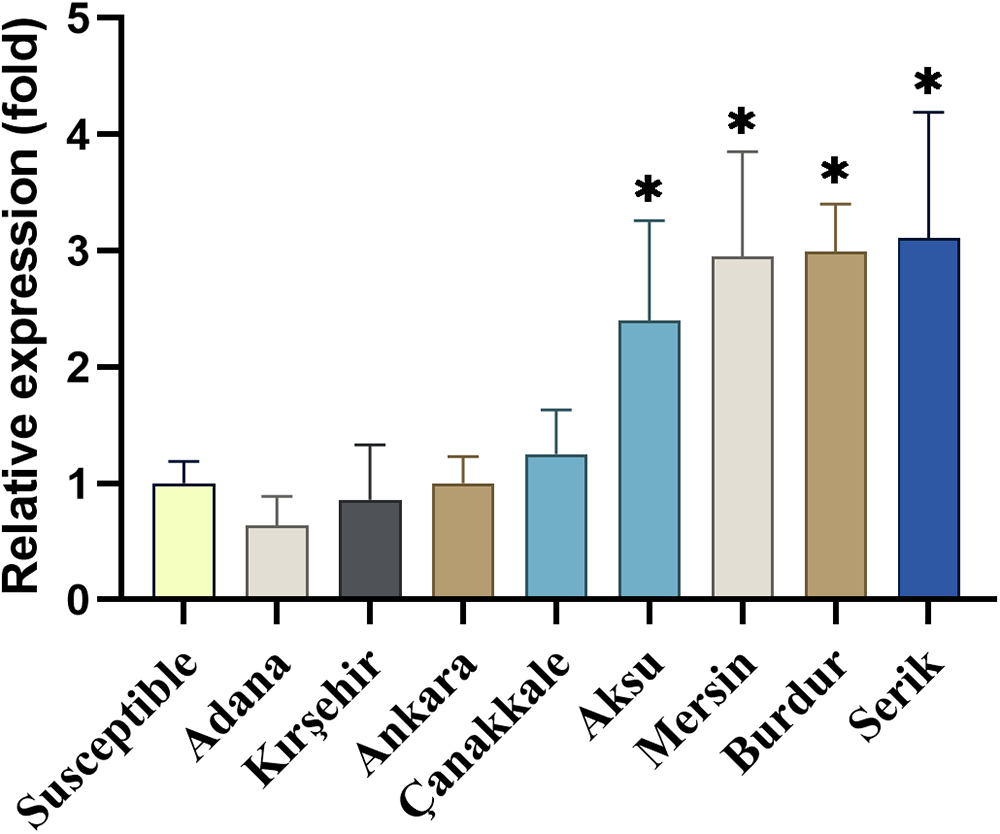
To assess potential qualitative changes in RyR and their association with chlorantraniliprole resistance in field populations, we compared their relative mRNA expression levels to those of the susceptible population using RT-qPCR. As shown in fig. 1, RyR expression levels were significantly upregulated in the Serik, Burdur, Mersin, and Aksu populations, with fold changes ranging from 2.40 to 3.11. However, correlation analysis indicated no significant association between chlorantraniliprole resistance and RyR expression levels in field populations (R 2 = 0.145, P < 0.05).
The relative expression levels of RyR in the susceptible and field populations of P. absoluta. Data are presented as means ± SE. Graph bars with asterisks on the top are significantly different on the basis of the t-test (P < 0.05).

Characterisation of the PaRyR
A single contig of 16,074 bp corresponding to the P. absoluta RyR sequence (Cluster-2201.17092) was identified in our transcriptome data (TA-Serik) based on BLAST_NR annotation. This transcript contains a 15,633 bp ORF, along with a 274 bp 5′ untranslated region (5′-UTR) and a 434 bp 3′-UTR. The predicted P. absoluta RyR protein consists of 5,121 amino acids, with an estimated molecular weight of 578.939 kDa and an isoelectric point (pI) of 5.41 (table S2). Comparison of this gene with the available RyR sequence of P. absoluta in GenBank revealed 100% identity at the amino acid level.
Analysis of the amino acid sequence revealed eight conserved domains (fig. 2A). N-terminal region contains an IP3R (Inositol 1,4,5-trisphosphate receptor, Pfam08709) domain between residues 12 and 212, followed by a MIR (mannosyltransferase, IP3R, and RyR, Pfam02815) domain spanning residues 217–398. Additionally, two RIH (RyR and IP3R Homology, Pfam01365) domains were detected at positions 449–647 and 2214–2442. Three SPRY (SPla and RyR, cd12877-cd12879) domains were observed at residues 653–805, 1085–1217, and 1518–1669, along with four RyR (RyR repeated, Pfam02026) domains located at 860–949, 973–1063, 2818–2908, and 2944–3028. Furthermore, a RIH-associated domain (RyR and IP3R homology associated, Pfam08454) was identified between residues 3993 and 4110. In the C-terminal region, EF-hand domain pair (Pfam13499) was found at residues 4194–4249, along with six TM domains: TM1 (4452–4471), TM2 (4646–4667), TM3 (4731–4752), TM4 (4873–4895), TM5 (4921–4943), and TM6 (5001–5020). The hydropathy profile analysis revealed that these six TM domains corresponded to six highly hydrophobic regions (fig. S1). Additionally, multiple sequence alignments of the TM domains of PaRyR and its orthologs demonstrated a high degree of conservation in this region (fig. 2B). I4746M/K mutations are located in TM3, while G4903E/V mutations are located in the linker between TM4 and TM5 in the carboxy-terminal region. The conserved pore-forming segment (GXRXGGGXGD), which plays a crucial role in RyR ion channel formation, was also located between TM5 and TM6 (4973–4982) and highly conserved in PaRyR and other insect RyRs.
Characterisation of P. absoluta RyR. (A) Conserved domains in the PaRyR structure. (B) Multiple sequence alignment of the TM domain region of RyRs from different insect species. The red triangle indicates the I4746M/K mutation site, while the black triangle marks the G4903E/V mutation site. For interpretation of the references to colour in this figure legend, the reader is referred to the web version of this article.

Pairwise sequence identity and similarity analyses (fig. 3) revealed that PaRyR shares over 78% sequence identity with RyRs from other insect species. RyR identity and similarity between P. absoluta and other species revealed that PaRyR is more closely related to Lepidopteran RyRs, particularly those of the Asian corn borer, Ostrinia furnacalis (Lepidoptera: Crambidae), and the cotton bollworm, Helicoverpa armigera (Lepidoptera: Noctuidae). The sequence identity of PaRyR with the honeybee, Apis mellifera (Hymenoptera: Apidae), and the whitefly, Bemisia tabaci (Hemiptera: Aleyrodidae), was determined to be 79.92% and 78.60%, respectively. In contrast, insect RyRs exhibited relatively low similarity (approximately 40%) to the human RyR (Homo sapiens, Primates: Hominidae).
Sequence identity and similarity between P. absoluta and other species RyR. Abbreviations and GenBank entries for the RyR isoforms are provided in Table S3. For interpretation of the references to colour in this figure legend, the reader is referred to the web version of this article.

To assess the evolutionary relationships among insect RyRs, a phylogenetic tree was constructed using 63 insect RyR sequences. TA-Serik was clustered with PaRyR (Accession no: APC65631) in a subbranch, and all Lepidopteran insects were clearly separated from the other groups and clustered with the Diptera. Furthermore, it was observed that the Coleoptera, Hemiptera, and Hymenoptera orders clustered separately within their respective groups (fig. 4).
Phylogenetic analysis of P. absoluta and other insect RyR sequences. The TA-Serik sequence, obtained from transcriptome data, is highlighted in red. All the bootstrap values next to each branch are shown. For interpretation of the references to colour in this figure legend, the reader is referred to the web version of this article.

Discussion
Similar to many other insecticides, chlorantraniliprole demonstrated excellent efficacy against worldwide populations of P. absoluta upon its initial introduction to the market. Likewise, Daǧli et al. (Reference Daǧli, Ikten, Sert and Bölücek2012) reported high susceptibility to chlorantraniliprole in seven Turkish populations collected between 2009 and 2011. However, the extensive and prolonged use of chlorantraniliprole has led to reduced efficacy in practical field conditions, resulting in control failure. After the first report of chlorantraniliprole resistance in Italian populations of P. absoluta (Roditakis et al., Reference Roditakis, Vasakis, Grispou, Stavrakaki, Nauen, Gravouil and Bassi2015), many other cases have been reported across the globe. The susceptibility survey in Brazil revealed that the majority of the tested populations exhibited significant RR (up to 288,995-fold) to chlorantraniliprole in 2014 (Silva et al., Reference Silva, Assis, Ribeiro and Siqueira2016). A comprehensive monitoring by Roditakis et al. (Reference Roditakis, Steinbach, Moritz, Vasakis, Stavrakaki, Ilias, García-Vidal, Martínez-Aguirre, Bielza, Morou, Silva, Silva, Siqueira, Iqbal, Troczka, Williamson, Bass, Tsagkarakou, Vontas and Nauen2017) reported moderate to high levels of chlorantraniliprole resistance in populations from Greece (55-fold), Italy (181-fold), and Brazil (ranging from 400- to 3000-fold) during 2014–2015. In line with these findings, the present study detected moderate to high levels of chlorantraniliprole resistance in eight field populations. While the absence of a standardised laboratory-susceptible population limits the ability to precisely quantify RRs, the observed LC50 values clearly indicate that all tested populations would survive the recommended field rate of chlorantraniliprole (35 mg/L). This evidence underscores the widespread resistance in P. absoluta populations from Türkiye, which may significantly compromise the effectiveness of field applications and highlights the importance of continuous resistance monitoring.
Understanding the mechanisms underpinning insecticide resistance is crucial for developing effective management strategies. In this study, biochemical assays measuring total activities of key detoxification enzyme groups showed a moderate but significant correlation between the log LC50 values of chlorantraniliprole and cytochrome P450s activity. This indicated that chlorantraniliprole resistance could be at least partially due to detoxification by P450. Similarly, synergism studies and analyses of metabolic enzyme activity in a near-isogenic line (WZ-NIL) of P. absoluta suggest that increased cytochrome P450 activity may contribute to resistance against chlorantraniliprole (Ma et al., Reference Ma, Qu, Yao, Xia, Luo, Guedes and Wang2024). In addition, an integrated analysis using Illumina RNA-Seq and PacBio Iso-Seq suggested that several P450 genes in P. absoluta may play a role in the detoxification of chlorantraniliprole (Liu et al., Reference Liu, Xiao, Zhu, Fu, Wang and Xiao2023). However, there is no direct evidence yet indicating that metabolic resistance to chlorantraniliprole has compromised its efficacy at recommended field rates (Nauen and Steinbach, Reference Nauen and Steinbach2016; Richardson et al., Reference Richardson, Troczka, Gutbrod, Davies and Nauen2020). Thus, although increased P450 activity suggests a potential contribution of metabolic detoxification, the precise CYP genes remain to be elucidated in future functional studies.
Resistance can also be acquired through changes in the quantity and/or quality of the target protein. Gene expression analyses showed upregulation of the target gene at the mRNA level in some populations with moderate to high resistance to chlorantraniliprole. However, no overall correlation between RyR expression and resistance was found, suggesting that it is likely not a major mechanism contributing to resistance. This suggests that changes in RyR expression alone do not play a decisive role in resistance and may reflect a compensatory mechanism to offset the inhibitory effects of insecticides (Liang et al., Reference Liang, Xiao, Ojo, Chao, Ahmad, Alam, Abbas, Abdelhafez, Rahman, Khan, Ghramh, Ali and Chen2025). Instead, chlorantraniliprole resistance is primarily attributed to target-site mutations in regions II to VI of the RyR TM domain. Roditakis et al. (Reference Roditakis, Steinbach, Moritz, Vasakis, Stavrakaki, Ilias, García-Vidal, Martínez-Aguirre, Bielza, Morou, Silva, Silva, Siqueira, Iqbal, Troczka, Williamson, Bass, Tsagkarakou, Vontas and Nauen2017) identified the I4746M–G4903E mutations in P. absoluta, which are homologous to those previously described in P. xylostella, along with two novel mutations (G4903V–I4746T) (Troczka et al., Reference Troczka, Zimmer, Elias, Schorn, Bass, Davies, Field, Williamson, Slater and Nauen2012; Guo et al., Reference Guo, Liang, Zhou and Gao2014). Additionally, İnak et al. (Reference İnak, Özdemir, Atış, Randa Zelyüt, İnak, Demir, Roditakis and Vontas2021) uncovered chlorantraniliprole resistance-associated mutations (I4746M/K and G4903E) at varying frequencies in all 22 P. absoluta populations from Türkiye, indicating high prevalence of target-site mutations in the country. Several studies have confirmed the functional role of these mutations in conferring chlorantraniliprole resistance. For example, CRISPR/Cas9 genome-modified S. exigua carrying G4946E and Drosophila melanogaster with G4946V mutation exhibited high levels of resistance to chlorantraniliprole, with RRs of 223- and 195-fold, respectively (Douris et al., Reference Douris, Papapostolou, Ilias, Roditakis, Kounadi, Riga, Nauen and Vontas2017; Zuo et al., Reference Zuo, Wang, Xu, Huang, Wu, Wu and Yang2017). However, D. melanogaster, which is naturally wild-type for the I4790M mutation, and a homozygous I4790M knock-in strain of P. xylostella displayed low resistance to chlorantraniliprole (RR: 7.5- and 6.0-fold, respectively) (Douris et al., Reference Douris, Papapostolou, Ilias, Roditakis, Kounadi, Riga, Nauen and Vontas2017; Wang et al., Reference Wang, Cao, Jiang, Yang and Wu2020). In contrast, a homozygous I4790K knock-in strain (I4790K-KI) of P. xylostella exhibited over 1000-fold resistance to diamide insecticides, and field populations of P. xylostella in China showed a positive correlation between the prevalence of the I4790K mutation and chlorantraniliprole resistance (Jiang et al., Reference Jiang, Yu, He, Wang, Gu, Davies, Fan, Wang and Wu2024).
In this study, resistance-associated RyR mutations I4746M/K and G4903E/V were detected in field populations of P. absoluta from Türkiye. These mutations were observed across multiple populations, indicating their widespread presence in the field. Among them, the I4746K mutation was identified in the Adana, Aksu, and Kırşehir populations. This study is the first to report a potential association between this mutation and high levels of chlorantraniliprole resistance in P. absoluta. Notably, the Aksu and Kırşehir populations were collected from the same greenhouses sampled 1 and 2 years earlier, respectively, in the study by İnak et al. (Reference İnak, Özdemir, Atış, Randa Zelyüt, İnak, Demir, Roditakis and Vontas2021), where the I4746K mutation was also detected. This highlights the potential persistence of the I4746K mutation in field populations, suggesting that it may confer a selective advantage and warrants continued monitoring. However, the contribution of I4746K to the resistance phenotype in P. absoluta remains to be elucidated.
In addition, the co-occurrence of multiple RyR mutations has been recognised as an important factor contributing to increased diamide resistance in lepidopteran pests (Kim et al., Reference Kim, Khan, Lee and Nauen2025). Previous studies have shown that combined mutations can enhance resistance by causing greater alterations in RyR channel properties and further reducing ligand binding affinity compared to single mutations. For instance, RyRs harboring multiple mutations such as E1338D, Q4594L, I4790M, and G4946E in P. xylostella exhibit markedly reduced affinity for chlorantraniliprole (Guo et al., Reference Guo, Liang, Zhou and Gao2014). Similarly, in Chilo suppressalis, the I4758M mutation confers substantially higher resistance when combined with other mutations such as Y4667D or Y4891F than when present alone (Huang et al., Reference Huang, Rao, Wang, He, Zhao, Zhou, Zhao, Yang, Gao and Wu2020). In this study, the detection of I4746M/K and G4903E/V mutations in Turkish populations of P. absoluta aligns with these findings, suggesting their co-occurrence may contribute to moderate to high levels of chlorantraniliprole resistance observed in the field. Further studies focusing on the combined effects of I4746M/K and G4903E/V in P. absoluta may improve understanding of their contribution to diamide resistance.
RyRs are the largest known ligand-gated ion channels, and insects possess a single, highly conserved RyR isoform, which maintains similar domain architecture across various insect species (Sattelle et al., Reference Sattelle, Cordova and Cheek2008). Multiple sequence alignment of PaRyR revealed high similarity with other insect RyRs but relatively low identity compared to mammalian RyRs. Structurally, PaRyR comprises a large N-terminal region containing a MIR domain, two RIH domains, three SPRY domains, four RyR domains, and one RIH-associated domain. Its C-terminal region features six TM domains and two EF-hand domains, consistent with RyR structures found in other insects (Toprak et al., Reference Toprak, Doğan and Hegedus2021). Phylogenetic analysis demonstrated that the different insect orders were distinctly separated, suggesting that RyR genes may be diversified following the evolutionary divergence of insect orders. Nevertheless, lepidopteran RyRs seem to be more closely related to dipteran ones.
In conclusion, our findings reveal widespread and moderate to high levels of resistance to chlorantraniliprole in P. absoluta field populations in Türkiye. Although P450-mediated detoxification and target gene overexpression may contribute to resistance in some populations, RyR target-site mutations also appear to be involved in the observed resistance patterns. Therefore, molecular markers capable of rapidly and easily detecting resistance would be valuable in future resistance management programs. Continuous resistance monitoring and the implementation of effective resistance management strategies are essential to ensuring the long-term efficacy of chlorantraniliprole.
Supplementary material
The supplementary material for this article can be found at https://doi.org/10.1017/S0007485326100819.
Acknowledgements
This study was supported by the Scientific and Technological Research Council of Türkiye (TUBITAK) under Grant Number 122O126. The authors would like to thank the General Directorate of Agricultural Research and Policies (TAGEM) for their support. This study is a part of the PhD thesis of first author.
Competing interests
The authors declare that they have no known competing financial interests or personal relationships that could have appeared to influence the work reported in this paper.