In the fall 2007 Diet session, the legislation to continue the Self-Defense Forces (SDF) mission in the Indian Ocean for antiterrorism activities became a central issue. The administration under Yasuo Fukuda introduced new legislation which specifically authorized Tokyo to dispatch the Maritime SDF for refueling operations to support maritime inspections in the Indian Ocean. President Ichiro Ozawa of the Democratic Party of Japan (DPJ), which became the largest party in the upper house after the July 2007 election, publicly announced his opposition to the legislation. The public and media attention was focused on political confrontation over the legislation which would extend Japan's personnel contribution in Afghanistan through its refueling mission.
This article aims to identify the position of this confrontation between the Liberal Democratic Party (LDP) and the DPJ by comparing it with other case studies in the post-Cold War period. Was the DPJ's reaction as confrontational as that of the opposition parties, which killed the 1990 UN peace cooperation legislation? What factors made the DPJ act so differently from the case of the 2003 emergency legislation in which the DPJ reached an agreement with the LDP?
Although there has been a cascade of studies of Japanese defense and foreign policy recently, very few studies paid special attention on the legislative process of the post-Cold War national security policies.Footnote 1 Among the few studies on this subject, the study by Robert Pekkanen and Ellis S. Krauss stresses that the change in the political party system allowed parliamentary confrontation over security issues.Footnote 2 Although it presents the new and more complex policy process involving the division within the DPJ and between the LDP and Komeito within the coalition government, it does not explain why the DPJ chose a confrontational or cooperative approach in each incident.
In order to explain DPJ's behavior, this article first offers the background to Japan's legislative process and presents different forms of reactions that the opposition parties take in the Diet operations. Next, it examines seven different cases of post-Cold War national security policies to see how the moderate opposition parties reacted in each case. Finally, it examines the impact of possible factors of the politicization between the ruling parties and the DPJ.
Japan's diet operations
In Japan's legislative process, there exists a strong and continuing political tradition. The ruling party's majority does not mean an automatic approval in the Diet. About 100 cabinet bills are submitted in an average year, and their passage rate between 1947 and 2007 was about 80%.Footnote 3 Opposition parties have blocked about one in every five cabinet bills, despite their minority position. One of the largest factors in the legislative process, and one that works against the ruling party, is time – time to get a bill through the Diet before the Diet session comes to a close. The short duration of Diet sessions, the two-house system, and the committee system in the Japanese Diet mean that filibusters and time-consuming measures by the opposition parties can be effective.Footnote 4
These constraints have made the way the ruling party deals with the opposition parties very important. The government tries to avoid forceful passages by getting some kind of understanding from at least one opposition party. In the national security policy area, traditionally the Socialists and the Communists voiced strong objection to any government initiative for defense expansion or SDF activities. The Socialists often formed an alliance with Komeito and the Democratic Socialist Party (DSP), which were often regarded as ‘the middle of the road (chudo)’ or non-leftist, moderate political parties. In order to avoid forceful passages, the LDP sought some cooperation with these two opposition parties, and more recently with the DPJ, as the Socialist and the Communist Parties avoided negotiations with the LDP. Even when an opposition party does not vote for the policy, its presence at the committee or floor voting helps the LDP not conduct a ‘tyranny of a majority’.
During the Cold War era, Komeito and the DSP often cooperated with the LDP in order to influence the government-sponsored legislation. Especially in the 1970s when the LDP barely maintained a majority in the lower and upper houses, the DSP supported 90.2% and Komeito supported 83.8% of the government-sponsored bills in exchange for some concession from the government.Footnote 5 Their support rate on national security legislation, which is the subject of this article, however, was lower, with 56.4% from the DSP and 53.8% from Komeito. This suggests that there was a higher degree of politicization on national security policies, as they were more ideology oriented than other policy issues.
In his 1963 classic article, Donald Stokes describes that there are two different kinds of policy matters on which political parties compete: ‘position issues’ and ‘valence issues’.Footnote 6 Position issues are defined by Stokes as ones on which parties ‘are differentiated by their advocacy of alternative position on an ordered dimension’.Footnote 7 In position issues, parties take up the ‘pro’ and ‘con’ positions, creating a more confrontational environment.Footnote 8 The national security policies during the Cold War era, which created the left−right confrontation between the LDP and the Socialists, can be classified as position issues.Footnote 9
On the other hand, valence issues are defined by Stokes as ones on which parties ‘are differentiated not by what they advocate but by the degree to which they are linked in the public's mind with conditions or goals of which almost every one approves or disapproves’.Footnote 10 Stokes argues that the most important issues in politics tend to be valence ones, citing the 1952 US Presidential campaign slogan of ‘Korea, Corruption and Communism’ which was used by the Republicans. Everybody had to be against these themes.Footnote 11
On valence issues, there is a broad agreement among the public. Parties compete by prioritizing policy issues and pursuing different measures to achieve the goal. For example, environment is a typical case for this. Parties avoid taking anti-environment positions, as the public generally agrees about the desired policy outcome to improve the environment. Instead, they will compete ‘by emphasizing different priorities, concentrating on those issues where each believes its credibility is strong enough to attract voters’.Footnote 12
After the Cold War ended, Japan's ‘1955 system’, which was based on ideological confrontation between the LDP and the Socialists on national security, collapsed, as a broad public consensus in favor the US–Japan alliance and the Self-Defense Forces arose. Since the 1990s, Japan's debate on national security largely focused on the role of the SDF to contribute to international peace and security in addition to defending Japan's territory. After the heated debate on the dispatch of the SDF to the 1991 Gulf War, and especially after the successful PKO activities of the SDF in Cambodia and other places, a broad consensus for Japan’ personnel contributions arose among the LDP and the other non-leftist parties. A new political debate focused on how, when, and under what conditions Tokyo sends the SDF overseas. This development suggests that national security policies shifted from position issues toward valence issues, at least between the LDP and the non-leftist, moderate parties.
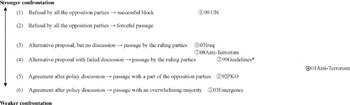
The degree of Japan's party confrontation in the Diet can be classified into six levels in terms of the reaction of the opposition parties. Listing from the stronger levels are: (1) objection by all the opposition parties successfully kills the government-sponsored bill; (2) despite an objection by all the opposition parties, the government party forcefully passes the bill; (3) an opposition party introduces an alternative proposal but refuses to cooperate with the government party, and the government party passes the bill; (4) an opposition party introduces an alternative proposal and holds an unsuccessful conference with the government party, and the government party passes their original bill; (5) an opposition party and the government party reaches an agreement, and jointly pass the bill; and (6) more than one opposition party supports the bill, and helps to pass it with an overwhelming majority.
The first and second cases are obviously typical examples of position issues with strong confrontation, and the fourth, fifth and sixth cases can be described as valence issues. The third case is debatable. Opposition parties can create confrontation by introducing an unacceptable alternative plan. However, the introduction of an alternative proposal forces an opposition party to participate in Diet deliberation, and effectively prohibits a filibuster that they could otherwise conduct. It is less confrontational than the situation under which opposition parties are allowed to boycott deliberations as in the first and second cases. Therefore, it seems more like a valence issue than position one.
On position issues, whether the government party takes a forceful step or not depends largely on public and media support. If the public and the media do not fully support the position of the opposition parties, it is relatively easy for the ruling party (or parties) to forcefully enact legislation. On the other hand, full public and media support for the opposition parties’ action to block government legislation forces the ruling party to offer a satisfactory length of time for deliberations in the Diet, and often results in the ruling party giving up on its legislation. The more important a bill is, the harder the government will try to persuade the opposition parties. This tends to be especially true on issues of national security. The actual interactions in the important national security legislation in the post-Cold War period will be examined in the next section.
Party confrontation in post-Cold War national security
In order to identify the changes of degree of politicization in the national security area and put the 2008 anti-terrorism legislation into perspective, we will look at the positions of Japan's political parties and public opinion on seven major events since 1990: (1) the 1990 UN peace cooperation legislation; (2) the 1992 international peace cooperation legislation; (3) the 1999 US–Japan defense guideline legislation; (4) the 2001 anti-terrorism legislation; (5) the 2003 emergency legislation; (6) the 2003 Iraq legislation; and (7) the 2008 anti-terrorism legislation. As frequent reorganization of political parties was seen during this period, we examine the interaction between the LDP and the non-leftist, moderate parties. As the DPJ became the largest opposition party in 1998, in the third to seventh cases we focus on the reaction of the DPJ, which tried to be a viable opposition party.
Case 1: The 1990 UN peace cooperation legislation
After the outbreak of the 1990 Gulf Crisis, the US government requested that Tokyo contribute personnel in addition to providing financial support. In order to meet this request, the LDP single party government under Toshiki Kaifu prepared the UN peace cooperation legislation that would enable the SDF to assist the multinational forces in the Persian Gulf area.
The Socialist Party strongly voiced its opposition against overseas dispatch of the SDF. The two non-leftist opposition parties, Komeito and the DSP, aligned with the Socialists to oppose the government's initiative to provide a personnel contribution in the Gulf War.
Prime Minister Kaifu publicly stated that he staked his political life on the bill's successful passage, but at Diet meetings he only emphasized the idealistic aspects of the bill, and it became apparent that he did not actually know the details of the bill. Kaifu even denied that the SDF could be dispatched to combat zones, though the Japan Defense Agency (JDA) and Ministry of Foreign Affairs (MOFA) officials told opposition party members that the bill would make such deployment possible. All the opposition parties attacked the government for its internal disarray, and accused the prime minister of testifying falsely. The LDP leadership tried to appease the two non-leftist opposition parties, but the latter would not relent and refused to settle the issue. After failing to get cooperation from any opposition party, LDP Secretary General Ichiro Ozawa told Kaifu on November 5 that they had to let the legislation die.Footnote 13
Case 2: The 1992 international peace cooperation (PKO) legislation
The Kaifu government submitted another bill to the Diet that would allow the SDF to participate in the peace-keeping operation under UN command. As Kaifu resigned in the midst of his term of service, the legislation was resubmitted by the new prime minister, Kiichi Miyazawa, in September 1991. Although the Miyazawa cabinet passed the legislation in the lower house with support from Komeito, it failed to pass it in the upper house committee. When the opposition parties came up with many unexpected questions, the committee chairman had to stop the deliberation, as the government officials could not come up with appropriate answers. As a result, the Miyazawa cabinet gave up trying to pass the PKO legislation in the 1991 diet session.
It was not until the end of April 1992 that the deliberation over the PKO bill restarted in the upper house. Meanwhile, in early February, Komeito Secretary General, Yuichi Ichikawa, proposed to freeze peace-keeping force deliberations in order to invite the DSP into the supporting camp. At the 21 April party conference, DSP Chairman, Keigo Ouchi, announced his intention to cooperate on the PKO bill.
On 29 May, the secretaries general of the LDP, Komeito, and the DSP reached an agreement that the provisions on the SDF dispatch to the peace-keeping activities going beyond logistics would be frozen until a new legislation was enacted. On 5 June, the revised legislation passed the upper house special committee to be introduced on the floor. On the upper house floor, the two leftist parties, the Socialist Party and the Communist Party, conducted many different kinds of filibusters to block voting on the legislation. They introduced non-confidence resolutions against diet committee chairmen and cabinet members. For each voting, they used a traditional filibuster in the Japanese Diet for the first time since the 1988 deliberation on the tax reform bill, ‘cow walking’ (walking extremely slowly during their voting) to use up already limited deliberation time allocated to the upper house. It took 75 hours to go through the entire voting process, but finally the PKO bill passed.
The revised bill was then reintroduced to the lower house special committee on the evening of 9 June. Although the two leftist parties tried to block the legislation, it passed the committee in two days with support from Komeito and the DSP, and was finally enacted on 15 June.
Case 3: The 1999 US–Japan defense guidelines legislation
The 1993–94 North Korean nuclear crisis made both Tokyo and Washington realize the need for Japan to form a legal basis through which to take action in a regional crisis outside the UN peace-keeping operations. At the April 1996 summit meeting, Prime Minister Ryutaro Hashimoto and American President Bill Clinton announced an initiative to create new defense cooperation guidelines between the two countries.
The legislation to authorize defense guidelines was originally initiated by the Hashimoto government in Spring 1996 with the Socialist Party and Sakigake as coalition partners. In 1994 when the Socialist leader Tomiichi Murayama was prime minister, the Socialist Party abandoned its traditional goal of unarmed neutrality, and expressed its support for the US–Japan alliance and the SDF arrangement, effectively putting an end to the traditional ‘1955 system’. But the Socialist Party was very hesitant to further strengthen the alliance with the United States by enacting this legislation. While remaining in the coalition, the Socialist Party did not openly oppose the initiative. In the September 1996 general election, however, the Socialist's representation in the lower house decreased from 30 seats to 15 seats. This forced the party to rethink its political strategy.
When the Hashimoto cabinet approved the guidelines legislation in April 1998, the Socialist Party expressed their opposition. As a result, although the legislation was submitted, it was never deliberated during that Diet session. The Socialist strategy was to disassociate from the LDP in order to regain their traditional supporters who had been disappointed by their compromise on national security policies as a coalition partner. Just before the July 1998 upper house election, the Socialist Party left the coalition government. However, this action did not benefit the party in the election outcome. The Socialist Party decreased its share in the upper house from 20 to 13 seats. Meanwhile, the LDP lost 17 seats, losing its majority in the upper house, and Hashimoto took political responsibility by resigning as prime minister.
Hashimoto's successor, Keizo Obuchi, sought to form a new coalition in order to enact the guidelines legislation. In January 1999, a new coalition was established with the Liberal Party, a conservative party led by Ichiro Ozawa. Soon after the establishment, the Obuchi government resubmitted the guidelines legislation to the Diet. But the legislation met with disagreement from the Liberal Party within the coalition.
A compromise was made on the area of application of US–Japan defense guidelines. In the government proposal, the applied area of the legislation had not been specified, citing that the area should not be limited geographically. Ozawa strongly criticized this, by stating that the area should be limited within the framework of the US–Japan Security Treaty, which limits its application to the region of the Far East.
Another area of disagreement between the LDP and the Liberal Party was on vessel inspection. The original government proposal included a clause that would allow SDF vessels to inspect foreign vessels in the area surrounding Japan, if the United Nations authorized member states to conduct such inspections. Ozawa, however, argued that such an inspection was beyond the framework of the US–Japan security treaty. Therefore, it should be drafted separately from the US–Japan guidelines legislation. Following Ozawa's argument, the inspection clause was removed from the government proposal.
After the agreement was reached between the LDP and the Liberal Party, the three pieces of then new guideline-related legislation were introduced to the Diet: the revision of the acquisition and cross-service and agreement (ACSA) between the United States and Japan, and the revision of the SDF Law and the newly drafted regional crisis legislation to authorize the government to mobilize the SDF to provide rear-echelon supports to US forces in the event of a crisis in the area surrounding Japan.
Among the opposition parties, Komeito, which was determined to join the coalition government later (joined in October 1999), voted for the legislation. Another non-leftist opposition party, the DPJ, which was the largest opposition party, was split on the issue. DPJ leader, Yukio Hatoyama, who wanted to strengthen the US–Japan alliance, came up with an alternative proposal for policy discussion with the LDP. Although the LDP unofficially negotiated with the DPJ, they put higher priority with policy coordination with its coalition partner, the Liberal Party, and gave up on reaching agreement with the DPJ. As a result, the DPJ voted for the revision of the ACSA and the SDF law, but voted against the regional crisis legislation. With support from the LDP, the Liberal Party, and Komeito, the three pieces of legislation were finally enacted in May 1999.
Case 4: The 2001 anti-terrorism legislation
In October 2001, the coalition government of the LDP, Komeito, and the Conservative Party, under Prime Minister Junichiro Koizumi, introduced the anti-terrorism legislation which would enable provision of rear-echelon support for US forces by the SDF to the Indian Ocean area. The Socialist Party denounced the US intention to retaliate, and portrayed the Koizumi plan as a step toward Japan's remilitarization. On the conservative front, the Liberal Party leader Ozawa released a position paper that heavily criticized Koizumi's plan as ‘ad hoc, spur-of-the-moment half-measures’. The Liberal Party (which had left the coalition government in April 2000) maintained that the use of armed forces must be approved by the United Nations, as in the case of the Gulf War, before Japan could send its troops into an international conflict.
Wishing to avoid a diet passage by the ruling coalition alone, the Koizumi government sought cooperation from the DPJ. DPJ leader, Hatoyama, presented the conditions for support, which included requiring prior Diet approval for ‘stronger civilian control’ over the SDF. Although Koizumi was willing to offer compromises to the DPJ, LDP's coalition partner, Komeito, strongly opposed. As a result, negotiation between Koizumi and Hatoyama broke up.
Some experts argue that this failed negotiation was due to the internal split of the DPJ.Footnote 14 But DPJ's demand was consistent in asking for prior Diet approval, which could have been accepted by the Koizumi government. As this legislation was a temporary one, it was not difficult for the government to receive Diet approval given the high level of public support. Komeito members were concerned that the popular prime minister might dissolve the current coalition and run the government with the DPJ instead. To avoid a possible coalition break-up, Komeito demanded that Koizumi offer no further compromises to the DPJ.
Once the decision was made to push the legislation through without any support from the opposition parties, Diet action was swift. On 16 October, the revised government bill was introduced and the lower house special committee approved it. Two days later, the lower house passed the bill. DPJ leader Hatoyama had a difficult time persuading some 20 Democratic lower house members, who were supportive of the bill, not to vote for it. The bill was enacted on 29 October, only 24 days after the upper house passed it. The Koizumi government managed to quickly pass legislation with strong public support, overcoming resistance from the opposition parties.
Case 5: The 2003 emergency legislation
When the emergency-related bills were first submitted to the Diet in April 2002, the Koizumi cabinet faced powerful resistance from the Communist and Socialist parties as well as the Liberal Party. Again, that left the Koizumi cabinet, the DPJ, as only one potential ally. The DPJ, however, was sharply divided on the issue. While the younger DPJ members recognized the urgent need for emergency legislation, many former members of the Japan Socialist Party within the DPJ vehemently opposed the government proposal. At the end, the DPJ joined the other opposition parties to boycott Diet operations. As the unity of the opposition parties boosted their influence significantly, the Koizumi government gave up the passage of the emergency legislation during the current Diet session.
In April 2003, the ruling parties submitted the revised emergency bills to the lower house. In response to criticisms made during the previous Diet session, the revised proposal included anti-terrorism measures as well as a concrete plan to prepare a separate piece of legislation within two years to protect peoples’ rights.
During this period, the DPJ made a leadership change from Hatoyama to Naoto Kan. Kan, as new party president, wanted to demonstrate to the public that his party was a viable opposition party that could run the government by displaying its solid understanding of, and policy for, national security affairs. Kan intentionally disassociated his party from the Socialist and the Communist, weakening the unity of the opposition parties against the government.
DPJ's project team produced a proposal to revise the government proposal. The proposal covered situations including not only an armed attack but also a terrorist attack and a large-scale natural disaster. It also would clearly guarantee the basic human rights of citizens, give the Diet the authority to end SDF activities, require the government to provide information on the situation to the public, and establish a new Crisis Control Agency. When the DPJ explained its proposal at the lower house special committee meeting, the ruling parties expressed their willingness to hold a conference to amend their bills.
After a week of meetings, on 13 May the ruling parties and the DPJ reached agreement. The amended emergency bills passed the special committee on 14 May and the Lower House floor on the following day with support from the ruling parties as well as the DPJ and the Liberal Party, which constituted 90% of members present. The upper house special committee began deliberations on 20 May. On 6 June, 202 of the 235 members at the upper house floor meeting voted for the emergency legislation. Nearly 60 years after the Second World War, Japan was finally equipped with a legal framework to deal with a national emergency.
Case 6: The 2003 Iraq legislation
When US forces initiated hostilities against Iraq in March 2003, Koizumi immediately declared Japan's support for the United States. After President George W. Bush announced the end of major combat operations, the Koizumi Cabinet moved swiftly on drafting a new legislation to allow the SDF to offer humanitarian and reconstruction assistance in postwar Iraq.
The Koizumi government submitted the Iraq legislation to the Diet on 13 June. In order to pass the legislation in the current session, the ruling parties needed to extend the ordinary Diet session by 40 days. When the three parties asked the speakers of both houses of the Diet for the extension, however, all the opposition parties were united in opposing it. They argued that such an extension for major legislation submitted at the end of the session was against the general operating principle of the Diet. The ruling parties, however, forced the extension through both houses.
Deliberations on the legislation in the lower house started on 24 June. The Koizumi government planned to pass the legislation in the lower house within two weeks and to enact it by 28 July, the last day of the Diet session. Such swift approval usually requires an agreement from the largest opposition party, the DPJ.
To gain DPJ support, the legislation was designed with room for several political compromises.Footnote 15 With compromise in mind, the government sought an early conference with the DPJ, but the DPJ refused. Instead, the DPJ submitted its own legislation for reconstruction of Iraq, which excluded the SDF dispatch. The DPJ argued that as long as there was no clear difference between combat and non-combat areas, sending the SDF might violate Article 9 of the Constitution, which prohibits Japan's belligerency. DPJ leader Kan again wanted to prove the DPJ's status as a responsible party by showing its willingness to contribute to the reconstruction of Iraq, while opposing the government proposal to dispatch the SDF. The ruling parties, however, regarded this bill as evidence of the DPJ's refusal to negotiate with them.
The DPJ's refusal made it impossible for the Koizumi government to win an overwhelming majority to pass the legislation as it had done for the emergency legislation. However, submitting a bill of its own committed the DPJ to attending the Diet session. This meant the ruling parties could avoid the worst possible scenario – a boycott of deliberations by all the opposition parties. The government proposal passed the lower house on July 4. By submitting its own bill, the DPJ also disassociated itself from the other opposition parties, weakening the solidarity of the opposition camp.
Deliberations in the upper house moved ahead as scheduled. The opposition parties introduced a no-confidence motion against the Koizumi cabinet on 25 July in a bid to delay passage. On the following day, however, the ruling parties voted for and enacted the legislation to dispatch Japanese troops to Iraq.
Case 7: The 2008 anti-terrorism legislation
In the fall 2007 Diet session, Prime Minister Shinzo Abe was planning to extend the existing 2001 anti-terrorism legislation to continue the SDF mission in the Indian Ocean as the Koizumi administration had done three times. In the July election, the ruling coalition lost a majority in the upper house. The DPJ became the largest party in the house with 115 seats, compared with 84 seats of the LDP. After the election, DPJ President, Ichiro Ozawa, publicly stated his opposition to the extension of the anti-terrorism legislation. The political situation surrounding the legislation became very complicated.
As the ruling coalition maintained more than a two-thirds majority in the lower house, the government was legally able to override the rejection by the upper house under the rule in Article 59 of the Constitution. But it was politically difficult for the Abe cabinet to actually take advantage of this rarely used constitutional arrangement, as it suffered low public support due to the scandals of several cabinet members and the mismanagement of millions of pension accounts.Footnote 16 Abe's sudden resignation in September made it logistically impossible to extend the existing anti-terrorism legislation beyond the expiration date of 1 November.
The newly established cabinet under Yasuo Fukuda needed to introduce a new piece of legislation to extend the SDF activities. The LDP's coalition partner, Komeito, strongly requested the prime minister to persuade the DPJ to support the legislation in order to avoid the rarely used constitutional procedure.Footnote 17 The Fukuda administration made the proposal in a joint conference on the legislation to the DPJ, but DPJ leader, Ozawa, rejected the proposal.
On 17 October, the Fukuda administration approved a new draft of the legislation which would limit the SDF's activities in the region to refueling operations in support of maritime inspections in the Indian Oceans. DPJ leader, Ozawa, in a magazine article, criticized the government draft as allowing the SDF to exercise the right of collective self-defense, which the Japanese constitution prohibits. Instead, he proposed an alternative idea to promote Japan's participation in the International Security Assistance Force (ISAF) on the soil of Afghanistan, which had been authorized by the United Nations.Footnote 18
However, Ozawa's idea was not widely accepted by other DPJ members, as the ground activities by the ISAF would be more dangerous than the maritime operations. In November, Ozawa met with Prime Minister Fukuda, and agreed to form a coalition government with the LDP. This initiative by Ozawa also met strong opposition within the DPJ, and Ozawa once publicly announced his resignation as DPJ president. Although Ozawa was persuaded to keep the party leadership, this turmoil confused DPJ's diet operation to deal with the anti-terrorism legislation.
In mid-December, the ruling parties found that it was impossible to get cooperation with the DPJ on the legislation, and decided to pass the legislation with the two-third majority in the lower house. However, the DPJ decided to introduce a counterproposal. The DPJ proposal would allow SDF dispatch only for reconstruction purposes in the area where a ceasefire agreement was established, and suggested future consideration on the maritime operations only if a United Nations resolution specifically requested it. After the DPJ submitted its proposal to the Diet, it requested cooperation from the other opposition parties. But all the other opposition parties – the Socialists, the Communists, and Kokumin Shinto – refused to cooperate, as they were upset by the DPJ's inconsistent behavior in the legislative process. On 11 January 2008, the ruling parties enacted the legislation with a two-thirds majority in the lower house to authorize the government to restart maritime operations in the Indian Ocean.
The factor analysis of parliamentary confrontation
The above seven cases are shown in Figure 1 in terms of the degree of parliamentary confrontation. Full confrontation only appeared in the 1990 UN peace cooperation legislation. In all the other cases, at least one opposition party showed some degree of understanding. The 2003 emergency legislation was voted in by an overwhelming majority in both houses. A proportion of the opposition parties supported the government proposal in the case of the 1992 PKO legislation, and in the 1999 guideline legislation. On the 2001 anti-terrorism legislation, the DPJ held a conference with the government parties. Against the 2003 Iraq and the 2008 anti-terrorism legislation, the DPJ participated in the Diet deliberation by introducing an alternative proposal. Although a conference was not held with the government parties, the DPJ recognized the significance of personnel contribution in Iraq and Afghanistan.
Degree of party confrontation in the Diet
Note: *Although Komeito officially was an opposition party when it voted for the bill, the party is regarded here as part of the coalition as it was clear that it would join the coalition government shortly.

In short, Japan's political parties in general became less confrontational against overseas dispatch of the SDF in the post Cold-War period. This minimized politicization of national security policies, turning the issues from ‘position’ ones to ‘valence’ ones.
Despite the post-Cold War general trend of political parties, the DPJ's degree of cooperation and confrontation varied from case to case since it became the largest opposition party. While the DPJ offered its own proposals in the third to seventh cases, the DPJ effectively refused to negotiate with the government in the 2003 Iraq legislation and the 2008 anti-terrorism legislation.
This section examines the influence of possible factors on the DPJ's chosen reaction. It looks into the public opinion on the legislation, the editorials of major newspapers, the supporting group for the DPJ, and the electoral pressure.
Public opinion
The shift from the position issue toward the valence issues probably reflected the trend of opinion poll results over national security policies. Public opinion showed significant changes before and after the 1991 Gulf War.
In the first case of the UN peace cooperation legislation, public sentiment was generally hesitant for the first overseas dispatch of the SDF, and was on the side of the opposition parties. In the October 1990 Asahi Shimbun opinion poll, only 19% of the respondents supported the SDF dispatch by revising the current laws or the Constitution. On the other hand, 67% preferred a ‘non-military contribution’.Footnote 19 In another Asahi poll conducted immediately after the legislation was introduced to the Diet, 58% opposed the bill, while only 21% supported its passage.Footnote 20 There was very limited public support for the SDF dispatch.
However, Japan's public opinion had significantly changed after the 1991 Gulf War. The international criticism against the lack of man-power support to the war contributed to the change. When the Kaifu cabinet successfully dispatched SDF minesweepers in 1991, the public strongly supported the government decision.Footnote 21 This significantly lowered public reservation against the SDP dispatch.
During the Diet deliberation of the second case, Asahi Shimbun conducted an opinion poll to find how much support the 1992 PKO legislation received. In strong contrast to the poll on the 1990 legislation, as many as 71% of the respondents supported the overseas dispatch of the SDF, and only 24% were opposed. Among the supporters, 50% preferred to limit the operation to non-military functions, such as disaster relief, while 19% endorsed military assistance under the UN flag. Only 2% expressed support for the participation on multinational forces.Footnote 22
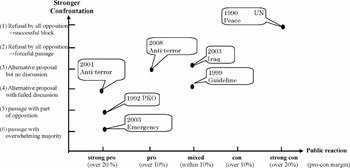
From the third to the seventh cases, the public did not express strong opposition during the Diet deliberation (defined by more than a 10% margin). For the 1999 guidelines legislation and the 2003 Iraq legislation, the difference between support and opposition was within a 10% margin.Footnote 23 The 2008 anti-terrorism legislation received a positive public reaction by more than a 10% margin in the poll conducted by most of major newspapers except Asahi.Footnote 24 The 2001 anti-terrorism legislation and the 2003 emergency legislation saw strong public support, by a more than 20% margin.Footnote 25
The cases are shown in Figure 2 to demonstrate the relations between parliamentary confrontation and public reaction. Strong public opposition only appeared in the 1990 UN Peace Cooperation legislation, which resulted in full confrontation by all the opposition parties. In all the other cases, split or supportive public opinion made at least one opposition party show some degree of understanding. The shift in public attitude regarding the SDF dispatch can be seen as an important factor in the change of security issues from a position issue toward a valence issue. However, public opinion does not explain why the DPJ took a more confrontational approach in the 2003 Iraq and the 2008 anti-terrorism legislation.
Party confrontation and public reaction on the national security policies

Media opinion
The media has a significant impact in the Japanese political scene. A 1985 study shows that political leaders and other groups identified the media as the most influential group in the decision-making process.Footnote 26 Political leaders in the ruling and opposition parties read major newspapers every morning. The media reaction often becomes an important reference point for them to decide their actions. Among the most influential media are the five major newspapers with nation-wide distribution – Yomiuri, Asahi, Mainichi, Nihon Keizai, and Sankei. Here, the editorials of these newspapers on the national security issues are examined to assess their impact on the legislative process.
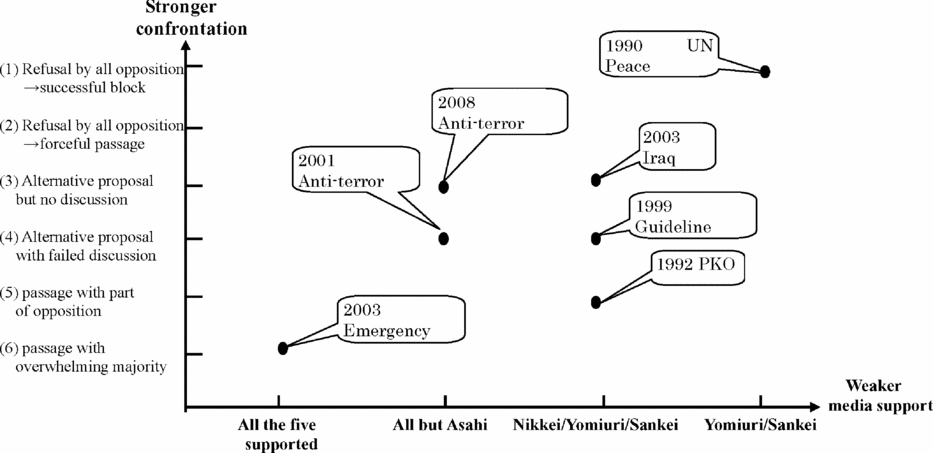
On the 1990 UN peace cooperation legislation, only Sankei and Yomiuri supported SDF dispatch, while Nihon Keizai, Mainichi, and Asahi opposed it.Footnote 27 But over the 1992 international peace cooperation legislation, Nihon Keizai became supportive of Japan's active role of sending the SDF abroad.Footnote 28 Since then, the business newspaper constantly joined the conservative camp with Sankei and Yomiuri over the 1999 guideline legislation,Footnote 29 the 2001 anti-terrorism legislation,Footnote 30 the 2003 emergency legislation,Footnote 31 and the 2003 Iraq legislation. Over the issue of the 2001 and 2008 anti-terrorism legislation, Mainichi also supported SDF dispatch.
In Figure 3, media reaction to and parliamentary confrontation on national security issues are depicted. The strongest confrontation on the 1990 UN peace cooperation legislation can be explained by weak media support only by Sankei and Yomiuri among the five major newspapers. Over the 2003 emergency legislation, even Asahi expressed its support. Asahi's support indicated strong media consensus, with all five newspapers in agreement. This was important to the most cooperative legislative approach in establishing a legal framework to defend Japan.
Party confrontation and media support on the national security policies
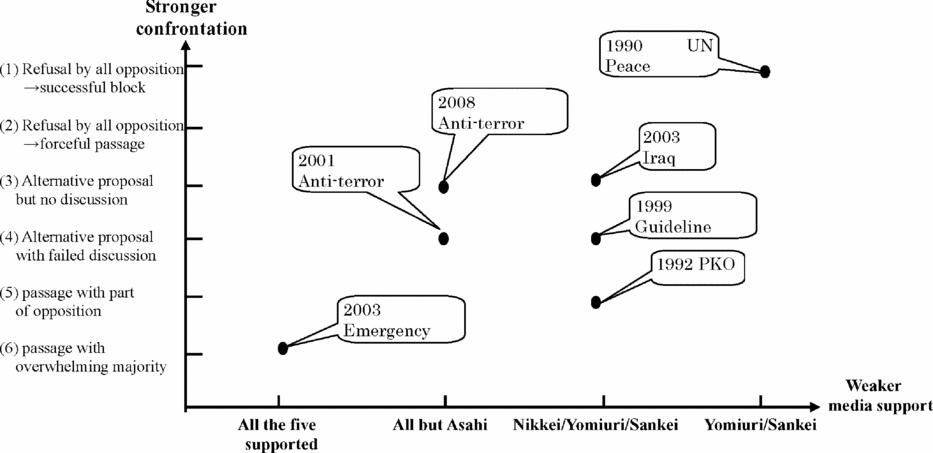
Yet, the media reaction cannot explain the reason why the DPJ demonstrated stronger confrontation by rejecting negotiations with the government on the 2003 Iraq legislation and the 2008 anti-terrorism legislation. Especially in the following case, even Asahi, which was the only major newspaper to object to the government-proposed legislation, strongly criticized the DPJ for refusing to negotiate.Footnote 32
The reaction of the support group
Can the strong confrontation by the DPJ in the above two cases be explained by the influence of its supporting group? The largest organized support for the DPJ is provided by Japan's biggest labor union, Rengo or the Japanese Trade Union Confederation with 6.8 million membership.
Rengo was established in 1989 by merging the existing affiliates of the two major labor unions, Domei and Sohyo. Rengo at first supported the Socialist Party. However, in the process of the 1992 international cooperation legislation, Rengo chairman, Akira Yamagishi, openly criticized the Socialists who had refused to negotiate with the government on PKO. Rengo then announced their support on the legislation.Footnote 33
Rengo shifted its support from the Socialists to the DPJ after the DPJ became the largest opposition party. However, Rengo's attitude toward the national security legislation became negative in the third case of the 1999 guidelines legislation and thereafter. Rengo officially announced their opposition by criticizing the government draft as hasty.Footnote 34 The largest labor union also announced its statement, in the form of ‘talk by the secretary general’, expressing its opposition to the 2001 and 2008 anti-terrorism legislation and the 2003 Iraq legislation.
Rengo constantly opposed all the government proposals on major national security after it began supporting the DPJ. Therefore, the reaction of the supporting organization cannot explain the different degree of confrontation presented by the DPJ.
Electoral pressure
Finally, the relation between DPJ's parliamentary approach and electoral pressure is examined. Reelection is the most important issue for the Diet members in the DPJ, the LDP, or any other party. The ruling parties would try to avoid being criticized for forceful passage of major legislation if the next election was coming soon. On the other hand, the DPJ may want to distinguish itself from the government for the election by refusing to cooperate in the legislative process. At the same time, as a result of a series of party reorganizations in the 1990s, the DPJ became the largest opposition party seeking to become the ruling party some day. In order to show its ability to run the government, the DPJ would like to participate in the Diet deliberation as a viable political party by disassociating itself from the leftist parties, and by avoiding blame for destroying important pieces of national security legislation.
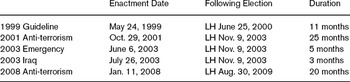
The enactment date of the five major pieces of legislation after the DPJ became the largest opposition party are listed in Table 1 with the date of the following election.
The enactment date of legislation and the following election

For the case of the 1999 guidelines legislation, electoral pressure was very low. The general election had to come by October 2000 when the lower house term would expire. But it was the first election for the DPJ after it became the largest opposition party. Therefore, it was more important for the DPJ to show the voters that it was a viable party and different from the old opposition parties that would simply confront the LDP. As a result, the DPJ chose to show its willingness to negotiate with the government by presenting its own counter proposal.
In the case of the 2001 anti-terrorism legislation, there was no electoral pressure as the general election took place in the previous year. The Koizumi cabinet with a high level of public support had enjoyed a big victory in the July upper house election. As the legislation was also highly supported by the public, DPJ members tried to show their influence by presenting their own proposal, which demanded prior Diet approval for the SDP dispatch.
The 2003 emergency law passed just five months before the general election. But as previously discussed, there was consensus of public and media opinion for the need for the law. The DPJ had to present a counter proposal in order to show the public their ability to be a viable political party. As a result, most of the proposals the DPJ presented were accepted by the government, making DPJ's influence the most significant among all the cases in this article.
In contrast, the DPJ took a more confrontational approach in the 2003 Iraq legislation, which passed the Diet one and a half months later. Although the government was eager to negotiate, the DPJ presented its own legislation, which would prohibit SDF dispatch to Iraq. This was unacceptable to the government, and effectively closed a chance for negotiations. The DPJ chose to show its policy preference different to the Koizumi government for the November general election as the public and media opinion was split over this issue.
In the case of the 2008 anti-terrorism legislation, the result of the July 2007 election, which left the DPJ as the largest political party in the upper house, had strong impact on the DPJ reaction. DPJ president, Ichiro Ozawa, publicly stated DPJ's opposition to the government draft of legislation, and refused to negotiate with the Fukuda government. Ozawa argued that Japan's personnel contribution must be limited to the activities under UN auspices. Although the Fukuda administration successfully lobbied the UN Security Council to adopt a resolution which expressed high appreciation for Japan's contribution in the Indian Ocean, Ozawa's party did not change its position. Athough the actual election for the lower house was scheduled on August 30, 2009, the electoral pressure had existed since fall 2007.
In short, the electoral pressure may be an appropriate factor to explain DPJ's reaction. In the cases of the 2003 Iraq and the 2008 anti-terrorism legislation, the DPJ chose to confront with the government by submitting its own legislative proposals which were not acceptable to the LDP. Facing the general election, the DPJ wanted to show the public that its policy stance differed from that of the government.
Conclusion
After the Cold War came to an end, the old ideological confrontation between the LDP and the Socialist Party under the ‘1955 system’ broke down. However, the legislative process in the 1990 UN peace cooperation legislation, which took place in the immediate post-Cold War period, showed strong signs of being a ‘position issue’. The Socialist Party displayed the traditional ideological confrontation against the LDP's initiative to dispatch the SDF overseas for the first time. The Socialists successfully established a joint front with the two non-leftist opposition parties, Komeito and the DSP, to block the Kaifu administration's initiative.
Komeito and the DSP, however, did not share the same political stance with the Socialist Party. These two non-leftist opposition parties recognized the significance for Japan to provide more than financial contribution. A new alliance among the LDP, Komeito and the DSP was thus established, creating a new political situation which created broad agreement among the three parties for the overseas dispatch of the SDF. Under the new alliance, the LDP successfully passed the PKO legislation with support from Komeito and the DSP, turning this policy into more of a ‘valence’ issue between the LDP and the two non-leftist parties
In the legislative process of the third to the seventh cases, the DPJ, which became the largest opposition party, played a very important role. While the traditional moderate opposition parties negotiated on minor changes of the government-sponsored legislation, the DPJ came up with their own counter proposal in order to show the public that they had the ability to formulate important security policies and to run the government on their own. Both in the third and the fourth cases, the DPJ presented counter proposals in order to negotiate with the coalition government for compromise. But in neither case was the coalition government willing to reach an agreement with the DPJ.
In contrast, the DPJ played a decisive role in the policymaking of the emergency legislation. The DPJ became a major force to block the voting on the original government bills in the 2002 ordinary Diet session. In the 2003 session, however, the DPJ directly involved itself in the policy process. The DPJ submitted its version of the emergency legislation, and showed its willingness to negotiate with the government. The DPJ and the LDP reached an agreement, leading to an enactment with an overwhelming majority in the both houses of the Diet. This set a precedent for cooperation between the ruling parties and the DPJ.
In the case of the Iraq legislation, the Koizumi government again preferred to seek passage with support from the DPJ. The government intentionally left room for negotiation in the government proposal. Before the upcoming general election, however, the DPJ wanted to showcase to the electorate its differences with the LDP by opposing the SDF dispatch. The largest opposition party submitted its own bill on Iraq, and ended up disassociating itself from the other opposition parties. The unity of the opposition parties was thus weakened which only helped the ruling coalition pass the legislation in the Diet in late July 2003.
After the July 2007 election, the role of DPJ was even more important as it became the largest political party represented in the upper house. The LDP government sought to seek with the DPJ for smooth passage of the new anti-terrorism legislation in the Diet. While the DPJ refused to cooperate on the government-sponsored legislation, it submitted a counterproposal. Their action allowed the normal Diet deliberation and led to enactment on the legislation. Although the new political environment with the loss of a majority in the upper house forced the ruling parties to override the upper house's decision by a two-thirds majority in the lower house, DPJ's action was very similar to the 2003 Iraq legislation. While the DPJ opposed the government proposal, the submission of the counterproposal enabled the ruling parties to enact the government legislation.
In the post-Cold War era, major national security policy concerning the role of SDF shifted from ‘position’ issue toward ‘valence’ issue. This tendency began with the 1992 international cooperation legislation, and continued afterwards. The DPJ after becoming the largest opposition party, constantly presented its own legislative proposal, and has avoided boycotting Diet deliberation, which usually results in the highest degree of confrontation. The shift can be explained at least partly by the changing opinion of the media and the public.
DPJ's counter proposals, however, were not always aimed at negotiations with the government. While the DPJ showed its willingness to negotiate in the cases of the 1999 guideline, the 2001 anti-terrorism, and the 2003 emergency legislation, it refused to cooperate with the government by presenting unacceptable proposals to the government. This different attitude by the DPJ could not be explained by the public and media opinion or the position of the supporting organization. The factor that may be able to explain the difference was DPJ's political calculation for the next election.
About the author
Tomohito Shinoda is Professor at the International University of Japan, Niigata, Japan. He received a Ph.D. from the School of Advanced International Studies of the Johns Hopkins University, and formerly served as Tokyo Representative of the Edwin O. Reischauer Center of East Asian Studies. He is the author of numerous studies of Japanese politics and US−Japan relations, including Koizumi Diplomacy: Japan's Kantei Approach to Foreign and Defense Affairs (University of Washington Press, 2007), Leading Japan: The Role of the Prime Minister (Praeger Publishing, 2000), and Redefining the Partnership: The United States and Japan in East Asia (co-editor, University Press of America, 1998).