Introduction
Early intervention in schizophrenia and related psychoses is a growing clinical and research field. Criteria have been developed to identify individuals vulnerable to developing a psychotic disorder (Yung et al. Reference Yung, McGorry, McFarlane, Jackson, Patton and Rakkar1996, Reference Yung, Phillips, McGorry, McFarlane, Francey, Harrigan, Patton and Jackson1998; Miller et al. Reference Miller, McGlashan, Rosen, Somjee, Markovich, Stein and Woods2002). These have been referred to as the prodromal, ultra-high risk (UHR), clinical high risk (CHR) and at-risk mental state (ARMS) criteria (Fusar-Poli et al. Reference Fusar-Poli, Borgwardt, Bechdolf, Addington, Riecher-Rössler, Schultze-Lutter, Keshavan, Wood, Ruhrmann, Seidman, Valmaggia, Cannon, Velthorst, De Haan, Cornblatt, Bonoldi, Birchwood, McGlashan, Carpenter, McGorry, Klosterkötter, McGuire and Yung2013b ). The rate of development of schizophrenia and other psychotic disorders (‘transition to psychosis’) has traditionally been the main outcome of interest in this UHR group (Yung et al. Reference Yung, Phillips, Yuen, Francey, McFarlane, Hallgren and McGorry2003; Cannon et al. Reference Cannon, Cadenhead, Cornblatt, Woods, Addington, Walker, Seidman, Perkins, Tsuang, McGlashan and Heinssen2008; Ruhrmann et al. Reference Ruhrmann, Schultze-Lutter, Salokangas, Heinimaa, Linszen, Dingemans, Birchwood, Patterson, Juckel, Heinz, Morrison, Lewis, von Reventlow and Klosterkötter2010). However, the majority of UHR patients do not develop psychotic disorder even up to 10 years post-identification (Nelson et al. Reference Nelson, Yuen, Wood, Lin, Spiliotacopoulos, Bruxner, Broussard, Simmons, Foley, Brewer, Francey, Amminger, Thompson, McGorry and Yung2013). Nonetheless, many remain symptomatic and disabled (Addington et al. Reference Addington, Cornblatt, Cadenhead, Cannon, McGlashan, Perkins, Seidman, Tsuang, Walker, Woods and Heinssen2011; Schlosser et al. Reference Schlosser, Jacobson, Chen, Sugar, Niendam, Li, Bearden and Cannon2012; Lin et al. Reference Lin, Wood, Nelson, Beavan, McGorry and Yung2015b ). It is important therefore to study psychosocial functioning as an outcome in at-risk research (Yung et al. Reference Yung, Nelson, Thompson and Wood2010; Lin et al. Reference Lin, Wood and Yung2013b ).
There are few studies examining functional outcome in the UHR group and these tend to have small sample sizes and either cross-sectional or only medium-term follow-up data (Barbato et al. Reference Barbato, Liu, Penn, Keefe, Perkins, Woods and Addington2013; Carrión et al. Reference Carrión, McLaughlin, Goldberg, Auther, Olsen, Olvet, Correll and Cornblatt2013; Meyer et al. Reference Meyer, Carrión, Cornblatt, Addington, Cadenhead, Cannon, McGlashan, Perkins, Tsuang, Walker, Woods, Heinssen and Seidman2014; Brandizzi et al. Reference Brandizzi, Valmaggia, Byrne, Jones, Iwegbu, Badger, McGuire and Fusar-Poli2015). Poor premorbid functioning, negative and disorganized symptoms and neurocognitive deficits have been associated with poor functioning in longitudinal studies (Cotter et al. Reference Cotter, Drake, Bucci, Firth, Edge and Yung2014; Salokangas et al. Reference Salokangas, Heinimaa, From, Löyttyniemi, Ilonen, Luutonen, Hietala, Svirskis, von Reventlow, Juckel, Linszen, Dingemans, Birchwood, Patterson, Schultze-Lutter, Ruhrmann and Klosterkötter2014). However, the relationship between transition to psychotic disorder and functioning is unclear. While transition to psychosis is defined by an increase in positive symptoms (Yung et al. Reference Yung, Yuen, McGorry, Phillips, Kelly, Dell'Olio, Francey, Cosgrave, Killackey, Stanford, Godfrey and Buckby2005), positive symptoms per se have not been found to be associated with functional disability (Cotter et al. Reference Cotter, Drake, Bucci, Firth, Edge and Yung2014) and many who do not transition remain functionally impaired (Lin et al. Reference Lin, Wood, Nelson, Brewer, Spiliotacopoulos, Bruxner, Broussard, Pantelis and Yung2011; Schlosser et al. Reference Schlosser, Jacobson, Chen, Sugar, Niendam, Li, Bearden and Cannon2012; Brandizzi et al. Reference Brandizzi, Valmaggia, Byrne, Jones, Iwegbu, Badger, McGuire and Fusar-Poli2015). Furthermore, while the majority of UHR individuals who develop psychosis receive a diagnosis of schizophrenia (Fusar-Poli et al. Reference Fusar-Poli, Bechdolf, Taylor, Bonoldi, Carpenter, Yung and McGuire2013a ), implying functional decline, a recent study reported that poor functional outcome in the UHR group is unrelated to development of psychotic disorder (Salokangas et al. Reference Salokangas, Nieman, Heinimaa, Svirskis, Luutonen, From, von Reventlow, Juckel, Linszen, Dingemans, Birchwood, Patterson, Schultze-Lutter, Klosterkötter and Ruhrmann2013).
Another risk factor for poor functioning is history of childhood trauma that has been linked with social and occupational dysfunction across a number of clinical disorders that share psychotic features, including schizophrenia, bipolar disorder and borderline personality disorder (Cotter et al. Reference Cotter, Kaess and Yung2015). Among UHR patients, bullying in childhood has been correlated with poor functioning cross-sectionally (Addington et al. Reference Addington, Stowkowy, Cadenhead, Cornblatt, McGlashan, Perkins, Seidman, Tsuang, Walker, Woods and Cannon2013), and childhood sexual abuse has been associated with increased risk for transition to psychosis (Thompson et al. Reference Thompson, Nelson, Yuen, Lin, Amminger, McGorry, Wood and Yung2014). However the relationship between childhood trauma and long-term functioning in the UHR population has not yet been examined. This is despite evidence of an association between history of childhood trauma and neurocognitive dysfunction in patients with schizophrenia spectrum disorders, including in first-episode psychosis patients (Aas et al. Reference Aas, Dazzan, Fisher, Morgan, Morgan, Reichenberg, Zanelli, Fearon, Jones, Murray and Pariante2011) and those with chronic schizophrenia (Schenkel et al. Reference Schenkel, Spaulding, DiLillo and Silverstein2005; Shannon et al. Reference Shannon, Douse, McCusker, Feeney, Barrett and Mulholland2011), and the established link between cognitive impairment and functioning in schizophrenia (e.g. Green et al. Reference Green, Kern, Braff and Mintz2000).
In this study we build on our previous work showing an association between neurocognitive deficits and poor functioning in the UHR group (Lin et al. Reference Lin, Wood, Nelson, Brewer, Spiliotacopoulos, Bruxner, Broussard, Pantelis and Yung2011). We aimed to assess clinical predictors, including history of childhood maltreatment and transition to psychotic disorder, of functional outcome in a large sample of UHR individuals followed up to 14 years post-identification.
Aims
-
(1) To determine which baseline clinical factors predict poor functional outcome in UHR individuals.
-
(2) To determine if transition to psychotic disorder is associated with poor functioning.
Hypotheses
-
(1) Based on previous research (Cotter et al. Reference Cotter, Drake, Bucci, Firth, Edge and Yung2014), we hypothesized that the following baseline factors would be associated with poor long-term functioning: long duration of illness prior to identification, negative and disorganized symptoms, poor functioning at baseline and history of childhood maltreatment.
-
(2) Given that the majority of individuals who transition to psychotic disorder in the UHR group have a diagnosis of schizophrenia (Fusar-Poli et al. Reference Fusar-Poli, Bechdolf, Taylor, Bonoldi, Carpenter, Yung and McGuire2013a ), we hypothesized that transition to psychotic disorder would be associated with poor long-term functional outcome.
Method
Participants
PACE (Personal Assessment and Clinical Evaluation) is a specialist clinic for young people at UHR for psychosis, in Melbourne, Australia. The current data are part of a longitudinal study that aimed to reassess all individuals who took part in research at PACE between 1993 and 2006 (n = 416).
At baseline, participants were aged 15–30 years and met UHR criteria rated on the Comprehensive Assessment of At-Risk Mental States (CAARMS; Yung et al. Reference Yung, Yuen, McGorry, Phillips, Kelly, Dell'Olio, Francey, Cosgrave, Killackey, Stanford, Godfrey and Buckby2005). The operationalized criteria have previously been described (Yung et al. Reference Yung, Phillips, Yuen, Francey, McFarlane, Hallgren and McGorry2003, Reference Yung, Phillips, Yuen and McGorry2004). Exclusion criteria were a previous psychotic episode (treated or untreated), organic cause for presentation or past antipsychotic exposure equivalent to a total haloperidol dose of >50 mg.
A previously developed tracking system was used to relocate participants (Henry et al. Reference Henry, Harris, Amminger, Yuen, Harrigan, Lambert, Conus, Schwartz, Prosser, Farrelly, Purcell, Herrman, Jackson and McGorry2007). If participants did not consent to face-to-face assessment, they were asked for a telephone interview or written assessment. This study was approved by the local research and ethics committee. All participants provided written informed consent. Follow-up measures (conducted from 2007–2009) were available for 311 (75%) of the 416 subjects. Of these, 268 (64.4%) completed a face-to-face interview, 40 (9.6%) completed telephone interviews, and three (0.7%) provided written assessments. Forty-nine (11.8%) people refused follow-up and a further 47 (11.3%) could not be located. There were no baseline demographic or clinical differences between the interviewed and non-interviewed participants, apart from gender, with a slightly higher percentage of females in the interviewed group (56.7% v. 43.2%). For a full description of the sample see Nelson et al. (Reference Nelson, Yuen, Wood, Lin, Spiliotacopoulos, Bruxner, Broussard, Simmons, Foley, Brewer, Francey, Amminger, Thompson, McGorry and Yung2013).
Measures
Outcome
The outcome of interest was psychosocial functioning at long-term follow-up. This was assessed in two ways. First, using the Social and Occupational Functioning Assessment Scale (SOFAS; Goldman et al. Reference Goldman, Skodol and Lave1992) at long-term follow-up as a continuous measure. Second, we defined two categories of ‘good outcome’ and ‘poor outcome’ using latent group analysis (see Statistical analysis section).
Candidate predictors
The following potential predictors were assessed at initial presentation: Positive psychotic symptoms were assessed using the Brief Psychiatric Rating Scale (BPRS) positive symptom subscale (unusual thought content, hallucinations, suspiciousness and conceptual disorganization) (Overall & Gorham, Reference Overall and Gorham1962) and the CAARMS positive symptoms scales (disorders of thought content, perceptual abnormalities, conceptual disorganization). Negative symptoms were assessed with the Scale for the Assessment of Negative Symptoms (SANS; Andreasen, Reference Andreasen1984) and the CAARMS negative symptoms scales (disorders of concentration and attention, disorders of emotion and affect, reduced energy and decreased tolerance of stress). Basic symptoms are self-experienced cognitive, affective and social disturbances hypothesized to be core early features of schizophrenia in the German literature (Klosterkotter et al. Reference Klosterkotter, Ebel, Schultze-Lutter and Steinmeyer1996). Basic symptoms of perceived changes to perception, cognition, emotional functioning, bodily sensations and autonomic functioning were assessed with the CAARMS. Depression and anxiety were measured with the Hamilton Rating Scale for Depression (HAMD) and Hamilton Rating Scale for Anxiety (HAMA), respectively. Duration of untreated illness was recorded as the time between first experienced symptoms and acceptance into treatment at the PACE Clinic, and was measured using the CAARMS. Baseline functioning was assessed using the Global Assessment of Functioning scale (GAF; Hall, Reference Hall1995). Sex and age were recorded.
At follow-up the following candidate predictors were assessed: History of substance use was determined by enquiring about years of smoking and number of cigarettes smoked per day, age at first use of cannabis, and number of years of regular cannabis use and past diagnosis of a substance use disorder using the Structured Clinical Interview for DSM-IV (SCID). History of childhood maltreatment was assessed using the brief Childhood Trauma Questionnaire (CTQ; Bernstein et al. Reference Bernstein, Stein, Newcomb, Walker, Pogge, Ahluvalia, Stokes, Handelsman, Medrano, Desmond and Zule2003), a 28-item self-report instrument that assesses childhood experiences of physical abuse and neglect, sexual abuse and emotional abuse and neglect and provides a total score for all trauma.
Transition status was defined as the development of full threshold psychotic disorder, according to CAARMS criteria (Yung et al. Reference Yung, Yuen, McGorry, Phillips, Kelly, Dell'Olio, Francey, Cosgrave, Killackey, Stanford, Godfrey and Buckby2005), at any time during the follow-up period. The CAARMS threshold for psychotic disorder was empirically defined as 1 week of full threshold psychotic symptoms for several times per week and corresponds to a level of symptoms that would normally be treated with antipsychotic medication. If CAARMS data were not available then transition was ascertained by reference to medical records (nine cases).
Statistical analyses
Defining SOFAS scores at follow-up as the dependent variable, and using IBM SPSS version 20 (IBM Corp., USA), baseline demographic, clinical, substance use and childhood trauma variables were independently entered into univariate linear regression analyses. We also examined the effect of length of follow-up (time between baseline assessment and follow-up assessment). Predictors with a p value <0.10 were retained for use in all subsequent multivariate analyses. Bivariate correlations were computed to examine collinearity between variables. Predictors were then simultaneously entered into a multivariate linear regression. Model fit was assessed using the adjusted R 2 statistic.
In the next step we explored differences between those UHR individuals that developed a psychotic disorder over the follow-up period and those that did not. We performed an independent samples t test to determine whether SOFAS scores at follow-up significantly differed between the transitioned and non-transitioned groups. The multivariate model was rerun and adjusted for transition status to determine whether this confounded our initial findings. Next, the sample was split into transitioned and non-transitioned cases and the initial multivariate regression analyses were rerun separately for each group to identify whether baseline predictors of functional outcome differed between those who did and did not develop a psychotic disorder.
Finally in order to assess the sensitivity, specificity, positive predictive value (PPV) and negative predictive value (NPV) of transition status as a predictor of poor functioning we constructed a 2 × 2 table with transition status and a dichotomized outcome variable (poor v. good outcome). The poor v. good outcome groups were defined using our previous analyses that examined functioning as a categorical outcome by conducting latent group analyses based on SOFAS and Quality of Life (QLS) scores at follow-up assessment. As described in Lin et al. (Reference Lin, Brewer, Yung, Nelson, Pantelis and Wood2015a ), we tested two-, three- and four-group models using entropy and Bayesian Information Criterion (BIC) as indicators of model fit. The two-group model had the best fit (entropy = 0.950, BIC = 4521.41) [v. three-group model (entropy = 0.851; BIC = 4428.59) and four-group model (entropy = 0.881, BIC = 4369.91)].
Results
The sample
The current sample consisted of the 268 UHR participants (152 females, 116 males) who completed fac- to-face assessment of functioning at follow-up between 2.39 and 14.87 years post-identification (mean = 7.43, s.d. = 3.27). Only 205 participants had full baseline measures, CTQ and follow-up functioning data available for multivariate analyses. There were no significant differences in baseline variables of age, BPRS psychotic subscale, GAF, duration of untreated illness, CTQ score, impaired emotional functioning or disorders of thought content between the 205 participants included in the multivariate analyses and the overall sample seen at baseline (n = 416). However, those included in the multivariate analyses had significantly lower negative symptoms than those not included (mean = 18.42, s.d. = 12.078 v. mean = 23.82, s.d. = 15.575; t 264 = 2.855, p = 0.005). Patients included in the multivariate analyses (mean = 2456, s.d. = 1066) also had a significantly shorter length of follow-up period (in days) compared to those who were not included (mean = 3566, s.d. = 1199; t 265 = 6.97, p < 0.001).
Predictors of functional outcome
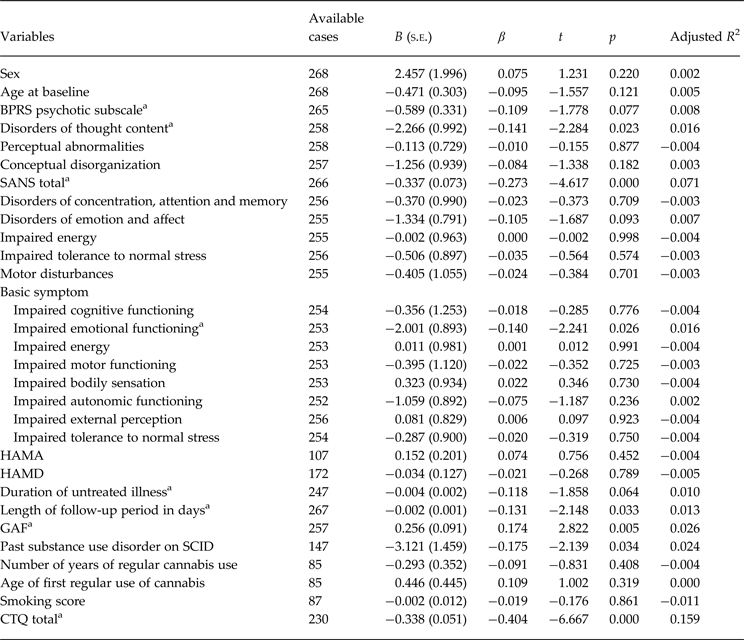
The results for the univariate analyses are presented in Table 1. Significant predictors of poor functioning were high levels of negative symptoms, poor functioning at baseline, history of childhood maltreatment, higher scores on the CAARMS disorders of thought content subscale, past substance use disorder, impaired emotional functioning and longer follow-up period (all p < 0.05). Positive symptoms, as measured by the BPRS psychotic subscale, the CAARMS disorders of emotion and affect subscale, and the duration of untreated illness all showed trends to significance (p < 0.1).
Univariate baseline predictors of SOFAS score at follow-up

β, Standardized regression coefficients; B, unstandardized regression coefficients; BPRS, Brief Psychiatric Rating Scale; CTQ, Childhood Trauma Questionnaire; GAF, Global Assessment of Functioning; HAMA, Hamilton Rating Scale for Anxiety; HAMD, Hamilton Rating Scale for Depression; SANS, Scale for the Assessment of Negative Symptoms; SCID, Structured Clinical Interview for DSM-IV; SOFAS, Social and Occupational Functioning Assessment Scale.
a Included in subsequent multivariate linear regression analyses.
The disorders of emotion and affect subscale of the CAARMS was not included in subsequent multivariate analyses due to high correlation with both the SANS total (r = 0.504, p < 0.001) and impaired emotional functioning (basic symptom) item (r = 0.798, p < 0.001). Past substance use disorder according to the SCID was also a significant univariate predictor; however, this was not retained for use in multivariate analyses due to a large number of missing data points.
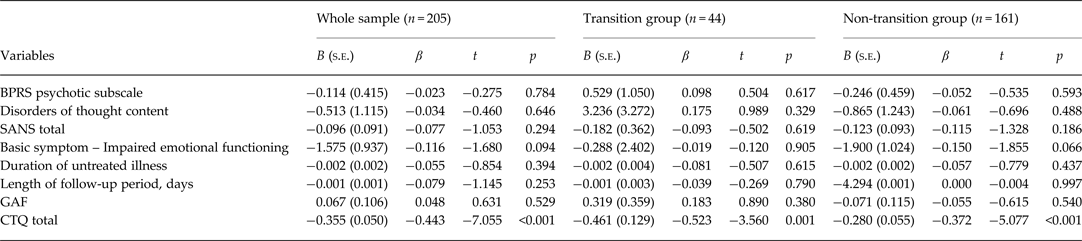
The BPRS psychotic subscale, CAARMS disorder of thought content subscale, SANS total, the impaired emotional functioning item, duration of untreated illness, baseline GAF score, CTQ total and length of follow-up period were entered simultaneously into a multivariate linear regression. The sample had a mean SOFAS score at follow-up of 69.35 (s.d. = 15.037). The results for the multivariate analyses are presented in Table 2. CTQ total was the only significant predictor (β = −0.443, p < 0.001), the model accounting for 21% of variance in SOFAS scores (adjusted R 2 = 0.210) (see Table 2).
Multivariate analyses of predictors of SOFAS score at follow-up for whole sample, and split according to transition status at follow-up

β, Standardized regression coefficients; B, unstandardized regression coefficients; BPRS: Brief Psychiatric Rating Scale; CTQ, Childhood Trauma Questionnaire; GAF, Global Assessment of Functioning; SANS, Scale for the Assessment of Negative Symptoms; SOFAS, Social and Occupational Functioning Assessment Scale.
Transition status and functioning
An independent samples t test in the whole sample of 268 indicated that SOFAS scores at follow-up were significantly lower in those patients that transitioned to psychosis (mean = 59.12, s.d. = 18.54) compared to those that had not (mean = 70.89, s.d. = 14.00; t 266 = 5.58, p < 0.001). We reran the multivariate regression adjusting for transition status at follow-up and found that both CTQ total (β = −0.426, p < 0.001) and transition status (β = −0.152, p = 0.030) were significant independent predictors of outcome. The model accounted for 22% of the variance in SOFAS scores at follow-up (adjusted R 2 = 0.225).
We then split the sample according to transition status at follow-up and reran the original multivariate linear regression separately for each group (Table 2). Both models were significant, accounting for 22% and 17% of variance in SOFAS scores in the transitioned (adjusted R 2 = 0.228) and non-transitioned groups (adjusted R 2 = 0.170), respectively. CTQ total remained the only significant predictor in both the transitioned (β = −0.523, p = 0.001) and non-transitioned (β = −0.372, p < 0.001) groups.
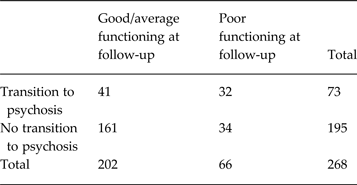
We then examined the dichotomized ‘good’ v. ‘poor’ outcome groups defined by latent group analyses. Here, 24.8% of the sample was in the poor functional outcome group (mean QLS = 60.55, s.d. = 17.68; mean SOFAS = 46.54, s.d. = 8.65) and 75.2% in the good outcome group (mean QLS = 108.52, s.d. = 11.64; mean SOFAS = 74.73, s.d. = 11.25). Using membership of these categories as outcome, we aimed to determine how effective transition status was at predicting poor long-term functioning (similar to assessing the usefulness of a screening test to detect cancer, for example). A 2 × 2 table was created using transition status (transition/no transition) and (good/poor outcome) – see Table 3. The rates of poor long-term outcome were 24.6% in the whole sample, 43.8% in those who transitioned and 17.4% in those who did not transition. Transition was significantly associated with poor outcome (Pearson χ 2 < 0.0001).
Transition status as a predictor of poor outcome

Sensitivity = 0.485 [95% confidence interval (CI) 0.361–0.610].
Specificity = 0.797 (95% CI 0.734–0.849).
Positive predictive value = 0.438 (95% CI 0.324–0.559).
Negative predictive value = 0.826 (95% CI 0.763–0.875).
Post-hoc analyses
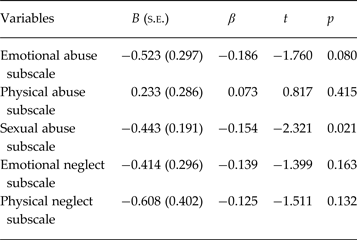
Post-hoc analyses were conducted to further investigate the relationship between childhood maltreatment and functioning. An independent samples t test indicated that CTQ total score did not significantly differ between those patients who did (mean = 50.44, s.d. = 20.20) and did not (mean = 47.14, s.d. = 17.95) transition (t 228 = −1.148, p = 0.252). We examined the individual subscales of the CTQ in a multivariate regression to determine if any particular type of childhood maltreatment predicted poor functioning. Sexual abuse was the only significant predictor (β = −0.154, p = 0.021) (see Table 4).
Post-hoc multivariate analysis of CTQ subscales predicting SOFAS score at follow-up

β, Standardized regression coefficients; B, unstandardized regression coefficients; CTQ, Childhood Trauma Questionnaire; SOFAS, Social and Occupational Functioning Assessment Scale.
Given that childhood maltreatment is associated with high levels of depression and anxiety in later life (Chapman et al. Reference Chapman, Whitfield, Felitti, Dube, Edwards and Anda2004), we wanted to establish whether the apparent association between it and poor functioning was in fact due to current depression and/or anxiety. A univariate regression revealed that depression and anxiety at follow-up were associated with poor functioning. However in a multivariate linear regression that included follow-up (current) positive and negative symptoms, CTQ and baseline functioning, current depression and anxiety were no longer significantly associated with low functioning, but current negative symptoms and childhood maltreatment were. In other words, poor functioning at follow-up could not be attributed to current levels of anxiety and depression. Negative symptoms at follow-up and history of child maltreatment accounted for nearly 60% of the variance in SOFAS scores at follow-up. In a further analysis, we analysed transitioned and non-transitioned cases separately (see Table 5). The results were the same: neither depression nor anxiety was associated with functioning, while negative symptoms at follow-up and childhood maltreatment were, accounting for 66% of the variance in the transitioned group and 53% of the variance in the non-transitioned group.
Multivariate analysis of association between functioning and symptom scores at follow-up

β, Standardized regression coefficients; B, unstandardized regression coefficients; BPRS, Brief Psychiatric Rating Scale; CTQ, Childhood Trauma Questionnaire; GAF, Global Assessment of Functioning; HAMA, Hamilton Rating Scale for Anxiety; HAMD, Hamilton Rating Scale for Depression; SANS, Scale for the Assessment of Negative Symptom.
In a further post-hoc analysis we examined the relationship between childhood trauma and neurocognitive functioning by assessing correlations between CTQ scores and the neurocognitive deficits previously found to be associated with poor functioning in our earlier paper (Lin et al. Reference Lin, Wood, Nelson, Brewer, Spiliotacopoulos, Bruxner, Broussard, Pantelis and Yung2011). These were tests of verbal memory, verbal fluency and processing speed. No correlation was found in any of these measures (data available on request). However only a small number of participants (n = 46–48) had data on both CTQ and these specific neurocognitive assessments.
Discussion
This follow-up study of a large sample of UHR individuals examined risk factors for poor functioning in the long term. This paper adds to our previous study in the same group investigating neurocognitive predictors of functional outcome (Lin et al. Reference Lin, Wood, Nelson, Brewer, Spiliotacopoulos, Bruxner, Broussard, Pantelis and Yung2011). Childhood maltreatment and development of psychotic disorder were independent predictors of poor functional outcome.
Consistent with other research (Cotter et al. Reference Cotter, Drake, Bucci, Firth, Edge and Yung2014), we did not find an association between positive psychotic symptoms and functioning at follow-up. Expected associations between long-term poor functioning and high baseline negative and disorganized symptoms (Carrión et al. Reference Carrión, McLaughlin, Goldberg, Auther, Olsen, Olvet, Correll and Cornblatt2013; Meyer et al. Reference Meyer, Carrión, Cornblatt, Addington, Cadenhead, Cannon, McGlashan, Perkins, Tsuang, Walker, Woods, Heinssen and Seidman2014), and long duration of symptoms (Fusar-Poli et al. Reference Fusar-Poli, Meneghelli, Valmaggia, Allen, Galvan, McGuire and Cocchi2009) were not found after controlling for other variables. However, individuals with higher baseline negative symptoms were less likely to have follow-up assessments than those with lower negative symptoms, possibly biasing our study against finding an association between baseline negative symptoms and low functioning. A cross-sectional association was found between negative symptoms at follow-up and long term poor functioning, in both transitioned and non-transitioned groups even after controlling for baseline functioning and childhood maltreatment.
Childhood maltreatment and poor functioning
Childhood maltreatment is associated with risk for a range of psychotic and non-psychotic disorders (Janssen et al. Reference Janssen, Krabbendam, Bak, Hanssen, Vollebergh, de Graaf and van Os2004; Ball & Links, Reference Ball and Links2009; Chen et al. Reference Chen, Murad, Paras, Colbenson, Sattler, Goranson, Elamin, Seime, Shinozaki, Prokop and Zirakzadeh2010; Thompson et al. Reference Thompson, Nelson, McNab, Simmons, Leicester, McGorry, Bechdolf and Yung2010; Varese et al. Reference Varese, Smeets, Drukker, Lieverse, Lataster, Viechtbauer, Read, van Os and Bentall2012) and is associated with poor functioning regardless of diagnosis (Cotter et al. Reference Cotter, Kaess and Yung2015). History of childhood trauma is common in the UHR group (Kraan et al. Reference Kraan, Velthorst, Smit, de Haan and van der Gaag2015). Explanations for the link between childhood trauma and poor functioning include psychosocial and biological models. For example, being abused in childhood may lead to insecure attachment and paranoid world view (Lovatt et al. Reference Lovatt, Mason, Brett and Peters2010), low self-esteem (Fowke et al. Reference Fowke, Ross and Ashcroft2012), behavioural hostility (Lysaker et al. Reference Lysaker, Wright, Clements and Plascak-Hallberg2002) and perceived discrimination (Addington et al. Reference Addington, Stowkowy, Cadenhead, Cornblatt, McGlashan, Perkins, Seidman, Tsuang, Walker, Woods and Cannon2013), all of which could result in difficulties forming relationships and maintaining employment.
Childhood maltreatment is also associated with detrimental effects on the developing brain, such as reduced volume of the amygdala (Aas et al. Reference Aas, Navari, Gibbs, Mondelli, Fisher, Morgan, Morgan, MacCabe, Reichenberg, Zanelli, Fearon, Jones, Murray, Pariante and Dazzan2012; Hoy et al. Reference Hoy, Barrett, Shannon, Campbell, Watson, Rushe, Shevlin, Bai, Cooper and Mulholland2012), hippocampus (Hoy et al. Reference Hoy, Barrett, Shannon, Campbell, Watson, Rushe, Shevlin, Bai, Cooper and Mulholland2012), ventrolateral prefrontal cortex (Morandotti et al. Reference Morandotti, Dima, Jogia, Frangou, Sala, Vidovich, Lazzaretti, Gambini, Marraffini, d'Allio, Barale, Zappoli, Caverzasi and Brambilla2013) and in total grey matter (Sheffield et al. Reference Sheffield, Williams, Woodward and Heckers2013). It may modify sensitivity to stress among patients with psychosis, potentially through dysregulation of the hypothalamic-pituitary-adrenal (HPA) axis (Neigh et al. Reference Neigh, Gillespie and Nemeroff2009; Lardinois et al. Reference Lardinois, Lataster, Mengelers, Van Os and Myin-Germeys2011; Frodl & O'Keane, Reference Frodl and O'Keane2013). Childhood stress is thought to initially cause hyperactivation of the HPA axis resulting in hippocampal damage. The damaged hippocampus, which normally mediates feedback inhibition on the HPA axis, can then no longer respond effectively, leading to further cortisol secretion and a cascade of hippocampal damage (Sapolsky et al. Reference Sapolsky, Krey and McEwen1986). There is also evidence of long term HPA axis hypoactivation (Elzinga et al. Reference Elzinga, Roelofs, Tollenaar, Bakvis, van Pelt and Spinhoven2008), including in the UHR group (Pruessner et al. Reference Pruessner, Béchard-Evans, Boekestyn, Iyer, Pruessner and Malla2013; Day et al. Reference Day, Valmaggia, Mondelli, Papadopoulos, Papadopoulos, Pariante and McGuire2014). This may then impact on brain regions rich in glucocorticoids receptors, such as the prefrontal cortex, contributing to cognitive impairment. Stress has also been associated with neuroinflammation, that in turns affects brain-derived neurotrophic factor, neurogenesis and hippocampal volume and there is evidence linking childhood trauma and markers of inflammation (Mondelli et al. Reference Mondelli, Cattaneo, Belvederi Murri, Di Forti, Handley, Hepgul, Miorelli, Navari, Papadopoulos, Aitchison, Morgan, Murray, Dazzan and Pariante2011; Dennison et al. Reference Dennison, McKernan, Cryan and Dinan2012).
It is therefore not surprising that childhood trauma is associated with a range of neurocognitive deficits, in both the general adult population (Mills et al. Reference Mills, Alati, O'Callaghan, Najman, Williams, Bor and Strathearn2011; Sideli et al. Reference Sideli, Fisher, Russo, Murray, Stilo, Wiffen, O'Connor, Aurora Falcone, Pintore, Ferraro, Mule’, La Barbera, Morgan and Di Forti2014), depressed patients (Frodl & O'Keane, Reference Frodl and O'Keane2013) and in individuals with schizophrenia spectrum disorders (Shannon et al. Reference Shannon, Douse, McCusker, Feeney, Barrett and Mulholland2011; Aas et al. Reference Aas, Dazzan, Mondelli, Melle, Murray and Pariante2014). The effect of neurocognitive impairments on functional ability is consistent with the association between childhood trauma and poor premorbid adjustment in the UHR group (Tikka et al. Reference Tikka, Luutonen, Ilonen, Tuominen, Kotimäki, Hankala and Salokangas2013).
However, we did not find a correlation between history of childhood maltreatment and neurocognitive dysfunction. One explanation for this is the low numbers of participants who had both cognition and childhood maltreatment assessed and it is likely that our post-hoc analysis was underpowered to detect an association between these factors. Alternatively, it may also be that childhood maltreatment and neurocognitive deficits drive poor functioning through different pathways. Thus individuals with a history of maltreatment may develop psychosis and cope poorly through psychological and social processes noted above. Other individuals may have a more ‘neurodevelopmental’ schizophrenia, with early cognitive difficulties manifested as delayed development (Jones et al. Reference Jones, Rodgers, Murray and Marmot1994) and later as onset of positive and negative symptoms and neurocognitive dysfunction. It is relevant to note here that Sideli et al. (Reference Sideli, Fisher, Russo, Murray, Stilo, Wiffen, O'Connor, Aurora Falcone, Pintore, Ferraro, Mule’, La Barbera, Morgan and Di Forti2014) failed to find an association between childhood maltreatment and cognition in a first episode psychosis sample.
Other individuals may have a combination of the two pathways, with early trauma making them sensitive to stress and this chronic stress impacting on the structure and function of the brain and social interactions. There is also evidence for gene environment interaction, with some individuals more vulnerable to neurocognitive impairment following childhood maltreatment than others (Aas et al. Reference Aas, Haukvik, Djurovic, Bergmann, Athanasiu, Tesli, Hellvin, Steen, Agartz, Lorentzen, Sundet, Andreassen and Melle2013).
Clinically, our findings indicate that it is important to assess history of childhood maltreatment and take this into account in management. Treatment that combines principles of Dialectical Behaviour Therapy (DBT; Linehan, Reference Linehan1993) and trauma-focused interventions seems to be effective in women with borderline personality disorder with a history of childhood sexual abuse (Bohus et al. Reference Bohus, Dyer, Priebe, Krüger, Kleindienst, Schmahl, Niedtfeld and Steil2013) and eye movement desensitization and reprocessing (EMDR) may be helpful for people with psychotic disorder and post-traumatic stress disorder (van den Berg & van der Gaag, Reference van den Berg and van der Gaag2012 ). These may be considered for UHR individuals. Cognitive remediation therapy may improve functioning (Wykes et al. Reference Wykes, Huddy, Cellard, McGurk and Czobor2011; Statucka & Walder, Reference Statucka and Walder2013), given that neurocognitive and social cognitive deficits are often associated with a history of childhood trauma. Potential difficulties with adherence and therapeutic alliance need to be acknowledged and managed to minimize treatment disengagement.
Transition to psychotic disorder and poor functioning
As hypothesized, development of psychotic disorder was associated with poor functioning in this UHR cohort. It may seem obvious that individuals who develop a psychotic disorder would have lower functioning than those who do not develop a psychotic disorder. However, as we defined transition as development of psychotic disorder at any time after baseline assessment, it is possible that an individual could have transitioned and then recovered and could be functioning well at later follow-up (Yung et al. Reference Yung, Nelson, Thompson and Wood2010). Indeed Salokangas et al. (Reference Salokangas, Nieman, Heinimaa, Svirskis, Luutonen, From, von Reventlow, Juckel, Linszen, Dingemans, Birchwood, Patterson, Schultze-Lutter, Klosterkötter and Ruhrmann2013), studying a similar population at risk of psychosis, found no difference in psychosocial outcome between individuals who developed psychosis and those who did not.
Our study found that the transitioned group had a mean SOFAS score of 59 and a 43.8% chance of functioning poorly at long-term follow-up. This is consistent with rates of poor functioning and lack of recovery in schizophrenia (Hill et al. Reference Hill, Crumlish, Clarke, Whitty, Owens, Renwick, Browne, Macklin, Kinsella, Larkin, Waddington and O'Callaghan2012; Ten Velden Hegelstad et al. Reference Ten Velden Hegelstad, Haahr, Larsen, Auestad, Barder, Evensen, Joa, Johannessen, Langeveld, Melle, Opjordsmoen, Rossberg, Rund, Simonsen, Vaglum, McGlashan and Friis2013) and with the finding that about 70% of UHR individuals who develop psychosis have a diagnosis of schizophrenia (Fusar-Poli et al. Reference Fusar-Poli, Bechdolf, Taylor, Bonoldi, Carpenter, Yung and McGuire2013a ). It also aligns with the findings of structural brain changes around the time of transition (Wood et al. Reference Wood, Yung, McGorry and Pantelis2011; Ziermans et al. Reference Ziermans, Schothorst, Schnack, Koolschijn, Kahn, van Engeland and Durston2012). Thus although the definition of transition is arbitrary, it is roughly correct in terms of identifying a discontinuity from one phase to another in progression of illness, as hypothesized by the staging model (Wood et al. Reference Wood, Yung, McGorry and Pantelis2011; Lin et al. Reference Lin, Reniers and Wood2013a ). In the group that did not develop psychosis, 17.4% had poor functioning at long-term follow-up, which was associated with negative symptoms. It may be that such individuals have developed a deficit-type syndrome, but without ever developing full threshold psychotic symptoms, similar to the concept of schizotaxia (Tsuang et al. Reference Tsuang, Stone, Gamma and Faraone2003).
Depression and anxiety at follow-up were not associated with poor functioning, in either the transitioned or non-transitioned group. These findings are relevant to recent criticism that UHR individuals are not truly at risk of schizophrenia but are simply people with anxiety and depression who have co-occurring psychotic-like experiences (Wigman et al. Reference Wigman, van Nierop, Vollebergh, Lieb, Beesdo-Baum, Wittchen and van Os2012; Stochl et al. Reference Stochl, Khandaker, Lewis, Perez, Goodyer, Zammit, Sullivan, Croudace and Jones2015). Our findings have strengthened the argument that a subgroup of UHR individuals develop a schizophrenia spectrum disorder.
Strengths and limitations
A limitation of our study was that the follow-up time of our sample varied between 2.39 and 14.87 years post-identification. Those with a shorter follow-up time remain at risk of psychosis and poor functional outcome and should ideally be reassessed in the longer term, although the number of individuals is likely to be small. However, we did divide outcome data into epochs, consistent with our analysis of transition to psychosis (Nelson et al. Reference Nelson, Yuen, Wood, Lin, Spiliotacopoulos, Bruxner, Broussard, Simmons, Foley, Brewer, Francey, Amminger, Thompson, McGorry and Yung2013), and results did not change significantly. A further limitation was the use of the CTQ to assess childhood maltreatment. This measure does not assess frequency or age at which maltreatment occurred. Additionally, we did not include the CTQ at baseline assessment; rather it was added at the time of long-term follow-up, raising the possibility of recall bias. However, recollection of childhood trauma has been shown to be reliable in patients with psychosis (Fisher et al. Reference Fisher, Craig, Fearon, Morgan, Dazzan, Lappin, Hutchinson, Doody, Jones, McGuffin, Murray, Leff and Morgan2011). Another limitation was our assessment of functioning. Functioning is complex, consisting of role and social functioning and subjective quality of life (Cotter et al. Reference Cotter, Drake, Bucci, Firth, Edge and Yung2014). Ideally these different aspects would have been measured, but we instead used the SOFAS that provides a single global measure. Further, we were unable to assess the association between substance use and poor functioning due to low numbers. This is a limitation since substance use has been associated with poor functioning in schizophrenia (Kerfoot et al. Reference Kerfoot, Rosenheck, Petrakis, Swartz, Keefe, McEvoy and Stroup2011; Schmidt et al. Reference Schmidt, Hesse and Lykke2011), but paradoxically UHR patients who abused cannabis and developed psychosis had better social functioning than those who transitioned in the absence of cannabis abuse (Auther et al. Reference Auther, McLaughlin, Carrión, Nagachandran, Correll and Cornblatt2012). This may be because the latter group had a more ‘neurodevelopmental’ disorder such that they developed psychosis in the absence of substance use, while the former group perhaps would not have developed psychosis had they not abused cannabis. Clearly another limitation was the low number of participants who had both childhood maltreatment and neurocognitive functioning assessed, meaning that we could not draw firm conclusions about the association between these factors and could not elucidate the mechanisms by which history of trauma might affect functioning in the UHR group.
The strengths of this study are the large sample size from a single site that was followed up for a long period. The follow-up rate was good and we obtained comprehensive data on a range of possible predictors of functioning. Our findings have clinical implications and help to further characterize the UHR group. This is important given the debate about its inclusion as a diagnosis and its current status as ‘condition requiring further research’ in DSM5. We now have evidence that the UHR criteria identify a group with poor functioning over the longer term: 24.6% of the whole sample had poor long-term functioning, while 43.8% of the transitioned group had poor functioning, similar to rates in schizophrenia.
Acknowledgements
This work was supported by National Health and Medical Research Council (NHMRC) programme grants (350241 and 566529) to A.R.Y., S.J.W. and P.M., the Colonial Foundation, and an unrestricted research grant from Janssen-Cilag. A.R.Y., S.J.W. and B.N. were supported by NHMRC Awards and B.N. by a Griffith Fellowship. A.L. is currently supported by an NHMRC Award (no. 1072593). No funding source played any role in the collection, analysis, interpretation, or publication of data.
Declaration of Interest
Professor Yung has received a research grant from Janssen-Cilag, honoraria from Janssen-Cilag and grant funding from NARSAD. Professor McGorry has received grant funding from NARSAD and funding from AstraZeneca, Eli Lilly, Janssen-Cilag, Pfizer, and Novartis, and honoraria from AstraZeneca, Eli Lilly, Janssen-Cilag, Pfizer, Bristol-Myers Squibb, Roche, and the Lundbeck Institute. The other authors report no financial relationships with commercial interests.