Introduction
Intimate partner violence (IPV) against women exists in almost all societies (Campbell et al., Reference Campbell, Jones, Dienemann, Kub, Schollenberger, O'Campo, Gielen and Wynne2002; Okemgbo et al., Reference Okemgbo, Omideyi and Odimegwu2002; Watts & Zimmerman, Reference Watts and Zimmerman2002; WHO, 2002) and is associated with considerable mortality (Campbell et al., Reference Campbell, Jones, Dienemann, Kub, Schollenberger, O'Campo, Gielen and Wynne2002; WHO, 2002). A troubling aspect of IPV against women is that some societies and cultures justify acts of violence as a husband's right to physically reprimand his wife when her behaviour deviates from or defies what is considered socially or personally acceptable (Visaria, Reference Visaria2000). Furthermore it has been shown that living in societies where various forms of violence are socially accepted may be a risk factor for women to be victimized by IPV (Jewkes, Reference Jewkes2002). Yet few studies have examined norms as risk factors in justifying IPV perpetration (Koenig et al., Reference Koenig, Stephenson, Ahmed, Jejeebhoy and Campbell2006). In a sample of 5109 women in Uganda, younger age was associated with the acceptance of IPV and women were more likely than men to justify IPV perpetration (Koenig et al., Reference Koenig, Lutalo, Wabwire-Mangen, Kiwanuka, Wagman and Zhao2003b). In the United States, however, younger men were more likely to justify IPV perpetration compared with young women (Simon et al., Reference Simon, Anderson, Thompson, Crosby, Shelley and Sacks2001). A study conducted in Zimbabwe found that younger age, residing in rural versus urban areas, lower household income, unemployment and less than secondary education were associated with justifying IPV perpetration (Hindin, Reference Hindin2003). Associations between acceptance of IPV and a number of demographic, social and empowerment factors were examined among women in Zambia, and among other things, a history of IPV was found to be significantly associated with acceptance of this violence (Lawoko, 2006).
Various studies have shown that attitude towards IPV is one of the strongest predictors of IPV against women when compared with other possible factors, such as social and empowerment factors (Faramarzi et al., Reference Faramarzi, Esmailzadeh and Mosavi2005; Gage & Hutchinson, Reference Gage and Hutchinson2006; Lawoko, Reference Lawoko2008). In fact, attitudes that support IPV against women may be an indicator of greater societal problems (Oyediran & Isiugo-Abanihe, Reference Oyediran and Isiugo-Abanihe2005). In other words, high acceptance of IPV against women may be related to high levels of acceptance of violence to resolve any conflict and acceptance of violence as an instrument of retribution (Oyediran & Isiugo-Abanihe, Reference Oyediran and Isiugo-Abanihe2005). As has been emphasized by a number of scholars (Gracia, Reference Gracia2004; Gracia & Herrero, Reference Gracia and Herrero2006), without fundamental change in social attitudes that justify and condone IPV against women, substantially reducing its alarming rates alone will not provide an effective response to this problem. More importantly, women's own attitudes of condemnation regarding IPV may be an important factor in changing its prevalence. Most studies in low- and middle-income countries examining IPV against women have focused on prevalence rates and its determinants (Campbell et al., Reference Campbell, Jones, Dienemann, Kub, Schollenberger, O'Campo, Gielen and Wynne2002; Okemgbo et al., Reference Okemgbo, Omideyi and Odimegwu2002; Moore et al., Reference Moore, Stuart, Meehan, Rhatigan, Hellmuth and Keen2008), and fewer studies have focused specifically on the underlying attitudes towards IPV against women (Hindin, Reference Hindin2003; Rani et al., Reference Rani, Bonu and Diop-Sidibe2004; Lawoko, Reference Lawoko2008; Uthman et al., Reference Uthman, Lawoko and Moradi2009).
Attitudes towards intimate partner violence
Social norms and gender roles in patriarchal societies are learned within the social group and passed on to future generations. The custom of male dominance is practised and maintained in many societies through rigid gender norms and social practices such as polygamy, the sale of women for marriage and other practices that result in disempowerment among women in areas such as education, employment, finances and social status. Rani et al. (Reference Rani, Bonu and Diop-Sidibe2004) maintain that factors promoting intolerant attitudes towards IPV against women operate mainly via three mechanisms: (1) producing a conflict between reality and myth of male superiority, (2) exposing people to more egalitarian social networks and authority structures other than kin-based ones, and (3) exposing people to non-conformist ideas through modern media. Since poverty may increase chances of conflict over resources, it is likely that individuals growing up in disadvantaged communities with low socioeconomic status are often exposed to violence within the home and community, resulting in high levels of justification for the use of violence to resolve conflicts. On the other hand, the ‘just world hypothesis’ posits that a ‘just world’ is a safe, just place where people get what they deserve, and is a place where individuals believe that the social system that affects them is fair, legitimate and justifiable (Kay et al., Reference Kay, Jost and Young2005). Individuals perceive that good things happen to good people, and bad things to bad people (Idisis et al., Reference Idisis, Ben-David and Ben-David2007). With such beliefs, people may view being a victim of violence as being partly their own fault (Johnson et al., Reference Johnson, Mullick and Mulford2002). Therefore the just world hypothesis provides a way for these individuals to cope and restore their faith in the world by blaming victims for their own misfortunes (Walster, Reference Walster1966).
Previous studies among students have revealed that attitudes supporting patriarchal practices are positively correlated with attitudes justifying IPV, holding women responsible for their victimization, and that violent men are not responsible for their behaviour towards women (Glick et al., Reference Glick, Sakalli-Ugurlu, Ferreira and de Souza2002; Haj-Yahia & de Zoysa, Reference Haj-Yahia and de Zoysa2007). Researchers have also investigated the effects of factors such as gender, IPV severity, previous IPV exposure and current relationship status on individual attitudes to IPV (Sugarman & Cohn, Reference Sugarman and Cohn1986; Bethke & Dejoy, Reference Bethke and Dejoy1993). The findings indicate that women are more likely than men to place responsibility for both causing and resolving the violent conflict on their male partners. In addition, the findings reveal that male partners are perceived as having more control in the relationship to solve conflicts. Violent behaviour perpetrated by female partners has also been found to affect attitudes justifying consequences of the violence, including terminating the relationship. In addition, violent behaviour perpetrated by male partners was judged in Bethke & DeJoy's (Reference Bethke and Dejoy1993) study as less acceptable, more injurious and more criminal than such behaviour by female partners.
Coleman & Stith (Reference Coleman and Stith1997) conducted one of the few studies on beliefs about IPV. The findings of the study, which focused specifically on female nursing students, revealed that the more students maintained egalitarian sex-role attitudes, the greater their sympathy toward victims of IPV. Although most of the research on IPV has been conducted in developed nations, a growing body of research from the developing world has explored attitudes toward IPV. Most data on prevalence has been collected in Latin America, where between 8% and 32% of men and women report that IPV is justified in cases of suspected infidelity (Heise et al., Reference Heise, Ellsberg and Gottemoeller1999). Among the top reasons for society accepting IPV towards women are refusing to have sex and neglecting the children. Evidence taken from different settings like South African male and female public health care nurses (Kim & Motsei, Reference Kim and Motsei2002), women in a community-based study in Uganda (Koenig et al., Reference Koenig, Lutalo, Wabwire-Mangen, Kiwanuka, Wagman and Zhao2003b) and women from two regions in India (Jejeebhoy, Reference Jejeebhoy1998), also indicates that IPV is considered to be typical in marital relationships; IPV was justified by 41–90% of the female respondents in at least one situation.
Justifying intimate partner violence in Bangladesh
Intimate partner violence against women in Bangladesh is a common phenomenon. Several studies in Bangladesh, including the nationally represented BDHS (Bangladesh Demographic and Health Survey 2007), found that from 40% to 60% of women experienced violence from their husband during the last year (Khan et al., Reference Khan, Rob and Hossain2000; Koenig et al., Reference Koenig, Ahmed, Hossain and Khorshed Alam Mozumder2003a; Bhuiya et al., Reference Bhuiya, Sharmin and Hanifi2003; Bates et al., Reference Bates, Schuler, Islam and Islam2004; NIPORT et al., 2008). In Bangladesh society, women's status is determined in large part by their husband's identity (Zaman, Reference Zaman1999). As wives, women are expected to sacrifice self-fulfilling ambitions to the needs of their husbands. In addition, women are susceptible to IPV victimization due to Islamic laws. Some scholars have pointed out that the precedence accorded to sharia (Islamic personal law) limits women's rights in every personal or family matter (Jahan, Reference Jahan1994; Zaman, Reference Zaman1999). Moreover, men, in Islamic law, are given the right to polygamy, unilateral divorce, double share of inheritance and guardianship over wife and children; consequently, they create or expand the differences between men and women thus creating an imbalance in power and control. As expected, studies in Bangladesh have reflected that men justify violence through their patriarchal beliefs. A study conducted by Bhuiya et al. (Reference Bhuiya, Sharmin and Hanifi2003) found that IPV against women was justified when wives question their husbands regarding day-to-day matters (29%), fail to perform household work (11.5%), fail to take proper care of children (10%), do not conform to wearing veils or perform other expected customs (3%), and refuse to bring money from their family of origin (3%), as well as husbands' day-to-day frustrations (2%). Another study also found that men justified IPV if their wives failed in their family duties and if they were not being submissive (Johnson & Das, Reference Johnson and Das2009).
Recent data in Bangladesh suggest that 23.6%, 21.5%, 17.9%, 16.0%, 9.1% and 36.1% of women justified wife beating on the ground of, respectively, if a wife does not obey elders, argues with her husband, goes out without telling her husband, neglects the children or refuses to have sexual intercourse with him (NIPORT et al., 2008). The proportion of men who find physical violence against women justifiable is similar to that of women. Overall, 36% of Bangladeshi men aged 15–49 agree that at least one of the reasons given is sufficient justification for wife beating, whereas more than a third or 36.1% of women agreed with at least one specified reason for justifying wife beating (NIPORT et al., 2008). The same report also revealed that the pattern of justifying varied across different characteristics. For example, wife beating was justified more by women who were unemployed (36.7%) than employed for cash (36.0%) and employed not for cash (30%), currently married (36.3%) rather than divorced/separated/widowed (34.2%) and rural women (37.6%) than their urban counterparts (31.1%). However, justification was lower for women with twelve or more years of education (25.5%) than those with no education (35.6%), and for those in the highest wealth status quintile (28.3%) than those in the lowest quintile (37.3%). Nonetheless, in a qualitative study in men and women in Bangladesh, Schuler et al. (Reference Schuler, Lenzi and Yount2011) suggests that limitations in questionnaire designed in the BDHS may under-represent the proportions of women who justified IPV.
Knowing the extent and reasons for justifying IPV against women in a particular setting is important (Rani et al., 2004) because social and cultural acceptance of IPV may lead to encouraging such behaviour and may hinder progress towards shifting such practices. More importantly, understanding deep-rooted factors related to justifying and condoning IPV against women may be elemental to designing effective programmes. Social acceptance of IPV against women can often indicate women's status within that social and cultural setting. Levels of justification of IPV against women may be one way to provide insights into the social, cultural and behavioural makeup of a specific society's evolution towards a more gender-egalitarian society. However, studies on attitudes towards IPV against women are absent for Bangladesh. Although Bhuiya et al. (Reference Bhuiya, Sharmin and Hanifi2003) conducted a study on violence against women, their study mainly focused on the nature and types of IPV rather than women's attitude towards IPV. More importantly, the perspectives of women on this issue in disadvantaged areas have been neglected.
The present study is an attempt to a) identify the level of women's justification of IPV against women and b) examine the factors that determine women's attitude towards justifying IPV. The current study examined the factors related to socio-demographic, mass media exposure and women's decision-making authority that influence justification of IPV. In particular, the study focuses on the following hypotheses: (1) the higher the participant's education the lower the justification of IPV, (2) the higher the husband's education the lower the justification of IPV, (3) the higher the wealth status the lower the justification of IPV, (4) the higher the number of family members the lower the justification of IPV, (5) the higher the exposure to mass media the lower the justification of IPV, (6) the higher the age the higher the justification of IPV, (7) the higher the participant's age at marriage the higher the justification of IPV, (8) the higher the experience of violence the higher justification of IPV, (9) the higher the decision-making authority the lower the justification of IPV, and (10) women receiving micro-credit (small scale loan or financial assistance) have lower tendency to justify IPV.
Methods
Participants
Study participants included 331 disadvantaged women from five selected areas of Dhaka city. The participants were married, of reproductive age and living in slum areas during the survey. Married women were selected because intimate partner violence is usually observed after marriage. Although dating violence may be found between two partners, such violence is not easy to find, especially in the Bangladesh context because of perceived social stigma of having an affair among women in this country, which may compel them not to reveal such sensitive issues prior to marriage. However, it is quite easy for researchers to investigate women's attitude towards intimate partner violence among married women.
Procedures
In the first stage, a Bengali language draft questionnaire was prepared in discussion with the three researchers. The draft questionnaire was given to all three researchers who separately read through the questionnaire and noted comments. In the second stage, all the researchers sat with the noted comments, discussed and primarily finalized the questionnaire. The questionnaire was pilot-tested in five women of reproductive age. The final version of the questionnaire was developed incorporating the insights gained through the pilot test. The final version included questions pertaining to socio-demographic factors, mass media exposure and women's decision-making authority, as well as modified measurement for women's justification of IPV. The original attitude-measuring scale that was translated into Bengali by two linguists was discussed to maximize the accuracy. The scale was then translated back into English.
Five interviewers were recruited to collect data. Interviewers were trained before conducting the actual interview. Interviewers were provided with two days of interview training. Study content, obtaining informed consent, accurate data collection and building rapport with participants were emphasized. Two external professionals in addition to the study investigators provided training for the interviewers.
Trained interviewers went to a total of 400 households and asked a woman whether there was any married woman aged 15–49 years in the household. Out of 400 households, the interviewers found 384 households having at least one married woman within the specified age group who were present at that time. When approached, a total of 335 married women agreed; however, when interviewers attempted to obtain informed consent and brief women on the study purpose and contents, four women refused to take part in the study, resulting in a total of 331 women who provided informed consent and took part in the study. A total of 53 women refused to take part in the study at the initial approach. These women gave several reasons, such as the need to obtain the permission of their husbands or parents-in-law, not being interested in talking about this issue, and not having enough time to sit for a long time. The interviews were carried out in April 2010. On average, each interview took 20–30 minutes.
Measurements
Attitude towards justifying IPV
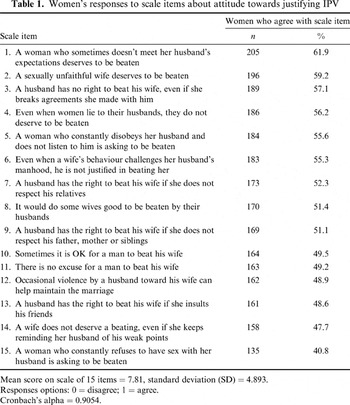
A shorter version of Haj-Yahia's (Reference Haj-Yahia2002, Reference Haj-Yahia2003) revised version of the Inventory of Beliefs about Wife Beating (IBWB) was used to measure women's attitudes to IPV against women. It should be noted that this scale was originally developed by Saunders et al. (Reference Saunders, Lynch, Grayson and Linz1987) and was utilized in this study to measure five beliefs about wife beating: more specifically, justifying IPV against wives. The Cronbach's alpha values were 0.86 for 15 items of the justifying wife-beating scale in Haj-Yahia's study. The Cronbach's alpha value for the current study was 0.91, suggesting that the internal consistency was strong enough to use them as a single combined score of justifying IPV, as an alpha value of 0.80 is probably reasonable (Gliem & Gliem, Reference Gliem and Gliem2003). However, there was a difference in the way the scale items were measured between the earlier study, which used a 7-point scale (ranging from 1=strongly disagree to 7=strongly agree) and the current study, which used a 2-point scale (ranging from 0=disagree and 1=agree). The total score of justifying was measured by summing individual item scores. The IBWB items are presented in Table 1.
Women's responses to scale items about attitude towards justifying IPV

Mean score on scale of 15 items=7.81, standard deviation (SD)=4.893.
Responses options: 0=disagree; 1=agree.
Cronbach's alpha=0.9054.
Explanatory variables
The study used socio-demographic factors, mass media exposure and women's decision-making authority as independent variables to identify the patterns of justifying intimate partner violence. The socio-demographic variables include: participant's age at time of interview (in complete years), education (in completed years of schooling), participant's age at time of marriage (in complete years), number of family members (total number of family members), women's decision-making authority (total score obtained in six indicators), husband's education (in completed years of schooling) and wealth status of family (score on nine household items). Wealth status of the family was measured by nine household items (i.e. radio/cassette player, active television, wall clock, motorcycle, bicycle, rickshaw/rickshaw van, steel/wood almirah/wardrobe, cot and mobile phone). If participants responded ‘yes’ to an individual indicator they scored 1, and they scored 0 if they responded ‘no’ to an individual indicator. Participants were asked to respond to all the indicators one by one. To obtain total scores, all the indicator scores were added together. Although two of the independent variables were categorical, these variables were treated as dichotomous, i.e. women's experiencing violence during last 12 months was measured as 0=no experience of physical violence during the last 12 months and 1=experienced physical violence during this time, while women's micro-credit status was measured as 0=no and 1=yes.
Women's exposure to mass media was used as an explanatory variable. It was measured with the number of types of mass media the participants were exposed to. The participants were asked if they: (1) watch television, (2) listen to the radio and (3) read newspapers. Each question was coded as 0 (no) or 1 (yes). Participants separately responded to each of these three types of mass media. The total score for mass media exposure was calculated by adding the scores for the three indicators.
Participant's decision-making authority was measured by six indicators used to measure women's decision-making authority in a national level survey, i.e. BDHS (NIPORT et al., 2008). These indicators included (1) participant's decision-making on own heath care, (2) health care of their children, (3) health care of husband, (4) major household purchases, (5) daily household purchases and (6) visiting the homes of relatives. For each question of decision-making authority, participants were provided with two response options: (1) decisions made by others (=0) and (2) decisions made by wife alone or both husband and wife jointly (=1). The scores of all the indicators were added together to get a total score of decision-making authority.
Statistical analyses
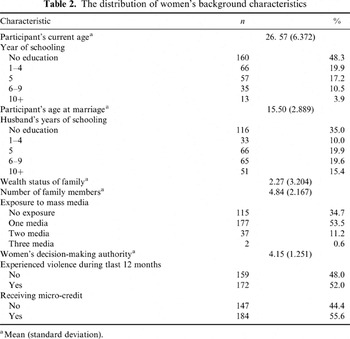
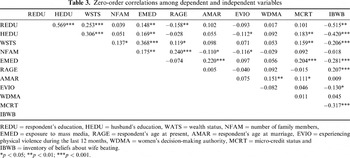
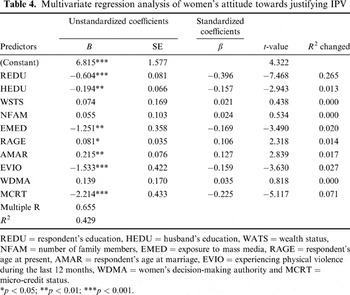
Three types of statistical analyses were conducted. First, descriptive statistics were calculated for each of the items that examined justifying IPV against women (frequency and percentages of each item are presented in Table 1). Additionally, independent variable percentages (presented in Table 2) were calculated. Secondly, Pearson correlation coefficients were calculated, as dependent and independent variables were interval level of measurement (De Vaus, Reference De Vaus2002). The study variables were: participant's education (REDU), husband's education (HEDU), wealth status (WATS), number of family members (NFAM), exposure to mass media (EMED), participant's age at the time of interview (RAGE), participant's age at the time of marriage (AMAR), experiencing physical violence during last 12 months (EVIO), women's decision-making authority (WDMA), micro-credit status (MCRT) and inventory of beliefs about wife beating (IBWB) (see Table 3 for details). Third, multivariate regression analysis was carried out for justifying IPV against women. All independent variables used in the bivariate correlations were used in the regression analysis. The linear regression technique was used as the dependent and independent variables had interval level of measurement (De Vaus, Reference De Vaus2002). The results of the multivariate analysis are presented in Table 4. Before conducting the multivariate regression analysis, multicollinearity was diagnosed with zero-order correlation. As no correlation coefficients reached 0.70, it was assumed that there was no multicollinearity (De Vaus, Reference De Vaus2002) and all the independent variables were entered into the regression analysis.
The distribution of women's background characteristics
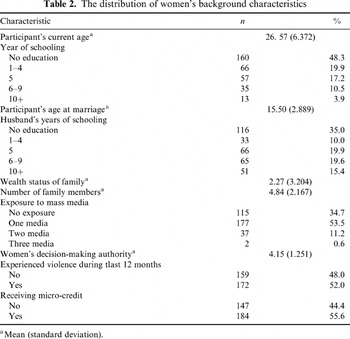
a Mean (standard deviation).
Zero-order correlations among dependent and independent variables

REDU=respondent's education, HEDU=husband's education, WATS=wealth status, NFAM=number of family members, EMED=exposure to mass media, RAGE=respondent's age at present, AMAR=respondent's age at marriage, EVIO=experiencing physical violence during the last 12 months, WDMA=women's decision-making authority, MCRT=micro-credit status and IBWB=inventory of beliefs about wife beating.
*p<0.05; **p<0.01; ***p<0.001.
Multivariate regression analysis of women's attitude towards justifying IPV

REDU=respondent's education, HEDU=husband's education, WATS=wealth status, NFAM=number of family members, EMED=exposure to mass media, RAGE=respondent's age at present, AMAR=respondent's age at marriage, EVIO=experiencing physical violence during the last 12 months, WDMA=women's decision-making authority and MCRT=micro-credit status.
*p<0.05; **p<0.01; ***p<0.001.
Results
Background characteristics
Participants ranged in age from 15 to 49 years, with an average age of 26.57 years (SD=6.372) (Table 2). The majority of the participants (51.7%) had some years of formal education. Of the participants, 19.9%, 17.2%, 10.5% and 3.9%, respectively, had not completed primary education (<5 years of schooling), completed primary (5 years of schooling), had not completed secondary (6–9 years of schooling) and completed secondary education or beyond (10 or more years of schooling). Approximately three-fifths of the participants' husbands (65.0%) had some years of formal education. Of the husbands who had some formal education, those who had not completed primary education, completed primary, had not completed secondary and completed secondary education or beyond were reported at 10.0%, 19.9%, 19.6% and 15.4%, respectively. On average, the participants had 4.84 family members (SD=2.167). Participant's age at marriage ranged from 9 years to 23 years with an average of 15.50 years (SD=2.889). Around three-fifths of participants (65.3%) had exposure to a number of types of mass media, i.e. 53.5%, 11.2% and 0.6% of participants had, respectively, one, two and three types of media exposure. A few participants (2.1%) reported that they had no decision-making authority, and the majority had some decision-making authority (ranging from one to six indicators of decision-making authority). On average, the participants made decisions alone/jointly with their husbands in 4.15 out of 6 indicators (SD=1.251). The wealth status of the participants was low, with participants having on average 2.27 household items out of 9 items (SD=3.204). The highest number of possessed household items was found to be 6 out of 9. The majority of participants (52.0%) had experienced physical violence during the last 12 months. The majority of the participants (55.6%) received micro-credit.
Justifying IPV
The mean score on the wife-beating scale of 15 items was 7.81 (SD=4.893) (Table 1). More than two-fifths of the participants (46.5%) were found to justify IPV on ≤5 out of 15 items, 14.4% justified on 6–10 items and 39.0% justified wife beating on 11–15 items. The most agreed scale item was ‘A woman who sometimes doesn't meet her husband's expectations deserves to be beaten’ (61.9%) whereas the least-agreed scale item was ‘A woman who constantly refuses to have sex with her husband is asking to be beaten’ (40.8%).
Bivariate associations
Bivariate correlations (Table 3) revealed the strongest association between justifying IPV and participant's education (r=−0.515, p<0.01). A significant negative correlation appeared with husband's education (r=−0.420, p<0.001), wealth status (r=−0.206, p<0.001), participant's exposure to mass media (r=−0.281, p< 0.001), experiencing physical violence during last 12 months (r=−0.130, p<0.05) and micro-credit status (r=−0.317, p<0.001). A higher score in the aforementioned independent variables means a higher score in justifying IPV. Participant's age at the time of the interview appeared to have a significant positive correlation with justification of IPV (r=0.207, p<0.001) indicating that as age increased so too did justification of IPV. Notably women's decision-making authority was not correlated with justifying IPV (r=0.045, p>0.05).
Multivariate regression analysis
Multivariate regression analysis revealed that independent variables explained 42.9% of variance in justifying IPV against women. Seven independent variables had a significant impact on justifying IPV (Table 4). Participants with higher levels of education reported lower scores of justification of IPV (B=−0.60, p<0.001). The negative correlation on justifying IPV also was found with husband's education (B=−0.194, p<0.01), exposure to mass media (B=−1.251, p<0.01), experiencing violence during the last 12 months (B=−1.533, p<0.001) and micro-credit status (B=−2.214, p<0.001). Participant's age at the time of interview had a significant positive impact on justifying IPV (B=0.081, p<0.05). Similarly, participant's age at the time of marriage appeared significant in the multivariate analysis (B=0.215, p<0.01).
Discussion
The aim of this study was to identify patterns of attitudes towards justifying IPV among disadvantaged women in five slum areas of Dhaka city, Bangladesh. A 15-item scale was utilized in this study. The findings reveal that more than half of the participants justified IPV on nine grounds. There is limited research on attitudes towards IPV, but an important difference between Western and non-Western countries is the prevalence of women justifying IPV perpetrated against women. In the US, young males are significantly more likely than females to justify IPV (Simon et al., Reference Simon, Anderson, Thompson, Crosby, Shelley and Sacks2001), yet in patriarchal communities such as Jordan (Khawaja, Reference Khawaja2004) women are equally or more likely than men to justify IPV. One may argue that the attitudes of the community towards IPV are less important than the prevalence itself. However, women's attitudes about IPV may indicate the social and cultural norms and expectations regarding IPV (Hindin, Reference Hindin2003). In Bangladesh, a high proportion (56%) of male respondents said that IPV against wives is justified under various circumstances (Islam, Reference Islam2001; Mannan, Reference Mannan2004; Naved & Persson, Reference Naved and Persson2005). Other studies (Kishor & Johnson, Reference Kishor and Johnson2004) have also shown considerable variation among countries, both in prevalence and justification of IPV.
In the present survey, 67% of women had experienced IPV and 84% named one or more scenarios in which they said IPV was justified. In surveys conducted in a wide variety of settings worldwide, both men and women assert that IPV is justified under various circumstances (Heise et al., Reference Heise, Ellsberg and Gottemoeller1999; Kishor & Johnson, Reference Kishor and Johnson2004). Available research suggests that women's susceptibility to IPV is greatest in societies where the use of violence in many situations is an accepted social norm (Jewkes, Reference Jewkes2002). In our survey, the majority of women justified IPV against women by the assertion that ‘a woman who constantly disobeys her husband and does not listen to him is asking to be beaten’. Research has identified that violence is one way to create and put into effect gender hierarchy and punish disobedience (Burazeri et al., Reference Burazeri, Roshi, Jewkes, Jordan, Bjegovic and Laaser2005). In addition, some theorize that men who perpetrate IPV towards women do so as a method to resolve conflict and to strengthen their sense of masculinity by providing a sense of power (Burazeri et al., Reference Burazeri, Roshi, Jewkes, Jordan, Bjegovic and Laaser2005). By perpetrating IPV towards a female partner, men may be attempting to resolve the interpersonal conflict as well as their conflict of masculinity by taking power over a woman and enacting a gender hierarchy.
The major methodological drawback of the current study is the measurement of attitude towards justifying IPV. As previously noted, the Inventory of Beliefs about Wife-Beating scale was implemented earlier with a 7-point scale, whereas the current study used a 2-point scale (Haj-Yahia, Reference Haj-Yahia2002, Reference Haj-Yahia2003). The literature shows that the dichotomization of an attitude scale item is frequently encountered in social or political science research (Cohen, Reference Cohen1983); however, Cohen and Cohen (1983 as cited in Cohen, Reference Cohen1983) have criticized dichotomization and argued that it results in underestimating effect sizes and reducing the power of statistical tests. Consequently, this measurement difference may mean that the prevalence of IPV in the current study cannot be equated with that of the previous study of Haj-Yahia; however, it is expected that this measurement difference would not invalidate the current study because disadvantaged women, who are mostly uneducated or have a limited level of education, are less likely to accurately rate their attitude on a scale ranging from 1 to 7 compared with simply two options. As a result, it has been assumed that such women would easily be capable of accurately rating either positive or negative.
Convenience sampling and a small sample size without statistical determination may raise the issue of generalizability of the findings for the vast portion of disadvantaged women living in slum areas of Bangladesh. The literature has shown that convenience sampling may not be representative of a population (Frankfort-Nachmias & Nachmias, Reference Frankfort-Nachmias and Nachmias1996). Considering all the methodological limitations of the current study, future studies should use a 7-point Likert scale in a randomly selected large sample population to better capture women's attitude towards justification of IPV in Bangladesh. Additional studies could also be undertaken to test whether less educated women of lower socioeconomic strata respond poorly to a 7-point Likert scale or to dichotomized categories. Moreover, women's responses to experiencing violence during the last 12 months might be under-reported. The literature suggests that violence against women remains one of the most under-reported crimes in Bangladesh (Farouk, Reference Farouk2005). Under-reporting of IPV events is expected since women may experience feelings of shame and guilt. Thus, the findings of this variable should be generalized with caution.
The findings of this study reveal that multiple factors are associated with wives' justification of IPV. Higher levels of education were associated with lower levels of justifying IPV. Although education was found to have no significant impact on justifying IPV in another study in Jordan (Khawaja et al., Reference Khawaja, Linos and El-Roueiheb2008), several studies have found a significant impact of women's education on justifying IPV (e.g. Hindin, Reference Hindin2003). This study found that husband's higher levels of education were associated with lower levels of justifying IPV. This is consistent with another study conducted in Bangladesh (Hadi, Reference Hadi2009). It is noteworthy that IPV is lower among couples in which both husband and wife are equally educated than among couples in which the husband has obtained a higher education than his wife. In South Africa, men with fewer years of education were found to be more likely to report perpetrating physical violence (Abrahams et al., Reference Abrahams, Jewkes, Laubscher and Hoffman2006). Relatively lower rates of violence perpetrated by educated husbands might impart the idea of low or no IPV and hence low justification of IPV.
Some earlier studies have found that violent sexuality portrayed via mass media has undesirable attitudinal and behavioural effects (Brownmiller, Reference Brownmiller1975; Burt, Reference Burt1980; Clark, Reference Clark1980). Sexual content in the media is often condemned as being too prevalent, too blatant and as encouraging children to be promiscuous (Kilbourne, Reference Kilbourne1999). Other researchers have found that mass media that portrays favourable consequences resulting from perpetrating violence against women contribute to greater social acceptance of sexual and non-sexual violence against women (Brownmiller, Reference Brownmiller1975; Burt, Reference Burt1980). Inconsistent with this expectation, this study revealed that women with higher levels of exposure to media had lower levels of justifying IPV against women. This might be due to the fact that mass media disseminates low or no sexual or non-sexual violent content in Bangladesh. In fact, the Bangladeshi media plays an important role in building awareness in areas including discouraging dowry, acid throwing and rape cases, which indirectly influence the audience negatively. Evidence indicates that married women become victims of dowry when their husbands do not receive the dowry for which they were promised in return for marrying the woman (Marcus, Reference Marcus1993). The data suggest that there were 27 acid-throwing attacks on women recorded in 1985, and 525 rape cases reported to the police in Bangladesh in 1986 (Khondker, Reference Khondker1990). Indeed, the media can be vital in changing traditional gender norms in a patriarchal society like Bangladesh. Although the transition in traditional gender norms in Bangladesh is slow, progression can be seen in part because of women's ability to work for money and their economic participation in the family. Currently, many young girls in Bangladesh are involved in different formal and informal income-generating activities, including working in garment industries. Due to their economic contribution to the family, such women may hold a better position in the family context. Perhaps women are becoming more assertive about their rights while men are becoming more liberal because women are becoming important financial contributors to the family.
This study found that the higher the age of women the higher the tendency to justify IPV. This is consistent with some previous work (Khawaja et al., Reference Khawaja, Linos and El-Roueiheb2008) but inconsistent with others (Rani et al., Reference Rani, Bonu and Diop-Sidibe2004; Haj-Yahia & Uysal, Reference Haj-Yahia and Uysal2008). This may be because of the development process in patriarchal societies, whereby younger women are taking part in different activities, managing their own place in society and attempting to play an equal role to men. This may, in turn, be for several reasons, such as education in schools/colleges/universities encouraging them to be self-reliant. Greater physical strength and higher motivation to improve their lives compared with those of their mothers could be additional factors. On the other hand, regular experience of male domination within the private and public sphere gradually pushes women to the margin of conforming to patriarchal norms and values. It is aggravated by a reduction in women's body strength with age and reduced motivation due to other family demands such as child-rearing and family maintenance in a society like Bangladesh. As a result, older women would be expected to consider IPV a justified event in their lives.
It is expected that women with a higher age at the time of marriage would be more likely to have higher education, to be career oriented and to be selective in many aspects of their lives. Thus it is likely that these women will have better decision-making capacity in the family and generate more value from their family members and husband. Alternatively it is indicative of less or non-justification of IPV. A study by Khawaja et al. (Reference Khawaja, Linos and El-Roueiheb2008) found that age at marriage was of borderline significance when comparing men who were married younger than 19 years of age with those married when 24 or older. However, the current study found that the higher the age of disadvantaged women at the time they married, the higher the tendency to justify IPV. This could be for two reasons. First, the highest age of disadvantaged women who participated in this study was not as high as anticipated, i.e. 23 years (average 15.5 years). This is no way suggestive of pursuing higher education. It is likely that these women were rather engaged in income-generating activities, in most cases in exchange for a poor salary, to provide for their families. As a result, it is likely that these women married men from similar socioeconomic backgrounds, which in turn limits upward movement among women of higher age compared with that of women with lower age at marriage. Consequently, the existing helplessness among these women puts them in a state of supporting IPV.
The study also found that women exposed to physical violence during the previous 12 months had a lower tendency to justify IPV. However, this is inconsistent with another study conducted in a Muslim country (Khawaja et al., Reference Khawaja, Linos and El-Roueiheb2008). In fact, women living in patriarchal communities with no legal or social protection for victims of IPV may justify their victimization as a coping mechanism. Haj-Yahia (Reference Haj-Yahia2000) maintains that the Arab family structure and the broader socio-cultural context prevent Arab women from seeking help when victimized by IPV, to avoid dishonouring their family. Women obey their families and submit to injustice brought by their husbands, which gradually evolves into justifying IPV as a form of their dominant role. However, the contrary finding in the current study may be indicative of liberal Islamic ideology in Bangladesh compared with that of the Arab world.
The findings of the current study are inconsistent with the ‘just world hypothesis’, which states the more severe the consequences of IPV, the more negatively the victim is evaluated (Lerner & Miller, Reference Lerner and Miller1978). Although this study did not consider the severity of IPV, the comparative picture (i.e. women experiencing physical violence versus women not experiencing physical violence) indicates that experiencing physical violence was negatively associated with justification of IPV. In other words, women experiencing physical violence had negative reactions towards, and less justification of, IPV. Perhaps women who had experienced violence did not believe in a just world, and did not blame themselves for their victimization, but instead developed a sense of protest.
A study conducted in sub-Saharan African countries found that empowered women were less likely to justify IPV (Rani et al., Reference Rani, Bonu and Diop-Sidibe2004). However, although not significant, the present study found that women with higher decision-making authority had a greater tendency to justify IPV. This finding is consistent with the findings of Haj-Yahia among Arab men in Israel (Haj-Yahia, Reference Haj-Yahia2003). In fact in many low-income countries, most women work largely in the informal sector in low-paid jobs under very exploitative conditions. In such circumstances, women may be exposed to the same patriarchal social structures at the work place, which may further reinforce the myth of male superiority among them (Rani et al., Reference Rani, Bonu and Diop-Sidibe2004). Similar situations exist in disadvantaged areas of Bangladesh. Women in such areas mainly occupy lower-paid jobs. However, patriarchal societal norms in low-income and disadvantaged areas support the domination of women, which results in IPV against women; consequently, women in these areas are still likely to accept IPV as the fate of being women.
This study further found that women receiving micro-credit (small-scale loan or financial assistance) had a lower tendency to justify IPV. In fact, the issue of loan use through micro-credit programmes is of particular importance. Women with such loans have been found to experience a decreased incidence of IPV (Schular et al., Reference Schuler, Hashemi and Badal1998). Different non-government organizations (NGOs) in Bangladesh, including Grameen and BRAC (Bangladesh Rural Advancement Committee), provide micro-credit to the poor so that they can earn their livelihood. Indeed, micro-credit helps women contribute financially to their families, shifting them from housewives to self-sufficient women, and from passive family members to active ones. In some of cases, where micro-finance is provided, women take sole responsibility for family expenditure. As a result, the position of earning women in the family settings changes to a greater extent compared with that of non-earning women. Earning women are likely to be treated as both housewives and bread-winners, while non-earning women are only treated as housewives. In addition, the traditional position of women, especially non-earning women, puts them in a position of dependency on their male family members, making them vulnerable to violence, resulting in tolerance of such violence due to their positional helplessness. On the other hand, earning women become less tolerant of IPV due to their position in the family.
This study focused on justifying IPV against women among a sample of low-income married women in Bangladesh. It found that at least half of women justified IPV on more than 7 out of 15 items. Less than half of women justified IPV on five items. The study further attempted to identify the factors affecting women's attitude towards justifying wife beating, and variation was found in terms of socioeconomic characteristics. Some, such as age at the time of interview, age at marriage, family wealth status and number of family members, positively explained justification of IPV, while some of the variables such as years of education, husband's education, exposure to mass media, experiencing violence within the last 12 months and micro-credit status, explained it negatively.
In conclusion, this study has some important suggestions. First, both women's and husband's education appear to have a significant negative impact on attitude towards justifying IPV against women. There is evidence to suggest that women who have enough education to challenge existing gender norms are at greatest risk of abuse (Jewkes, Reference Jewkes2002). Thus the effect of education will depend on whether it is adaptive or transformative to social norms, and how it is used to challenge gender bias or to perpetuate traditional social norms (Haj-Yahia, Reference Haj-Yahia2002). As indicated in this study, mass media may be an effective means of disseminating information to women. It could be used to create awareness, as well as a social movement against the social norms that support IPV. The promotion of egalitarian gender norms and discouragement of patriarchal norms can be further explored. The study found that women experiencing violence during the last 12 months were less likely to justify IPV. This suggests that women's justification of IPV has already started to challenge patriarchal norms in a silent manner. Thus it is necessary to conduct further studies to better understand the reasons of non-acceptance of IPV in abused women. Finally, women receiving micro-credit were less likely to justify IPV. Thus micro-credit among women with low or no incomes should be promoted, along with effective messages that discourage IPV and help change attitudes towards justifying IPV.
Acknowledgments
The authors acknowledge the valuable help of Tami P. Sullivan PhD, Assistant Professor and Director, Family Violence Research and Programs, Yale University with commenting on and editing of the manuscript. They also acknowledge the study participants, who provided valuable information on the sensitive issue of intimate partner violence; without their information, this study could not have been conducted.