Introduction
Knowledge of the early development of fish is crucial for the correct identification of eggs and larvae in their habitats. Great similarities in the appearance of different fish species make taxonomic classification difficult in both fishery science studies and ichthyoplankton ecology studies (Silva, Reference Silva2010). In total, 2587 species of fish in Brazil are distributed among 517 genera and 39 families belonging to nine orders (Buckup et al., Reference Buckup, Menezes and Ghazzi2007). However, the early ontogeny of most of these species has not been described to date. These gaps in knowledge, together with the great morphological similarities among species in their early stages of life (Snyder, Reference Snyder1981) and the scarcity of taxonomic keys, constitute major obstacles to identifying material collected in the natural environment (Bialetzki, Reference Bialetzki1999). This situation is made even more difficult because the early development of fish larvae is a continuum of events and transitions that are expressed gradually or abruptly (Webb, Reference Webb1999).
During early development, fish larvae undergo rapid and complex morphogenesis and differentiation (Kupren et al., Reference Kupren, Mamcarz, Kucharczyk and Prusińska2008), which include changes in body proportions and physiology and consequently in behaviour (Comabella et al., Reference Comabella, Azanza, Hurtado, Canabal and García-Galano2013). This development, which is regulated by gene expression and influenced by the environment (Gilbert & Bolker, Reference Gilbert and Bolker2003), results in phenotypes in which growth coefficients differ among body parts, leading to allometric changes in proportions (Gisbert & Doroshov, Reference Gisbert and Doroshov2006). These differences area also linked to survival and how each species exploits the environment (Sala et al., Reference Sala, Santamaría and Crespo2005; Devlin et al., Reference Devlin, Vandersteen, Uh and Stevens2012.). Allometric pattern differences among species can be used by morphometric methods to identify species membership for a given individual (Monteiro & Reis, Reference Monteiro and Reis1999), complementing the study of early ontogeny.
The present study analysed the early development of five neotropical species of the order Characiformes [Salminus brasiliensis (= S. maxillosus) (Cuvier, 1816), Leporinus steindachneri (Eigenmann, 1907), Prochilodus lineatus (Valenciennes, 1837), Prochilodus vimboides (Kner, 1859), and Brycon insignis (Steindachner, 1877)]. All of these species are syntopic in the Paraíba do Sul River Basin in Brazil. They are rheophile species, with medium (standard length up to 40 cm) to large size (standard length up to 100 cm), and have expressive importance in local artisanal fisheries. During the juvenile and adult phases, these fish live on swiftly flowing rivers. Similar to the vast majority of South American potamodromous fish species, initial development of these Characiformes occurs in marginal backwater and/or in oxbow lakes with high plankton productivity. The developmental stages of the larvae were described only for S. brasiliensis, an introduced species in the Paraíba do Sul River (Nakatani et al., Reference Nakatani, Agostinho, Baumgartner, Bialetzki, Sanches, Makrakis and Pavanelli2001). For the other species, descriptive studies on larvae are available only from congeneric species in different drainages (e.g. Nakatani et al., Reference Nakatani, Agostinho, Baumgartner, Bialetzki, Sanches, Makrakis and Pavanelli2001). After the exhaustion of the vitelline reserve, the larvae of S. brasiliensis and B. insignis become ichthyophagous (Andrade-Talmelli et al., Reference Andrade-Talmelli, Kavamoto, Narahara and Fenerich-Verani2002; Souza, Reference Souza2004; Schutz & Nuner, Reference Schutz and Nuner2007). The larvae of P. lineatus are planktophagous (Marques et al., Reference Marques, Hayashi, Galdioli and Fernandes2007), as well as those of P. vimboides and L. steindachneri (G. Souza, personal observation). In the adult age, S. brasiliensis maintains the larval feeding habit (e.g. Moraes Filho & Schubart, Reference Moraes Filho and Schubart1955; Esteves & Pinto-Lobo, Reference Esteves and Pinto-Lobo2001), but B. insignis and L. steindachneri become omnivorous (G. Souza, personal observation). Prochilodus lineatus and P. vimboides become iliophagous (Castro & Vari, Reference Castro and Vari2004). Brycon insignis and P. vimboides are endangered species and this study contributes to the necessary knowledge for the restauration of their populations.
Morphometric techniques were used to analyse different development stages with a comparative approach. To improve the understanding of early development transitions and strengthen systematic identification through morphometrics, the study focused on two key questions: (1) Does an allometric pattern of ontogenetic differences emerge in the five species studied? and (2) Are the variables measured good metrics to define morphometric patterns that can contribute to taxonomic identification of larvae?
Materials and Methods
Larval samples
Larval samples were obtained from S. brasiliensis, L. steindachneri, P. lineatus, P. vimboides and B. insignis. The adults came from wild populations and maintained in the ex situ bank of fish species of the Paraíba do Sul River Basin belonging to the Piabanha Project, which is a non-governmental organization in Itaocara, Rio de Janeiro (21°38′6.33″S 42°1′59.25″W).
Induced reproduction
Induced reproduction followed by scheduled larval collection occurred in November of 2011 in the Piabanha Project incubators, with two couples of each species. Pituitary gland crude extract from the common carp was injected into the base of the pelvic fin or the pectoral fin to induce gonadal maturation. Females received two doses, with an 8 to 14 h interval between doses; the first dose was 0.5 mg of pituitary extract per kg of body weight and the second dose was 5.0 mg of pituitary extract per kg of body weight. Males received a single dose at a concentration of 2.5 mg of pituitary extract per kg of body weight at the same time the females received their second dose. This method was adapted to the species studied from a technique described by Woynarovich & Horváth (Reference Woynarovich and Horváth1983).
Egg incubation and larvae collection
The eggs produced by two females and mixed, were incubated in 200-litre cylindrical-conical incubators at a density of 0.5 g of eggs/litre. A constant flow of water was maintained at approximately 100 ml/s to promote oxygen supply to the eggs and larvae and to remove metabolites. Larval samples were collected from the incubators following the protocol described by Romagosa et al. (Reference Romagosa, Narahara and Fenerich-Verani2001) with modifications (Souza, Reference Souza2004). Larvae were collected from the incubators at 2-h intervals on the second day after hatching, at 3-h intervals on the third day, at 4-h intervals on the fourth day, and at 5-h intervals on the fifth day. After this period, the larvae were transferred to 1700-m² earthen tanks stocked with plenty of natural food and began to receive daily rations of commercial powdered feed with a 50% crude protein content.
Developmental stage sampling
Samples were taken from the tanks at the same time each day using 500-micron mesh nets until individuals of each species concluded the postflexion stage. During sampling of the early developmental stages, the accumulated degree-hours (DH) were recorded (the hourly sum of the water temperature measurements in degrees Celsius during the incubation and nursery process) using the thermometer of the YSI 550A dissolved oxygen metre (YSI Incorporated, 1700/1725 Brannum Lane, Yellow Springs, OH 45387, USA). Larval samples were placed in numbered plastic tubes with lids containing 4% buffered formalin solution (CaCO3) for a maximum of 12 months. After hatching, the larvae were classified according to the degree of notochord flexion and the development of the caudal fin and its supporting elements (following Ahlstrom & Ball, Reference Ahlstrom and Ball1954; Nakatani et al., Reference Nakatani, Agostinho, Baumgartner, Bialetzki, Sanches, Makrakis and Pavanelli2001). The larval yolk sac (YS) stage occurs between hatching and the first exogenous feeding and is characterized by fully or partially pigmented eyes and the opening of the anus and mouth. The preflexion (PF) stage extends from the first exogenous feeding to the onset of notochord flexion with the appearance of the caudal fin supporting elements. The flexion (FL) stage starts with the beginning of flexion of the notochord and the appearance of caudal fin support elements and continues until the notochord has reached its full degree of flexion, the pelvic fin bud has appeared and the dorsal and anal fins have begun to show segmented rays. The postflexion (POF) stage begins with full flexion of the notochord and the appearance of the pelvic fin bud and segmented rays on the dorsal and anal fins and extends until the pectoral fin rays have fully formed, the embryonic fin has been absorbed and scales have appeared.
Allometric coefficient determination
To determine the allometric coefficients during the PF to POF stages, 198 individuals belonging to the five species were used as follows: 86 S. brasiliensis, 74 B. insignis, 38 L. steindachneri, 45 P. lineatus and 26 P. vimboides. For the discriminant analysis during the PF stage, 126 individual larvae were measured, including 70 S. brasiliensis, 35 B. insignis and 21 L. steindachneri. The species P. lineatus and P. vimboides were not included in this stage because the sample sizes were too small. For the FL and POF stages, the morphometric variables used in discriminant analysis were based on 143 larvae as follows: 39 B. insignis, 18 L. steindachneri, 46 P. lineatus, 24 P. vimboides and 16 S. brasiliensis.
Larvae measurement
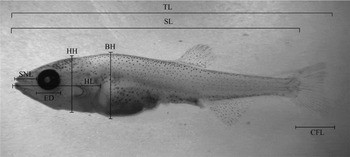
The larvae were measured with the aid of a Bell Photonics stereomicroscope equipped with a 5-megapixel digital camera and the EUREKAM 10.0 software. The method proposed by Ahlstrom et al.(1976) was used with modifications to take biometric measurements of the larvae. The following dimensions were measured (in mm): total length (TL), standard length (SL), head length (HL), head height (HH), snout length (SNL), body height (BH), eye diameter (ED) and caudal fin length (CFL) (Fig. 1).
Biometric variables used. Larva of Salminus brasiliensis, postflexion stage. Total length (TL), standard length (SL), head length (HL), head height (HH), snout length (SNL), body height (BH), eye diameter (ED) and caudal fin length (CFL).

Biometric characteristics
The biometric characteristics are expressed by body proportions as proposed by Leis & Trnski (Reference Leis and Trnski1989) and modified by Nakatani et al. (Reference Nakatani, Agostinho, Baumgartner, Bialetzki, Sanches, Makrakis and Pavanelli2001): BH in relation to SL: very long body (BH <10% of the SL), long body (BH between 10.01 and 20% of the SL), moderate body (BH between 20.01 and 40% of the SL), tall body (BH between 40.01 and 70% of the SL), and very tall body (BH ≥70.01% of the SL); HL in relation to the SL: small head (HL <20% of the SL), moderate head (HL between 20.01 and 33% the SL), and large head (HL ≥33.01% of the SL); and ED in relation to HL: small eye (ED <25% of the HL), moderate eye (ED between 25.01 and 33% of the HL), and large eye (ED ≥33.01% of the HL).
Allometric growth patterns
The allometric growth patterns during the larval stages were modelled from regressions between each logarithmic variable and the TL. The patterns were described by the equation Y = aXb, where Y is the dependent variable (measured characteristic), X is the independent variable (TL), a is the intercept and b is the allometric coefficient. Isometric growth occurred when b = 1. Positive allometric growth occurred when b > 1, and negative allometric growth occurred when b < 1 (Klingenberg, Reference Klingenberg2016).
Multivariate morphometric patterns
The multivariate morphometric patterns were evaluated by linear discriminant analysis, which calculates transformed axes of the original space where the variation between groups (species in this case) is maximized relative to the variation within groups. The linear discriminant axes are functions of the original variables where individuals are sorted according to morphological similarities inferred from the relationship between the original variables and the discriminant axes (coefficients of discriminant functions) (Monteiro & Reis, Reference Monteiro and Reis1999; Klingenberg & Monteiro, Reference Klingenberg and Monteiro2005). It is possible to make an individual taxonomic identification based on the distances between each individual and the mean for each species in the space of the discriminant functions (also called Mahalanobis distances) (Krzanowski, Reference Krzanowski2000). To avoid circularity, the discriminant functions are validated using a jackknife procedure in which the function is recalculated n times (n = sample size), each time leaving one of the individuals out of the sample and predicting its identification (Venables & Ripley, Reference Venables and Ripley2002). This procedure is called cross-validation and allows for an assessment of the reliability of the results. All analyses were performed in the R environment (R Core Team, 2015) with the specialized functions of the MASS package (Venables & Ripley, Reference Venables and Ripley2002).
Results
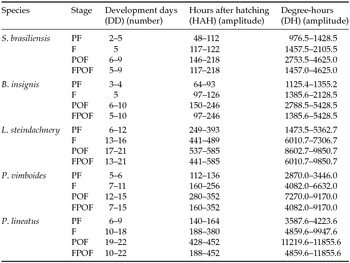
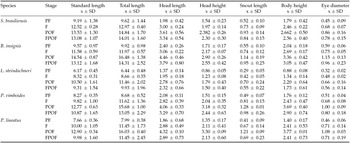
The ranges obtained for the number of development days (DD), hours of development after hatching (HAH) and the number of DH are described in Table 1. The means related to morphometric variables are shown in Table 2. The mean incubation temperatures (°C) were 28.61 ± 1.04 (B. insignis), 26.80 ± 0.90 (S. brasiliensis), 26.60 ± 1.22 (L. steindachneri), 27.98 ± 1.30 (P. lineatus) and 26.67 ± 0.57 (P. vimboides).
Number of development days, hours after hatching, and degree-hours of the development of larvae of Salminus brasiliensis, Brycon insignis, Leporinus steindachneri, Prochilodus vimboides and Prochilodus lineatus (PF: preflexion; F: flexion; POF: postflexion; FPOF: flexion + postflexion)

Mean (x) and standard deviation (SD) in millimetres of the morphological variables obtained from measurements of Salminus brasiliensis, Brycon insignis, Leporinus steindachneri, Prochilodus vimboides and Prochilodus lineatus larvae (PF: preflexion; F: flexion; POF: postflexion; FPOF: flexion + postflexion)

We found three development groups when the means of TL and BH were correlated to the values of the DH ranges during the period from the preflexion to postflexion stages. Group 1 consists of the species S. brasiliensis (TL: 13.53 ± 1.30 mm, BH: 2.662 ± 0.50 mm, and DH: 976.5 to 4625.00°C) and B. insignis (TL: 14.54 ± 0.87 mm, BH: 2.90 ± 0.26 mm, and DH: 1125.4 to 5428.50°C), which have similar developmental means and ranges and reach larger sizes in a shorter DH. Group 2 consists of P. lineatus (TL: 12.90 ± 0.34 mm, BH: 3.77 ± 0.01 mm, and DH: 3587.6 to 11,855.60 ˚C) and P. vimboides (TL: 12.77 ± 0.63 mm, BH: 3.69 ± 0.40 mm, and DH: 2870.00 to 9170.00°C). Group 3 consists of L. steindachneri (TL: 10.50 ± 1.61 mm, BH: 2.20 ± 0.64 mm, and DH: 1473.5 to 9850.7°C). The latter two groups exhibit lower means but greater developmental ranges in DH. However, when the preflexion stage of L. steindachneri is analysed individually, it displays a development that is distinct from the other species. Measured in hours, the development time of L. steindachneri in the preflexion stage (393 h) is much higher than that of S. brasiliensis (112 h), B. insignis (93 h). P. lineatus (136 h) and P. vimboides (164 h) during the same stage (Table 1).
Allometric patterns
Preflexion stage
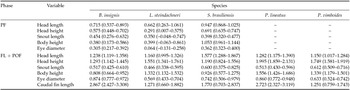
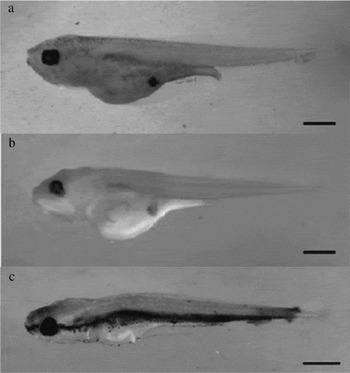
During the preflexion stage of B. insignis, all variables measured presented negative allometries relative to the TL (Table 3). These values indicate that the larval growth rates for the head, snout, ED and BH are proportionately smaller than the rate for TL. Based on the biometric characteristics expressed by the body proportions, the larvae are characterized as having small eyes and moderate heads and bodies (Table 4). Salminus brasiliensis differs with respect to the HL and BH, which are isometric (Table 3). Nevertheless, when the body proportions are considered, S. brasiliensis larvae are also characterized as having moderate heads and bodies with small eyes (Table 4). Leporinus steindachneri did not present significant allometric coefficients for SNL, BH and ED (Table 3). Head height is allometrically negative similar to the other species, and HL is isometric as observed in S. brasiliensis; thus, the HL increases in proportion to the TL of the larvae, which are also characterized by small eyes and moderate heads and bodies (Fig. 2).
Allometric coefficients for the species studied. The 95% confidence intervals are shown in parentheses (PF: preflexion; FL + POF: flexion + postflexion)

Body proportions (%) of the morphometric variables for Salminus brasiliensis, Brycon insignis, Leporinus steindachneri, Prochilodus vimboides and Prochilodus lineatus

Early development in the preflexion stage of Brycon insignis (a) 70 hours after hatching (HAH), Salminus brasiliensis (b) 63 HAH, and Leporinus steindachneri (c) 257 HAH. Scale bar = 1.00 mm.

Flexion and postflexion stages
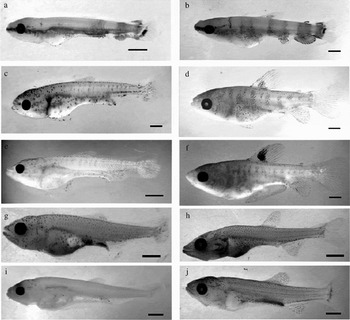
The proportions and allometric coefficients change considerably in the flexion and postflexion phases. Head length and height have positive allometric growth for most species; the exception is S. brasiliensis, with isometric growth in HH (Table 3). The ED and snout length have negative allometric coefficients and thus do not follow the proportionality of the head growth. The BH is allometrically positive for the L. steindachneri, P. lineatus, and P. vimboides., but negative for B. insignis, and isometric for S. brasiliensis. Caudal fin length has a positive allometry for B. insignis and P. lineatus, whereas the other three species have isometric coefficients. At the end of the postflexion stage, the S. brasiliensis, B. insignis and L. steindachneri larvae displayed elongated bodies, moderate HLs and small eyes; the exception is B. insignis, which displays moderate eyes. Prochilodus lineatus and P. vimboides have taller BHs than the other three species. These two species also have moderate heads and small eyes (Table 4; Fig. 3).
Early development, flexion and postflexion stages of Leporinus steindachneri (a, b) 257 and 329 hours after hatching (HAH), Prochilodus lineatus (c, d) 185 and 449 HAH, Prochilodus vimboides (e, f) 136 and 304 HAH, Salminus brasiliensis (g, h) 120 and 218 HAH, and Brycon insignis (i, j) 101 and 246 HAH. Scale bar = 1.00 mm.

Morphometry and linear discriminant analysis
Preflexion stage
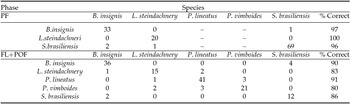
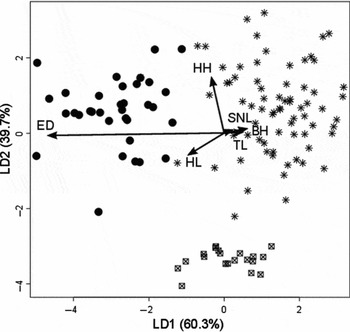
The discriminant analysis of B. insignis, L. steindachneri and S. brasiliensis predicted an overall 97% of observation species correctly in the preflexion phase (Table 5). The ordination of scores show a clear separation of species along the discriminant axes, where the LD1 explains 60.26% of the total among species variation and the LD2 explains 30.74% of the variation (Fig. 4). In this ordination, S. brasiliensis shows positive scores on both axes, B. insignis shows negative scores on LD1 and positive scores on LD2, and L. steindachneri shows scores close to zero on LD1 and negative scores on LD2. The variables TL, SNL and BH have weak positive associations with the LD1 axis (indicated by the arrow lengths and directions in Fig. 4), whereas the variables HL, HH and ED have negative associations with LD1. The differences among the species are represented in this system as a contrast in the ratios between the variables with positive and negative coefficients on the axes, which are used to calculate the scores. The primary contrast along the LD1 axis indicates that the B. insignis larvae are characterized by proportionally longer heads and larger eyes and proportionally smaller BHs, TLs and snout lengths than the larvae of S. brasiliensis. In the second axis (LD2), the larvae of L. steindachneri are characterized by more elongated heads (longer and lower) than the larvae of B. insignis and S. brasiliensis.
Classification matrix of the discriminant analysis with cross-validation. Known classifications along the lines and predicted classification in the columns (PF: preflexion; FL + POF: flexion + postflexion)

Biplot ordination of scores along the two discriminant axes for the preflexion stage. Closed circles: Brycon insignis; Stars: Salminus brasiliensis; crossed squares: Leporinus steindachneri. Arrows indicate the direction of variation for each variable (TL: total length; HL: head length; HH: head height; SNL: snout length; BH: body height; ED: eye diameter).

Flexion and postflexion stages
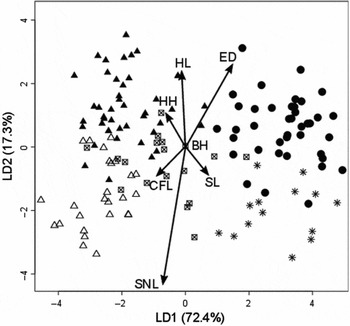
The discriminant analysis of data from the flexion and postflexion phases predicted an overall 87% of correct species (Table 5). The first two discriminant axes explain together 89.7% of total among species variation (Fig. 5). The first discriminant axis separates mainly the Prochilodus species (with negative scores) from S. brasiliensis and B. insignis (positive scores). The second discriminant axis separates the two Prochilodus and S. brasiliensis from B. insignis. Leporinus steindachneri has average scores near zero on LD1 and LD2 and individuals have positive and negative scores on the two axes (Fig. 5). This latter species is separated from the remaining four along the third discriminant axis (not shown), which explains only 7% of total among species variation. The primary contrast of the biplot variables along the LD1 axis indicates that the P. lineatus and P. vimboides larvae have relatively smaller eyes and standard lengths and larger relative dimensions of snout, HH and caudal fins than B. insignis and S. brasiliensis. The second discriminant axis shows a contrast among snout, caudal fin and body length in the negative direction and head dimensions and ED in the positive direction.
Biplot ordination of the scores along the first two discriminant axes for the flexion and postflexion stages. Closed circles: Brycon insignis; Stars: Salminus brasiliensis; crossed squares: Leporinus steindachneri; open triangles: P. vimboides; closed triangles: P. lineatus. Variables: SL: standard length; HL: head length; HH: head height; SNL: snout length; BH: body height; ED: eye diameter; CFL: caudal fin length.

Discussion
This study showed that larval allometries during the initial development stages of the five species analysed comprised developmental patterns that could be grouped by development time (degree-hours) and morphological development. The development patterns are spatiotemporally tied to the habitats used (Gisbert et al., Reference Gisbert1999). Several morphometric methods have been found to be very efficient for separating groups of closely related organisms. Thus, various taxonomists have used these methods to confirm species identification, justify synonymies, and recognize new taxa at the species level (Daly, Reference Daly1985). In this context, the use of discriminant analysis to identify larvae was found to be a good method for defining morphometric patterns. However, this finding does not diminish the importance of detailed ontogenetic descriptions. The analysis employed here contributes to the correct identification of larvae captured in the natural environment, because they can be easily categorized in the basic stages of preflexion and flexion/postflexion. Starting from this point, the most appropriate discriminant function can be used. A number of caveats should be considered when performing morphometric analyses of larval fish. When specimens are originated from artificial hatcheries, their growth patterns can be modified (Blaxter et al., 1984). Furthermore, fixative solutions can change body measurements due to shrinkage (Gómez et al., Reference Gómez, Sánchez and Fuentes2014), making it more difficult to identify certain species. In such cases, it might be worth considering complementary approaches, such as molecular methods (Kirtiklis et al., Reference Kirtiklis, Palińska-żarska, Krejszeff, Kupren, Żarski, Fopp-Bayat and Szabelska2016).
Morphological changes in fish larvae occur continuously and are regulated by gene expression and influenced by the environment (Gilbert & Bolker, Reference Gilbert and Bolker2003), which results in phenotypes with different relative growth. Thus, the duration of the early development period varies considerably among species (Balon, Reference Balon1981). Brycon insignis and Salminus brasiliensis exhibit rapid and similar early development. The same phenomenon is observed for Prochilodus lineatus and Prochilodus vimboides; however, these species have longer development times compared with the first two species. Finally, Leporinus steindachneri has an even longer development time than the other species. Water temperature is the environmental factor with largest influence in development time (Chambers & Leggett, Reference Chambers and Leggett1987; Souza, Reference Souza2004; Ninhaus-Silveira et al., 2006), but in this case, water temperature was similar during the development of the five species. The development times of the species were most similar between phylogenetically related species.
In many teleost fishes, significant behavioural changes during early development occur simultaneously with morphological changes (swimming development, feeding, sensory and respiratory systems), allowing the larvae to occupy different habitats depending on their stage of development (Balon Reference Balon1985). This timing increases the growth performance and the probability of survival of individuals (Fuiman, Reference Fuiman1983), and even considered as an adaptive response to counteract environmental stress (Osse & van den Boogaart, Reference Osse, van den Boogaart and Govoni2004). Because the body structures designed for feeding and locomotion are of fundamental importance for larval survival in the natural environment, these structures originate in a proportional and simultaneous manner. According to Peña & Dumas (Reference Peña and Dumas2009), the positive allometry of the head contributes to the feeding process; thus, a proportionally larger head is reflected in a proportionally larger nervous system and sensory organs and an improved feeding efficiency, which contributes to the detection and ingestion of prey. Early differentiation of the nervous system (brain), vision (positive allometry of the eyes) and feeding system (positive allometry of the mouth) increases the likelihood of detecting zooplankton (Fuiman, Reference Fuiman1983; Koumoundouros et al., Reference Koumoundouros, Divanach and Kentouri1999). The development of the opercular region (gills and gill arches) promotes greater blood oxygenation, which ultimately contributes to increased swimming activity (Gisbert et al., Reference Gisbert, Merino, Muguet, Bush, Piedrahita and Conklin2002). Considering the results of the five species analysed, the proportionally larger heads seem to be more related to the development of the brain and opercular region because the eyes and snouts exhibit negative growth. In this sense, food detection may be more closely related to other sensory organs, such as the sense of smell and/or the ability to detect the vibrations of prey in water, at least in the later stages analysed (flexion and postflexion).
During early development, the reduction in HH and snout length seems to be associated with behavioural transitions (pelagic for the larva/juvenile stages and benthic for the juvenile stage) (Kupren et al., Reference Kupren, Trąbska, Żarski, Krejszeff, Palińska-Żarska and Kucharczyk2014b). According to Kupren et al. (Reference Kupren, Trąbska, Żarski, Krejszeff, Palińska-Żarska and Kucharczyk2014b), this transition results in a clear change in the proportions of the head, which becomes more elongated and flatter compared with the previous stages. Considering the species P. lineatus, P. vimboides and L. steindachneri, which are benthic in the adult stage, the transition from the pelagic to the benthic phase must occur only after the postflexion stage. The B. insignis and S. brasiliensis larvae have positive allometry for the HL during the flexion and postflexion stages and seem to maintain this trend into the adult form when they will continue to exhibit pelagic behaviour. With regards to the snout length, this variable already has negative allometry for both species during the flexion and postflexion stages and should continue through later stages in P. lineatus, P. vimboides and L. steindachneri, whereas the changes in B. insignis and S. brasiliensis start with the juvenile stage.
Among the larvae studied, different morphological patterns were observed regarding body length and height, such as more elongated larvae and taller larvae. More elongated bodies are associated with swimming agility (Fuiman, Reference Fuiman1983; Osse et al., 1997), making it easier to obtain food and escape from predators (Snik et al., 1997; Gisbert, Reference Gisbert1999). It is assumed that the elongated morphotype of B. insignis and partially elongated morphotype of S. brasiliensis enable the larvae to swim faster when attempting to capture prey, which is mostly other larvae (Souza, Reference Souza2004; Schutz & Nuner, Reference Schutz and Nuner2007). These shapes and patterns aid in identification; however, the larvae are difficult to identify because they are very similar in their early stages. The difficulty is even greater when the species are phylogenetically close.
The present study found that the larvae of L. steindachneri, B. insignis and S. brasiliensis had well-defined morphometric characteristics during the preflexion stage and that these morphometric variables were good metrics for identification of the species by cross-validation. The same can be said for using a comparison of the scores of the five species studied to identify the species in their flexion and postflexion stages.
Acknowledgements
The authors thank the Piabanha Project Socioenvironmental Centre [Projeto Piabanha Centro Socioambiental] and the Agricultural Research Company of the State of Rio de Janeiro [Empresa de Pesquisas Agropecuárias do Estado do Rio de Janeiro – PESAGRO-RIO] for their logistic support during the collection of egg and larva samples.
Financial support
Work by the authors is supported by Mr. José Roberto Marinho, Conselho Nacional de Desenvolvimento Científico e Tecnológico – CNPq, and Fundação de Amparo à Pesquisa do Estado do Rio de Janeiro – FAPERJ.
Statement of interest
The authors have no conflicts of interest to declare.