Alongside China's economic and political reforms, the central government has identified the previously overshadowed society as an important partner in improving governance. Following the government's rhetorical lead of “small state, big society,” non-governmental organizations (NGOs) have increased in number and broadened in scope to fill gaps left by the downsized state and address problems that have emerged, in part, because of the country's massive development schemes. At the same time, the government is mindful that empowered social actors, and independent NGOs in particular, could threaten its political monopoly. Like other authoritarian states (and even some democratic ones), the government has instituted a system of legal registration to manage – and hopefully control – Chinese social organizations.Footnote 1
Although the regulation system was instituted to protect the state from the threat of NGOs, it contains incitements to encourage organizations to register; registered NGOs can operate legally and thus pursue a wider array of financial opportunities.Footnote 2 Conforming to government preferences is not necessarily a choice for NGOs but sometimes the only way to exist in China's closed political environment. Registration is, at best, a “win-win” for both state and society and, at worst, the only option for NGOs.Footnote 3 We might thus expect it to be widespread.
In reality, registration rates are uneven. Many NGOs operate unregistered and registration status varies significantly based upon the work organizations pursue. This article shows that registration is a complicated and difficult process. Its benefits do not always outweigh the costs and therefore it is not necessarily true that groups want to register. But to understand why organizations can operate outside the system, we must look beyond the motivations of NGOs themselves. By identifying the incentive structure for government officials at all levels, I explain why not all officials want social organizations registered. Economic and political rationales have led governments to condone groups' lack of registration and even encourage some to stay unregistered. In sum, conflicting incentives for NGOs and government complicate our understanding of social organization registration in China.
This article begins with an explanation of the formal government regulations on social organizations in China, then presents survey data that show a surprisingly large percentage of social organizations operate without obtaining registration. The next section draws on interview and survey data to examine reasons why NGOs stay unregistered; it also includes a systematic investigation into the key characteristics of organizations that affect registration status. The final section analyses the economics of registration, a previously unexplored but important factor in explaining registration and government–NGO relations; the way in which certain groups obtain funding dramatically alters the incentive structure for both group leaders and local government officials, ultimately affecting the registration calculus.
Case Selection and Research Methods
To explore social organization registration this article focuses on groups from three different issue areas in China: environmental protection, HIV/AIDS prevention, and gay and lesbian rights. Issues were selected based on a “most-similar” logic: groups often share similar funding sources; NGOs tend to employ similar strategies to ensure emergence; and leaders from one issue area have been known to move to another. However, they vary in that each issue area fits with state interests differently.
Environmental groups are the oldest NGOs in the country and have come to exemplify successful Chinese social organizations.Footnote 4 They tend to have more autonomy because their work complements state goals of tackling environmental degradation. HIV/AIDS is a growing problem throughout China. While the central government has increased attention to the issue, some local government officials are more uncomfortable confronting the realities of this problem than environmental issues, suggesting less correlation with state interests. Gay and lesbian NGOs are often engaged in HIV/AIDS-related activities, but they also represent a minority group that may address human rights issues the state has long avoided; these groups might have the least comfortable fit with state policy and goals.Footnote 5 Variation between groups' goals and state interests in the three issue areas could affect the amount of political space NGOs enjoy and their registration status. This expectation for variation stands in contrast to organizations that are fully co-opted government-organized NGO (GONGOs), which are almost all registered, and explicitly illegal organizations (such as falun gong 法轮功), which are almost certainly not registered.Footnote 6
Evidence is drawn from semi-structured in-depth interviews and an original survey. Interviews with 80 NGO leaders and observers were conducted in Yunnan province (historically more open to social organizations), Beijing (usually more closed to NGOs), and Sichuan and Henan provinces (even more open and closed, respectively).Footnote 7 A nationwide internet survey of over 100 leaders in all three issue areas produced a data-set for statistical testing.Footnote 8
State of Registration
Early into Chinese social organization development, the central government established a system by which NGOs could become officially registered. The system was designed to allow groups to operate openly, but keep the growth of civil society in check. In essence, through the registration system the state constructed the notion of what an NGO is, defined its legitimate scope of activity and limited its autonomy.Footnote 9 The current legal status of NGOs is derived from the 1998 Regulations for the Administration and Registration of Social Organizations (Shehui tuanti dengji guanli tiaoli 社会团体登记管理条例),Footnote 10 which include numerous mechanisms to ensure that groups do not exert too much autonomy and move beyond their narrow official political space: to limit capacity building, the regulations forbid organizations from establishing branch offices; to keep a watchful eye on the organization, groups must have a sponsoring institution within the government; and to keep alliances and mission creep to a minimum, the regulation declares that no more than one social organization devoted to “similar issues” can be registered in the same administrative region.Footnote 11
These regulations have helped control the growth of registered NGOs. Three years after they came into effect, the total number of social organizations (shehui tuanti 社会团体) dropped from 165,500 to 129,000.Footnote 12 Recent figures published by the Ministry of Civil Affairs, the government agency in charge of registering social organizations, showed an increase to 153,000 in 2004 and 220,000 in 2008.Footnote 13 Considering the popularity and usefulness of NGOs in global governance, the size of the Chinese population and the severity of social problems, this growth is modest. However, these figures are misleading and fail to capture the reality of NGO growth in China: though the 1998 regulations succeeded in controlling the number of organizations that have acquired legal registration, they did little to stop the growth of unregistered groups.Footnote 14
For social organizations, the primary advantage of registration is that it, somewhat counter-intuitively, allows them to operate more independently. When registered, groups can open bank accounts and pursue a wider variety of funding opportunities. It also helps them stay more transparent, which is itself a common tactic for avoiding repression. It allows groups to be more public, thereby drawing in more participants, who can increase sustainability. With registration, groups' existence is less dependent upon the changing whims and interests of government partners. It can sometimes shelter them from government interference (such as pressure to change tactics and activities or dismiss leaders).Footnote 15 Moreover, registration affords NGOs the opportunity to forge more formal ties with government institutions. Unregistered groups, on the other hand, rely on informal ties with individual officials, which are less sustainable and reliable.
As evidence of this, leaders who pursue registration have done so to “formalize” their relationship with government. They see registration as a way to ensure that they are not too deeply embedded with the government. An environmental leader explained that registration is the best way for organizations to build an “authentic government–NGO relationship” whereas unregistered groups have more “inauthentic relationships.”Footnote 16 These groups must work harder to nurture their relationship with government officials because of their precarious legal status, which can ultimately make them more embedded within the state.
Although environmental NGOs boast a high rate of registration, nearly 60 per cent of all survey respondents reported that their organization was not registeredFootnote 17; registration status varies significantly across issue area (see Table 1).Footnote 18 Thus, focusing only on environmental groups (as is common in past studies of Chinese NGOs) overlooks the infrequency of registration among organizations in other issue areas; misses an important opportunity to explore the myriad reasons why groups are, and in some cases prefer to stay, unregistered; and obscures competing interests of local and central governments regarding social organization registration.
Registration Status of Organizations, as Percentage of Respondents

Politics of Registration
Despite the incentives for organizations to become registered, unregistered groups do not lack legal status simply because they have tried and failed to register. In fact, some NGO leaders do not actively pursue or even prefer registration. Several factors contribute to low registration rates: many leaders claim the process is too complicated, the benefits are too low or registration is simply unnecessary.Footnote 19 According to the survey, the most common reason for being unregistered is that the process is “too complicated”; 44 per cent of respondents ranked this first among six different explanations.Footnote 20 Many leaders reported that the difficulty of the registration process differed across provinces. Not surprisingly, unregistered groups are far more likely to characterize the process in their home province as “somewhat harder” or “harder” (53 per cent of respondents) than organizations that have already obtained registration (13 per cent).Footnote 21
Many leaders see registration as offering little benefit to their organization and do not believe it is fundamental for long-term viability. When ranking eight different determinants for NGO success, just over a quarter of survey respondents placed registration among the top three.Footnote 22 But responses varied significantly across issue area: environmental group leaders were far more likely to rank registration as a top three determinant of success (half of respondents) than were gay and lesbian leaders (less than 8 per cent).Footnote 23 Even more telling, 90 per cent of gay and lesbian leaders ranked registration in the bottom three of determinants. These findings are not altogether surprising: nearly 80 per cent of gay and lesbian leaders described their group as “successful” or “somewhat successful” and yet less than 18 per cent are registered. Perhaps because of its perceived limited contribution to an organization's success, leaders do not highly prioritize the pursuit of legal registration. Among survey respondents whose groups are unregistered, 67 per cent listed “our work is more important than registration” as the first or second most accurate explanation.Footnote 24
Most organization leaders believe that registration increases independence, but not all see this as a good thing. Because strong relations with the government, however secured, are necessary for viability, anything that might sour them must be avoided. In some contexts, this can include registration: for those groups that interact with the centre more, registration should be more common; organizations closely tied to local government are more likely to stay unregistered. These leaders fear that more independence will create a rift between their organization and local governments; they believe independence breeds antagonism, warranting more government scrutiny of registered groups, not less.Footnote 25 True independence, one leader argued, would make accomplishing his organization's goals nearly impossible.Footnote 26 The reluctance to register sometimes comes from a belief that registration does not always coincide with local government interests. This is most common among groups that rely upon HIV/AIDS funding, but is also increasingly the case for groups in more established issue areas: a veteran environmental leader, for example, sees a similar pattern of infrequent registration among organizations in this issue area and offers the same explanation for it.Footnote 27
For some, registration is thought unnecessary. As most groups have short time horizons, any long-term benefits of registration do not outweigh the short-term costs. This is a prevailing belief among leaders of newer organizations. Small groups, gay and lesbian organizations in particular, do not believe registration is even intended for them. A leader of a lesbian group in Yunnan laughed off questions about registration: “How could we be registered? We do not even have an office!”Footnote 28 An environmental leader in Sichuan believes that the primary benefit of registration – opening a bank account and thus fundraising more freely – is not worth the effort. Indicative of the creative adaptations employed by unregistered groups, she deposits group funds into her own personal bank account instead.Footnote 29
Even more commonly, leaders believe that pre-existing good relations and frequent co-operation with government agencies makes registration redundant (a position shared by some local officials).Footnote 30 For those who believe their work already complements government interests, it is not seen as a necessary step. Similarly, leaders commonly suggest that registration is intended as a check on potentially threatening organizations. The idea that it is unnecessary also stems from the fact that there are few legal injunctions stopping groups from operating without registration and that some local governments do not insist that groups become registered. While there are clear regulations on the registration process, there is no regulation that deems unregistered groups explicitly illegal.Footnote 31
Confirming this professed weak link between registration and good government relations, the survey finds no significant variation in leaders' ratings of their organizations' relationship with central or local governments and registration status. Unregistered groups are no less likely to rate their relationship with government positively than registered groups. In fact, many of the former have cultivated closer relations with local government officials than have the latter. The survey found significant variation in the frequency of informal meetings with local government officials between those groups that are registered and those that are not: 37 per cent of unregistered groups met with local officials once a week or once a month, compared to 17 per cent of registered groups, none of which reported meetings at the frequency of once a week.Footnote 32
In addition to the explanations explored above, the interviews point to four key characteristics of NGOs that might predict registration status: the older the organization, the larger its budget and the closer to the political centre of Beijing, the more likely it will be registered. Issue area matters as well: a higher proportion of environmental organizations appear to be registered than groups in the other issue areas, perhaps because they are both older and boast larger budgets.
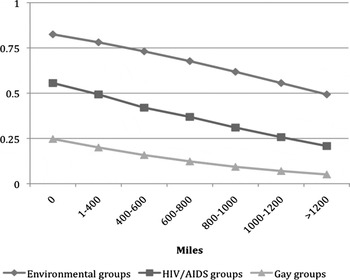
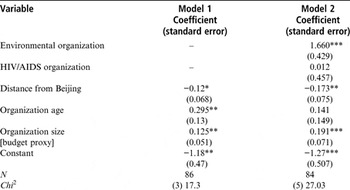
To further explore these relationships, I estimated two statistical models. These probit models examine the effect of several independent variables on a dichotomous dependent variable (in this case, registration or non-registration). The first model holds issue area constant and tests the relation of three variables on registration status (distance from the political centre, organization age, budget size); the second model adds another variable, issue area. The models support the observation drawn from interviews that the closer an organization is to Beijing, the more likely it will be registered (indicated by the significant negative coefficient in the results), as is consistent with central government preferences. Based upon these models, I estimated predicted probabilities for the three issue areas to emphasize the point (see Figure 1).
Predicted Probabilities of Registration by Distance from Beijing

Probit Model Results for Registration Status

Notes:
***represents p < .01; **represents p < .05; *represents p < .10; two-tailed test using Huber-White standard errors.
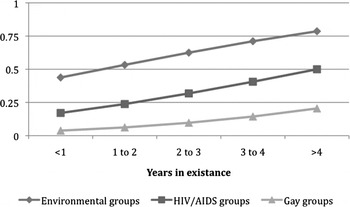
The first model suggests that organization age plays an important role in predicting which groups are registered and which are not (indicated by the significant positive coefficient). Among organizations less than four years old, 78 per cent are unregistered. However, among groups in existence for more than four years, unregistered status drops dramatically to 37 per cent. To illustrate this point, I estimated predicted probabilities for groups in all three issue areas, holding distance from Beijing constant (see Figure 2).
Predicted Probabilities of Registration by Organization Age

These data offer a compelling case that the age of a group affects its registration status. Becoming registered might be part of the natural life cycle of Chinese NGOs: as groups get older, they build up the institutional knowledge and resources necessary to pursue registration. Alternatively, registration might be a time-intensive process that is only completed once groups are older. But these explanations are complicated by the fact that environmental groups are older than NGOs in the other issue areas. Thus, the effect of age is driven by the large number of older environmental groups in the survey sample.Footnote 33 Although older environmental groups are more likely to be registered, the same does not hold true for organizations in the other issue areas: survey data suggest that of groups four years of age or older, a greater proportion of environmental organizations are registered than HIV/AIDS or gay and lesbian groups.
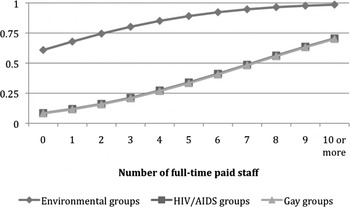
The models show that the size of an organization's budget (using the number of full-time paid staff members as a proxy) has a positive relationship with registration status. When controlling for issue area in model 2, the budget proxy had a strong effect on registration status whereas organization age did not; the effect of budget essentially washes out that of age. To illustrate this relationship, I estimated predicted probabilities for registration by budget size (see Figure 3).Footnote 34 This relationship is not entirely surprising since registration allows groups to fundraise more easily. Older, registered groups should be expected to have larger budgets than younger, unregistered organizations. A less likely, though probable, explanation is that the causal arrow points in the opposite direction: larger budgets help groups become registered in the first place, allowing them to devote staff members to the time-intensive task of obtaining legal registration.
Predicted Probabilities of Registration by Budget

All of these data may properly reflect the recent history of registration but may not accurately predict the future. As groups get older, they will not necessarily become registered. In fact, as the number of organizations increases in certain issue areas, there is a decreasing likelihood that newer organizations will ever be registered despite their longevity. This is best explained by revisiting the regulations for social organization registration. A key article in the regulations forbids more than one group working on the same issue in the same administrative region.Footnote 35 Therefore, among groups with a wider issue portfolio, registration is easier: environmental groups work on a greater diversity of issues, allowing many environmental groups to be registered in the same administrative region. Among groups with a more narrow issue portfolio, registration is more difficult: HIV/AIDS and gay and lesbian groups work on far fewer issues, making registration of multiple organizations unlikely.
Given the high rate of unregistered NGOs and the explanations offered above, it is clear that not all leaders are interested in becoming registered. But leaders' willingness to stay unregistered does not alone explain why they are able to do so. It is necessary to examine government interests in social organization registration.
There is considerable variation of registration preferences between levels of government. Central government attitudes are easiest to explain. The centre's primary concern with NGOs is the threat they pose to the Party's political monopoly and it thus prefers that organizations register to keep them in check.Footnote 36 Survey data showing higher registration rates closer to Beijing support this characterization and the compliance of organizations with this preference. Local governments' interests are more complex and diverse. Moreover, political decentralization, and the resulting co-ordination problems, has created an important opportunity for local officials to implement the registration laws at their leisure, only when they fit their overarching interests.Footnote 37 Simply put, social organization registration is not always in the best interests of local government officials.
Registration preferences vary across issue area and locality. For instance, leaders reported that governments in some provinces are more lax about registration when groups are engaged in work that fits local interests. HIV/AIDS groups in Yunnan report far less pressure to become registered than do environmental groups.Footnote 38 While many environmental groups are engaged in work that can interfere with local governments' economic development, HIV/AIDS groups help provide a much needed service in controlling the public health crisis without negatively affecting economic outputs. Attention to such government preferences should not obscure the reality that while local officials might wish to register certain organizations they do not also have the capability to do so.Footnote 39 The same precarious financial situation that has led many local governments to welcome NGOs might also interfere with efforts to control those they wish to register or shut down.
In sum, when local governments are indifferent to or prefer an NGO be unregistered, most groups will not register. There are three non-mutually exclusive explanations for why local governments condone social organizations remaining unregistered or, in some cases, even encourage them to remain unregistered. First, the 1998 regulations make it virtually impossible for the legal registration of more than one social organization working on the same issue. Local governments are increasingly reliant upon NGOs to help tackle pressing social problems.Footnote 40 For local government officials interested in actually solving these problems, allowing only registered groups to operate in their jurisdiction diminishes the number of available “service providers” and decreases the likelihood that they will effectively address problems. This proves particularly problematic for governments dealing with HIV/AIDS, because groups all tend to work on the same issues: HIV/AIDS education and prevention. There is a clear incentive for local governments to put aside concerns of registration status and work in co-ordination with unregistered social organizations.
Second, unregistered groups are actually easier to control and will abide by the wishes of the government largely because they occupy a legal grey area. As such, they are even more dependent upon good relations than registered groups. Moreover, some local governments fear registration because it gives social organizations the opportunity to raise more funds independently and grow in size, potentially undermining their authority.Footnote 41
The first explanation assumes that local officials are interested in solving social problems. But in some cases, they are just interested in filling government coffers and lining their own pockets. HIV/AIDS and gay groups are primarily funded through schemes that filter money through the central government. When organizations are not registered, funds must go through a local government agent before reaching the social organization; when groups are registered, the economic opportunity for local officials is eliminated. Therefore, a third explanation suggests that there is a monetary incentive for local government officials to work with unregistered groups or encourage them not to register in the first place. For their part, NGOs appreciate the “easy money” available through these funding schemes and also recognize that as the primary recipient of monies, it is government officials who decide where funds go. If these organizations believe local officials prefer unregistered groups, they will also have diminishing incentives to become registered.
Economics of Registration
To understand why some local governments do not require some organizations to register, or encourage them to stay unregistered, it is important to understand first how NGOs in some issue areas gain their funding. This section focuses on HIV/AIDS and gay groups, organizations in issue areas that boast the lowest rate of registration. In order to ensure freer movement and full co-operation with governments, HIV/AIDS funding schemes usually employ a “filter model” whereby international funds are directed first to the Chinese government. Government agents, usually the Centres for Disease Control (CDC), then pass funds to “community-based” organizations.
This distribution mechanism can be traced back to 2001 and the UK's Department for International Development's first HIV/AIDS project in China. It has been adopted by private donors such as the Clinton Foundation and Gates Foundation, as well as the largest single source of international funding to HIV/AIDS groups, the Global Fund. As in the original iteration of the model, Global Fund monies are given to a “primary recipient,” the CDC. This government agent distributes funds to local government agents, which distribute them to social organizations (“sub-recipients”). If groups are unregistered, funds are held by another “sub-recipient,” a local agency or GONGO, and then distributed to NGOs (“sub-sub-recipients” in Global Fund parlance). Many of these groups contend that government participation has been motivated less by concerns for disease prevention and control and more by the economic opportunities presented by these funding schemes. Moreover, this distribution model allows the government to decide who receives financial support, thereby controlling the emergence and determining the future of many NGOs in China.
Observers believe that the government works with certain groups based upon the perceived economic benefit they can provide. Governments prefer to co-ordinate with one high-risk group (gay men) over others (intravenous drug users, commercial sex workers) simply because this is where most of the international funding is going; it presents the best economic opportunity for officials.Footnote 42 In fact, some gay groups have been created at the request of government officials for the primary purpose of “eating” HIV/AIDS funds.Footnote 43 Government agencies are so eager to collect a share of HIV/AIDS funding that some religious affairs bureaus have begun work on AIDS projects.Footnote 44 A leader candidly noted that local governments are keen on HIV/AIDS projects in Yunnan because, “[they] like getting new facilities.”Footnote 45
HIV/AIDS funding schemes have also resulted in corruption.Footnote 46 With little oversight by the funder and government agencies serving as intermediaries, money is often “lost along the way.”Footnote 47 A former leader of a gay group in Yunnan recalled the time his organization received new computers from its foreign donor. Just days after unpacking them, officials from the group's government sponsor took the computers. When asked why, he immediately responded: “Because the sponsor wanted nice new computers.”Footnote 48 Even more troubling was the report by an NGO leader who claims that local government health officials were charging 10 yuan for methadone treatments that were supposed to be free thanks to Global Fund support.Footnote 49
By virtue of their role as financial go-between, government officials sometimes intervene in the day-to-day operations of recipient organizations. In some cases, this appears to have a financial motive. Concerned that there was not enough money to go around – or enough for the government sponsor to share in the spoils and have the group do its assigned work – a gay group leader was instructed that his community space, which operated as a down-market tea house, should begin to stock beer, which the government sponsor thought would sell better and increase previously small receipts. This was in direct contradiction to the agreement with his international funder. But because the group's economic and political opportunities were dependent upon maintaining good relations with the government first and the funder second, it acquiesced and began to sell beer.Footnote 50
Instances of impropriety and intervention aside, the prominent government role in dispensing funds has had some positive impacts on NGOs, HIV/AIDS prevention, and even the gay and lesbian community in China. HIV/AIDS and gay and lesbian groups in Sichuan report that the early entry of a UK-AIDS project – and over £30 million that came with it – has had a lasting impact in leading the government to be more open to NGOs in general. HIV/AIDS funds can, in some areas, create a political as well as an economic opportunity: recipients contend that without the funding, organizations would not be as plentiful nor would they enjoy such close, positive relations with local governments.
Survey results show that leaders who receive funds through the government report better relations with it than those who do not. The most positive assessment appears when respondents are asked to rate their relationship with the provincial government, the primary distributor of HIV/AIDS funding. Two-thirds of NGOs receiving funds through the government characterized their relationship with the provincial government as good or very good; less than half of organizations not receiving funds by this method responded the same way. Similar results at local and central levels suggest an overall positive relationship between recipients and governments. There are two plausible interpretations of the data. As most interviews suggest, groups with a priori good relationships will receive money from the government. This explanation is more convincing when we consider that some groups may have come into existence at the behest of local or provincial governments to attract money to the area. Alternatively, when organizations receive funds through the government, the relationship improves. Regardless of which explanation is more accurate, one point cannot be overemphasized: the nature of this funding forces organizations to maintain good relations with the government. They have no choice. If the relationship soured, NGOs could lose not just a political opportunity but also their lone economic opportunity.
In distributing international HIV/AIDS funds, the government controls the destiny of the fastest growing issue area of NGOs in China, making this economic opportunity nearly indistinguishable from a political one. Although the Global Fund attempted to funnel 50 per cent of their round-six funds in 2006 to “civil society,” the government's representative agency ultimately decides which groups receive the money. The CDC provides a list of “recommended” groups to the Fund. In theory, the Fund has the final say over recipients, but its China representative admits that there are few changes between the government's recommended list and eventual recipients. Moreover, although the Fund provided its own definition of civil society organizations, it was unacceptable to the CDC and was redefined to reflect the government's interests.Footnote 51 The new definition was broader, leading to distribution at odds with the Fund's professed goals of growing civil society. Of the 50 per cent of funds directed to civil society groups, 15 per cent is earmarked for NGOs, 20 per cent for GONGOs, and the remainder for research institutions that are usually government-affiliated. This has led some to question the independence of groups receiving HIV/AIDS monies.
The interstate nature of the Global Fund also limits the degree to which it can try to influence the Chinese government. At a November 2007 meeting of the Fund in Kunming, an NGO leader argued that despite receiving some resources, groups he calls “true grassroots organizations” are unable to play their intended role.Footnote 52 In an attempt at transnational advocacy networking, he implored the Fund to pressure the government to include more truly independent NGOs.Footnote 53 The Global Fund's chairman replied that while he was sympathetic, because the Fund is “country-led” and relies on strong partnerships with the governments of those countries in which it operates, it “will not impose or pressure governments to do one thing or another.”Footnote 54 He was emphatic that the Fund “must work within the framework of existing national laws and will not do anything to oppose it.”Footnote 55
According to one donor representative, this filtering scheme is intended to increase the capacity of local communities.Footnote 56 But among leaders who are financial beneficiaries of the scheme, there is wide recognition that the model is not well suited to achieve that goal. They are also keenly aware that the provincial and local governments prefer the model: government control of groups is helped by infrequent registration and the funding structure that gives groups a disincentive to register in the first place.
According to the survey, the vast majority of HIV/AIDS and gay men's organizations, both of which rely heavily on Global Fund and other HIV/AIDS-related monies, are unregistered. One of the perceived advantages of Global Fund money is that recipients do not have to be registered; this provides welcome economic opportunities for unregistered groups.Footnote 57 Although the central government encourages the registration of social organizations in order to keep closer tabs on them, provincial and local governments have different preferences.
As evidence of these preferences, few unregistered organizations report pressure by local and provincial governments to be registered. In Yunnan and Guangxi provinces, for example, government agencies rarely encourage registration.Footnote 58 Some governments rationalize this by claiming that if they have a tie to the group through a funding mechanism, registration is extraneous; others simply claim ignorance about the process.Footnote 59 NGO leaders have a different explanation. They contend that local governments have little incentive to ensure that groups are registered.Footnote 60 Because the government chooses recipients for the main HIV/AIDS funding scheme, it maintains more control over them.
If organizations register, they gain financial independence to pursue funding options outside Global Fund and other government-administered funding, eliminating the need for a government intermediary. More funding opportunities for organizations can translate into fewer opportunities for government control and intervention in the lives of these groups; it might also limit the opportunities for government agencies to share in the spoils of funding.
While registration is the best long-term solution for ensuring the sustainability of these groups, the relative ease of collecting Global Fund support presents a perverse incentive for organizations to stay unregistered: by registering, they increase their long-term ability to secure new funds, but run the risk of upsetting their relationship with local government officials (who prefer they stay unregistered) and losing their short-term economic windfall.Footnote 61 A group in rural Yunnan, upon the suggestion of its INGO partner, successfully registered and received legal NGO status in 2003, one of the earliest of HIV/AIDS groups to do so. This independence led to a deterioration of its previously close relationship with the government; it lost out on Global Fund monies, which most other HIV/AIDS and gay groups in the province enjoy.Footnote 62 Thus, for some NGOs, operating unregistered but in co-operation with the government may be the most efficient way to collect funds in China.
For unregistered social organizations, this short-term incentive has long-term consequences: by accepting some international funds, like those provided by the Global Fund, many have entered into a Faustian bargain. In the short term, they secure funds with little effort. But the long-term costs could be debilitating: groups are not only reliant on one funding source and vulnerable to collapse when they lose it, but they are also too reliant upon the goodwill of the government. Of course, this double-edged deal might be a group's only option. Even if they chose to forego these government-tied funds and attempt to become registered, they are unlikely to succeed because of the regulation registration limiting each administrative region to one registered group working in a given area. A greater irony is that even if local government officials opted to ignore the economic and political incentives addressed above and encourage these NGOs to be registered, this same restriction would stymie their plans as well.
Conclusion
A large proportion of Chinese NGOs operate unregistered. But these organizations have not necessarily failed in their efforts to become legally registered. Staying unregistered is sometimes necessary to take advantage of limited political and economic opportunities. This article has shown that NGO registration is closely tied to the interests of local governments, which vary across issue area and geographic region and can be in frequent flux. In this respect, all social organizations, irrespective of registration status, are ultimately circumscribed by the government. While registered groups enjoy some autonomy and more fundraising opportunities, they must still abide by strict criteria. Unregistered groups save the effort of registration but are also more tightly tied to the state and therefore restricted in a different, informal way.
The issue of social organization registration provides a good example of how the nature of political and economic opportunities in China puts social actors in an untenable position. The current incentive structure has given local governments a reason to allow unregistered groups to exist in the short term, but over the long term the position of these groups might not be secure. Without registration, fundraising is difficult. But becoming registered is not always a choice; even if groups can fit the strict criteria, if it is against the wishes of the local government they will not become registered, for that would sacrifice their immediate and very important political opportunity.
More generally, this article shows how centre–local relations have complicated state–society relations in China. On the one hand, it demonstrates that the most direct mechanism for controlling the growth of NGOs is not as effective as the central government might have hoped. The number of unregistered groups remains high and continues to grow. Thus, requiring groups to register does not mean they cannot exist without doing so. To this extent, the central government's efforts have been undermined by strong and sometimes contrary political and economic interests at the local level. Because of decentralization, and the increased autonomy and responsibility of local government, unregistered organizations can exist provided they serve local interests. What is more, the economics of registration – manifested in the way that HIV/AIDS and gay groups are funded – create an incentive for local government officials to keep these groups unregistered.
On the other hand, all NGOs, registered or not, maintain a precarious existence. Unregistered groups are not controlled institutionally or formally, but work at the pleasure of the government. Here the economics and politics of registration are deeply intertwined. Because of how of they are funded, most HIV/AIDS and gay organizations are tied to local governments, even without the formal management mechanism that the central government has put into place. In other words, unregistered groups are not working in the shadows. They are not engaged in provocative, subversive activities. They are just as circumscribed, if not more so, than registered organizations.
However, registered groups do not enjoy total autonomy either. If they fall out of favour with the state, they too might suffer. Despite some advantages, registration cannot inoculate NGOs from government interference or repression. Registered organizations report instances of strong negative state response when their activities work against government interests, particularly at the local level. For example, a registered environmental NGO in Yunnan province has been under close scrutiny for its anti-dam activities; its leaders have been placed under a travel ban and the organization repeatedly threatened with having its registration status rescinded.Footnote 63
Assumptions about registration preferences are turned on their head. Not only do groups not always desire it but governments would sometimes prefer groups not to be registered, so whether an organization is registered might not matter much at all. This article makes clear that the “choice” to become registered is rarely such. It is highly constrained both by the structure of the registration regulation and, even more importantly, the preferences of local government. Both registered and unregistered groups are in an untenable position and, irrespective of registration status, the result is the same: organizations are controlled, making a more independent future unlikely. While the central government's attempt to manage social organizations has not been effective, its overall goals of constraining these groups by closely tying them to the state has been largely achieved, and just not in the manner originally intended. Even if Beijing strengthens the registration law, it is unlikely to have much of an effect so long as local government has control over its implementation. Likewise, the life of social organizations is unlikely to change substantially while the situation at the local level remains the same.