INTRODUCTION
Man-made structures in the marine environment, such as ship hulls, cooling systems pipes of power plants and aquaculture equipment, are exposed to surface colonization by marine fouling organisms. This poses serious threats to the safe and efficient operation of these marine structures and constitutes a global technical and economic problem (Richmond & Seed, Reference Richmond and Seed1991; Rittschof, Reference Rittschof2000; Townsin, Reference Townsin2003; Yebra et al., Reference Yebra, Kiil and Dam-Johansen2004; Pérez et al., Reference Pérez, Blustein, García, del Amo and Stupak2006). Although coating surfaces with metal-based antifouling paints, in particular those containing organotins, is the most effective solution to marine biofouling (Alberte et al., Reference Alberte, Snyder and Zahuranec1992; Clare, Reference Clare1996; Yebra et al., Reference Yebra, Kiil and Dam-Johansen2004), environmental and human health problems associated with the use of toxic antifoulants (Ellis, Reference Ellis1991; Lau, Reference Lau1991; Cardwell et al., Reference Cardwell, Brancato, Toll, DeForest and Tear1999; Guerin et al., Reference Guerin, Sirot, Volatier and Leblanc2007) have led to regulations for, or bans on, their use in a number of countries (Dalley, Reference Dalley1989; Rittschof, Reference Rittschof, McClintock and Baker2001; van Wezel & van Wlaardingen, Reference van Wezel and van Wlaardingen2004). This makes the development of non-toxic or biodegradable alternatives a necessity (Clare et al., Reference Clare, Rittschof, Gerhart and Maki1992; Fusetani, Reference Fusetani2004; Yebra et al., Reference Yebra, Kiil and Dam-Johansen2004).
Marine sessile organisms are also susceptible to surface biofouling. Epibionts can decrease the fitness or even lead to the death of the host by increasing weight, drag and surface friction; reducing elasticity; interfering with vital processes such as gas exchange, nutrient absorption, excretion and sensing; and enhancing susceptibility to predation (Witman & Suchanek, Reference Witman and Suchanek1984; Wahl, Reference Wahl1989; Williams & Seed, Reference Williams, Seed, John, Hawkins and Price1992). Consequently antifouling defence mechanisms are expected to have evolved in some less-fouled marine sessile organisms (Guenther et al., Reference Guenther, Walker-Smith, Waren and de Nys2007). In fact, many secondary metabolites with antifouling activity are found in many marine invertebrates and seaweeds, suggesting the presence of a chemical defence against epibionts (Clare, Reference Clare1996; Fusetani, Reference Fusetani1998, Reference Fusetani2004; Armstrong et al., Reference Armstrong, Boyd and Burgess2000; Rittschof, Reference Rittschof2000, Reference Rittschof, McClintock and Baker2001; Steinberg et al., Reference Steinberg, de Nys, Kjelleberg, McClintock and Baker2001). These naturally occurring antifouling compounds could provide a potential source of environmentally friendly alternatives to toxic antifoulants. Therefore, research on the antifouling activity of secondary metabolites or extracts from such marine sessile organisms could provide important information not only for understanding the chemical mediation of host–epibiont interactions, but also for non-toxic fouling control in marine technology. Thus, in recent years, a large number of studies have focused on screening compounds and extracts from marine organisms for their antifouling activity. In some of these studies, individual compounds are isolated, structurally characterized and tested for their antifouling activity (Okino et al., Reference Okino, Yoshimura, Hirota and Fusetani1996; Tsukamoto et al., Reference Tsukamoto, Kato, Hirota and Fusetani1997; Cho et al., Reference Cho, Choi, Kang, Kim, Shin and Hong2005). On the other hand, crude extracts are also used to evaluate the antifouling activity of marine organisms (Willemsen, Reference Willemsen1994; Devi et al., Reference Devi, Vennam, Naik, Parameshwaran, Raveendran and Yeshwant1998; Cho et al., Reference Cho, Kwon, Choi, Hong, Shin and Hong2001; Wilsanand et al., Reference Wilsanand, Wagh and Bapuji2001; Bhosale et al., Reference Bhosale, Nagle and Jagtap2002; Hellio et al., Reference Hellio, Marechal, Véron, Bremer, Clare and Gal2004; Bers et al., Reference Bers, D'Souza, Klijnstra, Willemsen and Wahl2006). The use of crude extracts is very important and should not be discounted, since it provides a method for the widest possible screening for antifouling substances and because synergism may exist between the different components of an extract.
Therefore, the present study investigated the antifouling potential of crude extracts from various marine sessile organisms. The species chosen all occur abundantly along the south-east coast of China and, according to our observations, their body surfaces were less fouled or clean compared to the surrounding organisms. For each species, four extracts were made using solvents of increasing polarity. Antifouling assays were performed against the cyprid larval settlement of the barnacle Balanus albicostatus Pilsbry, a notorious fouling macroorganism in the seas of East Asia.
MATERIALS AND METHODS
Collection of marine sessile organisms
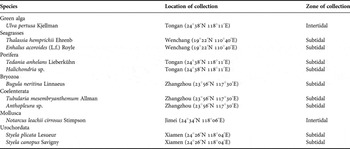
Eleven species of marine sessile organisms were collected by hand at several locations along the south-east coast of China (Table 1) during April 2005 to September 2006. The samples were immediately rinsed with freshwater, placed in coolers on ice and transported to the laboratory. These organisms were identified using standard literature and keys with the aid of Professor Shiqiang Zhou, an expert on the taxonomic identification of marine organisms.
Taxonomy and details of collection of marine sessile organisms.

Preparation of extracts
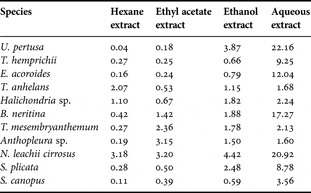
Each collected organism was treated in an identical manner. Each species was initially frozen at –20°C and then freeze-dried. The lyophilized material was weighed, ground to powder and sequentially extracted at room temperature with hexane, ethyl acetate, ethanol and distilled water to extract substances with different polarity. To maximize extract collection, dried material was extracted three times with each solvent at an approximately 1:8 (w/v) ratio. After filtration to remove solid fragments, the hexane, ethyl acetate and ethanol extracts were evaporated to dryness using rotary evaporation, and the aqueous extract was lyophilized. All extracts were weighed and stored at –20°C prior to their use. The yield of each extract was determined by dividing the weight of the dry extract by the dry weight of each organism extracted (Table 2).

Antifouling assay
Antifouling activities of the extracts against barnacle settlement were tested using cyprid larvae of the barnacle Balanus albicostatus. Rearing of cyprid larvae was carried out at Xiamen University Marine Biological Laboratory. Adults of B. albicostatus were collected together with their rock substrate from intertidal rocks in Xiamen, China. To obtain nauplii for cyprid culture, adults were left to dry overnight and upon immersion in seawater, the nauplius I and nauplius II stages were released. Nauplii were cultured in filtered seawater (FSW; 0.22 µm, salinity 30‰ and temperature 25°C) at a density of 1 larva/ml and fed with the diatom Chaetoceros muelleri at a concentration of 2.5 × 10⁵ cells/ml. Each day, nauplii were collected and transferred to fresh algal diet suspensions. After 5–6 days, most of the larvae had metamorphosed to the cyprid stage and cyprids were harvested using filtration. Since it was too difficult to test all the extracts obtained at one time, several batches of cyprids were used.
Settlement assays were conducted in glass Petri dishes (6 cm diameter). The hexane, ethyl acetate, ethanol and aqueous extracts were respectively introduced to the Petri dishes using hexane, ethyl acetate, ethanol and FSW respectively as carrier solvent. After evaporation of the organic carrier solvents at room temperature, 30 cyprids were added to each Petri dish containing the extracts in 10 ml FSW or to 10 ml FSW alone as the control. Each extract was tested at concentrations of 0 (control), 10, 50, 100 and 500 µg/ml with cyprids from one batch, and each concentration was assayed in triplicate. All test Petri dishes were incubated at a temperature of 25°C in darkness and examined after 48 hours of incubation. The numbers of settled larvae were enumerated under a stereomicroscope and rates of settled larvae were calculated. Cyprids that became permanently attached and metamorphosed were scored as settled (Rittschof et al., Reference Rittschof, Lai, Kok and Teo2003; Hellio et al., Reference Hellio, Tsoukatou, Maréchal, Aldred, Beaupoil, Clare, Vagias and Roussis2005).
Statistical analysis
Prior to statistical analysis, percentage settlement values were arcsine-transformed. We used one-way analysis of variance followed by a Dunnett post-hoc test for multiple comparisons of treatment means with the control. The significance level was set at P < 0.05. The data presented in the figures are not transformed. For each extract, the EC50 value (the concentration of extract that reduced the settlement rate by 50% relative to the control) was estimated using the Spearman–Karber method (Hamilton et al., Reference Hamilton, Russo and Thurston1977, Reference Hamilton, Russo and Thurston1978; Reichelt-Brushett & Michalek-Wagner, Reference Reichelt-Brushett and Michalek-Wagner2005). All calculations were based on the test concentrations of the extracts, and the EC50 value was given when it was inside the range of concentrations.
RESULTS
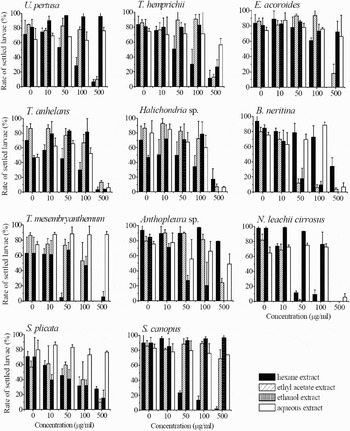
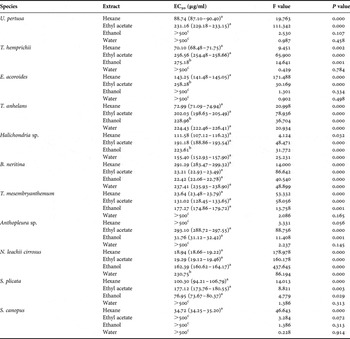
In the present investigation, a series of hexane, ethyl acetate, ethanol and aqueous extracts of 11 marine sessile organisms from the south-east coast of China, whose body surfaces are less fouled or clean compared to surrounding organisms in the field, were tested for antifouling activity. The effectiveness of the extracts in inhibiting settlement of Balanus albicostatus cyprids is shown in Figure 1 and their EC50, F and P values are summarized in Table 3. The 44 extracts were observed to possess various degrees of antifouling activity and, on the basis of their level of activity, the extracts were divided into four groups. Group I comprised the hexane extracts of Tubularia mesembryanthemum, Notarcus leachii cirrosus and Styela canopus, the ethyl acetate extracts of Bugula neritina and N. leachii cirrosus, and the ethanol extracts of B. neritina and Anthopleura sp., which were all strongly active in inhibiting barnacle settlement, with EC50 values <50 µg/ml. Group II contained extracts exhibiting moderate antifouling activity (50 µg/ml < EC50 < 100 µg/ml). These extracts were the hexane extracts of Ulva pertusa and Thalassia hemprichii and Tedania anhelans, and the ethanol extract of Styela plicata. Group III included extracts showing mild antifouling activity (100 µg/ml < EC50 < 500 µg/ml) and was the most numerous. Group IV included ethanol and aqueous extracts of U. pertusa, Enhalus acoroides and S. canopus, the aqueous extracts of T. hemprichii, T. mesembryanthemum, Anthopleura sp. and S. plicata, the hexane extract of Anthopleura sp., and the ethyl acetate extract of S. canopus, all of which were inactive in terms of inhibiting the settlement of B. albicostatus cyprids at any of the concentrations tested (P > 0.05) and with EC50 values > 500 µg/ml.
Effects of hexane, ethyl acetate, ethanol and aqueous extracts from marine sessile organisms on settlement of Balanus albicostatus cyprids. Rates of settlement at different concentrations are plotted. Data plotted are the means of three replicates ± standard deviation.

Antifouling activity of extracts from marine sessile organisms using solvents with different polarity against cyprid larvae of the barnacle Balanus albicostatus.

a, EC50 and 95% confidence limits are presented for each extract; b, the 95% confidence limits are not reliable, based on analysis of the data from the antifouling assays using the Spearman–Karber method; c, the EC50 values could not be determined because the rate of settled larvae did not fall below 50% in any tested concentration. Full species names are as in Table 1.
Of the hexane extracts, 90.9% were active, and 9.1% were inactive; of the ethyl acetate extracts, 90.9% were active, and 9.1% were inactive; of the ethanol extracts, 72.7% were active, and 27.3% were inactive; and of the aqueous extracts, 36.4% were active and 63.6% were inactive. It seems that the substances of low or medium polarity, which in the present case were extracted in hexane, ethyl acetate and ethanol, were more likely to be associated with antifouling activity than the high-polarity substances, which were extracted in water. Furthermore, the results highlighted the danger of relying on the extraction of marine organisms using a single solvent for marine natural product antifoulant studies. Clearly, the fact that the extracts from one species of marine organisms showed significantly different activities, varying with the solvent used in the extraction process, suggested that extraction with a single solvent might overlook highly active antifouling compounds, or might even overlook compounds with antifouling activity, thus the wrong conclusions could be drawn.
DISCUSSION
Many secondary metabolites produced by marine organisms are demonstrated to function in defence against consumers, diminishing fouling, inhibiting competitors or microbial pathogens, attracting gametes, and forming the chemical underpinning for many important life processes of marine organisms (Hey & Fenical, Reference Hey and Fenical1996). In our work, four crude extracts were prepared for each species tested and at least one extract exhibited antifouling activity, confirming the presence of substances with activity against barnacle settlement in all 11 species. It was suggested that they might all have evolved chemical defences against biofouling on their surfaces. The details for each species are described below.
Large numbers of marine algae possess metabolites with antifouling properties (Bhadury & Wright, Reference Bhadury and Wright2004). In our study, the hexane and ethyl acetate extracts from Ulva pertusa both displayed antifouling activity. However, neither the ethanol nor the aqueous extract showed any inhibition towards the settlement of B. albicostatus larvae. This result indicated the low polar nature of the antifouling active component in U. pertusa.
Antifouling activity is a poorly investigated property of seagrasses. As far as we know, only three seagrass species, namely Zostera marina Linn (Harrison & Chan, Reference Harrison and Chan1980; Todd et al., Reference Todd, Zimmerman, Crews and Alberte1993), Cymodocea rotundata Ehrenb. & Hempr. ex Aschers. (Bhosale et al., Reference Bhosale, Nagle and Jagtap2002) and Thalassia testudinum Banks ex König (Jensen et al., Reference Jensen, Jenkins, Porter and Fenical1998) have been studied for their antifouling activity. Here we explored the antifouling activity of Thalassia hemprichii and Enhalus acoroides and found that all the crude extracts of T. hemprichii other than its aqueous extract, significantly inhibited barnacle settlement (P < 0.05), but in the case of E. acoroides, only its hexane and ethyl acetate extracts displayed antifouling activity. Furthermore, among the extracts of both T. hemprichii and E. acoroides, the hexane extract was the most potent in antifouling.
In many studies sponges are a rich source of biogenic compounds with antifouling potential (Sears et al., Reference Sears, Gerhart and Rittschof1990; Goto et al., Reference Goto, Kado, Muramoto and Kamiya1992; Willemsen, Reference Willemsen1994; Clare, Reference Clare1996). Our results also revealed the presence of antifouling active metabolites in the sponges Tedania anhelans and Halichondria sp. To our surprise, and different from the other extracts tested in our work, the ethanol extracts of T. anhelans and Halichondria sp. both significantly induced larval settlement of B. albicostatus in the concentration range 10–100 µg/ml. However, at a concentration of 500 µg/ml they exhibited antifouling activity, which was caused by their acute toxicity to B. albicostatus cyprid larvae (personal observation). This interesting phenomenon whereby substances with inhibiting activity against barnacle settlement and those with promoting activity for barnacle settlement coexist in one organism is also found in the corals Leptogorgia virgulata Lamarck and Renilla reniformis Pallas (Standing et al., Reference Standing, Hooper and Costlow1984). This is a logical consequence of the production by sponges and corals of a high number of metabolites with diverse bioactivities and the complexity of the biochemical pathways controlling larval settlement and metamorphosis in the barnacle.
The marine bryozoan Bugula neritina is a major target organism for antifouling technology and a settlement inhibition assay with its larvae is often used for screening antifouling active substances (Butler et al., Reference Butler, van Altena and Dunne1996; Perry et al., Reference Perry, Zinn and Mitchell2001; Harder et al., Reference Harder, Dobretsov and Qian2004; Dobretsov et al., Reference Dobretsov, Xiong, Xu, Levin and Qian2007). However, the antifouling activity itself has not received any attention. In our study, we extracted B. neritina with four solvents and assayed the extracts for their ability to inhibit the settlement of B. albicostatus. As the results show, ethyl acetate and ethanol extracts of B. neritina were strongly active in inhibiting barnacle settlement. On the other hand, the hexane and aqueous extracts showed only mild antifouling activity.
When seeking natural product antifoulants from the phylum Coelenterata, most research focuses on corals (Clare, Reference Clare1996). Other species belonging to the Coelenterata have been poorly investigated for antifouling activity, and no mention either of finding significant antifouling active compounds from them or any understanding of the potential chemical defence against surface fouling are made. In our work, hexane, ethyl acetate and ethanol extracts of Tubularia mesembryanthemum all exhibited settlement-inhibiting activity against the barnacle B. albicostatus, and of these three extracts, hexane displayed the highest level of antifouling activity. Furthermore, barnacle larval settlement was also inhibited in the presence of ethyl acetate and ethanol extracts of Anthopleura sp. These results warrant follow-up studies to search for natural product antifoulants in T. mesembryanthemum and Anthopleura sp.
The sea hare, Notarcus leachii cirrosus, which is endemic to China, contains antineoplastic active compounds (Lin et al., Reference Lin, Zhang, Yi, Shen, Guo and Shao2001, Reference Lin, Tang, Liu, Zhang, Shen, Yi and Wu2002). In our work, the four extracts of N. leachii cirrosus were all observed to be antifouling active against the barnacle. In particular, its hexane and ethyl acetate extracts were most potent among all the extracts tested, indicating that N. leachii cirrosus also harbours natural products with high antifouling activity and these are lipophilic substances.
Two ascidians of the genus Styela, Styela plicata and Styela canopus, both showed antifouling activity against the barnacle. Although the aqueous extract of S. plicata did not exhibit any settlement-inhibiting activity, mild antifouling activity was observed in the hexane and ethyl acetate extracts, and its ethanol extract showed moderate antifouling activity. On the other hand, among the S. canopus extracts tested, only the hexane extract showed activity and strongly inhibited the settlement of B. albicostatus. The present results indicated the very different activities displayed by these two taxonomically close ascidian species. Similar observations are also made by Devi et al. (Reference Devi, Vennam, Naik, Parameshwaran, Raveendran and Yeshwant1998) for the soft coral species Sinularia granosa Tixier-Durivault, S. numerosa Tixier-Durivault, S. leptoclados Ehrenberg, S. minima Verseveldt, S. capillosa Tixier-Durivault, S. compressa Tixier-Durivault and Sinularia sp., and by Bandurraga & Fenical (Reference Bandurraga and Fenical1985) for the octocoral species Muricea californica Aurivillius and M. fruticosa Verrill.
It can be seen that the type of solvent used to obtain extracts from marine sessile organisms can have a great impact on the antifouling activity. In the present study, hexane, a non-polar solvent, was employed for the extraction of non-polar compounds such as waxes, fats and fixed oils; ethyl acetate, a solvent of medium polarity, for the extraction of alkaloids, aglycones and glycosides; ethanol, a solvent of medium polarity greater than ethyl acetate, for the extraction of glycosides; and water, a solvent of high polarity, for the extraction of sugars, amino acids, and glycosides (Houghton & Raman, Reference Houghton and Raman1998). A greater percentage of hexane, ethyl acetate or ethanol extracts showed antifouling activity than did aqueous extracts, indicating that low or medium polar compounds are more likely to be associated with antifouling activity than high polar compounds.
In conclusion, the 11 species of marine sessile organisms tested all possessed antisettlement active substances against cyprid larvae of the barnacle B. albicostatus. It is suggested that the production of antifouling active metabolites may be common in those marine benthos with a relatively clean surface. Group I extracts were noteworthy for strongly inhibiting barnacle settlement and thus were confirmed as promising sources of natural product antifoulants that should be explored for the development of novel antifouling technology.
ACKNOWLEDGEMENTS
We express our sincere thanks to Professor John Hodgkiss for his help with English in this manuscript. This research was supported by the National Natural Science Foundation of China (grant number 40906078) and the China Postdoctoral Science Foundation funded project (grant number 20090450836).