Introduction
Seeds of most plant species acquire desiccation tolerance during maturation, that is, the ability to dry without irreversible damage and to resume metabolism after rehydration (Leprince and Buitink, Reference Leprince and Buitink2010). However, a lesser number of species produce desiccation-sensitive seeds, which show a lack of maturation drying, and are consequently dispersed with high moisture content (Berjak and Pammenter, Reference Berjak and Pammenter2001). Desiccation-sensitive seeds are most common among species of wet environments (Tweddle et al., Reference Tweddle, Dickie, Baskin and Baskin2003) and are usually not dormant (Joët et al., Reference Joët, Ourcival and Dussert2013). Based on their storage behaviour, desiccation-tolerant seeds are referred to as orthodox, while desiccation-sensitive seeds are referred to as recalcitrant (Chin and Roberts, Reference Chin and Roberts1980).
Temperature ranges for germination, characteristic of each species, are generally related to the microhabitats where species naturally occur (Oliveira and Garcia, Reference Oliveira and Garcia2011). Thermal thresholds of seed germination delimit the minimal and maximal temperature in which radicle protrusion is possible (Batlla and Benech-Arnold, Reference Batlla and Benech-Arnold2010). Besides determining the speed of germination, the temperature range is related to the level of physiological dormancy of seeds, with a narrow range related to deep dormancy (Allen et al., Reference Allen, Benech-Arnold, Batlla, Bradford, Bradford, Nonogaki, Bradford and Nonogaki2007). In addition, the temperature influences the respiratory and the enzymatic activity of seed metabolism and, consequently, affect the fluctuations of phytohormones and other substances acting during germination (Footitt et al., Reference Footitt, Douterelo-Soler, Clay and Finch-Savage2011). Phytohormones are known as signalling molecules during the germination of some palm species (Bicalho et al., Reference Bicalho, Pintó-Marijuan, Morales, Müller, Munné-Bosch and Garcia2015; Bailly, Reference Bailly2019). Reactive oxygen species (ROS) are also known to be involved in seed dormancy-breaking and germination (Liu et al., Reference Liu, Ye, Liu, Chen and Zhang2010; Finch-Savage and Footitt, Reference Finch-Savage and Footitt2012; Gomes and Garcia, Reference Gomes and Garcia2013). Production of ROS stimulates the antioxidant system to scavenge toxic levels of those same chemicals as they interact with abscisic acid (ABA) catabolism to improve germination signalling pathways (Diaz-Vivancos et al., Reference Diaz-Vivancos, Barba-Espín and Hernández2013; Bicalho et al., Reference Bicalho, Santos and Garcia2018).
Palms (Arecaceae) can be found in a variety of environments (Svenning, Reference Svenning2001), and most species produce seeds with primary dormancy (Baskin and Baskin, Reference Baskin and Baskin2014). Mauritia flexuosa (buriti palm) grows in wetlands (Brazilian palm swamps, Veredas) and produces seeds with high water content at maturity and sensitivity to post-dispersion desiccation (Spera et al., Reference Spera, Cunha and Teixeira2001). Attalea speciosa occurs in a transition zone between humid and semi-arid environments, is common in frequently burned and degraded landscapes, and their seeds are dispersed with low water content and are tolerant to desiccation (Saleh et al., Reference Saleh, Luis and Scherwinski-Pereira2017). Despite these differences, seeds of both species exhibit dormancy (Spera et al., Reference Spera, Cunha and Teixeira2001; Lorenzi, Reference Lorenzi, Noblick, Kahn and Ferreira2010). Both species are palms of extraordinary socioeconomic and ecological importance to large areas of tropical Brazil and are considered resources of high commercial significance (Gehring et al., Reference Gehring, Zelarayán, Almeida and Moraes2011; Campos et al., Reference Campos, da Silva, Albuquerque, Peroni and Araújo2015; Virapongse et al., Reference Virapongse, Endress, Gilmore, Horn and Romulo2017). Nevertheless, seed germination in these keystone species remains surprisingly poorly understood.
We evaluated the interactive responses of ABA, ROS and the antioxidant system during dormancy-breaking and germination in these two palm species with contrasting desiccation tolerance. We hypothesized that the relationship between ABA and oxidative signalling after dormancy-breaking and germination would differ between desiccation-tolerant and desiccation-sensitive palm seeds. To test this hypothesis, we intended to address the following questions: (1) Are there differences in thermal thresholds of seed germination in two species with contrasting desiccation tolerance from different environments? (2) Are ROS and the antioxidant system equally functional during dormancy-breaking and germination in seeds of desiccation-tolerant and desiccation-sensitive palm species? (3) Are ROS and ABA dynamics similar during these processes for both species? Results of this investigation contribute to a better understanding of dormancy and germination of desiccation-tolerant and -sensitive palm seeds.
Material and methods
Plant material and collection sites
Fruits of Mauritia flexuosa L. f. (buriti palm, with recalcitrant seeds) were collected in permanent wetlands – a phytofisionomy known as Veredas (‘Brazilian palm swamp’), located in the Cerrado biome (Brazilian savanna) in the state of Minas Gerais. Veredas are permanently wet areas resulting from the overflow of the water table to the surface of hydromorphic soils that remain saturated with water during most of the year regardless of precipitation (Ribeiro and Walter, Reference Ribeiro, Walter, Sano and Almeida1998). Fruits of Attalea speciosa Mart. (babassu, with orthodox seeds) were collected in a vegetal formation called Cocais, a transition zone between the Amazon basin and the semi-arid northeast of Brazil (May et al., Reference May, Anderson, Balick and Frazão1985), with drained soils, in the state of Maranhão. Fruits were collected from at least 30 trees of each species.
Viability, imbibition and germination
The viability of recently recovered seeds was tested using five replicates of ten embryos, which were immersed in 2 ml of tetrazolium chloride solution (0.5%) and kept in the dark for 4 h at 35°C before the initiation of the experiments. Stained embryos (pink-red) were considered viable.
Seeds of M. flexuosa (recalcitrant) had a moisture content of approximately 80% upon collection. The seeds were immersed in water immediately after harvesting to prevent water losses and to preserve their viability and so were considered ‘imbibed’. Four replicates of 15 seeds of A. speciosa (moisture content of approximately 15%) were used to determine imbibition time. The seeds were held in distilled water and weighed daily until reaching constant weight. The resulting imbibition curve indicated that the seeds complete imbibition in 6 d.
For all germination tests, seeds were previously surface sterilized with 5% NaClO for 15 min and then rinsed three times with distilled water. Four replicates of 25 intact seeds for each species were used for the preliminary germination experiments. The seeds were maintained in transparent germination boxes lined with double layers of filter paper moistened with distilled water and kept in a germination chamber for 60 d under a 12 h-photoperiod (40 μmol photons m−2 s−1) at 30°C.
Dormancy-breaking treatment
The absence of germination for intact seeds after 60 d confirmed the dormancy of both species studied (sensu Baskin and Baskin, Reference Baskin and Baskin2014), and thus a dormancy-breaking treatment was performed. An efficient treatment to increase and synchronize palm seed germination is to remove the operculum (Spera et al., Reference Spera, Cunha and Teixeira2001), which comprises the region with micropylar endosperm and the tegument that is pushed by the embryo during natural germination. After full imbibition, the opercular region of each seed was removed using a blade. The opercula of the seeds of A. speciosa were removed 6 d after immersion in distilled water (according to their imbibition curve), while the opercula of seeds of M. flexuosa seeds were removed before sowing in the germination boxes since they had already been immersed in water since harvesting to avoid water loss.
After operculum removal, the germination experiments were carried out in the germination chambers at temperatures ranging from 15 to 40°C at 5°C intervals, as previously described. For both species, four replicates of 25 seeds per temperature were used. Germination was evaluated daily, with the criterion for germination being the protrusion of the cotyledonary petiole. The germination speed index (GSI) was calculated according to Maguire (Reference Maguire1962). The time to reach 50% germination (T 50) was calculated according to the formula of Coolbear et al. (Reference Coolbear, Francis and Grierson1984) modified by Farooq et al. (Reference Farooq, Basra, Ahmad and Hafeez2005).
Embryo sample collection
Embryos were extracted from the palm seeds at different phases of the germination process at 30°C (optimal temperature for both species). The embryos of seeds of M. flexuosa were extracted before sowing (and considered imbibed – I-phase), at 24 and 72 h after operculum removal (using only non-germinated seeds) and at early-germinated seeds (G-phase). Since 50% of the A. speciosa seeds germinated 24 h after operculum removal, the embryos were extracted before imbibition (D-phase, dry), during imbibition (I), at 12 and 24 h after operculum removal (non-germinated seeds) and early-germinated seeds (G).
The embryos thus sampled were used for biochemical analysis. The germination phases were sampled independently with samples consisting of four replicates of 20–30 seeds (depending on the weight of the embryos).
ABA quantification
ABA extraction was performed using four replicates of 100 mg of embryos following Weiler (Reference Weiler1980), with modifications according to Bicalho et al. (Reference Bicalho, Santos and Garcia2018). Measurements for ABA quantification (controls, standard curve, samples and calculations) were performed strictly following the recommendations of Phytodetek® ABA Test Kits (Agdia Incorporated, Indiana, USA). Since water content increased during imbibition, the values obtained for ABA quantification for I, 12 h, 24 h and G-phases were corrected based on D-phase moisture content of the desiccation-tolerant seeds of A. speciosa.
Hydrogen peroxide (H2O2)
H2O2 quantification was performed following Velikova et al. (Reference Velikova, Yordanov and Edreva2000). Four replicates of 100 mg of embryos were ground in liquid nitrogen, homogenized with 0.1% trichloroacetic acid (TCA) and centrifuged at 12,000g for 15 min. To the extract was added phosphate buffer 10 mM, pH 7.0 and 1 M KI (potassium iodide). Absorbance was measured at 390 nm and the H2O2 content was calculated from the standard curve. The values of H2O2 were also corrected as done for ABA quantification.
Antioxidant enzyme system
The extract of the antioxidant enzyme was performed according to Gomes et al. (Reference Gomes, Carneiro, Nogueira, Soares and Garcia2013). Four replicates of 100 mg of embryos were grounded in liquid nitrogen and homogenized in 100 mM of pH 7.8 phosphate buffer with 100 mM EDTA and 5% PVP (polyvinylpyrrolidone). The extract was then centrifuged at 12,000g (4°C) and used to determine enzymatic activity and protein content. The protein content was quantified using Bradford's method.
Catalase (CAT; EC1.11.1.6) activity was determined following Aebi (Reference Aebi1984) in 67 mM phosphate buffer (pH 7.0) with 10 mM H2O2 and adequate amounts of enzyme extract. H2O2 consumption was recorded at 240 nm for 2 min (ɛ = 0.0394 mM−1 cm−1). Ascorbate peroxidase (APX; EC 1.11.1.11) activity was determined following Nakano and Asada (Reference Nakano and Asada1981) in a medium composed of 50 mM phosphate buffer (pH 7.0), 0.5 mM ascorbic acid, 2 mM H2O2 and adequate amounts of enzyme extract. Ascorbate oxidation was monitored at 290 nm (ɛ = 2.8 mM−1 cm−1). Superoxide dismutase (SOD; EC 1.15.1.1) activity was determined in a reaction buffer containing 50 mM phosphate buffer (pH 7.8), 13 mM L-methionine, 0.1 mM EDTA, 0.002 mM riboflavin and 0.075 mM nitroblue tetrazolium (NBT) (Giannopolitis and Ries, Reference Giannopolitis and Ries1977). Blue formazan concentrations were read at 575 nm, and one unit of SOD was considered as the amount of enzyme necessary to reduce 50% of the O2−. Glutathione reductase (GR; EC 1.6.4.2) activity was determined in a medium containing 100 mM phosphate buffer (pH 7.8), 50 mM oxidized glutathione, 5 mM NADPH and adequate amounts of enzymatic extract. NADPH oxidation was monitored at 340 nm (ɛ = 6.2 mM−1 cm−1) (Foyer and Halliwell, Reference Foyer and Halliwell1976).
Histolocalization of superoxide anions
Histolocalization of superoxide anions (O2−) was performed following Oracz et al. (Reference Oracz, Voegele, Tarkowská, Jacquemoud, Turečková, Urbanová, Strnad, Sliwinska and Leubner-Metzger2012) and modifications of Bicalho et al. (Reference Bicalho, Santos and Garcia2018). At least four embryos per phase of each species were immersed in 10 mM of TRIS buffer (pH 7.0) with 1 mM of a NBT solution under illumination for 30 and 25 min for M. flexuosa and A. speciosa embryos, respectively. The embryos were then washed three times in 10 mM TRIS buffer pH 7.0 and photographed. The representative embryos of each phase were selected for the presentation of the results.
Statistical analyses
Data for seed germination (percentage and GSI), ABA, H2O2 levels and antioxidant enzyme activity were tested for normality and homoscedasticity using Cochran and Levene's test. The normal and homoscedastic or transformed data (arcsine root square for germination percentage data) were analysed by ANOVA followed by the Tukey test set at a 5% level of probability, using Statistica 7 StatSoft® software.
Results
Seed viability and germination
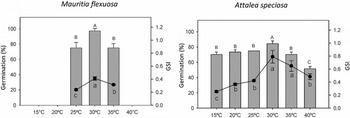
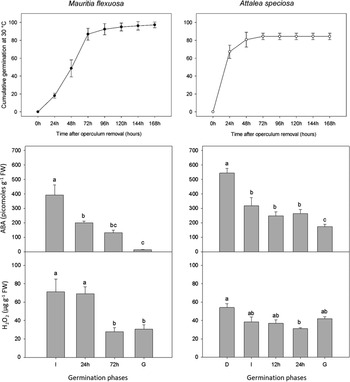
Whilst the viability tests showed that 100% of the seeds of M. flexuosa and 90% of the seeds of A. speciosa were viable before initiating the experiments, the intact seeds (without dormancy-breaking treatment) did not germinate after 60 d of evaluation. However, the germinability of seeds without operculum in responses to different temperatures differed between the two species; seeds of M. flexuosa germinated only in a narrow temperature range between 25 and 35°C, while greater than 50% of the seeds of A. speciosa germinated between 15 and 40°C (Fig. 1). At 30°C, the germination percentage of both species reached more than 80% after operculum removal. The T 50 was reached within 45 and 14 h by seeds of M. flexuosa and A. speciosa, respectively (Fig. 2).
Final germination percentages (bars ± standard error) and GSI (lines ± standard error) of M. flexuosa and A. speciosa seeds after the treatment to overcome dormancy (operculum removal) under a range of temperatures. The bars represent the means ± SE of four replicates with 25 seeds. Means followed by the same letters in each graph do not differ statistically by the Tukey test (P < 0.05). Capital letters compare germination percentages and lowercase letters compare the GSI values at different temperatures.

Germination percentages over time and ABA and H2O2 levels in embryos of M. flexuosa and A. speciosa during germination phases, at 30°C after operculum removal. Dots and bars represent the means ± SE of four replicates of 25 seeds. Means followed by the same letters do not differ statistically by the Tukey test (P < 0.05) between germination phases. (*) significant differences between I and 12 or 24 h (t test, P < 0.05). D, dry seeds, before imbibition; I, imbibed seeds; 12, 24 and 72 h, time after operculum removal; G, early germinated.

ABA and H2O2 contents
Levels of ABA decreased in M. flexuosa embryos 24 h after operculum removal, compared to imbibed embryos (Fig. 2). The embryos of A. speciosa had reduced concentrations of ABA after imbibition and remained constants after operculum removal (12 and 24 h). A further reduction of ABA was observed in G-phase embryos (recently germinated seeds) in both species (Fig. 2). The significant reductions in ABA concentrations observed for M. flexuosa embryos just after operculum removal were not exhibited by A. speciosa. Moreover, comparing both species during G-phase, M. flexuosa embryos showed greater reductions in ABA levels for visible germination than did A. speciosa; germination in A. speciosa occurred with 20-fold higher ABA levels than those found in M. flexuosa (Fig. 2).
The H2O2 concentration in embryos of M. flexuosa was reduced only after 72 h post-operculum removal. In contrast, H2O2 concentrations in embryos of A. speciosa decreased just 24 h post-operculum removal concerning D-phase (Fig. 2). The removal of the operculum did not cause an immediate reduction in H2O2 level in M. flexuosa as it did with ABA level in this species (Fig. 2). In A. speciosa, the H2O2 levels remained similar throughout the germination phases sampled (Fig. 2).
Histolocalization of superoxide anions (O2−)
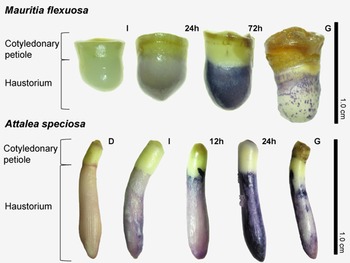
The presence and concentration of O2− in embryos were indicated by the intensity of the purple staining in both species, which was observed only in the region of the haustorium (Fig. 3). Staining was not observed in the region of the cotyledonary petiole in any of the germination phases. The presence of O2− was similar in M. flexuosa and A. speciosa embryos from imbibition to early germination (Fig. 3). In both species, embryos were characterized by uniform staining that became more intense during imbibition and 24 and 72 h after operculum removal for A. speciosa and M. flexuosa, respectively. Germinated embryos (G-phase) of both species exhibited less-intense superoxide anion staining than embryos from intermediate phases (24 or 72 h).
Histolocalization of superoxide anions (O2−) during different germination phases in M. flexuosa and A. speciosa embryos. The concentrations of the anions are indicated by the intensity of staining (increasing from pink to purple to dark blue). D, dry seeds, before imbibition; I, imbibed seeds; 12, 24 and 72 h, time after operculum removal; G, early germinated.

Antioxidant enzymes
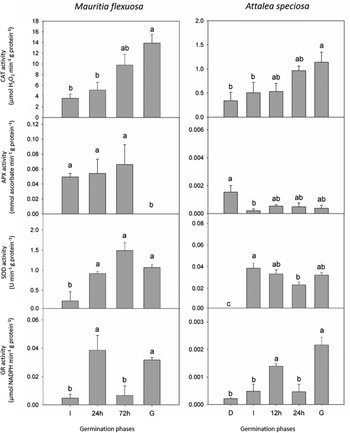
Concerning the enzymatic antioxidant system evaluated here, similarities were noted between both species regarding CAT, SOD and GR activities; however, the activities were ten times greater in embryos from M. flexuosa than in those from A. speciosa. Increased CAT activity was observed in M. flexuosa embryos from I and 24 h after operculum removal to G-phase (Fig. 4), whereas SOD activity increased after operculum removal and remained at that level until G-phase. The activity of GR increased 24 h after operculum removal, as well as in recently germinated embryos, in relation to embryos at I and 72 h (Fig. 4). Although no APX activity was observed in recently germinated embryos, its activity from I-phase embryos to 72 h after operculum removal was similar (Fig. 4).
Enzymatic activity of CAT, SOD and GR during different germination phases in M. flexuosa and A. speciosa embryos. The bars represent the means ± SE of four replicates with 100 mg. Means followed by the same letters in each graph do not differ statistically by the Tukey test (P < 0.05). NS, not significant. D, dry seeds, before imbibition; I, imbibed seeds; 12, 24 and 72 h, time after operculum removal; G, early germinated.

The activity of CAT in A. speciosa embryos increased from I to G (Fig. 4). The activity of APX decreased only during imbibition, and I-phase differed from the D-phase (Fig. 4). No SOD activity was shown by A. speciosa embryos in D, while its highest activities were exhibited in I-phase. The activity of GR was higher in embryos 12 h after operculum removal and in recently germinated embryos, following the same tendency seen in M. flexuosa (Fig. 4).
Discussion
Temperature threshold for seed germination
The palm seeds studied here exhibit distinct temperature thresholds to germinate. The optimal temperature for germination, considered the temperature that promoted the greatest germinability and germination velocity (Labouriau, Reference Labouriau1983), of both species was found to be 30°C. However, the temperature range allowing seed germination of M. flexuosa was more restricted than that of A. speciosa. These differing temperature limits for germination are intriguing and probably strongly related to the natural microhabitats of these species. M. flexuosa occurs in Veredas, a swampy environment, while A. speciosa is typical of drained soils (in Cocais vegetation). Oliveira and Garcia (Reference Oliveira and Garcia2011) reported that seed germination of Eriocaulaceae species from wet soils has a more restricted temperature range for germination than those from mesic or xeric environments. These authors suggested that high soil humidity dampens the temperature resulting in lower amplitude thermal fluctuations in the soil. The influence of the microhabitat where the seeds germinate is reflected in the different temperature thresholds for germination of these species. According to Giorni et al. (Reference Giorni, Bicalho and Garcia2018), the germination process may be finely adjusted to the specific conditions of the seeds’ microenvironment. Besides having a relatively restricted temperature range for germination, M. flexuosa also exhibited lower germination velocity at optimal temperature than did seeds of A. speciosa (see Fig. 1).
Oxidant system and ABA fluctuations following operculum removal
Distinct fluctuations of ABA, ROS and the antioxidant system were observed during seed dormancy-breaking and germination in both palm species studied. Embryos of M. flexuosa and A. speciosa showed a decrease in ABA concentrations during the process of germination. ABA concentrations reached their lowest values in recently germinated seeds, corroborating the findings of Bicalho et al. (Reference Bicalho, Pintó-Marijuan, Morales, Müller, Munné-Bosch and Garcia2015) for macaw palm, a species with desiccation-tolerant seeds. However, the species exhibited different ABA dynamics. In embryos of M. flexuosa, after the removal of the operculum, there was a reduction in the levels of ABA however, the levels of H2O2 remained constant. The reduction in ABA levels, probably induced by catabolism, allowed the germination of M. flexuosa seeds. However, in A. speciosa embryos, reductions in ABA levels were observed during imbibition, probably due to leakage, and operculum removal was the ultimate barrier to germination. Comparatively to A. speciosa, M. flexuosa embryos showed higher levels of H2O2, which may be related to the high water content of these seeds (recalcitrant), which allows metabolic activity since the maturation phase (Berjak and Pammenter, Reference Berjak and Pammenter2001; Umarani et al., Reference Umarani, Aadhavan and Faisal2015). On the other hand, in A. speciosa, the operculum removal did not promote a significant reduction in ABA levels, and H2O2 concentrations were maintained constants throughout all germination phases (see Fig. 2).
In seeds of both species, we found that the germination process, mainly upon operculum removal, generated O2− in the haustorium, probably due to the increase in the respiratory metabolism. We suggest that in M. flexuosa embryos, O2− signalled the decrease in ABA levels 24 h after operculum removal. Controlled O2− production showed a definitive role in the germination of the recalcitrant seeds, as also found by Roach et al. (Reference Roach, Beckett, Minibayeva, Colville, Whitaker, Chen, Bailly and Kranner2010) for Castanea sativa seeds.
Interestingly, O2− was restricted to the haustorium region of the embryos. The embryos of palm species are composed of two well-defined yet anatomically connected regions: the cotyledonary petiole (containing the embryonic axis) and the haustorium (a modified cotyledon with reserve compounds) (DeMason, Reference DeMason1988; Moura et al., Reference Moura, Ventrella and Motoike2010; Bicalho et al., Reference Bicalho, Motoike, Borges, Ataíde and Guimarães2016). The presence of O2− only in the haustorium during all germination phases indicates that this region of the embryo is probably very active since imbibition and is likely involved in germination itself besides reserve mobilization (a post-germination event) (Panza et al., Reference Panza, Pighin, Láinez, Pollero and Maldonado2009). The marked presence of O2− was a common effect noticed for both desiccation-tolerant and sensitive palm species, as was also reported by Bicalho et al. (Reference Bicalho, Santos and Garcia2018) for Butia capitata seeds. A peak of O2− accumulation was observed at 24 h (A. speciosa) and 72 h (M. flexuosa) following operculum removal, which was observed together with reductions in ABA levels during the early-germinated phase. ROS and scavenging systems are key cellular signalling pathways involved in overcoming dormancy (Oracz et al., Reference Oracz, El-Maarouf-Bouteau, Kranner, Bogatek, Corbineau and Bailly2009). We suggest, therefore, that the haustorium is central in ROS generation, functioning as a hub of signalling mediated by O2− produced. In the species studied here, there is probably a signalling pathway involving both the haustorium and the cotyledonary petiole, which still must be better investigated. Therefore, we can assume that the haustorium is more than a structure for reserve mobilization, acting as a source of signalling for germination as well.
We propose that the increasing formation of O2− induced the activity of antioxidant enzymes (CAT, SOD and GR) without substantially affecting the levels of H2O2. The increase in SOD activity is probably an effect of superoxide anion accumulation that increased CAT activity as also shown by Sharma et al. (Reference Sharma, Jha, Dubey and Pessarakli2012) and by Bailly (Reference Bailly2019). This effect could reduce the H2O2 levels, a delayed effect observed 72 h after operculum removal. SOD and CAT are antioxidant enzymes that work together to control the excess of O2− and H2O2 (Mittler et al., Reference Mittler, Vanderauwera, Gollery and Van Breusegem2004). During the oxidative burst typical of increasing metabolism or resumption, that is, imbibition and germination, mitochondria and RBOH-induced activity become the main sources of signalling (El-Maarouf and Bailly, Reference El-Maarouf-Bouteau and Bailly2008; Considine and Foyer, Reference Considine and Foyer2021). The APX activity and the levels of enzymatic activity of M. flexuosa seeds demonstrate the metabolic activation of desiccation-sensitive seeds, that is, beginning since the first stages of germination. These results are in agreement with those reported by Tommasi et al. (Reference Tommasi, Paciolla and Arrigoni1999), in which the ascorbate system, including APX, is efficiently functional in recalcitrant seeds and almost non-existent in orthodox seeds during germination.
The present study also demonstrated that GR activity increased after the removal of the operculum and in early-germinated embryos of A. speciosa and M. flexuosa (Fig. 4). Interestingly, GR activity in both species increased when the embryos were exposed to the removal of the operculum, and after the emergence of the cotyledonary petiole. The increased GR activity with the exposure of the embryo during both dormancy-breaking and visible germination, two processes in which respiratory activity is supposedly enhanced, was well marked for both species. GR activity is enhanced during burst respiration events (Miller et al., Reference Miller, Suzuki, Ciftci-Yilmaz and Mittler2010). Regenerating the glutathione pool is a key step in preventing oxidative injuries (Bailly et al., Reference Bailly, Benamar, Corbineau and Come1996), and it is part of cellular redox buffering (Verma et al., Reference Verma, Mishra, Sangwan and Sharma2015). The observed increase in GR activity suggests that it is related to signalling and breaking dormancy after operculum removal in A. speciosa and M. flexuosa seeds, as well as to embryo growth upon germination. Our findings are in agreement with those of Oracz et al. (Reference Oracz, El-Maarouf-Bouteau, Kranner, Bogatek, Corbineau and Bailly2009), who found that increases in GR activity were closely related to dormancy-breaking treatments in sunflower seeds.
Conclusion and further approach
It can be concluded that the palm seeds studied here exhibit distinct germination responses to a range of temperatures, probably due to the microhabitats where their seeds naturally germinate. These important cues added to differences in seed metabolism (desiccation tolerance and desiccation sensitivity) influence both germination velocity and biochemical signalling. However, some differences between the species stood out. Seeds of A. speciosa did not exhibit fluctuations in H2O2 levels that could be related to decreases in ABA, as seen for M. flexuosa. Moreover, proportionally, the levels of ABA that allowed seed germination of both species were quite distinct. Seeds of M. flexuosa experienced deeper reductions in ABA levels than were A. speciosa embryos, even with the greater germination velocity of A. speciosa. The present study also demonstrated the integrated roles of O2−, SOD and CAT activities during dormancy-breaking and germination, including the haustorium as a possible source of signalling during the entire process. We suggest the role of haustorium in the signalling pathway between ROS and hormones in the overcoming dormancy, and the germination process must be investigated in further research with palm seeds.
Acknowledgements
We thank IBAMA (Instituto Brasileiro do Meio Ambiente e dos Recursos Naturais Renováveis) and IEF-MG (Instituto Estadual de Florestas of Minas Gerais State) to concede the licences of collection of the fruits. The authors also thank Prof. L. V. Modolo to allow the use of equipment and Prof. M. P. Gomes for critical reading of the manuscript.
Financial support
Financial support was conceded by CNPq (Conselho Nacional de Desenvolvimento Científico e Tecnológico (Q.S.G, grant 446346/2014-4) and FAPEMIG (Fundação de Amparo à Pesquisa do Estado de Minas Gerais (Q.S.G, grant PPM-00163-16). T.R.S.S. received grant scholarship from CNPq, E.M.B. received postdoc scholarship from CAPES (Coordenação de Aperfeiçoamento de Pessoal de Nível Superior) and Q.S.G. received a research productivity scholarship from CNPq.
Conflicts of interest
The authors declare none.