INTRODUCTION
LanzaTech was founded in 2005 by Dr. Sean SimpsonFootnote 1 and Dr. Richard Forster. The two entrepreneurs developed a proprietary microbe which fed on waste carbon monoxide (CO) gas to produce ethanol through a fermentation process. The journey from idea to research commercialization has been full of challenges as well as opportunities. Not only the technology was radically new and disruptive, but the industry for carbon capture was in its infancy. This rendered the journey complex and uncertain. Challenges were emphasized by the limited entrepreneurial experience of the foundersFootnote 2 .
This case exemplifies two debates arising in the literature: the debate between opportunity creation as opposed to opportunity discovery (Alvarez & Barney, Reference Alvarez and Barney2007), and between effectuation and causation (Read, Sarasvathy, Dew, Wiltbank, & Ohlsson, 2011). This case shows that in highly uncertain environments, the entrepreneur plays a crucial role in creating an opportunity, and in exploiting it through an effectuation logic. The five effectuation principles identified by Read et al. (2011) offer appropriate guidance in uncertain and dynamic contexts where the opportunity is not apparent and needs to be created. The case will explain, step by step, how entrepreneurs created an opportunity, from ideation to commercialization, following an effectuation logic.
LanzaTech experienced several crucial moments. It received seed funding from investors Dr. Ross Clark, Stephen Tindall and Vinod Khosla to construct a pilot plant at the Glenbrook steel mill in South Auckland. In the following 5 years, Simpson took the company through various rounds of venture capital (VC) fundraising, and signed joint venture agreements with large steel and oil companies in United States, China, India, South Korea and Japan. LanzaTech registered over 100 patents within two proprietary microbe families, and continued to develop and modify the microbe to produce other chemicals including succinic acid, butanol and 2,3 Butanediol.
The company’s science is of crucial importance to reduce carbon emissions. LanzaTech’s bioprocessing platform offers the possibility to capture and re-use carbon, enabling the monetization of local gas sources. In other words, the LanzaTech process converts waste gases, such as CO2, into fuels and chemicals. Considering the challenges facing climate change and the political resistance to reducing CO2 emissions, this type of technology offers an important solution to pollution problems.
However, LanzaTech remains a high-risk venture. By 2012 the company had offices in NZ, the United States and China, and employed upwards of 70 staff. Simpson estimated LanzaTech would need another US$250 million worth of capital before it would begin to generate a profit. In the following years, LanzaTech raised further rounds of VC including a US$112 million series DFootnote 3 . By 2017, LanzaTech entered agreements with companies in South Africa, United States, China and India becoming a major player.
NZ BIOSCIENCE INDUSTRY
Bioscience is the development and application of knowledge of the way plants, animals and humans function – to develop products and servicesFootnote 4 . Bioscience activities may occur in areas such as aquaculture, horticulture and forestry; agriculture feedstock and chemicals; medical devices and equipment; animal and human therapeutics and diagnostics; research testing and medical laboratories; microbes; biotechnology.
According to the 2011 bioscience survey conducted by the NZ government, 474 organizations were involved in bioscience. However, only 147 of these indicated bioscience as their main activity. The remaining companies were either using bioscience processes to manufacture their products (291) or were conducting research in the space (39). As a comparison, in United States in 2014, 77,000 organizations and 1.66 million individuals were involved in bioscience activitiesFootnote 5 . These numbers highlight the relatively small size of the NZ ecosystem.
A large portion of these organizations was working in human wellness (52%) and animal-based biosciences (38%). The Auckland and Northland region had the largest number of bioscience organizations. Of the bioscience technologies being used in 2011, 51% were early stage, mostly conducting research and development (R&D), 26% were in the production process stage and the remaining 23% had developed and were selling a product. These organizations were generating an aggregate income of $677 million, most of which from exports ($376 million).
Interestingly, these bioscience companies declared that capital was a constraint to their R&D and commercialization activities. More than half (59%) of the companies whose primary activity is bioscience reported that capital access was a constraint to R&D, whereas 47% reported it as a constraint to commercialization. In this case, we will discuss both the challenges of LanzaTech in raising capital as well as in commercializing its research.
THEORETICAL BACKGROUND
Do entrepreneurial opportunities exist, independent of the perceptions of entrepreneurs, just waiting to be discovered? Or, are these opportunities created by the actions of entrepreneurs? Alvarez and Barney (Reference Alvarez and Barney2007) identified two internally consistent theories of how entrepreneurial opportunities exist – discovery theory and creation theory. The former theory assumes that entrepreneurial opportunities are objective phenomena waiting to be discovered and exploited. The latter theory assumes that opportunities are created through an iterative process that ultimately leads to the formation of an opportunity.
The LanzaTech opportunity was created and exploited through a series of interconnected but serendipitous steps. This approach was particularly useful due to the rapidly changing environment and radically new technology LanzaTech was working with. In this context, opportunities do not exist until they are created. In 2005, it was impossible to understand what the ultimate opportunity would have been, what resources were needed or information required to estimate the possible outcomes associated with particular strategies. In this highly uncertain environment, Sean Simpson adopted an effectuation logic which is more appropriate than a causal logic.
Read et al. explain that causation ‘focuses on achieving a desired goal through a specific set of given means. Causation invokes search and select tactics and underlies most good management theories. Effectuation focuses on using a set of evolving means to achieve new and different goals. Effectuation evokes creative and transformative tactics’ (emphasis added) (2011: 7).
Effectuation is based on five key principles (Read et al., 2011). The first principle is ‘bird in hand’: An entrepreneur should start with his/her means. It is important to start with what is available rather than to wait for the perfect moment and opportunity. The second principle is ‘affordable loss’: An entrepreneur should evaluate the opportunities based on whether the downside is acceptable. The third principle is the ‘crazy quilt’: An entrepreneur should leverage contingencies and embrace surprises that arise from uncertain and unexpected situations. The fourth principle is called ‘lemonade’: An entrepreneur should form partnerships with entities willing to embrace the technology and that are willing to add value. The fifth and final principle is labelled the ‘pilot on the plane’: An entrepreneur can and should create opportunities. Opportunities can be created by working with resources under control without the necessity to precisely predict future outcomes. This case will show how, using the five principles of effectuation logic, the two entrepreneurs were able to create and exploit a business opportunity.
LANZATECH BACKGROUND
Dr. Sean Simpson was born in Zambia and obtained a PhD in plant science at the University of York. He moved to NZ in 2002 to work at Genesis Research, the first biotech company listed on the New Zealand Stock Exchange. While working at Genesis, Simpson and his colleague Dr. Richard Forster convinced the Board to fund their research into the use of forestry biomass as a feedstock for cellulosic ethanol productionFootnote 6 . This technology had the potential to develop a new market for the company, grow its revenues and formulate intellectual property (IP). Unlike corn-based biofuel, cellulosic ethanol did not use food resources, but did require greater processing to transform the biomass into sugar monomers which then were fermented to create ethanol.
After several years of research, Simpson and Forster concluded that cellulosic ethanol was as globally unsustainable as carbohydrate-based biofuel because it still diverted land and forestry resources from other uses, and that there was no biomass appropriate as a feedstock for biofuel. Simpson questioned: ‘Why are we talking about a solution that is predicated on the use of a crop that doesn’t exist?’ Instead, he drew up a list of requirements for a sustainable feedstock. It needed to be low cost, readily available, produced in high volume, not require transport and not use food resources. The two researchers hit on the idea of waste gases, which were plentiful, produced or aggregated in a single location, and did not need to be transported. Simpson identified the steel industry as a potential feedstock source. Steel manufacturing produced large amounts of CO waste, which could be fermented to produce ethanol. Simpson explained:
At that stage, we knew enough about microbiology to be dangerous. We could marry the availability of carbon monoxide with a biochemical process for the production of ethanol. But what hadn’t been investigated before was whether this biochemistry could operate in the absence of hydrogen.
EARLY COMMERCIALIZATION
In 2005, leveraging the newly acquired knowledge, Simpson and Forster left Genesis and decided to start their own enterprise: LanzaTech. Their initial goal was to find a way to make biofuel using steel waste gases as a feedstock. As Simpson explained:
Our first proposition was to find the feedstock, identify the biochemistry that linked feedstock to product, and then identify the technical challenges of that.
They discovered a paper at the University of Waikato library describing a microbe which could convert CO into ethanol. Simpson and Forster bought the microbe from a microorganism and cell culture bank in Germany for $1,000, but soon discovered that it could not process large amounts of CO and that it was expensive to handle and maintain. They began to modify the microbe, utilizing the natural selection process of bacteria by exposing it to a range of demanding environments, isolating the bacteria that survived, then repeating the process, before eventually developing a microbe that could process CO into ethanol in a hydrogen-free atmosphereFootnote 7 . LanzaTech’s original IP idea was scrawled on an A4-sized piece of paper and demonstrated how the microbe could function energetically without hydrogen.
Simpson and Forster were unsure on how to fund the project, and were turned down by government research funding bodies and universities as well as local venture capitalists. ‘We had a great idea, but people just don’t start up big biotech companies in New Zealand very regularly’. They eventually raised seed capital from two scientists running their own company, Biodiscovery. The scientists liked and understood the science behind the project. They invested NZ$100,000 (NZ$40,000 in cash and NZ$60,000 in laboratory space), which allowed Simpson and Forster to hire one staff member to continue developing the microbe, while they focussed on raising more capital. They approached the Foundation for Research, Science and Technology (FRST) and raised a grant which matched the Biodiscovery investment. ‘Then we got some actual runway to do some actual experiments, and we managed to produce in practice what we were saying’. At that stage they had no clear idea how a business based around their technology might function. ‘We said, well we will probably license it, but I had no idea what that really meant. It was just a word I knew. But everybody would say it, and the people you’d say it to would accept it’.
After producing 5 ml of ethanol in the laboratory, Simpson and Forster approached entrepreneur Dr. Ross Clark to raise more capital. Clark was a friend of Forster’s from university, and a former Professor of Endocrinology at the University of Auckland. Clark had also started the Californian pharmaceutical company Tercica to commercialize human growth hormone IGF-1, and the company had listed on the NASDAQ in 2004. Simpson considered the meeting with Clark a ‘nexus moment’ in the development of LanzaTech. Clark asked tough questions about commercializing their product that Simpson and Forster had not previously considered:
How is this going to translate from your test-tube? How are you going to scale things up? What sort of team size do you need? What are your milestones? The concept we had was completely wrong. But that was the point where I started understanding the fundraising game.
Clark also emphasized the importance of IP generation and ownership. As Simpson recalled, ‘[Clark said] that IP for a start-up is like a bar of gold. Think of it like bullion. Every patent you add is another bar of gold you have … we think about owning everything we spend our money on’. LanzaTech was operating in a relatively empty IP landscape and there was potential to capture a significant area of that before competitors moved into the market. Simpson focussed on IP generation and protection early in the research commercialization process, and one of the first employees hired at LanzaTech was a full-time patent attorney.
Clark agreed to invest in LanzaTech on the basis that Simpson and Forster would gather enough data on the process to file a patent ‘to the satisfaction of AJ Park’ (a NZ IP law firm). Clark also convinced The Warehouse Footnote 8 founder Stephen Tindall to invest, despite Tindall’s initial reservations. ‘Stephen said, this test tube is full of muck. But Ross said, this is interesting, just put a little bit of money in and we’ll see what these guys get’. Clark and Tindall invested in LanzaTech at the end of 2005, which allowed Simpson and Forster to draw a small salary for the first time. They bought a second-hand bioreactor, and in combination with a fermenter, managed to produce a small amount of ethanol (~4 g) at 1 l scale from CO gas. Simpson explained that ‘it was awful. It didn’t really work very well. But it worked well enough for us to have some data’.
Clark believed the project had the potential to make ‘serious money’, so Simpson and Forster approached NZ VC firms again, with no success. Instead, Clark used his contacts and good reputation in Silicon Valley to get Simpson an introduction to billionaire Vinod Khosla. Khosla was the cofounder of Sun Microsystems, who had set up his own VC firm to invest in information technology and clean-tech start-ups. Clark’s role was crucial. As Simpson explained:
People think it’s really a straightforward thing to get an introduction to a VC like this, and it really isn’t. You need to meet the top people, and you need to meet them early and you need to make a big impression. The only reason they invested in us, they liked the technology, it ticked their boxes, but they had Ross Clark who they knew that they could trust. He was reliable. We weren’t.
In September 2006, Simpson flew to California to meet with Khosla and presented a research case on the project.
We said that over the course of two or three years, we were going to get to ten litres. We thought that this was wildly aggressive, producing at 50 grams per litre per day. We were all terribly nervous. We didn’t know if we had done a good thing or a bad thing.
Khosla thought the project fitted within the Khosla Ventures ‘wheelhouse’, and in November sent a group of scientists to Auckland to perform due diligence on the company. In March 2007, Khosla Ventures announced they would invest US$3.5 million in LanzaTech, the first investment the company had made outside of the United States.
However, Khosla wanted LanzaTech to take advantage of funding available for bioethanol and syngas research within the United States, so the company opened a small research office in Colorado. As Simpson explained, despite the United States being ‘awash with cash’ the office proved hard to establish:
In New Zealand things were developing away quite nicely. Over there, it was all about trying to set up a lab and do everything from scratch. It was hard to coordinate across the two sites. Either we should have moved the whole company or we should not have bothered.
In October 2008, the US sub-prime mortgage market collapsed, causing a global financial crisis and economic recession, and Simpson was pushed by his investors to reduce the LanzaTech ‘burn rate’ and cut costs. He closed the US office, and refocussed on NZ. ‘Pulling the guys out of the U.S. was part of [reducing costs], capping off hiring and battening down the hatches while the financial storm was blowing up. So we were able to survive until we raised our next round of cash’. By that stage LanzaTech’s NZ operations had scaled up, and Simpson’s focus was on the construction of their first pilot plant in Glenbrook, South Auckland.
DEVELOPMENT
Immediately after investing in LanzaTech, Khosla began to push Simpson and Forster to build a pilot plant and test the microbe on a large scale.
He said, go to a steel mill and get a relationship there, stick your pilot plant there and let’s prove this thing out. And we said, what are you talking about? It’s going to cost a lot of money, and it’s going to be very big. And he said, go on and do it. You’ve got to build that thing, and then let’s find out that it doesn’t work.
Simpson cold-called NZ Steel, whose Glenbrook manufacturing plant was the only steel plant in NZ and emitted up to 1,000,000 m3 of waste gases per hour, but the company was uninterested. Forster had a contact within Bluescope Steel (NZ Steel’s parent company) who was equally dismissive. NZ Steel said ‘we don’t like to have microbes on our steel mill. We don’t like to have flammable liquids. They hated the whole idea’. Simpson and Forster ‘came back with a bunch of thermo-dynamics’ to further prove how the microbe might work.
NZ Steel was finally motivated by a change in policy. The company was lobbying the Labour Government to exempt steel manufacturing from the incoming carbon emission trading scheme, and needed to find ways to reduce their emissions and have a ‘good news story, other than the fact that they were just burning a bunch of carbon’. Stephen Tindall and Ross Clark both lobbied NZ Steel on behalf of LanzaTech, and they finally agreed to the project.
Simpson hired engineers to do the basic plant design and outsourced the detailed design to New Plymouth company Fitzroy. At that stage, Simpson was unsure whether the plant would work effectively, and uncertainty was high. ‘The results in the lab weren’t that flash. Lots of issues, going down blind alleys and trying to pull a team together. It was chaotic, it was really nerve wracking’. They did not know whether the microbes would tolerate the changeability of the steel mill or whether there would be variations in the steel mill they had not anticipated that would kill the microbe. When they eventually switched on the pilot plant in November 2008, it did not work. The microbes coped well but the design of the plant was wrong. It took a further 12 months to redesign and rebuild the plant. Simpson and Forster were ‘devastated’ when the plant did not work but Khosla was unconcerned. As Simpson recalled, Khosla ‘was completely prepared for it not to be working, but obviously they weren’t going to tell us that. We were sufficiently naïve to think that it was going to work … but often the mistakes are things that end up driving you to the right place’. This setback could have been fatal. If LanzaTech was not able to test and prove itself viable in a steel plant, it would have been a deal breaker for the survival of the enterprise. Simpson was also distracted by hiring new staff and dealing with the legal aspects of setting up a company in NZ.
We were really badly organized in some ways. The way the constitution was set up and all these things were pretty ropey. There were lots of things like that, which at the time were really distracting. You could get buried in how to organize this thing, rather than buried in how to make it work. And we needed to be buried in how to make it work.
The uncertainty was exacerbated by the speed in which the project moved. Within 2 years, the fledgling company had moved from a test tube of data to running a substantial pilot plant. In addition, in 2009 Forster had left the company due to unrelated health reasons. LanzaTech’s business model was also relatively undeveloped. Simpson believed that the company would have to find a way to raise enough capital to build reactors to attach to existing commercial steel plants, as they had done at Glenbrook.
The $5 million Glenbrook pilot plant eventually produced 58,700 l/year of ethanol, and proved the microbe could function in the unpredictable steel mill environment, tolerate changes to gas composition and cope with gas contaminants. The process worked successfully with converter gas (40–50% CO) and blast furnace gas (minimum 15% CO), due to its ability to produce its own hydrogen. All production targets at Glenbrook were achieved, and the predicted revenue from ethanol was almost twice that from power generation, which was the only other option available to generate revenue from steel mill gasesFootnote 9 . However, the cost of the plant was much larger than originally anticipated. Simpson raised another US$5 million from Khosla and in July 2008 received a 3 year, $12 million grant from the FRST Low Carbon Energy Technology fund, based on LanzaTech’s potential to reduce NZ’s carbon emissions. The $12 million grant was the largest administered under the scheme.
LanzaTech’s investors remained supportive because Simpson was utilizing synthetic biology to experiment with the original microbe and fermenting process to produce chemicals other than ethanol, and expand the company’s IP portfolio. As Simpson explained:
Our investors were getting nervous that this was kind of hard. We had an interesting technology, but we had to find some way of partnering it with big steel mills and how would that work. All their other companies were following the biomass to ethanol path in the States, which at the time was much clearer. But [Khosla Ventures] really gets synthetic biology. We were able to show that with the same biochemistry we could produce more valuable modifications, and they were very excited.
The original microbe (LZ-1561) was eventually modified to produce butanol, acetone, isopropanol, succinic acid and the chemical 2,3 Butanediol, which could be ‘dropped in’ (blended) with aviation fuel.
Simpson had also seen an opportunity to commercialize LanzaTech technology in China, which he felt had the right mix of energy and opportunity. China was the largest steel manufacturer in the world and the microbial technology would reduce carbon emissions without compromising the outputs of a steel plant, plus produce an economically viable biofuel. In 2010, China manufactured 44% of steel produced globally, and output was predicted to keep growing at a compound annual growth rate of 18.1% by 2015Footnote 10 . However, rapid industrialization and double figure economic growth had caused extensive environmental degradation, including air, water and ground pollution, associated health problems and civic unrest. The Chinese government had set targets for tackling environmental problems without compromising economic growth, and was scheduled to invest US$268 billion in renewable energy projects by 2020 (Fang, Reference Teece2006), while Chinese biofuel consumption was forecasted to rise to 30.4 million barrels by 2030. Simpson believed the true value of the market opportunity could not be validated without visiting the country first-hand. ‘The complexity of the opportunity and the interplay between all the pieces can’t really be appreciated’.
In November 2009, Simpson travelled to China for the first time, and was impressed by the willingness of Chinese businesspeople to do deals, take risks, and try new technologies. However, he needed a ‘meaningful’ way of getting into the market and meeting key people within the steel industry. Vinod Khosla introduced Simpson to James Zhang, a Chinese-born scientist who had done his PhD in genetics at the University of California, and had cofounded Mendel Biotechnology, a San Francisco plant biotech company which developed new technologies for increasing crop yield and stabilityFootnote 11 . Zhang joined Khosla Ventures in 2009, and accompanied Simpson on his second trip to China. ‘We were his new project. We went around with James and he had great relationships with the Chinese Academy of Sciences (CAS), which had great relationships with Baosteel’. CAS was a research and development centre in Beijing which Simpson visited in November 2009. CAS executives subsequently visited the LanzaTech laboratory and Glenbrook pilot plant in March 2010; a month later, LanzaTech and CAS signed a letter of intent to collaborate on a number of projects. CAS executives introduced Simpson to Baosteel, the second-largest steel producer in China, which had revenue of US$29.8 billion in 2010Footnote 12 and a strategic focus on the research and development of innovative steel-making technologiesFootnote 13 . Baosteel was interested in LanzaTech’s microbes to reduce carbon emissions, maintain technological leadership in the local and global market, and maximize profit margins. As Simpson recalled: ‘Fundamentally they want to make more money than they do now, with the gases they emit’.
In early 2010, LanzaTech and Baosteel began negotiations to commercialize the LanzaTech microbe. Simpson initially led the negotiations for LanzaTech, before being joined by new CEO Jennifer Holmgren, who was appointed in June 2010. Holmgren was previously Vice-President of the Renewable Energy and Chemicals unit at UOP, a division of Honeywell, and had experience in commercializing chemical technology in the energy industry. Holmgren helped to refine LanzaTech’s strategy in the negotiation, which was to retain exclusive rights to their existing IP plus any IP developed during the commercialization process. Simpson explained that her influence ‘gave real clarity to the negotiations, because she would say, we’re not going to accept any [loss of IP], but we want to do a deal. We will bring the technology, you’ll bring cash and we’ll commit to certain milestones that describe whether or not this thing works’. In June 2010, LanzaTech and Baosteel announced the creation of a new joint venture company, the Shanghai Baosteel LanzaTech New Energy Company Ltd. The intention was to build a demonstration plant in Shanghai by late 2011, before scaling up the technology to a commercial level. LanzaTech retained the IP and any future IP developed within the field. Any profits realized from the sale of ethanol produced by the plant would be split between the partners. Shortly afterwards, LanzaTech completed its second VC round, raising US$18 million from a preround valuation of US$70 million. The round was led by Shanghai investors Qiming Ventures, who were joined by Khosla Ventures, K1W1 and Softbank China Venture Capital. The capital raised would go towards the commercialization of the technology with Baosteel.
Simpson considered the deal with Baosteel to be:
The first grain of sand in that beach of experience’ towards commercialization. [The focus became] about project execution, putting together a team to do the detailed design, project management and having people out there commissioning it, in a foreign land with a real gas stream.
The agreement with Baosteel also cemented LanzaTech’s IP strategy in China. The company structured its IP access to protect individual elements rather selling the technology as a package. ‘We’ve set up our microbe differently to our control systems to our engineering systems to our chemistries. We sell bits, we license bits in, and other things are provided under confidentiality’. Simpson realized that LanzaTech owned a platform technology (the microbe) which could be built on and refined to produce any number of other chemicals, and maximize their partners return on investment.
Our partners recognize that ethanol is step one. Producing propanol and isoprene are step two and three. We are saying, this is a platform and we’re going to make more and more money out of your waste gases from this platform.
After Holmgren’s appointment Simpson stepped into the role of Chief Technology Officer. ‘I’m not a CEO. I knew that when I started the company. I don’t want to be a CEO [and] I’m a limitation to the growth of the company if I’m in charge’. Holmgren implemented a clearer staff structure (including hiring a Chief Financial Officer) and opened two offices, in Chicago and Shanghai. She also provided a: ‘much clearer vision of what kind of expertise we needed in order to scale. One thing that was really lacking in the company before that was people who sat back and looked at the technology from the perspective of where it needed to be’. Simpson also felt that LanzaTech’s transition to commercial company was helped by their international orientation from the outset. The NZ government had no policy around clean-tech and there was no local market for ethanol, so they had targeted international markets from the start. ‘Our approach was, where is the feedstock? And then we developed the technology for that space. So China then makes a lot of sense, India makes a lot of sense, so do some places in Brazil’.
The Baosteel agreement furthered the process of developing a more feasible and ‘capital light’ business model for LanzaTech. Simpson realized that, ‘we didn’t have to spend the money to build our plants, because our partners would. We have a technology in a space where the feedstock provider has a lot of money’. Large steel manufacturers could take on the cost of building the fermentation reactor, while LanzaTech provided the technological expertise and IP access, instead of having to continuously raise enough capital to build the plants themselves. As a result, LanzaTech’s strategy changed, and instead from moving forward in a sequential pattern, they could scale and validate the technology at the same time as forming multiple partnerships to dominate the market. As Simpson argued:
You can’t wait for perfection before you move to the next scale. You keep compounding the risk in some respects, but in others it’s just about challenging yourself to get out of the pilot to the next big scale, and just make it work.
In 2011, LanzaTech signed several partnerships within Asia and the United States. This included a memorandum of understanding with India Oil, to evaluate the viability of the LanzaTech microbe at their refineries; a memorandum of understanding with Posco, the largest steel maker in South Korea, covering the implementation of the technology at their steel plants; agreements were signed with Mitsui and Co (Japan), LCY Chemical Corp (Taiwan), Henan Coal and Industrial Corp (China), and Shougang (Capital Steel) Group (China) to construct demonstration plants and identify new research opportunities; and an agreement with coal producer Yankuang Group (China) to produce biofuels and chemicals from syngas. Partnerships formed in the United States included the U.S. Defence Advanced Research Project Agency to find new ways of producing jet fuel (JP-8) from CO; the US Federal Aviation Authority to assess production opportunities for alternative jet fuel within the United States; and Pacific Northwest National Laboratory to scope the use of the LanzaTech technology within the US market.
In January 2012, LanzaTech announced their third round of VC fundraising, which raised US$55.8 million. Series C was spearheaded by Holmgren, with the purpose of attracting strategic rather than institutional investors. LanzaTech considered several investors before deciding on Petronas, a Malaysian-based international oil and gas corporation and a member of the international Fortune 500. The round was led by the Malaysian Life Sciences Capital Fund, and included the Dialog Group, a technical services provider, as well as Qiming Ventures, Khosla Ventures and K1W1 Footnote 14 . That same month, LanzaTech purchased a biofuels plant in the United States for US$5.1 million, to work on its gasification technology and convert woody biomass into ethanol using microbial fermentation. In November, China Steel Corporation, LCY Chemical Corporation and LanzaTech formed a joint venture to develop a plant to demonstrate the technology. The trial met or exceeded all ethanol production milestones and the China Steel Corporation Board formally approved the capital to move to commercial scale with a US$46 million investment (formalized in 2015)Footnote 15 .
In September 2013, LanzaTech had been awarded a US$4 million grant by the Advanced Research Projects Agency-Energy of the US Department of Energy to extend LanzaTech’s core fermentation technology. The focus of the grant was on reducing waste methane emissions from remote oil wells, coal seam and coalmine gases as well as landfill biogas often located in remote areas or released in relatively low volumes making them uneconomical to convert into other products. The ultimate goal of the research was to increase the intensity of the LanzaTech bioreactor to produce fuels and chemicals more efficiently, and economically at a smaller scaleFootnote 16 .
In December 2014, LanzaTech raised a substantial US$112 million series D investment from various investors including Khosla Ventures, the New Zealand Superannuation Fund, K1W1, Qiming Venture Partners, CICC, Next47 and the Malaysian Life Sciences Capital Fund Footnote 17 . Although confidential data about investment term sheets and valuation are rarely disclosed, sources speculate that LanzaTech was valued around US$280 million. After the 2014 investment round, Khosla Ventures owned 35% of LanzaTech’s sharesFootnote 18 .
From this moment, LanzaTech growth and success pick up through a number of international deals and recognitions. In 2015, LanzaTech was included in the Global Cleantech 100Footnote 19 . In the same year, LanzaTech partnered up with ArcelorMittal, the world’s leading steel and mining company, and Primetals Technologies, a leading technology and service provider to the iron and steel industry, to construct Europe’s first-ever commercial scale production facility to create bioethanol from waste gases produced during the steel-making processFootnote 20 .
In March 2016, the company sold exclusive rights to its technology to Aemetis. The technology was to be adopted for the conversion of agricultural waste, forest waste, dairy waste, and construction and demolition waste to ethanol in CaliforniaFootnote 21 . Curiously, despite the initial intention to license the technology, Aemetis became the first licensee of the LanzaTech technology in North America. The agreement provided for 12 years of exclusive rights in California based upon achieving certain milestones.
In July 2017, Lanzatech signed two partnerships. It agreed with Indian Oil Corporation Limited, India’s flagship national oil company to construct the world’s first refinery of gas-to-bioethanol production facility in IndiaFootnote 22 . It also agreed with South African Swayana to use its proprietary technology to capture carbon. Swayana had signed a Memorandum of Understanding with LanzaTech to collaborate on developing projects for the production of ethanol and higher value products from waste gases in the ferroalloy and titania smelting sectors in South AfricaFootnote 23 .
WHERE TO FROM HERE?
LanzaTech had a seemingly meteoric rise. Sean Simpson and Richard Forster began the company in 2005 with the idea of using waste gases as a feedstock for ethanol production. With support and financing provided by Dr. Ross Clark, Stephen Tindall and Vinod Khosla, the pair developed the technology and built a pilot plant at the Glenbrook steel mill. Over the following 4 years the company went through two further VC rounds and signed partnerships with large steel, oil and coal firms in China, India and South Korea. LanzaTech was operating in a relatively empty IP landscape and owned more than 100 patents across two proprietary microbe families, with a strategy to ‘own everything we spend our money on’ in the form of IP. Ultimately, Simpson wanted LanzaTech to be a chemicals company and the research strategy was focussed on refining the original technology and finding new ways of making more lucrative chemicals from the same process.
However, LanzaTech remained high-risk. Simpson originally estimated that the company would require at least $250 million in VC before it would realize a profit. This prediction proved to be correct, with the company’s fundraising to date (2017) reaching a total of more than $200 million. LanzaTech is now expanding globally with a series of partnerships in the United States, South Africa, China and India. LanzaTech also begins to see competition from start-up companies in different industries that are finding new uses for the same waste gas feedstock. The company had successfully negotiated the early stages of research commercialization, but now faces the challenges of scaling and growing the company, making sure that it captures value and retains its competitive advantages vis-à-vis new entrants.
TIMELINE OF KEY EVENTS
2005:
– Founding of LanzaTech by Dr. Sean Simpson and Dr. Richard Forster
– Biodiscovery invests NZ$100,000
– Ross Clark and Stephen Tindall invest in LanzaTech
– Successful grant application to the FRST raising NZ$100,000
– Successful production of 5 ml ethanol
2007:
– Khosla Ventures invests US$3.5 million
– Opening of small research office in Colorado, US
2008:
– Closing of research office in Colorado, US
– Khosla Ventures invests US$5 million
– Successful grant application to FRST Low Carbon Energy Technology fundraising NZ$12 million
2009:
– Forster leaves the company due to health reasons
– Simpson travels to China for the first time
2010:
– LanzaTech and CAS sign LOI to collaborate on some projects
– Dr. Jennifer Holmgren is appointed CEO and Simpson becomes CTO
– Founding of Shanghai Baosteel LanzaTech New Energy Company Ltd, a joint venture between LanzaTech and Baosteel, to build a demonstration plant in Shanghai by 2011
– LanzaTech raises US$18 million after preround company evaluation of US$70 million
– LanzaTech opens offices in Chicago and Shanghai
2011:
– LanzaTech starts various cooperations in Asia and the United States
2012:
– LanzaTech raises US$55.8 million from Malaysian-based Petronas
– Acquisition of biofuel plant in United States for US$5.1 million
– Baosteel china, in the precommercialization stage produces 100,000 gallons a year
– LanzaTech purchases a cellulosic plant in Scoperton, and renamed the facility Freedom Pine Biorefinery
2013:
– LanzaTech is awarded a US$4 million research from the US Department of Energy
2014:
– LanzaTech raises US$112 million series D from various investors
2014:
– The Freedom Pine refinery pilot program manages to process 125/tons a day of dry wood residue
2015:
– LanzaTech is included in the Global Cleantech 100
– LanzaTech partners up with ArcelorMittal and Primetals Technologies to construct Europe’s first-ever commercial scale production facility to create bioethanol from waste gases
2016:
– LanzaTech commercial product achieves production levels of 10–30 million gallons a year
– LanzaTech sells exclusive rights to its technology to Aemetis to convert agricultural waste, forest waste, dairy waste, and construction and demolition waste into ethanol in California
2017:
– Lanzatech agrees with Indian Oil Corporation Limited to construct the world’s first refinery off gas-to-bioethanol production facility in India
– Lanzatech agrees with South African Swayana to collaborate on developing projects for the production of ethanol and higher value products from waste gases in the ferroalloy and titania smelting sectors in South Africa
TEACHING NOTES
INTRODUCTION
‘Commercializing LanzaTech, From Waste to Fuel: An Effectuation Case’, is set in mid-2017, roughly 12 years into the commercialization process at NZ biotech start-up LanzaTech. The case takes students through a journey starting from ideation, to commercialization and rapid growth. The journey is interpreted with an effectual logic and shows how, in uncertain and rapidly changing contexts, opportunities are created rather than discovered. The case asks students to consider how LanzaTech fits in to a typical research commercialization arc and whether this impacts company sustainability or success in the longer run. It also asks students to assess the risks and benefits inherent in starting a company within NZ and rapidly internationalizing, as well as moving into a ‘white paper’ IP space, with no competitors, an undefined market and limited technological expertise. However, as soon as the industry and the company develop, new entrants pose risks and the students are asked to evaluate competition dynamics. In this new context, a causation perspective might prove more beneficial.
In exploring the LanzaTech story, the case addresses the following topics:
EFFECTUATION VERSUS CAUSATION
-
– The case discusses the different logics involved in the effectual and causal logics.
-
– It shows how, in uncertain environments, effectuation is a more appropriate lens.
-
– Effectuation also leads to opportunity creation, rather than opportunity discovery.
-
– From this moment on, causation might be more appropriate to discover new opportunities.
RESEARCH COMMERCIALIZATION
-
– Commercialized science from lab to the market. Displayed through four distinct stages (early stage, development, market introduction, growth).
-
– A multidisciplinary approach to research commercialization illustrated through the interaction between several key aspects of research commercialization (marketing, IP, accounting and finance, research focus, organizational development, collaboration).
-
– The inherent nature of uncertainty, complexity and risk related to research commercialization.
ENTREPRENEURSHIP
-
– How entrepreneurs create and exploit opportunities.
-
– New venture creation.
-
– Entrepreneurial finance: the value added of investors and the challenges of raising VC.
BIOSCIENCE INDUSTRY
-
– An overview of the bioscience industry.
-
– Managing risk in a rapidly growing biotech enterprise.
-
– Introduction of a new product to a new market.
-
– The importance of an IP strategy and the risks and benefits of expanding into a ‘white paper’ IP area.
In addition, this case could also be used as a starting point for discussion on the challenges and benefits to commercializing in China; the changing role of an entrepreneur as their business rapidly expands; the challenges and benefits of international capital raising; and the entrepreneurial ecosystem in NZ.
1. CASE SUMMARY
LanzaTech was established by Dr. Sean Simpson and Dr. Richard Forster in 2005, to develop a method of making biofuel using nonfood feedstocks, like waste gases. Simpson spent two years modifying an imported microbe to create a patentable product. He raised seed funding from local and international entrepreneurs to fund the construction of a pilot plant at the Glenbrook steel mill in South Auckland, which proved the commercial potential of the microbe. Simpson looked at China to commercialize the product. He established academic partnerships in Beijing, before signing a number of joint venture agreements with large steel-making firms in China, India and South Korea. LanzaTech eventually employed a US-based CEO and established an office in Illinois, and undertook several rounds of VC raising, worth more than US$200 million. This figure is in line with the initial expectations of Simpson who, in 2012, considered the venture to be high risk, and anticipated it would require US$250 million of capital before it would realize a profit. In fact, a large funding round was achieved in 2014. From this moment on, the company initiated a phase of rapid growth and internationalization. The case builds upon effectuation logic to explain the steps necessary to create and exploit the LanzaTech opportunity. However, students could discuss whether, at this stage, a causation approach would be more appropriate to discover new opportunities. A key strength of the case is its multidisciplinary focus. The case discusses various entrepreneurial phases including capital raising, developing a business model and forming partnerships.
2. STRUCTURE OF THE CASE
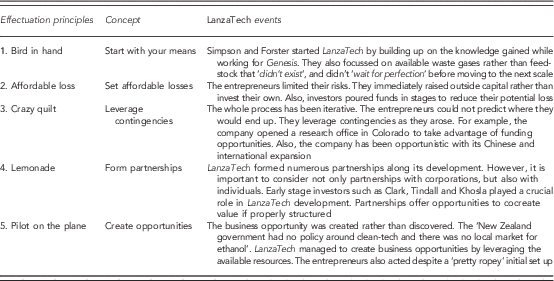
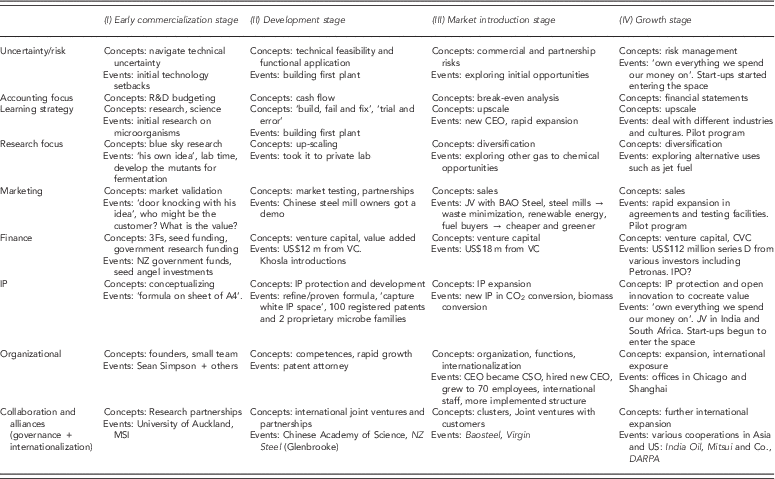
The case is structured around Tables 1 and 2. Table 1 connects the five effectuation principles with the events described in the case.
Effectuation principles, concepts and events

LanzaTech development stages and themes

Note. IP=intellectual property; IPO=initial public offering; JV=joint venture; NZ=New Zealand; R&D=research and development; VC=venture capital.
Table 2 demonstrates the four stages of research commercialization and enterprise growth: early commercialization, development, market introduction and growth. The four stages are explored through a number of topics, including uncertainty, accounting focus, IP development, finance and capital raising, marketing, research and collaboration and alliances. The case demonstrates that development in each area is dependent on development in another (e.g., development of an IP portfolio is partially dependent on raising capital and developing research focus). Likewise, the interdependence between topics is designed to demonstrate the relationship between resource availability and uncertainty. Typically, an increase in resource availability corresponds to a drop in uncertainty. However, since LanzaTech required large amounts of capital to prove and commercialize its technology, uncertainty remained high. In 2017, after several funding rounds and joint ventures, the technology proved itself and uncertainty declined.
Lecturers can use the structure to discuss the LanzaTech case in either by theme (horizontally) or by development stage (vertically). Stages I–III build on the concept of innovation pipelines, Stage IV builds on organizational life cycle theory.
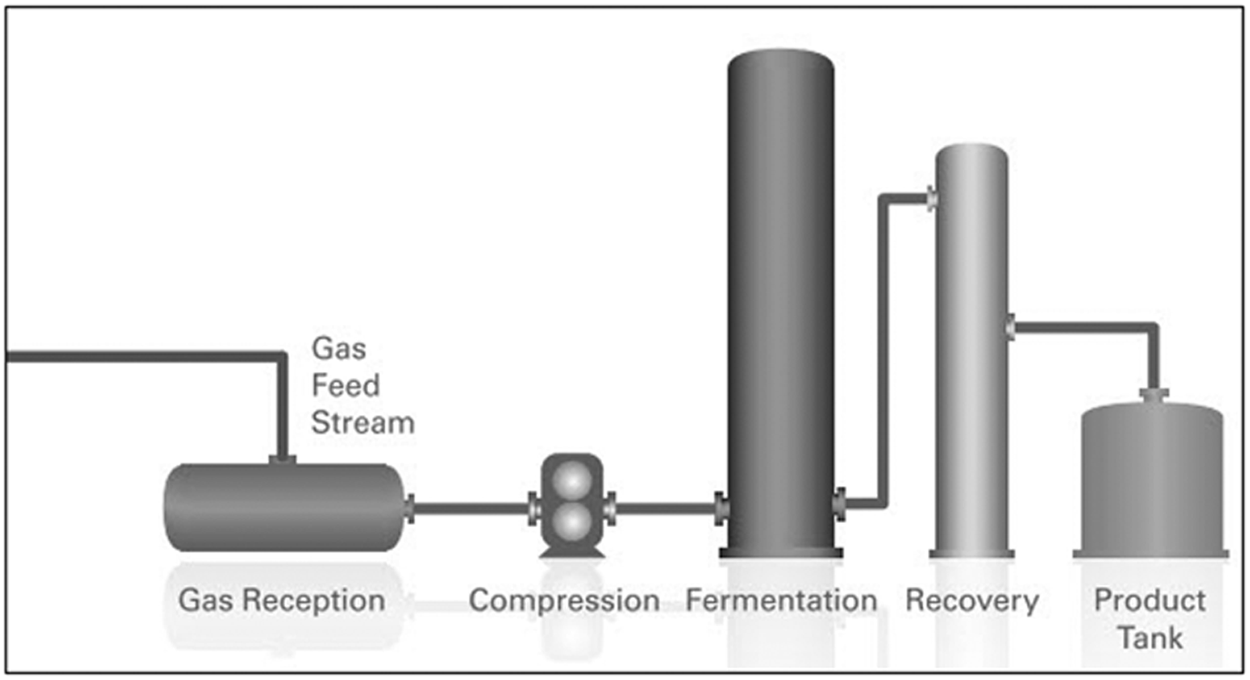
Figure 1 summarizes and simplifies the technology.
LanzaTech technology

The LanzaTech Process converts CO containing gases produced by industries such as steel manufacturing, oil refining and chemical production, as well as gases generated by gasification of forestry and agricultural residues, municipal waste, and coal into valuable fuel and chemical products. The gas enters the gas reception container and it is then compressed and transferred into the fermentation tank, also called LanzaTech reactor. The reactor contains a liquid medium enriched with LanzaTech proprietary microbes. Next, the net product is withdrawn and sent to the recovery tank, also called Hybrid Separation System. This system uses an advanced system to recover the valuable products and coproducts from the fermentation process. The products are collected for downstream use in the product tank. In some cases, these products can be used for fuel or chemical products. In other cases, they need to be further refinedFootnote 24 .
3. STUDY QUESTIONS
What was the impact of working from a small country like New Zealand (NZ)?
This question encourages students to think about the advantages and disadvantages of doing business in NZ. On the positive side, the World Bank ‘Ease of doing business’ 2016 report, shows that NZ is the best country to do business in the world. NZ regulation makes starting a business very easy. The ecosystem is also protective of minority investors, a crucial factor in attracting external equity capital, especially from abroad. However, NZ biotech companies face several challenges.
First, NZ is a small country with a limited number of potential clients. In the case of LanzaTech, the company identified a very small number of steel plants to begin with. In fact, NZ Steel Glenbrook manufacturing plant was the only steel plant in NZ. Hence, the initial rejection from NZ Steel represented a major setback. This lack of potential clients was one of the main reasons that pushed the company to internationalize rapidly and find collaborations in China and the United States.
Second, funding challenges emerged. LanzaTech faced local barriers in raising substantial VC from NZ investors. The New Zealand Private Equity and Venture Capital Association (NZVCA) shows that, in 2016, the total VC/private equity investment value was NZ$1,2 billion (US$820 million). This figure declines significantly if we include only early stage deals. In 2016, NZ early stage companies across all industries, raised NZ$92.3 million (US$ 63 million). Yet, health and bioscience received only a third of this sum. As a comparison, US VC firms, in 2016 (PriceWaterhouseCoopers Money Tree data), invested a total of $61 billion. The gap is emphasized if we only include seed and early stage investments which amounted to $13 billion. Therefore, it is not surprising that LanzaTech relied on international investors for its funding needs.
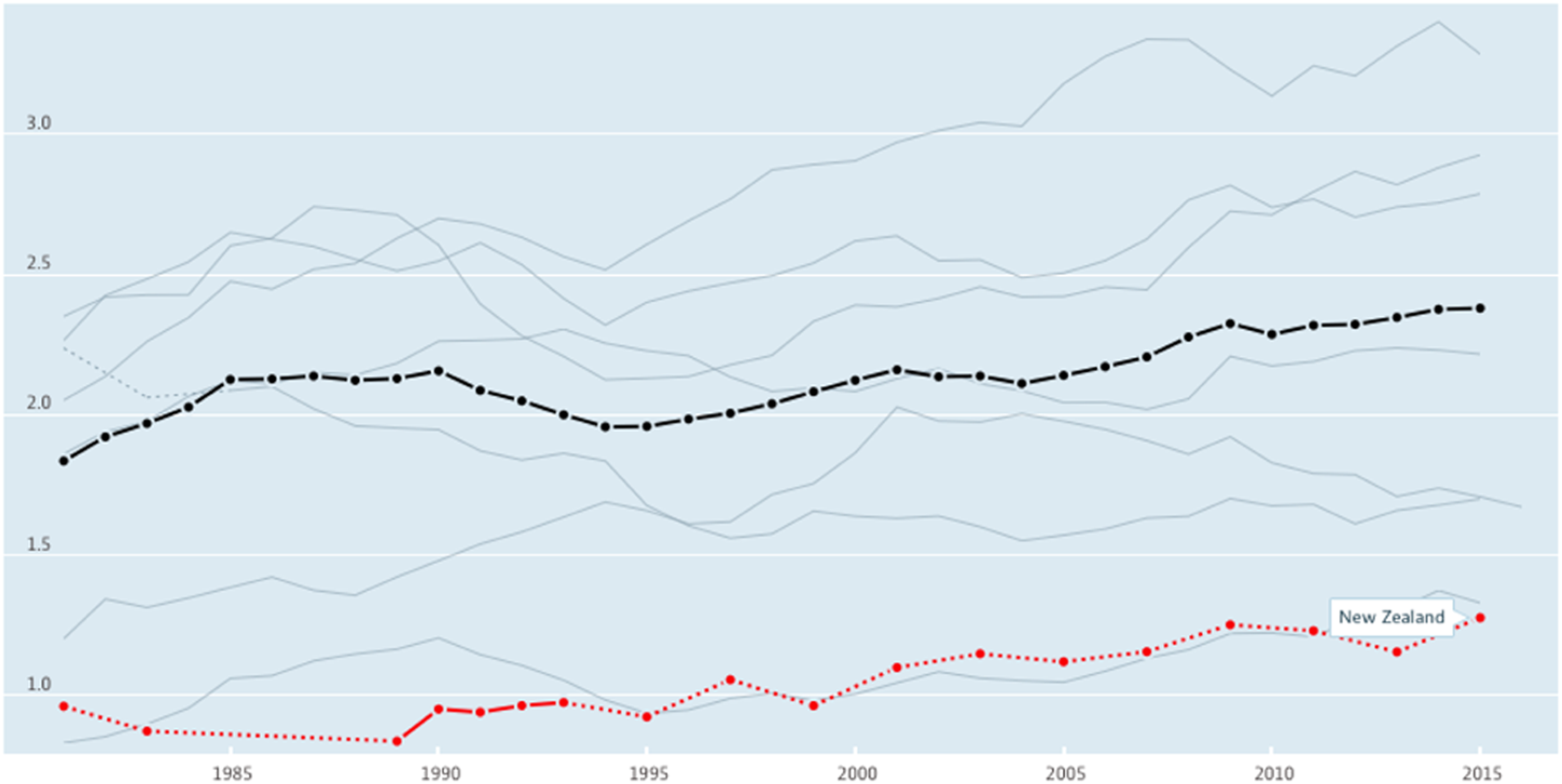
Third, R&D investments in NZ are below international standards. Figure 2 shows that NZ persistently invest in R&D below G7 countries and significantly below the Organization for Economic Co-Operation and Development (OECD) average. For example, in 2015, NZ invested only 1.27% of its gross domestic product in R&D. This compares with 2.38% for the average OECD country, 3.28% for Japan, 2.92% for Germany and 2.78% for the United States. The only country with comparable levels of investments is Italy with 1.33%.
Gross domestic spending on research and development investments as % of gross domestic product; 2000–2016. G7 countries, Organization for Economic Co-Operation and Development (OECD) average in black and New Zealand in red. Source: OECD.

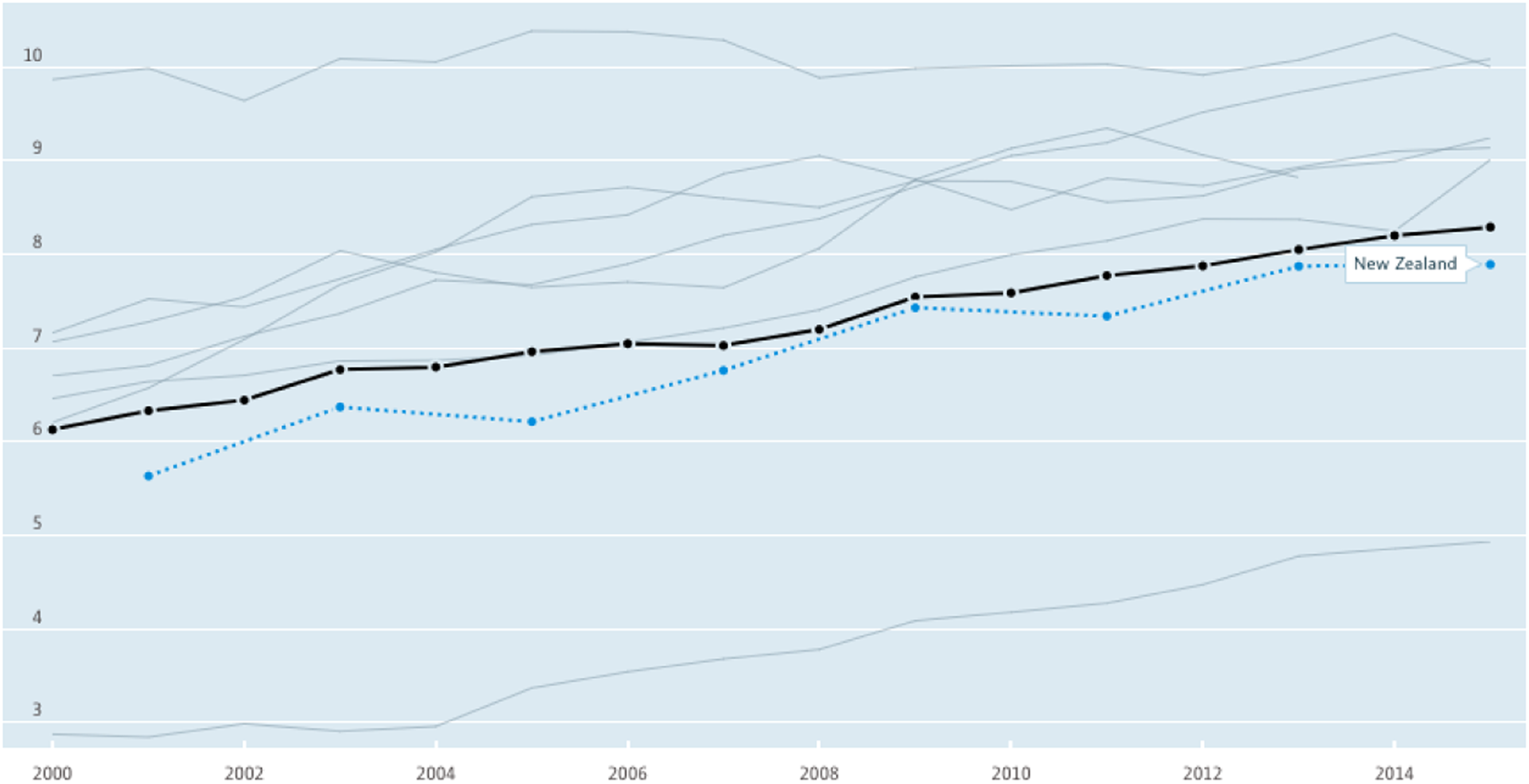
Fourth, NZ has structural issues also in relation to the number of researchers available in the country. This can represent a significant obstacle for an early stage technology company trying to develop its product. Figure 3 shows that NZ has the second lowest proportion of researchers across G7 countries. In 2015, NZ employed only 7.89 researchers out of 1000 employees. This figure is below the 8.29 OECD average and below countries such as France and Japan which employ approximately 10 researchers. Italy, with 4.93 researchers, is at the bottom of this ranking. The NZ gap with other countries might be explained by the below average investment in education. According to OECD data, in 2014, NZ spent on tertiary education US$15,100 per student. This compares with US$29,328 in the United States. The only G7 with lower investments is, again, Italy with US$11,510.
Researchers per 1000 employees; 2000–2015. G7 countries, Organization for Economic Co-Operation and Development (OECD) average in black and New Zealand in blue. Source: OECD. Researchers are defined as professionals engaged in the conception or creation of new knowledge, products, processes, methods and systems, as well as in the management of the projects concerned.

Therefore, it is crucial for NZ companies to consider international opportunities from the outset. National barriers related to funding, human capital, R&D and commercial opportunities make NZ a particularly challenging environment to start and scale a company.
Key reading
NZ business environment: World Bank ‘Ease of Doing Business’ http://www.doingbusiness.org/data/exploreeconomies/new-zealand
NZ funding environment: NZVCA Monitor (2017 or latest year) http://www.nzvca.co.nz/wp-content/uploads/2017/05/1730455_NZ-PE-VC-Monitor-2017_Full-year-review_FINAL_LR.pdf
National statistics on science and technology: OECD data and publications http://www.oecd-ilibrary.org/science-and-technology/main-science-and-technology-indicators_2304277x
Research commercialization in NZ: Karlson, France, and Bellavitis (Reference Fang2017).
Outline the difference between causal and effectual logic
Causation ‘focuses on achieving a desired goal through a specific set of given means. Causation invokes search and select tactics and underlies most good management theories. Effectuation focuses on using a set of evolving means to achieve new and different goals. Effectuation evokes creative and transformative tactics. Effectual logic is the name given to heuristics used by expert entrepreneurs in new venture creation’.
Key reading
Read et al. (2011)
Describe how Lanzatech applied effectual logic to develop and grow Lanzatech
See Table 1.
How would you continue to expand LanzaTech? What strategy would you choose at this stage? Would you continue with an effectuation logic?
These questions touch upon a variety of commercialization and expansion strategies. LanzaTech has various options to work with an incumbent through mergers and acquisitions, licensing or joint venture. First, the company could be acquired by a large player such as General Electric. This solution would provide a deep pool of capital and industrial contacts. Second, an alternative strategy to leverage a large company’s resources would be to licence the technology to an international established player. This route would provide a quick revenue stream, but it would add IP risks. Third, LanzaTech might establish a joint venture with a chemical producer and, for example, offer revenue streams to industrial plants through the agreement with the chemical company.
Alternatively, the company could decide to stay independent. Considering that, at this stage, LanzaTech is a maturing company with significant core competencies. Starting from these core competencies, students might discuss the advantages and disadvantages of (a) related, or (b) unrelated diversification and (c) international expansion. This discussion should centre around the core competencies of LanzaTech as well as its competitive advantage and disadvantage. LanzaTech core competencies are mostly centred around its innovative platform, IP and long-term relationships with steel plants. As Simpson argued, LanzaTech owns a platform technology (the microbe) which could be built on and refined to produce any number of other chemicals, and maximize their partners’ return on investment. Future expansion might leverage this platform and the company’s core competencies. In general, these questions are supposed to encourage students to discuss the advantages and disadvantages of these commercialization and expansion strategies and connect them to core competencies.
Further, students could discuss the advantages of disadvantages of causation and effectuation in a more mature company. Considering that the environment and the company are more mature and stable, a causation logic might more appropriate to discover, rather than create, new opportunities.
Key readings
Business models: Teece (Reference Sapienza, Manigart and Vermeir2010).
Licensing: Kollmer and Dowling (Reference Karlson, France and Bellavitis2004).
Strategic partnerships: Teece (Reference Teece1988).
Core competencies: Javidan (Reference Kollmer and Dowling1998).
What type of value did early stage investors provide?
This question is based on the entrepreneurial finance literature which praises the valued added by business angels and VCs. This literature argues that investors are crucial for the early developments of start-ups not only because of the financial investment, but also because of the strategic advice, reputation and networking opportunities provided.
In this case, three prominent examples are discussed. Dr. Ross Clark helped the founders to bring on board The Warehouse founder Stephen Tindall and used his contacts and good reputation in Silicon Valley to get Simpson an introduction to billionaire Vinod Khosla. Having Clark on board, helped and provided a strong signal of reliability. This, in turn, helped to receive a significant investment from Khosla as well as to sign the following agreement with NZ Steel. Khosla himself has proven to be a valuable asset. For example, Khosla introduced Simpson to James Zhang who, in turn, opened a whole set of opportunities in China and with Baosteel.
Key readings
Value added: Sapienza, Manigart, and Vermeir (Reference Read, Sarasvathy, Dew, Wiltbank and Ohlsson1996).
Entrepreneurial finance trends: Bellavitis, Filatotchev, Kamuriwo, and Vanacker (Reference Bellavitis, Filatotchev, Kamuriwo and Vanacker2017).
VC networks: Bellavitis, Filatotchev, and Kamuriwo (Reference Bellavitis, Filatotchev and Kamuriwo2014) and Bellavitis, Filatotchev, and Souitaris (Reference Bellavitis, Kamuriwo and Hommel2017).
Early stage investors want to exit, what is the best option to monetize their stake? And what are the strategies to reduce the downside risks?
Private companies are generally illiquid. Exit opportunities arise in the form of mergers and acquisitions, initial public offering or, in certain cases, secondary sales. However, these possibilities usually arise once the company matures and proves its technology and market. In certain cases, the early investors can sell their stake to new and incoming investors, or back to the company. However, these events are uncommon.
Early investors’ intention to exit sends a negative signal to incoming investors which are usually impacted by information asymmetries vis-à-vis the management and existing investors. Further, growing companies usually have limited liquidity and prefer to invest to grow the business rather than to buy out existing shareholders. In order to reduce downside losses, investors can include protective clauses inside the term-sheet and can disburse capital in stages.
Key readings
Exits: Cumming and MacIntosh (Reference Cumming and MacIntosh2003).
NZ VC market: NZVCA (Reference Moogk2008).
Investor–Entrepreneur conflicts and contracts: Bellavitis, Kamuriwo, and Hommel (Reference Bellavitis, Filatotchev and Souitaris2018).
Are there new competing technologies that can endanger LanzaTech success?
In answering this question, it is important that students consider direct and indirect competition. A company developing similar solutions is Carbon Clean Solutions which has built a plant in Tuticorin in southern India to capture carbon dioxide from its coal-fired boiler and convert it into soda ash (a chemical cousin of the baking soda). Similarly, Covestro, a large German multinational, has developed a technology to turn carbon into raw material. Another competitor in the industrial space is Petra Nova, a joint venture between NRG and JX Nippon. This facility captures more than 90% of the carbon dioxide from a 240 MW slipstream of flue gas for the use and ultimate sequestration of 1.6 million tons of this greenhouse gas annually. Further, several companies are targeting the space of ‘carbon capture’ technologies. These alternative technologies have the advantage that they do not need to be placed in particular locations, for example, near steel mills. For example, Climeworks has developed filters to capture carbon and turn it into products. The ‘smog-free tower’ is a crowdfunded project to develop an air purifier that captures carbon and turns it into diamond jewellery. This example can also be used to discuss crowdfunding as a fundraising solution.
Key readings:
Carbon Clean Solutions: http://www.carboncleansolutions.com/
Covestro: https://www.covestro.com/en/cardyon/overview
Climeworks: http://www.climeworks.com/about/
Smog-free tower: https://www.kickstarter.com/projects/1777606920/the-smog-free-tower
Minimum viable product. Do you agree with the suggestion of Khosla to ‘stick your pilot plant there and let’s prove this thing out’? What are the advantages and disadvantages of this strategy?
Khosla encouraged Simpson and Forster to build a pilot plant and test the microbe on a large scale. Khosla ‘said, go to a steel mill and get a relationship there, stick your pilot plant there and let’s prove this thing out. And we said, what are you talking about? It’s going to cost a lot of money, and it’s going to be very big. And he said, go on and do it. You’ve got to build that thing, and then let’s find out that it doesn’t work’. Discuss with the students the advantages and disadvantages of an early stage minimum viable product. In this discussion, examples from other prominent companies can be included. For example, Facebook started as a simple database for Harvard students and slowly added features and expanded into different markets. This strategy provides various advantages. First, it allows early engagement with users and prompt feedback on which to build future iterations. Second, it significantly reduces the time to market compared to building a much more complicated version of the social network. Third, it reduces the cost of commercial mistakes. Fourth, it increases chances to engage with customers, for example, by asking for feedbacks on product versions and, consequently, increases customer retention and loyalty. In sum, early engagement with customers, through, for example, a minimum viable product, creates significant value for innovative companies. The example of Facebook can also explain how the social network can be used by entrepreneurs to explore the market for a potential product without large initial capital investments (e.g., survey).
Key readings:
Minimum viable product: Moogk (Reference Javidan2012).
Customer engagement: Blank (Reference Blank2013).