Introduction
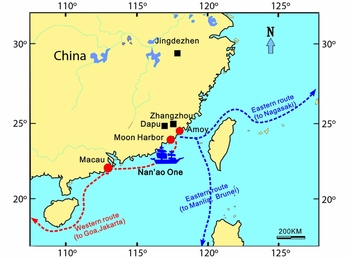
The discovery of an ancient shipwreck off the coast of Nan'ao Island, about six nautical miles from Shantou, Guangdong, China (Figure 1), is an excellent example of China's recent efforts to promote the study of underwater archaeology. The shipwreck, known as the Nan'ao One, was accidentally discovered by local fishermen in 2007; in 2010 it received an award as one of China's top 10 new archaeological discoveries.
Map showing the location of the Nan'ao One and production centres, along with possible destinations (note that the route to Japan was officially banned by the Ming government for all Chinese merchant ships).

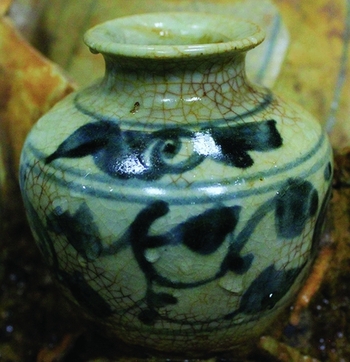
Underwater salvage operations on the Nan'ao One were conducted during three seasons (2010–2012). The ship was determined to be of typical Chinese construction, 25m in length and 7.5m wide. The Nan'ao One had 25 compartments and thousands of cultural relics, including porcelain, bronze, iron, tin, stone and lacquer. Of the more than 30000 artefacts recovered, 95% were blue-and-white export porcelain (Figure 2).
Pottery recovered from the Nan'ao One shipwreck.

Preliminary studies identified the ship as a Chinese merchant vessel from the late Ming dynasty. Typological examination of the ceramics on board (the main dating method) suggested that the ship had foundered during the reign of the emperor Wanli (AD 1573–1620) (Cui Reference Cui2011).
Some of the blue-and-white porcelains were visually identified as products of the leading workshops in Jingdezhen, which produced the highest quality porcelain, but the great majority were from Zhangzhou. The Zhangzhou kilns became active only after an imperial ban on Chinese maritime trade was officially revoked in the first year of the reign of the emperor Longqing (AD 1567). Chinese and Western documents relating to maritime trading in the late Ming period, along with an examination of material from excavations at the Zhangzhou kilns, suggest that these reached their greatest levels of production and export during the Wanli reign (Li Reference Li2001: 158; Canepa Reference Canepa2010).The origins of the remaining vessels found in the shipwreck could not be determined by eye alone. Some of the larger porcelain bowls were probably made specifically for foreign trade, as they were of a design not commonly used in Chinese daily life. To deepen our knowledge of the Nan'ao One and its cargo, a compositional study of several fragments of blue-and-white porcelain recovered from the ship was undertaken.
Historical context
Chinese porcelain, silk and tea have been commodities of international trade for more than a millennium. As early as the ninth century, trade contacts between China, India and the Persian Gulf were well established. By the fourteenth century, Chinese porcelain, silk and spices were known to Europe—most probably the result of traders who travelled across Central Asia by the ‘Silk Road’. Chinese porcelains, in particular, became regarded as items of great rarity and luxury. The peak of Chinese ceramic trade occurred between the mid sixteenth and mid seventeenth centuries after the carreira da India (sea route to India) had been established for half a century. Two production zones operated during this period: Jingdezhen in the north-east, and Zanghzhou in the south-eastern coastal area. These were the major manufacturers of export porcelain for the overseas market.
Kaolin clay, an essential ingredient for porcelain manufacture, was amply available. Porcelain with the purest white paste was produced in the Jingdezhen kilns (Ming et al. Reference Ming, Yang, Zhu, Guan, Fan, Xu, Yao, Kenoyer, Song and Wang2014). The blue-and-white porcelain, with an underglaze decoration, was manufactured by a one-step firing process after glazing, using a firing temperature of around 1250°C. Demand for blue-and-white porcelain developed rapidly, and the manufacturing technique was copied by kilns in other areas.
In the south-eastern coastal region, the leading porcelain-producing area was Zhangzhou city in Fujian Province. The volume of porcelain produced here was much greater than any other region, but the quality was generally considered below that of Jingdezhen. In general, the high-quality late Ming export porcelain was produced in Jingdezhen and made for the European and Middle Eastern markets; middle-to-low quality late Ming export porcelain was produced at various sites in the south-eastern coastal area and made for intra-Asia trade (Volker Reference Volker1954: 59).
The fifteenth century was a period of global exploration by Portuguese and Spanish navigators seeking ocean routes to East Asia. By the start of the sixteenth century, ocean routes were established and one of the most important periods of cultural exchange began. The Dutch joined the Eurasian trading network decades later but had caught up with their competitors by the turn of the seventeenth century. Huge amounts of Chinese export porcelain were traded during this period. The Dutch East India Company alone traded 16 million porcelain wares to markets in Southeast Asia, Central Asia and Europe between 1602 and 1682 (Volker Reference Volker1954: 223–25).
The geographer Zhang Xie (Reference Zhang1981 [1617]) describes the development of overseas commerce between the southern Fujian Province and foreign countries in south-eastern Asia and Europe in his book, Investigations of the Eastern and Western Oceans, recording places where merchant ships travelled. Another source, the Selden map of 1619, recently rediscovered by Batchelor (Reference Batchelor2013), shows the East Asian ports and shipping routes linking China to Japan to the north, the Philippines to the east and Indonesia to the south. Trading routes to the Western (Indian) Ocean went to ports on the mainland of Southeast Asia and western Indonesia, and those to the Eastern (Pacific) Ocean went to ports in Japan and maritime Southeast Asia, including the Philippines and eastern Malaysia.
Previous provenance studies
A large number of provenance studies of Chinese porcelain have been carried out during the past few decades, and several have reported on the chemical compositions of Jingdezhen porcelain and variations and trends in these over time. The most thorough study is by Pollard & Wood (Reference Pollard, Wood, Olin and Blackman1986), who analysed the major and minor element compositions of more than 150 Jingdezhen porcelain bodies of various ceramic types covering the twelfth century to post-eighteenth century. Their results suggest a probable chronology for the development of the art of porcelain manufacture at Jingdezhen.
Although a large quantity of analytical data is available for Jingdezhen porcelain, very little concerns late Ming export porcelain. There are even fewer scientific studies concerning such material from production sites other than Jingdezhen. Ma et al. (Reference Ma, Zhu, Henderson and Li2012) studied the trace element composition of late Ming dynasty porcelain from the Jingdezhen and Zhangzhou kilns using inductively coupled plasma-mass spectrometry, and established a method for identifying export blue-and-white porcelain of this origin and date using principal components analysis (PCA) and rare earth element (REE) distribution curves. Another study, by Dias et al. (Reference Dias, Prudêncio, Pinto De Matos and Rodrigues2013), used neutron activation analysis (NAA) to determine the chemical compositions of 25 major and trace elements in Ming dynasty export porcelain excavated from sites in Portugal. With the aid of cluster analysis and REE distribution curves, three compositional groups were identified. A few of the samples were specifically attributed to the Jingdezhen and Zhangzhou kilns.
Samples and locations
In the present investigation, 11 blue-and-white export porcelain fragments recovered from Nan'ao One were made available for compositional analysis by NAA. From visual examination by archaeologists, two of the samples displayed the features of Jingdezhen export porcelain and two others showed the typical characteristics of south-eastern coastal products from Zhangzhou. The origins of the remaining seven samples could not be identified by eye.
Forty-three late Ming blue-and-white export porcelain sherds excavated from Zhangzhou were selected as reference samples to establish a compositional signature for Zhangzhou products. The samples came from five kiln sites within Pinghe County in Fujian Province: Huazailou (HZ) and Tiankeng (TK) at Nansheng; and Dalong (DL), Erlong (RL) and Beigou (BG) at Wuzhai.
The largest late Ming export porcelain production complex found so far in Jingdezhen is the Guanyinge site. Although (and unlike the Zhangzhou kilns) it was not used exclusively to produce items for export, blue-and-white export porcelain vessels were the major products (Bai Reference Bai1995). Fourteen late Ming blue-and-white export sherds from the Guanyinge site were selected to serve as reference samples for the compositional signature of Jingdezhen products.
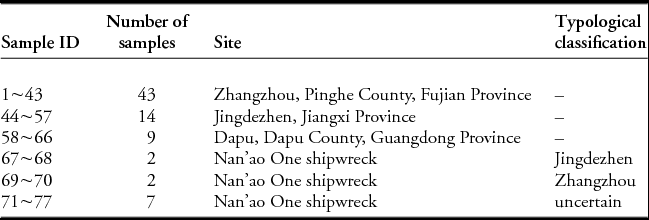
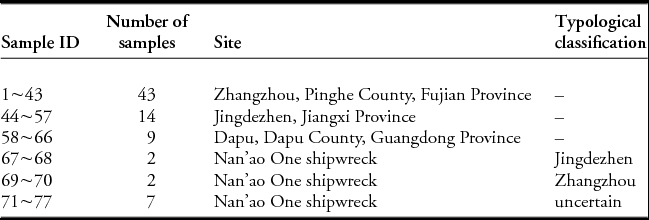
Finally, seven late Ming blue-and-white porcelain sherds from the Dapu kilns in Guangdong Province, a region producing lower quality ceramics, were included in the study for additional comparisons. The locations for all sites are shown in Figure 1. Detailed descriptions of the samples are presented in Table 1.
Summary description of the sherds in this study.
Analysis
The surface of each sample was abraded using a diamond dental drill to remove all glaze and surface deposits. Samples were then cleaned with a brush, rinsed in deionised water and cleaned again using an ultrasonic bath filled with pure alcohol to remove any loose surface contaminants. The samples were next ground into fine powders, stored in glass sample vials and dried for a minimum of 24 hours at 105°C.
Two analytical samples were prepared from each powdered sherd by weighing 150mg of powder into a high-density polyvial and a further 200mg into a high-purity quartz vial. Standards were prepared from SRM-1633b Coal Fly Ash and SRM-688 Basalt Rock, and quality control samples from SRM-278 Obsidian Rock and Ohio Red Clay were also prepared. The standards were used to create a calibration for the NAA measurements, and the quality control samples provided a check on measurement accuracy and precision.
NAA was carried out at the University of Missouri Research Reactor (MURR), using procedures described by Glascock (Reference Glascock and Neff1992). The samples in polyvials were irradiated for 5 seconds, allowed to decay for 25 minutes, then counted for 720 seconds to measure the short-lived elements: Al, Ba, Ca, Dy, K, Mn, Na, Ti and V. The samples in quartz vials were irradiated for 24 hours and counted twice: first following a decay time of seven days to measure the medium-lived elements: As, La, Lu, Nd, Sm, U and Yb; and then after an additional three weeks of decay to measure the long-lived elements: Ce, Co, Cr, Cs, Eu, Fe, Hf, Ni, Rb, Sb, Sc, Sr, Ta, Tb, Th, Zn and Zr.
Results
Compositions of the 33 elements listed above were measured in the majority of the ceramic analyses. Three elements (As, Ni and V), however, were not present at detectable levels in most of the shipwreck and kiln samples; these were eliminated from further consideration. The results for the quality control samples showed measurements of the remaining 30 elements to have high accuracy and precision (typically <3%). The supporting dataset is available for download from http://archaeometry.missouri.edu/datasets/.
Defining compositional groups for the kilns
As an initial step towards the interpretation of multivariate data (Glascock et al. Reference Glascock, Neff and Vaughn2004), the compositional groups for the kiln samples were inspected for outliers that would possibly indicate either contamination or misclassified samples. Three samples were removed: sample 63 from the Dapu kilns group had an extremely low Ca concentration relative to other kiln samples, and samples 40 and 43 from the Zhangzhou kilns group had high Ca concentrations. The Jingdezhen kilns group was left intact.
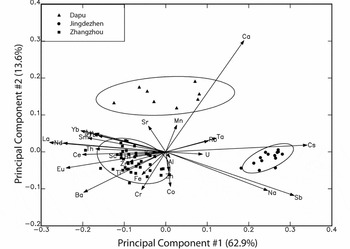
Principal component analysis (PCA) was then applied. This is a well-established procedure for handling large multivariate datasets, and uses an orthogonal transformation to convert a set of possibly correlated variables (elements) into values (scores) from a set of linearly uncorrelated variables known as principal components (PCs). By examining plots of the PCs, it is often possible to visualise groups from which provenance identifications can be made (Baxter Reference Baxter1994: 47–48). In this study, the PCs were calculated from log base-10 normalised data. Figure 3 shows a biplot of the first and second PC scores for the samples from the kilns at Jingdezhen, Zhangzhou and Dapu, along with element vectors that indicate the contributions of individual elements to group differences.
Biplot of principal components 1 and 2 showing the compositional groups and the element vectors, thereby indicating differences; groups are surrounded by 90% confidence ellipses.

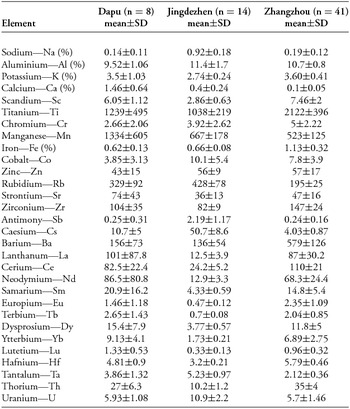
As shown in Figure 3, the kiln samples are completely separated by the PCA process such that there is no overlap between the different kiln groups. This supports our expectation that the first and second PCs can be used with great confidence to assign unknown samples to each of the three different kiln sources. The first PC accounts for 62.9% of the variance and the second PC for 13.6%. Thus, the cumulative variance explained by Figure 3 is 76.5%. The element vectors show the relationships between the elemental concentrations and the kiln compositional groups: the rare earth elements and several of the transition elements (Ti, Fe and Cr) are more highly concentrated in the Zhangzhou kilns group; the Jingdezhen kilns group has higher concentrations for Cs, Na and Sb; and the Dapu kilns group has the highest Mn concentrations and low concentrations for Cr and Co. Table 2 lists the means and standard deviations for each of the three kiln groups.
Element concentration means and standard deviations (SD) in parts per million measured in late Ming dynasty export blue-and-white porcelain compositional groups from kilns.

Assigning provenance to sherds from Nan'ao One
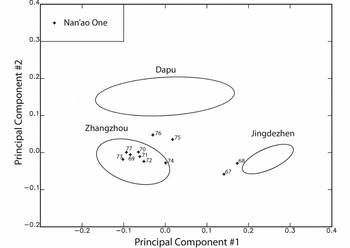
In order to identify sources for the individual Nan'ao One sherds, the results for these samples were mapped against the 90% confidence ellipses established for the compositional groups describing the kilns (Figure 4). The majority of the shipwreck sherds plotted within the confidence ellipse for Zhangzhou, with samples 75 and 76 located nearby. Samples 67 and 68 were located outside of, but near to, the confidence ellipse for Jingdezhen, and sufficiently distant from both Zhangzhou and Dapu. Inspection of the data for these samples revealed that the main difference from the Jingdezhen kilns group was lower concentrations for Cs and Na. For samples 75 and 76, the elements Ca and Mn were present at higher concentrations than in the kiln samples from Zhangzhou.
Scatterplot of principal components 1 and 2, showing samples from the Nan'ao One projected against confidence ellipses for the kilns.

Provenance studies of ceramics from other shipwrecks have been reported in the literature (Pradell et al. Reference Pradell, Vendrell-Saz, Krumbein and Picon1996; Taylor et al. Reference Taylor, Robinson and Gibbins1997; Waksman Reference Waksman2011). The earlier studies described serious difficulties in studying a range of highly mobile elements (Na, Mg, K, Ca, Mn, Rb, Sr, Cs and Ba) present in ceramics recovered from underwater environments. All of the above-mentioned studies involved ceramics fired at much lower temperatures than those used to manufacture porcelain. Although we noticed discrepancies when comparing the concentrations for Na, Mn, Ca and Cs from the porcelain sherds on the shipwreck to the kiln samples, the remaining elements were barely affected. Porcelain is vitrified (i.e. harder and more durable), and so is better able to withstand long-term exposure to seawater without significant alteration of its chemical composition. Therefore, it seems reasonable that samples 67 and 68 should be assigned, as per their visual identifications, to Jingdezhen. Similarly, the remaining nine sherds from 69 to 77 can be assigned to the kilns in Zhangzhou Province.
Discussion
Geochemical analysis by NAA of blue-and-white porcelain samples from kilns at Jingdezhen, Zhangzhou and Dapu was successful in establishing the differences in composition between these three kilns. Multivariate analysis by PCA and scatterplots was used to examine the data and to identify an efficient method for assigning provenance. Despite contamination/leaching issues of some of the mobile elements due to the porcelain resting in an underwater environment for four centuries, the provenance of porcelain samples from the Nan'ao One shipwreck could be determined with an acceptable level of confidence. Analysis of 11 porcelain sherds from the shipwreck found that 9 were linked to Zhangzhou, and 2 to Jingdezhen.
The design of the ship and material evidence recovered from the underwater excavation indicated that the Nan'ao One was a Chinese trading vessel that departed from the port of Zhangzhou during the late Ming period, most probably during the Wanli reign between 1573 and 1620. The port was the major international trading centre during this period. Ships leaving Zhangzhou would first stop at Amoy, where the cargo would be inspected, and then head out on routes across the Western (Indian) Ocean or the Eastern (Pacific) Ocean. The Nan'ao One shipwreck lay near the start of the voyage towards the Western Ocean, along the route described by Zhang Xie (Reference Zhang1981 [1617]), less than one day's sailing from Amoy. The ship's destination may have been any of the ports on the Western Ocean voyage, but its cargo of more than 30000 pieces of porcelain from Jingdezhen and Zhangzhou suggests that this export porcelain was headed to wealthy buyers who had connections with European markets. Both European and inter-Asian trading networks were controlled by the European powers during this period. The Spanish and British did not arrive in China until after the Wanli reign, so the most probable trading partners were the Portuguese, who mainly used the port of Macau, or the Dutch, who were just beginning to use the port of Batavia (Jakarta) on the island of Java. Our interpretation, therefore, is that the Nan'ao One was most probably headed for one of these destinations.
Acknowledgements
We thank Tim Ferguson (MURR) for assistance with the sample preparation, and Xinying Zhou (Institute of Vertebrate Paleontology and Paleoanthropology, University of Chinese Academy of Sciences) for the art work. Special appreciation goes to the archaeological team leaders Jian Sun and Yong Cui (Guangdong Provincial Institute of Cultural Relics and Archaeology) for supporting this research. Jianan Li (Fujian Museum) offered much assistance for the Zhangzhou kilns investigation. This research was supported by the National Natural Science Foundation of China (grant numbers 11275265 and 11205073), by the Presidential Fund of the University of Chinese Academy of Sciences and by the Humanities and Social Sciences Research Project from the Ministry of Education (Youth Project 14YJCZH013). The research also received support from a US National Science Foundation grant #1415403 to the Archaeometry Laboratory at MURR.