INTRODUCTION
On 2 August 1991 a remarkable example of late Viking metalwork was found by chance on the hazardous formations known today as The Smalls (Ordnance Survey SM 466 088), situated about seven nautical miles (13km) due west of the uninhabited island of Grassholm, Pembrokeshire (figs 1–2). The geological survey of The Smalls indicates that the rocks are made up of basalts in the north and dolerite on the extreme south.Footnote 1
The Smalls reef lies astride a main shipping route between Ireland and south Wales. Image: reproduced with permission, © Amgueddfa Cymru – Museum Wales.

South-west Wales and the location of The Smalls reef. Image: reproduced with permission, © Amgueddfa Cymru – Museum Wales.

Long recognised as a shipping hazard astride the western approaches to Milford Haven (about 32km due west), and located in the eastern part of the southern entrance to the St George’s Channel, the main northernmost outcrop within The Smalls cluster of low reefs has been marked by a lighthouse since the eighteenth century. The first structure, a unique pile-supported design by Henry Whiteside, lasted from 1776 to 1861.Footnote 2 Apart from two other rock outcrops just to the east of this largest reef, all are covered by the sea at high water (fig 3).Footnote 3 The south-going tidal stream from St George’s Channel turns eastward to the south of The Smalls and turns into the Bristol Channel. The west-going stream from the Bristol Channel turns north and runs into the St George’s Channel.Footnote 4
Aerial view from north-west showing the extent of the shipping hazard posed by The Smalls, photographed at low tide by Toby Driver on 9 September 2010. Photograph: reproduced with permission, © Crown copyright: RCAHMW; cat no. C908306; File Reference: AP_2010_3329.

Discovery
On the afternoon of 2 August 1991, during a leisure dive on The Smalls by members of the Milton Keynes Sub-Aqua Club, one of the divers spotted a bluish object protruding from beneath one of the iron hull plates from one of the modern shipwrecks that litter the seabed around these rocks and gullies that make up the reef.
At the time of the dive, which lasted thirty minutes, visibility was about four metres. The finder described swimming with her buddy diver down what was later designated ‘Gully 2’, over rock into kelp (Laminaria hyperborea) at its southern end (described as being about 45cm high, and in water above 14m depth; fig 4). They then turned back for about ‘10 metres’ (on other occasions reported as 11–14m), and it was at this point that the finder noticed something bright blue in colour, lying beneath a metal plate at the end of the gully. The object was apparently lying upside down, partially trapped and covered by the plate, and after some effort, it was pulled free (see fig 8 for suggested findspots).
Sketch from a dive log (prepared on the site from memory in 1992) showing the dive route followed by the finder of the sword guard and dive buddy on 2 August 1991. Image: reproduced with permission, © Amgueddfa Cymru – Museum Wales.

When found, the artefact was fairly clean (a pattern was visible), although iron corrosion was described to be covering some of the design in the centre. Its centre appeared to be hollow and contained some sand. The finder and her partner described initially putting the object in vinegar for 24 hours to remove the outer coating of corrosion, then scrubbing this off under a tap (not recommended; fig 5).
The copper-alloy casting of the Smalls sword guard, pre-conservation, retained much of its original colour and showed little sign of underwater abrasion or wear (noted on exposed examples copper-alloy from recent wrecks on the site). Photograph: reproduced with permission, © Amgueddfa Cymru – Museum Wales.

The object was reported to the local Receiver of Wreck based at Pembroke Dock and in September 1991 taken to the then Department of Medieval and Later Antiquities at the British Museum for identification. Recognised as significant by Susan Youngs, she referred the sword guard to the author at Amgueddfa Cymru – Museum Wales (henceforth Amgueddfa Cymru) in Cardiff for reporting. It was acquired by Amgueddfa Cymru in 1992 through the Receiver of WreckFootnote 5 and is currently displayed at St Fagans National Museum of History.
Protection
Following the identification of the find and an assessment of its significance, the Secretary of State for Wales designated the site under the Protection of Wrecks Act (Designation no. 2) Order 1991 no. 2746 (5.12.1991), centred on a 300m radius of position Latitude 51° 43’.18 North, Longitude 05° 40’.29 West. This came into force on 7 December 1991. In 1992 the author was granted a licence to survey the site, and two on-site assessments were undertaken in May and June 1992.Footnote 6 In 1993 the author indicated that the most likely findspot should be taken, in the absence of other data, as the theoretical centre of any debris field, some 120m due south of the present lighthouse (which formed the centre of the previously scheduled area). In 1995 there was a revision to the Designation order relating to The Smalls, to be cited as the Protection of Wrecks (Designation no. 1) Order 1995, no. 2654 (9.10.1995), which came into force on 20 November 1995. This reduced the extent of the designated area from a 300m radius to a 100m radius of position Latitude 51° 43’.18 North, Longitude 5° 40’.13 West. On the current Receiver of Wreck list, it is centred on 51° 43’ 10.8N; 05° 40’ 7.8W, and the Wessex Archaeology Maritime Assessment gives 51° 43’.202N 05° 40’.1937W.
SITE SURVEY AND INVESTIGATION
Early in 1992 an expedition was organised by Amgueddfa Cymru under the direction of the author to record in detail the findspot and assess the likelihood of further Viking-Age material being preserved. There appeared to be little chance of large sections of hull structure surviving in such an unyielding, hostile environment, but it was considered possible that smaller associated items could have become buried, lodged between rocks or embedded in concretion. The first expedition was conducted during 18–31 May 1992, and a second the following month (24–9 June 1992). Their objectives were to interview the finders on site and relocate the findspot, to plot its relationship to underwater and dry features, to conduct a general search of the vicinity and to establish the likelihood of further associated material being located, and the likely extent of the archaeological site and its debris field. Natural features and the underwater environment were also to be investigated (visibility underwater varied from 4–5m or more). Recording was by 35mm camera and diver observations recorded on log sheets, supplemented by a Hi 8 V.900 video of Gully 3, made by Jerry Cross of HTV. The site plan was prepared by combining bearings with sketch plans of rocks by the author after landing on them and information from aerial photography.
The logistics were formidable as The Smalls is the most remote, exposed archaeological site in Wales, and it was anticipated that the investigation strategy might be constrained by the large swells that frequently roll unhindered from the Atlantic to break onto the exposed rocks. Searches and site inspection involved challenging diving conditions with a significant swell in the narrow rock gullies between tides (figs 6, 7).Footnote 7 During the initial visits (18–26 May), most days were aborted owing to high seas and heavy swell. The only successful dives on the site occurred on 28 May, when Gullies 2 and 3 and the Main Gully were examined, and on 29 May, when the same gullies and an area to the south were examined (total dive time about 12 hours). The second expedition from 24–9 June was more productive, with diving at both slack tides on 25 and 26 June, and single slack tide dives on 27 June (total dive time approximately 24 hours). Attempts to inspect the site in August 1992 were prevented by bad weather.
The main cluster of rocks in the vicinity of the findspot of the Smalls guard, photographed on 9 September 2010. Photograph: reproduced with permission, © Crown copyright: RCAHMW; AP_2020_3339; C908317.

The findspot of the sword guard and the area of the site investigation is indicated by the rocks breaking surface to the east (right) of the present lighthouse, designed by James Walker and completed in 1861. Photograph: reproduced with permission, © Amgueddfa Cymru – Museum Wales.

Site description
Three main rock outcrops break at high tide, the others becoming submerged. The seabed comprises bedrock gullies of varying width and depth, containing at their base variable amounts of coarse sand (depending on effect of tidal stream). In shallow areas there is dense short kelp colonisation. The gullies have steep sides, and range in depth from 9m in their centres, sloping gradually to 15+m at ends. Three narrow north–east/south–west gullies run into a larger, slightly deeper north–south gully. Bottom cover comprises broken shell and some rounded pebbles/boulders, but no significant sand accumulation (except for the occasional small amount in hollows, much derived from broken shell). The ‘main gully’ appears to have more pebbles than sand visible. There is short kelp cover down to approximately 10m (none below 14m), much of which was observed in June to have been stripped off by earlier storms.
Most gullies are scattered with wreckage and the finder and her diving partner, though initially unable to pinpoint the exact findspot of the sword guard, reidentified the general area involved at the south end of Gully 2, in the vicinity of later wreck debris (fig 8, red dots). However, there were some discrepancies in witness accounts of the gully involved – both Gullies 2 and 3 were cited in some interviews. On a subsequent dive by the finder, she recognised an area at the end of Gully 3, where it merges with Gully 2, as the most likely findspot.Footnote 8
Plan of The Smalls, showing main gullies, designated 1–3 and ‘Main Gully’, during the 1992 survey. Image: reproduced with permission, © Amgueddfa Cymru – Museum Wales.

Divers in Gully 2 noted that it has a steep north side, with rounded boulders (>10cm) littering the bottom, and sand lying in rock hollows. Some areas were covered with large sections of rivetted iron hull plate, nineteenth-century copper and brass plate.Footnote 9 Iron and rock both appeared to have a similar pinkish red colour, and a considerable amount of iron plate and even some copper sheet has ‘cemented’ onto exposed rock. This included a section of iron pipe against the north side of the gully, and beneath it Victorian cast brass decorative fretwork, covered in concretion (fig 10, left).
Gully 3 rises in the centre, and is strewn with chain, iron hull plate, at least two large anchors (at least one of Trotman type widely used on merchant ships post-1852) at its northern end (one 2.75m long × 2.01m wide; the other 1.8m long × 1.2m wide), a smaller anchor near the gully centre (about 1m in width), and a ship’s propeller shaft and box-section hull structure covering much of the bottom at the south end. The principal feature is the coherent bottom of a rivetted iron hull with a single propeller shaft (length about 22.5m) and a three-blade propeller (one blade missing). The sword guard appears to have been discovered beneath a large iron plate from this collapsed hull, identified as the steamship Rhiwabon, a cargo steamer built in 1880 and owned by Cory & Sons, Cardiff (registered at 1,364 registered tons). The ship was lost in a force 6 south-westerly on 29 January 1884, while in ballast from Fleetwood (Morecambe Bay) to Cardiff (fig 9).Footnote 10
A variety of metalwork derived from the wreck of SS Rhiwabon (and other wrecks) lies trapped beneath its rivetted hull plates, being inspected here during the 1992 expedition to The Smalls. Photograph: reproduced with permission, © Amgueddfa Cymru – Museum Wales.

No further components of the sword have been found, and the guard may have been separated from the other components by later events, such as the loss of the Rhiwabon, whose lower hull has now concreted to the rock formations, creating an artificial reef. A few unstratified copper-alloy objects and late nineteenth- and early twentieth-century potsherds were recovered (fig 10), probably from the Rhiwabon or other post-medieval wrecks lost on The Smalls.Footnote 11
Finds from Gully 2, The Smalls, originating from SS Rhiwabon (wrecked 1884) included transfer-printed ware, a cast copper-alloy decorative surround from a stove or decorative ship’s fitting (left) and a slightly tapering copper-alloy (high Sn content) ingot-shaped block (right). Image: reproduced with permission, © Amgueddfa Cymru – Museum Wales.

Subsequent inspections
Following the 1992 surveys, there were visits to The Smalls by the Archaeological Diving Unit (ADU) on behalf of the Advisory Committee on Historic Wreck Sites.Footnote 12 The only archaeological material seen in 1997 were large sheets of iron and debris from nineteenth- and twentieth-century shipwrecks, including the Cambro (lost 1913). The ADU concluded that ‘It is likely that this is the site of a Viking wreck, but the evidence remains inconclusive … Despite the dynamic nature of the site the remains of recent wreckage still in situ suggest that it is possible for material to remain in the gully’, overlain and protected by modern wreckage.Footnote 13 In view of the rarity and fragility of such remains and potential importance of the site from an archaeological and historical perspective, it was recommended that designation of the site should continue, and that licence applicants seeking permission to visit the site should co-operate in gathering environmental and archaeological information about the site as part of their visit, to incrementally increase the accuracy of site information and any rate of change.
THE SWORD GUARD
The lower sword guard from The Smalls is a hollow casting of brass, with a thickness of about 2mm. Each side is engraved with a field of ornament, filled with pairs of intertwined animals with thick and thin body widths, ultimately based on the fluid ornamental style known as ‘Urnes’ (fig 11). The beasts are enhanced with silver wire, and against a cross-hatched background which once held black niello inlay. The guard has a maximum length of 117mm; maximum width in centre of 27mm; maximum height towards ends of 26mm; tang length 32mm; tang width 7.5mm; maximum blade thickness 6mm; blade thickness in centre of fuller (groove down the middle of the blade) about 5.25mm.
(a) Face A, (b) underside, (c) Face C and (d) top of the Smalls sword guard. Drawing: Tony Daly; reproduced with permission, © Amgueddfa Cymru – Museum Wales.

The condition of the guard’s surfaces is good, with little sign of underwater erosion or post-loss wear. There has been considerable loss of niello, probably a consequence of initial cleaning by the finders, and there has been minor loss of silver wire (twenty short lengths on side A, and seventeen on side B; figs 12 and 13). It is unclear if any of these became detached during the active life of the sword. Marks on the underside of the guard, adjacent to where the blade passed through it, have the appearance of hammer blows. These could have been to make the guard wall bear against the fuller, and it is unclear whether this action caused damage at the time to the niello in this area. No signs of cuts, abrasions and dents that might result from combat use have been recorded.
Face A of the Smalls sword guard, on display mount. Photograph: reproduced with permission, © Amgueddfa Cymru – Museum Wales.

Face C of the Smalls sword guard, showing surviving background niello bottom left. Photograph: reproduced with permission, © Amgueddfa Cymru – Museum Wales.

The upper perforation for the blade tang is rectangular (fig 14), while the lower retained the cross section of the original double-edged blade and its fuller. No casting core has been conserved inside the casting, which only contains iron corrosion products, presumably derived from the missing blade.
Top of the Smalls sword guard, showing that care had been taken to file away the area between the upper and lower jaws of the flanking beasts. Photograph: reproduced with permission, © Amgueddfa Cymru – Museum Wales.

Ornament
The distinctive patterns and inlays indicate that this object is decorated in the style and techniques of Irish fine metalwork of Hiberno-Scandinavian type. This was in origin the ornamental style of Viking art known as ‘Urnes’, named after the large, graceful carvings found on the eponymous wooden stave church in Western Norway (on timber felled ad 1069–70)Footnote 14 and preserved by reuse in its reconstruction c ad 1129/30. Scandinavian Urnes animal decoration is found on objects of different sizes, from runestones to wood and bone artefacts, wooden furniture, as well as small metal objects such as the openwork silver brooch from Lindholm Høje, Jutland (Denmark), and cast products of workshops in Lund and elsewhere.Footnote 15
The main fields of ornament on the guard have softly sweeping figure-of-eight compositions with Urnes-type antecedents,Footnote 16 engraved/chased with precision, with raised areas inlaid with drawn silver wire. The background was originally inlayed with niello, which remains in places held on by a cross-hatched roughened surface cut into the brass. Three distinct animal types can be identified (fig 15):
-
Type 1 animals, or ‘great beasts’, are quadrupeds (sometimes identified as highly stylised lions) shown in profile, each having one front and one back leg represented. The large bodies taper towards the hind quarters, and where the legs join the body are marked with simple hip spirals, accentuated with inlaid niello. Each head has a ‘tear drop’ eye, coming to a point forward, a small, rounded ear, open jaws, the upper prolonged by a lobe turning slightly backwards along the snout, the lower jaw ending with a lobe turned downwards. The single foreleg, inlaid with central line of silver wire, stretches forwards and upwards, and incised ribs are filled with niello. A thin sinuous tail accentuated with silver wire curves forward from behind the rear leg, passing in a diagonal towards the ear and passing behind the neck to wrap around the foreleg of the opposed ‘great beast’. The tail also has a small bulbous terminal. The mid-joints of the larger legs display pointed swellings, and the larger bodies slightly taper towards their hind legs.
-
Type 2 animals are thin, sinuous and snake-like, with bodies and legs accentuated with inlaid silver wire. Each has a small head, single ‘almond’ eye coming to a point forwards, open jaw and lappet lips, with small single foreleg, no spiral-joint and a tail ending in a bulbous terminal. The ribbon-like animal interlaces with itself and the larger beast on its side, and its tail. Their bodies remain a constant narrow width, and do not taper.
The intertwined pairs of Type 1 and Type 2 beasts, differentially coloured. The latter were accentuated with mid-lines of inlaid silver wire, as were the front legs and tails of the Type 1 beasts; Type 1 ribs and hip spirals were inlaid with niello, which originally joined with the background niello inlay. Image: reproduced with permission, © Amgueddfa Cymru – Museum Wales.

Each pair of Type 1 and 2 animals intertwines with the foreleg of the ‘great beast’ opposite.
-
Type 3 animals occur on the top face (fig 14). Two heavier animals with ‘tear drop’ eyes coming to a point backwards have open jaws. They bite opposed sides of the tang of the grip which once projected through the guard, but has now perished. The stiff forelegs end in exaggerated clawed feet similar to those on the Type 1 ‘great beasts’, while the hind legs are similar and back-turned. The tails curl between the hind legs, and end in small bulbous terminals just behind the small, rounded ears.
Type 1 in this classification conforms to Kendrick’s ‘Great Beast’ and Moe’s Type 1 dominant standing quadruped.Footnote 17 Type 2 conforms to Moe’s snake-like curving animal with a single limb. The third common element to Urnes style, Moe’s ‘filiform animal’, is absent, but the top of the guard has two small quadrupeds in profile, with Romanesque features (Smalls Type 3). Their biting action recalls the ornate pair of biting round eared animal heads which grip the base of the Cross of Cong in their jaws,Footnote 18 and the overall composition appears to herald that of some twelfth-century Romanesque animals in profile, such as those on the font at Topsham, Devon,Footnote 19 and on one of the wooden capitals inside Urnes church,Footnote 20 albeit with differences such as the elongated body, rounded ears, Insular back-pointing eyes and small lobed tail end. Unlike the animal combat of the Urnes Church animals, Types 1 and 2 animals on the guard are not biting each other.
Composition
The sword guard was analysed in September 1991 by x-ray diffraction by Sue La Niece while the object was in the care of the Department of Medieval and Later Antiquities at the BM.Footnote 21 This ascertained that the metal alloy is brass – surface analysis gave a composition of 80–5 per cent Cu, 15–20 per cent Zn and 1–5 per cent Sn, with less than 1 per cent Pb. The guard’s metal composition is comparable to that of hammered overlay on the earlier Viking sword hilt from Donnybrook, Co Dublin (not of Insular manufactureFootnote 22 ), and a Viking sword hilt examined by the BM.Footnote 23 It is also similar to the XRF analysis of the reverse of the central plate on the Cross of Cong of about ad 1123 (78.87 per cent Cu, 2.84 per cent Sn, 0.8 per cent Pb, 16.42 per cent Zn, 0.14 per cent Ag, 0.38 per cent FeFootnote 24 ).
The niello on the Smalls guard was identified as copper sulphide, which is more unusual than silver sulphide by this period.Footnote 25 Analysis by the BM of the niello on the late eleventh-century Bearnán Chúláin bell shrine from Glankeen, Co Tipperary, on the crozier from the River Laune, Co Kerry, and on an Insular disc-headed pin from Ely Cathedral established that it was copper-silver sulphide (stromeyerite, CuAgS, a 1:1 copper-silver ratio).Footnote 26 In contrast, three areas of niello on the decorated knop of an unprovenanced Irish tau-staff in the National Museum of IrelandFootnote 27 analysed using XRF by Paul Mullarkey produced different compositions – niello strip from knop: 66 per cent Cu, 30 per cent Ag, 3 per cent Zn, traces of Sn, Pb, Au; niello inlay 1 from knop: 36 per cent Cu, 62 per cent Ag, traces of Pb, Au, Zn; niello inlay 2 from knop: 57 per cent Cu, 1 per cent Sn, 1 per cent Pb, 29 per cent Ag, 12 per cent Zn.Footnote 28
Date and place of manufacture
Elaborate intertwined beasts were a popular decorative device on tenth/eleventh-century sword pommels and guards within the Viking world, such as the examples with Jellinge-style beasts from Sandbu, Tomberg, Tredge, Østre Alm (Norway), Jelling (Denmark) and Busdorf near Hedeby (Germany),Footnote 29 and the guard of the so-called St Stephen’s sword in Prague Cathedral (Czech Republic), with symmetrical beasts in Mammen style.Footnote 30 The Smalls guard illustrates the longevity of beast decoration, executed in a version of the later Urnes style.
Objects such as spearheads decorated in Scandinavian Urnes style reached England during the later eleventh century, where the style was absorbed by workshops producing metalwork that often displayed a mixture of influences. Elements of Urnes and Ringerike styles can be seen on a bronze plaque from Hammersmith, London,Footnote 31 while Urnes-style ornament combined with characteristics that may be English occur on the crozier for a bishop of Durham.Footnote 32 The most common representations of English Urnes style on metalwork, with varying degrees of stylisation, occur on small items such as functional stirrup-strap mounts, strap ends and brooches, and a closely related group of openwork items with asymmetrical designs based on a single ribbon animal.Footnote 33 None display close stylistic affinities to the Smalls decoration, and few traits are shared with examples of Urnes-style influence on Romanesque English sculpture (eg Jevington, Sussex; Palmer Lane, Coventry, or the peripheral influences on the stone lintel at Southwell Minster, and tympanum at Hoveringham, Nottinghamshire), which borrow from pre-Conquest sculptural traditions in England.Footnote 34
The Ringerike styleFootnote 35 appears to have reached Ireland via southern England, its variant being recognised among decorated ‘Dublin school’ woodworkFootnote 36 and bone ‘motif-pieces’. Urnes style was similarly adapted by artists in Ireland for a range of objects with local features (called ‘Irish Urnes’ since the 1940s, and more recently called ‘Hiberno-Urnes’),Footnote 37 creating distinctive examples of manuscript art and ecclesiastical metalwork, such as the Cross of Cong (commissioned by the Connacht king Turlough O’Connor, about ad 1123).
In the case of the Smalls sword guard, the use of niello, the symmetry of the zoomorphic decoration and the Urnes style of animals is closely related to metalwork and woodwork produced in Ireland from about ad 1100. The animals display considerable energy and tension – although they are not biting each other, they appear to represent confrontation. The style is surprisingly pure for being executed in Irish technique, the best Scandinavian antecedents being the animals on transitional Ringerike/Urnes grave monuments named after those from Eskilstuna, Södermanland (Sweden), although symmetry is mostly lacking in Scandinavian Urnes designs (fig 16a).Footnote 38 The Smalls guard ‘great beast’ heads share their forward-pointing almond eyes and rounded ears, but differ in mouth and foot details, and they lack neck crests. Rounded ears and protruding lips occur on the beast head carved on a stone at Botkyrka church, Diocese of Stockholm, and the mouth form and forward-pointing eyes on an Eskilstuna cist from Husaby, Västergötland (both Sweden) (fig 16b).Footnote 39 The overall impression of regularity in the Smalls guard recalls that of Gräslund’s ‘Profile 5’/Ljung’s later eleventh-century Group III,Footnote 40 and is visible in the layout of the beasts on the grave monument from St Lars Church, Linköping, Östergötland (Sweden).Footnote 41
Animal decoration on transitional Ringerike/Urnes or Urnes-style grave monuments named after those from Eskilstuna, Södermanland (Sweden). (a) Urnes-style crossing animals on a slab from Eskilstuna, Södermanland (Ljung Reference Ljung2016b, Eskilstuna Kloster 2, Nr. 37, end of the eleventh century; redrawn from Fuglesang Reference Fuglesang1980, pl 97D); (b) animals on a slab from Husaby, Västergötland (Vg 53; Ljung Reference Ljung2016b, Husaby 3, Nr. 6, mid- to late eleventh century; redrawn from Åhfeldt Reference Åhfeldt2012, fig 4).

There was a long period of mixing Ringerike and Urnes styles, which could have lasted up to the end of the eleventh century. The thin silver diagonals of the snake-like beasts on the Smalls guard with tight regular bodies and graceful sinuous loops recall the snake-like Ringerike-style ornament on the crook of the late eleventh-century Clonmacnoise crozier with ribbon-shaped bodies writhing in figure-of-eight patterns inlaid with strips of silver outlined in niello (fig 17).Footnote 42 The overall impression and symmetry are also reminiscent of the regularity of the ribbon ornament in silver and niello of Ó Floinn’s ‘St Lachtín’s arm-shrine group’, including a strap-end from Greenmount, Co Louth, which shares slightly expanded joints derived from zoomorphic ornament.Footnote 43 The decorative use of cross-hatching is also an Insular rather than Scandinavian feature, but it is used on the guard in a non-decorative manner.
Crook of the Clonmacnoise crozier, Clonmacnoise, Co Offaly, showing the use of silver wire inlay bordered by bands of niello flush with the surrounding metal (eleventh century; NMI R2988). Photograph: reproduced with permission, © National Museum of Ireland.

Use of silver wire inlaid decoration also occurs on the late eleventh-century workshop products such as the Bearnán Chúláin bell-shrine found near Glankeen, Co Tipperary,Footnote 44 on the grip-mounts of the sword hilt from Lough Derg, Shannon River Basin near Curraghmore, Co Tipperary (c ad 1100;Footnote 45 fig 18), and on a Hiberno-Ringerike strap-end from Bulford near Amesbury, Wiltshire.Footnote 46 However, there are differences: the Clonmacnoise crozier and Lough Derg hilt have copper-alloy castings decorated with strips of silver and copper wire inset directly into black niello background bands, creating niello ‘edging’. The Bulford strap-end has silver inlaid into copper-alloy, outlined in narrow bands of niello. These objects show how Ringerike animal-interlace style was absorbed by Irish metalworkers, the bell-shrine and the Lough Derg hilt being attributed to a Munster/north Tipperary workshopFootnote 47 and strap-end to a north Munster workshop.Footnote 48 The wider use of niello inlaid on a copper-alloy sword guard is further illustrated by an example found on the beach at Greencastle, Co Down, which is decorated with interlace and spirals on both sides and triangles on top face.Footnote 49
The slightly curved hilt of the double-edged iron sword with fullered blade and decorated grip-mounts inlaid with silver wire from Lough Derg near Curraghmore, Co Tipperary (Ireland), made c ad 1100. Unlike the Smalls guard, twisted silver/copper wire inlays frame the decorative panels, and its interlace terminates in plant scrolls. NMI acc. no. 1988:226. Image: reproduced with permission, © National Museum of Ireland.

The Smalls guard shares hip spirals, extended front legs, along with Insular features, such as angular projections behind knee joints, with animals on St Patrick’s Bell Shrine (c ad 1100)Footnote 50 and St Manchán’s Shrine, dated by Murray to the 1120s.Footnote 51 The main Smalls design also shares some principles (mirror image quadrupeds in profile, form of the feet, eyes pointed forward) with those on small panels of animal ornament on the Irish horn reliquary from the treasury of the convent of the Beguines, Tongeren (Belgium), stylistically linked to products of a Munster workshop and made about ad 1100 (perhaps a votive gift from a Munster king to the altar of a church on the ContinentFootnote 52 ).
Overall, the Smalls decoration gives the impression of a much freer rendering of what occurs ‘in the round’ on the shrine of St Lachtín’s Arm (dated ad 1118–21Footnote 53 ) or on the Cross of Cong (made in a Roscommon/Tuam workshop in ad 1123Footnote 54 ), where the ornament lines are stiff and often form a grid of diagonals, and whose Type 1 animals are decorated with cross-hatching.Footnote 55
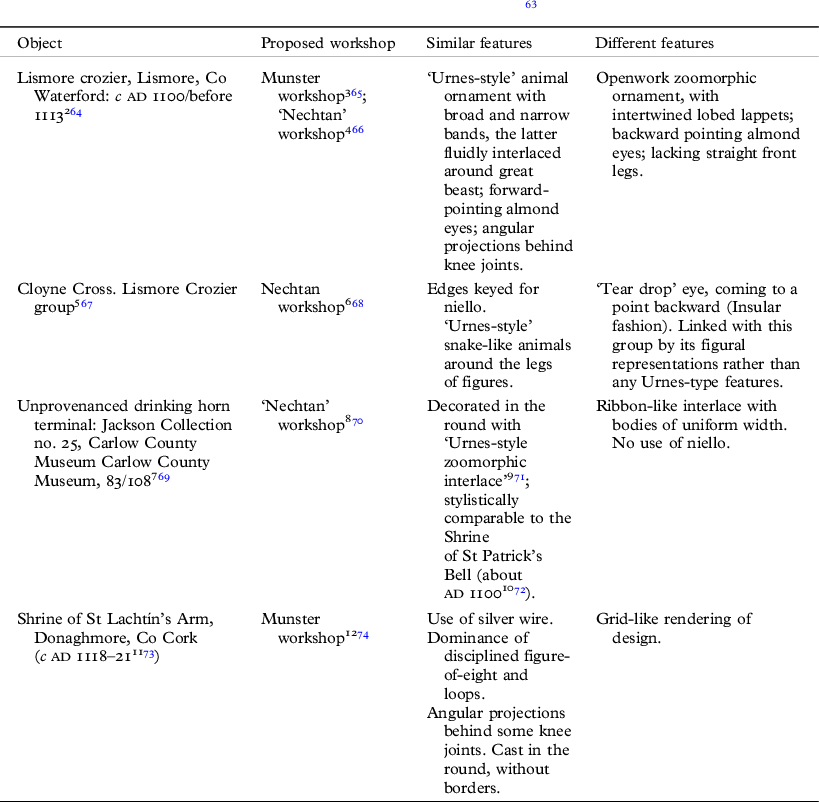
Irish Urnes style appears to be particularly associated with churches such as Lismore, Donaghmore and Dysert O’Dea, which received patronage from powerful local rulers and were areas of innovation and change close to or within Hiberno-Viking towns, and Tuam, influenced through Turlough O’Connor’s control of Dublin from ad 1118.Footnote 56 The so-called ‘Lismore Crozier’ group, named after the eponymous crozier (c ad 1090–before ad 1113; fig 19), has been proposed as a closer attribution to the Smalls guard style, with a date around ad 1100.Footnote 57 Murray has linked the Smalls guard with the workmanship of Nechtan,Footnote 58 the craftsman who made the Lismore crozier, to whom he also attributes a cross from Cloyne, Co Cork,Footnote 59 and a silver drinking form terminal in Carlow County Museum (‘covered in very fine Urnes-style zoomorphic interlace’Footnote 60 ). These Murray attributes to a workshop located in the east Cork/west Waterford area, producing secular and ecclesiastical metalwork. The Smalls guard beasts do resemble in their composition and head profiles those on a small panel on the lower knop and ferrule of the Lismore crozier;Footnote 61 however, close correspondence on other ‘Lismore group’ objects is limited, perhaps influenced to some degree by the different natures and scales of the commissions (Table 1).
Hiberno-Urnes panel on the lower knop and ferrule of the Lismore crozier. Photograph: reproduced with permission, © National Museum of Ireland.

Similarities and differences of the ‘Nechtan’/‘Munster’ workshopsFootnote 63 with features on the Smalls sword guard.

Rather than point to the product of a single saer, it is safer, on the basis of present knowledge, to suggest a southern Ireland/ Munster workshop as a plausible source for the guard, although the proposal that it may be the product of a workshop in Hiberno-Scandinavian Dublin cannot be dismissed.Footnote 62
The use of Hiberno-Urnes zoomorphic animal ornament to cover large surfaces is exemplified on stonework such as the stone sarcophagus from the Rock of Cashel, Co Tipperary. Its main panel is decorated in Hiberno-Urnes style with two great beasts intertwined with a background filled with thin asymmetrical snakes, and slightly tapering bodies. The slightly tapering bodies on two ‘great beasts’ and their figure-of-eight composition recall those of the Smalls guard, though the ‘tear drop’ eye comes to a point backward (Insular fashion) and there is a front talon in front of three rounded toes on the feet. The patron of the chapel was Cormac Mac Carthaigh, king of Munster, and it was dedicated in ad 1134;Footnote 75 the sarcophagus has been regarded as that of king Tadhg Mac Carthaig, Cormac’s brother and predecessor.Footnote 76
Taking all the above points into account, a date for the manufacture of the Smalls guard during the first quarter of twelfth century is most likely, perhaps c ad 1100. It is a clear illustration of an item made by a workshop working for both lay and ecclesiastical customers. While most surviving eleventh-/twelfth-century Irish decorative metalwork is ecclesiastical, and the craft of the goldsmith was hereditary, such monastic craftsmen also produced work for secular patrons. The Greenmount plaque from Co Louth is another secular piece in the same style, possibly a sword belt fitting.Footnote 77 The Life of St Colmán of Lynn describes how Anniaraid ‘a famous goldsmith of the community of Tech Conan’ while at Lynn made a bridle ornamented with gold and silver for the king of Offaly.Footnote 78
EXPERIMENTAL MANUFACTURE OF THE SWORD GUARD AND A BLADE OF CONTEMPORARY TYPE
In light of the rarity of the sword guard, its technical accomplishment and beauty, and Amgueddfa Cymru’s wish to provide a meaningful visualisation for public display, Master Bladesmith Frank J M Craddock was commissioned in late 1993 to manufacture a copy of the decorated guard and recreate experimentally the process of forging a high-quality Viking sword blade to accompany it.
Detailed biographies of the creation and use of replicas are frequent lacunae in the records of many replication projects,Footnote 79 and those that are published are often summary, lacking detail of benefit to makers, conservators and archaeologists. The commission included full documentation of the making process, with commentary on the decisions made along the way, and statistics on production time, volumes of material and fuel consumed, to inform our view of the probable cost of such swords. This account in the project archive amplifies the short summary report previously published.Footnote 80
For the purposes of interpretation, a pattern-welded blade was made, although there is no proof of pattern-welding on the original sword.Footnote 81 Radiographic survey of Anglo-Saxon swords in the BM collections indicated that about two-thirds of ninth-/tenth-century examples showed pattern-welding, which appeared to have gone out of fashion from about ad 1000, with the exception of scramasaxes (until about ad 1200).Footnote 82
The treasuring and refitting of famous blades do not completely rule out the use of pattern-welded sword blades at this later date, and pattern-welded swords were used by the Rus into the twelfth century (recorded on swords found in Latvia, though Viking type swords from Novgorod do not appear to have been pattern-weldedFootnote 83 ). Pedersen has noted in her study of inscribed swords from Denmark that, to judge from the hilts, recorded blades with inscriptions or symbols were in use over a long period of time from the ninth to the eleventh or even twelfth century, and that blades may have been rehilted either as a repair or to meet changing requirements.Footnote 84 Recent x-ray analysis of sword blades in the National Museum of Ireland collections, which show little sign of Anglo-Saxon influence, have identified a smaller than expected number of examples (most commonly associated with swords with elaborate hilts, as prestige swords).Footnote 85 Variations in blade form have been studied by Maure and Geibig, and summarised by Jones.Footnote 86 It is also acknowledged that, since the recreation of a blade to accompany the guard, considerable advances have been made in understanding pattern-welding as primarily a decorative technique designed to demonstrate excellence in the exploitation and welding of different iron alloys.Footnote 87
An initial design was prepared by the author with advice on form, dimensions and materials provided by Barry Ager, tempered by a recognition of the wide variety of Viking sword types and the lack of standard sizes making certainty impossible. The double-edged sword blade was informed by drawings of Viking swords from Norway and the river Lea at Edmonton, Middlesex, in the BM collections,Footnote 88 and examples from Ballinderry crannog, Co Westmeath,Footnote 89 and Lough Derg, Co Tipperary (overall length 785mm). These suggested a blade thickness of 4–5mm at the thickest points either side of the fuller at the point where the bevel edges commence, and blade lengths of about 770–800/850mm. A rectangular-sectioned tang, based on guard hole, was given an estimated length between guard and pommel-bar of about 100mm; the pommel-bar and pommel, which would have been decorated to match that of the guard, was to be made of Perspex. A blade length was hypothesised at a length of about 800mm plus the length of the tang (overall length about 960mmFootnote 90 ). The target for the overall weight was to be about 0.8–1.5kg. Sources for technical details included Tylecote and GilmourFootnote 91 and accounts of experimental forging of pattern-welded swords such as Davidson’s account,Footnote 92 prepared from a fuller description by J W Anstee and Leo Biek.Footnote 93 While the suggestion of a plain steel/iron blade with maker’s name such as INGELRII and mark inlaid with strips was considered, it was decided to reflect a narrative informed by the evidence of the blade being rehilted.
Summary of processes
The hollow casting technique, materials chosen and the precise engraving/chasing point entailed a highly skilled level of craftsmanship, and considerable cost for the patron. The process of inlaying the silver into the engraved beasts appears to combine two techniques – an ‘early’ technique of creating small jagged teeth on the bottom of the cut line, to act as a key for the silver when hammered into place, and a more ‘advanced’ technique of undercutting the sides of the engraved line to form a dovetail keyway, which closes around the wire as it is punched into the cut (fig 20).Footnote 94
Details of (a) tool marks associated with inlaying silver wire; (b) cross-hatching to key in niello. Photograph: reproduced with permission, © Amgueddfa Cymru – Museum Wales.

Making the guard
-
i. To cast the guard, a clay core was dipped in wax, which was smoothed to shape (fig 21 a, b). This was enclosed in clay, and the resulting clay mould, once dry, was heated to melt out the wax and leave a cavity. This was then filled with molten brass.
Fig 21.Recreating the Smalls sword guard: (a) core; (b) wax model over core, in casting box; (c) recreated blank of the guard marked out with design; (d) decoration engraved on a leather pad. Photographs: F Craddock; reproduced with permission, © Amgueddfa Cymru – Museum Wales.

-
ii. Once the rough casting had been dressed with files, a design was marked out and cut with small gravers and chisels. The guard was held firm, by a strap attached to the craftsmen’s foot, against a special sand-filled leather bag (fig 20 c, d).
-
iii. After the silver wire had been inlaid, the black niello (copper sulphide) was applied; any surplus was then filed off ready for polishing (fig 22 a–c).
Fig 22.Recreating the Smalls sword guard: (a) niello applied to decorated areas; (b) niello gradually rubbed down to reveal the decoration; (c) the completed guard. Photographs: F Craddock; reproduced with permission, © Amgueddfa Cymru – Museum Wales.
-
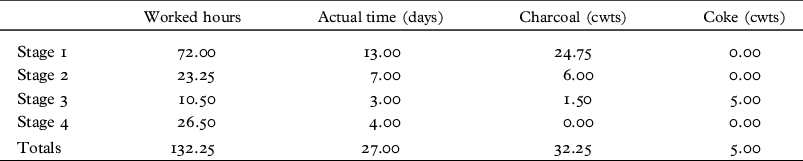
iv. The finished guard was fitted to the blade. The missing handle (grip) was represented in Perspex (table 2).
Table 2.Summary of labour and materials required to produce the guard.
Not including waste resulting from experimentation, errors, research, etc.


Its experimental recreation has shown the challenging and skilful nature of the task of adding niello to a three-dimensional guard of this type and size, and then polishing back to reveal the pattern (fig 23).
Hilt of the recreated Smalls sword guard and blade. Perspex suggests a form for the missing pommel, which was probably decorated the manner of the guard. Photograph: reproduced with permission, © Amgueddfa Cymru – Museum Wales.

Making the blade
The sword blade (fig 24, table 3) would probably have matched the guard and pommel in quality.
-
i. The first block of iron for the blade was forged and welded into a billet.
-
ii–iii. The forged strips of iron of differing steel composition (pure iron and iron with more carbon in it/low carbon iron and high phosphorous iron) were stacked and bundled together to form a forged core.
-
iv. The core bars were twisted.
-
v. To fire-weld the blade blank, the tips of the core bars and filler strips were hammer-welded together, prior to hammer-welding down their length. Harder, sharper steel could then be welded to the edges.
-
vi. To shape and finish the blade, after rough dressing with scrapers, stone and a file, the fuller was shaped using a sliver of steel set in a wooden bar (sometimes known as an ‘Old Maid’s Tooth’). The fuller both lightened the blade and increased its flexibility.
-
vii. Finally, one of three possible finishing processes was used to bring out the pattern in the blade. A mild organic acid was used to etch the surface, which was occasionally brushed with a feather to ensure an even finish.
Recreating a blade for the Smalls sword guard. 1–2: strips of iron of differing steel composition forged from billet, stacked and bundled together to form a forged core; 3: core bars twisted; 4: fire-welding the blade blank. The tips of the core bars and filler strips were hammer-welded together, prior to hammer-welding down their length. Harder, sharper steel could then be welded to the edges; 5: shaping and finishing the blade. After rough dressing with scrapers, stone and a file, the central groove (‘fuller’) was shaped using a sliver of steel set in a wooden bar, sometimes known as an ‘Old Maid’s Tooth’. Drawing: T Daly. Photograph: F Craddock; reproduced with permission, © Amgueddfa Cymru – Museum Wales.

Summary of labour and materials required to produce the blade.

DISCUSSION
On the basis of the above evidence, the Smalls sword guard can be considered part of a sword grip decorated in Hiberno-Urnes style to polychrome effect, probably made by highly skilled craftsmen in a workshop making items for both secular and ecclesiastical patrons during the first quarter of the twelfth century.Footnote 95 Its free flowing, energetic and lively style, with fairly ‘pure’ Urnes heads, may point to a production date about ad 1100 or shortly thereafter.
The use of silver wire inlay and niello and the quality of the execution indicate that this elaborate guard was made as a prestige sword (praksverd Footnote 96 ). The accompanying fittings and scabbard furniture would have been of equal quality, and the missing pommel may have been similarly hollow cast, engraved and finished ‘en suite’ with the lower guard, in a similar decorative style. Its profile is not known, but may have been trilobite to pyramidal, and hollow cast. The nature of the grip remains conjectural, but could have been wood or bone/horn, covered in silver wire or leather (see fig 18).
The design is bold and dramatic, but structurally delicate, in that any appreciable shocks of the type to be expected in combat risked loosening the niello, as well as the guard itself. This raises the question of whether the sword was intended for combat, or primarily for display as a symbol of authority and position (in the manner of a sceptre or parade sword). The underside of the guard appears to show small dents from hammers, as if refitted or tightened at some point. The hollow casting may have been prone to working loose as a result of concussion transmitted down the blade. This may have been accidental, resulting in the need to tighten up the grip on the blade. Alternatively, the guard and matching elements could have been fitted to a second blade at some point in its working life, perhaps as a result of damage or changing fashion. The closing up of the guard against the blade fuller by hammering may suggest the replacement of an original, slightly thicker blade by one with a deeper fuller or thinner profile. The U-shaped notches cut between the upper and lower jaws of the Type 3 beasts (flanking the tang; see figs 11 and 14) to prevent stress cracks and a mating without blank gaps also suggest a quality blade. The upper opening on the guard where the tang passed up through the hilt appears to have been widened, encroaching on the original engraving – again, pointing to an adjustment following the fitting of a second blade. As a consequence, the grip may have concealed an appreciable amount of the gripping beasts’ heads.
In addition to Dublin, other related groups of Hiberno-Scandinavian metalwork and possible fine metalworking workshops have been proposed in Ireland during the eleventh and twelfth centuries, associated with the patronage of powerful kings based at regional centres.Footnote 97 These include Roscommon for the Cross of Cong,Footnote 98 and a Munster workshop for the Glankeen bell-shrine, Lough Derg sword hilt and Bulford mount.Footnote 99 Many workshops formed part of significant monastic communities or towns under royal patronage, as indicated by the frequent mention of the names of secular patrons on metalwork enshrining relics,Footnote 100 and some craftsmen will have supplied both secular patrons as well as the church. While it is not possible in the case of the Smalls sword guard to confirm whether it was made by a fixed or itinerant workshop, regular patronage for ecclesiastic and secular orders appears likely. The high quality, probable cost, fine original finish and appearance of the sword illustrate the role of prestigious and valuable weapons to seal ties between factions through a diplomatic gesture or gift exchange, and to reinforce authority and status.
Loss
The guard shows little sign of wear through use, and would have been a prized possession when lost. The findspot probably indicates the location of a shipwreck carrying an elite passenger or wealthy merchant, lost some time after ad 1100. Other explanations can be dismissed:
-
1. The rock is completely uninhabitable, and the find cannot represent occupational debris.
-
2. The guard is unlikely to have been brought over during the eighteenth- or nineteenth-century construction work on the lighthouse.
-
3. It is equally unlikely to represent antiquarian material onboard a post-medieval wreck.
-
4. The sword is unlikely to have been accidentally lost overboard, unless accompanied by other loss through shipwreck (fig 25).
Fig 25.The shipwreck of mercenary Hugh de Boves off Great Yarmouth (ad 1215), as illustrated by Matthew Paris in his Chronica Majora, II, fol 42v (46v), shows scabbarded swords tumbling into the sea. Image: reproduced by permission of The Parker Library, Corpus Christi College, Cambridge, © The Master and Fellows of Corpus Christi College, Cambridge.

Such was the quality of the Smalls sword – perhaps a personal possession or gift to a friend or ally – that it is probable that it would have been carefully wrapped in a watertight leather bag and safely stowed on board, perhaps in a chest. This implies that the ship on which it was being carried came to grief on The Smalls, close to a sea route between Ireland and south-west Wales, at some time during the early twelfth century – a period of frequent contact between Wales and Ireland.
Place names and seascapes
The nature of the findspot, close to sea-routes between Dublin/Ireland and Wales/Bristol during a period of intensive Viking activity in this area, made it a shipping hazard. An example of the risks taken is provided by the Welsh chronicles, which records that in the year ad 1050 a fleet from Ireland foundered off Deheubarth.Footnote 101 By the mid-twelfth century, ships were making frequent voyages from Ireland along the south coast of Wales to Bristol and other ports, for a wide range of reasons, from military campaigns to pilgrimage (stimulated by shared cults and Glastonbury) and the movement of people and commodities,Footnote 102 while ports such as Wicklow and Arklow are mentioned as trading with the small Welsh ports.Footnote 103
Many of the rocks and islands of the Pembrokeshire coast bear names of Scandinavian origin, and some also have Welsh names (for example, the Scandinavian name Ramsey bears the Welsh names Ynys Dewi and Ynys Dyfannog, saints associated with it).Footnote 104 Several place names in the vicinity of The Smalls appear on early fifteenth-century and early sixteenth-century sailing directions in several languages. One of the earliest forms of The Smalls is Ismael, in Italian sailing directions attributed to Alvise Cadamosto and published in ad 1490,Footnote 105 and Low German directions have Ysmal or Hysmal. Names beginning with ‘I’ could have the initial letter removed, cartographers under the impression that it stood for ‘island’, ‘ilha, ‘isla’ etc.Footnote 106 Other names for The Smalls include Masquin goales and schitual, in a variety of spellings.Footnote 107 It has been suggested that schitual may be a version of the Old Norse name for harpoon (skutill),Footnote 108 and possibly also a shuttle (modern Norwegian Skyttel), based on the shape of the main rock. RichardsonFootnote 109 has suggested that the Welsh for The Smalls, lly wennol,Footnote 110 (g)wennol may be a translation of the Old Norse name, on the basis of the resemblance of the main rock to a ‘boat shuttle’ used by weavers. However, weaving swords would have been the norm in the eleventh/twelfth century, and Richardson acknowledged another possible source, suggested by Gwynedd Pierce – the Welsh adjective ewynnol, from the noun ‘foam, spume, forth’ – as used at Swallow Falls near Bettws-y-Coed. ‘Foamy’ would also fit with the meaning of maesgwyn, ‘white field’ (English ‘White water’), and Breton maez gwenn, suggested source for masquin on Guillaume Brouscon’s pilotage manual of ad 1548.Footnote 111 ‘White open field’ or ‘white open sea’ could also be applied to the large stretch of water around The Smalls and the clusters of rocks to the east known as the Hats and Barrels. The first cartographical appearance of ‘small’ seems to be Laurence Nowell’s map of Ireland of the mid-1560s,Footnote 112 as ‘Smalle’, and from early in the seventeenth-century versions appear with a final ‘s’ added (I. Smeals, I. Smals,Footnote 113 the Smalles and the Smaels Footnote 114 ).
Many ships have been lost on The Smalls, both before and after the advent of navigational aids and lighthouses, and any vessel wishing to travel to Ireland from the south coast of Wales, or vice versa, still needs to keep a course well to the south of the Hats and Barrels to be sure of clearing these hazardous rocks.Footnote 115 In his remarkable survey of the coast of Wales, begun in 1737, Lewis Morris drew attention to its hazards:
The Smalls lie about three Leagues W. by N. of Gresholm Island, and are covered at half Flood, which makes them very dangerous.
The main Rock of the Smalls appears, at a Distance, like the Hull of a large Ship overset; and is about Fifty Yards long at low Water, lying S.E. and N.W.; and from it to the S.E. there are Four other smaller Rocks, that appear in a Line before low Water, extending for about a Hundred Yards, and a sunken Rock Twenty Yards further; and then you are, all at once, in Thirty or Forty Fathom Water.Footnote 116
Lewis goes on to recommend that ‘a large Perch upon the main Rock of the Smalls, would be of infinite Service to the Navigation of Great Britain’, alongside ‘a new Kind of double Light-house’ on Grassholm.Footnote 117 The first lighthouse, designed and built by Henry Whiteside, was erected on The Smalls following the loss in a tearing gale of the Pennsylvania of 1,000 tons, which smashed onto the rocks in 1773 while en route from Philadelphia to Bristol, with the loss of seventy-five souls. This was not the first casualty – four lives were lost when the Mart & Susanna, outward bound from Dublin to Bilbao, was lost on The Smalls in 1753.Footnote 118
Bad weather, careless navigation and the failure to make allowances for the spring tidal race are common reasons for many more losses. These include the Manuel of Bilbao, en route from Liverpool to Havannah in broad daylight in 1858, despite the presence of a lighthouse, and the George Moore, stranded close to the lighthouse in 1887. Other wrecks in the vicinity include the Captain McClure (lost a few weeks after the Rhiwabon on 4 March 1884), the Datura (lost off the Barrels Rocks on 1 February 1897), the Wexford schooner Reliance wrecked in the gullies immediately outside the lighthouse and salvaged in 1902,Footnote 119 the Cardiff registered steamer Cambro, driven ashore on The Smalls in fog on 24 May 1913 during a voyage from Spain to Lancashire with a cargo of iron ore, and the remaining half of the Liverpool tanker Athelduchess, of 8,940 tons, built in 1929 and part of a convoy formed in the Bristol Channel before crossing the Atlantic,Footnote 120 stranded in a south-west force 8 on The Smalls on 20 August 1943, where she broke in two. The stern section was salvaged.Footnote 121
CONCLUSIONS
Recent research has put the study of the Hiberno-Urnes style on a new footing, and Dublin has been seen as the source of inspiration for the Hiberno-Urnes style decoration seen on products of Mael Isu and his workshop (eg the Cross of Cong, St Manchán’s Shrine, the Holycross plaque, the Aghadoe crozier).Footnote 122 Relationships between Wales and Ireland, and in particular Dublin, were at times close, exemplified in Welsh ruler Gruffudd ap Cynan (ad 1055–1137). Born in Dublin of mixed Welsh-Ostman-Irish ancestry, he grew up within its Scandinavian community, before his attempts to re-establish the old line of Rhodri Mawr as ruler of Gwynedd, supported by the king of Dublin. The eleventh century saw Ireland provide shelter for disaffected members of the Anglo-Saxon aristocracy, such as the flight of Harold and Leofwine Godwinson to the court of Diarmait, king of Leinster, after he took control of Dublin.Footnote 123 If the attribution to a workshop of the Lismore Crozier group is correct for the Smalls sword guard, then it may have been associated with the Eóganachta, depending on its date of manufacture, as the influence of the McCarthy-sept grew in dominance there from the end of the eleventh century.Footnote 124 Munster was dominated by the Irish high king Muirchertach Ua Briain of the Dál Cais (ad 1086–1119), and in the late eleventh century the dynasty moved from the Rock of Cashel (Co Tipperary) to the Hiberno-Norse port of Limerick. Here the Uí Briain rulers could benefit from its trading capacity with the west of Britain and France, having the Dublin and Waterford fleets also at their disposal.Footnote 125 Brut y Tywysogyon and Brenhinedd y Saeson record that Arnulf de Montgomery, Earl of Pembroke (c ad 1066–1118×1122), sent his steward/seneschal Gerald of Windsor (c ad 1075–1135) to Ireland in order to arrange military assistance from king Muirchertach.Footnote 126 The alliance was formalised by marriage between Arnulf de Montgomery and one of Muirchertach’s daughters, Lafracoth, the record of which is also preserved by Historia ecclesiastica and alluded to by the eleventh- to fourteenth-century Annals of Inisfallen. According to the Welsh Brut y Tywysogyon, Arnulf ‘ sent messengers to Ireland … to ask for the daughter of King Muircertach [‘Murtart’] for his wife. And that he easily obtained; and the messengers came joyfully to their land. And Muircertach [‘Murtart’] sent his daughter and many armed ships along with her to his aid …’.Footnote 127 It is not possible to associate the loss of the Smalls guard with a particular recorded historical event, although these annals and the alliance forged between the earl of Pembroke and the king of Munster provide an elite context for movement by sea. Muirchertach banished his brother Diarmait Ua Briain (ad 1060–1118), who had raided Wales in ad 1080, and Diarmait may have spent time supporting the ruler of Deheubarth. When Muirchertach temporarily retired his kingship in ad 1116, he retired to Lismore.
The early twelfth-century wreck on The Smalls is likely to be a scattered and dispersed site, with the likelihood of surviving archaeological material (including cargo) lodged in rock gullies and covered by modern wreckage (which may protect areas). In view of the high energy conditions within the gullies, while it is unlikely that hull structure will survive, other evidence for the wreck probably exists. Perhaps in time more evidence for this historic wreck site will be revealed and, with it, greater understanding of the context of the ship’s voyage and those who never reached their desired destinations.
ACKNOWLEDGEMENTS
The archive related to The Smalls site investigation is housed with files relating to the sword replica.Footnote 128 This archive includes full documentation of the manufacturing process and associated discussions.
The author would like to thank the following for their generous support and information. Firstly, members of the dive teams: K Anyon, N Anyon, M Chopping, J Carter, N Carter, S Craddock, D Green, C Howkins, K Howkins, A Lumb, F Mitchell, F Pitt, D Richman (Milton Keynes Sub-Aqua Club); N and P Mensikov (Southampton University BSAC and the Cardiff British Sub-Aqua Club); C Smith, M Williams; West Wales Divers Ltd; J Cross for underwater filming; R and G Smith and Mrs and Mrs Reynolds for logistical support; A Barak for supervising operations; N O’Neill; H and T James.
I am most grateful to numerous colleagues and friends for their advice and comments over the years, so freely given: Susan Youngs (then of the BM); Raghnall Ó Floinn (then of the National Museum of Ireland); Griffin Murray; Signe Horn Fuglesang; Barry Ager (then of the BM); Cormac Bourke (then of Ulster Museum); Professor W A R Richardson (The Flinders University of South Australia) for discussion of Welsh coastal place names; Professor Richard Bevins (then of Amgueddfa Cymru) for geological identifications; Tom Bennett for sharing his deep knowledge of Welsh shipwrecks; Kurt Schietzel; Susan la Niece (then of BM) for analysis of the guard; Peter Northover for analysis on the post-medieval copper ingot by electron probe microanalyser in the Department of Materials, University of Oxford; the late Martin Dean (ADU). I would also like to thank my colleagues in Amgueddfa Cymru: Tony Daly for plans and drawings; Kevin Thomas and Robin Maggs for photography. Frank Craddock would like to thank Mark Constable (jeweller) for making the niello, and Mr Ranjit S Singh and family for information.
The images AP_2010_3343 and AP_2020_3339 Smalls Reef are Crown copyright and are reproduced with the permission of RCAHMW, under delegated authority from The Keeper of Public Records. I am also grateful to the Irish Antiquities Division, National Museum Ireland, for permission to reproduce figs 17, 18 and 19 and the Master and Fellows of Corpus Christ College, Cambridge, for permission to publish fig 25.
ABBREVIATIONS AND BIBLIOGRAPHY
Abbreviations
- ADU
-
Archaeological Diving Unit
- BL
-
British Library, London
- BM
-
British Museum, London
- HTV
-
Harlech Television
- NMI
-
National Museum of Ireland
- NMW
-
Amgueddfa Cymru – Museum Wales
- RCAHMW
-
Royal Commission on the Ancient and Historical Monuments of Wales
- RIB
-
rigid inflatable boat
- XRF
-
x-ray fluorescence