INTRODUCTION
The rare deep-sea family Bathypalaemonellidae de Saint Laurent, 1985 is known from a small number of specimens and includes two genera: Bathypalaemonella Balss, 1914, with eight species and Bathypalaemonetes Cleva, Reference Cleva2001 with three species (Wicksten & Méndez, Reference Wicksten and Méndez1983; Cleva, Reference Cleva2001, Reference Cleva2004, Reference Cleva2008).
Among the eight Bathypalaemonella species, three (B. pandaloides Rathbun, 1906; B. humilis Bruce, 1966 and B. delsolari Wicksten & Méndez, Reference Wicksten and Méndez1983) are recorded from the Pacific Ocean, two (B. zimmeri Balss, 1914 and B. adenensis Cleva, Reference Cleva2001) from the Indian Ocean, one (B. hayashi Komai, 1995) from the Indian and Pacific Oceans and two (B. serratipalma Pequegnat, Reference Pequegnat, Pequegnat and Chace1970 and B. texana Pequegnat, Reference Pequegnat, Pequegnat and Chace1970) from the Atlantic Ocean in the Gulf of Mexico (Wicksten & Méndez, Reference Wicksten and Méndez1983; Cleva, Reference Cleva2001).
The only previous record of Bathypalaemonella texana is from the original description by Pequegnat (Reference Pequegnat, Pequegnat and Chace1970) in the Gulf of Mexico, where only one adult male was collected. The present work presents the second published record of this rare species.
Bathypalaemonella texana was collected in a deep-sea coral reef habitat. These habitats aggregate the fauna and act as feeding grounds and sites of reproduction for many species. The main builder of these reefs is the stony coral Lophelia pertusa (Linnaeus, 1758) that occurs in many world localities including the Brazilian coast (Rogers, Reference Rogers1999). To observe and collect in the deep-sea corals without impact in this rare habitat, high technology had to be used: human occupied vehicles or remotely operated vehicles.
MATERIALS AND METHODS
The material examined herein was sampled by a remotely operated vehicle (ROV), during two expeditions (January and July, 2008), at Campos Basin (21° to 23°S), Rio de Janeiro, Brazil, as part of the project Ecoprof-Deep-sea Ecosystems, coordinated by Petrobras, Brazilian Energy Company. These expeditions aimed to observe and sample at the deep-sea coral reefs habitat. This material is deposited in the Crustacea Collection at the Museu Nacional/Universidade Federal do Rio de Janeiro.
SYSTEMATICS
Bathypalaemonella texana Pequegnat, Reference Pequegnat, Pequegnat and Chace1970: 81, figures 4.7, 4.8; Crosnier & Forest, Reference Crosnier and Forest1973: 156; Wicksten & Méndez, Reference Wicksten and Méndez1983: 230; Chace, Reference Chace1997: 31; Cleva, Reference Cleva2001: 780.
MATERIAL EXAMINED
One ovigerous female, 14.6 mm, Ecoprof 4, ‘TOISA Voyager’, 22°22′33.256″S and 40°6′17.974″W, 620 m, MNRJ 22074; among deep-sea corals Lophelia pertusa; 2 females, 11, 11.1 mm, Ecoprof 1, ‘TOISA Voyager’, 22°22′34.797″S and 40°7′12.844″W, 600 m, MNRJ 22075, among deep-sea corals Lophelia pertusa.
DIAGNOSIS
Rostrum armed with at least 12 teeth dorsally, 5–6 behind orbit, and at least five ventrally. Posterior margin of telson with four pairs of spines. Major second chela smooth along posterior margin; cutting edge of propodus with three blunt teeth; tips of fingers curved, ending in sharp points (modified from Pequegnat, Reference Pequegnat, Pequegnat and Chace1970).
DESCRIPTION
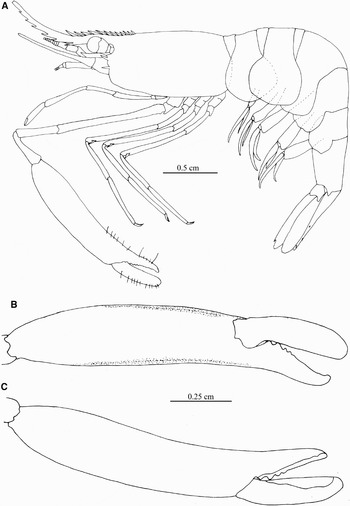
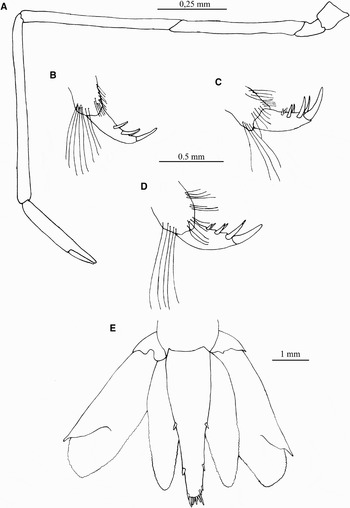
Rostrum long and slender, directed upwards, overreaching antennal scale, armed with at least 12 teeth dorsally, 5–6 behind orbit, and 5–6 ventrally (Figure 1A). Carapace smooth with strong antennal and branchiostegal spines (Figure 1A). Anterolateral angle of carapace rounded (Figure 1A). Abdomen smooth (Figure 1A). Eyes well developed, cornea diameter larger than ocular peduncle (Figure 1A). First pereopod extending beyond antennular peduncle (Figure 1A). The second pereopods are very unequal in shape and strength, the major pereopod on left side, with much enlarged palm, nearly three times fingers length; palm smooth on posterior border; cutting edge of the fingers are smooth except three blunt teeth on propod proximal end; finger tips sharply curved (Figure 1B&C). Smaller second pereopod resembling first, but longer and stronger; carpus 1.9 times length of propod and 1.25 times length of merus, which is 1.3 times length of ischium (Figure 2A). Third pereopod reaching slightly beyond antennal scale, dactyl curved at tip, armed with two pairs of posteriorly directed spines (Figure 2B); propod 5.7 to more than six times as long as dactyl. Dactyls of pereopods 4 and 5 with two or three pairs of posteriorly directed spines (Figure 2C & D). Telson elongate with two dorsolateral pairs of spines; blunt posterior margin, with four pairs of spines, outer short, second long and two inner pairs of equal length, longer than outer pair but shorter than longest pair (Figure 2E). Uropods not overreaching telson (Figure 2E).
Bathypalaemonella texana Pequegnat, Reference Pequegnat, Pequegnat and Chace1970, female (11.1 mm), MNRJ 22075. (A) Lateral view; (B) major cheliped of pereopod 2, inner face; (C) major cheliped of pereopod 2, outer face.

Bathypalaemonella texana Pequegnat, Reference Pequegnat, Pequegnat and Chace1970, female (11.1 mm), MNRJ 22075. (A) Minor pereopod 2; (B) dactyl of pereopod 3; (C) dactyl of pereopod 4; (D) dactyl of pereopod 5; (E) telson and uropods.

DISTRIBUTION
Known only from the type locality, the north-western Gulf of Mexico, 27°01′S–94°42′W (1.463 m) and from Brazil, at Campos Basin, 21° to 23°S, 620 m, in Rio de Janeiro State (new record in bold).
REMARKS
The material examined herein agrees with the original description of Bathypalaemonella texana from Pequegnat (Reference Pequegnat, Pequegnat and Chace1970). The major pereopod 2 has a smooth posterior edge of palm and three teeth on the cutting edge of the propod, and there are four pairs of distal spines on telson. These features distinguish the Brazilian material from six of the Bathypalaemonella species (Table 1).
Comparison between Bathypalaemonella species.

However, a variation on the number of spines on dactyl of pereopods 3–5 was observed (Figure 2B–D). Pequegnat (Reference Pequegnat, Pequegnat and Chace1970) pointed out that there were two pairs of spines on dactyls of pereopods 3–5 to B. texana while in the Brazilian material, two or three pairs of spines were present. Cleva (Reference Cleva2001) observed a wide variation of this feature in B. hayashi (3–6) and in B. serratipalma.
The closest related species to B. texana is B. delsolari. The main difference between them is the length of the uropods. They do not overreach the telson in Brazilian material of B. texana (Figure 2E), and overreach in B. delsolari.
The rostral formula of Brazilian material ((6)12 + 1/5–6) also was different from that observed by Pequegnat (Reference Pequegnat, Pequegnat and Chace1970) and Wicksten & Méndez (Reference Wicksten and Méndez1983) ((5)15 + 1/5) in B. texana. Actually, this rostral formula differs from all Bathypalaemonella species. The rostrum shape and the teeth disposition in Brazilian material are very close to that described for B. texana. Considering the small number of specimens of B. texana sampled as of today, these increases on teeth range of rostral formula should be expected.
Pequegnat (Reference Pequegnat, Pequegnat and Chace1970) distinguished between B. serratipalma and B. texana mainly on the basis of the rostral formula, the posterior margin of telson, the posterior border of the palm of the major second chela and the cutting edge of the propod. Chace (Reference Chace1997) stated that: ‘positive confirmation that the unique specimen of B. texana is specifically distinct and not an aberrant example of B. serratipalma … can be realized only by the study of additional specimens’. The study of the Brazilian material (three well-preserved adult specimens) allowed the confirmation that the distinctive features pointed out by Pequegnat (Reference Pequegnat, Pequegnat and Chace1970) are valid. In all examined material the posterior border of telson presents four pairs of spines (Figure 2E) instead of six, the posterior border of the palm of the major second chela is smooth (Figure 1B&C) instead of toothed, and the cutting edge of the propod bears three teeth (Figure 1B&C), instead of one. The rostral formula, considering the increased range of teeth observed herein, appears not to be a reliable feature to distinguish between these two species.
The shrimps examined herein were collected among a dense growth of the deep-sea scleractinian Lophelia pertusa. The deep-sea coral reefs are known to harbour many unusual and poorly sampled invertebrate species. The previous records of the greatest part of deep-sea decapods of the western Atlantic are based on sampling by trawls or benthic skimmers, which are destructive methods and should not be used to sample among corals. The finding of Bathypalaemonella texana among deep-sea corals adds another species to the list of the supposedly rare decapods that may, in fact, be restricted to the areas that are difficult to study without use of an ROV.
ACKNOWLEDGEMENTS
To Petrobras, Brazilian Energy Company for sampling the material, and for their financial support to the deep-sea research projects at Campos Basin (Rio de Janeiro, Brazil).