‘Greg Sheehan is not liable for where his methods will lead you, creatively, physically or personally’. This humorous comment in the author’s preamble implies that The Rhythm Diaries may present a risky exploration into new musical territory for the reader. Sheehan is an Australian percussionist who, through a diverse range of collaborations and creative research, has developed a system which guides his teaching and professional practice known as Greg Sheehan’s rhythm diamonds. This book introduces his system, supported by copious illustrations, anecdotes, and contributions from Sheehan’s musical collaborators. The inspiration for the central thesis behind ‘rhythm diamonds’ came to Sheehan at age 26, when a student of Indian classical music unwittingly introduced the author to the concepts of additive rhythm and permutation (p. 2).
Whilst the term additive rhythm is not specifically used by Sheehan, that musical time and rhythm can be entirely represented by integers is a tacit assumption that underpins his introductory chapter ‘Playing with Numbers’.Footnote 1 Sheehan recommends that the reader master the syntactical units of duration before assembling them into the phrases and geometric sequences of integers that comprise rhythm diamonds. The syntactical units that represent the ‘most basic elements’ are 1, 2, and 3, introduced in his chapter ‘Phrasing’ (p. 14). Here Sheehan infers unique-prime-factorisation theorem – also congruent with additive rhythm – but does not explicitly introduce the term nor the associated theory. This omission limits the scope of his phrasing sequences chart for integers 3 to 32 (pp. 16–17), but Sheehan acknowledges this limitation to ‘keep it simple’ (p. 15).
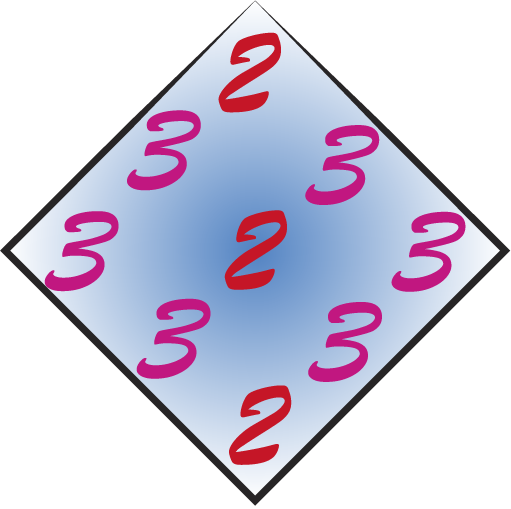
Diamonds are the formative arrangement in Sheehan’s rhythmic system, and the ‘Number Diamonds’ chapter brings together the central features which are explored and varied in much of the remainder of the book. Rhythm diamonds are geometric arrangements of nine digits intended to be executed as continuous sequences of any combination. To limit the range of mathematical combinations and to make the resulting sequences simpler to execute, Sheehan’s rhythm diamonds are designed with three permutations of two single-digit numerals in strings of three – one of one digit and two of another (i.e. aab, aba, baa). Figure 1 illustrates the 332 diamond. There are seventy-two 9-digit diamonds that use groupings from 1 through 9, illustrated by Sheehan (pp. 24–25). Each contains combinations of eighty-four pathways.
332 Diamond.

For the reader to determine a suitable application for any diamond, they need to first calculate the ‘sum total’ value of the digits contained (p. 25). For the 332 diamond in Figure 1, this is 24. Next, the applicable time signature and subdivision may be determined. Given the factors of 24 are 2 × 12, 3 × 8, 4 × 6, and 24 × 1, choosing the factors of 4 and 6, for example, means that one sequence of the 332 diamond fills 4 beats of sextuplets (6 divisions per beat). The interdependence of sum total value upon time signature, beat, and subdivision is not explained by Sheehan. The reader must adopt the practice of looking at the sum total value and deducing its factors before then considering what subdivision, metre and number of beats will be required.
Whilst The Rhythm Diaries reflects the author’s bias towards percussionists, it is ‘intended for musicians of all instruments’ and offers concepts that improvisers and composers can apply (p. 5). For readers lacking rhythmic skills, Sheehan recommends clapping, walking, and body percussion – all elemental actions that not only remove the obstacles of instrumental prowess and consideration of pitch, but are widely recognised by teachers to improve rhythmic skills through embodied practices. Notably missing from his recommendations is the South Indian rhythmic lexicon konnakol. A beginners’ introduction would have been appropriate considering the Indian inspiration for rhythm diamonds.Footnote 2 Sheehan would have benefitted by referencing such authors as Sankaran (Reference Sankaran1994) or any number of theses on the topic, such as Young (Reference Young1998).
Sheehan fails to define the terminology he employs. Moreover, he potentially confuses the reader with its inconsistent and erroneous application. This includes mathematical terminology (such as permutationsFootnote 3 which are cyclical reorderings that uphold relative position, and combinationsFootnote 4 which are unordered), and musical terminology (such as the conflation of beat, rhythm, and pulse, of sum total and beats, and of time signature and pulse). Whilst Sheehan frequently uses the term phrase, its use implies various meanings, and the applicable term grouping – suited to the additive rhythmic language involving the concatenation of atomic durational units of time – appears only once (on p. 15). The term ratio is commonly used in music theory when discussing polyrhythm, yet Sheehan inexplicably uses it once as a simile for grouping (on p. 32).
Furthermore, Sheehan is inconsistent in his expression of how units of pulse are grouped. For example, 15/8 time signature is defined as consisting of a ‘pulse of 5 threes’ by default, which means five groups of 3 (p. 193). This syntactical ordering of the group count and value is contradicted in his phrasing sequences chart, where the multiplicator appears last not first, so 15 = 2 × 7 + 1 is intended to read as seven groups of 2, plus 1 – or a pulse of 7 twos, plus 1, using Sheehan’s terminology (pp. 16–17). The musical notation also suffers from errors, such as the 12/8 time signature with only 12/16 of value per bar (p. 31).
Sheehan concludes his book with educational aspirations for music students and professionals alike. The Rhythm Diaries may best suit readers with advanced rhythmic skills who are able to resolve the contradictions in Sheehan’s application of music theory. For them, the book can be explored freely, and concepts applied immediately, as they discover new ways of navigating strands of time. For readers without percussion skills and with rhythmic experience constrained to Western divisive rhythmic language, the true potential of the book may only be realised with tutelage, such as via Sheehan’s own live workshops. For others, the book could be considered a mystical coffee-table book, replete with substantial aesthetic appeal arising from its handwritten text, colourful illustrations, and personal stories and anecdotes by the author and his colleagues.