About 60 years after the Spanish invasion and conquest of Mexico, a group of Nahua intellectuals gathered in Tenochtitlan. On the very site of the heart of the Aztec empire stood a city of a new name: Mexico City, capital of New Spain. There the Nahuas set about compiling an extensive book of miscellanea, now known as the Codex Mexicanus. Owned by the Bibliothèque National de France, the codex includes records pertaining to the Christian and Aztec calendars, European medical astrology, a genealogy of the Tenochca royal house, and the annals of preconquest and early colonial Mexico City, among other intriguing topics.Footnote 1
Filled though it is with fascinating records, the manuscript has defied comprehensive scholarly analysis, most likely due to its disparate contents.Footnote 2 Indeed, when Donald Robertson considered the Mexicanus in his pioneering study of Aztec pictorial manuscripts, he appeared to diminish its value by describing its contents as “more a compendium or gathering together of seemingly unrelated information than a proper well-ordered manuscript.”Footnote 3 Scholars who have considered the Codex Mexicanus more recently have concentrated on particular sections of the work, but in so doing, they have been unable to adequately explain the significance of the codex in its entirety.Footnote 4
Here, I take a holistic approach to the book and make sense of it by revealing how the miscellaneous content of the Mexicanus finds a counterpart in Spanish books called reportorios de los tiempos. Based on the medieval almanac tradition, reportorios contain vast assortments of information related to the facets and faces of time—its passage as well as its influence—as does the Mexicanus. Indeed, scholars who have studied the calendric information contained in the Mexicanus have noted that reportorios likely served as source material for those sections.Footnote 5 However, other sections of the Mexicanus, such as its genealogy and history, also find counterparts in some reportorios, which points to the Mexicanus as a whole being modeled after these Spanish books. Reportorios were used as guides to living in early modern Spain; likewise, the Codex Mexicanus would have provided its native audience a guide to living in colonial New Spain.
By comparing the contents of the Mexicanus with various sixteenth-century Spanish reportorios, I bring to light points of convergence and divergence between the native codex and the Spanish books. The Mexicanus painters did not slavishly copy the contents of the reportorios but modified them by compiling a variety of texts, putting them together in new ways, and even going so far as to translate Spanish alphabetic texts into the Aztec pictorial system of writing. At the same time, they wove information pertaining to the Aztec world into the codex, surely using Aztec books as the sources for this information and thereby establishing a corollary between the Spanish world and the Aztec one. Moreover, the creators of the Mexicanus were selective in the types of information they chose to include. The reportorios contain copious amounts of information that are not included in the Mexicanus.
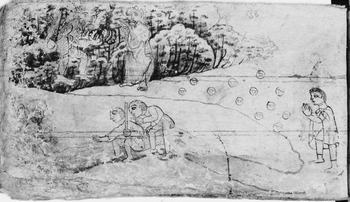
The Mexicanus includes one anomalous page (shown in Figure 2) that does not find a corollary in the reportorio tradition: an image of biblical visions received by a native convert that serves to establish the Mexicanus's owners and contributors as exemplary Christians. This was a particularly important message given the colonial context in which the codex was produced. The late sixteenth century was a particularly turbulent time for Spain's colonial project and one in which many Spaniards were questioning the success of their earlier attempts to convert the Nahuas.
Created by native intellectuals living at a time of transition under Spanish colonial rule, the Mexicanus functioned as colonial discourse, a means by which its compilers attempted to gain control over an increasingly unstable world.Footnote 6 María Fernández uses the concept of cosmopolitanism to better understand Mexican visual culture from this era, as it “entails juxtapositions, amalgamations, and translations of visual materials from various cultural traditions.”Footnote 7 She sees this process as fundamental to identity formation. Hence, the Codex Mexicanus, with its contents carefully culled from native, European, and Christian traditions and spanning religion, history, and science, is a cosmopolitan work that formulates an identity for its patrons. In this regard, there is a parallel along which the Mexicanus further mimics the reportorios, which communicate an identity for Spain that is tied to its ancient Roman past and suggest a pagan, but illustrious, foundation for the modern Christian nation. The Codex Mexicanus fashions a corollary identity for Christian New Spain, one that is built upon its own pagan, and equally illustrious, Aztec foundation. As I show here, the Codex Mexicanus was not a compendium of random information but a carefully curated collection that its native compilers must have considered essential to know and remember in late sixteenth-century New Spain and through which they asserted their identity as proud Christian heirs to the great Aztec empire.
The Codex Mexicanus and Its World of Creation
The physical nature of the Codex Mexicanus reveals its place in both the native and European worlds. The work is composed of native bark paper cut into 51 leaves, then covered in gesso and written and painted on by a number of different contributors, after which the pages were bound together into a book in the European fashion. By contrast, Aztec books were traditionally formatted as long strips of paper folded like screens. The Mexicanus is also quite small. At a page size of approximately 10 cm × 20 cm, it will fit in one's pocket, which suggests more personal reading. Thus, in format, the Mexicanus is a true codex, more a European book than an Aztec one.
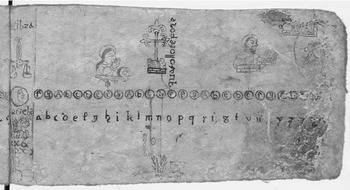
In terms of its writing system, the codex is also hybrid in nature, with the majority of its material recorded in the Aztec pictorial writing system, in which imagery is rendered in a codified form to communicate general information and hieroglyphic compounds are used for personal and place names. Other information in the Mexicanus is recorded in European alphabetic script, either clarifying the pictorial contents or adding new information all together. Because the Mexicanus genealogy and annals history derive largely from Aztec sources, their use of Aztec pictorial writing is expected. However, other contents in the Mexicanus are clearly derived from European alphabetic sources and reveal interesting uses of cross-cultural translation. One striking example is the monthly calendar (shown in Figure 3), in which the alphabetic script of the Spaniards is combined with the pictorial script of the Aztecs, thereby suggesting a sense of equivalency between the two systems of writing.Footnote 8
The contents of the Mexicanus, too, are multicultural, recording information derived from Aztec pictorial books and Spanish reportorios, both of which focused on the larger theme of time. Two common genres of Aztec books were pictorial histories and divinatory codices. Pictorial histories from Tenochtitlan were typically recorded in an annals format linked to the solar calendar, while books of divination were filled with references to the sacred calendar.Footnote 9 The reportorio tradition in Spain can be traced to the later fifteenth century and was itself based on a calendar tradition that extended back to the ancient world.Footnote 10 One of the first reportorios, published by Andrés de Li in 1492, was used to note the passage of time as well as cultural information. For example, an ecclesiastical calendar was included in the reportorio, as was agricultural information, both important to early modern life. Later reportorios, such as one by Gerónimo de Chaves first published in 1534 and again in numerous editions thereafter, increasingly included historical information as well, suggesting a growing sense that history too was significant to the understanding of the present.Footnote 11 Indeed, the first reportorio written and published in the New World, by Enrico Martínez in 1606, was based on the reportorio tradition of Spain but updated to serve those living in New Spain.Footnote 12 Accordingly, Martínez included information on the Aztec calendar and history that was surely derived from native sources.
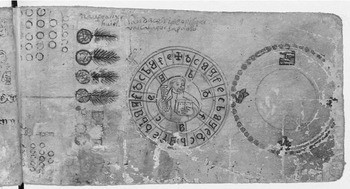
Page 9 of the codex describes the nature of the Mexicanus and the context of its creation (Figure 1). An annotation in Nahuatl at the top of this page reads, “San Acosti teopixqui ualcallaque sa paollo,” or “The friars of Saint Augustine arrived at San Pablo.”Footnote 13 This annotation references the establishment of the Colegio de San Pablo, which was founded in Mexico City in 1575 by the eminent Augustinian friar Alonso de la Vera Cruz.Footnote 14 Clues on the same page suggest the manuscript was created soon after the colegio was founded. At the center of the page is a dominical wheel that charts a 28-year cycle created by tracking Sundays in the Christian calendar. The year 1575 is marked on the wheel in reference to the establishment of the colegio, but this date also serves to correlate the rest of the years of the wheel. Accordingly, the cross at the top of the wheel falls between dominical letters corresponding to the years 1578 and 1579, which implies that the Mexicanus was begun at about this time. Other calendric notations, on Mexicanus page 15, reference the years from 1579 to 1582. The last historic notice in the annals history was written for the year 1583, making it likely that the codex was begun and updated during those years.Footnote 15
Christian and Aztec Calendar Wheels

In the decades after the conquest, Spanish friars used education as a key tool in the conversion process and established schools for the education of native elites.Footnote 16 The first, the Colegio de Santa Cruz, located in Tlatelolco, neighbor to Mexico City, was founded by Franciscans in 1536 and was dedicated to the education of native children, who were taught to read and write, an endeavor facilitated through the books collected by the library.Footnote 17 Though the majority of these books were religious in focus, there is evidence that the library also contained almanacs, as well as books of a more humanistic nature.Footnote 18 For example, a 1574 inventory lists a reportorio by Gerónimo de Chaves.Footnote 19 Reportorios were also quite popular in Spain and were exported to the New World, appearing in a number of wills and bookstore inventories from sixteenth-century New Spain.Footnote 20
Though no inventory of the Colegio de San Pablo's library is known today, it would not be surprising to find that it contained a reportorio as well. Alonso de la Vera Cruz, a humanist scholar known for his defense of the natives, was well regarded for his vast library, which he shipped from Spain and donated to the colegio. Considered one of the colony's “finest and most complete libraries,” Vera Cruz's collection was renowned for including “all the latest equipment in such things as maps, globes, and the scientific instruments known to that age.”Footnote 21 Moreover, the colegio was established for the education of friars so that they could work with the Nahuas who made up the majority of the population of the San Pablo barrio in Mexico City.Footnote 22 Based on the annotation and the educational attainments of the Mexicanus creators, it is logical to assume that they had some sort of connection to this school and access to its library as source material for their work.
The page of biblical visions included in the Mexicanus further suggests that its creators were immersed in the religious world of the Augustinians. Figure 2 on page 88 pictures two biblical events, linked in space by a winding road that extends from the lower left-hand side of the page to the right and then back again to the top left. Its inclusion here suggests a need on the part of the Mexicanus's patrons and contributors to include a statement on their Christian piety and theological understanding, which they may have gained through an Augustinian education.
Biblical Visions Received by a Native Convert

At the lower left, Christ, identified by his halo and beard, appears on a road and points to two men before him. The first, dressed in tattered clothing, holds a staff in one hand and extends the other to Christ, while a second man, in finer clothing, stands behind the first, leaning over his shoulder and pointing to Christ. Similar iconography in European art is used to reference an event that happened three days after Christ's resurrection, when two men encountered a stranger on the road to Emmaus. Unaware of the stranger's identity, the men discussed the disappearance of Christ from his tomb. Upon their arrival at Emmaus at the end of the day, the two invited the stranger to stay for dinner, and only upon breaking bread did they finally realize it was Christ before them. At that moment, Christ disappeared from their sight.
Along the road on its curve at the right, a figure stands, holding his hands together in prayer. His mantel communicates his native identity, but his pants and short hair show that he lives in the Christian world. Twelve eyes, drawn in a schematized manner, extend before him and lead to the image at the left. Eyes such as these are often used in Aztec imagery to suggest sight. Here, they must communicate a vision received by the native convert and pictured to the left, where Christ stands before a forest and communicates with the devil. Satan's representation is based on European precedents, though he holds stones that are Aztec in appearance. These are icons for stones, not mimetic depictions of stones. This scene references the temptation of Christ, when Satan taunted a famished Christ to turn stones into bread.
Of precedence here is not the biblical tale of Christ's temptation but the fact that a native convert received such a vision. As Jeannette Peterson has explained, the Augustinians in particular emphasized sight in the process of evangelization, with St. Augustine differentiating two kinds of sight. The first is physical sight, which is inherently partial and flawed, in contrast to spiritual sight, the ability to see the truth of Christianity with one's mind.Footnote 23 The implication is that Christians have true vision while non-Christians are blinded to the truth. By depicting a native receiving this biblical vision, the painter communicates that natives were indeed capable of being true Christians. Moreover, the unique linking of this vision with the story of Christ on the road to Emmaus further emphasizes the issue of sight. At the moment when the men finally understand, or see, that it is Christ before them, he disappears, suggesting that they now have spiritual sight, much like the native convert.
This page, then, establishes the book's patrons as true Christians, perhaps even witness to such miraculous visions themselves and in command of biblical understanding. During the later sixteenth century, both Church and crown were questioning the success of earlier evangelization efforts in New Spain and increasingly threatened by what they saw as lingering paganism among the native converts.Footnote 24 Hence, this particular page sends an important message about the compilers of the Codex Mexicanus: that they were true Christians, capable of spiritual sight. As explained below, the contents of the Mexicanus focus largely on bringing the Aztec and Spanish worlds together, but this page clarifies that the work's creators did so as Christians.
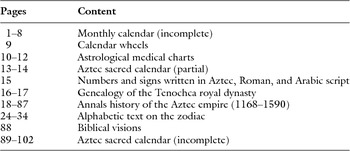
The table of contents for the Mexicanus, provided in Table 1, highlights the work's seemingly miscellaneous contents. The first section of the book deals with calendric matters pertaining to both the native and Christian spheres, followed by astrological information related to European medical practices, and then more information on the Aztec calendar. Next comes a two-page genealogy of the Tenochca ruling house, then the majority of the book is devoted to an extensive annals history of preconquest Tenochtitlan and early colonial Mexico City, with an extensive alphabetic text concerning the zodiac inserted into the annals history. Succeeding the pictorial history is a page of biblical imagery. The book ends with an incomplete Aztec sacred calendar.
Contents of the Codex Mexicanus

Source: Bibliothèque National de France, http://gallica.bnf.fr/ark:/12148/btv1b55005834g
By considering these contents in terms of three thematic areas—time and religion in the Christian and Aztec worlds, medical astrology, and history—and comparing them with content in the reportorios, I elucidate the areas of concern for the native patrons of the book, as well as their larger message that the Aztec past was a legitimate foundation for the building of Christian New Spain. As Laura Delbrugge writes in her analysis of the 1492 reportorio by Andrés de Li, “An almanac is not only the way in which humans mark the passage of time, but also a compendium of information, a commentary on the society and state of knowledge at a certain point in history… a reflection of its creating society.”Footnote 25 The same is true of the Mexicanus, with its contents offering a commentary on native society and the native intellectuals' issues of concern as they created a guide for living in late sixteenth-century Mexico City.
Time and Religion in the Christian and Aztec Worlds
Nahuas and Spaniards were concerned with time and its relation to the sacred. For both societies, calendars were closely linked with religious practices and figured prominently in their books. References to native and Christian means of tracking time are sprinkled throughout the Mexicanus. The book begins (pages 1–8) with a perpetual calendar that correlates important Christian holy and saints' days with Aztec sacred festivals from the 365-day Aztec solar calendar. The following page (9) includes two calendar wheels that essentially link the Christian yearly cycle with its Aztec counterpart. A few pages later (13–14), Aztec calendar dates are noted, and the Mexicanus ends with another Aztec calendar, this time the 260-day sacred calendar (pages 89–102).
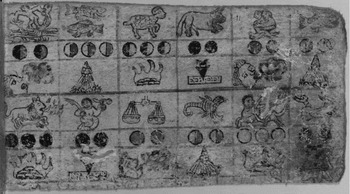
Each page of the perpetual calendar that begins the Codex Mexicanus is devoted to one of the European months, beginning with May. The first four pages (months) are now lost. The page for September is in fairly good condition and serves as a useful model (Figure 3). A column at the left records information on the month in a combination of alphabetic and pictorial script. At the middle of the column, the circle filled with a crescent shape and a human face is the European sign for moon/month. Above this is a reference to the month's zodiac sign, in this case Libra, which is indicated alphabetically and with its pictorial icon of scales. Below the moon, a portion of the word “septiembre” is barely visible, and under this is a pictorial image, which may be a ‘spelling’ of the month using Aztec script. The dots and banner at the bottom of the column are Aztec icons for numbers: the banner records 20 dots combined with an additional ten dots to indicate that September is a month of 30 days.
Month of September, Christian Holy Days (Upper Register) and Aztec Sacred Festivals (Lower Register)

To the right is more information on September. Each day of the month is indicated with its associated dominical letter enclosed in a circle; these reference a sequence of letters from ‘a’ to ‘g’ for the seven days of the week. The dominical cycle begins each January 1 with ‘a,’ and the seven-letter sequence repeats for each month throughout the year. Such calendars are known as perpetual calendars because they remain accurate in perpetuity. Another series of letters, floating below the dominical letter sequence, records the 27-day lunar cycle. The days of September are further correlated with Christian holy days shown on the upper register and Aztec sacred festivals on the lower register.
For September, the first Christian holy day is the Nativity of Mary, September 8. Here it is recorded with an image of a young, haloed woman holding her hands together in prayer. She is placed over a stream of water that is drawn in the codified manner typical of Aztec pictorial writings, with wavy lines forming streams and ending in dots. At the end of the stream is the wrinkled face of an old man. The word for water in Nahuatl is a-tl and the word for old is huehueh, so together this compound approximates the Latin “Ave Maria,” or a-hue Maria.Footnote 26 A week later, on September 14, is a representation of the Feast of the Holy Cross. Reading from bottom to top, the first sign is a brick wall (Nahuatl xan-tli) and then an iconic stone for te-tl. This compound approximates the word xan-te, for Santa, which is paired with a cross to indicate the day of Santa Cruz.Footnote 27 Immediately following this is an alphabetic text, “quatollotepore,” referencing the four seasons of the year. Here the phrase marks the September Ember Days that follow the day of Santa Cruz.
Four more holy days complete September, and these are recorded in a variety of pictorial ways. September 20 is marked as a day of vigil by a fish, as this was a day when Catholics abstained from eating meat but could consume fish. September 21 is marked as the day of San Mateo, who is referenced with the brick wall icon for xan or San and his attributes, a stylus and book for his gospel. The xan sign is used again on September 27 and marks a double holy day, the day of San Cosme and San Damián, whose names are written with glyphic approximations. For example, Cosme is written with a jar (co-mitl) and maguey plant (me-tl), for ‘Co-me.’Footnote 28 Finally, the day of Saint Michael the Archangel is recorded in a more narrative fashion with a winged angel holding a sword.
Although it is in poor condition, yet another calendric sequence can be seen in the lower register, this one referencing Aztec means of keeping time. The Aztecs organized the 365-day solar year into 18 months of 20 days each, with five extra days at the end. This solar calendar was structured around monthly feasts that are recorded in the Mexicanus. Below September 12, a drawing of a grass broom records the feast known as Ochpaniztli, or the Sweeping of the Way. The 365-day solar calendar ran simultaneously to another 260-day calendar composed of 20 day-signs that cycled through coefficients from 1 to 13. This was the more common calendar for the marking of days in Nahua society. An additional sign here, of 12 dots and a simplified flint knife, gives the Aztec day 12 Flint and must reference the day from the 260-day calendar on which the Ochpaniztli celebration fell in a particular year.Footnote 29 Thus, the Aztec sacred days are located within the Christian month and visually equated with the Catholic saints' days.
Monthly calendars with similar information are included in the reportorios. The reportorio by Gerónimo de Chaves includes a monthly calendar that records the golden number cycle along with each day's number, Roman calendar division (Kalend, Nones, and Ides), dominical letter, and associated holy reference.Footnote 30 Chaves follows this information with a longer text that details the appropriate agricultural practices for each month. The Andrés de Li reportorio includes a calendar with the same information as Chaves's, plus pictorial icons of the month's zodiac sign and the month's labors, as well as the same 27-letter lunar cycle as the Mexicanus.Footnote 31
Nevertheless, there are telling differences between the information contained in the Mexicanus and the reportorios. The Mexicanus painters made no references to labors or to the agricultural associations of the months, perhaps because the Aztec monthly festivals, with their ties to the seasonal agricultural calendar, fulfilled this same function. Moreover, the Mexicanus scribes left out the Roman calendar divisions, perhaps because in their minds, the Aztec calendar references performed a similar feat. Just as some reportorios correlated the Christian calendar with the ancient Roman one, the Mexicanus linked it with the Aztec one, indicating that its compilers saw the Aztec calendar as equivalent to the Roman and Christian ones.
The reportorios also correlate each day of the month with a holy day, while marking the most important venerations with a cross. These marked holy days are the ones included in the Mexicanus, and they largely match the holy days that converted natives were originally required to observe upon their evangelization. However, in the middle of the sixteenth century, it was decided that the natives were too poor to celebrate so many holy days, so an abbreviated list was distributed throughout the colony.Footnote 32 That the Mexicanus includes a fuller list of holy days than may have been necessary for native converts to observe suggests that its patrons were exemplary Christians wishing to worship a full roster of saints. Though the Mexicanus painter looked to Spanish sources for information to compile his book, he did not slavishly copy these sources. Indeed, the Mexicanus adds the Ember Days, whereas these are not typically included on the monthly calendars of the reportorios but set apart and explained in a brief text following the monthly calendar. In the Andres de Li reportorio, this information is found five pages after the monthly calendar ends.
The interest in correlating the Christian and Aztec calendars is further evident on the page that follows the monthly calendar (see Figure 1). In the center is a dominical wheel inside of which the painter shows St. Peter holding his gospel book and a key and thereby marking the wheel as Catholic time. This wheel is a visualization of a 28-year cycle based on the letters seen in the perpetual calendar on the preceding pages. For any given year, the letter of the calendar date on which the first Sunday of the year falls is known as that year's dominical letter; these cycle through a formalized sequence that repeats every 28 years and are charted by dominical wheels like the one seen here, which is meant to be read in a clockwise direction. Accordingly, if Sunday fell on dominical letter ‘c’ in a given year, it would fall in the following years on dominical letter ‘b,’ then ‘a,’ and so on.
The double columns reference leap years, in which Sunday falls on one dominical letter and then moves to another after February 29. The dominical wheel is linked with an Aztec calendar wheel to the right. The last day of each Aztec solar year always falls on one of four signs in the 260-day sacred cycle: Rabbit, Reed, Flint, or House. The day on which the year ends gives that year its name. Since the day-signs cycle through coefficients from 1 to 13, the cycle repeats every 52 years. Thus, 1 Rabbit begins the count, and the next year is 2 Reed, then 3 Flint, 4 House, 5 Rabbit. Following 13 Rabbit is 1 Reed, and so on. The Mexicanus wheel begins with 1 Rabbit at the left and is read in a counterclockwise direction. The 12 dots mark the 12 years after 1 Rabbit, leading us to 1 Reed, shown at the bottom; 12 more years bring 1 Flint, and another 12 years bring 1 House, and back again to 1 Rabbit.
The Mexicanus's calendar wheels have corollaries in the European and Aztec worlds. The reportorios typically include textual descriptions of the dominical letter cycle along with a 28-year dominical chart, but these are enclosed in rectangles that do not emphasize the cyclical nature of the years as markedly as does the Mexicanus.Footnote 33 However, circular dominical wheels are known in European sources such as calendar books and prints. For example, a calendar book by the German mathematician and astronomer Regiomantanus contains a dominical wheel similar to that included in the Codex Mexicanus, including a shared Gothic font.Footnote 34 Calendar wheels were also common in the Aztec world, as suggested by the monumental calendar stone in the Museo Nacional de Antropología, Mexico City. Though not a calendar in the traditional sense, the sculpture does show the 20 day-signs of the Aztec calendar progressing in a counterclockwise direction in one of its rings, suggesting a cyclical conception for the progression of time.
When Spanish chroniclers attempted to explain the Aztec calendar, they often reverted to images of calendar wheels. An informative example is included in Rhetorica Christiana, published in 1579 and written by the mestizo author Diego Valadés while he was living in Italy. An engraving in the book depicts an Aztec calendar wheel correlated with a European one akin to the one found in the Mexicanus.Footnote 35 As Thomas Cummins explains, Valadés's engraving “provides the reader with an image in which European and native forms of knowledge have equal and corresponding truth value.”Footnote 36 Accordingly, the Mexicanus's visualization of a cyclical equivalency between the native and Christian calendars establishes the two systems as equally valid. In fact, an alphabetic annotation on the same page indicates that the two calendars were seen as correlated and united. The text in Nahuatl reads “nuahpohualli xihuitl,” or “80 years,” the number arrived at when combining the 52-year Aztec cycle with the 28-year Christian dominical cycle. The implication is that New Spain was home to a new conception of time, one based in both the Aztec and Christian worlds.
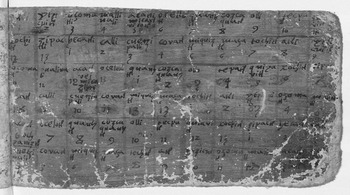
The sequence on pages 13 and 14 of the Mexicanus focuses on native time in its own right, recording a portion of days from the Aztec 260-day sacred calendar, called the tonalpohualli, with references to some of the Aztec monthly feasts (Figure 4). On these pages, the Aztec day-signs that were traditionally written pictorially were instead written alphabetically, while the numbers were written with Arabic numerals. However, faint dots for Aztec coefficients can be seen under the gesso coating, suggesting that day-sign coefficients were originally written pictorially and later covered and replaced with Arabic numerals; the gesso coating here has a grey tint that does not match that of the gesso in the rest of the book. In Aztec divinatory codices, strings of dates were usually written and read in a continuous and unbroken stream, often in a boustrophedon pattern, whereas the reading order here is from left to right in the first and each successive row. Thus, the order adheres more to the Spanish alphabetic system and manner of reading. Though difficult to understand completely, the next page seems to correlate the Spanish and Aztec numerical systems in relation to particular years. For instance, at the top of the page the year 1579 is written with Arabic numbers and then with pictorial signs that correspond to Aztec numbers. This notation points again to the Mexicanus being created around this time.
Portion of an Aztec Tonalpohualli (Sacred Calendar)

The Mexicanus ends with an incomplete Aztec tonalpohualli, or book of days. Each page records one of the 20 trecenas, or 13-day periods, of the sacred Aztec calendar, but provides little additional information, apart from the occasional alphabetic notation of a monthly festival. For example, on page 97, the Aztec monthly festival of Hueytozoztontli is written in above 9 Reed. On page 99, Toxcatli is written in for 3 Reed, and on page 100, Etzalqualiztli is written above 10 Reed. Using the Caso correlation of the Aztec and European calendars, these dates correspond to the indicated monthly feasts in the year 1579, further supporting a late sixteenth-century date for the work.
Rather than depicting the days in their iconic pictorial form, the Mexicanus painter writes each day name alphabetically and includes its associated coefficient, but now as a Roman numeral. Presumably, additional information pertaining to the sacred features of each trecena would have been added, but in the Mexicanus, the pages are now mostly blank with only faint traces of imagery visible under the gesso coating. The original contents may have been whitewashed at some point in the manuscript's history, perhaps because of fears that such information would be deemed suspect by Spanish authorities. Toward the end of the sixteenth century, Spanish officials were becoming increasingly suspicious of the native converts and fearful of the persistence of heretical beliefs, as evidenced by the whitewashing of monastic murals that were believed to contain native content.Footnote 37 We may see a similar whitewashing here.
The focus on time and its connection with religion at the beginning and end of the manuscript suggests an area of interest for the Mexicanus painters. As Louise Burkhart has shown in her studies of Nahua understandings of Christianity, the saints' calendar provided the indigenous peoples a means of tracking time analogous to their traditional ways: “The saints'-day calendar differed in structure and character, but for the Nahuas it functioned somewhat similarly: it provided a means of symbolically structuring both the passage of time and the interaction with sacred beings.”Footnote 38 Thus, for native Christians, the intertwining of religious practices and observances in their calendar and that of the Spaniards was a point of convergence between the two cultures. By recording this information in their book, the Mexicanus compilers made sense of Christian practices through their correlation with Aztec ones, while at the same time ensuring the survival of both systems—if not creating a new cosmopolitan one.
Medical Astrology and Issues of Health
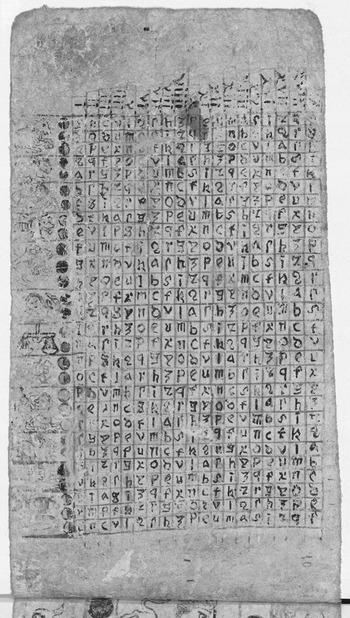
An intriguing three-page section in the Mexicanus pertains to astrology and could be used on its own or in conjunction with information taken from the perpetual calendar that begins the book. In the early modern world, astrology was believed to influence human affairs and, as emphasized here, medicine. It was believed that one had to have knowledge of astrology in order to know when to perform medical practices such as bleeding and purging. A table that would have been used to determine the position of the moon in the zodiac on any given day is recorded on the first page of this section.Footnote 39 Composed with a vertical orientation, the table includes a column at the left with each sign of the zodiac shown two or three times, for a total of 28 rows (Figure 5). Each of these signs is associated with a disk, variously colored red, black, white, half-red/half-black, or half-red/half-white. At the top of the column are the 19 golden numbers based on the Metonic cycle. Filling the 532 squares of the chart is the same 27 lunar letter sequence that appears on the monthly calendar. To use this chart on September 1 in the year 1580, one would first calculate the year's golden number by dividing the year by 19 and adding 1 to the remainder, which gives a golden number of 4. Locating September 1 on the monthly calendar in the Mexicanus, one would learn that the associated lunar letter for that day is ‘a.’ Returning to the lunar table, one would find the number 4 on the golden number row, follow that column down to lunar letter ‘a,’ and then follow that row to the left, arriving at the sign for Cancer. This tells the reader that on September 1, 1580, the moon was in Cancer.
Lunar Chart Used for Medical Astrology

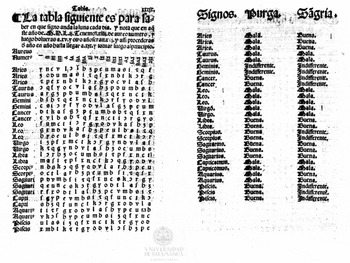
The table just described has a close corollary to information found in the reportorios. For example, immediately following the monthly calendar in an anonymous reportorio of 1554 is a golden number chart similar to that included in the Mexicanus, and this chart is succeeded by another that correlates the presence of the moon in a given sign on a particular day to indicate a time that is good, bad, or indifferent for purging and bleeding (Figure 6). The Mexicanus's association of zodiac signs with circles on the golden number chart serves as a shorthand device to record similar information on a particular day's suitability, or lack thereof, for these same medical practices. For example, the signs that are bad for both purging and bleeding in the reportorio of 1554 are also marked as fully black in the Mexicanus, while those that are indifferent for both purging and bleeding are fully red, and those that are good for both are fully white. If black is bad, red indifferent, and white good, the Mexicanus is an almost exact match with this reportorio (the only disjunction being Aquarius). Accordingly, as the moon was in cancer on September 1, 1580, this would have been a good day for purging and an indifferent one for bleeding. These European medical beliefs may have been compelling to Nahuas as they had corollaries in the native world, such as the understanding of bloodletting as a means of restoring balance to the body.Footnote 40
Lunar Chart Used for Medical Astrology (left) and Propitiousness of Zodiac Signs and Times for Bleeding and Purging (right)

The golden number chart in the Mexicanus is followed by another zodiacal chart that is also associated with medical practices. It shows the 12 signs of the zodiac coupled with the same sequence of red, black, and white-colored disks that relate the zodiac signs with bleeding and purging (Figure 7). Below each of these is a pictorial icon referencing one of the four elements: wind, water, fire, and earth. A lengthy section of the anonymous reportorio of 1554 provides thorough information on the zodiac signs and their associations with the different elements, but the author of the Mexicanus has greatly condensed this information and translated it into pictorial form.Footnote 41 Early modern medical books often related the zodiac signs and their elements to different bodily functions: the signs associated with air were believed to govern the digestive faculty of the human body, those associated with water its evacuative faculty, those associated with fire its attractive faculty, and those with the earth its retentive faculty.Footnote 42 Accordingly, the inclusion of the signs and their elements reveals that this page was also used for medical knowledge.
Chart of Zodiac Signs, the Elements, and Times for Bleeding and Purging

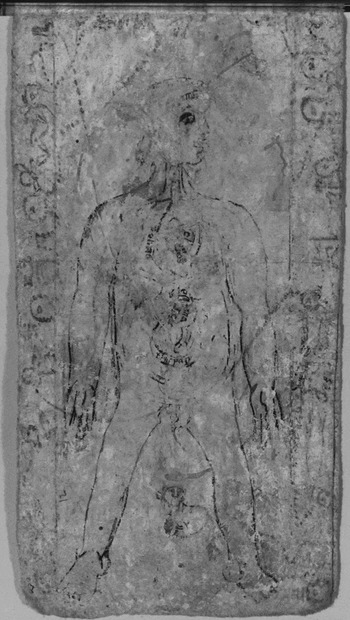
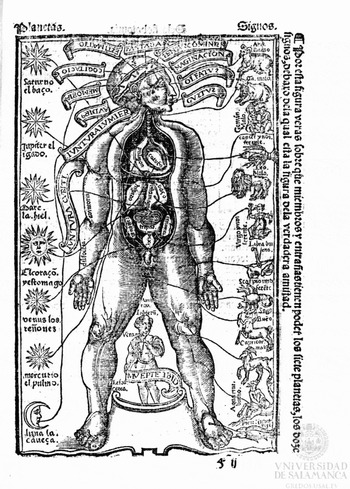
Continuing the medical theme is the image on the next page, which is commonly known as a Zodiac Man and again reveals the interrelated nature of medicine and astrology (Figure 8). The Zodiac Man is based on the belief that each sign of the zodiac influenced the part of the body with which it was associated.Footnote 43 The anonymous reportorio golden number and purging and bleeding charts are followed just a few pages later by a zodiac man that is similar to the one included in the Mexicanus, although the former is in poor condition (Figure 9). Clearly, the concern with health was shared by natives and Europeans, but the native painters of the Mexicanus may have been drawn to the image of the Zodiac Man because of a predisposition to the visual sphere as a means of recording knowledge, and also because the Nahuas too linked the body with time. As Elizabeth Boone has pointed out, native books also included diagrams that linked the day-signs with body parts.Footnote 44 The preconquest books included a number of such diagrams related to animals and supernaturals, but the only one to picture a human was included in a postconquest source, the Codex Ríos (also known as Vaticanus A). According to an explanation of the image by the patron of the manuscript, Fray Pedro de los Ríos, this corporeal almanac pertained to healing, in that “a cure could be developed according to the day and time an ailment began.”Footnote 45
Zodiac Man, from the Mexicanus

Zodiac Man, from the 1554 Reportorio

In more practical terms, the interest in European medicine evidences a concern with the diseases introduced by the Europeans, to which the indigenous peoples had little immunity. A series of epidemics devastated the native populations in the 1570s, just before the Mexicanus was compiled. These epidemics are noted on page 86 of the Mexicanus annals section, with a skull referencing death above the years 6 Reed/7 House (1576/1577) and the Nahuatl word “cocoliztli” (sickness) below. Unaware that the Spaniards were more resistant to these diseases because of the immunities they had built up to them, the Mexicanus contributors may have believed that European medical practices were able to combat the illnesses, hence the decision to copy this specific information into their book. The native chronicler Juan de Pomar suggested that since the illnesses were introduced by the Spaniards, they would know the cures: “as all these illnesses are known by the Spaniards, they have cured and treated according to their rule and opinion.”Footnote 46 The poor condition of the Zodiac Man in the Mexicanus suggests frequent consultation by the book's readers.
This interest in astrology and its influence on human affairs continues in the annals section of the codex. Making use of a span of 11 pages (plates 24–34) in which no historic events were recorded on the lower register, a scribe added a long Nahuatl text written in a distinctive blocky script. Though difficult to read in places, it clearly references the 12 zodiac signs and characteristics of those born under each sign. For example, the text on page 27 reads, “Ynic nauhtetli yn itoca taolloes yn aqui ypa tlaca …” (And the fourth sign, named Taurus, and those born then …). Descriptions of the zodiac signs and their associations are also included in the reportorios. Just as the Christian saints' calendar provided the native peoples a way of tracking time analogous to traditional ways, the zodiac signs and their influence over human affairs offered a divinatory mechanism comparable to preconquest beliefs. Before the conquest, when a child was born, parents consulted wise men who used their pictorial books to determine the fate of that child.Footnote 47 The European zodiac would thus have been another perceived equivalency between the two worlds and between the reportorios and Aztec divinatory books.
Preconquest Past to the Colonial Present
The focus on time in the Mexicanus appears to give way to more historical matters, specifically a genealogy of the Tenochca royal house and an extensive annals history that traces the growth of Tenochtitlan, capital of the Aztec empire, and its transition into Mexico City, capital of New Spain. The form of these sections of the Mexicanus had precedents in the preconquest past, specifically the pictorial annals used to record historic events, but they also mimic an interest in history on the part of the Spaniards. For example, Gerónimo de Chaves's reportorio included genealogical and historical information pertaining to Spain, whereas Martínez's contained historical information on both Spain and the Mexica past.Footnote 48
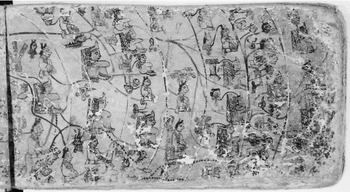
The genealogy begins with the divine ancestors of the future Aztec imperial leaders and links them to the founders of Tenochtitlan, the Aztec capital.Footnote 49 The Mexica peoples, eventual leaders of the Aztec empire, had humble beginnings, and were compelled by their patron deity to migrate south from a northern homeland into the Valley of Mexico. The foundation of Tenochtitlan and the subsequent establishment of its royal dynasty are shown at the far left of page 17 (Figure 10). Tenochtitlan's first official ruler, Acamapichtli (Handful of Reeds) is shown with two wives, and from them the generations fan out into increasingly higher numbers, eventually ending at the far right with the generation that lived during the 1560s.
Genealogy of the Tenochca Royal Lineage

After the conquest, native elites continued to act as rulers over their indigenous communities. Accordingly, descendants of the Tenochca dynastic line continued to rule the native sphere of Mexico City. These men are included in the pictorial genealogy, where they are distinguished as rulers by their turquoise crowns. However, starting with the death of the colonial era governor don Luis Santa Maria Cipac, who ruled from 1562–1565, rulers of Mexico City were no longer descendants of the royal bloodline.Footnote 50 As the native chronicler Chimalpahin wrote, “With him it came to an end that descendants of the Mexica and Tenochca rulers should rule in Tenochtitlan any more; at that time their governing as rulers was cut off forever.”Footnote 51
The Mexicanus genealogy does not have a clear corollary to other known Aztec works.Footnote 52 Genealogies must have been painted before the conquest, as Bernardino de Sahagún includes a description of the genealogist in his encyclopedic work on Aztec culture, and the alphabetic histories of the Aztec past recorded in the colonial period are filled with genealogical details.Footnote 53 However, no preconquest examples survive, and colonial pictorial genealogies of the Tenochca ruling lineage are rare, with the few that are known focusing on particular family lines to bolster claims of colonial era descendants. Moreover, the Mexica pictorial histories that were recorded during the early colonial period contain little in the way of genealogical information.Footnote 54 However, the Mexicanus genealogy does have a corollary in the reportorios, specifically the Chaves one. Within his long historical text relating the history of Spain with that of the Roman empire, Chaves includes a list of kings that traces Spain's rulers from Philip II back to the biblical past.Footnote 55 The Mexicanus genealogy performs a similar feat, tracing the lineage of New Spain's colonial rulers through its Mexica imperial leaders and all the way back to its divine ancestors.
The annals history that follows the genealogy takes up the majority of the manuscript. Here again, time is the organizing element, with historic events linked to a timeline that runs the length of this section.Footnote 56 As Elizabeth Boone points out, Mexica histories tend to have two parts. The first focuses on the migration of the people, and the second concerns Tenochtitlan after its foundation. Footnote 57 The Codex Mexicanus is no different. Page 18 offers a succinct visualization of the start of the Mexica migration, with a group of migrants standing in a stream of water. They are about to climb up onto a timeline, thereby initiating both time and history.Footnote 58 They are led by their patron deity, Huitzilopochtli.
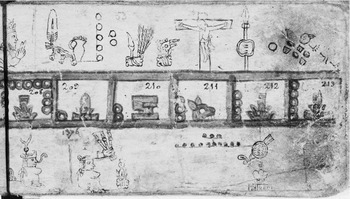
When the migrants arrived in the Valley of Mexico, they found a land already occupied. They stopped for a time in a number of different cities and tried to establish themselves, but were unsuccessful. Over the next dozen pages, two different painters show the Mexica migrants in a series of places. They settled for a time in each before events drove them to move on, until they finally saw the sign of their homeland and established Tenochtitlan in 1325 (page 44). About 50 years later, they inaugurated their first ruler, Acamapichtli, as shown in Figure 11 on the lower register under the year 1 Flint. The new ruler is identified with his familiar nametag of a hand holding reeds. The crown he wears signals his inauguration as ruler of Tenochtitlan, whose nopal cactus place sign is placed just before him. The annals history then records the events leading to the growth of the Aztec empire and the primacy of Tenochtitlan in the preconquest world. It continues through the arrival of the Spaniards, the imposition of Spanish colonial rule, and the introduction of Christianity.
Annals History, 1375–1380

Though the annals history largely focuses on the Mexica of Tenochtitlan, it also includes references to Christianity in the times preceding the Spanish arrival, suggesting the presence of Christianity in Aztec Mexico long before the Spaniards themselves arrived. For example, images of a Catholic bishop and a crucifixion were painted on the register above Acamapichtli's inauguration in 1376 (Figure 11).
The inclusion of such a vast history in this manuscript parallels the scope of the historical text in the Chaves reportorio, which traces Spain's growth from an ancient Roman outpost to a modern Christian nation. Chaves even includes an annals history that begins with the life of Saint Peter and follows the growth of the Catholic Church.Footnote 59 Likewise, the Mexicanus annals history traces the metamorphosis of Aztec Tenochtitlan into Christian Mexico City. In fact, the Mexicanus anticipates the reportorio written and published by Enrico Martínez in New Spain in 1606. This reportorio follows the distinctive pattern of the others but was updated to serve those living in New Spain. Accordingly, Martínez included a long history of the Aztec empire in his work, suggesting that he too saw an equivalency between Spain's Roman past and New Spain's Aztec one.Footnote 60 Together, the Martínez reportorio and the Mexicanus suggest an increasing sense, among both natives and Europeans, that knowledge of the Aztec past was necessary for an understanding of New Spain and the formation of the capital's identity.
The Reportorio Tradition in Colonial New Spain
The Mexicanus is not unique among native works for its interest in the reportorio tradition. Other native intellectuals, too, had access to reportorios, and they were particularly drawn to the astrological information contained in the almanacs, suggesting an area of shared concern and interest and pointing to a circulation of reportorios among native intellectuals. For example, excerpts from a reportorio were translated into Nahuatl and then added to a 1553 edition of fray Pedro de Gante's Doctrina christiana en lengua mexicana; the style of writing suggests this was done in the second half of the sixteenth century.Footnote 61 The text is organized by the European months and contains information on agriculture, astrology, and medicine, but the scribe included only information deemed important to the natives, as he wrote, “Muchas cosas no se ponen aquí que no aprovechan a los indios.”Footnote 62
More numerous examples of native interest in Spanish almanacs are found in later works. A manuscript known as the Codex Cozcaztin, likely compiled in Mexico City in the seventeenth century but perhaps copied from earlier works, is made up predominantly of a native history written both pictorially and alphabetically in Nahuatl. However, it also includes a page of text in Spanish with information pertaining to the planets.Footnote 63 As similar information is typically included in the reportorios, this section may have been copied from such a Spanish book. Another manuscript in the collection of the Bibliothèque National de France, created in the mid seventeenth century and known as Fonds Mexicain 381, contains an adaptation of a reportorio written in Nahuatl and focused mainly on the calendar and astrology. The rest of the manuscript is filled with Christian prayers translated into Nahuatl.Footnote 64 Additionally, a Nahuatl manuscript in the Tropenmuseum in Amsterdam, written in 1758 but perhaps copied from an earlier source, contains information comparable to the Codex Mexicanus, including texts on medical astrology that were also derived from a reportorio.Footnote 65 Farther afield, in the Maya region, the series of books compiled during the eighteenth and nineteenth centuries and known collectively as the books of Chilam Balam, also contains information similar to that contained in reportorios. In particular, the Books of Kaua and Ixil contain astrological and medical information analogous to the Mexicanus.Footnote 66
Books clearly played a significant role in the formation and circulation of knowledge for many native peoples, some of whom consulted Spanish reportorios and copied information from them into their own works. Nevertheless, as David Tavárez argues, these native writers were not “replicating the encoded cultural assumptions” of the reportorio genre, nor were they simply transferring contents from a Spanish book to a Nahua one.Footnote 67 Instead, like the Nahua who inserted astrological texts into his copy of Gante's Doctrina Christiana, these native intellectuals were compiling books filled with information important to their own lives. Thus, the choice of the Mexicanus compilers to catalog information pertaining to time and religion, astrology and medicine, and history reveals that the new Christian religion and health were topics of concern for the native patrons of this book, along with the necessity of maintaining historic and calendric records related to Aztec traditions.
Indeed, though the contents of the Codex Mexicanus establish a correlation with Spanish reportorios de los tiempos, there are significant dissimilarities. The reportorios contain a wealth of information on topics left unaddressed by the compilers of the Mexicanus, such as lunar charts, eclipse tables, agricultural references, and treatises on the heavens and the planets. Moreover, the one addition without a clear corollary to the reportorios is the biblical imagery intended to illustrate the piety of the Mexicanus's owners despite the book's pagan references. This consideration of the Mexicanus shows that its creators may have been using a Spanish book as a model, but they did so to record information important to their own lives and to the formation of their identity as Nahua Christians of New Spain.
CONCLUSION
By taking from Spanish books the information they considered essential and coupling it with what they considered necessary to remember from their own books, the Mexicanus compilers created a book that would help them to live autonomously in a world that was growing increasingly unstable. At the time this work was created, epidemics had ravaged the indigenous populations, and the Tenochca royal lineage had lost control over the native sphere of government. The Church, too, was marked by growing tensions. In 1574, the Ordenanza del Patronazgo sought to officially limit the powers of the regular clergy, who had worked closely with the native populations in the decades following the conquest, and bolster those of the secular clergy. The result was the escalation of already simmering tensions between the two divisions of the church.Footnote 68 In fact, Alonso de la Vera Cruz was a particularly outspoken critic of the Ordenanza and the secular clergy.Footnote 69 This tense atmosphere may have sparked a desire on the part of a group of educated Nahuas, perhaps educated in Vera Cruz's recently founded Colegio de San Pablo and with access to his library, and fearful of losing the guidance of their mendicant teachers, to create this particular book with its carefully chosen contents reflecting the areas over which they must have desired control and guidance: time, religion, history, and health.
That this book was made with these particular contents is remarkable. At the time the work was created, books were particularly feared for the spreading of heretical beliefs. Indexes of banned books from the sixteenth century include bibles and books of hours written in vernacular languages, while the major purge of prohibited books in New Spain in 1572 particularly targeted the libraries of the mendicant orders.Footnote 70 Even native language doctrinas and historical works, such as Sahagún's Historia general, were confiscated due to “fear that such works would facilitate a spiritual recidivism to the old deities.”Footnote 71 Accordingly, the Codex Mexicanus, with its Christian content translated into the native pictorial language and references to sacred Aztec festivals, would surely have aroused suspicion, perhaps even compelling later owners of the Mexicanus to whitewash the pagan contents of the tonalamatl at the end of the book.
The Mexicanus must have been geared to a native audience, as the majority of the book's contents were written using Aztec pictorial script and the few alphabetic texts added to the book were written in Nahuatl rather than Spanish. In fact, it is likely that the work's owners purposefully kept the small book from Spanish eyes. Tavárez classifies the Mexicanus and other similar Nahua texts as clandestine documents, while the books of Chilam Balam, which have contents similar to the Mexicanus, include admonitions to keep the books away from Spaniards.Footnote 72 Nonetheless, the Mexicanus was read and consulted in the years after its creation, as evidenced by the wear seen throughout the book and in particular at the edges of its pages, testimony to the numerous hands that thumbed through its contents over time. However, its exact ownership history prior to its acquisition by a French collector in Mexico in the 1830s remains unknown.
The reportorios and their function as guides to living were a likely inspiration for the Codex Mexicanus as a whole, which indicates that the compilers of the Mexicanus were crafting a vision and identity for New Spain based upon the coming together of Aztec and Christian traditions. The model they followed in creating the codex was that of Spain, which had built its own Christian identity on a pagan Roman foundation. David Lupher has shown that ancient Rome became a paradigm for the Spanish enterprise in the Americas, and for educated Nahua elites, the similarities between Spain and New Spain would have been impossible to miss—as would the similarities between the ancient Roman and Aztec empires.Footnote 73 As Serge Gruzinski has argued, “Like Europeans, literate Amerindians could legitimately feel that their pagan past was more than a pre-Christian era or period of demonic darkness. … The cult of classical antiquity showed that an indisputably pagan past could enjoy glamorous status and value.”Footnote 74 Thus, the references to the Aztec past were not antithetical to the Christian present. Indeed, the Mexicanus pictures the Aztec past as a necessary step in the formation of Christian New Spain. These native intellectuals, then, looked to the Spanish reportorio tradition but reconceptualized it as a book fit for a native audience seeking to gain control and assert its identity as Nahua Christians of New Spain. Ultimately, this book was not a random assortment of miscellaneous information, but a guide drawn from the Spanish and Aztec worlds about life in colonial New Spain.