The Canadian population is aging. According to a medium-growth scenario, the percentage of seniors aged 65 and older, which was estimated at 15 per cent in 2013, is expected to near 24 per cent by 2036, when the baby boomers born between 1945 and 1965 will all have passed this age threshold. At the same time, the proportion of seniors aged 75 and older will increase from 7 per cent to 13 per cent (Statistics Canada, 2010, 2013). Seniors, especially older seniors, are more likely than others in the adult population to live with a number of chronic conditions and to need assistance with certain tasks, including personal care (Gilmour & Park, Reference Gilmour and Park2005). It is thus reasonable to expect that the need for care will increase in the future as a consequence of the growing proportion of elders in the population.
At a time when governments wish to limit public expenses on eldercare, individuals might increasingly have to depend upon their network of relatives and friends to receive care (Keefe, Fancey, & White, Reference Keefe, Fancey and White2005). The family constitutes the main source of unpaid care, the provision of which is gendered. The increasing involvement of women in paid employment since the 1960s raises questions as to their potential availability to provide unpaid care (Lilly, Laporte, & Coyte, Reference Lilly, Laporte and Coyte2007). Being employed does not appear to prevent individuals from taking up caregiving (Henz, Reference Henz2006). However, the provision of care might lead them to cut back on hours of paid work or to leave employment, particularly when the care recipient is an immediate family member (Lilly et al., Reference Lilly, Laporte and Coyte2007). This is not without consequences as it may place unpaid caregivers in a vulnerable economic position, affecting their employment levels (even long after the end of the caregiving episode) as well as their retirement savings (Lilly et al., Reference Lilly, Laporte and Coyte2007).
Women may be particularly affected since they have traditionally taken on more caregiving responsibilities and are more likely than men to experience paid work interruptions (Cook & Beaujot, Reference Cook and Beaujot1996; Henz, Reference Henz2004). These gender differences are well known, yet additional comparative research is needed in order to gain a better understanding of how men’s and women’s employment trajectories are affected by the provision of unpaid care (Lilly et al., Reference Lilly, Laporte and Coyte2007). Limited evidence suggests that a greater proportion of women than men report interrupting paid employment after the onset of caregiving (Henz, Reference Henz2004). However, it is not clear whether part-time employment, a form of employment in which women engage more often than men, allows individuals to combine paid work and care responsibilities more easily than would full-time employment.
Rising life expectancy and delayed childbearing have modified the composition of families, now often comprising several superposed generations, and altered patterns of intergenerational relationships (Bengtson, Reference Bengtson2001). It has become common for adult individuals to have aging parents while, at the same time, they have children living with them in the family home. Although the experience of giving assistance to an elderly parent while having children in the home, a situation often referred to as being “caught in the middle” or “sandwiched”, remains relatively rare (Rosenthal, Martin-Matthews, & Matthews, Reference Rosenthal, Martin-Matthews and Matthews1996; Williams, Reference Williams2005), the implications of such arrangements on the risk of leaving employment are still not well understood.
The study described in this article assessed the impact of providing care to a spouse or partner, a parent or parent-in-law, another relative, or a non-relative on the risk of leaving employment, after controlling for individuals’ conjugal and parental histories and other co-variates. In addition, we explored the impact of providing care to a parent or parent-in-law on the risk of leaving employment as to whether it varied according to the intensity of paid work (full-time vs. part-time), as well as to the presence of young children. In this analysis, we used the 2007 General Social Survey (GSS), which followed up on respondents aged 45 and older who were interviewed in the 2006 retrospective GSS on family. This database is extremely well suited for our analysis, as it contains the respondents’ retrospective caregiving histories (i.e., care episodes of at least 6 months) collected in the 2007 cycle, as well as their employment and conjugal and parental histories gathered in the 2006 cycle. The use of Cox proportional hazards models applied to these data allowed us to examine the effect of providing unpaid care on the employment trajectories of individuals, while taking into account their changing work and family circumstances. We estimated separate models for men and women, given that the provision of care has been shown to affect differently their risk of leaving employment (Henz, Reference Henz2004; Lilly et al., Reference Lilly, Laporte and Coyte2007).
Theoretical Background
Two main theoretical frameworks guided our analyses. First, we drew on role theory and contemporary theorizing on work–life balance to help us understand the potential consequences for individuals of combining multiple roles such as employment and caregiving. The role strain or conflict hypothesis posits that holding multiple roles has negative consequences for individuals’ lives (Goode, Reference Goode1960), given that individuals have limited resources, including time, to meet all the obligations that spring from those roles. For instance, providing unpaid care can disrupt normal employment routines and reduce the time spent at work (Sinha, Reference Sinha2013). If the strain is too great, leaving employment may constitute the only acceptable option for some caregivers (Lilly et al., Reference Lilly, Laporte and Coyte2007). Taking part-time employment can be considered as an alternative and help individuals to balance their unpaid care and employment responsibilities, but little is known in this regard (Henz, Reference Henz2006; Lilly et al., Reference Lilly, Laporte and Coyte2007).
Critiques of this hypothesis and proponents of the role accumulation and enhancement frameworks instead posit that being involved in multiple roles can bring various rewards and advantages to individuals (Marks, Reference Marks1977; Sieber, Reference Sieber1974). Some scholars argue that being involved in paid work can provide caregivers with a break from unpaid care responsibilities, but only when the caregiving role is not too demanding (Masuy, Reference Masuy2009). This respite effect could also be felt when the level of satisfaction in paid work is high, or when the job conditions, such as flexible work schedules, facilitate the balance between employment and other roles (Pavalko & Artis, Reference Pavalko and Artis1997).
Contemporary views on work–life balance seek to take into account the behavioural responses of individuals – that is, how they act in relation to their roles – as well as the multi-faceted nature of work–life balance (Rantanen, Kinnunen, Mauno, & Tillemann, Reference Rantanen, Kinnunen, Mauno, Tillemann, Kaiser, Ringlstetter, Eikhof and Pina e Cunha2011). Overall, scholars generally agree that situations in which rewards outweigh demands usually lead to positive outcomes for individuals, whereas those associated with greater demands than resources yield negative outcomes, such as high stress levels. In addition to affecting individual well-being, the difficulty of managing multiple roles, and especially those of caregiver, parent, and employee, could lead individuals to set aside some of their responsibilities, such as employment, in order to concentrate their energy and resources on their other roles.
Second, our analysis draws on life course theory (Elder, Reference Elder1998). It adopts a longitudinal approach that takes into account the influence that past events and experiences are likely to exert on the likelihood that individuals will undergo given events or transitions – in this case, that of leaving employment. Research has shown that previous work experience, measured as the proportion of years employed in the previous 15 years (Pavalko & Artis, Reference Pavalko and Artis1997) or the number of years worked in full-time and part-time jobs (Henz, Reference Henz2006), is positively linked to the number of hours worked or reduces the likelihood of leaving employment. In other words, past work experience may reflect and influence the current level of labour force attachment.
The life course perspective also emphasizes the interdependence and interconnectedness of the various dimensions of individuals’ lives. Conjugal and parental histories are likely to affect employment trajectories and to do so differently by gender. Hence, the birth of a child has been shown to increase the risk that women will interrupt their careers but reduce the probability of work interruptions among men (Cook & Beaujot, Reference Cook and Beaujot1996). Married men appear less likely than their never-married or divorced counterparts to experience a work interruption of at least 6 months, whereas the opposite is found among women, with those who are married or cohabiting facing higher risks of an interruption (Cook & Beaujot, Reference Cook and Beaujot1996; Henz, Reference Henz2006; Pacaut, Le Bourdais, & Laplante, Reference Pacaut, Le Bourdais and Laplante2011). Conjugal and parental histories thus need to be taken into consideration in the analysis of employment transitions.
Relationship with the Care Recipient
Research on the impact of care provision on employment shows that caring for an immediate family member tends to increase the probability of leaving employment and of reducing work hours (Lilly et al., Reference Lilly, Laporte and Coyte2007), an effect that is more pronounced among women than men (Arber & Ginn, Reference Arber and Ginn1995; Covinsky et al., Reference Covinsky, Eng, Lui, Sands, Sehgal and Walter2001). To our knowledge, only two studies have taken into consideration the nature of the care relationships: one focusing on employment status in Britain (Arber & Ginn, Reference Arber and Ginn1995), the other on retirement timing in the United States (Dentinger & Clarkberg, Reference Dentinger and Clarkberg2002). The former shows that men’s employment status is generally not affected by the provision of care to a parent, another relative, or a non-relative (Arber & Ginn, Reference Arber and Ginn1995), and that when it is, attachment to the labour market tends to be strengthened. The sole exception concerns care provided to a spouse that decreases the likelihood of being employed. Among women, compared to their counterparts who are not caregivers, the probability of being employed is lower for those providing care to a spouse or a child. Providing care to a parent or parent-in-law also lowers that probability but only for co-resident care; when the parent or parent-in-law is not residing with them, women are as likely to be employed but more likely to work part-time. Women thus seem to opt for part-time work to balance their employment with care responsibilities.
In regard to retirement decisions, once again men appear to behave differently than women. On one hand, men postpone their retirement when they provide care to a partner but also when they care for a parent or another relative (Dentinger & Clarkberg, Reference Dentinger and Clarkberg2002). On the other hand, women’s retirement decisions do not appear to be influenced by the provision of care to people other than their partners. In this case, the probability of their retiring is higher than that of women not providing care – the opposite relationship of that observed for men.
Caregivers’ Family Responsibilities and Support
The presence of dependent children in the household may further shape the effect of caregiving on employment. Being sandwiched between eldercare, childcare, and employment brings its share of challenges. Individuals engaged in paid work or self-employment, who provide eldercare and who have children under the age of 25 living at home, report significantly more stress than their counterparts who provide only eldercare or neither eldercare nor childcare (Williams, Reference Williams2005). On a positive note, nearly all (95%) of these sandwiched workers report being satisfied with their lives, a proportion that is similar to that found among workers assuming fewer roles. This illustrates that work–life balance is a multi-faceted concept, comprising negative and positive aspects. Some of these sandwiched workers have probably found a way to manage their many responsibilities by making adjustments at work or at home. Hence, as reported in one Canadian study, “one in seven sandwiched workers had reduced their work hours over the previous 12 months, 20% shifted their work hours, and 10% lost income” (Williams, Reference Williams2005, p. 17).
Some relief may be provided to caregivers by children, intimate partners, and other family members. In 2007, almost one-third of Canadians aged 45 and older who identified themselves as unpaid caregivers reported that their children helped them – for instance, by doing more household chores (Cranswick & Dosman, Reference Cranswick and Dosman2008). The second main source of help, mentioned by 26 per cent of caregivers, was spouses or cohabiting partners, closely followed by members of the extended family. Although not mentioned in the study, children who are a source of support are probably adolescents or young adults. Having very young children, particularly those below the age of 6, is likely to create more demands and may make it especially difficult to combine parental, employment, and unpaid care obligations.
With the emergence of the “sandwich generation”, one could expect the presence of children to affect the impact of caregiving on employment. However, the results of one study show that the effect of the provision of care does not vary with the age of the youngest child or the number of children (Henz, Reference Henz2006). The null finding observed in this study was perhaps due to the fact that caregiving was broadly defined as having “looked after someone, for at least 3 months, who is sick, disabled or elderly” (Henz, Reference Henz2006, p. 415). The results might have been different if parent care had been isolated from other care relationships.
Other Factors Influencing Employment
A number of other factors influence labour force participation and were included in our analysis where possible. Having a low income or education level, being in poor health, and nearing retirement age are all associated with lower labour force participation (Lilly et al., Reference Lilly, Laporte and Coyte2007). As we have mentioned, the conjugal status of individuals and the ages and number of their children are likely to influence employment behaviours; past work experience and employment status (full-time versus part-time work) also need to be considered. Labour market conditions, which vary considerably across Canada, are also likely to exert an impact on the risk of leaving employment. Finally, immigrants, who constitute an important share of the Canadian population, face a number of obstacles in the labour market (Reitz, Reference Reitz2001), which could influence their propensity to leave employment.
Research Questions
Based on the literature review, our study assessed to what extent the provision of care increases the probability of individuals to leave employment. More specifically, we examined three criteria as to whether the impact of providing care on the transition out of employment varies: (a) according to the nature of the care relationship; (b) depending upon whether respondents were working full-time or part-time; and (c) according to whether they were or were not “sandwiched” between children and parents. One of the main contributions of our analysis rests on its ability to isolate parent care from other care relationships and to identify individuals who were sandwiched between parent care and childcare.
Methods
Data
The data used in the analysis were gathered in 2006 and 2007 by Statistics Canada as part of two cycles of the General Social Survey (GSS). Nearly 24,000 individuals aged 15 and older were sampled in 2006 by the GSS (Cycle 20) on family transitions, which collected the detailed retrospective employment, conjugal and parental histories of respondents living in private households in one of the 10 provinces. Of these respondents, those aged 45 and older in 2007 were re-interviewed on family, social support, and retirement by the GSS (Cycle 21), which collected their retrospective caregiving histories. In total, 10,403 respondents were interviewed in both GSS cycles.
Sample
Only respondents who had at least one employment episode of at least 6 months since the end of their schooling and who were under the age of 80 in 2006 were retained in the analysis.Footnote 1 Of these 8,748 respondents, 1,889 cases were excluded. The majority of the excluded cases (n = 1,328) had incomplete information regarding care provided in the 12 months preceding the survey. Nearly 90 per cent of these cases were lost due to survey design and not to recall error. They concern respondents who reported providing care to more than one person in the past 12 months, but for whom only the information about the care provided to the main care recipient was collected.Footnote 2 An additional 382 respondents were excluded because they did not mention if they had ever provided care after the age of 15, or because they failed to report the start date, end date, or relationship with the care recipient for some past care episodes. Fewer respondents were excluded on the basis of missing information on other independent variables: 40 and 80 cases respectively for the conjugal and parental histories, and 59 cases for work experience, education, and place of birth. Our analytic sample therefore includes 6,859 respondents aged 44–79 in 2006 who reported at least one employment episode and who had no missing information on any of the control variables.
Measurement
Employment Episodes. In Cycle 20, all respondents who reported having worked for a period of at least 6 months while not in school were asked if they had ever been away from work for at least 3 months and, if so, whether they had started working again following that interruption. Specific dates (month and year) of the start and end of up to five periods of employment were collected. Statistics Canada distinguished three types of work: paid work, self-employment, and unpaid family work. With these data, we were able to reconstruct the paid work history of respondents for up to five work episodes (comprising four work interruptions) until the time of survey. We excluded periods of self-employment and considered those who were unpaid family workers as not engaged in paid employment. For each work episode, we know whether the respondent was employed full-time or part-time (less than 30 hours per week) at the beginning of the episode, as well as the dates of transition between statuses during the episode, if any. For each employment episode, we can therefore track whether the respondent was working full-time or part-time until he or she left employment or until the observation period ended (that is, if the respondent was still employed at the time of survey in 2006). We are also able to distinguish the rank of each paid work episode.
Caregiving. The provision of unpaid care constitutes the main independent variable in our analysis. The 2007 GSS collected information on that provided in the 12 months preceding the survey in addition to up to five past care episodes. Respondents were first asked if they had provided assistance to a person because of a long-term health condition or physical limitation in the past 12 months. They were also asked if this assistance consisted of one of the following task sets: (a) transportation, shopping, banking, bill paying; (b) meal preparation and housework; (c) house maintenance and outdoor work; (d) personal care; (e) medical care; and/or (f) coordinating caregiving tasks and managing finances. Data were also collected on the start date of the caregiving episode as well as the type of the relationship they had with the main care recipient.
In a separate section of the survey, respondents were asked how many people they had helped since the age of 15, for a period of 6 months or longer, excluding those helped in the past 12 months. The start and end dates of up to five caregiving episodes, along with the relationship with each care recipient, were collected. After adding the care episode recorded in the previous 12 months that lasted at least 6 months,Footnote 3 respondents’ complete caregiving histories can thus contain up to six caregiving episodes.
The overlapping of a number of caregiving episodes complicated the creation of a mutually exclusive categorical variable indicating the relationship with the care recipient. In the analysis, we differentiated among individuals who (1) did not provide care; (2) provided care to a spouse or partner, regardless of whether they also helped someone else or not; (3) provided care to a parent or parent-in-law, and perhaps to another person, excluding a partner,Footnote 4 (4) helped another relative, regardless of whether they also helped a non-relative; and (5) provided assistance only to a non-relative. The value of this variable could change throughout the course of an employment episode as the relationship of the person cared for by the respondent changed. For the sake of brevity, the expressions “care to parents” or “parent care” refer to “care to parents or parents-in-law” in the rest of this article.
Conjugal and Parental Histories. The 2006 GSS includes the respondents’ conjugal and parental histories. The survey collected retrospective information on up to four marriages and four cohabiting unions, in addition to any ongoing union at the time of the survey. We know the start date of each union, as well as the date of and reason for each union dissolution, if applicable.Footnote 5 This information allowed us to reconstruct the conjugal trajectories of respondents and to distinguish between individuals who (1) had never been in a union; (2) had a married or cohabiting partner; or (3) did not have a partner following separation, divorce, or the death of a partner. The value of this variable can change throughout employment episodes as respondents move between categories.
In addition, the 2006 GSS collected retrospective information on up to 20 biological, adoptive, and stepchildren, including the dates when each child was born, started living with the respondent, and died, if applicable. Unfortunately, the date at which children left the respondent’s household was not asked of the majority of respondents; therefore, we could not control for the presence of children in the household during the work episodes.Footnote 6 Two variables were derived from the parental history. The age of the youngest child includes five categories representing different stages of childhood, adolescence, and young adulthood: (1) 0–5 years old; (2) 6–12 years old; (3) 13–17 years old; (4) 18–24 years old; (5) no child under age 25, including childless respondents (reference category). The other variable indicates the total number of children that the respondent had (0, 1, 2 or more). The value taken by these two variables can change throughout employment episodes.
Control Variables. These include (a) the age of respondent over the course of the employment episode (less than 30 years old; age 30–39; age 40–49; age 50–59; age 60 and older); (b) the cumulative number of years of full-time and part-time employment up to the start of the considered work episode; (c) the respondent’s highest level of completed education at the time of survey (less than a high school diploma; high school diploma; college diploma or certificate; university degree); (d) the region of residence at the time of survey (Atlantic region, Quebec, Ontario, Prairie region, British Columbia); and (e) place of birth (Canada, outside Canada).
Statistical Method
We used event history analysis to investigate the effect of providing care to a relative or friend on the likelihood of leaving employment. More specifically, we used Cox proportional hazards models that allowed us to estimate the influence of independent variables on the probability (or hazard) of leaving employment, without having to parameterize the baseline hazard. In this type of model, the baseline hazard is left unspecified and only the relative differences in hazards between individuals with different characteristics are estimated (Cleves, Gould, Gutierrez, & Marchenko, Reference Cleves, Gould, Gutierrez and Marchenko2008).Footnote 7 Respondents are considered at risk of leaving employment from the moment the episode of employment starts until they leave employment or the observation ends.Footnote 8
Since the complete employment history was taken into consideration in our models, many respondents had more than one employment episode over the course of their working lives. Thus, the models need to estimate the effect of the independent variables on recurrent events (i.e., on multiple paid work interruptions), while correcting for the bias arising from the fact that respondents who had multiple interruptions were probably more likely to leave employment again. To correct for this bias, we followed the method used by Prentice, Williams, and Peterson (Reference Prentice, Williams and Peterson1981). Respondents who had more than one episode were considered at risk of leaving employment at the start of the first employment episode and remained at risk until that episode ended. They became at risk of leaving employment again only at the start of their second period of employment; the same procedure was followed for the third, fourth, and fifth employment episodes. In the model, the rank of the employment episode was used as a stratum variable to correct for the aforementioned bias. We further clustered the employment episodes within respondents in order to correct the standard errors for individuals who had multiple episodes. To control for the stratified sampling design, we estimated all models using population weights, adjusted by dividing by the number of job episodes for each respondent.Footnote 9
The first model estimated the impact of the provision of care according to the nature of the care relationship, which could vary throughout the employment episode, on the risk of leaving employment of both men and women, after controlling for a number of co-variates. In the second model, we examined whether the provision of care varied with the intensity of work, and we included an interaction term that combined the care relationship variable with the status of work. We ran this model solely for women, the number of men employed part-time while providing care being too small to provide estimates. Finally, the third model included an interaction term that combined a less-detailed care variable (not providing care; care to parents; care to others) with the age of the youngest child. Its aim was to compare the risk of leaving employment by men and women, sandwiched between childcare responsibilities and parent care, with the risk of others who held fewer roles (such as individuals having a 0–5-year-old child, but who were not providing unpaid care or those providing care to a parent, but who had older children aged 18 to 24 or age 25 and older).
Results
Descriptive Statistics
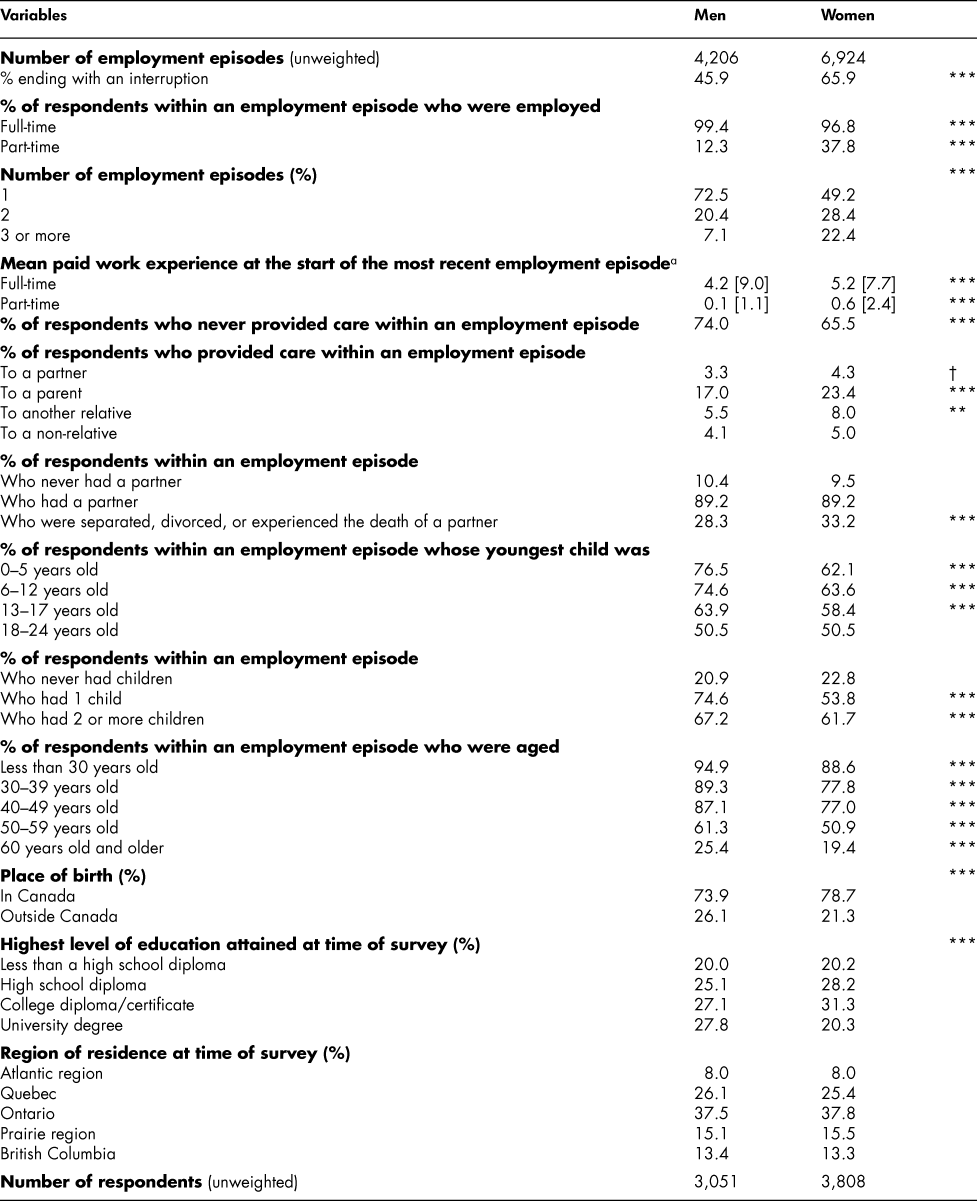
Table 1 reports the distribution of the variables used in the models separately for men and women. As the Table shows, the 3,051 male and 3,808 female respondents retained in the sample reported 4,206 and 6,924 employment episodes respectively. Of these, 46 per cent (men) and 66 per cent (women) ended with an interruption. Nearly all men and women experienced full-time employment at some point during their working lives; however, women were three times more likely than men to have been employed part-time at some point during their careers (38% versus 12%). Women experienced a larger number of paid work interruptions than men; 22 per cent of them had cumulated at least three periods of employment compared to only 7 per cent of men. This explains the higher number of cumulated years of work experience observed among women than men at the beginning of their most recent employment episode (5.2 vs. 4.2 of full-time years of experience).
Characteristics of men and women aged 44 to 79 in 2006 who worked at least once for at least 6 months (weighted)

Source: Statistics Canada (2007), GSS, Cycles 20 and 21.
a Standard deviations in squared brackets. χ2or t-test according to gender, significance level: †p < .10; *p < .05; **p < .01; ***p < .001.
Parent care appeared to be more common than care provided to any other persons: 17 per cent of men provided care to a parent while they were employed, and as much as 23 per cent of women did so. The least common care relationship observed among employed Canadians was that between partners, with only 3 per cent of men and 4 per cent of women found to provide care to a partner. This was not surprising given that we restricted the analysis to respondents under the age of 80.
Almost 9 out of 10 respondents lived in a married or cohabiting union at some point during an employment episode, and 28 per cent of men and one-third of women lived without a partner after experiencing a union dissolution. Men were more likely to have very young children while engaged in paid work than their female counterparts: 77 per cent of them had at least one child aged 0–5 years during an employment episode compared to 62 per cent of women. Men were more likely than women to be employed, no matter the age group considered, and a larger proportion of them were born outside Canada and held a university degree. Finally, no statistical difference was found between men and women regarding the region of residence at the time of the survey.
Multivariate Results
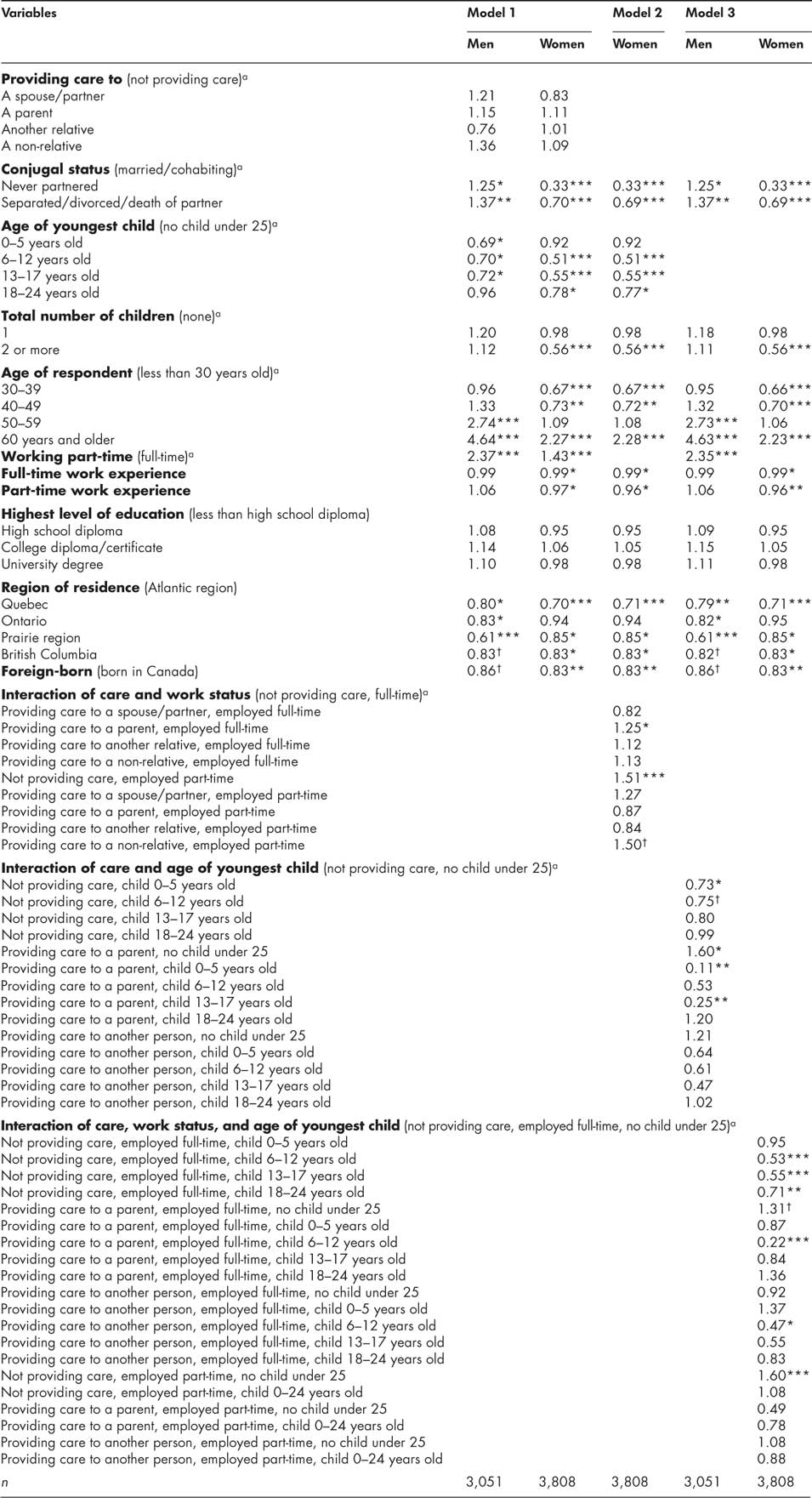
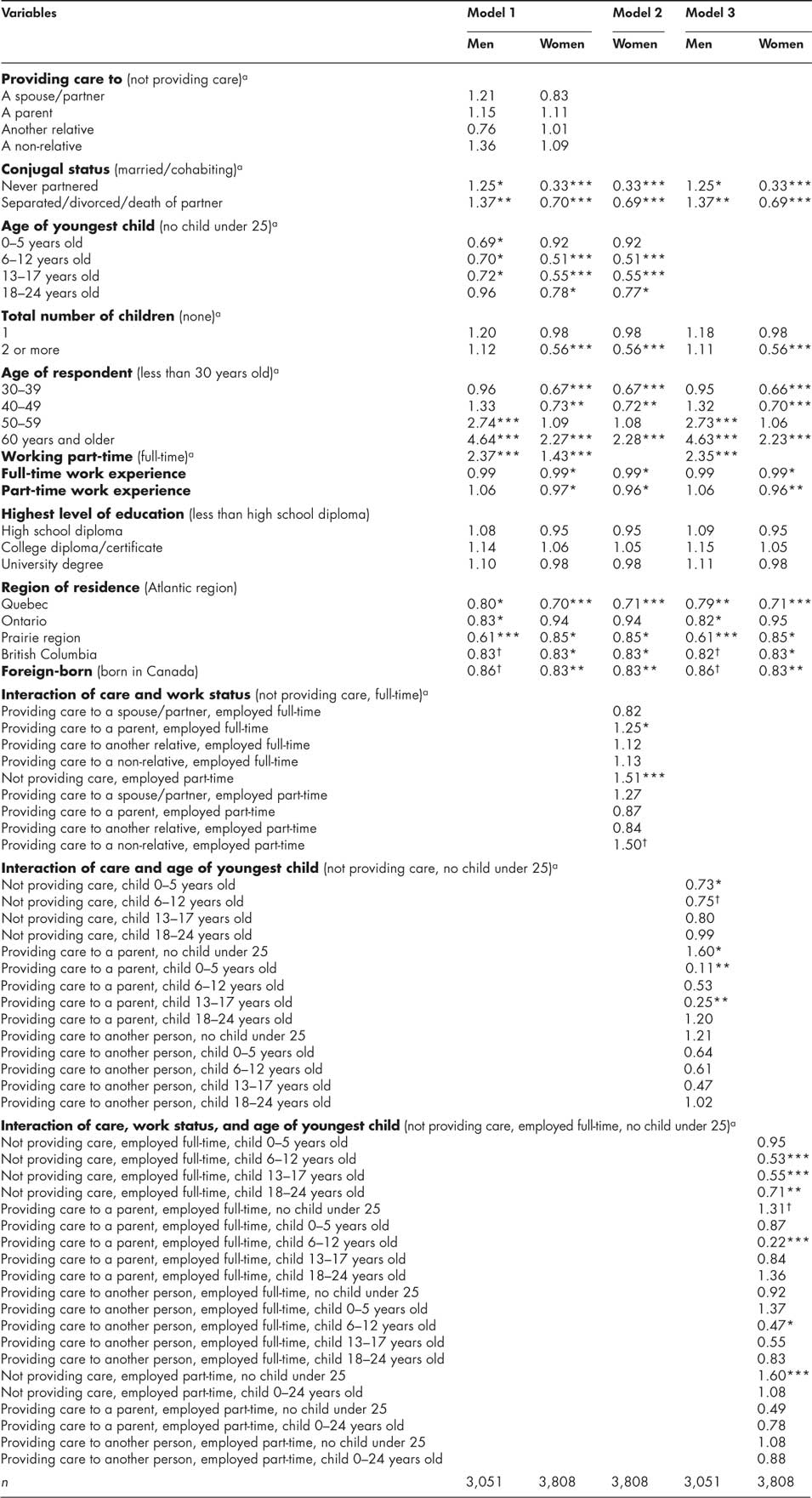
Table 2 presents the results of the Cox proportional hazard models separately for men and women. In Model 1, we included all independent variables. We tested interaction effects in Models 2 and 3. In Model 1, the analysis showed that providing care to a relative or friend did not in itself appear to significantly affect the risk of leaving employment, regardless of the nature of the relationship with the care recipient. However, as we will see later, the lack of statistical effect observed here was due to the fact that the provision of care differently affects the employment behaviours of women depending upon their work status, and affects behaviours of both men and women according to the age of their youngest child.
Weighted hazard ratios of leaving employment for Canadian men and women aged 44 to 79 years old in 2006 who had worked at least once for at least 6 months
Source: Statistics Canada (2007), GSS, Cycles 20 and 21.
Cox proportional hazard models stratified by job rank, clustered by respondent ID. Significance levels: †p < .10; *p < .05; **p < .01; ***p < .001.
a Time-varying co-variates.
We also examined the effect of other variables on the risk of leaving employment. As Model 1 shows, conjugal status exerted a different impact depending on the respondent’s gender. Not being in a married or cohabiting union increased the likelihood of leaving employment among men, but strongly reduced it among women; hence, compared to their counterparts who were married or in a cohabiting union, women who never lived with a partner had only one-third the risk of leaving employment, and those separated, divorced, or widowed, 70 per cent of that risk. Fewer differences separated genders with regard to the presence and age of children. When compared to those who were childless or had no children under 25, men whose youngest child was under the age of 18 were less likely to leave employment, and women whose youngest child was between 6 and 24 years old also faced a lower risk of doing so. However, women with preschool-aged children appeared no more likely to leave their jobs than those without a child under age 25. This lack of effect might appear surprising; in fact, it resulted from the inclusion in the model of the age of women, which was closely linked to the age of children, and which modified the impact of the latter. Finally, women who had two or more children had approximately half the risk of women with no children of leaving employment. Although it was unexpected, this result was in line with that observed in past research (Henz, Reference Henz2006; Pacaut et al., Reference Pacaut, Le Bourdais and Laplante2011).
The influence of the respondent’s age helped clarify the impact of the age of the youngest child on women’s employment trajectories. Whereas men’s probability of leaving employment increased with age, that of women was reasonably high below age 30 and when they reached the age of 50. Compared to women who were less than 30 years old, those aged 30–39 were 33 per cent less likely to leave employment; those aged 40–49, 27 per cent less likely. In contrast, women aged 60 and older faced more than twice the risk to do so. Women with very young children were more likely to be found in the under-age-30 category; this accounted for the lack of significant effect we observed for women whose youngest child was aged 0–5.
The work status experienced during the employment episode exerted a significant effect on the risk of leaving work for both men and women. Men who worked part-time had more than twice the risk of leaving employment than their counterparts engaged in full-time employment. Part-time work was not as common among men as among women, and the latter faced only a 43 per cent higher risk of leaving work when working part-time as opposed to full-time. The cumulative number of years spent in full-time and part-time work at the beginning of the employment episode only significantly affected the transition out of employment among women. Each year of full-time work experience reduced the risk of leaving employment by 1 per cent, and that of part-time work, by 3 per cent.
Among the other control variables, the region of residence and the place of birth appeared linked to employment behaviours. Living in the Atlantic region as opposed to elsewhere in Canada was associated with a higher probability of leaving employment. Finally, immigrants faced a lower risk of leaving work than native-born Canadians, a relationship found among both men and women, but which was only marginally significant among men.
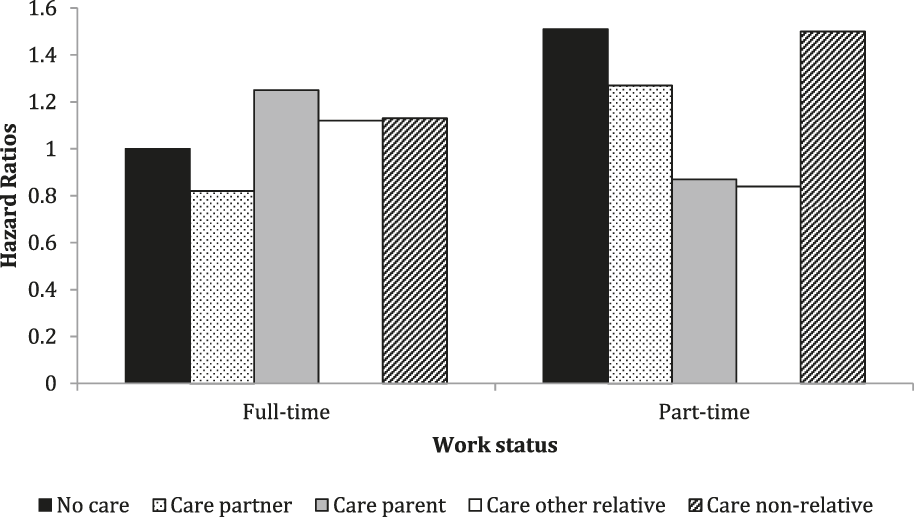
In Model 2, we examined whether being employed on a full- or part-time basis modified the impact of care provision on the risk of women’s leaving employment, and thus the model includes interaction terms between these two variables. To facilitate discussion of the results, Figure 1 presents the hazard ratios of the interaction terms between providing care and work status among women, after controlling for the other variables included in Table 2. The reference category includes women not providing care and employed full-time. Differences between all categories were also statistically tested; only significant effects are discussed here.
Impact of caregiving status and relationship with care recipient according to paid work status on the risk of leaving employment, women (reference category: not providing care, full-time)
Source: Statistics Canada (2007), GSS, Cycles 20 and 21.
Cox proportional hazard models controlling for other co-variates, stratified by job rank and clustered by respondent ID.
Figure 1 shows that the provision of care to a parent significantly influenced the risk of leaving employment among women employed full-time. Hence, women providing care to a parent had a 25 per cent higher probability of leaving work than those who were employed full-time but did not provide care. In contrast, among women working part-time, those who provided care to a parent had a much lower risk of leaving employment than those who did not provide care (nearly half that risk). The opposite effect that the provision of care to a parent exerted on the risk of leaving employment, depending upon the work status of women, explains the lack of statistical significance that we observed for this variable in Model 1 (see Table 2). Working fewer hours thus appeared to help female caregivers combine their employment and care responsibilities, at least when helping a parent. This difference in the work behaviours of full- and part-time employed female caregivers thus needs to be considered when estimating the impact of being sandwiched between parent and child care.
In Model 3, we included interaction terms between providing care and the age of the youngest child (see Table 2) to test the influence of combining unpaid care and childcare responsibilities. In order to have a sufficient number of cases in each category for the proportional hazard model to be estimated, we grouped the care variable into three categories: (1) no care; (2) care to a parent; and (3) care to others (including partners, other relatives, and non-relatives). This strategy enabled us to estimate the effect of being sandwiched between parent care and childcare – that is, the impact of providing care to a parent depending on the age of the youngest child. Again, only significant effects are discussed here.
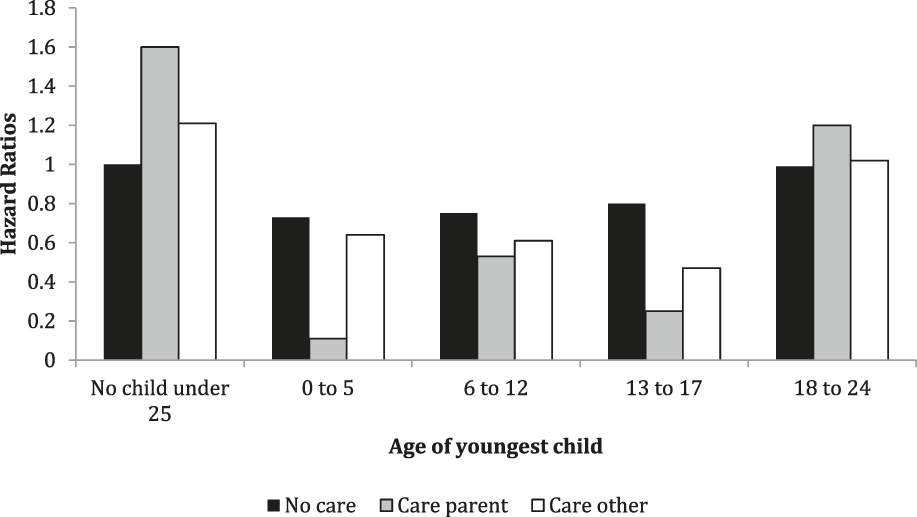
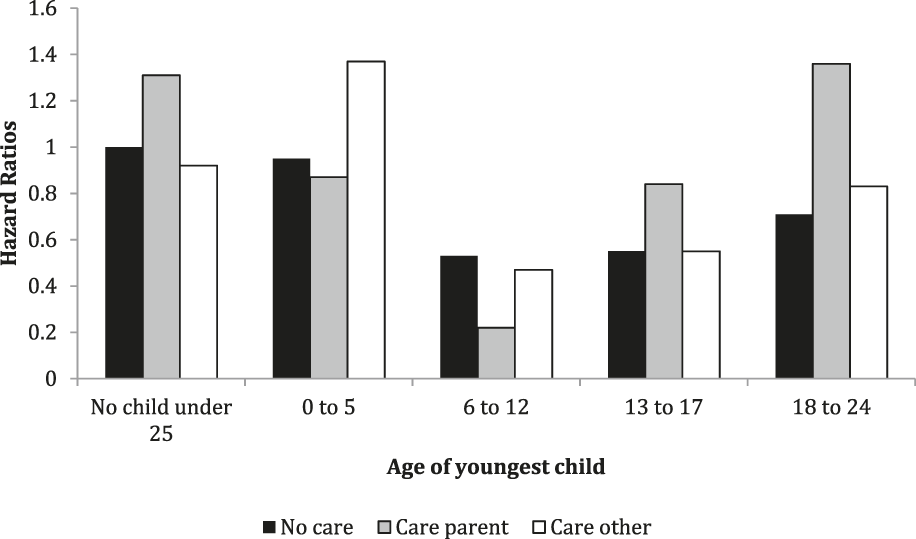
Figure 2 shows the hazard ratios of the interaction terms for men. The analysis shows that men who provided care to a parent but had no children under age 25 were 60 per cent more likely to leave employment than their counterparts who did not provide care and had no children under 25 (the reference category). In contrast, men who provided care to a parent, but whose youngest child was under age 18, had a much lower probability of leaving employment than their counterparts who were assisting a parent but had no children under age 25. Among men whose youngest child was aged 0–5 or 13–17, those providing care to a parent had a significantly lower risk of leaving work than those not providing care. In other words, the analysis suggested that the combination of care to parents and relatively young children tended to decrease, rather than increase, the risk of men to leave paid work. No statistical differences in the risk of leaving employment were found among men having children aged 18–24. These children were more independent than younger children, and given that their presence in the household was unknown, it was difficult to consider these men as being “sandwiched”. However, regardless of their place of residence, fathers may still have been involved in providing financial support to these children, whereas the latter may have acted as resources in assisting their grandparents. These counterbalancing forces, of young adults creating demands and providing relief simultaneously, could explain the lack of significance we found of parent care on leaving employment for men with children of that age.
Impact of caregiving status and relationship with care recipient according to age of the youngest child on the risk of leaving employment, men (reference category: not providing care, no child under 25)
Source: Statistics Canada (2007), GSS, Cycles 20 and 21.
Cox proportional hazard models controlling for other co-variates, stratified by job rank and clustered by respondent ID.
We conducted this analysis separately for women. In order to control for the different effect that the provision of care to a parent exerted among women with children of different ages, the analysis also included interaction terms between care and work status. However, due to the small number of part-time working women in the categories in which the youngest child was under 25, this variable only distinguished women with and without children under age 25 among part-time employees. Model 3 presents the hazard ratios of this three-way interaction. Among women without children under age 25, those employed full-time and not providing care, as well as caregivers working part-time, are less likely to interrupt work than part-time employees not providing care. Given that no other significant differences were found among women employed part-time according to the care status or the age of the youngest child, these effects are not discussed further. Figure 3 provides the hazard ratios of the interaction terms for full-time employed women. The reference category includes women not providing care, employed full-time, and without children under age 25; statistical tests were run to examine differences between all categories of the interaction variable.
Impact of caregiving status and relationship with care recipient according to age of the youngest child on the risk of leaving employment, women employed full-time (reference category: not providing care, no child under 25)
Source: Statistics Canada (2007), GSS, Cycles 20 and 21.
Cox proportional hazard models controlling for other co-variates, stratified by job rank and clustered by respondent ID.
As Figure 3 shows, the influence of being sandwiched between parents’ and children’s responsibilities on the risk of leaving employment among full-time female paid workers appeared similar to that observed for men. Hence, we observed that women employed full-time who provided care to a parent were less likely to leave employment when their youngest child was aged 6–12 than their counterparts who had a child of the same age but were not providing care. The effect of parent care did not, however, appear to significantly affect the propensity of leaving work among women employed full-time whose youngest child belonged to another age group under 18. When the child was above that age, the provision of care to a parent was positively linked to the risk of leaving employment. Hence, women employed full-time who had a child aged 18–24 had nearly twice the risk of leaving paid work when they provided care to a parent than when they did not. We found a similar effect, but of a smaller magnitude, among women employed full-time who had no children under age 25.
The main difference emerging between men and women thus concerned the life stage at which parent care increased the risk of leaving employment. For women employed full-time, this impact was felt earlier, when their youngest child was still aged 18–24. Among employed men, providing care to a parent increased the likelihood of leaving paid work only when their youngest child reached the age of 25. In conclusion, this analysis showed that the probability of leaving employment was lower for both men and women who were sandwiched between parent care and the care of minor children, compared to those holding fewer roles.
Discussion
This study makes a significant contribution to existing research on the impact of the provision of unpaid care on paid work interruptions. The identification of various care relationships has allowed us to untangle the effect of combining multiple caregiving roles on the risk of leaving employment, and to examine their influence across employment of varying intensity and in conjunction with parental responsibilities. In addition, our study responds to the need outlined by Lilly et al. (Reference Lilly, Laporte and Coyte2007) to engage in comparative research to deepen our understanding of the gendered nature of this unpaid caregiving relationship.
Our analysis did not, at first, reveal a significant influence of providing care to a partner, a parent, another relative, or a non-relative on the likelihood of leaving employment. However, further analysis showed that women who were employed full-time were particularly vulnerable to leaving employment when they provided care to a parent. Providing care to persons other than parents did not appear to significantly affect employment behaviours; this is perhaps due to the relatively small sample size in those categories. The more demanding nature of full-time paid work in comparison to part-time employment seems to put strain on women and to make it more difficult for them to combine full-time employment with parent care. In contrast, among women employed part-time, those who provided care to a parent faced a lower risk of leaving paid work than their counterparts not providing care. This tends to suggest that employment, when not too demanding, may provide a break from care responsibilities (Masuy, Reference Masuy2009). However, without information on the frequency of the care or tasks performed, it was impossible to determine whether the apparent ability to combine unpaid care and employment among females employed part-time was due to less demanding care responsibilities than those faced by their counterparts employed full-time. This last hypothesis does not appear very convincing given that women employed part-time may simply have had more time to allocate to unpaid caregiving than those employed full-time. It is also difficult to imagine that the health needs of the care recipients should have differed according to the caregiver’s work status.
Being sandwiched between the provision of care to a parent and to children was found to influence paid work interruptions, but perhaps not in the way that theories on the balance of multiple roles suggest. Whereas male employees and women employed full-time both viewed their risk of leaving employment reduced if they had school-aged children when compared to respondents with no children under 25, this risk became even lower when they provided care to a parent. In other words, “being sandwiched” would appear to reduce the risk of leaving employment among men as well as women spending at least 30 hours per week in paid work. Balance is said to be positive when rewards outweigh demands (Rantanen et al., Reference Rantanen, Kinnunen, Mauno, Tillemann, Kaiser, Ringlstetter, Eikhof and Pina e Cunha2011). For women who maintained full-time employment, holding multiple roles probably led to additional demands, but the financial resources and satisfaction derived from employment was perhaps sufficient to allow them to respond to their own needs, as well as to those of their children and parents. Sandwiched employees may have experienced strain or found that time was scarce, but leaving paid work may simply not have represented a viable option for them to meet their many obligations.
Employed men and full-time working women who were childless or who had only older children and who provided care to a parent were found to be more likely to leave employment than those not providing care. At the time when their parental responsibilities were probably diminishing, providing care to an aging parent might have encouraged some individuals to leave the labour market. This finding holds even when controlling for the age of respondents. Nonetheless, one might think that the option of leaving employment is more often considered when approaching retirement, usually at the time when children are becoming young adults and financially independent. Along those lines, other analyses conducted using the same dataset showed that both men and women aged 50 and over had a higher probability of retiring when providing care to a relative or friend (Hébert & Uriarte-Landa, Reference Hébert and Uriarte-Landa2012). Our study underscores that it was not only the fact of being older, but also the stage in the life course when children were more independent, that increased the likelihood of leaving employment while providing unpaid care to a parent. This stage arrived earlier for women than for men, when their youngest child was 18 to 24 years old and in the process of becoming more independent. In contrast, for men, the probability of leaving employment was greater only when their youngest child was 25 years old and older. Controlling for these two age groups of adult children was necessary to understand this gender difference, given that the data contains no information on the age at which children left the household.
Few gender differences were found regarding the impact of parent care on the risk of leaving employment. A notable difference concerns the greater proportion of women employed part-time during the course of their working lives, and the apparent ability of these women to combine part-time work with parent care. This finding is perhaps related to the job sectors or occupations in which these women were employed and which provided them with flexible work arrangements, such as flexible schedules or the possibility to work from home. Female caregivers employed part-time may even have worked fewer hours than other women employed part-time, which could explain their relative ability to balance unpaid care and paid work. Unfortunately, the GSS contains no information on these work characteristics in the retrospective employment histories. Nevertheless, our findings suggest that less demanding work schedules, at least in the form of part-time employment, could alleviate some of the demands associated with the provision of unpaid care. Clearly, further research on this topic is needed.
Part-time work raises other important issues, however. When individuals cut back on hours of paid work, their earnings are generally reduced and can thus make many of them economically vulnerable. Leaving employment after starting to provide unpaid care is also not without consequences. An investigation of the extent to which other sources of income partly compensate for the drop in employment earnings would help better describe the economic situation of caregivers who reduce or leave employment. Some may rely on the financial support of a partner who might even in some cases increase his or her working hours, but this situation does not preclude the possibility that their own, as well as their family’s, economic well-being may be at stake in the short and long terms due to reduced capacity to accumulate retirement savings. A few studies further indicate that following the end of a caregiving episode, individuals who had reduced their hours of paid work or left employment rarely return to the same employment levels (Lilly et al., Reference Lilly, Laporte and Coyte2007). Little is known, however, about the impact of such transitions on their income.
The reduced labour force participation of individuals who provide care to a parent has implications for the ability of governments to maintain their income tax revenues and, ultimately, to provide services to the population. However, the imputed economic contribution of unpaid caregivers in Canada, which was estimated at nearly $25 billion in 2009, undoubtedly helps contain public health expenditures (Hollander, Liu, & Chappell, Reference Hollander, Liu and Chappell2009). Confronted with rapid population aging, all levels of government therefore need to address the issues of balancing eldercare and paid work, which are likely to become increasingly salient in coming years. Our study attempted to document this issue but is not, however, without limitations.
Retrospective surveys, which collect the specific dates of major events experienced by respondents and allow the reconstruction of their life histories, are useful for studying transitions over the life course but often lack important detailed information. For example, information on respondents’ health, income, and region of residence was collected only at the time the GSS surveys were conducted in 2006 and 2007. Moreover, the average number of hours per week spent in any caregiver role was not available in the retrospective history and thus could not be taken into consideration in our models. It is unclear whether the inclusion of this variable in the analyses would have yielded different results, given that the relationship with the care recipient has been shown to be linked to the intensity of caregiving (Sinha, Reference Sinha2013). Another issue arising in retrospective surveys is the potential for recall bias, which cannot be ruled out even though we limited our sample to those under the age of 80.
Finally, some caution is required in the interpretation of the results since a relatively large fraction of respondents with missing data were excluded from the analysis. We know that this group significantly differs from respondents with complete information on a number of characteristics. Most of these cases were lost due to survey design, and not to recall bias. However, we cannot eliminate the possibility that the inclusion of this group, had we had complete information about them, could have modified the results. Nonetheless, our findings are generally in line with those observed in previous research, which is reassuring. It suggests that selection bias is perhaps not that important an issue in our study.