In the eighteenth and nineteenth centuries, European merchants opened and deepened trade routes throughout Asia, Africa, and Latin America. However, in these markets they faced considerable challenges as the result of linguistic and cultural barriers. This led to difficulties in integrating into indigenous commercial and political systems, which restricted their operations. The use of intermediaries with expertise of the local markets and languages rapidly proliferated. In Southeast Asia this was known as the “comprador” system, while in the Anglo-Indian trade, individuals carrying out these functions were known as “banians.”Footnote 1 These intermediaries fulfilled various internal and external roles for trading companies, such as managing treasury functions, securing credit, and acting as brokers in the local markets.Footnote 2 A contemporary described the banian as an individual “by whom the English gentlemen in general conduct all their business. He is interpreter, head book-keeper, head secretary, head broker, the supplier of cash and cash-keeper, and in general also secret-keeper.”Footnote 3
In these roles, banians were crucial in enabling British mercantile interests to establish themselves in India, and they rose to great prominence and wealth in the eighteenth century. In the nineteenth century, the need for intermediation in local product, credit, and labor markets remained critical as the scale of the Indian economy and scope of business enterprise expanded. There is disagreement, however, about the evolution of the banians’ function and importance.
The extant literature proposes two distinct explanations. The first is reflective of narratives of Western economic dominance and the imposition of a global capitalist system that supplanted indigenous economies. Thus, from their positions as highly valued partners of East India Company (EIC) managers and as important administrators in the agency houses that proliferated after 1813, the banians rapidly declined into irrelevance around the middle of the nineteenth century.Footnote 4 The domination of British business and political interests in India subordinated Indian commercial interests. Contemporaries commonly ascribed European domination as a cultural facet, pointing to a lack of entrepreneurial drive among the indigenous population.Footnote 5 This stereotyping saw Indians reduced to low-level clerical positions, effectively becoming servants of the British.Footnote 6 The second explanation places emphasis on the importance of local “bazaar” economies, in which Indian commercial interests adapted to and integrated with colonial economic structures.Footnote 7 Evidence shows that the banians continued to play a role within European trading firms after 1850, providing access to local credit and labor markets.Footnote 8 A growing number of firms combined British and Indian capital and expertise to enter emerging industries such as tea and jute.Footnote 9 This literature also shows how Indian business interests expanded directly into international markets in the second half of the nineteenth century.Footnote 10 Indeed, by the early twentieth century, Bengali-owned and managed firms, inspired by the nationalistic Swadeshi movement, were established in a number of technologically innovative sectors such as pharmaceuticals.Footnote 11
These explanations raise questions about the extent to which the banians were able to use their commercial experience and networks to adapt their operations, both in partnership with and in parallel to European business interests. This article focuses on two questions: How did their role and relationships with European merchants evolve across the nineteenth century? What effect did these changes have on the Bengal economy?
To address these questions, the article draws on new data from Bengal commercial registers. The registers’ commercial appendices listed Indian merchants, bankers, and brokers alongside European merchants.Footnote 12 This enables quantification of the number and types of banians and other Indian-owned ventures operating in Bengal across the century. The article also uses a range of new qualitative sources, including legal contracts and a diary of a senior Indian manager from the British firm Gillanders, Arbuthnot and Co., to identify changes in the role of the banians and their relationship with European firms.
Analysis of these changes reflects on problems of contracting, managerial control, and knowledge transfer. The article proposes that the banians’ role evolved in response to the emergence of capital-intensive industries in Bengal in the second half of the nineteenth century. Interaction between European firms and banians led to innovations in contracting and organizational forms to address challenges in these nascent industries. This process contributed to the emergence of the managing agency system and saw caste groups related to the banian profession utilize their experiences with innovative forms of business organization to expand the scale and scope of their operations and enter a wide range of industries.Footnote 13
The analysis focuses on Bengal as it was the center of British political and commercial interests in India. Changes in the relationship between European and Indian business interests, and subsequent effects on the economy, were most pronounced and contentious there. Yet it is important to note that similar commercial arrangements existed elsewhere in India.Footnote 14 This article sheds light on how an overlooked, but important, commercial group acted as a nexus for the transference of knowledge through long-term collaboration with European firms.Footnote 15 Such an insight contributes to debates on the development of Indian business forms and the Bengal economy at the end of the nineteenth century.
The article proceeds with analysis of the banians’ activities in two periods of economic transition: first, after the rescinding of the monopoly in 1813, and second, in the mid-nineteenth century as the scale and scope of the Bengal economy dramatically expanded and industrialized. Subsequently, the article identifies three different responses by banians and European firms in response to the evolving economic environment: adaptation, internalization, and innovation. The article concludes with analysis of the factors that motivated each of the responses and discussion of their effects on the role of the banians in the Bengal economy at the end of the nineteenth century.
The End of Monopoly: Banians and Private Trade
In the seventeenth century, correspondence from the EIC's Indian trading factories describes banians employed as brokers to intermediate with local merchants and producers and to monitor production.Footnote 16 By the eighteenth century, the relationship between the banians and Europeans had changed from one of broker and client to a more personal arrangement. The banian acted as an agent for individual EIC managers and performed a range of functions including bookkeeping, interpreting, and brokerage, as well as managing his household and personal business activities.Footnote 17 These were often long-lasting personal relationships, more akin to a business partnership than to that of a master and hired hand.Footnote 18 The banian obtained credit from local bankers but often provided his own family's capital to fund joint trading activities. Many EIC officials depended on such loans and knowledge of local markets to enter into trade on their own account.Footnote 19 The banians’ remuneration reflected the nature of the partnership. It was common to receive a monthly wage, and commission payments on trade transactions were widespread. Similarly, interest on the loans to the EIC officials delivered further revenues, with some banians holding portfolios of loans.Footnote 20 Yet, proximity to the EIC official provided the greatest opportunities for enrichment. Patronage allowed harvesting of commissions and bribes from those seeking favors, while the EIC's trading channels and privileges were exploited for personal trade. Notably, the balance of power in these relationships often favored the Indian. As Maria Misra notes, “In many respects the banian was in reality the senior partner in these arrangements, making the commercial decisions and merely paying to use the name of the British merchant.”Footnote 21 These were men of standing, or, as Philip Curtin describes them, “more than a mere broker”; the banian “was also a capitalist” looking for commercial opportunities in which to invest his capital.Footnote 22 Those who were successful were able to move beyond the confines of the partnership to invest in other industries, such as insurance, banking, and estate management.
In 1813, the Anglo-Indian trade was radically reorganized through the repeal of the EIC's monopoly. Into this space stepped a range of private merchants and entrepreneurs. Many had established themselves in India as licensed private traders under the EIC. They formed trading partnerships, known as agency houses, which carried out a range of mercantile functions.Footnote 23 Between 1813 and 1833, around thirty of these firms operated in Calcutta.Footnote 24 British merchants with no connections to India also entered the market, and entrepreneurs rushed into growing industries such as indigo. The opening of the market presented opportunities but also numerous challenges, amply demonstrated in the indigo industry.
By the end of the eighteenth century India was the source of most of Britain's indigo, which was one of Bengal's most valuable exports.Footnote 25 Hundreds of Europeans set up indigo factories; by 1831, around 829 factories operated in Bengal.Footnote 26 Factory owners needed capital to invest in the building of factories, while credit was required to fund the production process. However, most factory owners were reliant on capital and credit from external sources.Footnote 27 Access to local finance was limited; indeed, in the first half of the nineteenth century only two joint-stock banks operated in Bengal.Footnote 28 Local credit systems revolved around native moneylenders, known as shroffs, and credit provided by the agency houses that offered deposit banking and loan functions.Footnote 29 For many of the Europeans new to India, their operations depended on local intermediaries. Thin credit markets meant the factory owners and agency houses had to interact with the shroffs. Similarly, the production and purchase of indigo required coordination and interaction with local Indian landowners and brokers. Even for those experienced in the markets, intermediation by knowledgeable and well-connected banians was valuable in procuring credit and products at preferential rates.
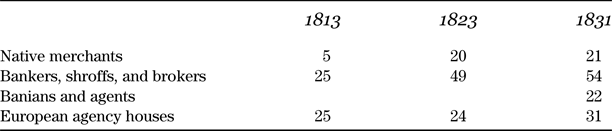
The commercial registers reveal four main groups in the ecology of European and Indian commercial interests in the first half of the nineteenth century. Alongside the agency houses, there were three broad groups of Indian-owned businesses: merchants; bankers and shroffs; and banians and agents. Table 1 shows that the growth in the number of European trading firms was broadly matched by the number of local merchants and bankers.
European Agency Houses and Indian Merchants, Bankers, and Agents in Bengal, 1813–1831

Sources: Bengal Annual Registers, 1813, 1823, 1831, Bengal Annual Register and Directory series, OIR 954.14 ST 1216 CH, British Library, London.
Note: The numbers of Indian merchants and bankers are likely to underestimate their total population in Calcutta, as the registers were constructed around those with close proximity to British interests.
It is likely that all of the agency houses in this period employed banians; however, there is relatively little direct evidence as to their number or role.Footnote 30 In his study of the leading agency house, John Palmer and Co., Anthony Webster notes that a chief banian and two senior Indian administrators operated alongside the European partners—all were long-serving members of the firm and personally close to the senior partners. They held important internal roles as they controlled the cash accounts and were responsible for overseeing the firm's financial records. They also provided links to the local Indian commercial communities, facilitating trade in export products and access to the local money markets.Footnote 31
The high status of the banians and their close relationship with European partners initially persisted after 1813.Footnote 32 They may not have been official partners in the agency houses, but they remained highly valued members of the firm, with the relationships maintained through long-standing personal ties. The banians were also able to use their position to pursue opportunities to trade on their own account. In the case of Palmer and Co., though, it also became apparent that they undertook endemic fraud, covering up the theft through their control of the account books.Footnote 33
An article published in the Calcutta Magazine and Monthly Register in 1832 supports the description of the scope of the activities outlined above but highlights changes in the nature and structure of the relationship. It details a court case between Tarrachund Chatterjee, a banian, and Walker, Roussac and Co., the merchant firm he represented. The central issue of the case rested on “whether a banian, being employed by his principal to purchase, could buy on his own account, and then sell in a fictitious name to his employer, at an enormous price advantage.” The banian was accused of exploiting the knowledge gained through his role and overcharging his principal, and the article made clear the expectation that “on purchases made by order [from the principal], the banian cannot charge more than he pays; he is a mere broker to the house.” In this case, the court found in favor of the merchants. The case represents three significant changes: first, the description of the banian is of a “mere broker” rather than commercial partner; second, the reliance on informal personal ties proved insufficient for the governance of these relationships; and third, the article noted that Tarrachund Chatterjee did not act solely for one firm but was “banian to others also.” Indeed, part of the legal case turned on the fact that “a banian who purchases for several parties, should charge to all the average price.”Footnote 34 Tarrachund was, in effect, a separate business entity providing services to several firms while also pursuing his own commercial interests.
There is further evidence, from the banians’ operations with American merchants in the 1820s and 1830s, to indicate a change in role and status. Unlike their British counterparts, American merchants did not establish permanent agency houses in Calcutta; instead, they conducted trade through appointed banians. The career of Ramdulal Dey is illustrative of these developments.Footnote 35 He was an independent merchant who acted for numerous American clients. Although great importance was still attached to close personal ties, these were no longer exclusive relationships. The data in Table 1 also provides tentative support for this development; the lower number of banians relative to their European counterparts potentially indicates that some agents had multiple clients if all the European firms used their services.
An Economy in Transition
The rescinding of the monopoly and subsequent expansion of private business saw intermediary services remain crucial in the Bengal economy. These developments reshaped the relationships between banians and European firms. Business-to-business arrangements increasingly replaced individual relationships, as nascent banian firms provided services to multiple clients. However, from the 1830s the Bengal economy underwent a significant transition, creating various challenges for both European and Indian firms.
Financial panics racked Bengal in the 1830s and the 1840s. The collapse of the principal Calcutta agency houses in the early 1830s led to a local liquidity and trade credit crisis, while panic in the British financial markets in 1847 saw contagion and failure among Calcutta's banks and trading firms.Footnote 36 Both crises saw the removal of large incumbent firms, which encouraged new entrants.Footnote 37 The crisis of the 1830s was severe enough to warrant investigation of the causes by a British parliamentary select committee. According to evidence given by George Larpent, a major East India merchant, “These lamentable events will ultimately bring forward houses who will take up business upon different principles, and who will be enabled to give sufficient support to the manufacturing and commercial interests of India.”Footnote 38 As a result, the number of trading companies operating in Bengal increased from around thirty in 1830 to eighty-six in 1858.Footnote 39
While confronted with volatile financial markets, new entrants also found opportunities in emerging industries in Bengal and elsewhere in India. A cotton boom in the 1860s saw a rapid increase in investment in a growing number of cotton mills and presses around Bombay, and a tea boom in the Northeast led to the establishment of hundreds of tea gardens.Footnote 40 The expansion of industry and trade called for investment in physical infrastructure, including railways and ports. European entrepreneurs and investors increasingly used joint-stock corporations to channel capital into these industries. The number of joint-stock firms operating in Bengal increased from 4 in 1831 to over 170 by the late 1860s.Footnote 41
Many of the trading companies retained their partnership status but promoted and managed joint-stock ventures in these emerging sectors. Known as the managing agent system, the erstwhile trading firms provided managerial expertise, placing their own partners in the managed firms, and acted as conduits to factor and product markets.Footnote 42 Through this model, the managing agents came to control large swathes of industrial activity in India.Footnote 43
The growth of the scale and scope of commercial and industrial activity in Bengal raised various coordination and resourcing challenges. First, the increased use of equity financing required access to capital in both Europe and India. Second, volatility in other factor and product markets meant that intermediation remained important for improving efficiency of access to labor and other inputs. Third, the growth in the scope of the managing agent firms, complicated by the location of activities in geographically distant areas, challenged the extent to which they could operate effectively through personal ties and loose governance regimes. Fourth, the increased integration into manufacturing required managerial skills different from the mercantile expertise developed within the trading companies. These challenges encouraged experimentation with organizational forms and structure. Where, then, did the banians fit in this evolving economy and the managing agent system?
Responding to Change: Adaptation
The mid-nineteenth century is the point at which the banians’ influence supposedly declined, as British commercial interests supplanted them. The data in the commercial registers enables a more rigorous analysis of the extent and nature of this decline. In 1855, the names of the banians employed by European trading company were included in the listings for the first time, allowing quantification of their number. That the registers included this detail indicates the continued importance of banians in Bengal's commercial world at this time.
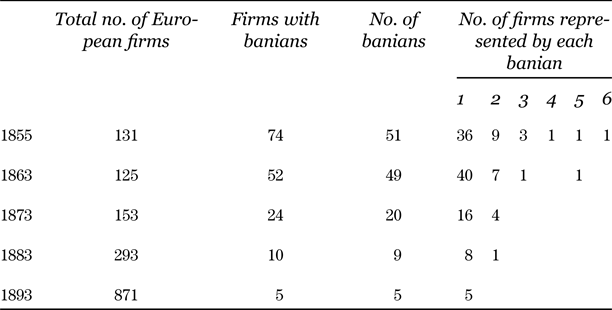
Two notable trends emerge from this data (Table 2). The first is a clear decline in the number both of banians and of European firms using their services, certainly supporting the assertion that the role had become obsolete by the end of the nineteenth century. However, between 1855 and 1873 the data indicates that banians remained active participants in the economy. It clarifies the presence of banian firms such as Hurrischunder Bose and Sons, which provided services to multiple clients. It also highlights the longevity of a number of these firms, such as Prankissen Law and Co., that remained active throughout the period of study. The firm, founded in 1839, was managed by various members of the Law family over multiple generations.Footnote 44
Banians and the European Firms They Represented, 1855–1893

Sources: Bengal Annual Registers, 1855, 1863, 1873, 1883, 1893, Bengal Annual Register and Directory series, OIR 954.14 ST 1216 CH, British Library, London.
Notes: The dramatic increase in the number of European firms between 1883 and 1893 was due to change in the structure of the directory, with the combination of all firms into a single list. It is also important to note that some European firms listed more than one named banian.
Evidence points to significant changes in the structure of the relationship between the parties. Legal contracts formally defined roles and replaced the informal, personal relationships of the earlier generations. One example is the “Articles of agreement” between Ramnarain Sein and W. P. Ewing, Esq., signed in 1847. This document details the nature of the banian's work and the structure of remuneration. Ramnarain acted as an intermediary in obtaining all the resources necessary to operate Ewing's inland transportation and insurance business. He managed this business, overseeing the workforce, and was responsible for the revenues. In return, he received 25 percent of the profits after the deduction of overheads. He also received a dustoory, or commission payment, for each worker hired.Footnote 45 A second example is a contract signed in 1866 between the firm Gillanders, Arbuthnot and Co. and three individuals, Gobind Chund Doss, Doyal Chund Doss, and Kallydoss Seal.Footnote 46 The contract specified that the three would act as the “Head native managers, Salesman and Assistants of the firm” for a period of five years. They managed bazaar sales and purchases, buying products for export and selling imported British goods. The contract centers on the use of a del credere account to manage the sales. Through this account, the banians guaranteed the surety of those with whom they did business and were liable for any shortfall. In lieu of a salary, they received 98 percent of the balance of the account after the deduction of costs, plus commission on consignments of produce they procured.
In the years after 1850, banians remained active in the Bengal economy, providing services to new European entrants who arrived after the crisis of 1847. The new arrivals required access to, and knowledge of, local markets. A contemporary newspaper account notes the widespread practice of banians using del credere accounts to provide the newly arrived European merchant with credit and brokerage facilities.Footnote 47 The role of the banian persisted as intermediation in factor markets remained crucial. From the 1850s, however, changes in the Bengal economy increasingly emphasized the management of operations and labor. These were often in geographically distant up-country locations, like the tea gardens of Assam, which required local expertise. Adept banians recognized these opportunities and significantly adapted to undertake these activities. The contracts show that the banians operated as independent entities to the European firms, with the relationship formally and legally defined.
Responding to Change: Internalization
While the registers show that some banian firms adapted and survived after 1850, the role of banian was almost obsolete by the end of that century. What, then, became of them in the later part of the nineteenth century? Analysis of the caste composition of the banian profession identifies other areas of the economy with significant numbers of shared caste members. Castes had rules and norms, as well as shared knowledge, that conditioned their members’ responses to economic change.Footnote 48
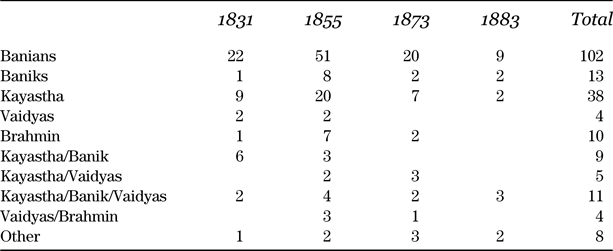
Analysis of four benchmark years reveals that the banian profession was predominantly composed of four castes: the Baniks, a Bengali derivation of the Baniya mercantile caste; the Kayasthas, a writer caste; the Vaidyas, a medical caste from Bengal; and the priestly Brahmin caste (see Table 3).Footnote 49 Of the four, the Kayastha and Banik castes dominated, and the composition changed little across the period. It is also notable that the majority of Banians were of Bengali origin, with only a couple of Marwari names appearing in the 1850s.
Caste Composition of the Banian Profession, 1831–1883

Sources: Jogendra Nath Bhattacharya, Hindu Castes and Sects (Calcutta, 1896); Bengal Annual Registers, 1831, 1855, 1873, 1883, Bengal Annual Register and Directory series, OIR 954.14 ST 1216 CH, British Library, London.
Note: Bengal Annual Registers identify the names of the banians; these were cross-referenced with Bhattacharya to identify their caste. Certain names, such as Dass, Dutt, and Roy, are not caste specific, hence the multiple caste categories.
The Kayasthas, strongly associated with high-level administrative posts in both the Mughal and British governments, benefited widely through association with the British.Footnote 50 From 1873, the registers recorded an increasing number of Indians named as writers or assistants in European firms.Footnote 51 These were administrative positions dominated by the Kayastha caste.Footnote 52 The shared caste origins and administrative nature of the role strongly indicate a transition between the declining banian profession and the growing number of directly employed writers.
The roles played by Indian clerks and writers, and their relationship with European partners, can be examined through new sources from the archives of Gillanders, Arbuthnot and Co. Founded in Calcutta in 1825, the firm initially undertook a growing trade in British exports.Footnote 53 In the second half of the nineteenth century, the firm became widely involved in indigo, tea, and jute production, expanding into the agency business in these industries.Footnote 54 To undertake the growing agency business the firm's Calcutta office was organized into thirteen administrative, trading, and agency departments. A British partner oversaw each department, but a senior Indian writer managed the office, with junior writers employed as accountants, cashiers, cash keepers, and parcel clerks. Indians also managed the firm's warehouses.Footnote 55 In 1870, the firm employed twenty-two Indian writers and roughly one hundred other Indian workers.
Mohendro Nath Mookerjee joined the firm as a writer in 1859. He followed in the steps of his uncle, who had worked in the firm for forty years. Written in 1900, the diary was in effect a memoir of their time in the firm.Footnote 56 He noted that many other senior writers worked at the firm for decades, introducing relatives to build multigenerational dynasties. The most senior Indian writers worked in the key administrative departments of correspondence and accounting, where they had extensive responsibilities managing the accounts and coordinating the flows of correspondence. In these roles, the writers could become very wealthy. While paid a monthly salary and a pension, the writers also undertook trades on their own account. One earned Rs 6,000 (£600) per month from investments, more than a European assistant's yearly salary. Another rose from the position of assistant, earning Rs 16 per month, to head of department, at which time he made Rs 100,000 (£10,000) from investments in jute shares.
Because of the importance of the Indian writers in these critical roles, their relationships with the European partners were close. One of the senior partners, in discussion with a writer, said, “Why Baboo, you are not my servant, say you are an assistant to Gillanders Arbuthnot, and Co. as I am.”Footnote 57 Mohendro Nath wrote, “When my wife was dangerously ill he [partner J. F. Ogilvy] very kindly favoured me with Rs. 500 to clear out all medical bills,” noting that bonuses and allowances were regularly advanced to the Indian workers.Footnote 58 In a further letter, a writer asked for a loan to cover debts incurred through personal trade, to which the partners agreed.Footnote 59
By directly employing the writers, the European firms internalized the roles undertaken by banians earlier in the century. Although they were now employees, or servants of the firm, the senior Indian writers were highly valued. The significant latitude in pursuit of personal trade and financial support offered to the writers is indicative of the importance of these relationships to the European partners.
Responding to Change: Innovation
Further analysis of caste groups identifies other destinations in the Bengal economy for those linked to the banian profession. The 1911 census recorded that 50 percent of Bengal's mills, mines, and factories were Indian owned, and the kayastha and brahmin castes dominated these ventures.Footnote 60 Adoption of new organizational forms and entry into nascent industries in the Bengal economy was not solely a European phenomenon.
The banians could draw on knowledge and expertise, resulting from their proximity to European commercial interests, to innovate and diversify their activities. As Nilmani Mukherjee notes, in the second half of the nineteenth century, “the new generation of [Indian] merchants were no longer prepared to carry on business according to old systems handed down from generation to generation, confining themselves to the internal trade of the country.”Footnote 61 One route was to develop partnerships with European business interests. Misra notes that “once the British independent traders had ceased to be wholly dependent on them for capital and market knowledge, they [banians] began to enter into formal partnerships with Europeans.”Footnote 62 Indeed, high-profile Calcutta agency firms, among them Carr, Tagore, and Co. and Rustomjee, Turner, and Co., were the result of formalized partnerships between British and Indian interests. Further examples—including Kerr, Tarruck, and Co., founded in 1873, and Mookerjea, Clark, and Co.—show that such partnerships survived toward the end of the nineteenth century. Networks of British and Indian interests were also common in industries such as tea and jute, linking up-country producers with agents in Calcutta.Footnote 63 The model of Anglo-Indian partnerships, however, appears to have been short-lived; the census of 1911 shows that only 2 percent of ventures in Bengal were under joint ownership.Footnote 64
The registers do provide evidence for the expansion and innovation of Indian-owned businesses across the Bengal economy. From 1873, the number of Indian-owned ventures that appear in the registers’ main list of merchants and commercial firms increased. It is difficult to precisely calculate the increase, as the structure of the lists changed significantly between 1873 and 1893, but it is possible to highlight the range and variety of Indian-owned enterprises. Although European trading companies dominated the managing agency system, by the end of the nineteenth century the registers show that Indian entrepreneurs had adopted the organizational form.Footnote 65 Prankissen, Chatterjee and Co. acted as agents for various tea estates, while Doss and Co. was agent for thirteen tea estates and listed various London corresponding firms, indicative of direct trading relationships with British firms. Nundo Mohun Banerjee and Co. was agent and secretary for the Oriental Hosiery Manufacturing Co. Ltd., the Elgin Mills Co., the Cawnpore Cotton Mills Co., and the Victoria Mills Co., as well as the Landing, Shipping and Forwarding agents to the Consul of France, and proprietors of the Full Moon Printworks.Footnote 66
The registers further support Mukherjee's claims that Indian mercantile firms sought to engage directly in international markets. Hurrischunder Bose and Sons, now listed as a merchant and commission agent rather than banian, was recorded as working with various agents in London and France.Footnote 67 Prankissen Law and Co. established agencies in London, Liverpool, and Glasgow in the early 1860s.Footnote 68
Indian-owned and managed firms appeared in a wide range of industries, using a range of ownership and organizational forms. For example, S. C. Chander and Co., importers of jute, integrated vertically to become proprietors of the Bengal Hydraulic Press, used to bale jute.Footnote 69 A further notable trend was the emergence of Indian-owned businesses that employed British managers. Shib Nath Sircar owned and managed the Calcutta-Burma Timber Trading Co. with a British superintendent and assistant. The Caledonia Dock was owned by Kally Kristo Pramanick, again with an English superintendent and foreman.Footnote 70
Indian business ownership extended beyond partnerships and privately owned companies to include publicly traded joint-stock firms. The Calcutta Cotton Mills Company Ltd. had Indian directors and an Indian secretary, mill manager, and assistant. The Bengal Safety Match Manufacturing Company Ltd. had Indian owners and managers but also an Indian solicitor, Sen and Co., and managing agent, Ludhu Rahimtoola and Co.Footnote 71 Indeed, members of the kayastha and brahmin castes owned many of the Swadeshi-inspired firms founded in the first decade of the twentieth century, including Bengal Chemicals and Bengal Lamps.Footnote 72
Indian entrepreneurs not only used European forms of business ownership and organization but also developed the commercial ecosystem of solicitors, accountants, managing agents, and stockbrokers needed to support these ventures.Footnote 73 Other services such as joint-stock banking and insurance, previously dominated by Europeans, also saw Indian involvement. Durga Charan Law, head of Prankissen Law and Co., was one of the founders and directors of the Calcutta City Banking Corporation.Footnote 74 Joint-stock banks—including the North West Commercial Banking Corporation, Oudh Commercial Bank Ltd., Provincial Bank of India, and the Punjab Banking Company—also had significant levels of Indian ownership and management.Footnote 75 The importance of the Bengali banians as providers of credit continued, although the organizational form had evolved.
By the end of the nineteenth century, the registers show that Bengali-owned and managed firms were not singular enterprises, with ownership restricted to the preserve of a few extraordinary individuals, but encompassed numerous participants in a wide range of sectors. They were fully conversant with a range of business ownership and organizational forms. Some were highly successful enterprises; S. C. Chander and Co. and Prankissen Law and Co. were established enough to be invited to join the Bengal Chamber of Commerce, an almost exclusively European organization.Footnote 76 European contemporaries described the Empress Cotton Mill Company Ltd., whose owners and managers were Indian, as the most profitable and best-run mill in Bengal.Footnote 77 Firms such as Prankissen, Law and Co. and Hurrischunder Bose and Sons show a direct line of evolution from banians to international traders and industrialists, while others with shared caste origins established themselves throughout the Bengal economy.
Contracts, Governance, and Knowledge
Across the nineteenth century, the banians’ role was adapted, internalized, and finally made obsolete. However, those in the profession innovated and transitioned into a wide range of roles and function in the Bengal economy. To explain these outcomes, the article considers how issues with contracts and governance mechanisms reshaped the intermediary relationships between banians and European firms. Indian and European entrepreneurs contended with significant changes in the Bengal economy. After 1813, Bengal's credit markets remained thin and its managerial expertise in short supply. However, the new industries that emerged in the second half of the century required finance, labor, and managerial resources. To address these constraints, Indian and European entrepreneurs responded by experimenting with organizational forms, resulting in the proliferation of joint-stock firms and the emergence of the managing agent system. Intermediation between European businesses and local markets remained a critical feature of business organization, and banians continued to provide efficient access into the second half of the nineteenth century. Although intermediation improved access to markets, it presented various governance and contracting challenges. The personal nature of the relationships that defined the governance of the banians’ earlier operations broke down, in part, because the informal governance mechanisms that underpinned the system offered excessive scope for opportunistic behavior. The cases of fraud show that a reliance on trust, engendered through personal relations, failed to regulate these relationships, while acting for multiple clients further weakened the strength of personal ties.
This led to experimentation with different contracting mechanisms. The use of legal contracts formalized these relationships; they stipulated guarantees to curb opportunistic behavior and used incentives such as profit shares to align interests between the banians and European firms. After 1850, the contracts show that the banians remained active, yet their role became predominantly external to the European firms, focused on the provision of credit, bazaar brokerage, and the management of up-country operations.Footnote 78 It is difficult to make a strong claim as to whether contracting became the norm in these relationships, but the passage of a Indian Contract Act in 1872, which sought to improve the legal status of commercial contracts, is indicative of their widening use.Footnote 79 Contemporaries, however, noted problems with the banians’ credit agreements that made liabilities difficult to identify and enforce.Footnote 80 Despite the Indian Contract Act, the enforceability of commercial contracts governing these relationships remained unclear. In response to these contracting problems, Tirthankar Roy and Anand Swamy claim, “informal and extralegal mediation continued to rule” when defining commercial relationships in India until the late nineteenth century.Footnote 81 The limited enforceability of contracts, and subsequent threats of opportunism, offers a plausible explanation for the decision of European firms to internalize key administrative functions through the direct employment of writers. This offered more effective oversight and control over the firms’ most important and commercially sensitive activities.
As a result, the number of Indians working in European firms as salaried “servants” increased after 1850. Despite their status as employees, strong personal ties and intergenerational dynasties continued to shape the relationships between the European partners and Indian writers. Like banians in the eighteenth century, the writers exploited their proximity to European trade to enrich themselves, tacitly supported and enabled by the European partners as an incentive to align their interests.
By the end of the nineteenth century, the role of the banians had become obsolete. The salaried writers had replaced the banians’ internal functions, while the managing agents efficiently accessed European factor markets, reducing the need for local intermediation. However, the ongoing interactions between the banians and European firms had created relationships that enabled the exchange of knowledge not only about markets and products but also of business organization.
Roy notes that professional collectives in India, such as merchants and bankers, facilitated the transfer of occupational knowledge.Footnote 82 The banians can be viewed as a professional collective that shared experiences and knowledge of the financing and management of the new business forms and nascent industries in Bengal. The caste groups that made up the profession further extended these transfers, as the writers gained and shared insights into the operations of joint-stock firms and the managing agency system. This knowledge provided a platform for these groups to enter other parts of the Bengal economy. Members of the profession used this knowledge to innovate both in partnership with and independent from European firms. In the last quarter of the nineteenth century, the registers show the emergence of formalized business partnerships between European and Indian entrepreneurs that combined capital and expertise while strengthening governance mechanisms to align interests and control investments in nascent industries. The joint-stock and managing agent forms provided further legally defined mechanisms to link British and Indian interests, as shareholders and directors were drawn from both communities. Among these firms were Indian-owned joint-stock, managing agent, and international trading firms, linked directly to banians and their associated caste and professional groups.Footnote 83
This evidence provides support for the proposition that the banians entrepreneurially expanded their scale and scope to integrate into manufacturing and international trade. More significantly, it shows a bidirectional transfer of knowledge between the banians and Europeans that enabled experimentation and innovation with contracting and business forms. Similarities between the organization and scope of the managing agents and banian firms, with both using contracts to provide management services and financing to multiple clients, suggests common origins, as European and Indian entrepreneurs sought solutions to the problems of contracting and market access. Innovations in business organization were accompanied by modernization of the bazaar economy as Indian-owned banks, stockbrokers, accountants, and lawyers emerged to enable the functioning of Indian-owned joint-stock and managing agent firms. Rajat Ray identifies the advanced nature and importance of the bazaar economy, to the extent that “Western corporations found [it] sophisticated enough to utilize for their own operations on terms profitable both to themselves and to their Asian associates.”Footnote 84 Yet this modernization also enabled those in the Bengal bazaar economy to integrate into the global economy.
Conclusion
The role of the banian, as understood at the beginning of the nineteenth century, had effectively declined into obsolescence by the century's end. From acting as personal business partners of EIC managers, their internal roles in European firms were finally occupied by directly employed writers or servants. This article reassesses this narrative of decline, to reveal instead one of adaptation and innovation in the face of changing economic and business conditions.Footnote 85 In the second half of the nineteenth century, the caste groups that made up the banian profession used knowledge gained from their relationships with European firms to innovate and find new opportunities in the Bengal economy. They formed firms, developed contractual relationships as brokers and up-country managers, and experimented with business forms, both in partnership with and independent of European firms. These innovations saw enterprises owned by members of these groups established in a wide range of domestic industries and international trade.
Reassessing the evolution of the banians has implications for explanations of the changes in the organization and structure of the Bengal economy in the late nineteenth and early twentieth centuries. This analysis reinforces the importance of the bazaar economy as the nexus between European and Asian commercial interests, and in Bengal the banians were critical conduits in enabling these connections.Footnote 86 The ongoing interactions between banians and European firms fostered an interdependent relationship between those in the bazaar and participants in the emerging global economy. These findings emphasize the importance of the interaction between Europeans and Bengalis in processes of organizational innovation and the emergence of an ecology of firm ownership in Bengal that is more diverse than current explanations of British and Marwari firms suggest.Footnote 87
Analysis of the configuration of the bazaar and global economies, and subsequent changes in the relationships between indigenous and European business interests, also offers further insights in explaining different patterns of regional industrialization and economic development between Bengal and West and South India.Footnote 88 These findings challenge the view that as political and social relationships between the British and Indian populations became increasingly hierarchical and segregated, so too did economic relations.Footnote 89 The business forms, partnerships, contractual agreements, and employment practices suggest that commercial relationships remained more flexible. Roy also emphasizes that although political and social segregation may have become the norm in Bengal, British commercial interests remained deeply engaged with Indian counterparts well into the twentieth century.Footnote 90 The innovative forms of business organization supported the emergence of a “cosmopolitan commercial bourgeoisie” in Calcutta, which rose above ethnicity and nationality.Footnote 91
The article demonstrates that the Bengali banians remained commercially active far beyond their supposed demise in the mid-nineteenth century, but their fate in the twentieth century is less clear. If by the end of the nineteenth century they were present in a range of business organizations and industries, important questions remain about their evolution in the twentieth century. As Omkar Goswami, Thomas Timberg, and others show, the Marwaris were firmly entrenched in the Bengal economy by the end of the nineteenth century and continued to expand their operations across the twentieth century.Footnote 92 Ray notes that “out of the pulsating world of the bazaar, there emerged ultimately a modern Asian business and industrial class.”Footnote 93 Yet, among this class, few successors of the Bengali banians are present, despite their knowledge, expertise, and capacity for adaptation and innovation demonstrated across the nineteenth century. Explaining their twentieth-century disappearance requires further research.